W. Joseph Campbell

Posts Tagged ‘History’

‘Kane’ at 70: ‘More relevant than ever’?

In Anniversaries, Cinematic treatments on September 10, 2011 at 9:53 am

In the year of its 70th anniversary, Orson Welles’ cinematic masterpiece Citizen Kane “is more relevant than ever,” says a polished, thoughtful essay posted yesterday at TechCentral, a South African site devoted to technology news and reviews.

Orson Welles in 'Kane'

In pressing the point about Kane’s relevance, the essay argues:

“Newspaper magnate Charles Foster Kane, sitting in his already-crumbling but unfinished Xanadu, is Colonel Gaddafi railing at the Libyan rebels from his exile or a doddering Rupert Murdoch stumbling over his words in front of the commission investigating the News of the World scandal.”

Those are telling observations, particularly the reference to the 80-year-old Murdoch and his excruciating, hapless performance before a Parliamentary commission hearing in July in London.

“Today,” the TechCentral essay adds, “you’ll see Citizen Kane’s influence in the strangest places,” including parodies in The Simpsons” television show.

As superb and influential as it was, Kane took liberties and in doing so helped popularize a powerful media-driven myth.

The movie was released in 1941 and was based loosely on the life and times of American media magnate William Randolph Hearst.

A rollicking scene early in Kane offers clear evidence that Hearst was the movie’s principal inspiration; the scene paraphrased Hearst’s purported vow, which he supposedly cabled to an artist in Cuba months before the Spanish-American War:

You furnish the pictures, and I’ll furnish the war.”

As I note in my latest book, Getting It Wrong, that scene in Kane “firmly and finally pressed Hearst’s purported vow to ‘furnish the war’ into the public’s consciousness.”

I also point out in Getting It Wrong that the anecdote about Hearst’s vow “is almost too good not to be true” and note that the “furnish the war” line “has made its way into countless textbooks of journalism.

“It [also] has figured in innumerable discussions about Hearst and about the news media and war. It has been repeated over the years by no small number of journalists, scholars, and critics of the news media such as Ben Bagdikian, Helen Thomas, Nicholas Lemann, and the late David Halberstam.”

Interestingly, “furnish the war” endures despite a near-total absence of supporting documentation. It lives on even though cable containing Hearst’s purported vow has never turned up.

It lives on even though Hearst denied ever sending such a message.

It lives on despite of what I call “an irreconcilable internal inconsistency”: It would have been absurd for Hearst to vow to “furnish the war” because war — specifically, the Cuban rebellion against Spanish rule — was the very reason Hearst sent the artist, Frederic Remington, to Cuba in the first place.

And Remington’s trip to Cuba came in January 1897 — more than 15 months before the start of the Spanish-American War.

Kane is no faithful portrait of Hearst.

As David Nasaw pointed out in The Chief, his admirably even-handed biographyof Hearst:

“Welles’ Kane is a cartoon-like caricature of a man who is hollowed out on the inside, forlorn, defeated, solitary because he cannot command the total obedience … of those around him. Hearst, to the contrary, never regarded himself as a failure, never recognized defeat, never stopped loving Marion [his mistress] or his wife.

“He did not, at the end of his life, run away from the world to entomb himself in a vast, gloomy, art-choked hermitage,” as portrayed in Citizen Kane.

WJC

Recent and related:

Recalling the 1960s ‘bra-burning days of women’s lib’

In Bra-burning, Debunking, Media myths on September 6, 2011 at 4:33 am

Ah, yes: “the 60s bra-burning days of women’s lib.”

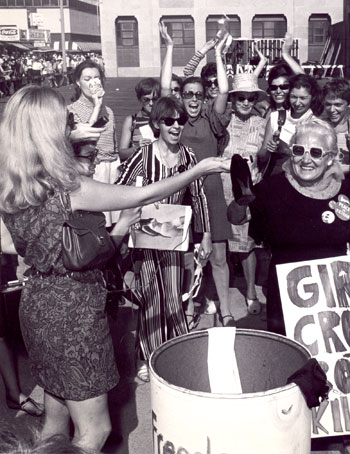
Those “bra-burning days” can be traced to the boardwalk at Atlantic City, NJ, 43 years ago, when about 100 women’s liberation demonstrators protested the Miss America pageant at the city’s Convention Center.

At the 'Freedom Trash Can,' 1968

A centerpiece of the protest was what the demonstrators called the “freedom trash can,” into which they consigned such “instruments of torture” as brassieres, girdles, high-heeled shoes, false eyelashes, copies of  Playboy and Cosmopolitan magazines.

The protesters have long insisted that, contrary to legend, bras and other items were not set afire that long ago September day.

The protest’s principal organizer, Robin Morgan, has asserted:

“There were no bras burned” at Atlantic City. “That’s a media myth.”

But in my latest book, Getting It Wrong, I offer evidence that bras were set afire, briefly, during the protest at Atlantic City. It was perhaps more akin to bra-smoldering.

The evidence is from separate witness accounts — one of them published in the local newspaper, the Press of Atlantic City, on September 8, 1968, the day after the protest.

That account appeared beneath the byline of a veteran reporter named John L. Boucher and carried the headline:

Bra burners blitz Boardwalk.”

The article’s key passage stated:

“As the bras, girdles, falsies, curlers, and copies of popular women’s magazines burned in the ‘Freedom Trash Can,’ the demonstration reached the pinnacle of ridicule when the participants paraded a small lamb wearing a gold banner worded ‘Miss America.’”

Boucher’s account, as I note in Getting It Wrong, “did not elaborate about the fire and the articles burning in the Freedom Trash Can, nor did it suggest the fire was all that important. Rather, the article conveyed a sense of astonishment that an event such as the women’s liberation protest could take place near the venue of the pageant.”

Boucher’s contemporaneous account was buttressed by the recollections of Jon Katz, a prolific writer who in 1968 was a young reporter for the Atlantic City Press.

He was on the boardwalk the day of the protest, gathering material for a sidebar article about reactions to the demonstration.

Katz’s article did not mention the burning bras. But in correspondence with me, Katz stated:

“I quite clearly remember the ‘Freedom Trash Can,’ and also remember some protestors putting their bras into it along with other articles of clothing, and some Pageant brochures, and setting the can on fire. I am quite certain of this.”

He added: “I recall and remember noting at the time that the fire was small, and quickly was extinguished, and didn’t pose a credible threat to the Boardwalk. I noted this as a reporter in case a fire did erupt ….”

Boucher’s long-overlooked article and Katz’s more recent recollections represent strong evidence that bras and other items were burned at the 1968 protest.

As I write in Getting It Wrong,  “This evidence cannot be taken lightly, dismissed or ignored.

“But it must be said as well,” I add, “that the witness accounts of Boucher and Katz lend no support to the far more vivid and popular imagery that many bras went up in flames in flamboyant protest that September day.”

Still, the notion that bra burnings were numerous during the late 1960s and 1970s became well-ingrained in American popular culture — as the recent reference in the Australian newspaper to “the 60s bra-burning days of women’s lib” suggests.

The phrase “bra-burning,” as I note in Getting It Wrong, became a sneering, off-hand way “of ridiculing feminists and mocking their sometimes-militant efforts to confront gender-based discrimination in the home and the work place.”

Bra-burning was hardly a common element of women’s liberation protests of the late 1960s and 1970s. Evidence is scant at best of feminist protesters during those years setting fire to bras and tossing the flaming undergarments into spectacular bonfires.

WJC

Recent and related:

Challenge the dominant narrative? Who, us?

In Debunking, Media myths on September 4, 2011 at 9:01 am

No surprise here.

The mainstream news media, as expected, have ignored the publication of an impressively researched and authoritative book challenging the narrative that Thomas Jefferson had children by one of his slaves, Sally Hemings.

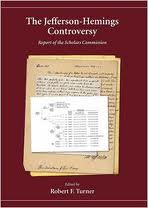
The 400-page work, The Jefferson-Hemings Controversy: Report of the Scholars Commission, was released September 1 at a news conference at the National Press Club in Washington.

A search of the LexisNexis database reveals no major U.S. news organization has since reported on the book’s appearance or, more important, on its content.

That Jefferson sired children with Hemings has long been accepted and reported as fact by mainstream news media, even though DNA testing often cited to support the claim was misreported when released in Nature magazine in 1998.

News reports then often characterized the DNA tests as having verified Jefferson’s parentage of at least one of Hemings’ children.

The Philadelphia Inquirer, for example, declared:

“DNA evidence has confirmed that Thomas Jefferson, the revered third president of the United States, fathered at least one child by his slave-mistress, Sally Hemings.”

And the New York Times asserted:

“DNA tests on the descendants of Thomas Jefferson’s family and of Jefferson’s young slave, Sally Hemings, offer compelling evidence that the nation’s third President fathered at least one of her children, according to an article in the scientific journal Nature.”

That evidence, the Times declared, “is likely to send historians scurrying to re-evaluate Jefferson, particularly his role in the anti-slavery movement.”

But in fact the DNA tests identified Jefferson as one of about two dozen Jefferson males who could have fathered Hemings’ last child, Eston.

The new book  — which places between hard covers the report and essays issued 10 years ago by a commission of scholars that investigated the Jefferson-Hemings matter — declares that “much of the public has been misled about the significance of the DNA tests … first reported in the journal Nature in November 1998.

“While the tests were professionally done by distinguished experts, they were never designed to prove, and in fact could not have proven, that Thomas Jefferson was the father of any of Sally Hemings’ children.

“The tests merely establish a strong probability that Sally Hemings’ youngest son, Eston, was fathered by one of the more than two dozen Jefferson men in Virginia at the time ….”

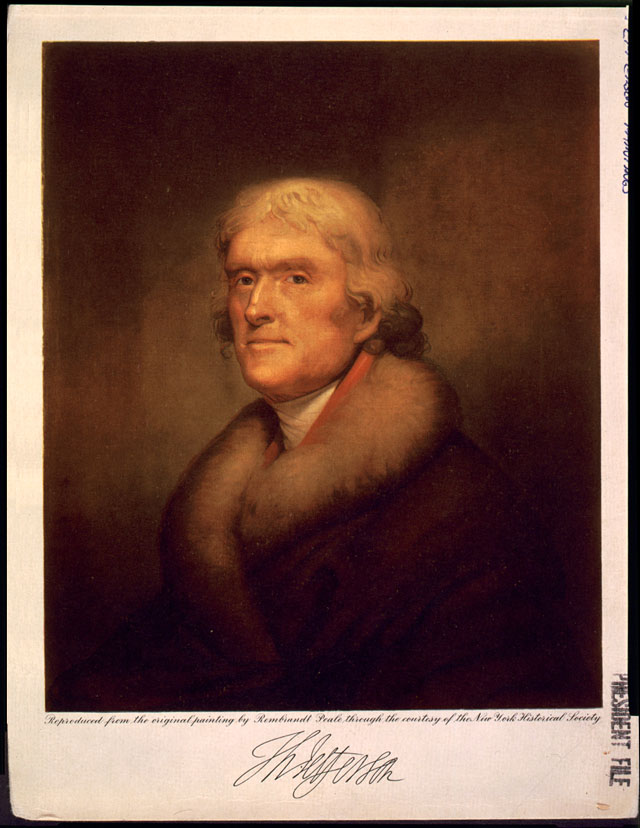
Thomas Jefferson: Library of Congress

The new book says circumstantial evidence points more powerfully to Jefferson’s younger brother, Randolph (or his sons), in the question of Eston Hemings’ paternity.

Randolph Jefferson, the book says, was known to have socialized with the slaves at Monticello, Thomas Jefferson’s home near Charlottesville, VA.

Randolph Jefferson was a dozen years younger than the president, and the available record offers no evidence that Thomas Jefferson “enjoyed socializing at night with Monticello slaves,” the book says.

Eston Hemings’ was conceived around August 1807, when Thomas Jefferson was 64 and in declining health — factors that further diminish the likelihood of his paternity.

Jefferson’s age and ailments always have represented crucial exculpatory evidence, in my view. That and the fact that Hemings had no children after Jefferson retired to Monticello from public life.

What’s more, the book says “Sally Hemings appears to have been a very minor figure in Thomas Jefferson’s life,” noting that Jefferson referred to her “in but four of his tens of thousands of letters.”

Of particular interest to Media Myth Alert is why the mainstream news media would ignore compelling evidence that exonerates Jefferson, or at least seriously complicates the paternity case against him.

Why wouldn’t the news media find appealing an opportunity to challenge the dominant narrative about Jefferson and his purported slave-mistress?

A number of reasons offer themselves.

One is that the new book essentially is a compilation of reports released in April 2001. In the new book’s acknowledgements, editor Robert F. Turner apologizes to members of the scholars commission “for the long delay in finally getting this volume in print.”

But the volume’s delayed publication doesn’t make the case against Jefferson’s paternity any less powerful or less compelling.

It is a complex case, and complexity seldom appeals to the news media. Simplistic tales are far more engaging, alluring, and easy to report.

As I point out in my latest book, Getting It Wrong (which does not discuss the Jefferson-Hemings controversy), media-driven myths “tend to minimize or negate complexity in historical events and offer simplistic and misleading interpretations instead.”

As does the dominant narrative of the Jefferson-Hemings matter.

That Thomas Jefferson sired offspring by a slave-mistress is an intriguing and perversely delicious story. But it is hardly settled history. It’s more likely a misreading of history — a misreading that the well-written and thoroughly researched new book, to its credit, seeks to correct.

WJC

Recent and related:

‘Deep Throat’ garage marker errs about Watergate source disclosures

In Debunking, Media myths, Washington Post, Watergate myth on August 18, 2011 at 10:16 am

An historical marker went up the other day outside the parking garage in Arlington, Virginia, where Washington Post reporter Bob Woodward periodically met during the Watergate scandal with a stealthy, high-level source code-named “Deep Throat.”

It’s a handsome marker, artfully scalloped at the top.

Felt: Cagey source

But it errs in describing the information Woodward received from “Deep Throat,” who in 2005 revealed himself as W. Mark Felt, formerly the FBI’s second in command.

The marker, which is titled “Watergate Investigation,” says:

“Felt provided Woodward information that exposed the Nixon administration’s obstruction of the FBI’s Watergate investigation.”

Not so.

Such evidence would have been so damaging and explosive that it surely would have forced Nixon to resign the presidency well before he did, in August 1974.

Felt didn’t have that sort of information — or (less likely) didn’t share it with Woodward.

As described in Woodward’s book about Felt, The Secret Man, the FBI official provided or confirmed a good deal of piecemeal evidence about the scandal as it unfolded.

And he could be cagey and evasive in doing so.

Here, for example, is a passage from Secret Man, in which Woodward discussed efforts he and his Post colleague Carl Bernstein had made to identify Nixon’s chief of staff, H.R. Haldemann, as one of five people controlling a secret slush fund:

“I told Felt that we were going to publish a story next week saying that Haldemann was the fifth and final person to control the secret fund.

“‘You’ve got to do it on your own,’ Felt said.

“I said I expected him to warn me if we were wrong.

“Felt said he would.

“So he was essentially confirming Haldemann?

“‘I’m not,’ he said. ‘You’ve got to do it on your own.’

“It was a distinction that didn’t make sense to me. I was tired of this dancing around.

“‘You cannot use me as a source [on that story],’ Felt said. ‘I won’t be a source on a Haldemann story.””

And so it went.

(All the President’s Men, Woodward and Bernstein’s book about their Watergate reporting, says Woodward’s conversations with “Deep Throat” were intended “only to confirm information that had been gathered elsewhere and to add some perspective.”)

Woodward met Felt at the garage six times from October 1972 to November 1973, the marker notes. The last meeting at the garage was a few months after Felt had been passed over for the FBI directorship and retired.

Not until late summer 1974 — months after Felt left the FBI — did unequivocal evidence emerge about Nixon’s attempt to thwart the agency’s investigation into Watergate.

That came when Nixon complied with a unanimous Supreme Court ruling and surrendered audiotape recordings he had secretly made of conversations at the White House.

A recording of Nixon’s meeting with Haldemann on June 23, 1972, revealed that the president had sought to deflect or derail the FBI investigation into the burglary six days before at the headquarters of the Democratic National Committee at the Watergate complex in Washington.

The recording was called the “Smoking Gun” tape — and that tape, not information Felt gave Woodward, exposed Nixon’s guilt and forced his resignation.

The tape offered stunning and incontrovertible evidence that Nixon “had participated in an obstruction of justice almost from the outset” of the scandal, Stanley I. Kutler, the leading historian of the scandal, wrote in The Wars of Watergate.

As I note in my latest book, Getting It Wrong, had Nixon not recorded his conversations, he likely would have survived the Watergate scandal and served out his second term.

The marker outside the “Deep Throat” garage contains another, smaller error, too.

It says it was “erected in 2008 by Arlington County, Virginia.” But the online news site arlnow .com pointed out that the marker went up late last week — “after a three year delay.”

WJC

Recent and related:

That’s not what Zhou meant

In Debunking, Furnish the war, Media myths, Spanish-American War on August 17, 2011 at 7:52 am

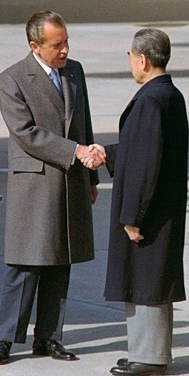
Nixon and Zhou, 1972

In 1972, Chinese premier Zhou Enlai told President Richard M. Nixon that it was “too early to say” what would be the implications of political upheaval in France.

It’s long been thought that Zhou was referring to the French Revolution that began in 1789 — that Zhou was taking a decidedly wise, sagacious, and patient view of history.

But in reality, according to a former U.S. diplomat who was present at the discussion in China, Zhou was referring to the more recent turmoil that had shaken France in 1968.

Still, the conventional interpretation — the Zhou was thinking in centuries, not in mere years — is so appealing that it lives on, as was suggested by a commentary posted yesterday by the English-language Moscow Times newspaper.

The commentary, which considered the significance of the attempted coup in the former Soviet Union in August 1991, began this way:

“Chinese leader Zhou Enlai may have been correct when he told U.S. President Richard Nixon in 1972 that it was too early to determine the impact of the French Revolution, but 20 years is usually enough to assess the importance of most historical events.”

The commentary may be quite correct about a 20-year interval being sufficient for assessing historical events.

But the characterization about Zhou’s comment is off-target, in light of recollections offered in June by Charles W.  (Chas) Freeman Jr., a retired diplomat who was interpreter for Nixon on his famous 1972 trip to China.

The Financial Times of London was first to report about the revised interpretation of Zhou’s comment. The newspaper quoted Freeman’s remarks at a panel discussion in Washington, D.C., that the Chinese leader was referring to the events of 1968.

Freeman, in a subsequent interview with me, described Zhou’s comment as “one of those convenient misunderstandings that never gets corrected,” noting that “it conveniently bolstered a stereotype … about Chinese statesmen as far-sighted individuals who think in longer terms than their Western counterparts.”

The misconstrued comment fit nicely with “what people wanted to hear and believe,” Freeman said, “so it took” hold.  And is not infrequently repeated.

Freeman said it was “absolutely clear” from the context of the discussion that Zhou’s “too early to say” remark was in reference to upheaval of 1968, not the years of turmoil that began in 1789.

Freeman described Zhou’s remark as “a classic of the genre of a constantly repeated misunderstanding that has taken on a life of its own.”

In that way, it’s akin to other deliciously irresistible quotations that are just too neat and too tidy to be true — a topic I discuss in my latest book, Getting It Wrong, which addresses and debunks 10 prominent media-driven myths.

One of the too-perfect-to-be-true quotations I discuss is the vow attributed to William Randolph Hearst, who purportedly pledged to “furnish the war” with Spain in the late 19th century.

The Hearstian vow suggests the depths to which journalists can stoop — to agitate for a war the country otherwise would not fight. That’s a reason for the tenacity of the purported Hearst quote. It reveals journalists at their most depraved.

But the purported vow, however well-known, is surely apocryphal.

Hearst denied having sent such a message, and the artifact — the telegram conveying the vow — has never turned up.

What’s more, pledging to “furnish the war” would have made no sense, given the context. Hearst’s telegram was supposedly sent to an artist, Frederic Remington, who was in Cuba to draw sketches of the rebellion against Spanish colonial rule.

It’s illogical that Hearst would have vowed to “furnish the war” when war — the Cuban rebellion — was the reason he sent Remington to the island in the first place.

WJC

Recent and related:

60 years after his death, media myth towers around Hearst

In Anniversaries, Debunking, Furnish the war, Media myths, Spanish-American War on August 15, 2011 at 4:35 am

The BBC over the weekend marked the 60th anniversary of the death of William Randolph Hearst by posting a piece I wrote about the mythology surrounding the often-scorned media tycoon of the late 19th and 20th centuries.

Hearst: Routinely scorned

Hearst, I wrote, “lives on 60 years after his death as the mythical bogeyman of American journalism, the personification of the field’s most egregious impulses,” and the inspiration for the epithet “yellow journalism.”

I discussed the hardy media myths that Hearst famously vowed to “furnish the war” with Spain and then made good on the pledge.

“The towering mythology that envelopes Hearst,” I noted, “began to take hold long before his death on 14 August 1951.

“The lore dates to the late 1930s and the first in a succession of wretched biographies about Hearst.

“Among them was Imperial Hearst, a truculent work that excoriated Hearst’s increasingly conservative politics and resurrected the ‘furnish the war’ myth.”

Even more important to the mythology around Hearst, I wrote, was Orson Welles’ cinematic masterpiece, Citizen Kane.

“The movie was based loosely on Hearst’s life and times, and received mostly mixed reviews when it was released in 1941,” I noted, adding:

“Hearst did try to have the film killed, which served to enhance its latent appeal. Kane was rediscovered in the 1960s and ultimately gained deserved recognition as a classic.”

I noted that a rollicking scene in Kane “borrows from and paraphrases the ‘furnish the war’ anecdote, which further helped to implant the myth in the popular consciousness.”

Hearst was a ready target for the contempt of his peers and rivals because of inherited wealth enabled him to enter journalism at the top — as publisher of the San Francisco Examiner and, later in the 19th century, the New York Journal.

Hearst’s quixotic personality also made his a target of media mythmaking. I quoted David Nasaw’s fine biography of Hearst, The Chief, which noted:

“William Randolph Hearst was a huge man with a tiny voice; a shy man who was most comfortable in crowds; a war hawk in Cuba and Mexico but a pacifist in Europe; an autocratic boss who could not fire people; a devoted husband who lived with his mistress; a Californian who spent half his life in the East.”

It’s little wonder then why Hearst was, and remains, the object of so much myth and misunderstanding.

He also used his newspapers as platforms for pursuing his mostly unfulfilled political ambitions — which further accounts for the mythology, which further explains why he became a lightning rod for enduring scorn.

Hearst ran for the Democratic Party’s nomination for the presidency in 1904, but fell well short. Later, he ran for governor of New York and mayor of New York City, and lost.

By 1910 or so, Hearst’s political ambitions were, I noted, mostly spent.

And now, 60 years after his death, the mythology surrounding Hearst is so firmly entrenched so as never to be expunged.

WJC

Recent and related:

Blogging about journalism history: Why, and why bother?

In Debunking, Media myths on August 10, 2011 at 6:44 am

Journalism historians who blog.

It seems a little oxymoronic.

After all, isn’t journalism history a little too fusty, a little too musty, and a little too obscure to be readily adapted to contemporary social media such as blogging?

One might reflexively think so.

But a panel of four journalism historians who blog will discuss why they do so at a panel in St. Louis this afternoon, during the annual conference of the Association for Education in Journalism and Mass Communication (AEJMC).

The panel, titled “We blog about journalism history: Why, and why bother,” will consider the value of injecting historical dimension into contemporary debates and critiques about the performance of  news media, both traditional and online.

I’ll moderate and participate on the panel, which will bring together Chris Daly of Boston University, Karen Russell of the University of Georgia, and James McPherson of Whitworth College.

I intend to point out how blogging about journalism history can offer relevant and valuable context to the blogosphere’s never-ending debates about media performance. Journalism historians can bring to those debates perspective and analysis that would otherwise be missing or overlooked.

I also expect to note there are personal reasons for blogging as well. By blogging, journalism historians can test emergent ideas and hypotheses. Blogging can reinforce (and direct attention to) previously published work — much as Media Myth Alert seeks to do in promoting my latest book, Getting It Wrong, which debunks 10 prominent media-driven myths.

Blogging is a way to call out media myths. After all, as historian Gerard DeGroot has pointed out, “The good historian is a mythbuster.”

Blogging also allows journalism historians to take the steps toward developing larger, more detailed works, a point suggested several years ago in an intriguing blog post by Timothy Burke about why historians blog.

Among other points, Burke said he writes online essays because “I want to find out how much of my scholarly work is usefully translatable into a wider public conversation.”

Blogging about journalism history can have pedagogical value and impact far beyond the blogger’s expectations and knowledge. As such, blog posts about topics in journalism history may greatly expand the reach and application of a scholar’s research.

So it promises to be lively, the AEJMC blogging panel, which convenes at 1:30 p.m. in the Landmark #1 meeting room of the Renaissance Grand and Suites Hotel in St. Louis.

Panel-goers are invited to live-Tweet the proceedings, and use the Twitter hashtags #AEJMCblogging and #AEJMC11.

WJC

Recent and related:

Following the money on 37th anniversary of Nixon’s fall

In Anniversaries, Cinematic treatments, Debunking, Media myths, Washington Post on August 9, 2011 at 12:55 am

Nixon resigns, 1974

It’s somehow fitting on this, the 37th anniversary of President Richard Nixon’s resignation, to direct attention to the myth and hyperbole that embrace the best-known line of the Watergate scandal, the line that supposedly helped bring him down.

That line, of course, is “follow the money,” which purportedly was crucial advice given the Washington Post by a super-secret, high-level source code-named “Deep Throat.”

Follow the money” was said to have been so telling and effective that it’s still cited as exemplary guidance applicable in journalism, politics, and finance.

Just yesterday, for example, Barry Nolan, a journalist and contributor to Boston Magazine’sBoston Daily” blog, invoked the famous phrase, writing:

“Any time you really want to know why a vote happened the way it did, the single best piece of advice ever given came from ‘Deep Throat,’ the shadowy tipster in the Watergate scandal. ‘Follow the money,’ he told the Washington Post reporters.”

It may seem like stellar advice, but it’s guidance that the “Deep Throat” source offered only in the movies.

As I’ve discussed at Media Myth Alert, “follow the money” is Watergate’s most famous made-up line.

The phrase was written into the screenplay of All the President’s Men, the 1976 cinematic version of the book by Bob Woodward and Carl Bernstein of the Washington Post.

“Follow the money” appears nowhere in Woodward and Bernstein’s book about their Watergate reporting — reporting that did not, as I discuss in my latest work, Getting It Wrong, take down Nixon’s corrupt presidency.

Nor did “follow the money” appear in any Watergate-related news article or editorial in the Post until June 1981, nearly seven years after Nixon’s resignation.

Nor did “Deep Throat” — who was self-identified in 2005 as W. Mark Felt, formerly the FBI’s second-ranking official — utter the line in his periodic meetings with Woodward. (And Felt/”Deep Throat” didn’t meet Bernstein until 2008.)

Follow the money” was memorably intoned not by Mark Felt but by Hal Holbrook, the actor who played “Deep Throat” in All the President’s Men.

As I’ve noted, Holbrook turned in a marvelous performance as a tormented, conflicted, and stealthy “Deep Throat.”

Holbrook delivered the “follow the money” line with such conviction and steely assurance, that it seemed for all the world to offer a way through the labyrinth of the Watergate scandal.

But even if Woodward had been counseled to “follow the money,” the advice certainly neither would have unraveled Watergate nor led him to Nixon.

Nixon resigned 37 years ago today not because he misused campaign funds but because he sought to obstruct justice by covering up the signal crime of Watergate, the break-in at the headquarters of the Democratic National Committee in June 1972.

The simplified follow-the-money  interpretation of Watergate effectively deflects attention from the decisive forces that ultimately forced Nixon from office.

As I note in Getting It Wrong, rolling up a scandal of Watergate’s intricacy and dimension required “the collective if not always the coordinated forces of special prosecutors, federal judges, both houses of Congress, the Supreme Court, as well as the Justice Department and the FBI.

“Even then,” I write, “Nixon likely would have served out his term if not for the audiotape recordings he secretly made of most conversations in the Oval Office of the White House.

“Only when compelled by the Supreme Court did Nixon surrender those recordings, which captured him plotting the cover-up” that cost him the presidency.

WJC

Recent and related:

No ‘rock-em,’ no ‘sock-em’: What ails WaPo

In Debunking, Jessica Lynch, Media myths, Newspapers, Washington Post, Watergate myth on August 7, 2011 at 1:59 am

The ombudsman of the Washington Post, Patrick Pexton, weighs in today with platitudes and hang-wringing about the newspaper. He mostly misses the mark.

Pexton writes in his column that the Post’s “future lies not with the rich; it lies with the citizenry.

“This newspaper must be the one source of high-quality, probing Washington news that readers in this region and across the country can look to for holding their government accountable. This publication must be for all Americans.”

Oh, brother.

But wait: Here’s more vague abstraction:

“The Post,” Pexton writes, “can’t be a liberal publication or a conservative one. It must be hard-hitting, scrappy and questioning — skeptical of all political figures and parties and beholden to no one. It has to be the rock-’em-sock-’em organization that is passionate about the news. It needs to be less bloodless and take more risks when chasing the story and the truth.”

A “rock-’em-sock-’em organization,” eh? Well, that’s useful guidance.

In his five or so months as ombudsman, Pexton hasn’t dared touch the electrified third rail about the Post, which one of his predecessors, Deborah Howell, gamely if belatedly addressed.

That’s a decided lack of intellectual diversity in the Post’s newsroom. In mid-November 2008, shortly after Barack Obama was elected president, Howell wrote in her ombudsman column:

“I’ll bet that most Post journalists voted for Obama. I did. There are centrists at The Post as well. But the conservatives I know here feel so outnumbered that they don’t even want to be quoted by name in a memo.”

Howell’s column quoted Tom Rosenstiel of the Project for Excellence in Journalism as saying that “conservatives are right that journalism has too many liberals and not enough conservatives. It’s inconceivable that that is irrelevant.”

In Obama's thrall

The lack of intellectual diversity often shows in the Post’s report. Even casual reading signals that the newspaper remains in the thrall of Obama, despite his clearly failing presidency.

Obama scarcely gets “rock-’em-sock-’em” treatment from the Post.

Last Wednesday, for example, the Post’s once-edgy “Style” section devoted most of its front page to a cheery feature about the meaning of Obama’s turning 50-years-old.

“On Thursday,” the article gushed, “President Obama — one of American history’s most precocious achievers — joins the ranks of Washington 50-somethings ….”

But what ails the Post goes well beyond its routinely tender treatment of Obama.

The Post’s local report is superficial, a diet of eye-rolling, feel-good features. The newspaper carries little staff-produced national coverage. Its international report is undistinguished, especially compared to that of the New York Times.

Moreover, the Post offers few notable cases of investigative journalism any more.

It has won two Pulitzer Prizes for investigative reporting in 25 years, which has to be considered meager for a newspaper that reputedly brought down Richard Nixon’s corrupt presidency with its relentless digging into the Watergate scandal.

But as I discuss in my latest book, Getting It Wrong, the Post-Watergate trope, of course, is a powerful media-driven myth.

I’d be remiss were I to fail to note that the Post never has come clean about how it erred so utterly in offering the world the bogus hero-warrior tale about Jessica Lynch in the early days of the Iraq War.

Lynch, the Post reported on its front page on April 3, 2003, “fought fiercely and shot several enemy soldiers after Iraqi forces ambushed the Army’s 507th Ordnance Maintenance Company, firing her weapon until she ran out of ammunition, U.S. officials said yesterday.”

But none of the derring-do attributed to Lynch was true, and the Post has never explained who led it so badly astray.

Moreover, the staff cuts and buyouts of recent years left few notable characters on the newspaper’s staff.

Gone are such colorful figures as the erudite and pugnacious Henry Allen, a Pulitzer winner who left the Post after throwing punches at a staff writer who called him a c—sucker.

Now there was “rock-’em-sock-’em,” old school variety.

WJC

Many thanks to Instapundit
Glenn Reynolds for linking to this post.

Recent and related:

India high court order invokes phony Watergate line

In Debunking, Furnish the war, Media myths, Washington Post, Watergate myth on August 2, 2011 at 9:48 am

Two Supreme Court judges in India last month turned to Watergate’s most famous made-up line in ordering an investigation into large sums of money believed stashed in banks abroad.

The judges in their order cited the made-up line as if it had been genuine advice from a high-level source to Bob Woodward of the Washington Post  during the newspaper’s investigation of the Watergate scandal.

The line is “follow the money” — and it had no role whatsoever in the Watergate scandal.

Follow the money” was never uttered by Woodward’s stealthy source, who was code-named “Deep Throat.”

The line appears nowhere in the All the President’s Men, the book Woodward and Carl Bernstein wrote about their Watergate reporting for the Post.

Nor did the passage appear in any Watergate-related news article or editorial in the Post before June 1981 — nearly seven years after the scandal reached its denouement with President Richard Nixon’s resignation.

Follow the money” was written into the screenplay of All the President’s Men, the 1976 movie based on Woodward and Bernstein’s book.

Many people and many news outlets over the years have cited “follow the money” as if it were real, as if it had been advice to Woodward that really worked.

Just last week, for example, a column in London’s high-brow Financial Times newspaper described “follow the money” as the “mantra” of Watergate. And a column posted at Huffington Post a couple of weeks ago also repeated “follow the money” as if it had been vital guidance to uncovering Watergate.

But finding its way into a high court order probably represents a first for “follow the money.”

As noted in a Bloomberg news service report yesterday, the two judges — B. Sudershan Reddy and S.S. Singh Nijjar — invoked “follow the money” at the outset of the order they released early last month.

Credulously, the judges wrote:

“‘Follow the money’ was the short and simple advice given by the secret informant, within the American Government, to Bob Woodward, the journalist from Washington Post, in aid of his investigations of the Watergate Hotel break in.”

So how is it that such errors are made? What explains the impressive reach and popularity of this appealing but contrived statement?

A partial explanation is that “follow the money” seems just too good, too delicious, not to be true. It’s in the class of William Randolph Hearst’s purported vow to “furnish the war” with Spain: It’s a quotation that really ought to true.

And as I point out in my media myth-busting book, Getting It Wrong:

“To thwart media myths, journalists can start by applying a measure of skepticism to pithy, telling quotes such as Hearst’s vow to ‘furnish the war.’ … Turns of phrase that sound too neat and tidy often are too perfect to be true.”

The popularity of “follow the money” goes beyond appealing pithiness and is rooted in the dramatic quality of All the President’s Men, the most-watched movie ever made about Watergate.

The “Deep Throat” character was played in All the President’s Men by the actor Hal Holbrook, who turned in a marvelous performance.

In a late-night scene in a darkened parking garage, the shadowy, raspy-voiced Holbrook told the Woodward character (played by Robert Redford):

“I have to do this my way. You tell me what you know, and I’ll confirm. I’ll keep you in the right direction, if I can, but that’s all.

“Just follow the money.”

Holbrook delivered the line with such quiet insistence that it truly seemed to offer a way through the labyrinth of the Watergate scandal. And the popularity of the movie carried “follow the money” into the vernacular.

But such guidance, had it really been offered to Woodward, would have taken the reporter only so far. Watergate, after all, was much broader than the improper use of campaign monies.

Nixon was toppled not by heroic journalists who followed a money trail, but by irrefutable evidence captured on audiotapes that he had ordered the cover up Watergate’s signal crime, the break-in at the headquarters of the Democratic National Committee in June 1972.

WJC

Recent and related: