W. Joseph Campbell

Posts Tagged ‘Hurricane Katrina’

‘Getting It Wrong’ goes Majic

In Bay of Pigs, Bra-burning, Debunking, Furnish the war, Jessica Lynch, Media myths, Media myths and radio, New York Times, War of the Worlds, Washington Post, Watergate myth on July 1, 2010 at 11:34 am

I did an engaging and entertaining in-studio interview yesterday on the Lanigan & Malone show, one of the most popular radio programs in Cleveland, the gritty city where I cut my teeth, journalistically, years ago.

On the air with Lanigan (center) and Malone

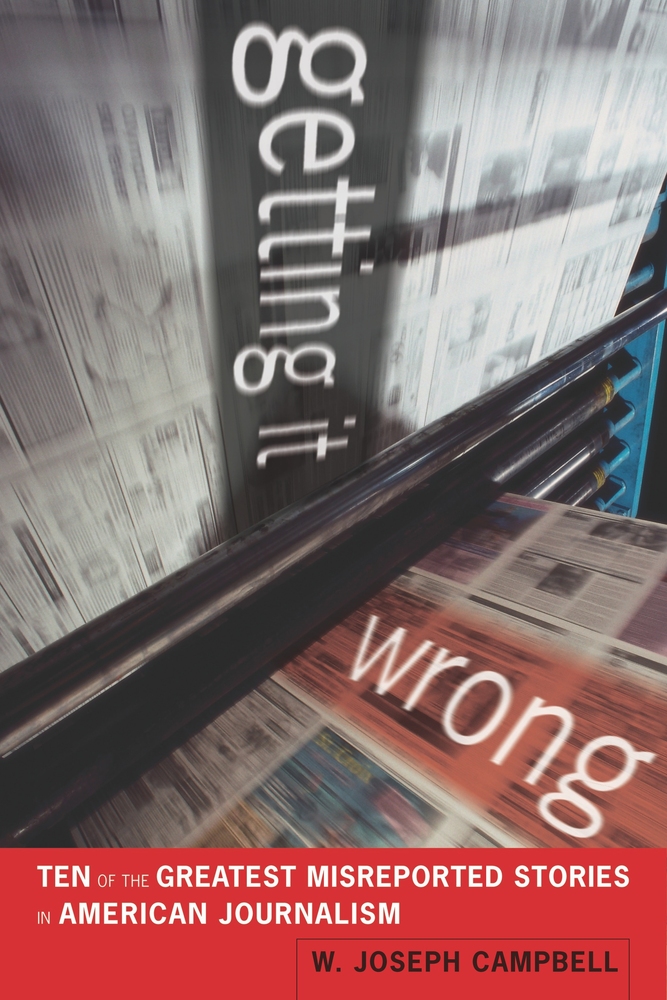
The show airs on WMJI, Majic 105.7 FM, and I spoke with hosts John Lanigan and Jimmy Malone about several media-driven myths addressed and debunked in my new book, Getting It Wrong.

They included the case of Jessica Lynch, the waiflike Army private whom the Washington Post elevated to hero status in a sensational but utterly erroneous report early in the Iraq War in 2003.

The Post depicted Lynch as having “fought fiercely” in the Iraqi ambush at Nasiriyah of the Army’s 507th Maintenance Company. The newspaper said Lynch had “shot several enemy soldiers” and kept “firing her weapon until she ran out of ammunition.”

Walters

The Lynch case, I said during the Lanigan & Malone interview, appears to have centered around a case of mistaken identity. It wasn’t Lynch who had fought heroically at Nasiriyah. It was most likely Donald Walters, a cook-sergeant in Lynch’s unit who, after running out of ammunition, was captured by Iraqi irregulars and executed.

I pointed out during the interview how war and conflict can readily give rise to myth and misunderstanding. Indeed, half the chapters in Getting It Wrong are related to warfare, including the book’s first chapter, the myth of William Randolph Hearst’s infamous vow to “furnish the war” with Spain.

We moved on to discuss the myth that widespread panic and mass hysteria characterized the reactions to the 1938 radio dramatization of The War of the Worlds, then jumped to a discussion of the myth of superlative reporting of Hurricane Katrina’s aftermath in September 2005, and considered at some length about what I call the “nuanced myth” of bra-burning.

“Bra-smoldering,” I said, would be a more accurate characterization of what happened during the women’s liberation protest at Atlantic City in September 1968. My research shows that bras and other items were set afire, if briefly, during the demonstration against that year’s Miss America pageant.

“All these are ruined,” Lanigan said at one point about the myths debunked in Getting It Wrong.

We also discussed the Bay of Pigs-New York Times suppression myth. That myth centers around a telephone call President John F. Kennedy supposedly placed to the Times publisher or top editors in April 1961, asking that the newspaper hold off on reporting about the pending CIA-supported invasion of Cuba.

There is no evidence, I said, that Kennedy ever placed such a call. (Or even had time to place such a call.)

What appears to have happened is that the Bay of Pigs-suppression myth has become confounded with the 1962 Cuban missile crisis, during which Kennedy did call the Times to request a delay on a report about nuclear-tipped missiles the Soviets had deployed on the island.

As the interview wrapped up, Lanigan said he’s “sure there will be another” volume, a sequel, to Getting It Wrong.

“It’s a good book,” he said afterward. “I’m glad he did it.”

WJC

Related:

Launching ‘Getting It Wrong’ at Newseum

In Bay of Pigs, Bra-burning, Cronkite Moment, Debunking, Furnish the war, Jessica Lynch, Media myths, Murrow-McCarthy myth, War of the Worlds, Washington Post, Watergate myth on June 14, 2010 at 6:28 am

My new book, Getting It Wrong, will be launched Saturday, June 19, at an “Inside Media” program at the Newseum, the $450 million museum of news in downtown Washington, D.C.

The program will begin at 2:30 p.m. in the Knight TV Studio on the third level and will feature a discussion with the Newseum’s John Maynard, followed by audience Q-and-A.

I’ll be signing copies of Getting It Wrong afterward.

The book addresses, and debunks, 10 prominent media-driven myths–stories about and/or by the news media that are widely believed and often retold but which, on close inspection, proved to be apocryphal or wildly exaggerated.

Here is a brief description about each of the 10 myths:

  1. Remington-Hearst: William Randolph Hearst’s famous vow, “you furnish the pictures, I’ll furnish the war,” is almost certainly apocryphal.
  2. War of Worlds: The notion that the War of Worlds radio dramatization in 1938 caused nationwide panic and mass hysteria is exaggerated.
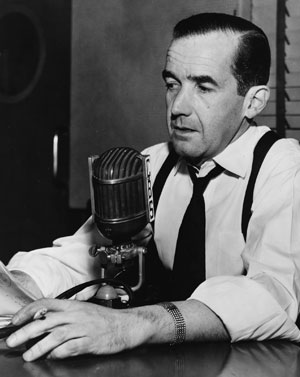
  3. Murrow-McCarthy: Edward R. Murrow’s famous See It Now program in March 1954 did not end Senator Joseph McCarthy’s communists-in-government witch-hunt; Murrow in fact was very late to take on McCarthy.

    Murrow in 1954

  4. Bay of Pigs: The New York Times did not suppress its reporting in the run-up to the ill-fated Bay of Pigs invasion in April 1961.
  5. Cronkite-Johnson: Walter Cronkite’s special report on Vietnam in February 1968 did not prompt an immediate reassessment of U.S. war policy.
  6. Bra-burning: Humor columnist Art Buchwald helped spread the notion that feminist demonstrators dramatically burned their bras at a Miss America protest in September 1968.
  7. Watergate: The Washington Post’s intrepid reporters, Carl Bernstein and Bob Woodward, did not bring down Richard Nixon’s corrupt presidency. That they did is a trope that knows few bounds.
  8. Crack babies: The much-feared “bio-underclass” of children born to women who smoked crack cocaine during their pregnancies never materialized.
  9. Jessica Lynch: The Washington Post’s erroneous reporting about Jessica Lynch early in the Iraq War gave rise to several myths about her capture and rescue.
  10. Hurricane Katrina: News coverage of Katrina’s aftermath in New Orleans in early September 2005 was marred by wild exaggerations of extreme, Mad Max-like violence.

As I write in Getting It Wrong, the myths debunked “are among American journalism’s best-known stories. Most of them are savory tales. And at least some of them seem almost too good to be false.”

I further write that because it “takes on some of the most treasured stories in American journalism,” Getting It Wrong is “a work with a provocative edge. It could not be otherwise.”

WJC

Related:

Media myths, the ‘junk food of journalism’

In Debunking, Furnish the war, Murrow-McCarthy myth, Spanish-American War, Washington Post, Watergate myth on May 26, 2010 at 9:14 pm

Media-driven myths, the subject of my soon-to-be-published book, Getting It Wrong, are prominent tales of doubtful authenticity—false, dubious, or improbable stories about the news media that masquerade as factual.

The  myths addressed and debunked in the book include the notion that two intrepid reporters for the Washington Post took down Richard Nixon’s corrupt presidency, that Edward R. Murrow’s See It Now television program brought an end to Senator Joseph McCarthy’s communists-in-government witch-hunt, and that newspaper magnate William Randolph Hearst vowed to “furnish the war” with Spain at the end of the 19th century.

“In a way,” I write in Getting It Wrong, media myths “are the junk food of journalism—alluring and delicious, perhaps, but not especially wholesome or nourishing.”

But why bother: Why devote a book to debunking media-driven myths?

It’s a question that, somewhat to my surprise, arises not infrequently.

Several answers offer themselves.

For one, there is inherent value is seeking to set straight the historical record. As I write in Getting It Wrong, “the effort to dismantle [media myths] is certainly worthy, if only to insist on a demarcation between fact and fiction.” That effort is aligned with a core objective of newsgathering—that of getting it right.

Media-driven myths, moreover, are neither trivial nor innocuous. They can have adverse consequences. They tend, for example, to minimize the nuance and complexity of historical events and offer simplistic and misleading interpretations instead. It’s effortless and undemanding to say the Washington Post brought down Nixon, that Murrow ended McCarthyism, or that Hearst plunged the United States into war with Spain. The historical reality in each of those cases is, of course, significantly more complex.

So media-driven myths distort popular understanding about the roles and functions of journalism in American society. They tend to confer on the news media far more power and influence than they typically wield.

Media influence, I write in the book, usually “is trumped by other forces” and further undercut by the traditional self-view of American journalists as messengers first, rather than as makers and shapers of news.

What’s more, the news media these days are too splintered and diverse—print, broadcast, cable, satellite, online—to exert much in the way of collective and sustained influence on policymakers or media audiences.

Thus, debunking media-driven myths can help to locate media influence in a more coherent context. Getting It Wrong offers the case that such influence tends to modest, nuanced, and situational.

There are occasions, though, when the splintered news media coalesce and devote exceptionally intense attention to a single topic—such as Hurricane Katrina’s rampage along the Gulf Coast nearly five years ago. The news media gave themselves high marks for their coverage of the disaster’s aftermath, especially of the federal government’s fitful response.

But as I discuss in Getting It Wrong, the coverage also was characterized by highly exaggerated reports of nightmarish violence and wanton criminality in New Orleans in the hurricane’s wake. The misreporting of the disaster’s aftermath, I write, effectively “defamed a battered city and impugned its residents at a time of their deep despair.”

Thus, another reason why debunking matters—media-driven myths can and do feed prejudices and stereotypes.

Finally, confronting media myths discourages the tendency to regard prominent journalists in extreme terms—as heroes or villains. Piercing the myth surrounding Murrow renders him somewhat less Olympian. Similarly, debunking the myth about Hearst and his purported vow to “furnish the war” with Spain makes him seem less manipulative, and less demonic.

Getting It Wrong is a work with a provocative edge. Given that it takes on some of the most treasured stories in American journalism, it could not be otherwise.

WJC

This post first appeared at the University of California Press blog.

Check out new trailer for ‘Getting It Wrong’

In 1897, Debunking, Furnish the war, Media myths, Spanish-American War, War of the Worlds, Yellow Journalism on May 8, 2010 at 3:45 pm

Here’s the book trailer for Getting It Wrong, my forthcoming book that addresses, and debunks, 10 prominent media-driven myths.

Getting It Wrong will be published this summer by University of California Press.

WJC

On laptops in the classroom, and technology-driven myths

In Debunking, Media myths, Washington Post on March 9, 2010 at 10:17 am

The front page of today’s Washington Post offers an interesting look at banning laptops in college classrooms.

The Post reporter spoke with me in researching the story, as I generally do not allow laptop use in my classes, a policy that dates at least five years. Typically, I mention my preference on the first day of class and thereafter rarely receive pushback from students.

And laptops in the classroom have never been mentioned in student evaluations of my teaching.

The Post article notes that wireless Internet connections in the classroom tend to “tempt students away from note-typing to e-mail, blogs, YouTube videos, sports scores, even online gaming–all the diversions of a home computer beamed into the classroom to compete with the professor for the student’s attention.”

True enough: Laptops can be a serious distraction, which is a principal reason I prefer not to see them open in the classroom.

But another factor, one the Post article doesn’t mention, is that of classroom etiquette.

It’s undeniably discourteous to be IM’ing or texting or sending email, especially in discussion-based classes.  It’s rude: Rude to the instructor, and rude to fellow students to be so dismissive of their contributions.

Laptops in classroom also can contribute, on occasion, to the frenzied circulation of technology-driven myths.

The Post article recalled an episode last week in the classroom of Professor Peter W. Tague at Georgetown Law School.

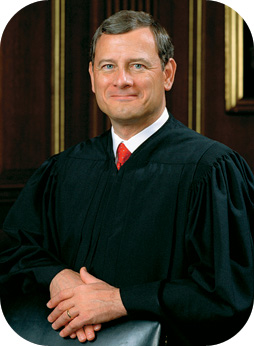
As part of an exercise on the importance of challenging sources who seem authoritative, Tague told the class that the Supreme Court chief justice, John G. Roberts Jr., was retiring.

Roberts

Students, the Post article noted, “promptly spread the news into the blogosphere. Later in class, Tague revealed that the tip was false, part of a lesson” on ascertaining source credibility. By then, however, the Roberts story had spread from students’ laptops to sources throughout the Internet.

The bogus report was posted at RadarOnline, which said Roberts (who is 55) was “seriously considering stepping down.” The DrudgeReport linked to the Radar post and, from there, it went viral–as recounted in delicious detail by the blog Above the Law.

The Radar report soon was knocked down–demonstrating anew how the Internet can rapidly disseminate media-driven rumors, and thoroughly debunk them as well.

The episode certainly confirmed the importance of Tague’s lesson about verifying the credibility of sources. It’s a lesson useful for journalists, too.

As I write in my forthcoming book about media-driven myths, Getting It Wrong, the flawed and exaggerated reporting that characterized the aftermath of Hurricane Katrina in 2005 was driven, in part, by reliance on official sources.

“Usually,” I write in Getting It Wrong, “the imprimatur of officialdom translates to adequate sourcing for journalists.” But in Katrina’s aftermath, the New Orleans mayor, Ray Nagin and the city’s police commissioner, Eddie Compass, “became the very public sources of alarming but false and exaggerated reports about their city and its inhabitants. And they offered their erroneous reports seemingly in all confidence, without equivocation or qualification.”

Nagin and Compass offered some of the most shocking reports about death and depravity in the disaster’s aftermath. Nagin, for example, estimated that the hurricane’s death toll in New Orleans would reach 10,000. And Compass went on the Oprah Winfrey show to tell of “little babies getting raped” at the Superdome, where thousands of evacuees had gathered.

None of it was true.

Journalists covering disaster must rely on public officials for critical details about casualties and relief efforts. But in doing so they can’t afford to shed the skepticism they’re encouraged to develop about the officials and personalities they cover.

WJC