W. Joseph Campbell

Posts Tagged ‘Jessica Lynch’

WaPo eludes responsibility in bogus hero-warrior tale about Lynch

In Debunking, Jessica Lynch, Media myths, Washington Post on July 6, 2011 at 9:17 am

The Washington Post has the exclusive though obviously unwanted distinction of having brought the world the bogus story about Jessica Lynch and her battlefield heroics during the early days of the Iraq War.
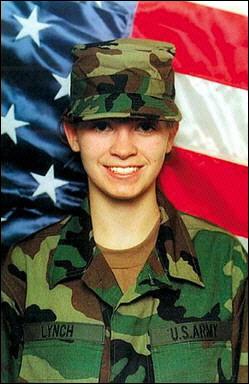
Private Lynch, 2003

But in what has been a remarkable case of deflected attention, the Post’s singular role in the botched hero-warrior tale about Lynch has been obscured in favor of a darker, more sinister narrative that the Pentagon concocted the story and fed it to the American public.

That version — the military made it up — has become the dominant narrative of the Lynch case and is predictably invoked whenever Lynch attracts the news media’s attention, as she did on the Fourth of July.

She was in Idaho then to give a talk at a Presbyterian camp. Her appearance drew local news coverage, including a report published yesterday in the Spokesman-Review newspaper of Spokane.

The Spokesman-Review account blithely repeated the dominant narrative about Lynch’s supposedly heroic deeds, stating without attribution:

“The military initially portrayed Lynch as a hero, saying she fought back until she ran out of ammunition.”

Which just isn’t so.

As Vernon Loeb, one of the Post reporters on the botched Lynch story has made clear, the Pentagon wasn’t the source of the hero-warrior tale.

“Far from promoting stories about Lynch,” Loeb has said, “the military didn’t like the story.”

The dominant narrative is a false narrative.

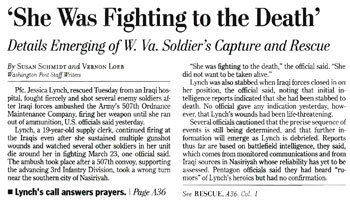
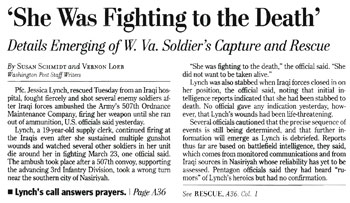
Loeb then was the Post’s defense correspondent. He shared a byline with Susan Schmidt on the sensational story about Lynch, which was published April 3, 2003, on the Post’s front page.

The Schmidt-Loeb report carried the headline:

“‘She was fighting to the death.'”

The story described how Lynch, then 19, supposedly had fought with Rambo-like ferocity in an ambush at Nasiriyah in southern Iraq, “even after she sustained multiple gunshot wounds and watched several other soldiers in her unit die around her.”

Lynch, a supply clerk in the Army’s 507th Maintenance Division, also was stabbed before being overwhelmed, according to the Post.

The newspaper cited otherwise unidentified “U.S. officials” for its sensational story, which was picked up and reported prominently by news organizations around the world.

The hero-warrior tale turned Lynch into the war’s best-known American soldier. But it wasn’t true.

Lynch hadn’t fired a shot in the ambush.

She was badly injured not from gunshots and stabbings, but in a Humvee that crashed fleeing the Iraqi attack.

In the years since, the Post  has not objected as the dominant narrative about the origins of the Lynch story has shifted to the Pentagon. The newspaper has said little, if anything, about the now-routine inclination to blame the military for the bogus tale.

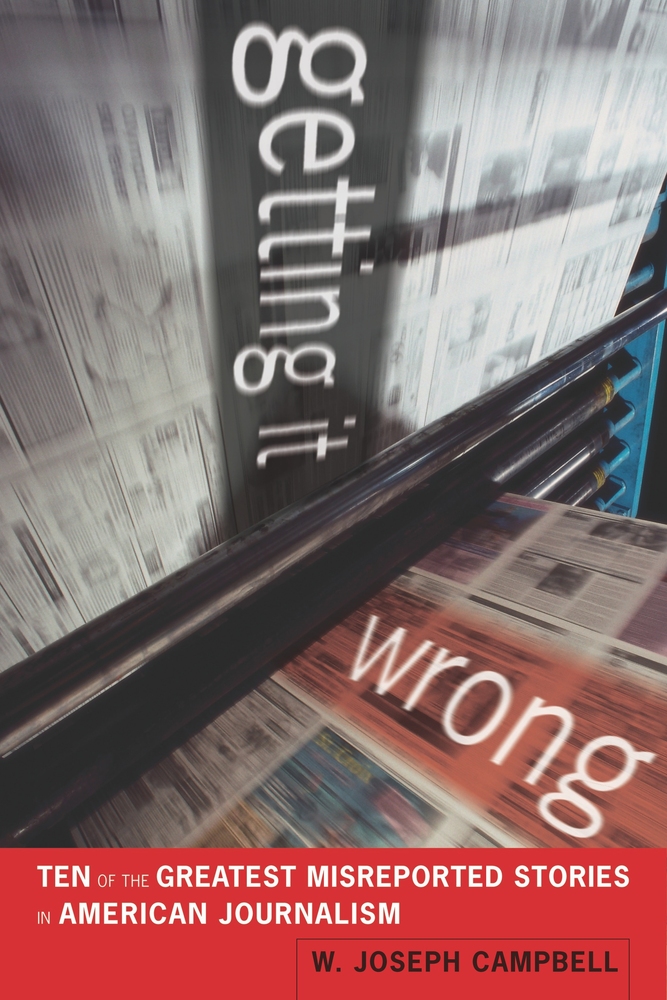
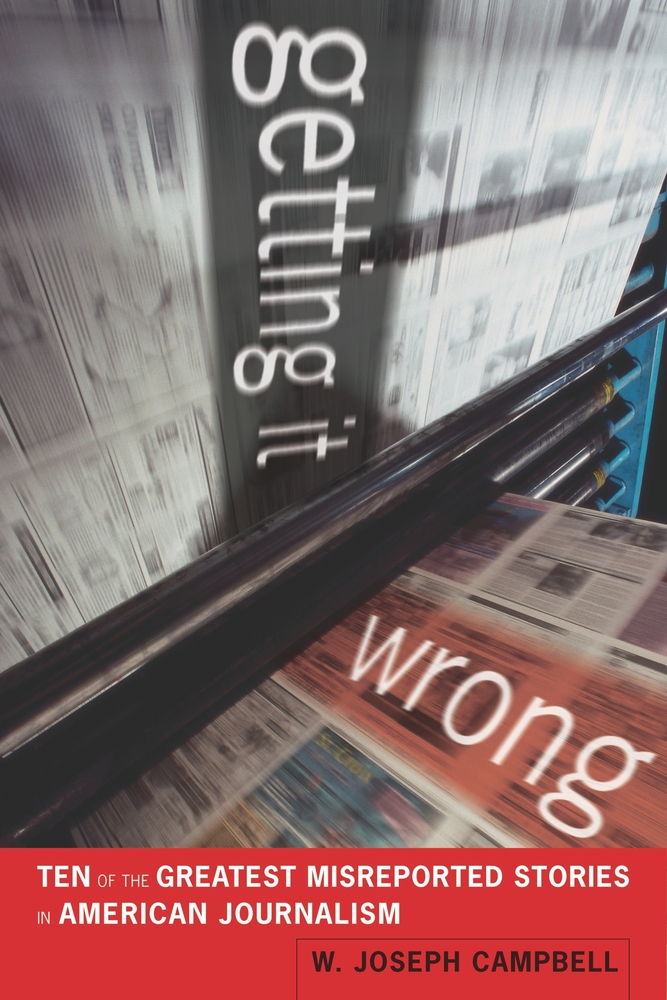
Indeed, the newspaper has “never fully acknowledged or explained its extraordinary error about Jessica Lynch,” as I write in my latest book, Getting It Wrong.

It is certainly time for the Post to identify the “U.S. officials” who led it so badly astray on the Lynch story; doing so would clarify what role, if any, the Pentagon had in the derivation of the bogus tale.

Loeb has effectively absolved the Pentagon in the hero-warrior tale about Lynch, saying in an interview on NPR in December 2003:

“Our sources for that story were not Pentagon sources.

“And, in fact, I could never get anybody from the Pentagon to talk about those reports [about Lynch’s battlefield heroics] at all. I got indications that they had, in fact, received those intelligence reports, but the Pentagon was completely unwilling to comment on those reports at all.

“They wouldn’t say anything about Jessica Lynch.”

WJC

Recent and related:

False narrative accompanies Jessica Lynch to Idaho

In Debunking, Jessica Lynch, Media myths, Washington Post on July 4, 2011 at 7:12 am

Lynch in 2003

The false narrative that the Pentagon cynically concocted the tale of her battlefield derring-do in Iraq has accompanied Jessica Lynch to Idaho, where she is to deliver a speech today on the Fourth of July.

News reports in advance of Lynch’s appearance have said the Pentagon was the source of the erroneous report that she fought fiercely in an ambush in Nasiriyah in March 2003 — an engagement in which 11 American soldiers were killed.

But as I discuss in my media-mythbusting book, Getting It Wrong, the tale of Lynch’s purported heroics was thrust into the public domain not by the Pentagon but solely by the Washington Post.

The Post in a sensational, front-page story published April 3, 2003, said that Lynch, a 19-year-old supply clerk in the Army’s 507th Maintenance Company, had fought fiercely in the attack at Nasiriyah, suffering gunshot and stab wounds while firing round after round into the attacking Iraqis.

The Post’s article, which appeared beneath the bylines of Susan Schmidt and Vernon Loeb, was built almost entirely around anonymous sources identified only as “U.S. officials.”

One of the Schmidt-Loeb sources was quoted as saying of Lynch:

“‘She was fighting to the death. She did not want to be taken alive.'”

The article was thoroughly wrong. Bogus.

Schmidt and Loeb were misled by their sources, who to this day remain unidentified.

Lynch never fired a shot in the fighting in Nasiriyah.

She was neither shot nor stabbed.

According to her own account in a co-authored book, I Am a Soldier, Too, Lynch cowered in the back seat of a Humvee as it sped from the attack, praying, “Oh God help us. Oh God, get us out of here.”

The fleeing Humvee was struck by a rocket-propelled grenade, which sent the vehicle crashing into a disabled tractor-trailer just ahead. Lynch suffered shattering injuries; the four other soldiers in the Humvee were fatally injured.

Lynch was taken to an Iraqi hospital where she lingered near death before a U.S. special forces team rescued her on April 1, 2003.

The Post’s botched story by Schmidt and Loeb appeared two days later, beneath the headline:

“‘She was fighting to the death.'”

Over time, the singular role of the Post in the bogus hero-warrior story about Lynch has faded.

In its place has emerged the false narrative that the Pentagon made up the story to bolster popular support for the war.

But as I note in Getting It Wrong, the Pentagon wasn’t the Post’s source for the bogus hero-warrior tale.

We know that from an interview in December 2003 on NPR’s  Fresh Air show program. On that show, Loeb said he “could never get anybody from the Pentagon to talk about” Lynch’s purported heroics.

“They wouldn’t say anything about Jessica Lynch,” Loeb declared.

“I just didn’t see the Pentagon trying to create a hero where there was none,” he added. “I mean …they never showed any interest in doing that, to me.”

Loeb was unequivocal in saying:

“Our sources for that story were not Pentagon sources.”

Loeb said they were “some really good intelligence sources” in Washington, D.C., and added:

“We wrote a story that turned out to be wrong because intelligence information we were given was wrong. That happens quite often.”

Loeb on another occasion was quoted in the New York Times as saying:

“Far from promoting stories about Lynch, the military didn’t like the story.”

Despite Loeb’s exculpatory comments, the erroneous interpretation that the Pentagon concocted the story about Lynch’s heroics has taken hold and lives on — in part because it corresponds well to a view that the war in Iraq was a thoroughly botched affair.

The erroneous references to the Pentagon in advance stories about Lynch’s Fourth of July talk near Craigmont, Idaho, underscore anew why the Post ought to identify the sources who led it astray on Lynch’s supposed heroics.

By doing so, the Post will help to debunk a malicious false narrative and help set the record straight.

And after all, that’s what journalism is supposed to do.

WJC

Recent and related:

WaPo’s latest ‘missed’ opportunity evokes Jessica Lynch case

In Debunking, Jessica Lynch, Washington Post on June 26, 2011 at 9:11 am

Patrick Pexton has been hesitant and a bit baffling in three-plus months as the Washington Post’s ombudsman.

His choice of topics — he recently discussed the Post’s coverage of women’s sports — suggests he’s no Michael Getler, who set a rather hard-nosed standard in five years as ombudsman, and no Deborah Howell, who poked at the ideological lopsidedness of the Post’s newsroom.

But Pexton gets moderately tough in his column published today, criticizing the Post for fumbling the case of Jose Antonio Vargas, an undocumented immigrant who was a Post reporter for several years and kept his status mostly a secret.

A Post editor, Patrick Perl, knew that Vargas was an undocumented immigrant but kept quiet about it.

Vargas recently submitted to the Post a lengthy, first-person essay about his status and time as a reporter there. For reasons not entirely clear, the newspaper in mid-June abruptly spiked the piece.

So Vargas took his account to the New York Times, which published it in today’s magazine.

In his column about the Vargas case, Pexton asks:

“Why would The Post punt to a rival a riveting, already edited story that could provoke national discussion on immigration — an issue that sorely needs it — and that also included possibly illegal, and perhaps forgivable, conduct by a former Post reporter and current member of management?

“Beats the heck out of many in The Post’s newsroom,” Pexton adds, “and beats the heck out of me.”

He adds that in the Vargas matter, the Post “missed an opportunity to tell a great and compelling story, and to air and take responsibility for some internal dirty laundry. It’s that kind of act that earns you the lasting respect of your readers. It keeps their trust.”

It’s a ringing line with which to close a column.

It’s also an observation that evokes another messy case the Post has never thoroughly addressed: It never has come clean about its bogus hero-warrior story about Jessica Lynch, a story that became an international sensation in the early days of the Iraq War.

Lynch was a shy 19-year-old private, a supply clerk in the Army’s 507th Maintenance Company. Elements of her unit were caught in a deadly ambush in southern Iraq in March 2003.

The Post reported that Lynch fought fiercely in the attack, “even after she sustained multiple gunshot wounds and watched several other soldiers in her unit die around her” before being taken prisoner. She also was stabbed in the attack, the Post reported, but fought the Iraqis until she ran out of ammunition.

The Post quoted an otherwise anonymous “U.S. official” as saying: “She was fighting to the death. She did not want to be taken alive.”

Private Lynch

But in fact Lynch never fired a shot in the ambush.

Lynch was neither shot nor stabbed.

She suffered shattering injuries was badly injured in the crash of a Humvee fleeing the attack.

Lynch was treated at an Iraqi hospital from where she was rescued by a U.S. commando team on April 1, 2003. The Post’s bogus hero-warrior story came out two days later.

In the years since, the newspaper has never fully explained how it got the hero-warrior story so utterly wrong; nor has it dealt adequately with fallout from the Lynch case.

As I note in my media myth-busting book, Getting It Wrong, the Post had the temerity, in a follow-up article published in June 2003, to blame the U.S. military and the administration of President George Bush for failing to correct an error for which the Post, alone, was responsible.

“Neither the Pentagon nor the White House publicly dispelled the more romanticized initial version of her capture,” the Post said in the follow-up article — as if the “romanticized initial version” wasn’t the Post’s, alone.

So why still fuss about the Post and its botched the story about Lynch?

For at least two compelling and somewhat related reasons.

One is the false narrative that has come to define the Lynch case — a narrative that says the Pentagon planted the bogus hero-warrior tale in order to bolster support for the war at home.

That narrative endures even though Vernon Loeb, one of the reporters on the original Lynch story, has said the Pentagon wasn’t the source for the hero-warrior tale.

“I could never get anybody from the Pentagon to talk about those reports [of Lynch’s battlefield derring-do] at all,” Loeb said on an NPR program in late 2003, adding:

“They wouldn’t say anything about Jessica Lynch.”

The other reason it still matters is that a former White House operative named Jim Wilkinson was fingered as the Post’s source in Where Men Win Glory: The Odyssey of Pat Tillman, a book by Jon Krakauer.

In the book, Krakauer referred to Wilkinson as a “master propagandist” and said he “deserves top billing for creating the myth of Jessica Lynch.”

But the book offered no specific source for its claims about Wilkinson, who at the time of Lynch’s capture and rescue was director of strategic communications for General Tommy Franks, then the commander of U.S. forces in Iraq.

I spoke with Wilkinson last year and he disputed Krakauer’s account as “factually incorrect” and insisted that “not one shred of evidence” links him to leaking the erroneous report to the Post.

Wilkinson also said:

“Tommy Franks would have killed me” had he been the Post’s source for the erroneous report about Lynch.

Wilkinson’s denial has a ring of validity, particularly his point about Franks.

The Post could swiftly resolve this lingering messiness by identifying the anonymous sources who led it astray on the Lynch story. The newspaper should feel no obligation to sources who caused it to err so badly.

Identifying those sources would reveal whether indeed the Pentagon planted the hero-warrior tale, and would clarify Wilkinson’s role, if any, in the Lynch case. And it would, as Pexton might say, represent “an opportunity to tell a great and compelling story” that would earn the respect of readers.

WJC

Recent and related:

NYT’s Keller and the dearth of viewpoint diversity in newsrooms

In Debunking, Jessica Lynch, Media myths, New York Times on June 20, 2011 at 4:36 pm

I enjoy Bill Keller‘s column in the New York Times Sunday magazine, not so much for strength of argument and depth of reporting as for its tendency to offer grist to Media Myth Alert.

Keller of the Times

Keller’s assertion a few months ago that the Times corrects errors of fact when it detects them prompted me to point out that the Times hadn’t corrected an erroneous reference in January to the Army-McCarthy hearings.

And I’m still waiting for that correction.

In his most recent column, Keller poked at Sarah Palin, the former Alaska governor who’s flirting with the notion of making a run for president. Ill-fated that would be.

But Keller’s column — especially its opening observation — revealed more about the dearth of intellectual diversity and contrarian thinking in American journalism than it did about the limited appeal of Sarah Palin.

Keller, the Times executive editor, wrote blithely:

“If the 2012 election were held in the newsrooms of America and pitted Sarah Palin against Barack Obama, I doubt Palin would get 10 percent of the vote. However tempting the newsworthy havoc of a Palin presidency, I’m pretty sure most journalists would recoil in horror from the idea.”

Keller’s probably correct.

Ten percent of the U.S. newsroom vote may even be a generous assessment.

But rather than consider the implications of such intellectual lopsidedness, Keller breezily wrote that “watching Palin answer a question is like watching a runaway train struggling to stay on the rails, and fact-checking her is like fishing with dynamite.”

OK, that’s amusing.

But in acknowledging and then sidestepping the larger matter of viewpoint diversity in the newsroom, Keller left a more compelling issue unaddressed.

A broad-based ongoing discussion about the dearth of intellectual diversity in the newsroom — why so few American journalists self-identify as politically conservative — would be beneficial to American journalism.

As I note in my latest book, Getting It Wrong, which came out last year, intellectual diversity and contrarian thinking are objectives that deserve to be vigorously promoted in American newsrooms.

“It is certainly not inconceivable,” I write in Getting It Wrong, “that a robust newsroom culture that embraces viewpoint diversity, encourages skepticism, invites challenges to dominant narratives, and rewards contrarian thinking would have helped thwart publication of embarrassing tales such as the Washington Post’s ‘fighting to the death’ story about Jessica Lynch.”

The Post’s bogus front-page story in 2003 about Lynch’s supposed battlefield heroics in Iraq catapulted her to international fame and celebrity. The newspaper has never fully explained how it botched the Lynch story and has never identified the anonymous sources that led it astray.

To its credit, the Post has raised the issue of limited intellectual diversity in the newsroom.

Notably, Deborah Howell, the newspaper’s former ombudsman, wrote in mid-November 2008 that more “conservatives in newsrooms and rigorous editing would be two” ways to confront what she termed “the perception of bias” in political coverage. (The week before, Howell had reported a “tilt” in the Post’s 2008 campaign coverage, in Obama’s favor.)

In her column about perception bias, Howell wrote:

“I’ll bet that most Post journalists voted for Obama. I did. There are centrists at The Post as well. But the conservatives I know here feel so outnumbered that they don’t even want to be quoted by name in a memo.”

Tellingly, Howell quoted Tom Rosenstiel of the Project for Excellence in Journalism as saying:

“The perception of liberal bias is a problem by itself for the news media. It’s not okay to dismiss it. Conservatives who think the press is deliberately trying to help Democrats are wrong.

“But conservatives are right that journalism has too many liberals and not enough conservatives. It’s inconceivable that that is irrelevant.”

Rosenstiel called for “more intellectual diversity among journalists” and was further quoted by Howell as saying:

“More conservatives in newsrooms will bring about better journalism.”

I wonder what Keller would say to that.

I offer it as grist for one of his columns.

WJC

Many thanks to Instapundit
Glenn Reynolds for linking to this post

Recent and related:

Why they get it wrong

In Bay of Pigs, Cronkite Moment, Debunking, Furnish the war, Jessica Lynch, Media myths, New York Times, Newspapers, Washington Post, Watergate myth on June 3, 2011 at 6:49 am

It’s striking how several well-known journalists and news outlets have indulged over last six months in media-driven myths, those dubious tales about the news media that masquerade as factual.

The lineup of myth-indulgers is impressive and, among others, includes:

  • Bill Keller, executive editor of the New York Times, who rubbed shoulders with the Bay of Pigs suppression myth in a column in the Times in January. The suppression myth holds that at the behest of President John F. Kennedy, the Times killed or emasculated its report about the pending Bay of Pigs invasion in 1961. That tale is unfounded, as I discuss in my latest book, Getting It Wrong.
  • Mother Jones magazine which, in its May/June cover story by Rick Perlstein, offered up a rare two-fer — two media myths discussed in a single article. One of the myths was the hoary and surely apocryphal tale about William Randolph Hearst and his reputed vow to “furnish the war” with Spain. The other was about the so-called the “Cronkite Moment” of 1968, in which Walter Cronkite’s on-air assessment that the U.S. military was “mired in stalemate” in Vietnam was so powerful as to alter U.S. policy.
  • Keith Olbermann, the acerbic cable television commentator who, as he quit his prime-time Countdown show in January, referred to the  “exaggerated rescue” of Army private Jessica Lynch in the early days of the Iraq War. Such claims, raised as long ago as 2003, were unsubstantiated by an inquiry of the Defense Department’s inspector general who found the rescue operation was found to have been “a valid mission” to recover Lynch, a prisoner of war, “under combat conditions.”

What accounts for such lapses by prominent journalists and their outlets? Why do these and other media-driven myths often find their way into news reports and commentaries?

Some media myths are just too good not to be true; they almost are too good to take time to check out. The tale about Hearst’s vowing to “furnish the war” certainly falls into this category. It shouldn’t be at all difficult to locate references to the dubious character of the anecdote, which has been the subject of repeated debunking over the years.

Likewise, it can be far easier to invoke a media myths that to commit to the tedium of research and legwork. Media myths are convenient, readily at hand. Poking into their details takes time, and a willingness to challenge what are accepted as consensus narratives.

As I noted in discussing Keller’s column that invoked the Bay of Pigs suppression myth:

“Had Keller consulted the newspaper’s database of reporting about the run-up to the Bay of Pigs invasion in April 1961, he would have found that the Times reported in detail, if not always accurately, about the preparations to infiltrate a U.S.-trained brigade of Cuban exiles in an attempt to topple Fidel Castro.”

Similarly, some media myths (such as the illusory “Cronkite Moment“) may be too ingrained, too dearly held by journalists, ever to be uprooted or thoroughly repudiated.

Unlearning such tales is no small challenge, after all. The conundrum of unlearning was addressed a few months ago in a Wall Street Journal column, which noted:

“For adults, one of the most important lessons to learn in life is the necessity of unlearning. We all think that we know certain things to be true beyond doubt, but these things often turn out to be false and, until we unlearn them, they get in the way of new understanding.”

Media myths also can be convenient means of scoring political points. The two-fer in Mother Jones magazine, for example, were presented as part of a sneering attack about “fact-free” Republicans.

Moreover, media myths — the most prominent of them, anyway — resonate in contemporary contexts.

History, it has been said, is “what we decide to remember,” and journalism history is not an exception. Recalling and celebrating the memory of Cronkite’s supposedly telling truth to power about Vietnam — or of Bob Woodward and Carl Bernstein’s bringing down a corrupt presidency — is to offer reassurance to contemporary journalists at a time of confusion and upheaval in their field.

Deciding to remember such mythical tales is understandable if not justifiable, given that those tales bring solace and reassurance amid sweeping uncertainty.

WJC

Recent and related:

Recalling how a ‘debunker’s work is never done’

In Bay of Pigs, Bra-burning, Cronkite Moment, Debunking, Furnish the war, Jessica Lynch, Media myths, Murrow-McCarthy myth, New York Times, Reviews, War of the Worlds, Washington Post, Watergate myth, Yellow Journalism on May 20, 2011 at 5:45 am

It’s been a year since Jack Shafer, media critic for slate.com, posted his review of my media-mythbusting book, Getting It Wrong. The review offered the telling observation that a “debunker’s work is never done.”

So true.

In the 52 weeks since the review went online, I’ve posted more than 275 essays at Media Myth Alert, nearly all of them calling attention to media-driven myths that have found their way into traditional or online media.

So, no, a debunker’s work is never done.

The top posts over the past 52 weeks, as measured by page views, were these:

Shafer’s review sent traffic to Media Myth Alert, too, as it linked to my post that critically discussed Evan Thomas’ book, The War Lovers.

The review, which appeared beneath the headline “The Master of Debunk,” noted that “the only way to debunk an enshrined falsehood is with maximum reportorial firepower.”

And repetitive firepower. Debunking media myths will happen no other way.

Even then, some myths are so deeply ingrained — so delicious, beloved, and readily at hand — that they’ll probably never be thoroughly uprooted and forgotten.

The tale about William Randolph Hearst’s vow to “furnish the war” with Spain at the end of the 19th century is an excellent example. It’s been around more than 100 years.

And it surely is apocryphal, for a long list of reasons I discuss in Getting It Wrong.

Even so, “furnish the war” lives on — hardy, robust, and apparently only slightly dented for all the debunking broadsides hurled its way. Evan Thomas turned to it in War Lovers. So, more recently, did the Nieman Watchdog blog.

Another especially hardy media myth is the presumptive “Cronkite Moment” of 1968, when Walter Cronkite’s on-air assessment that the U.S. military was “mired in stalemate” in Vietnam supposedly prompted President Lyndon Johnson to declare:

“If I’ve lost Cronkite, I’ve lost Middle America.”

Or something along those lines. Versions vary markedly.

That they do vary is among the many indicators the “Cronkite Moment” is media myth. Another, more direct indicator is that Johnson did not see the program when it aired.

The “Cronkite Moment” surely will live on, too, as it represents so well the news media conceit of the effects of telling truth to power, of serving as the indispensable watchdog of government.

Shafer noted the durability of media myths in one of his periodic dismantlings of the “pharm party” phenomenon, which in some form has circulated for 40-some years. (The mythical “pharm party” has it that teens swipe pharmaceuticals from medicine cabinets at home, dump the purloined pills into a bowl at a party, and take turns swallowing handfuls to see what sort of high they’ll reach.)

Shafer wrote early last year:

“I regret to inform you that this column has failed to eradicate the ‘pharm party’ meme. Since June 2006, I’ve written five columns … debunking pharm parties, and yet the press keeps on churning out stories that pretend the events are both real and ubiquitous.”

He added:

“Any myth hearty enough to survive and thrive for 40-plus years in the media is probably unkillable.”

The Hearstian vow is easily within the 40-plus-years category. So, too, are the “Cronkite Moment,” the Bay of Pigs suppression myth, and the War of the Worlds panic meme.

Irrepressible myths, all.

WJC

Recent and related:

Lynch heroics not ‘the Pentagon’s story’; it was WaPo’s

In Debunking, Jessica Lynch, Media myths, Washington Post on May 12, 2011 at 9:50 am

Private Lynch: No hero-warrior

The mythical tale that the Pentagon concocted the story about Jessica Lynch’s battlefield heroics early in the Iraq War probably is just too delicious ever to be thoroughly debunked and forgotten.

The tale about the Pentagon’s purported fabrication turned up today in a syndicated column published by the Modesto Bee.

The column deplored the exaggerated early accounts of the slaying of terror mastermind Osama bin Laden. Initial reports offered by the Obama administration inaccurately described bin Laden as having used one of his wives as a shield during the Navy SEALS’ dramatic raid on his lair in Pakistan.

“To their credit,” wrote the columnist, Bob Franken, “Obama administration leaders quickly owned up, which is far better than some of the cover-ups attempted during the Bush years.”

Franken then invoked the Lynch case, writing: “In April 2003, she was captured after being seriously injured in southern Iraq. News media at the time bought the Pentagon’s story that PFC Lynch had been badly wounded and taken prisoner after she had blazed away during a firefight.”

Franken,  formerly a correspondent for CNN, also wrote: “The truth, as she acknowledged after her release, is that her injuries were the result of a Humvee crash that occurred as she and the others in her unit tried to flee.”

For starters, let’s check the date: Lynch was captured March 23, 2003, after Iraqis ambushed elements of Lynch’s unit, the 507th Maintenance Company, in Nasiriyah. She was rescued by a U.S. special forces team April 1, 2003.

More important, though, the Pentagon wasn’t the source for the hero-warrior tale about Jessica Lynch. It wasn’t “the Pentagon’s story.”

The story was thrust into the public domain exclusively by the Washington Post, which reported on April 3, 2003, that Lynch had fought fiercely in the ambush at Nasariyah, ” firing at the Iraqis even after she sustained multiple gunshot wounds and watched several other soldiers in her unit die around her….”

Above this dramatic story, the Post ran the headline: “‘She was fighting to the death.'”

The story was utterly false.

Lynch never fired a shot during the ambush; her weapon jammed.

She was neither shot nor stabbed, although the Post reported she had been so wounded. Lynch suffered shattering injuries in the crash of the Humvee, as Franken’s column mentions.

We know from Vernon Loeb, who shared a byline with Susan Schmidt on the original, inaccurate Lynch story, that the Pentagon wasn’t the source for that report.

As I note in my latest book, Getting It Wrong, Loeb went on NPR’s Fresh Air program in December 2003 and declared, unequivocally:

“Our sources for that story were not Pentagon sources.”

Loeb then was the Post’s defense correspondent, and he and Schmidt reported the Lynch hero-warrior story from Washington, D.C. He also said in the NPR interview that Pentagon officials “wouldn’t say anything about Jessica Lynch.”

He also dismissed the interviewer’s suggestion that the Post’s “fighting to the death” report was the upshot of the Pentagon’s clever and cynical manipulation.

“I just didn’t see the Pentagon trying to create a hero where there was none,” Loeb said. “I mean …they never showed any interest in doing that, to me.”

On another occasion, Loeb was quoted by the New York Times as saying:

“Far from promoting stories about Lynch, the military didn’t like the story.”

Rarely do Loeb’s disclaimers find their way into articles, columns, blog posts, and other media discussions about the Lynch case. It’s far easier — and makes for a far better story — simply to embrace the false narrative about the Pentagon’s duplicity.

The false narrative, after all, conforms tidily and well to the curdled popular view that the Iraq War was a mistake, that it was a conflict waged on dubious grounds.

And yet no one who repeats or promotes the narrative about the Pentagon’s having concocted the story about Lynch ever explains how the Pentagon managed to dupe the Post so thoroughly that it published a bogus story.

I’d love to read a description about how that supposedly was accomplished.

WJC

Recent and related:

‘Getting It Wrong’ wins SPJ award for Research about Journalism

In Bay of Pigs, Bra-burning, Cronkite Moment, Debunking, Furnish the war, Hurricane Katrina, Jessica Lynch, Media myths, Media myths and radio, Murrow-McCarthy myth, New York Times, Spanish-American War, War of the Worlds, Washington Post, Watergate myth, Yellow Journalism on May 10, 2011 at 9:02 am

The Society of Professional Journalists announced today that my media-mythbusting book, Getting It Wrong, is the winner of the 2010 Sigma Delta Chi award for Research about Journalism.

The award will be presented in September at the Excellence in Journalism convention in New Orleans.

Getting It Wrong, which was published last year by the University of California Press, debunks 10 prominent media-driven myths, which are dubious tales about the news media that masquerade as factual.

Here’s a summary of the 10 myths dismantled in Getting It Wrong:

  1. Remington-Hearst: William Randolph Hearst’s famous vow “to furnish the war” with Spain is almost certainly apocryphal.
  2. War of Worlds: The notion that the War of Worlds radio dramatization in 1938 caused nationwide panic and mass hysteria is exaggerated.
  3. Murrow-McCarthy: Edward R. Murrow’s famous See It Now program in March 1954 did not end Senator Joseph McCarthy’s communists-in-government witch-hunt; Murrow in fact was very late to take on McCarthy.
  4. Bay of Pigs: The New York Times did not suppress its reporting in the run-up to the ill-fated Bay of Pigs invasion in April 1961.
  5. Cronkite-Johnson: Walter Cronkite’s special report on Vietnam in February 1968 did not prompt an immediate reassessment or revision of U.S. war policy.
  6. Bra-burning: Humor columnist Art Buchwald helped spread the notion that feminist demonstrators dramatically burned their bras at a Miss America protest in September 1968.
  7. Watergate: The Washington Post’s intrepid reporters, Carl Bernstein and Bob Woodward, did not bring down Richard Nixon’s corrupt presidency. That they did is a trope that knows few bounds.
  8. Crack babies: The much-feared “bio-underclass” of children born to women who smoked crack cocaine during their pregnancies never materialized.
  9. Jessica Lynch: The Washington Post’s erroneous reporting about Jessica Lynch early in the Iraq War gave rise to several myths about her capture and rescue.
  10. Hurricane Katrina: News coverage of Katrina’s aftermath in New Orleans in early September 2005 was marred by wild exaggerations about extreme, Mad Max-like violence.

The “Research about Journalism” award recognizes “an investigative study about some aspect of journalism,” SPJ says, and “must be based on original research; either published or unpublished, and must have been completed during the 2010 calendar year. … Judges will consider value to the profession, significance of the subject matter, thoroughness of the research, and soundness of the conclusion.”

WJC

Recent and related:

False narrative about Jessica Lynch and Pentagon surfaces anew

In Debunking, Jessica Lynch, Media myths, Washington Post on May 6, 2011 at 7:11 am

As the Obama Administration has made a hash of how terror leader Osama bin Laden was taken down, news outlets have blithely and misleadingly invoked false narrative about Jessica Lynch as a point of comparison.

Origin of the hero-warrior tale

The false narrative has it that the Pentagon concocted a tale about Lynch’s battlefield heroics in Iraq in 2003, fed it somehow to the Washington Post which spread the electrifying but bogus story around the world (see left).

In reality, the Pentagon treated the Lynch hero-warrior tale as if it were radioactive. The Post’s sensational story about Lynch, which was published April 3, 2003, indicated as much, referring to “Pentagon officials” as saying “they had heard ‘rumors’ of Lynch’s heroics but had had no confirmation.”

One of the Post reporters whose byline appeared on that story has stated unequivocally the Pentagon was not the newspaper’s source for the account of Lynch’s supposed derring-do.

“Our sources for that story were not Pentagon sources,” the reporter, Vernon Loeb, said in an interview on National Public Radio in late 2003.

Loeb, who then was the Post’s defense correspondent and now is the newspaper’s top editor for local news, also said in the NPR interview:

“I just didn’t see the Pentagon trying to create a hero where there was none. I mean …they never showed any interest in doing that, to me.”

Despite Loeb’s exculpatory statements, the false narrative that the Pentagon concocted the story about Lynch lives on — and has been repeated this week by the likes of filmmaker Michael Moore.

“The government, especially the Pentagon,” Moore has been quoted as saying, “has a poor track record of telling the truth, starting with Jessica Lynch.”

Moore has been on Twitter this week, making similarly unsubstantiated claims about the Pentagon.

The Guardian in  London also has offered unsupported claims about the Pentagon’s role in the Lynch hero-warrior tale.

The newspaper yesterday noted that “the White House has been busy messing up the aftermath [of bin Laden’s killing] with a display of PR ineptness that is remarkable.”

Notable among the administration’s flubs and mixed messages about bin Laden was the account, since repudiated, that the mastermind of the terrorist attacks of September 11, 2001, hid behind one of his wives before he was fatally shot by the U.S. commando team.

The Guardian article also declared:

“Whether it’s Islamists hoping Bin Laden is not dead or conservatives wondering if the facts are being manipulated in the way Pentagon officials did over Private Jessica Lynch during the Iraq war, this is precisely the opposite of what the Oval Office wanted.”

The Associated Press wire service has turned to the false narrative as well, asserting in a dispatch yesterday: “Initial military accounts of Jessica Lynch’s resistance to her captors were part of an effort to rally public support for the war, and were factually wrong.”

As I note in Getting It Wrong, making up the hero-warrior story to boost support for the conflict would have been nonsense: At the time, Americans in overwhelming numbers said they backed the war in Iraq.

It’s quite remarkable indeed how the singular role of the Post in reporting and spreading the bogus story about Lynch has receded so thoroughly in favor of the false narrative that blames the Pentagon for having made it all up.

Timothy Egan, writing at the New York Times’ “Opinionator” blog, revisited the Lynch case yesterday without once mentioning the Washington Post.

The Pentagon, after all, is a convenient foil and as I note in my latest book, Getting It Wrong, the bogus tale about Lynch corresponds well to the curdled popular view about the war in Iraq.

The Post, moreover, has never adequately explained how it got the Lynch story so thoroughly wrong.

Sgt. Walters

Nor has the Post ever had much to say about the American soldier who probably did perform the heroics that were misattributed to Lynch. His name was Donald Walters, a cook-sergeant in Lynch’s unit, which came under attack in Nasiriyah, in southern Iraq, on March 23, 2003.

Walters put down covering fire that allowed his comrades to attempt to flee.

Walters is believed to have fought until he was out of ammunition. He was overwhelmed, taken prisoner, and executed soon afterward.

A measure of the Post’s indifference about Walters can be found in searching a database of articles that the newspaper has published since 2003.  In that time, the Post has carried just two articles that even mention Donald Walters.

WJC

Recent and related:

False parallels: bin Laden slaying and bogus tale about Jessica Lynch

In Debunking, Jessica Lynch, Media myths, Washington Post on May 5, 2011 at 8:00 am

Lynch: No hero-warrior

The discrepancies and shifting details about the takedown of terror mastermind Osama bin Laden have reminded some commentators of the case of Jessica Lynch and the bogus tale of her battlefield heroics in the Iraq War.

Among those invoking such parallels was Ben Smith who, at a Politico blog the other day, examined the erroneous report that bin Laden used his wife as a human shield before being fatally shot during the U.S. commando raid on his lair in Pakistan.

“Every American war has been defined, in no small part, by mythmaking,” Smith wrote. “It was at its most egregious in the cases of Jessica Lynch and Pat Tillman, when the military establishment seemed, more or less, to have fed the press lies.”

The Guardian newspaper in London also brought up the Lynch case, in an article posted yesterday that carried the headline, “US military’s history of backtracking on initial reports.”

The Guardian said of Lynch: “Despite being badly wounded when her company came under attack near the town of Nasiriyah in March [2003], the soldier kept her finger on the trigger of her gun until her ammunition ran out. … The only problem with the official account is that it was untrue.”

But parallels between the Lynch and bin Laden cases are inexact and misleading. The heroics attributed to Jessica Lynch weren’t “lies” spread by the U.S. military; the account of her battlefield derring-do was no “official account,” either.

Far from it.

As I discuss in my media-mythbusting book, Getting It Wrong, the tale about Lynch was thrust into the public domain prominently and exclusively by the Washington Post.

The Post published an electrifying story on April 3, 2003, that declared that Lynch had been “‘fighting to the death'” when she was overpowered by Iraqi attackers  and taken prisoner.

The Post reported that Lynch, a supply clerk in the 507th Maintenance Unit, “continued firing at the Iraqis even after she sustained multiple gunshot wounds and watched several other soldiers in her unit die around her in fighting” at Nasiriyah.

The newspaper also said Lynch was “stabbed when Iraqi forces closed in on her position.”

But the Post’s dramatic hero-warrior tale was utterly wrong: Lynch never fired a shot in the fighting at Nasiriyah: Her rifle jammed.

She was neither shot nor stabbed; she suffered severe injuries in the crash of her Humvee as it sped away from the ambush.

As for sources, the Post vaguely cited “U.S. officials” who otherwise went unidentified. (And as I’ve said at Media Myth Alert, the Post has an obligation to the public to set the record straight by disclosing the identity of those sources.)

We do know that the Post’s sources were not Pentagon officials.

We know this from Vernon Loeb, one of the Post reporters who shared a byline on the “‘fighting to the death'” tale about Lynch.

As I discuss in Getting It Wrong, Loeb went on National Public Radio’s Fresh Air program in December 2003 and made clear that the Post’s sources weren’t Pentagon officials.

Loeb said: “They wouldn’t say anything about Jessica Lynch.”

He dismissed the interviewer’s suggestion that the Post’s “fighting to the death” report was the Pentagon’s result of clever and cynical manipulation.

“I just didn’t see the Pentagon trying to create a hero where there was none,” Loeb said. “I mean …they never showed any interest in doing that, to me.”

He also said: “Our sources for that story were not Pentagon sources.”

Moreover, the then Defense Department spokeswoman, Victoria Clarke, was quoted by the Associated Press news agency as saying in June 2003: “We were downplaying [the Lynch hero-warrior story]. We weren’t hyping it.”

The exaggerated tale about Lynch wasn’t a story that the Pentagon concocted, pushed, or embraced. It wasn’t an “official account” by any means.

It was solely the product of the Post’s over-eager journalism, an episode in flawed reporting for which the newspaper has never fully accounted.

Indeed, the Post has tried to dodge responsibility for its erroneous tale about Lynch.

In a follow-up story about Lynch published in June 2003, the Post had the temerity to fault the U.S. military and the administration of President George Bush for failing to correct the error for which the Post was responsible.

“Neither the Pentagon nor the White House publicly dispelled the more romanticized initial version of her capture,” the Post said, “helping to foster the myth surrounding Lynch and fuel accusations that the Bush administration stage-managed parts of Lynch’s story.”

It was, I write in Getting It Wrong, “an astounding assertion: The Post, alone, was responsible for propagating the ‘romanticized initial version’ that created the hero-warrior myth. To claim the Pentagon and the White House should have done more to dispel that report was, in short, exceedingly brazen.”

In his 2005 book, Misunderstimated, Bill Sammon, now a Fox News executive in Washington, D.C., said the Post’s attempt at blame-shifting represented “a new low, even for the shameless American press.”

He added:

“One of the most influential newspapers in the nation was now holding the Bush Administration responsible for correcting the paper’s own gross journalistic misdeeds. Instead of just coming clean and admitting its initial story was utterly bogus, the Post called it ‘romanticized,’ as if someone other than its own reporters had done the romanticizing.”

Appalling.

WJC

Recent and related: