W. Joseph Campbell

Posts Tagged ‘Jessica Lynch’

Thoughts on why journalists can get it badly wrong

In Debunking, Hurricane Katrina, Jessica Lynch, Media myths, Washington Post on November 27, 2010 at 6:34 am

I mentioned in a blog post yesterday the Time magazine essay about journalists getting it wrong.

It’s a fine and thoughtful discussion, written by Kathryn Schulz, who maintains: “Reporters make serious mistakes routinely, and we do so not because we are immoral, but because of the nature of journalism, and of the human mind.”
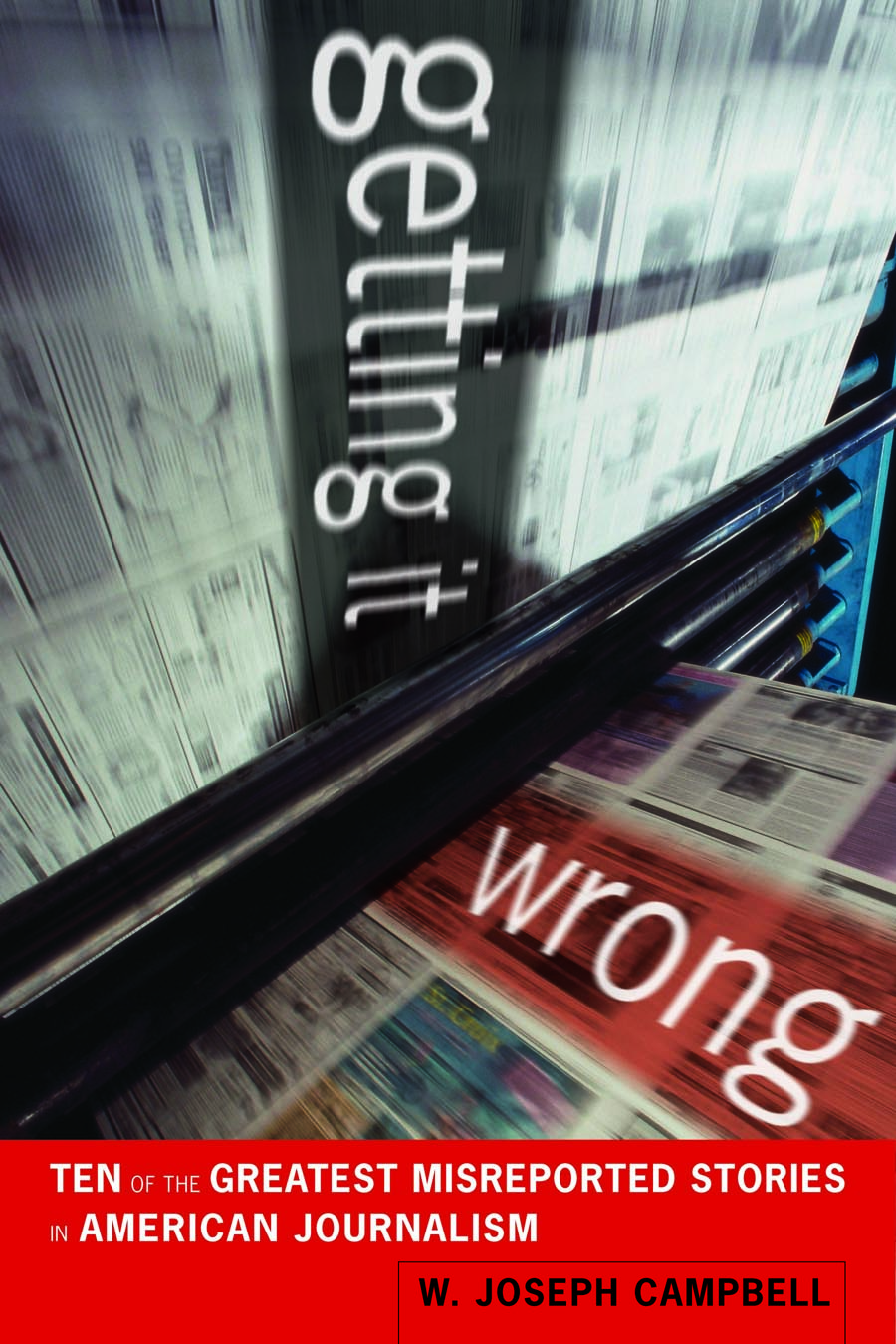
Schulz, author of Being Wrong: Adventures in the Margin of Error, refers in the essay to what she says are “two rich sources of error”–the echo-chamber effect and “the double whammy of journalism’s shrinking profit margin and growing news hole.”

As an example of the first, she describes what in effect is the phenomenon of inter-media agenda-setting, which I discuss in my latest book, Getting It Wrong.

Inter-media agenda-setting typically occurs when large news organizations with resources to cover events far from home effectively set the news agenda for smaller outlets. “Journalists,” Schulz writes in the Time essay, “…often just replicate one another’s conclusions.

“That goes some way toward explaining how the massive myth of Pfc. Jessica Lynch’s Iraq heroics grew out of a single inaccurate story in the Washington Post.”

It’s refreshing to see such an acknowledgement.

As I’ve periodically noted at Media Myth Alert, the singular role of the Washington Post in propelling Lynch into unimagined and undeserved fame has receded in favor of the false narrative that accuses the Pentagon of having concocted the hero-warrior story about Lynch in Iraq to bolster Americans’ support for the war.

As I discuss in Getting It Wrong, the Pentagon wasn’t the source for the botched report in the Post about Lynch’s supposed heroics. The U.S. military was loath to discuss Lynch’s reputed derring-do. And yet, the false story line has since become entrenched as the dominant narrative about the Lynch case.

In writing about “the double whammy of journalism’s shrinking profit margin and growing news hole,” Schulz points out that thorough investigations cost news organizations a lot in time and money, but that reporters these days “increasingly resemble doctors in an understaffed emergency room, working under immense time pressure with inadequate resources.

“Those conditions,” she adds, “are not exactly conducive to the stodgy, time-consuming business of accuracy: verifying quotes, contacting additional sources, fact-checking claims.”

I’m not so sure about that: Why wouldn’t the reality of time pressures make fact-checking even more imperative in newsrooms? Blaming times pressures of course doesn’t exonerate journalists or excuse them from their errors.

The observation is reminiscent of excuses offered for the highly exaggerated, over-the-top reporting about mayhem and violence in New Orleans in the aftermath of Hurricane Katrina in 2005. Telecommunication networks were down. Telephone service was out. Cell phones didn’t function. Electricity was scarce.

But as I write in Getting It Wrong, those conditions do not let journalists off the hook for the inaccurate reporting about the horrific violence supposedly unleashed by the hurricane.

“It would not have been unreasonable for the collapse of communication networks to have given reporters pause, leaving them more cautious and more wary about what they heard and reported, and thus less likely to traffic in wild and dubious claims” of apocalyptic violence in Katrina’s immediate aftermath, I point out in the book.

Schulz mentions the flawed reporting of the hurricane, referring in her essay to “the quasi-hysterical coverage of Katrina: the uncritical regurgitation by reporters of claims of mass murder, children being raped, gang wars in the Superdome.”

And she notes the Katrina-related research I discuss in Getting It Wrong, writing:

“Those claims proved hyperbolic to the point of sheer invention: according to journalist W. Joseph Campbell in Getting It Wrong, only six people died in the Superdome (four of natural causes, one of a drug overdose, one an apparent suicide), and not a single claim of sexual assault was ever substantiated.”

Indeed.

To Schulz’s short list of the causes of major error in journalism, I would add, at a minimum, the fog of war.

I note in Getting It Wrong that it’s scarcely surprising that war and conflict can be breeding grounds for media-driven myth. After all, I write, “The stakes in war are quite high, and the shock of combat is alien and unfamiliar to most people.

“Given their limited first-hand experience with war, media audiences usually find themselves in no position to challenge reports from the battlefield. The confusion and intensity inherent in warfare can lead journalists to place fragmented information that emerges from conflict into recognizable if sometimes misleading frames.”

The Lynch case is one of a number of war-related myths addressed and debunked in Getting It Wrong.

WJC

Recent and related:

Jessica Lynch one of ‘Time’ magazine’s ‘faces of decade’

In Debunking, Jessica Lynch, Media myths, Washington Post on November 26, 2010 at 6:42 am

I’ve expressed astonishment at Media Myth Alert from time to time about how the national spotlight still finds Jessica Lynch, who became the most familiar face of the early Iraq War because of a botched, front page story in the Washington Post about her supposed battlefield heroics.

Lynch, before the war

That was a sensational account, picked up by news organizations across the country and around the world. The Times of London, for example, declared that “one thing is certain”–Lynch “has won a place in history as a gritty, all-American hero.”

But the Post story  was utterly in error: Lynch, then a 19-year-old Army private, never fired a shot in Iraq. She was neither shot nor stabbed, as the Post reported, but suffered shattering injuries in the crash of a Humvee as it tried to escape an Iraqi ambush in Nasiriyah on March 23, 2003.

She was no battlefield hero.

Over time, however, the singular role of the Washington Post in propelling Lynch into unmerited fame has receded in favor of a false narrative that says the Pentagon concocted the hero-warrior story about Lynch to bolster Americans’ support for the war.

Time magazine repeated the false narrative  the other day in a writeup about Lynch, whom it calls one of the “faces of the decade”–a handful of men and women the magazine says “became famous overnight not for glamour or riches or simply being famous but for the explosive public issues they represented.”

Time says flatly that Lynch “was a victim of the propaganda machine at the Pentagon, which exaggerated her heroics.”

Whether Lynch merits inclusion in the “faces of the debate” is highly debatable. What’s not debatable is the magazine’s inaccurate characterization of Lynch’s improbable emergence to unsought fame.

As I discuss in my latest book, Getting It Wrong, the Pentagon was not the source for the botched report in the Post about Lynch’s supposed heroics in Iraq. The U.S. military was loath to discuss the sketchy reports from the battlefield that told of her heroic deeds.

I note in Getting It Wrong that Vernon Loeb, then the defense writer for the Post, went on an NPR program in late 2003 to say that he “could never get anybody from the Pentagon to talk about” the Lynch case.

“They wouldn’t say anything about Jessica Lynch,” Loeb said in an interview on the Fresh Air show.

“I just didn’t see the Pentagon trying to create a hero where there was none,” Loeb added. “I mean …they never showed any interest in doing that, to me.”

Loeb declared: “Our sources for that story were not Pentagon sources.”

Not surprisingly, the Time writeup doesn’t say how the Pentagon (if it had been the source) so thoroughly duped the Post into publishing the bogus report: No one pushing the false narrative about the Pentagon’s having ginned up the Lynch story addresses that critical element.

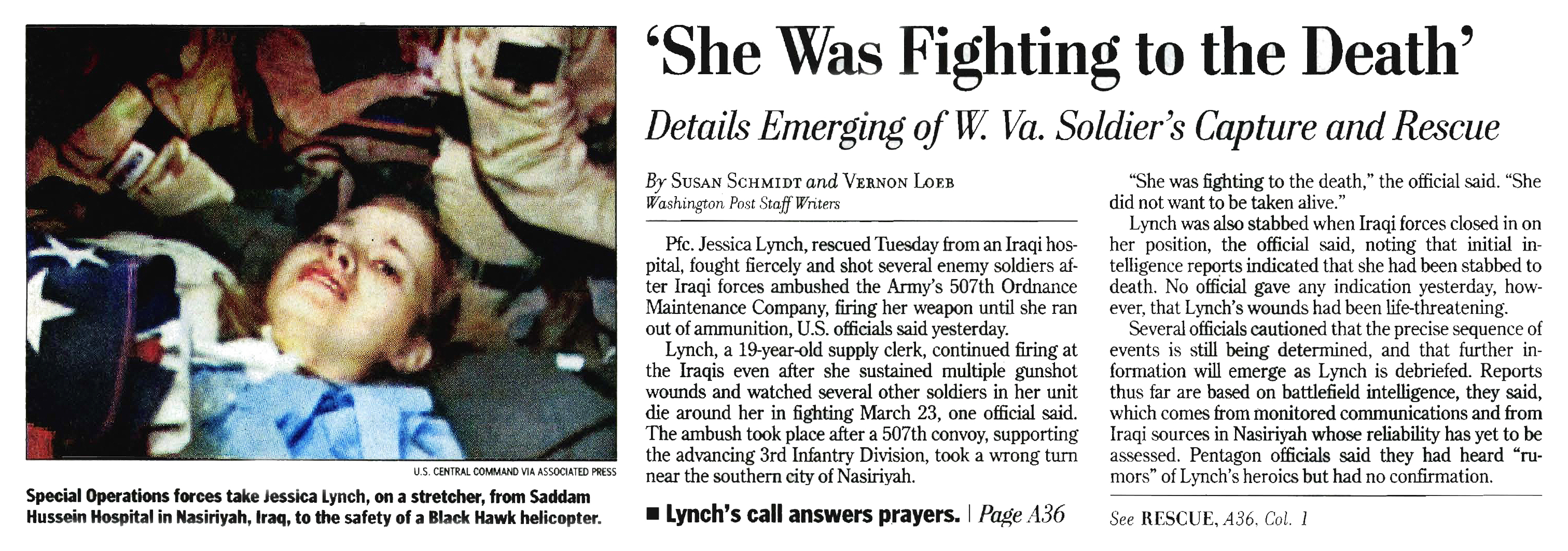
The Post–to its discredit–has never disclosed the source of its botched story, which appeared April 3, 2003, beneath the headline:

“‘She was fighting to the death.'”

The botched story

Lynch told Time that she doesn’t know how the phony report about her battlefield derring-do took hold. In excerpts of an interview posted at the Time online site, Lynch says:

“Honestly, I have no idea where the stories were created.”

The interview excerpts make no reference to the Post or its erroneous report. (Interestingly, a separate article in Time that ruminates about errors by journalists does mention the Post, saying: “Lynch’s Iraq heroics grew out of a single inaccurate story in the Washington Post.”)

Like many media-driven myths, though, the notion that the Pentagon pushed the phony hero-warrior story is just too good, too delicious, to be disbelieved.

And so it lives on, a blight on the historical record.

WJC

Recent and related:

Lynch says she could’ve embraced Post’s phony hero story

In Debunking, Jessica Lynch, Media myths, Washington Post on November 15, 2010 at 6:55 am

Jessica Lynch was back on the air the other day, doing a television interview that brought more muddle than clarity to the erroneous reporting about her battlefield heroics early in the Iraq War.

Lynch said on CNN’s HLN show that she could have embraced the storyline that said she fought like a female Rambo–and no one would have been the wiser if she had. No one “would have known,” she asserted.

The notion Lynch was a wartime hero, that she had fought like Rambo, was thrust into the public domain by the Washington Post in a botched, front-page story published April 3, 2003. The Post described how Lynch supposedly was fighting to the death in the ambush of her unit in Nasiriyah, Iraq.

The Post also said in its sensational yet thinly sourced  report that Lynch had been shot and stabbed before being overwhelmed and taken prisoner.

The Post published the article beneath the headline: “‘She was fighting to the death.’”

But as I discuss in my latest book, Getting It Wrong, none of that was true: Lynch had not fired a shot in the ambush; her weapon had jammed. She was neither shot nor stabbed.

She did suffer shattering injuries in the crash of a Humvee as it tried to flee the ambush. But Lynch was no battlefield hero.

She was taken prisoner and kept in an Iraqi hospital where she lingered near death until a U.S. special forces team rescued her on April 1, 2003.

On HLN, Lynch said she agreed with interviewer Joy Behar’s suggestion that she could have claimed the hero’s mantle.

“Absolutely,” Lynch said, “because nobody would have known. I mean, everyone in my vehicle was killed that day. So I was the only survivor out of the five of us.

“I mean, so it would have been very easy to take credit for everything.”

However, as I’ve noted previously, embracing the false hero-warrior storyline would have been untenable for Lynch.

The colonel commanding the Army hospital at Landstuhl, Germany, where Lynch was treated after her rescue, told journalists the day after the Post published its hero-warrior story that Lynch had been neither shot nor stabbed.

He thus undercut a crucial element of the hero-warrior tale–that Lynch had been shot and stabbed, but had kept fighting. That central component of the narrative was quickly exposed as untrue.

Moreover, it became apparent in the weeks after the Post‘s story that there had been a real hero at Nasiriyah, that the battlefield derring-do initially attributed to Lynch probably were the deeds of Sergeant Donald Walters, a cook in Lynch’s unit.

Walters either was left behind or stayed behind during the confusion of the ambush. He laid down covering fire as he fellow soldiers sought to escape.

After running out of ammunition, Walters was captured by Iraqi irregulars, and executed. His body when exhumed bore stab and gunshot wounds.

It’s curious–indeed, in my view inexcusable–that Lynch almost never refers to Walters. She didn’t mention his name in the interview with HLN.

It’s curious, too, that interviews with Lynch never bring up the Washington Post and its singular role in propelling the Lynch case into the public domain. HLN’s Behar certainly didn’t mention the Post and its phony hero-warrior story.

WJC

Recent and related:

SRO for ‘Getting It Wrong’ talk at UMd

In Anniversaries, Cronkite Moment, Debunking, Furnish the war, Jessica Lynch, Media myths, Media myths and radio, War of the Worlds, Washington Post, Watergate myth on November 5, 2010 at 11:50 am

A terrific audience of journalism students and faculty turned out last night for my talk at the University of Maryland’s Merrill College of Journalism.

It was standing-room-only at the Knight Hall conference room, where I discussed several chapters in my latest book, Getting It Wrong, which debunks 10 prominent media-driven myths.

I walked through the heroic-journalist myth of the Watergate scandal that toppled Richard Nixon’s presidency; the mythical  “Cronkite Moment” of 1968 that reputedly shifted U.S. public opinion about the war in Vietnam, and The War of the Worlds radio dramatization of 1938 that supposedly panicked listeners across the United States.

During the Q-and-A period that followed, I touched on the famous vow to “furnish the war” attributed to William Randolph Hearst and on the erroneously reported battlefield heroics of Private Jessica Lynch early in the Iraq War.

An intriguing question from the audience was what message should students take away from a book that identifies as media-driven myths some of the best-known stories in American journalism. The implication was that mythbusting may undercut the regard would-be journalists have for the profession.

I replied by saying that I  don’t consider Getting It Wrong a media-bashing book: Such books are many on the market as it is.

Rather, I said, the mythbusting in Getting It Wrong is aligned with the fundamental objective of American journalism. And that is to get it right, to offer an account that is as accurate as possible.

And it does journalism little good to indulge in tales such as the heroic-journalist myth of Watergate or the mythical “Cronkite Moment” that offer misleading interpretations about the news media and their power.

Debunking media myths, as I write in Getting It Wrong, “can help to place media influence in more coherent context.”

Nor should we worry about students being disappointed that well-known and even cherished stories about American journalism have been exposed as mythical. It shouldn’t be disheartening to learn the news media aren’t necessarily the powerful forces they are often believed to be.

Students can handle it.

Not only that, but mythbusting can offer them useful lessons in the importance of applying skepticism and a critical eye to dominant narratives and received wisdom of American journalism.

Indeed, Professor John Kirch, host and organizer of my talk at Maryland, does just that in presenting these and other tales in his journalism classes. Doing so can become a revealing exercise in critical thinking.

I also was asked about candidate-myths for a prospective sequel to Getting It Wrong.

A strong candidate for such a book, I said, is the myth of viewer-listener disagreement in the first Kennedy-Nixon debate in 1960.

The myth has it that people who watched the debate on television thought that Senator John F. Kennedy won; those who listened on radio thought Vice President Richard Nixon had the better of the exchanges.

The notion of listener-viewer-disagreement was long ago debunked by David L. Vancil and Sue D. Pendell, in an article in Central States Speech Journal. They noted that reports of viewer-listener disagreement typically were anecdotal and the few surveys that hinted at a viewer-listener disconnect were too small and unrepresentative from which to make confident judgments.

But the myth is a hardy one, I noted, and it resurfaced in late September, at the 50th anniversary of the Kennedy-Nixon encounter.

Among the 80 or so people in attendance last night was Jamie McIntyre, former Pentagon correspondent for CNN. Afterward, we compared notes about the misreported Lynch case, which the Washington Post propelled into the public domain with a botched, front-page story in early April 2003.

Recent and related:

WaPo’s belated and puzzling Lynch correction

In Debunking, Jessica Lynch, Media myths, Newspapers, Washington Post on October 20, 2010 at 7:54 am

Private Lynch

Nearly seven weeks after I brought up the matter in a post at Media Myth Alert, the Washington Post yesterday published this odd correction about its misleading characterization of the Jessica Lynch case:

“A Sept. 3 Style review of the documentary ‘The Tillman Story,’ which included a reference to the 2003 rescue in Iraq of Pfc. Jessica Lynch, should not have attributed to the Pentagon the early reports of Lynch’s supposed actions before her capture. Sources of those accounts, which appeared in The Washington Post, were never named.”

The correction is confusing, and awkwardly worded (“should not have attributed to the Pentagon the early reports of Lynch’s supposed actions before her capture” is absolutely headache-inducing).

The correction is puzzling, too, in that is so belated. (Supposedly, it’s policy at the Post to correct errors promptly. “But too often,” the newspaper’s ombudsman noted late last year, “reporters and editors move at a snail’s pace to correct errors.”)

The Lynch correction also is puzzling in what it’s supposed to tell the reader. Just what are readers to take away from reading such a flabby statement is not at all clear.

In publishing the correction, the Post was addressing this passage in its review of the Tillman film:

“In a surreal coincidence [Pat] Tillman’s first Army tour was in Iraq, where he helped provide perimeter support for the stage-managed rescue of Pfc. Jessica Lynch. Lynch later debunked the Pentagon’s account of her own actions before being captured by Iraqi forces, accusing the military of using her in their propaganda efforts.” (Emphasis added.)

What the correction should have made clear was that the review erred in calling Lynch’s rescue “stage-managed” and in blaming the Pentagon for a botched story that the Post–alone–thrust into the public domain.

It did so on its front page of April 3, 2003, in an electrifying account that quoted “U.S. officials” as saying Lynch had been shot and stabbed but nonetheless “was fighting to the death” until she was subdued and taken prisoner during an ambush in Nasiriyah, in southern Iraq.

The hero-warrior tale was sensational and, as I note in my new book, Getting It Wrong, was picked up by news organizations around the world. The Times of London, for example, declared that “one thing is certain”–Lynch “has won a place in history as a gritty, all-American hero.”

Lynch, as it turned out, was no hero. She was a 19-year-old supply clerk with the 507th Maintenance Company, elements of which were ambushed on March 23, 2003, a few days after the war began.

As the Post only belatedly reported–in a rollback in June 2003 that one media critic called “the journalistic equivalent of Napoleon’s retreat from Moscow”–Lynch never fired a shot during the ambush. Her gun had jammed, she later said. She was neither shot nor stabbed; she suffered shattering injuries in the crash of a Humvee as it tried to flee the attack.

Lynch was knocked out in the crash, and lingered near death in an Iraqi hospital until she was rescued April 1, 2003, by a U.S. special forces team. The bogus “fighting to the death” report appeared in the Post two days later.

As I point out in Getting It Wrong, which debunks 10 prominent media-driven myths, one of the reporters who wrote the “fighting to the death” story “made clear in late 2003 that the Post‘s sources were not Pentagon officials.”

The reporter, Vernon Loeb, said on National Public Radio’s Fresh Air interview program:

“Our sources for that story were not Pentagon sources.

“And, in fact, I could never get anybody from the Pentagon to talk about those reports [about Lynch’s battlefield heroics] at all. I got indications that they had, in fact, received those intelligence reports, but the Pentagon was completely unwilling to comment on those reports at all. They wouldn’t say anything about Jessica Lynch.”

Loeb said in the interview that the Post had been “told by some really good intelligence sources here in Washington that, you know, there were indications that she had, you know, fired back and resisted her capture and actually been shot and possibly stabbed doing so.”

Loeb dismissed at the interviewer’s suggestion that the “fighting to the death” report was the upshot of clever manipulation by the Pentagon.

“I just didn’t see the Pentagon trying to create a hero where there was none,” Loeb said. “I mean …they never showed any interest in doing that, to me.”

More than seven years on, it’s time for the Post to resolve this lingering mess; it’s time to identify just who were its sources, who were the “U.S. officials” to whom it referred in reporting the botched hero-warrior tale about Jessica Lynch.

There’s no good reason to continue to guard the anonymity of sources who misled the newspaper, its readers, and media audiences around the world.

Anonymity ought not to be a cloak when error and deception persist. Identifying those sources, whoever they were, can help correct the erroneous dominant narrative that the Pentagon concocted the tale.

It’s time  for the Post to say who they were.

WJC

Recent and related:

Ignoring WaPo role in pushing Lynch hero-warrior tale

In Debunking, Jessica Lynch, Media myths, Washington Post on October 13, 2010 at 8:12 am

It’s more than a mildly astonishing how the Washington Post‘s singular role in propelling the erroneous hero-warrior tale about Private Jessica Lynch is rarely noted when the case is recalled these days.

The dominant narrative about the Lynch case–one of 10  media-driven myths I examine in my new book, Getting It Wrong–has shifted decidedly away from the Post to focus on the Pentagon‘s purported role in concocting the story about Lynch’s battlefield heroics in Iraq.

London’s Daily Telegraph was the latest to buy into that misleading narrative, stating in an article posted online yesterday:

“The Pentagon was … accused of exaggerating the heroism of Private Jessica Lynch, who was rescued from an Iraqi prisoner of war hospital in 2003 after being captured and injured in an ambush.

“Government sources claimed she had tried to fight off her captors, but she later said her gun had jammed before she could fire a shot.”

It’s scarcely surprising that the Telegraph account makes no mention of the Post and its sensational, front-page report of April 3, 2003–the report that thrust Lynch into unwitting and undeserved international fame.

Lynch then was a 19-year-old Army private, a supply clerk with the 507th Maintenance Company. Elements of her unit were ambushed in Nasiriyah, in southern Iraq, on March 23, 2003, a few days into the war.

The Post‘s article of April 3 appeared beneath the headline: “‘She was fighting to the death.’” And it described how Lynch had fought fiercely in an ambush in southern Iraq in the early days of the Iraq War, that she had been shot and stabbed before taken prisoner.

But the story wasn’t true.

Lynch never fired her weapon in Iraq. Her gun jammed during the ambush, she later said. She was neither shot nor stabbed; she suffered serious injuries in the crash of a Humvee as it tried to flee. And she was sexually assaulted after the ambush.

Lynch lingered near death at a hospital in Nasiriyah before a U.S. special forces team rescued her, on April 1, 2003, two days before the Post‘s botched hero-warrior tale was published–and was promptly picked up by news organizations around the world.

The Post account vaguely cited “U.S. officials” as sources for the tale about Lynch’s derring-do.

But who those sources were has never been revealed.

As I mention in Getting It Wrong, Vernon Loeb, who shared a byline on the “fighting to the death” report about Lynch, made clear the Pentagon was not the source.

Speaking in what I called “a little-noted interview” on National Public Radio’s Fresh Air interview program in late 2003, Loeb said flatly :

“Our sources for that story were not Pentagon sources.

“And, in fact, I could never get anybody from the Pentagon to talk about those reports [about Lynch’s battlefield heroics] at all. I got indications that they had, in fact, received those intelligence reports, but the Pentagon was completely unwilling to comment on those reports at all. They wouldn’t say anything about Jessica Lynch.”

Loeb said in the interview that the Post had been “told by some really good intelligence sources here in Washington that, you know, there were indications that she had, you know, fired back and resisted her capture and actually been shot and possibly stabbed doing so.”

He added that the Post on April 3, 2003, “basically told our readers that day what the U.S. intelligence community was telling senior members of the U.S. government.”

Loeb, then the Post defense correspondent, dismissed the interviewer’s suggestion that the  “fighting to the death” report was the upshot of clever manipulation by the Pentagon.

“I just didn’t see the Pentagon trying to create a hero where there was none,” Loeb said. “I mean …they never showed any interest in doing that, to me.”

Why the Post escapes responsibility for the botched hero-warrior tale is intriguing, if not baffling.

It certainly makes for juicy story to claim the Pentagon for ginned up the tale about Lynch’s heroics. That story line fits well with the public’s curdled view of the war in Iraq: A bogus hero seems appropriate for a war fought on a supposedly dubious premise.

But that story line is deceptive: The bogus hero-warrior tale was a direct consequence of the bungled, credulous, and inadequately sourced reporting by the Washington Post.

WJC

Recent and related:

Pentagon ‘caught creating false narrative’ about Lynch? How so?

In Debunking, Jessica Lynch, Media myths, Washington Post on October 6, 2010 at 10:51 am

The Los Angeles Times indulged the other day in the tenacious media myth about the Pentagon’s concocting the hero-warrior tale about Jessica Lynch early in the Iraq War.

It was in fact the Washington Post that thrust the erroneous account about Lynch’s supposed battlefield heroics into the public domain, in a sensational front-page report published April 3, 2003. The article appeared beneath the headline: “‘She was fighting to the death.'”

The hero-warrior tale offered by the Post–which said Lynch had fought fiercely in an ambush in southern Iraq before being shot, stabbed, and taken prisoner–was picked up by news organizations around the world and turned Lynch into the best-known Army private of the war.

But the story wasn’t true.

Lynch never fired a shot in the ambush in Nasiriyah on March 23, 2003. Her gun jammed, she later said. She was neither shot nor stabbed; she suffered shattering injuries in the crash of a Humvee as it tried to flee the attack.

A U.S. special forces team rescued Lynch from a hospital in Iraq two days before the Post‘s erroneous hero-warrior tale was published.

In invoking the Lynch case, in an article examining why few Medals of Honor have been awarded in the Iraq and Afghan wars, the Los Angeles Times said:

“The medals process was tarnished when the Pentagon was caught creating false narratives to justify medals awarded in the high-profile cases of Army Ranger Pat Tillman and Army Pfc. Jessica Lynch.”

The matter of “false narratives” in the Tillman case is murky. The unrelated Lynch case is more clear-cut.

As I discuss in Getting It Wrong, my new book debunking 10 prominent media-driven myths, the Pentagon was not the source for the Post‘s botched hero-warrior report. Vernon Loeb, one of the authors of the “fighting to the death” story, was quite explicit on that point.

Loeb, who then was the Washington-based defense correspondent for the Post, said in an interview on NPR’s Fresh Air program in December 2003:

“I could never get anybody from the Pentagon to talk about those reports at all.”

He added that “the Pentagon was completely unwilling to comment on those reports at all. They wouldn’t say anything about Jessica Lynch.”

Loeb also said that the Post had been “told by some really good intelligence sources here in Washington that, you know, there were indications that she had, you know, fired back and resisted her capture and actually been shot and possibly stabbed doing so.”

Those sources have never been identified. But Loeb, who now is a senior editor for the Philadelphia Inquirer, scoffed at the interviewer’s suggestion that the Post‘s erroneous “fighting to the death” report was the result of clever manipulation by the Pentagon.

“I just didn’t see the Pentagon trying to create a hero where there was none,” Loeb said. “I mean …they never showed any interest in doing that, to me.”

On another occasion, Loeb was quoted in a commentary in the New York Times as saying:

“Far from promoting stories about Lynch, the military didn’t like the story.”

Lynch, who still struggles with the effects of injuries suffered in the Humvee crash, never claimed to have fought heroically in Iraq. She has suggested, though,  that “it would have been easy for me” to have adopted the hero’s mantle and embraced the  accounts about her supposed derring-do.

She was honorably discharged from the military in 2003–and was awarded the bronze star (see photo) for meritorious combat service, a decision that prompted low-level controversy.

The Lynch case–and the Post‘s hero-warrior tale–gave rise to another dispute about medals for valor.

According to Michael DeLong, a Marine lieutenant general who was deputy commander of U.S. Central Command in 2003, “politicians from her home state, West Virginia,” pressed the military “to award her the Medal of Honor.”

The requests were based on the Post‘s hero-warrior tale and “rose up the ladder until finally it reached me,” DeLong recalled in 2007 in a commentary in the New York Times, adding:

“In the case of Private Lynch, additional time was needed, since she was suffering from combat shock and loss of memory; facts, therefore, had to be gathered from other sources. The military simply didn’t know at that point whether her actions merited a medal.

“This is why, when the request landed on my desk, I told the politicians that we’d need to wait. I made it clear that no one would be awarded anything until all of the evidence was reviewed.

“The politicians did not like this,” DeLong added. “They called repeatedly, through their Congressional liaison, and pressured us to recommend her for the medal, even before all the evidence had been analyzed. I would not relent and we had many heated discussions.”

DeLong did not identify the politicians who lobbied for Lynch to be awarded the Medal of Honor but he wrote that they “repeatedly said that a medal would be good for women in the military; I responded that the paramount issue was finding out what had really happened.”

WJC

Recent and related:

Washington Post ignores its singular role in Lynch hero-warrior story

In Cinematic treatments, Debunking, Jessica Lynch, Media myths, Washington Post on September 3, 2010 at 9:47 am

In its review today of the new movie about Pat Tillman, the Army Ranger killed by friendly fire in Afghanistan, the Washington Post invokes the Jessica Lynch case–but disingenuously shifts blame to the Pentagon for thrusting the former Army private into unsought and undeserved fame early in the Iraq War.

In fact it was the Post that gave the world the erroneous story about Lynch and her supposed battlefield heroics in 2003. The hero-warrior tale about Lynch was an embarrassment that the Post still seems eager to sidestep.

The Post's report on Lynch, April 3, 2003

Not surprisingly, today’s review fails to mention the Post and its electrifying, but inaccurate, front-page report of April 3, 2003. The Post said Lynch had been shot and stabbed but yet “was fighting to the death” when captured by Iraqis.

Lynch then was a 19-year-old Army private, a supply clerk with the 507th Maintenance Company. Elements of her unit were ambushed in Nasiriyah, in southern Iraq, on March 23, 2003, a few days after the war began.

Lynch never fired a shot during the attack; her gun had jammed, she later said. She was neither shot nor stabbed; she suffered shattering injuries in the crash of a Humvee as it tried to flee the ambush.

Lynch was taken prisoner and hospitalized. She was rescued by a U.S. special forces team on April 1, 2003.

Two days later, the Post published its sensational account of Lynch’s supposed heroism, an account “unlike any to emerge from the war,” I write in Getting It Wrong, my new book debunking 10 prominent media-driven myths.

I note that the Post’s story about Lynch “quickly became a classic illustration of intermedia agenda-setting: News organizations around the world followed the Post’s lead by prominently reporting the supposed heroics of young Jessica Lynch and contemplating their significance.”

It was “all quite remarkable, fascinating, and irresistible,” I write in Getting It Wrong. “The petite, shy clerk who, in the Post’s telling, had fought her attackers with Rambo-like ferocity. But little of it proved true.”

Private Lynch

There’s no hint of any of that in the Post‘s review of the Tillman movie. Instead, the review serves up the dubious interpretation that the Pentagon concocted the hero-warrior story about Lynch.

“In a surreal coincidence,” the review says, “Tillman’s first Army tour was in Iraq, where he helped provide perimeter support for the stage-managed rescue of Pfc. Jessica Lynch. Lynch later debunked the Pentagon’s account of her own actions before being captured by Iraqi forces, accusing the military of using her in their propaganda efforts.” (Emphasis added.)

The Pentagon treated the hero-warrior story as if it were radioactive. And Vernon Loeb, who shared a byline on the Post‘s report about Lynch, later said the military was not the source.

I point out in Getting It Wrong that in “a little-noted interview on National Public Radio’s Fresh Air interview program in late 2003, Loeb made it clear the Post’s sources were not Pentagon officials.”

Loeb, then the Post‘s defense correspondent, said on the radio program:

“Our sources for that story were not Pentagon sources.

“And, in fact, I could never get anybody from the Pentagon to talk about those reports [about Lynch’s battlefield heroics] at all. I got indications that they had, in fact, received those intelligence reports, but the Pentagon was completely unwilling to comment on those reports at all. They wouldn’t say anything about Jessica Lynch.”

Loeb said in the interview that the Post had been “told by some really good intelligence sources here in Washington that, you know, there were indications that she had, you know, fired back and resisted her capture and actually been shot and possibly stabbed doing so.”

He added that the Post on April 3, 2003, “basically told our readers that day what the U.S. intelligence community was telling senior members of the U.S. government.”

Loeb dismissed at the interviewer’s suggestion that the Post‘s “fighting to the death” report was the upshot of clever manipulation by the Pentagon.

“I just didn’t see the Pentagon trying to create a hero where there was none,” Loeb said. “I mean …they never showed any interest in doing that, to me.”

The Post‘s movie review today refers to Lynch’s rescue as having been “stage-managed.”

That notion, I write in Getting It Wrong, represents a spinoff, or subsidiary, myth of the Lynch case.

The BBC was among the first to claim the rescue was a put-up job, calling it one  of the most stunning pieces of news management ever conceived.”

The Pentagon dismissed the BBC’s claims as “void of all facts and absolutely ridiculous.”

Later, at the request of three Democratic members of Congress, the Defense Department’s inspector general investigated the BBC’s allegations and found them baseless.

In testimony to Congress in April 2007, Thomas F. Gimble, then the acting inspector general, said no evidence had been uncovered to support claims that Lynch’s rescue “was a staged media event.”

Instead, Gimble said, the rescue operation was found to have been “a valid mission” to recover a prisoner of war “under combat conditions.”

More than 30 witnesses were interviewed in the inspector general’s inquiry, including members of the special operations team that had rescued Lynch, Gimble stated in written testimony.

Few if any of those witnesses, he noted, had been interviewed by news organizations.

WJC

Related:

Jessica Lynch returns to spotlight in unedifying Bio interview

In Debunking, Jessica Lynch, Media myths, Washington Post on August 24, 2010 at 12:41 am

Jessica Lynch returned to the national spotlight last night in a tedious and unedifying television interview that not once mentioned the Washington Post and its erroneous report that thrust her into unsought and largely undeserved fame early in the Iraq War.

Lynch, an Army supply clerk taken prisoner after her unit was ambushed at Nasiriyah in March 2003, was said by the Post in a sensational front-page account that to have fiercely battled her Iraqi attackers.

That Post‘s report–published April 3, 2003, beneath the headline “‘She Was Fighting to the Death'”–made her the single best-known Army private of the war.

Lynch, then 19, was rescued by U.S. special forces after nine days in captivity at an Iraqi hospital.

She was interviewed by William Shatner, the actor of Star Trek fame, on the Bio channel’s Aftermath show, which  seeks to catch up on people who once had been famous, or notorious.

Probing, Shatner proved not to be.

He was sappy, patronizing, and wholly uninterested in the derivation of the erroneous but electrifying story of Lynch’s battlefield heroics.

Shatner referred vaguely to the “machinery of publicity” and the “stage-managed media frenzy,” clearly suggesting–but not explicitly stating–that the Pentagon had concocted the hero-warrior story.

Astonishingly, neither Shatner nor Lynch spoke specifically about the Washington Post report that was solely responsible for placing her name and supposed heroics into the public domain.

The Post said in its hero-warrior story that Lynch had been shot and stabbed by attacking Iraqis, but had kept “firing her weapon until she ran out of ammunition.”

It was stunning detail, but none of it was true.

Lynch never fired a shot at Nasiriyah. She suffered severe injuries not from gunfire, but from the crash of the Humvee in which she tried to flee the ambush.

The Aftermath interview made no mention of the account offered by Vernon Loeb, a reporter who shared a byline on the hero-warrior story about Lynch. Loeb, in an interview with NPR’s Fresh Air program late in late 2003, made clear the Pentagon was not the source for the erroneous story about Lynch.

In the Fresh Air interview–which I cite in Getting It Wrong, my new book debunking prominent media-driven myths–Loeb said of U.S. military officials:

“They wouldn’t say anything about Jessica Lynch.”

He added:

“I just didn’t see the Pentagon trying to create a hero where there was none. I mean …they never showed any interest in doing that, to me.”

On another occasion, Loeb was quoted in the New York Times as saying:

“Far from promoting stories about Lynch, the military didn’t like the story.”

While he did not identify the Post’s sources for the hero-warrior story about Lynch, Loeb characterized them as “U.S. officials” who were “really good intelligence sources” in Washington, where he was based.

But more than seven years later, the identity of the Post‘s sources on the hero-warrior story remain unclear.

Lynch, who remained fairly poised throughout the hour-long Aftermath interview, said at one point “it would have been easy for me” to have adopted the hero’s mantle and embraced the Post‘s report about her supposed derring-do.

But in reality, doing so would have been untenable.

As I note in Getting It Wrong, the colonel commanding the Army hospital at Landstuhl, Germany, where Lynch was treated after her rescue, told journalists the day after the Post published its hero-warrior story that Lynch had been neither shot nor stabbed.

He thus undercut a crucial element of the hero-warrior narrative.

And as I write in Getting It Wrong:

“If the military was complicit in fabricating the Lynch saga, it defies logic to believe that it would permit one of its own, an Army colonel, to impugn that narrative just as it had begun circulating around the world.”

WJC

Related:

Lynch heroics ‘ginned up by Bush-era Pentagon’?

In Debunking, Jessica Lynch, Media myths, Washington Post on August 17, 2010 at 4:44 pm

Private Lynch

The Huffington Post today reviews the new movie about Pat Tillman, the pro football player turned Army Ranger who was killed in Afghanistan in 2004. The review also takes a swipe at the Pentagon for supposedly concocting a hero-warrior story around 19-year-old Army private Jessica Lynch in the early days of the Iraq War.

The review says that Lynch’s “combat actions, as ginned up by the Bush-era Pentagon, did not square with reality.”

Well, frankly, that observation doesn’t quite “square with reality.”

I discuss the myths that have been spun off from the Lynch case in my new book Getting It Wrong, noting that the Pentagon wasn’t the source for the erroneous account of Lynch’s battlefield heroics.

The Washington Post thrust that account into the public domain in a sensational, front-page report on April 3, 2003.

The Post‘s story described how Lynch, despite being shot and stabbed, fiercely fought Iraqi attackers in an ambush at Nasiriyah. The electrifying report appeared beneath the headline:

“‘She was fighting to the death.’”

And the story was picked up around the world. But it was wrong, badly wrong.

Lynch never fired a shot in the fighting at Nasiriyah. She suffered neither gunshot nor stab wounds; her injuries were severe, and came in the crash of a Humvee fleeing the ambush.

The Post‘s article was based on sources identified only as “U.S. officials.” The article said that “Pentagon officials … had heard ‘rumors’ of Lynch’s heroics but had no confirmation” to offer.

As I note in Getting It Wrong, one of the Post reporters on the story said on at least two occasions that the Pentagon was not the source for the Lynch story.

The reporter, Vernon Loeb, who has since moved on to the Philadelphia Inquirer, told the NPR Fresh Air program in December 2003 that he “could never get anybody from the Pentagon to talk about those reports [of Lynch’s supposed heroics] at all.”

He added that the Pentagon “was completely unwilling to comment on those reports at all.

“They wouldn’t say anything about Jessica Lynch.”

As denials and knock-downs go, that one is pretty solid. And unequivocal.

A few months earlier, Loeb was quoted in an op-ed article in the New York Times as saying: “Far from promoting stories about Lynch, the military didn’t like the story.”

As I also note in Getting It Wrong, the Pentagon’s then-spokeswoman, Victoria Clarke, told the Associated Press in June 2003: “We were downplaying [the Lynch story]. We weren’t hyping it.”

Even in the face of such denials, the notion the Pentagon concocted a phony hero-warrior story about Lynch has become the dominant narrative–one repeated blithely and often.

Interestingly, those pushing the Pentagon-made-it-up meme never seem to explain just how the veteran Post reporters on the Lynch story were so easily and thoroughly duped.

Loeb shared the byline on the story with Susan Schmidt, who later won a Pulitzer Prize for investigative reporting. Among those contributing to the story was Dana Priest, who also has won a Pulitzer.

And if the Pentagon had “ginned up” the hero-warrior story about Lynch, “it failed miserably in keeping the ruse from unraveling, ” I write in Getting It Wrong.

The day after the Post‘s “‘fighting to the death'” article appeared, the head of the Army hospital at Landstuhl, Germany, told reporters that Lynch had been neither shot nor stabbed–undercutting crucial elements of the hero-warrior tale.

WJC

Related:

<!–[if !mso]> the article that their information about Lynch and her heroics was from “U.S. officials” with access to what the reporters called “battlefield intelligence” compiled from “monitored communications and from Iraqi sources in Nasiriyah whose reliability has yet to be assessed.” The article said that “Pentagon officials … had heard ‘rumors’ of Lynch’s heroics but had no confirmation” to offer.[i]


[i] Schmidt and Loeb, “‘She Was Fighting to the Death,’” Washington Post.