W. Joseph Campbell

Posts Tagged ‘Jessica Lynch’

Ignoring the astonishing reporting lapses in Lynch case

In Debunking, Jessica Lynch, Media myths on August 15, 2010 at 9:09 am

It’s astonishing, and a bit dismaying, how readily the Jessica Lynch case is cited as an example as a hoax perpetuated by the Pentagon. And how readily the Washington Post‘s central role in promoting the case is overlooked and ignored.

Lynch was the waiflike, 19-year-old Army private whom the Washington Post, in its erroneous reporting, catapulted into sudden and undeserved international fame in April 2003, during the first days of the Gulf War.

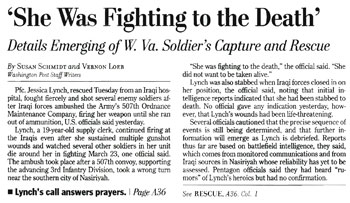
As I discuss in Getting It Wrong, my new book debunking prominent media-driven myths, the Post published a sensational, front-page report on April 3, 2003, that  said Lynch had fought with Rambo-like ferocity in an ambush at Nasiriyah in southern Iraq.
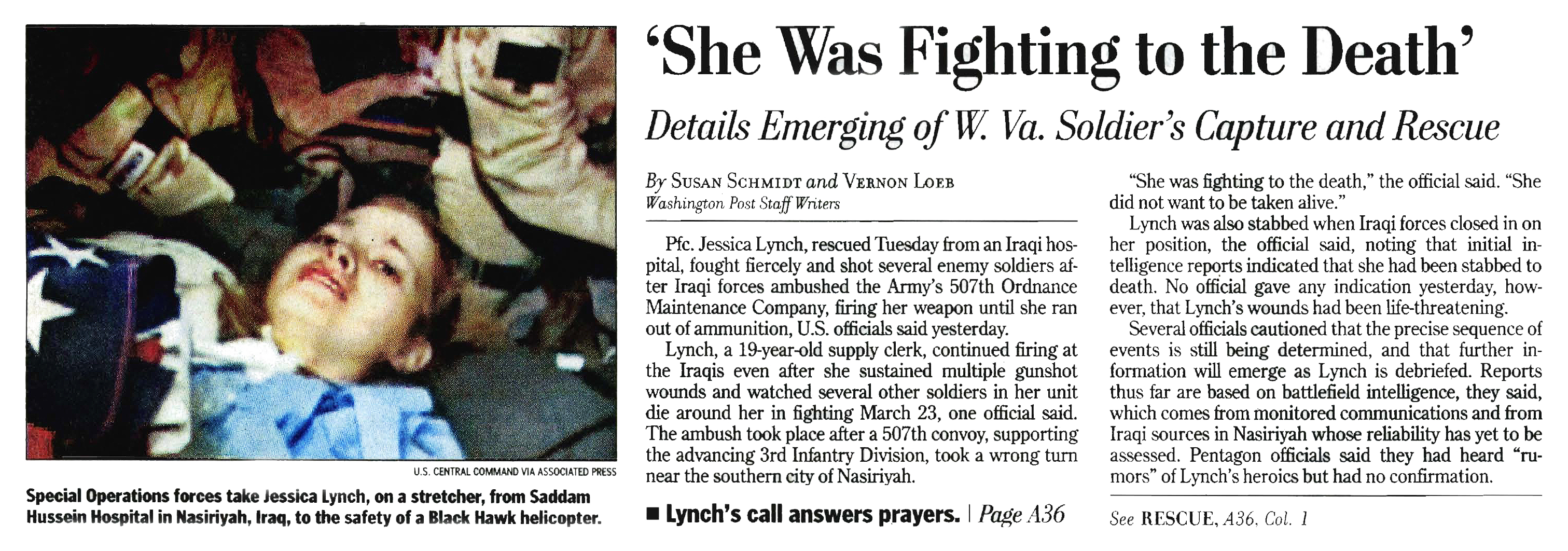
Washington Post, April 3, 2003

The Post said Lynch had “shot several enemy soldiers,” had herself been shot and stabbed, but had kept “firing her weapon until she ran out of ammunition.”

The article quoted a U.S. official as saying, anonymously:

“‘She was fighting to the death. She did not want to be taken alive.’”

“It was an electrifying account,” I write, one picked up by news outlets across the United States and around the world.

Only it wasn’t true.

Lynch didn’t fire a shot in the ambush.

She was badly injured not from gunshots and stabbings but from the crash of the Humvee fleeing the attack.

In the years since, the narrative of the Lynch case has shifted. The Post‘s role in injecting the story into the public domain has been largely forgotten–even though the newspaper “never fully acknowledged or explained its extraordinary error about Jessica Lynch,” as I write in Getting It Wrong.

Instead, the dominant narrative now blames the Pentagon for supposedly concocting a story about a heroic female soldier.

There’s scant evidence to support such claims, which reemerged the other day at the Huffington Post, in an interview with author Laura Browder.

The interview was to promote Browder’s book, When Janey Comes Marching Home. And in the interview, Browder declares:

“The Army’s first story about Lynch was that she tried to fight off her captors, then was taken prison[er] and needed to be rescued. Their version of events was pure fiction. And it embodied this stereotype of women in the military: the damsel in distress.”

Let’s see: The “pure fiction” part was that Lynch “tried to fight off her captors,” and that came from the Post, which cited as sources unidentified “U.S. officials.”

The Pentagon was not the source for the Post‘s erroneous account, one of the Post reporters on the story has said.

That reporter, Vernon Loeb, told the Fresh Air radio program in December 2003:

“I could never get anybody from the Pentagon to talk about those reports at all. I got indications that they had, in fact, received those intelligence reports [about Lynch], but the Pentagon was completely unwilling to comment on those reports at all.

“They wouldn’t say anything about Jessica Lynch.”

Loeb added:

“I just didn’t see the Pentagon trying to create a hero where there was none. I mean …they never showed any interest in doing that, to me.”

As I note in Getting It Wrong, Loeb on another occasion was quoted by the New York Times as saying:

“Far from promoting stories about Lynch, the military didn’t like the story.”

While he did not identify the Post’s sources for its “fighting to the death” article about Lynch, Loeb characterized them as “U.S. officials” who were “really good intelligence sources” in Washington, where he was based at the time.

It is little-remembered these days, but the Post‘s stunning story about Lynch’s heroics began unraveling within hours after publication.

I note in Getting It Wrong that Lynch’s father told reporters on the day the Post‘s account appeared that doctors at the U.S. military hospital in Landstuhl, Germany, said Jessica Lynch had suffered neither gunshot nor knife wounds.

If the military were complicit in fabricating the Lynch hero-warrior saga, it defies logic to believe that it would permit its doctors at Landstuhl to impugn that narrative just as it had begun circulating around the world.

WJC

Related:

A subsidiary myth: Lynch rescue ‘was played acted’

In Jessica Lynch, Media myths, Washington Post on July 29, 2010 at 12:11 pm

Seven years on, suspicions endure about the rescue of Jessica Lynch, the 19-year-old Army private whom the Washington Post catapulted into unsought, and undeserved, fame and celebrity early in the Iraq War.

Lynch was severely injured an ambush in Nasiriyah on March 23, 2003, and taken prisoner. Nine days later, a U.S. Special Operations team rescued Lynch  from a hospital that also had been a command post for Iraqi irregulars.

Rescuing Jessica Lynch

The Post reported soon after the rescue that Lynch had “fought fiercely” when her unit, the Army’s 507th Maintenance Company, was ambushed, and that she had “shot several enemy soldiers” and kept “firing her weapon until she ran out of ammunition.”

But as I write in Getting It Wrong, my new book about media-driven myths,  it turned out that Lynch was no hero; she never fired a shot at Nasiriyah. Her injuries were suffered not from gunfire but in the crash of a Humvee as she and others sought to flee.

The account of her battlefield derring-do probably was a case of mistaken identity or misattribution.  It wasn’t Lynch who had fought heroically at Nasiriyah, it most likely was Donald Walters, a cook-sergeant in Lynch’s unit who, after running out of ammunition, was captured by Iraqi irregulars, and executed.

I further note in Getting It Wrong that the Post’s sensational but erroneous account about Lynch’s heroics was picked up by news organizations around the world. The tale became what I call “a foundation myth” that enabled and encouraged “the emergence of subsidiary media myths, including the notion that Lynch’s dramatic rescue … a stunt manipulated by the U.S. military to boost morale at home.”

That subsidiary or spinoff myth reemerged yesterday in a commentary in Boston Globe, which declared:

“In April 2003, the American media latched onto the story of Jessica Lynch, a 19 year-old soldier, who, it was said, had been captured and mistreated by Iraqi soldiers. Her ‘rescue’ was play acted.”

Meaning what, “play acted”? That the rescue of Lynch wasn’t authentic? That it was staged? Bogus?

Presumably so. The writer doesn’t elaborate.

The BBC was among the first to claim the rescue was a put-up job. The BBC report’s, “War Spin,” called it “one of the most stunning pieces of news management ever conceived.”

The Pentagon dismissed the BBC’s claims as “void of all facts and absolutely ridiculous.”

Later, at the request of three Democratic members of Congress, the Defense Department’s inspector general investigated the BBC’s allegations and found them baseless.

In testimony to Congress in April 2007, Thomas F. Gimble, then the acting inspector general, reported that no evidence had been uncovered to support the claim that Lynch’s rescue “was a staged media event.”

Instead, Gimble said, the rescue operation was found to have been “a valid mission” to recover a prisoner of war “under combat conditions.”

More than thirty witnesses were interviewed in the inspector general’s inquiry, including members of the Special Operations team that rescued Lynch, Gimble said in his written testimony.

Few if any of those witnesses had been interviewed by news organizations, he noted.

In undertaking the Lynch rescue, Gimble said, the extrication team “fully expected to meet stiff resistance” and had come under enemy fire from the hospital building and areas nearby.

As I note in Getting It Wrong, Gimble’s report came four years after the BBC’s account. By then, the view that the rescue was a stunt had become solidified, a widely accepted element of the Lynch saga.

Gimble’s report in 2007 did not fit what had become the dominant narrative about the rescue.

It made little news.

That’s not so surprising.  After all, the notion of a counterfeit rescue operation fit well with the curdled popular view about the war in Iraq, I note in Getting It Wrong.

WJC

Related:

‘Persuasive and entertaining’: WSJ reviews ‘Getting It Wrong’

In Cronkite Moment, Debunking, Furnish the war, Jessica Lynch, Media myths, Murrow-McCarthy myth, New York Times, Reviews, Spanish-American War, War of the Worlds, Washington Post, Watergate myth on July 12, 2010 at 6:05 am

Today’s Wall Street Journal reviews Getting It Wrong, characterizing as “persuasive and entertaining” my new book debunking 10 prominent media-driven myths.

The review–which appears beneath the headline “Too good to check”–is clever and engaging, and opens this way:

“Hello, city desk, get me rewrite. Here’s the lead: Many of the landmark moments in American journalism are carefully nurtured myths—or, worse, outright fabrications.

“William Randolph Hearst never said, ‘You furnish the pictures, and I’ll furnish the war.’ Orson Welles’s ‘War of the Worlds’ radio broadcast didn’t panic America. Ed Murrow’s ‘See It Now’ TV show didn’t destroy Sen. Joseph McCarthy. JFK didn’t talk the New York Times into spiking its scoop on the Bay of Pigs invasion. Far from being the first hero of the Iraq War, captured Army Pvt. Jessica Lynch was caught sobbing ‘Oh, God help us’ and never fired a shot.

“These fables and more are lovingly undressed in W. Joseph Campbell’s persuasive and entertaining ‘Getting It Wrong.’ With old-school academic detachment, Mr. Campbell, a communications professor at American University, shows how the fog of war, the warp of ideology and muffled skepticism can transmute base journalism into golden legend.”

The reviewer, Edward Kosner, author of the memoir It’s News to Me, also discusses the myth of the “Cronkite Moment,” writing, “Television icons are central to two of Mr. Campbell’s dubious cases: Murrow and his successor as the patron saint of TV news, Walter Cronkite.”

Kosner notes–as I do in Getting It Wrong–that at least some of the myths confronted in the book will likely survive their debunking.

“For all Mr. Campbell’s earnest scholarship,” Kosner writes, “these media myths are certain to survive his efforts to slay them. Journalism can’t help itself—it loves and perpetuates its sacred legends of evil power-mongers, courageous underdogs, dread plagues and human folly.”

Well said.

And, alas, he may be right. Some of the myths almost certainly will live on. As I write in the introduction to Getting It Wrong, they “may prove resistant to debunking. They may still be widely believed despite the contrary evidence marshaled against them.

“The most resilient myths,” I further write, “may be those that can be distilled to a catchy, pithy phrase like: ‘If I’ve lost Cronkite, I’ve lost Middle America.’ Such quotations are neat, tidy, and easily remembered. Cinematic treatments influence how historical events are collectively remembered and can harden media-driven myths against debunking. The motion picture All the President’s Men, which cast Robert Redford and Dustin Hoffman in the lead roles of Washington Post reporters [B0b] Woodward and [Carl] Bernstein, has helped ensure that the journalists and their newspaper would be regarded as central to cracking the Watergate scandal.”

Kosner closes the review with a humorous observation, writing:

“At the end of the book, Mr. Campbell offers some remedies for media mythologizing, urging journalists, among other things, ‘to deepen their appreciation of complexity and ambiguity.’ Good luck with that, professor.'”

Heh, heh. Nice touch.

WJC

Related:

Seeking antidotes to journalism’s ‘junk food’

In Bra-burning, Debunking, Furnish the war, Jessica Lynch, Media myths, Murrow-McCarthy myth on July 2, 2010 at 12:31 am

Media-driven myths—those false, dubious yet prominent stories about the news media that masquerade as factual—can be thought of as the junk food of journalism. They’re alluring and delicious, but neither especially wholesome nor healthy.

As I note in Getting It Wrong, media-driven myths can spring from many sources. War is an especially fertile breeding ground for media myths, partly because the shock of combat is alien and unfamiliar to most people. Given their limited first-hand experience with war, media audiences generally are in no position to challenge reports from the battlefield.

“The confusion and intensity inherent in warfare can lead journalists to place fragmented information that emerges from conflict into recognizable if sometimes misleading frames,” I write.

An example of that came early in the Iraq War in 2003, with the Washington Post’s erroneous report about the battlefield heroics of Jessica Lynch, a topic discussed in Getting It Wrong. The Post’s characterization of Lynch as a female Rambo, pouring lead into attacking Iraqis, did not seem entirely implausible. It was, after all, a story picked up by news organizations around the world.

Hurried and sloppy reporting, which certainly figured in the sensational report about Lynch, also contributes to the rise to media myths. The myth of “crack babies” of the late 1980s and 1990s was certainly propelled by hurried reporting, by over-eager journalism and by premature medical findings.

Reporters and columnists pushed too eagerly on preliminary and inconclusive research about children born to women who took crack cocaine during pregnancy. The horrors that many journalists predicted—that “crack babies” would grow up to be a vast, permanently dependent class, a so-called “bio-underclass” of staggering dimension—proved quite wrong.

So are there antidotes to media-driven myths?

I argue in Getting It Wrong that while “they spring from multiple sources, it is not as if media-driven myths are beyond being tamed.”

To slow or thwart the spread of media myths, journalists might start by applying a measure of skepticism to pithy, telling quotes such as William Randolph Hearst’s vow to “furnish the war” with Spain at the end of the 19th century.

Turns of phrase that sound too neat and too tidy often are too good to be true.

Journalists also would do well to cultivate greater recognition of their fallibility. Too often they seem faintly concerned with correcting the record they tarnish. They tend not to like revisiting major flaws and errors. As Jack Shafer, media critic for the online magazine Slate, has written:

“The rotten truth is that media organizations are better at correcting trivial errors of fact—proper spellings of last names, for example—than they are at fixing a botched story.”

Not surprisingly, there was no sustained effort by the news media to set straight the record about the chimerical scourge of “crack babies.” Not surprisingly, there was little sustained effort to explore and explain the distorted and badly flawed reporting from New Orleans in 2005, in the aftermath of Hurricane Katrina’s landfall.

Encouraging a culture of skepticism and tolerance for viewpoint diversity in American newsrooms also would help curb the rise and dissemination of media-driven myths. Newsrooms can seem like bastions of group-think. Michael Kelly, the former editor of National Journal and the Atlantic once observed:

“Reporters like to picture themselves as independent thinkers. In truth, with the exception of 13-year-old girls, there is no social subspecies more slavish to fashion, more terrified of originality and more devoted to group-think.”

Group-think and viewpoint diversity are not topics often discussed in American newsrooms. But they’re hardly irrelevant. It is not inconceivable that a robust newsroom culture that embraces encourages skepticism, invites challenges to dominant narratives, and rewards contrarian thinking would have helped thwart publication of embarrassingly mistaken tales such as the Post’s account about Jessica Lynch.

Another antidote to media-driven myths is offered by the digitization of newspapers and other media content.

Digitization has made it easier than ever to consult and scrutinize source material from the past. Never has journalism’s record been more readily accessible, through such databases as ProQuest and LexisNexis.

Reading what was written makes it clear that radio dramatization of the War of the Worlds in 1938 created nothing approaching nationwide panic and hysteria. Reading what was written makes clear that Edward R. Murrow’s televised critique of Senator Joseph McCarthy in 1954 was belated and quite unremarkable.

Reading what was written can be a straightforward and effective antidote to media-driven myths.

WJC

A version of this post first appeared at the University of California Press blog.

‘Getting It Wrong’ goes Majic

In Bay of Pigs, Bra-burning, Debunking, Furnish the war, Jessica Lynch, Media myths, Media myths and radio, New York Times, War of the Worlds, Washington Post, Watergate myth on July 1, 2010 at 11:34 am

I did an engaging and entertaining in-studio interview yesterday on the Lanigan & Malone show, one of the most popular radio programs in Cleveland, the gritty city where I cut my teeth, journalistically, years ago.

On the air with Lanigan (center) and Malone

The show airs on WMJI, Majic 105.7 FM, and I spoke with hosts John Lanigan and Jimmy Malone about several media-driven myths addressed and debunked in my new book, Getting It Wrong.

They included the case of Jessica Lynch, the waiflike Army private whom the Washington Post elevated to hero status in a sensational but utterly erroneous report early in the Iraq War in 2003.

The Post depicted Lynch as having “fought fiercely” in the Iraqi ambush at Nasiriyah of the Army’s 507th Maintenance Company. The newspaper said Lynch had “shot several enemy soldiers” and kept “firing her weapon until she ran out of ammunition.”

Walters

The Lynch case, I said during the Lanigan & Malone interview, appears to have centered around a case of mistaken identity. It wasn’t Lynch who had fought heroically at Nasiriyah. It was most likely Donald Walters, a cook-sergeant in Lynch’s unit who, after running out of ammunition, was captured by Iraqi irregulars and executed.

I pointed out during the interview how war and conflict can readily give rise to myth and misunderstanding. Indeed, half the chapters in Getting It Wrong are related to warfare, including the book’s first chapter, the myth of William Randolph Hearst’s infamous vow to “furnish the war” with Spain.

We moved on to discuss the myth that widespread panic and mass hysteria characterized the reactions to the 1938 radio dramatization of The War of the Worlds, then jumped to a discussion of the myth of superlative reporting of Hurricane Katrina’s aftermath in September 2005, and considered at some length about what I call the “nuanced myth” of bra-burning.

“Bra-smoldering,” I said, would be a more accurate characterization of what happened during the women’s liberation protest at Atlantic City in September 1968. My research shows that bras and other items were set afire, if briefly, during the demonstration against that year’s Miss America pageant.

“All these are ruined,” Lanigan said at one point about the myths debunked in Getting It Wrong.

We also discussed the Bay of Pigs-New York Times suppression myth. That myth centers around a telephone call President John F. Kennedy supposedly placed to the Times publisher or top editors in April 1961, asking that the newspaper hold off on reporting about the pending CIA-supported invasion of Cuba.

There is no evidence, I said, that Kennedy ever placed such a call. (Or even had time to place such a call.)

What appears to have happened is that the Bay of Pigs-suppression myth has become confounded with the 1962 Cuban missile crisis, during which Kennedy did call the Times to request a delay on a report about nuclear-tipped missiles the Soviets had deployed on the island.

As the interview wrapped up, Lanigan said he’s “sure there will be another” volume, a sequel, to Getting It Wrong.

“It’s a good book,” he said afterward. “I’m glad he did it.”

WJC

Related:

‘Regret the Error’ considers ‘Getting It Wrong’

In Cronkite Moment, Debunking, Jessica Lynch, Media myths, Reviews, Watergate myth on June 18, 2010 at 6:41 pm

Craig Silverman’s latest “Regret the Error” column, posted today at the Columbia Journalism Review online site, offers a searching discussion of my new book, Getting It Wrong, and notes, insightfully:

“Every society needs heroes and villains, and stories that help forge identity and community. That’s why myths exist in the first place. But the press has the ability and means to shape and disseminate the tales of champions and villains, to create and propagate stories that reinforce role and identity. Media-driven myths are particularly powerful, which in turn makes them even harder to debunk.”

Silverman is the author of the well-received 2007 book, Regret the Error: How Media Mistakes Pollute the Press and Imperil Free Speech. His column discussing Getting It Wrong begins this way:

“Journalism is a profession built on storytelling, so it’s no surprise that its history is filled with some remarkable tales. Think Woodward and Bernstein bringing down a president. Or Walter Cronkite’s 1968 CBS News special about Vietnam that caused President Lyndon Johnson to exclaim, ‘If I’ve lost Cronkite, I’ve lost Middle America.’ Think of Edward R. Murrow demolishing Senator [Joe] McCarthy’s communist witch hunt on television, or William Randolph Hearst telling his correspondent in Cuba, ‘You furnish the pictures, I’ll furnish the war.’

McCarthy

“Great stories, all of them. If only they were built on facts—the other thing our profession is supposed to revere. W. Joseph Campbell, a professor at American University and respected journalism scholar, smashes the above media-driven myths, along with a few more, in his new book, Getting It Wrong: Ten of the Greatest Misreported Stories in American Journalism.”

About the emergence of media-driven myths, Silverman quotes me as saying:

“The notion of media power both for good, as in the Watergate example, or for bad, as in the William Randolph Hearst example, is one of the driving forces behind media myths.”

Indeed. Media myths, I write in Getting It Wrong, often stem from “an eagerness to find influence and lasting significance in what journalists do and tend to extend credit where credit is not entirely due.”

I further note in the book that media myths can “be self-flattering, offering heroes … to a profession more accustomed to criticism than applause.”

Silverman’s column wraps up by considering how to combat media-driven myths, quoting me as underscoring the importance of viewpoint diversity in American media newsrooms.

“There is room for a newsroom culture that embraces diverse viewpoints, and I think that will help encourage skepticism … and negate the groupthink that tends to take hold in newsroom culture,” he quotes me as saying.

“Challenging the dominant narrative and encouraging contrarian thinking is a good thing.”

On that point, I write in Getting It Wrong:

“It is certainly not inconceivable that a robust newsroom culture that embraces viewpoint diversity, encourages skepticism, invites challenges to dominant narratives, and rewards contrarian thinking would have helped thwart publication of embarrassing tales such as the Washington Post’s ‘fighting to the death‘ story about Jessica Lynch.”

WJC

Related:

Launching ‘Getting It Wrong’ at Newseum

In Bay of Pigs, Bra-burning, Cronkite Moment, Debunking, Furnish the war, Jessica Lynch, Media myths, Murrow-McCarthy myth, War of the Worlds, Washington Post, Watergate myth on June 14, 2010 at 6:28 am

My new book, Getting It Wrong, will be launched Saturday, June 19, at an “Inside Media” program at the Newseum, the $450 million museum of news in downtown Washington, D.C.

The program will begin at 2:30 p.m. in the Knight TV Studio on the third level and will feature a discussion with the Newseum’s John Maynard, followed by audience Q-and-A.

I’ll be signing copies of Getting It Wrong afterward.

The book addresses, and debunks, 10 prominent media-driven myths–stories about and/or by the news media that are widely believed and often retold but which, on close inspection, proved to be apocryphal or wildly exaggerated.

Here is a brief description about each of the 10 myths:

  1. Remington-Hearst: William Randolph Hearst’s famous vow, “you furnish the pictures, I’ll furnish the war,” is almost certainly apocryphal.
  2. War of Worlds: The notion that the War of Worlds radio dramatization in 1938 caused nationwide panic and mass hysteria is exaggerated.
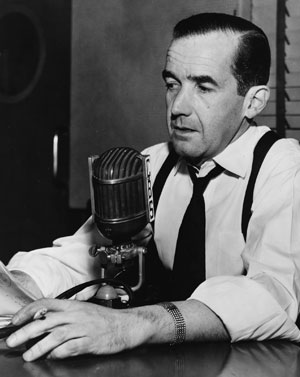
  3. Murrow-McCarthy: Edward R. Murrow’s famous See It Now program in March 1954 did not end Senator Joseph McCarthy’s communists-in-government witch-hunt; Murrow in fact was very late to take on McCarthy.

    Murrow in 1954

  4. Bay of Pigs: The New York Times did not suppress its reporting in the run-up to the ill-fated Bay of Pigs invasion in April 1961.
  5. Cronkite-Johnson: Walter Cronkite’s special report on Vietnam in February 1968 did not prompt an immediate reassessment of U.S. war policy.
  6. Bra-burning: Humor columnist Art Buchwald helped spread the notion that feminist demonstrators dramatically burned their bras at a Miss America protest in September 1968.
  7. Watergate: The Washington Post’s intrepid reporters, Carl Bernstein and Bob Woodward, did not bring down Richard Nixon’s corrupt presidency. That they did is a trope that knows few bounds.
  8. Crack babies: The much-feared “bio-underclass” of children born to women who smoked crack cocaine during their pregnancies never materialized.
  9. Jessica Lynch: The Washington Post’s erroneous reporting about Jessica Lynch early in the Iraq War gave rise to several myths about her capture and rescue.
  10. Hurricane Katrina: News coverage of Katrina’s aftermath in New Orleans in early September 2005 was marred by wild exaggerations of extreme, Mad Max-like violence.

As I write in Getting It Wrong, the myths debunked “are among American journalism’s best-known stories. Most of them are savory tales. And at least some of them seem almost too good to be false.”

I further write that because it “takes on some of the most treasured stories in American journalism,” Getting It Wrong is “a work with a provocative edge. It could not be otherwise.”

WJC

Related:

Too good to be disbelieved: The military, myth, and Jessica Lynch

In Jessica Lynch, Washington Post on May 10, 2010 at 2:01 pm

I blogged last week about how the international spotlight periodically lands on Jessica Lynch, even though seven years have passed since a sensational but erroneous report in the Washington Post vaulted her to unsought fame and celebrity.

The spotlight has dimmed considerably in the years since the Post article about the Army private’s supposed heroics in an ambush in Nasiriyah in southern Iraq in 2003.

But when the spotlight does find Lynch, the dubious notion that the military promoted the fictional account of her battlefield derring-do inevitably seems to reemerge.

Such was the case yesterday in an article about Lynch in the Pittsburgh Post-Gazette.

The article asserted, without attribution, that “military officials, in widely circulated reports early in the war, initially described her as a female Rambo who fought back fiercely after the ambush. Ms. Lynch has maintained she never fired her weapon and was knocked unconscious during the attack.”

My forthcoming book on media-driven myths, titled Getting It Wrong, revisits the Lynch case, recalling how the Washington Post reported that Lynch had “fought fiercely” when her unit, the 507th Maintenance Company, was ambushed at Nasiriyah, that she had “shot several enemy soldiers” and had kept “firing her weapon until she ran out of ammunition.”

News organizations “around the world,” I write, “followed the Post’s lead by prominently reporting the supposed heroics of young Jessica Lynch and contemplating their significance.”

These outlets included the Pittsburgh Post-Gazette which at the time predicted Lynch “appears headed for life as an American icon, regardless of whether she likes it.”

Lynch is no icon, and her battlefield heroics were misattributed:  It wasn’t Lynch who had fought heroically at Nasiriyah, it was most likely Donald Walters, a cook-sergeant in Lynch’s unit who, after running out of ammunition, was captured by Iraqi irregulars, and executed.

Walters’ selfless deeds at Nasiriyah have received nothing akin to the attention bestowed upon Lynch, who suffered shattering injuries in the crash of a Humvee as she and others tried to flee the ambush.

Lynch, then 19, was taken prisoner and treated at by Iraqis a hospital in Nasiriyah, from where she was rescued on April 1, 2003, by a U.S. special operations team.

The Post's botched story

The Post has never disclosed the sources of its botched report about Lynch. The article, which was published on the front page on April 3, 2003, vaguely cited “U.S. officials.”

But as I note in Getting It Wrong, the newspaper’s then defense writer, Vernon Loeb, went on an NPR program in late 2003 and said he “could never get anybody from the Pentagon to talk about” the raw, battlefield intelligence reports that hinted of Lynch’s heroism.

“I got indications that they had, in fact, received those intelligence reports, but the Pentagon was completely unwilling to comment on those reports at all,” Loeb said in an interview on the “Fresh Air” show. “They wouldn’t say anything about Jessica Lynch.”

Loeb added:

“I just didn’t see the Pentagon trying to create a hero where there was none. I mean …they never showed any interest in doing that, to me.”

Like many media-driven myths, the notion that the Pentagon pushed the phony hero-warrior story of Jessica Lynch has proven irresistible–too good and delicious, almost, to be disbelieved.

Despite substantial evidence to the contrary.

WJC

Turning a spotlight again on Jessica Lynch

In Debunking, Jessica Lynch, Media myths, Washington Post on May 6, 2010 at 3:54 pm

It’s striking how a measure of fame still attaches to Jessica Lynch, the Army private thrust into the international spotlight seven years ago by an erroneous report in the Washington Post about her heroism in Iraq.

The Post's erroneous story

As I write in Getting It Wrong, my forthcoming book about media-driven myths, the “international spotlight … has never fully receded” from Lynch, a waif-like 19-year-old whom the Post misidentified as having fought fiercely after supposedly being shot and stabbed.

As it turned out, Lynch never fired a shot in anger in Iraq. She suffered neither gunshot nor stab wounds. She was severely injured, in the crash of a fleeing Humvee.

Lynch was taken captive by Iraqis and placed in a hospital, from where she was rescued by a U.S. special operation team.

The Post‘s botched report about her derring-do on the battlefield appears to have been a case of mistaken identity: It wasn’t Lynch who had fought heroically; it was most likely Sergeant Donald Walters, who was in Lynch’s unit and who was captured by Iraqi irregulars, and executed.

Walters never received anything near to the attention that was bestowed upon Lynch.

Further evidence of that came yesterday, with reports of a new show on cable’s Bio Channel that will feature William Shatner of Star Trek fame catching up with people who had won sudden fame and attention. (Bio formerly was the Biography Channel.)

Lynch was mentioned by name in writeups about the program, to be called Shatner’s Aftermath and to premiere in the fall. TV Guide said today that six episodes of Shatner’s Aftermath have been ordered.

The Post’s erroneous article about Lynch was published in early April 2003—and was picked up by news organizations around the world.

Lynch’s photograph appeared on the cover of Time and Newsweek magazines.

She insisted she was no hero. But no matter.

She accepted a book deal estimated at $1 million, half of which reportedly went to her biographer, Rick Bragg, a former New York Times correspondent. She went on morning and evening  television shows to promote the book, I Am a Soldier, Too, which Bragg completed in time for publication on November 11, 2003—Veterans Day.

Lynch inspired a television movie, Saving Jessica Lynch. She was offered tuition-free education at West Virginia University. And she was named “West Virginian of the year” in 2003.

Although the frenzy long ago subsided, Lynch still pops up in the news from time to time. She still attracts a spotlight.

For example, NBC’s Today show in December 2009 featured the Lynch as one of the “buzziest” people in the news during the first decade of the 21st century.

In 2007, Lynch testified at a much-publicized hearing of the House Committee on Oversight and Government Reform. And she later wrote a first-person article for Glamour magazine.

She said in the Glamour article: “I don’t know why the military and the media tried to make me a legend.”

As I point out in Getting It Wrong, the story of Lynch’s heroics was a media-driven myth. The U.S. military was loath to promote the case. In fact, one of the Post reporters who worked on the erroneous article told NPR’s Fresh Air program in late 2003:

“I could never get anybody from the Pentagon to talk about those reports [of Lynch’s supposed heroism] at all. I got indications that they had, in fact, received those intelligence reports, but the Pentagon was completely unwilling to comment on those reports at all. They wouldn’t say anything about Jessica Lynch.”

WJC

Remembering big: Another April anniversary

In Anniversaries, Debunking, Jessica Lynch, Media myths, Washington Post, Watergate myth on April 4, 2010 at 5:56 pm

April 3 not only was the seventh anniversary of the Washington Post‘s botched report about the mythical battlefield heroics of Jessica Lynch. The date also marked the 150th anniversary of the first run of the legendary Pony Express–a short-lived institution that is impressively steeped in myth.

As Christopher Corbett wrote in an engaging commentary published Friday in the Wall Street Journal:

“We remember the Pony Express as one of the most enduring and endearing of American stories, a tale of the frontier, a story of bold entrepreneurs, daring young horsemen, true riders of the purple sage and all that.

“In truth, the venture hemorrhaged money from day one, was doomed by technology (another particularly American story), lasted a mere 78 weeks, ruined its backers and then disappeared into what historian Bernard DeVoto called ‘the border land of fable.'”

Corbett noted: “It was all over in 18 months. The service was shut down in the flash of a telegrapher’s key when the transcontinental telegraph was completed in October 1861.”

But for years afterward, “the West was aswarm with old men who claimed to be ‘the last of the Pony Express riders,'” Corbett wrote.

The tall tales and exaggerations that grew up around the Pony Express were in large part promoted by the cinema and the entertainment industry–factors akin to those that contribute to the rise and tenacity of media-driven myths, which are stories about and/or by the news media that are widely believed and often retold but which, on close inspection, prove to be apocryphal or wildly exaggerated.

The filmmaker John Ford incorporated the Pony Express into the 1948 Western, Fort Apache, where, Corbett noted, “the brave rider thunders into the fort to bring news of Custer’s Last Stand, which, alas, took place some 15 years after the Pony stopped running.”

It’s faintly reminiscent of the classic cinematic treatment of the Watergate scandal: Easily the best-known Watergate movie is All the President’s Men, a screen adaptation of the best-selling book by the same title.

The cinematic version of All the President‘s characterized the book’s authors, Carl Bernstein and Bob Woodward of the Washington Post, as central and essential to the scandal’s unraveling.

The upshot of that misrepresentation, I write in  Getting It Wrong, my forthcoming book about media-driven myths, has been “to solidify and elevate the heroic-journalist myth” of Watergate, to give it dramatic power, and sustain it in the collective memory.

I further note in Getting It Wrong that the film offers an unmistakable and unambiguous statement about “the power and centrality of the press in Nixon’s fall. All the President’s Men allows no other interpretation: It was the work Woodward and Bernstein that set in motion far-reaching effects that brought about the first-ever resignation of a U.S. president,” Richard Nixon.

What’s more, the heroic-journalist interpretation of Watergate minimizes or ignores the more decisive contributions in Nixon’s fall by agencies and organizations besides the Washington Post.

In his fine commentary, Corbett noted “the person who immortalized the Pony was William Frederick Cody, or Buffalo Bill. (He also claimed he had been a rider. Not true.)

“The [Pony Express] fast-mail service may have lasted only a year and a half, but it thrived for four decades in Cody’s Wild West show, seen by millions in the U.S. and Europe. To add drama to his re-enactment, Buffalo Bill might throw in a war party of savage Indians chasing a heroic rider who always managed to escape.

“It would become one of the most enduring images of the Pony Express, but it was not true; the actual riders rarely tangled with Indians,” Corbett wrote, adding:

“Why would a Paiute want a two-week-old copy of Horace Greeley’s New York Tribune?”

Corbett noted in closing:

“If the Pony Express continues to thrill and baffle us, consider the words of an old horseman in western Nebraska who advised me when I expressed some concerns about the pedigree of this yarn. ‘We don’t lie out here,’ he explained kindly. ‘We just remember big.'”

“Remember big.” A great line. And it’s certainly applicable in understanding why media-driven myths can be so tenacious and enduring.

WJC