W. Joseph Campbell

Posts Tagged ‘Kennedy’

Anniversary journalism and media-driven myths in 2011

In Anniversaries, Bay of Pigs, Debunking, Media myths, New York Times, Newspapers on January 1, 2011 at 7:21 am

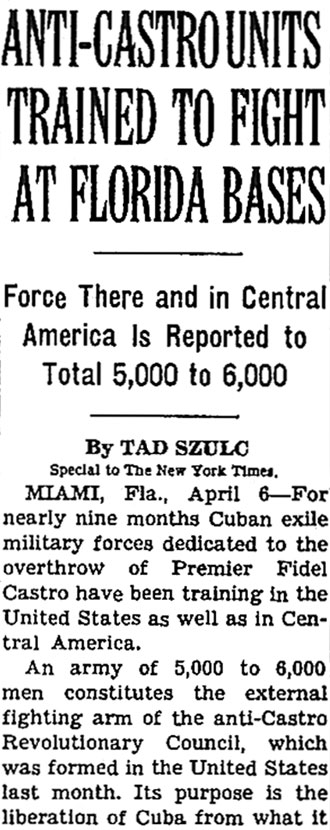
NY Times front page, April 7, 1961

“Anniversary journalism” has the appeal of being irresistible and easily done.

Typically, a reporter targets an upcoming anniversary (preferably, the occasion is divisible by 5 or 10), sells the idea to an editor, and cobbles together a story recalling the event. Easily done, but as the Independent newspaper in London has observed, not always very compelling.

We’ll surely see a lot of “anniversary journalism” in 2011.

The year, after all, brings the 10th anniversary of terrorist attacks of September 11, the 100th anniversary of the death of Joseph Pulitzer, and the 150th anniversary of the start of the American Civil War.

Media Myth Alert will be especially interested in 2011 in the 50th anniversary of the botched Bay of Pigs invasion of Cuba, which gave rise to the durable New York Times-Bay of Pigs suppression myth.

In the run-up to the anniversary in April of the Bay of Pigs invasion, we’ll no doubt see frequent references to this media-driven myth.

As I discuss in Getting It Wrong, my mythbusting book that came out in 2010, the suppression myth has it that the New York Times bowed to pressure from the White House of President John F. Kennedy and “spiked,” or self-censored, its detailed report about the pending Bay of Pigs invasion of Cuba.

The purported self-censorship took place about 10 days before the invasion– which failed utterly in its objective of toppling the Cuban revolutionary leader, Fidel Castro.

But as I point out in Getting It Wrong, the Times did not suppress its reports about the pending invasion of Cuba.

It did not censor itself.

The Times’ reports about preparations for the invasion were in fact fairly detailed–and prominently displayed on the front page in the days before the invasion.

The run-up to the Bay of Pigs was no one-day story. A succession of articles before the invasion “kept expanding the realm of what was publicly known about a coming assault against Castro,” I write.

To be sure, not all pre-invasion news reports were accurate or on-target. Much of the reporting was piecemeal.

But overall, the reports in the Times and other U.S. newspapers let readers know that something was afoot in the Caribbean, that an assault on Castro was in the works.

“Indeed,” I write in Getting It Wrong, “the coverage helped strip away the fiction circulated by the Kennedy administration that the invasion was strictly a Cuban affair.”

The suppression myth largely centers around a dispatch that a veteran Times correspondent, Tad Szulc, filed on April 6, 1961.

Supposedly, the Kennedy administration learned of the contents of Szulc’s dispatch about the pending invasion and urged that it be suppressed.

In his book The Powers That Be, David Halberstam offered a graphic, though exaggerated, account of Kennedy’s calling James Reston of the Times, saying the newspaper risked having blood on its hands were the article published.

Such a conversation never happened, according to Reston and others quoted in Harrison Salisbury’s Without Fear or Favor, an insider’s account of the Times and its history.

Moreover, as I note in Getting It Wrong:

“The Kennedy Library in Boston says that the White House telephone logs reveal no calls were placed to Reston” or other Times executives on April 6, 1961.

Szulc’s story was published on the front page on April 7, 1961 (see image, above).

I argue in Getting It Wrong that that the suppression myth likely stems from confusion over an episode in October 1962, when Kennedy did ask the Times to delay publication of a sensitive report.

That came during the Cuban Missile Crisis, when Reston was prepared to report that nuclear-tipped Soviet weapons had been deployed in Cuba. With the prospect of a nuclear exchange seemingly in the balance, the Times complied with the president’s request.

Kennedy took office in 1961–a year with more than a few significant anniversaries. In 1961, Berlin Wall went up, the Soviets put the first man into space, Hemingway killed himself, and Adolf Eichmann‘s war-crimes trial was convened in Israel.

And the Times suppression myth took hold.

WJC

Recent and related:

Indulging in myth on debate’s 50th anniversary

In Anniversaries, Debunking, Media myths, Washington Post, Watergate myth on September 27, 2010 at 7:12 am

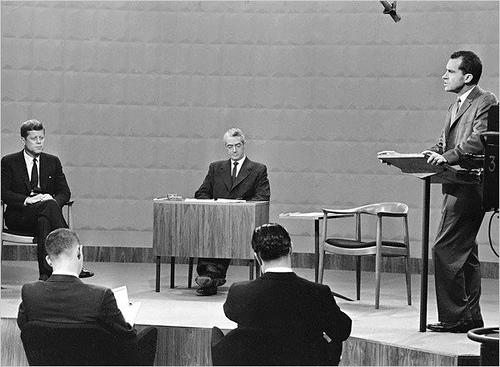
News outlets indulged in the myth of viewer-listener disagreement right through the 50th anniversary yesterday of the first Kennedy-Nixon debate.

The myth holds that people who watched the debate on television thought that Senator John F. Kennedy won; those who listened on radio thought Vice President Richard Nixon had the best of it.

The myth was long ago debunked by scholars David L. Vancil and Sue D. Pendell, in an article in Central States Speech Journal. They noted that reports of viewer-listener disagreement typically were anecdotal, and the few surveys that hinted at a viewer-listener disconnect were too small and unrepresentative by which to make confident judgments.

While it has been thoroughly dismantled, the myth lives on as irresistible testimony about the power of television and the importance of image in presidential politics.

An item posted yesterday at Andrew Breitbart’s Big Journalism online site said as much, declaring:

“The face of TV and politics changed forever on this date in history. …

“Those who watched the broadcast of the first ever televised presidential debate declared Kennedy the winner, those who listened on the radio gave the nod to Nixon. Thus, the political world changed forever.”

WLS-TV in Chicago, the city where the debate took place on September 26, 1960, said at its online site yesterday: “Most of the 70 million people who watched the event on television were convinced Kennedy won, and they voted for him in the presidential election of 1960.

“Surveys showed, though, that most of the people who listened on the radio thought Nixon won. It was the first time a nominee’s appearance may have affected voters.”

In addition, CBS Channel 2 in Chicago declared at its online site:

“Some listening on radio said it seemed like Nixon won. But as many as 74 million Americans were watching on television, and the medium became an overnight unexpected game-changer in our political system.”

As I’ve noted, specific evidence almost never is cited to support such claims about the debate. It’s as if the notion of viewer-listener disagreement is just too good, too delicious to check out–a factor that often characterizes the telling of media-driven myths. It’s a point I make in Getting it Wrong, my new book that debunks 10 prominent media myths. (While certainly prominent, the 1960 debate myth is not included in Getting It Wrong.)

There is evidence that a plurality of registered voters thought Kennedy fared better than Nixon in the debate 50 years ago.

But such impressions did not alter the campaign’s dynamic: The race remained a toss-up to Election Day.

Here’s what the evidence shows: A Gallup poll released in October 1960 reported that 43 percent of voters thought Kennedy “did the better job” in the first debate (of four debates during the campaign). Twenty-three percent thought Nixon was better; 29 percent said both candidates were about the same. Five percent offered no opinion.

The same survey reported Kennedy was narrowly ahead in the race, by 49 percent to 46 percent, with 5 percent undecided.

That result represented a slight change from Gallup’s survey taken just before the debate, which reported Nixon leading narrowly, by 47 percent to 46 percent.

Gallup called the post-debate shift too slight to be meaningful.

“The prudent reader can see,” George Gallup, head of the polling organization, wrote in reporting the results, “that polling accuracy has not reached the degree of accuracy required to say with certainty which candidate is ahead in a close race such as the present one.”

So, no: The debate 50 years ago didn’t change the “political world … forever.” Television wasn’t an “overnight … game-changer” in presidential campaigns. Nothing of the sort.

Media-driven myths are known to give rise to spin-off or subsidiary myths, a phenomenon I discuss in Getting It Wrong.

An example is the heroic-journalist myth of Watergate, which holds that the investigative reporting of Washington Post reporters Bob Woodward and Carl Bernstein brought down Nixon’s presidency in the 1970s. The spin-off or subsidiary myth is that Woodward and Bernstein’s work was so widely appealing that it prompted a surge in college students majoring in journalism.

But that wasn’t so: The surge in enrollments in journalism programs predated the Watergate scandal and was due in measure to young women entering the field.

A spin-off of the Kennedy-Nixon debate myth is that the widely watched televised encounter helped Kennedy become better known among Americans. Before then, the argument goes, Kennedy lacked much national recognition. Nixon, on the other hand, was well-known, having been vice president for almost eight years.

But in fact Kennedy had become nationally prominent long before the first debate.

So well-known that he ran well ahead of Nixon in many of the presidential trial heats that Gallup conducted nationally in late 1958 and 1959.

These matchups, while volatile, were seen by Gallup as early tests of a prospective candidate’s political strength.

The Gallup trial heat in December 1958 had Kennedy leading Nixon by 59 percent to 41 percent.

Kennedy was favored over Nixon by a larger margin, 61 percent to 39 percent, in the trial heat reported in July 1959.

To have polled as well as he did so long before the 1960 campaign, Kennedy simply could not have been an unknown in national politics.

WJC

Recent and related:

My many thanks to fivefeetoffury and Ed Driscoll for linking to this post.

Who won ’60 debate? Can’t say: Didn’t see it on TV

In Anniversaries, Debunking, Media myths on September 26, 2010 at 8:33 am

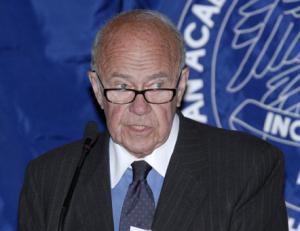
Sander Vanocur has been much in demand in the run-up to today’s 50th anniversary of the first Kennedy-Nixon televised presidential debate.

The 82-year-old Vanocur is sharp, witty, and droll–and the sole surviving member of the media panel that questioned the candidates during the debate on September 26, 1960.

Vanocur

Vanocur, a retired NBC newsman, has appeared on a number of panels in Washington that have examined the implications and legacies of the encounter between Senator John F. Kennedy and Vice President Richard Nixon. He’s also to participate on a panel today in Chicago, where the Kennedy-Nixon debate took place.

Among the comments that Vanocur has offered at these look-back events is:

“I don’t know who won the debate: I didn’t see it on television.”

He made such a remark yesterday, during a panel discussion at the Newseum, the $450 million museum of news in downtown Washington. (It’s where my new myth-busting book, Getting It Wrong, was launched in June.)

The comment “I didn’t see it on television” suggests the tube was decisive that night 50 years ago–and even was decisive to the outcome of the 1960 election.

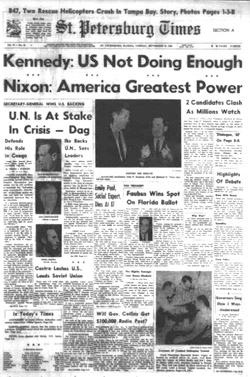
Debate coverage, 1960

Which it wasn’t.

Nixon supposedly lost the debate among television viewers because he looked so poorly, what with sweaty brow, wan complexion, and ill-chosen gray suit. But among radio listeners, he is said to have bested Kennedy.

That, anyway, is the widely told media myth that has come to define the first presidential debate.

It is also an explanation for Vanocur’s comment: You had to see the debate on television to appreciate fully the importance that image made that night.

Time magazine was among the news organizations to have repeated the debate myth in the run-up to the 50th anniversary, stating:

“As the story goes, those who listened to the debate on the radio thought Nixon had won. .. Those that watched the debate on TV thought Kennedy was the clear winner. Many say Kennedy won the election that night.”

But television images were decisive neither in the debate (the first of four during the fall campaign), nor in the 1960 election.

David L. Vancil and Sue D. Pendell, in an article in the Central States Speech Journal in 1987, thoroughly dismantled the notion that disagreement among TV viewers and radio listeners characterized the debate 50 years ago.

They identified serious flaws in the anecdotal reports and the limited post-debate surveys that suggested there had been such a divergence of opinion in assessing the Kennedy- Nixon encounter.

Vancil and Pendell also challenged the notion that Nixon’s beleaguered appearance much contributed to views about the debate.

“Appearance problems, such as Nixon’s perspiring brow, could have had a negative impact on viewer perceptions,” Vancil and Pendell wrote, “but it is also possible for viewers to be sympathetic to such problems, or to interpret them as evidence of attractive or desirable qualities.”

They added: “Even if viewers disliked Nixon’s physical appearance, the relative importance of this factor is a matter of conjecture.”

Indeed. The Washington Post declared in its post-debate editorial:

“Of the two performances Mr. Nixon’s probably was the smoother.”

Vancil and Pendell also pointed out that “the inference that appearance problems caused Nixon’s loss is classic post hoc fallacy.”

Nixon’s supporters may have been dismayed by his appearance that night; but that factor was scarcely enough to prompt them to alter their opinions about the vice president’s candidacy and opt for Kennedy.

The debate 50 years ago only slightly nudged public opinion–and any effect it had on voters dissipated by election day in November.

On the eve of that debate, the U.S. electorate was split. According to the Gallup poll before the encounter in Chicago, 47 percent of registered voters favored Nixon, 46 percent favored Kennedy, and 7 percent were undecided.

The Gallup poll immediately after the first debate put Kennedy ahead by three percentage points, 49-46, among registered voters. (Gallup noted in reporting the post-debate results: “polling accuracy has not reached the degree of accuracy required to say with certainty which candidate is ahead in a close race such as the present one.”)

The popular vote for president was quite close: Kennedy won by about 113,000 votes–a margin of just 0.1 percent.

The first debate had at best a modest effect in shifting public opinion–and was a wash in the overall sweep of the 1960 presidential campaign.

WJC

Recent and related:

Kennedy-Nixon debate myth emerges–as predicted

In Anniversaries, Debunking, Media myths on September 24, 2010 at 6:40 am

As predicted, the run-up to the 50th anniversary of the historic Kennedy-Nixon presidential debate has sparked references to the hardy and enticing media myth of TV viewer-radio listener disagreement.

The myth has it that Senator John F. Kennedy won the debate among television viewers while Vice President Richard M. Nixon was thought to have prevailed by most radio listeners.

That’s essentially what Newton Minow said yesterday in an interview on radio station WBEZ in Chicago, the city where the first Kennedy-Nixon debate took place on September 26, 1960. (Minow in 1961 was appointed by Kennedy to chair the Federal Communications Commission. He’s best known for having called television programming a “vast wasteland.”)

Minow declared in the radio interview:

“People who listened to the debate on radio tended to believe that Nixon won the debate. People who watched the debate on television felt that Kennedy won the debate.”

Like many other media-driven myths, the notion of viewer-listener disagreement in the 1960 debate tends to minimize the complexity of a historical event in favor of a simplistic, misleading, yet easily remembered interpretation.

And that is that Nixon lost the debate–and perhaps the 1960 election–because he looked poorly on television, especially so in comparison to the telegenic Kennedy.

The debate myth was expertly dismantled in 1987, in a journal article by David L. Vancil and Sue D. Pendell.

But still, it lives on.

And it endures despite the paucity of supporting evidence. Seldom is any supporting evidence cited in references to the purported disagreement among viewers and listeners in the debate 50 years ago.

Minow, for example, offered none in his interview on WBEZ.

Nor did Phil Ponce, a prominent Chicago TV journalist who wrote in a blog post yesterday: “People who saw the debate on TV thought Kennedy won; those who heard it on the radio gave it to Nixon.”

Nor did the editorial posted the other day at the online site of the Observer-Reporter, a newspaper in western Pennsylvania.

The editorial stated:

“Although Nixon was perceived to have been the debate winner by radio listeners, he didn’t fare as well when filtered through the unblinking, unforgiving eye of the television camera. In their living rooms, viewers saw a wan, jittery candidate with darting eyes and a five o’clock shadow.”

It further stated:

“Given how close the final result was in the 1960 presidential election–Kennedy and Nixon were separated by only [113,000] votes–perhaps Nixon could have ended up with the keys to 1600 Pennsylvania Ave. if he’d only taken a nap that day, as Kennedy did, and put on some makeup beforehand.”

Of course, the narrow outcome of the 1960 election may be interpreted another way–as evidence that the first debate (there were four in all during the campaign) was insignificant to the Kennedy’s victory.

A Gallup survey showed U.S. voters were effectively split on the eve of that debate: 47 percent favored Nixon, 46 percent favored Kennedy, and 7 percent were undecided.

The Gallup poll immediately after the first debate put Kennedy ahead by three percentage points.

The popular vote for president was, as the editorial noted, razor-thin–which suggests that any advantage Kennedy gained in the first debate dissipated over the course of the campaign.

As the journalism professor James Baughman recently pointed out in an insightful essay about the debate, “relatively few [voters] said they had changed their minds about their Election Day intentions.”

And that was the sense newspaper reporters and columnists detected, if anecdotally, in the immediate aftermath of the first debate: The election dynamic had not much changed.

James Reston, then the Washington bureau chief for the New York Times, wrote in a post-debate column:

“Who took the first round is a matter of individual opinion. My own view is that Kennedy gained more than Nixon, but it was a fielder’s choice, settling nothing.

“The main thing,” Reston added, “is that the nation gained in a unique and promising experiment.”

But the first iteration of that experiment has become steeped in the intervening 50 years in a blithe, appealing yet terribly misleading media myth.

WJC

Related:

Kennedy-Nixon debate myth certain to circulate anew

In Anniversaries, Debunking, Media myths on September 20, 2010 at 7:50 am

With the 50th anniversary of the first Kennedy-Nixon presidential debate just days away, it’s a fair bet that a particularly hardy media myth will make frequent appearances in news reports recalling the 1960 encounter.

And that’s the myth of viewer-listener disconnect, which holds that the debate’s television viewers mostly thought Senator John F. Kennedy won the encounter; those who heard the debate only on radio thought Vice President Richard M. Nixon had prevailed.
The debate myth lives on because it suggests that television–and how candidates look on the air–can be decisive in presidential elections. Like many of the media-driven myths debunked in my new book, Getting It Wrong, the debate myth also is appealing in that it offers a simplistic explanation for a complex historical event.

The viewer-listener disconnect in the 1960 debate isn’t discussed in Getting It Wrong. But I do admire the surgical dismantling of the myth that David L. Vancil and Sue D. Pendell presented in 1987 in the Central States Speech Journal.

They found scant support for a viewer-listener disconnect in the debate, which took place September 26, 1960.

In their article, Vancil and Pendell pointed to serious flaws in the anecdotal reports and the limited surveys that suggested disagreement among viewers and listeners in assessing what was the first televised debate between U.S. presidential candidates.

Central to the notion that radio audiences thought Nixon won the debate was a survey conducted by Sindlinger & Company. The survey indicated that by a 2-to-1 margin, radio audiences thought Nixon had prevailed.

But Vancil and Pendell pointed out that the Sindlinger survey, conducted the day after the debate, included more than 2,100 respondents–of whom only 282 had listened on radio.

Of that number, 178 (or fewer than four people per state) “expressed an opinion about the debate winner,” they wrote.

Further, Vancil and Pendell noted, “the critical characteristics of the 282 listeners surveyed are unknown. …Crucial information, such as the relative numbers of Republicans and Democrats in the sample” was not captured, rendering meaningless any generalizations about the debate’s radio audience.

Vancil and Pendell also wrote that the survey’s finding that an overwhelming number of radio listeners thought Nixon won ran contrary to the tendency of debates to “reinforce pre-debate candidate preferences.” And a Gallup survey showed the electorate nearly split on the eve of the debate: 47 percent favored Nixon, 46 percent favored Kennedy, and 7 percent were undecided.

Kennedy during the debate committed no gaffes or blunders that would have swung radio listeners to Nixon. “The available evidence,” they wrote, “suggests … that Kennedy’s supporters and potential supporters were delighted with his arguments and responses to questions during the debate….”

Indeed, anecdotal evidence gathered immediately afterward–including an informal survey conducted by Associated Press correspondents of 100 people in 10 cities–indicated that the debate changed few minds.

And James Reston, then a leading Washington-based columnist for the New York Times, wrote the day after the debate:

“This TV program did not do any of the dramatic things predicted for it. It did not make or break either candidate.”

Vancil and Pendell also challenged the notion that Nixon’s haggard appearance and sweaty brow contributed greatly to viewer perceptions about the debate.

“Appearance problems, such as Nixon’s perspiring brow, could have had a negative impact on viewer perceptions,” Vancil and Pendell wrote, “but it is also possible for viewers to be sympathetic to such problems, or to interpret them as evidence of attractive or desirable qualities.”

They added: “Even if viewers disliked Nixon’s physical appearance, the relative importance of this factor is a matter of conjecture.”

Not all observers thought Nixon’s performance was especially dismaying. In its post-debate editorial, the Washington Post even said:

“Of the two performances Mr. Nixon’s probably was the smoother.”

It is interesting to show undergraduate students portions of the first 1960 debate, as I sometimes do in journalism history classes. For many students, it’s their initial exposure to the debate’s televised record.

Invariably, some of them say they were surprised that Nixon didn’t look worse, given the received wisdom about his appearance that night.

They’re right: Nixon was fatigued, but he didn’t look awful debating Kennedy in what was the first of four presidential debates that fall.

What stands out, though, is how often during the first debate Nixon said he agreed with Kennedy’s views.

Not necessarily the most effective debate strategy, that.

WJC

Related:

‘Persuasive and entertaining’: WSJ reviews ‘Getting It Wrong’

In Cronkite Moment, Debunking, Furnish the war, Jessica Lynch, Media myths, Murrow-McCarthy myth, New York Times, Reviews, Spanish-American War, War of the Worlds, Washington Post, Watergate myth on July 12, 2010 at 6:05 am

Today’s Wall Street Journal reviews Getting It Wrong, characterizing as “persuasive and entertaining” my new book debunking 10 prominent media-driven myths.

The review–which appears beneath the headline “Too good to check”–is clever and engaging, and opens this way:

“Hello, city desk, get me rewrite. Here’s the lead: Many of the landmark moments in American journalism are carefully nurtured myths—or, worse, outright fabrications.

“William Randolph Hearst never said, ‘You furnish the pictures, and I’ll furnish the war.’ Orson Welles’s ‘War of the Worlds’ radio broadcast didn’t panic America. Ed Murrow’s ‘See It Now’ TV show didn’t destroy Sen. Joseph McCarthy. JFK didn’t talk the New York Times into spiking its scoop on the Bay of Pigs invasion. Far from being the first hero of the Iraq War, captured Army Pvt. Jessica Lynch was caught sobbing ‘Oh, God help us’ and never fired a shot.

“These fables and more are lovingly undressed in W. Joseph Campbell’s persuasive and entertaining ‘Getting It Wrong.’ With old-school academic detachment, Mr. Campbell, a communications professor at American University, shows how the fog of war, the warp of ideology and muffled skepticism can transmute base journalism into golden legend.”

The reviewer, Edward Kosner, author of the memoir It’s News to Me, also discusses the myth of the “Cronkite Moment,” writing, “Television icons are central to two of Mr. Campbell’s dubious cases: Murrow and his successor as the patron saint of TV news, Walter Cronkite.”

Kosner notes–as I do in Getting It Wrong–that at least some of the myths confronted in the book will likely survive their debunking.

“For all Mr. Campbell’s earnest scholarship,” Kosner writes, “these media myths are certain to survive his efforts to slay them. Journalism can’t help itself—it loves and perpetuates its sacred legends of evil power-mongers, courageous underdogs, dread plagues and human folly.”

Well said.

And, alas, he may be right. Some of the myths almost certainly will live on. As I write in the introduction to Getting It Wrong, they “may prove resistant to debunking. They may still be widely believed despite the contrary evidence marshaled against them.

“The most resilient myths,” I further write, “may be those that can be distilled to a catchy, pithy phrase like: ‘If I’ve lost Cronkite, I’ve lost Middle America.’ Such quotations are neat, tidy, and easily remembered. Cinematic treatments influence how historical events are collectively remembered and can harden media-driven myths against debunking. The motion picture All the President’s Men, which cast Robert Redford and Dustin Hoffman in the lead roles of Washington Post reporters [B0b] Woodward and [Carl] Bernstein, has helped ensure that the journalists and their newspaper would be regarded as central to cracking the Watergate scandal.”

Kosner closes the review with a humorous observation, writing:

“At the end of the book, Mr. Campbell offers some remedies for media mythologizing, urging journalists, among other things, ‘to deepen their appreciation of complexity and ambiguity.’ Good luck with that, professor.'”

Heh, heh. Nice touch.

WJC

Related:

‘Getting It Wrong’ goes Majic

In Bay of Pigs, Bra-burning, Debunking, Furnish the war, Jessica Lynch, Media myths, Media myths and radio, New York Times, War of the Worlds, Washington Post, Watergate myth on July 1, 2010 at 11:34 am

I did an engaging and entertaining in-studio interview yesterday on the Lanigan & Malone show, one of the most popular radio programs in Cleveland, the gritty city where I cut my teeth, journalistically, years ago.

On the air with Lanigan (center) and Malone

The show airs on WMJI, Majic 105.7 FM, and I spoke with hosts John Lanigan and Jimmy Malone about several media-driven myths addressed and debunked in my new book, Getting It Wrong.

They included the case of Jessica Lynch, the waiflike Army private whom the Washington Post elevated to hero status in a sensational but utterly erroneous report early in the Iraq War in 2003.

The Post depicted Lynch as having “fought fiercely” in the Iraqi ambush at Nasiriyah of the Army’s 507th Maintenance Company. The newspaper said Lynch had “shot several enemy soldiers” and kept “firing her weapon until she ran out of ammunition.”

Walters

The Lynch case, I said during the Lanigan & Malone interview, appears to have centered around a case of mistaken identity. It wasn’t Lynch who had fought heroically at Nasiriyah. It was most likely Donald Walters, a cook-sergeant in Lynch’s unit who, after running out of ammunition, was captured by Iraqi irregulars and executed.

I pointed out during the interview how war and conflict can readily give rise to myth and misunderstanding. Indeed, half the chapters in Getting It Wrong are related to warfare, including the book’s first chapter, the myth of William Randolph Hearst’s infamous vow to “furnish the war” with Spain.

We moved on to discuss the myth that widespread panic and mass hysteria characterized the reactions to the 1938 radio dramatization of The War of the Worlds, then jumped to a discussion of the myth of superlative reporting of Hurricane Katrina’s aftermath in September 2005, and considered at some length about what I call the “nuanced myth” of bra-burning.

“Bra-smoldering,” I said, would be a more accurate characterization of what happened during the women’s liberation protest at Atlantic City in September 1968. My research shows that bras and other items were set afire, if briefly, during the demonstration against that year’s Miss America pageant.

“All these are ruined,” Lanigan said at one point about the myths debunked in Getting It Wrong.

We also discussed the Bay of Pigs-New York Times suppression myth. That myth centers around a telephone call President John F. Kennedy supposedly placed to the Times publisher or top editors in April 1961, asking that the newspaper hold off on reporting about the pending CIA-supported invasion of Cuba.

There is no evidence, I said, that Kennedy ever placed such a call. (Or even had time to place such a call.)

What appears to have happened is that the Bay of Pigs-suppression myth has become confounded with the 1962 Cuban missile crisis, during which Kennedy did call the Times to request a delay on a report about nuclear-tipped missiles the Soviets had deployed on the island.

As the interview wrapped up, Lanigan said he’s “sure there will be another” volume, a sequel, to Getting It Wrong.

“It’s a good book,” he said afterward. “I’m glad he did it.”

WJC

Related:

Puncturing the Times-suppression myth

In Bay of Pigs, Debunking, Media myths, New York Times on June 9, 2010 at 4:42 pm

In early April 1961, the New York Times supposedly bowed to pressure from the White House of President John F. Kennedy and “spiked,” or suppressed, its detailed report about the pending Bay of Pigs invasion of Cuba.

The Times’ purported self-censorship took place a little more than a week before the invasion, which failed utterly in its objective of toppling the Cuban revolutionary leader, Fidel Castro.

The invasion force of CIA-trained Cuban exiles gave up in less than three days and the Kennedy presidency, as well as U.S. standing in the Caribbean and the world, suffered a humiliating setback.

Had the Times not censored itself, had the Times gone ahead and reported all that it knew, the ill-fated invasion may well have been scuttled and a national embarrassment avoided.

Or so the story goes.

Before the invasion: Front page, NYTimes

The tale of the Times’ purported self-censorship has been recounted in many books, journals, newspapers, and other periodicals over the years. The episode offers supposedly timeless lessons about the perils of self-censorship, about the risks of yielding to pressure to withhold sensitive information on national security grounds.

The anecdote about the Times’ self-censorship is potent, compelling, delicious and timeless.

But as I describe in my forthcoming book, Getting It Wrong, it is also a media-driven myth.

The Times did not suppress its reports about the pending invasion of Cuba. It did not censor itself.  As is discussed in Getting It Wrong, the Times’ reports about preparations for the invasion were fairly detailed, not to mention prominently displayed on the front page in the days before the Bay of Pigs invasion was launched.

Given the widely held notion that the Times censored itself, it was fairly surprising to find in my research just how much reporting there was in advance of the invasion. The run-up to the Bay of Pigs was no one-day story.

Not all pre-invasion news reports were accurate or on-target. Much of it was piecemeal.

But there was ample coverage in the Times and other U.S. newspapers so that readers knew something was afoot in the Caribbean, that an assault on Castro was in the works.

The coverage supposedly reached a point where Kennedy told his press secretary, Pierre Salinger, a week before the invasion:

“I can’t believe what I’m reading! Castro doesn’t need agents over here. All he has to do is read our papers. It’s all laid out for him.”

The notion that Kennedy asked or persuaded the Times to suppress, hold back, or dilute any of its reports about the pending Bay of Pigs invasion is utter fancy.

As I discuss in Getting It Wrong, there is no evidence that Kennedy or his administration knew in advance about the content of the Times’ reporting about the pending invasion. There is no evidence that Kennedy or anyone in his administration lobbied or persuaded the Times to hold back or spike that story, as is so often said.

So what accounts for what I call the “suppression myth”?

I write in Getting It Wrong that the myth “stems from confusion with a separate episode during the Cuban Missile Crisis in October 1962, when Kennedy did ask the Times to postpone publication of a report about the Soviets having deployed nuclear-tipped weapons in Cuba. On that occasion, when the prospect of a nuclear exchange seemed to be in the balance, the Times complied.”

As for the significance of debunking the suppression  myth, I write:

“Exposing the myth demonstrates how the Kennedy administration sought to deflect blame for the Bay of Pigs and make a scapegoat of the Times. On separate occasions in 1961 and 1962, Kennedy told the senior executives of the Times that had the newspaper published more about the pending assault on Cuba, the invasion might have been scuttled.

“Such an interpretation of course shifts responsibility away from the authorities who possessed the power to order an invasion of a sovereign state,” I write. “Puncturing the Timessuppression myth, then, allows blame for the Bay of Pigs fiasco to be more properly apportioned.”

WJC

A version of this post first appeared at the University of California Press blog.

Halberstam the ‘unimpeachable’? Try myth-promoter

In Bay of Pigs, Cronkite Moment, Debunking, Furnish the war, Media myths, New York Times, Spanish-American War on April 24, 2010 at 9:02 am

A book review in the New York Times the other day referred to David Halberstam, the legendary author and journalist, as an “unimpeachable” source.

Halberstam, who died in an automobile accident three years ago, certainly built an outsize reputation. But unimpeachable?

I’d say no way.

Halberstam, in his hefty and still-popular 1979 study of the news media, The Powers That Be, encouraged the rise of two prominent media-driven myths and endorsed a third.

As I note in Getting It Wrong, my forthcoming book about media-driven myths, Halberstam’s Powers That Be was an important source, perhaps the original source, for the so-called “Cronkite Moment” of February 27, 1968.

That was when CBS anchorman Walter Cronkite asserted in a special report that the U.S. war effort in Vietnam was “mired in stalemate.”

In Halberstam’s telling, Cronkite’s report represented “the first time in American history a war had been declared over by an anchorman.”

Halberstam wrote that President Lyndon Johnson was in Washington and watched the Cronkite special that night. Upon hearing Cronkite’s dire assessment about Vietnam, the president said that if he had lost Cronkite, he had lost Mr. Average Citizen.

Interestingly, Halberstam did not place Johnson’s purported lament inside quotation marks. He paraphrased the remarks and said Johnson had directed  them to presidential press secretary George Christian.

But as I write in Getting It Wrong, Johnson was not in Washington that night. He did not see the Cronkite program when it aired. Thus, he could not have had the abrupt, dramatic, yet resigned reaction that Halberstam, and others, have attributed to him.

Johnson that night was in Austin, Texas, at the 51st birthday party of a political ally, Governor John Connally.

About the time Johnson supposedly made the comment about losing Cronkite, he was offering light-hearted banter about Connally’s age, saying:

“That is the magic number that every man of politics prays for—a simple majority. Throughout the years we have worked long and hard—and I might say late—trying to maintain it, too.”

The “Cronkite Moment,” I write in Getting It Wrong, “is a media-driven myth. It did not have the effects that Halberstam and many others have attributed to it.”

Halberstam’s Powers That Be also offered a graphic, if exaggerated, account that President John Kennedy supposedly called James Reston of the New York Times in April 1961 and urged him not to publish a report about the pending Bay of Pigs invasion.

Kennedy “argued strongly and passionately,” Halberstam wrote, that the Times by reporting the story would damage his policy. Halberstam also wrote that in his call to Reston, Kennedy said the Times risked having blood on its hands were the article published and the invasion failed.

Such a conversation never happened, according to Reston and others quoted in Harrison Salisbury’s insider’s account of the Times, Without Fear or Favor.

Indeed, there is no evidence that Kennedy called anyone at the Times in advance of the report–which was written by Tad Szulc and published April 7, 1961, on the Times front page (see right).

As I note in Getting It Wrong:

“The Kennedy Library in Boston says that the White House telephone logs reveal no calls were placed to Reston” or other Times executives on April 6, 1961, the day the story was prepared for publication.

“Moreover,” I note, “Kennedy had almost no chance to speak with those executives during the interval from when Szulc’s story arrived at the Times building in midtown Manhattan and when it was set in type. … During that time, Kennedy was otherwise preoccupied. He spent the last half of the afternoon of April 6, 1961, playing host to Harold Macmillan, the British prime minister, on a lengthy cruise down the Potomac River to Mount Vernon.”

In addition, Halberstam’s Powers That Be invoked one of the most enduring media myths–the anecdote about William Randolph Hearst’s purported vow to “furnish the war” with Spain at the end of the 19th century.

That anecdote is revisited, and dismantled, in the first chapter of Getting It Wrong.

The Powers That Be was a popular success, reaching the second spot on the New York Times best-selling list in May 1979. But the book wasn’t without persuasive critics.

Among them was David Culbert, an historian at Louisiana State University who years ago raised questions about the “Cronkite Moment,” noting that Johnson was in Texas when the program aired.

In a devastating review published in the American Historical Review, Culbert called The Powers That Be overlong and declared:

“The absence of a developed thesis, lack of proper documentation, and numerous errors of fact for events before the 1960s suggest that historians will have to use this book with caution. There is much here that might be true and, if true, valuable, but there is also no certainty that sloppy research does not undermine the very parts that seem most interesting.”

WJC

Kennedy took responsibility?

In Bay of Pigs, Media myths on November 28, 2009 at 11:09 am

Leslie Gelb, a former columnist for the New York Times and president emeritus of the Council on Foreign Relations, says President Obama’s recent Asia trip was so thin on accomplishment that it revealed a “disturbing amateurishness in managing America’s power.”

Gelb, writing at the Daily Beast blog, also says Obama “should stare hard at the skills of his foreign-policy team and, more so, at his own dominant role in decision-making.” He further suggests that “Obama might take responsibility himself, as President Kennedy did after the Bay of Pigs fiasco in 1961.”

There’s no argument here with Gelb’s assessment about Obama’s foreign policy. It projects a decided whiff of amateurishness, indeed.

But on the point about Kennedy’s having taken responsibility for the Bay of Pigs debacle: Well, there’s a whiff of media myth in that claim.

As I write in my forthcoming book, Getting It Wrong, Kennedy in the aftermath of the failed Bay of Pigs invasion of Cuba, sought to spread the blame to the U.S. news media, particularly the New York Times. On separate occasions in 1961 and 1962, Kennedy told the Times publisher and its managing editor that had the newspaper printed all it knew about the pending invasion, the country and his administration would have been spared a major foreign policy embarrassment. That is, the pre-invasion publicity would have made an assault untenable.

But as James (Scotty) Reston, the veteran Times columnist and correspondent in Washington, correctly noted, Kennedy’s comments were “a cop-out.”

The decision to press ahead with the attempt to topple Fidel Castro rested squarely with the Kennedy administration.

Kennedy’s comments, made to Publisher Orvil E. Dryfoos and Managing Editor Turner Catledge, had the effect of solidifying the media-driven myth that the Times had censored itself in reporting about the run-up to the invasion.

The purported self-censorship took place in the days before the invasion, which failed utterly in its objective of toppling Castro.

But close reading of the newspaper in early April 1961 makes it clear that the Times did not spike it reports about the pending invasion of Cuba. The newspaper did not censor itself. The Times’ coverage about preparations for the assault was in fact fairly detailed and prominently displayed on front pages in the days before the invasion force of Cuban exiles hit the beaches.

The related notion that Kennedy asked or persuaded the Times to suppress, hold back, or dilute any of its reports about the pending Bay of Pigs invasion also is utter fancy.

But the anecdote about the Times’ self-censorship lives on as a timeless lesson about why the news media should not bow or defer to power. It’s a potent, durable, and compelling tale.

It’s also apocryphal.

WJC