W. Joseph Campbell

Posts Tagged ‘McCarthy’

How late was Ed Murrow in taking on Joe McCarthy?

In Cinematic treatments, Media myths, Murrow-McCarthy myth on September 28, 2010 at 4:25 pm

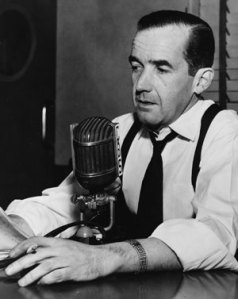
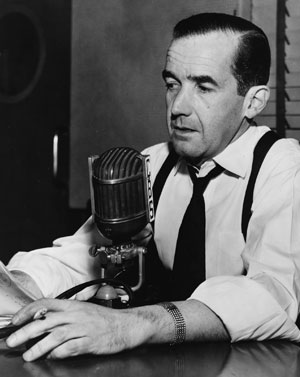
Murrow in 1954

Edward R. Murrow, the “white knight” of American broadcasting, is often credited with having ended the communists-in-government witch-hunt of Senator Joseph McCarthy at the height of the Cold War.

Murrow supposedly demolished the McCarthy scourge in a 30-minute television program, See It Now, that aired on CBS on March 9, 1954. The show made notably effective use of footage of the senator’s words, actions, and sometimes-bizarre conduct.

By doing that show, it is said, Murrow stood up to McCarthy when no one else would–or dared.

That, however, is a media-driven myth–a dubious tale about the news media that masquerades as factual.

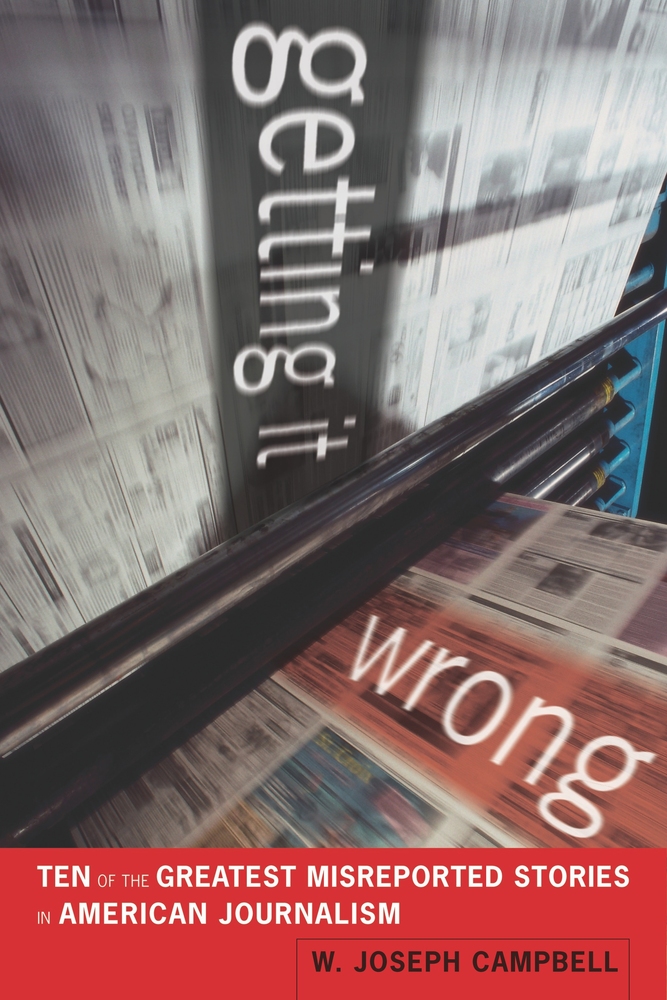
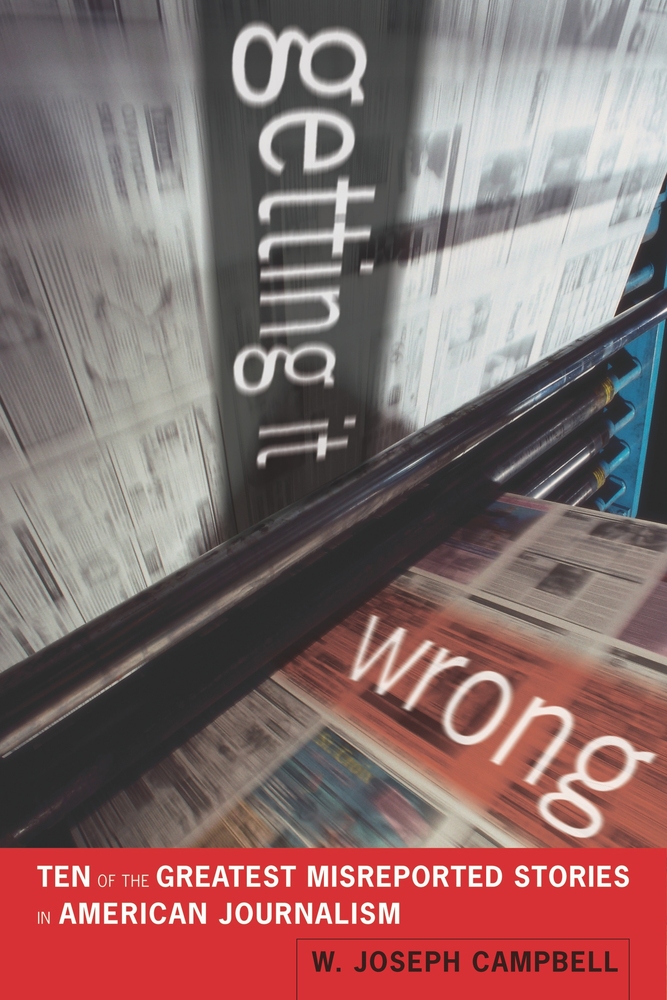
As I write in my new myth-busting book, Getting It Wrong, Murrow was very late in confronting McCarthy, doing so long after other journalists–among them muckraking columnist Drew Pearson–had become persistent and searching critics of the senator, his record, and his tactics.

Pearson wrote critically about McCarthy as early as February 1950–just days after the senator first raised claims about communists having infiltrated the U.S. State Department.

Pearson also raised searching questions years before Murrow’s program about McCarthy’s tax troubles, his accepting suspicious campaign contributions, and his taking a $10,000 payment from a U.S. government contractor for a 7,000 word article.

McCarthy, I write, “had no more relentless, implacable, or scathing foe in the news media than Drew Pearson.”

And there were other journalists, too, who challenged McCarthy and his ways long before Murrow’s See It Now program in 1954.

So undeniably, Murrow’s on-air takedown of McCarthy was belated.

But it wasn’t quite as late as historian Alan Brinkley suggested in a post yesterday at the Speakeasy blog, sponsored by the Wall Street Journal.

Brinkley wrote:

“Anyone who saw the George Clooney film ‘Good Night, and Good Luck,’ about Edward R. Murrow’s decision to attack Joe McCarthy in 1954, will remember the pervasive fear, indeed terror, of employees of CBS who have hidden their leftist political views. (Even Murrow waited until after the Army-McCarthy hearings began before he took on McCarthy.)”

That last bit isn’t correct.

The Army-McCarthy hearings were convened in April 1954, six or so weeks after Murrow’s program, and ran until June 1954. The Museum of Broadcast Communications in Chicago has called the hearings “the first nationally televised congressional inquiry.” And they led to McCarthy’s censure by the Senate in late 1954.

“What made the real difference” in toppling McCarthy, Fred Friendly, Murrow’s producer, later wrote, “wasn’t the Murrow program but the fact that ABC decided to run the Army-McCarthy hearings. People saw the evil right there on the tube. ABC helped put the mirror up to Joe McCarthy.”

The Clooney film that Brinkley mentioned, Good Night, and Good Luck, was an imaginative and clever cinematic treatment of Murrow’s See It Now program about McCarthy. The film came out in 2005 and included archival footage from Murrow’s show.

“While the movie never explicitly said as much,” I write in Getting It Wrong, “it left an inescapable impression that Murrow courageously and single-handedly stopped McCarthy. Many reviewers saw it that way, too.”

For example, the film critic for the Chicago Sun-Times, Roger Ebert, said Good Night, and Good Luck was about “a group of professional newsmen who with surgical precision remove a cancer from the body politic. They believe in the fundamental American freedoms, and in Sen. Joseph McCarthy they see a man who would destroy those freedoms in the name of defending them. … The instrument of his destruction is Edward R. Murrow, a television journalist above reproach.”

But Murrow wasn’t such a “white knight.”

As I note in Getting It Wrong, Murrow claimed a master’s degree he never earned, added five years to his age in his employment application at CBS, and in 1956 privately counseled Adlai Stevenson, the Democratic presidential candidate, on techniques of speaking before a television camera.

Such lapses today, I write in Getting It Wrong, would “almost surely disqualify Murrow, or any journalist, from prominent positions in America’s mainstream news media.”

WJC

Recent and related:

Edward R. Murrow ‘had guts’ in taking on Joe McCarthy? Not really

In Debunking, Media myths, Murrow-McCarthy myth on September 22, 2010 at 4:12 pm

How Edward R. Murrow single-handedly ended the witch-hunting ways of Senator Joseph McCarthy, the most feared and loathsome political figure of the Cold War era, is the stuff of legend.

It’s one of the best-known, most cherished stories about American journalism, one that lives on as an example of media power at its finest and most effective–as a lesson about what courageous journalists can accomplish, even in the face of imposing odds.

Murrow in 1954

It is also one of American journalism’s most tenacious myths.

As I write in my new book, Getting It Wrong, Murrow’s televised report on McCarthy on March 9, 1954–the 30-minute program that lies at the heart of the myth–did not have the outcome so often claimed for it.

Notably, I write, “McCarthy’s favorable ratings had begun to slide well before Murrow took to the air” with his report on McCarthy.

Moreover, Murrow’s program on McCarthy was aired months and even years after exposes of the senator and his tactics had been reported by other American journalists.

As Jay Nelson Turk, television critic for the New York Post wrote after Murrow’s program on McCarthy:

“Murrow said nothing, and his cameras showed nothing, that this and some other newspapers have not been saying—and saying more strongly—for three or four years.”

Still, the notion that Murrow stood up to McCarthy when no one else would, or dared, lives on. It was invoked most recently in a commentary published yesterday at the New Jersey Today online site.

It asserted that before Murrow’s report on McCarthy, “Little substantive commentary was coming from the news media. No one with any power was willing to take on the popular McCarthy ….

“However, on March 9, 1954, Edward R. Murrow, the most-respected newsman on television at the time, broke the ice. He attacked McCarthy on his weekly show, See It Now. Murrow interspersed his own comments and clarifications into a damaging series of film clips from McCarthy’s speeches.”

The commentary added:

“Murrow had guts—something lacking in most of today’s television commentators who are more adept at reading teleprompters than tackling issues—and he spoke truth to power.”

Those paragraphs contain no small amount of error and misinterpretation.

For one, McCarthy was never especially “popular” among Americans.

As I note in Getting It Wrong, “Gallup Poll data show that McCarthy’s appeal crested in December 1953, when 53 percent of Americans said they had a favorable view of him.

“McCarthy’s favorable rating had slipped to 40 percent by early January 1954, and to 39 percent in February 1954, when an almost identical number of Americans viewed him unfavorably.”

The sharp drop, of course, preceded Murrow’s program.

More significant is the commentary’s erroneous claim that the news media had offered little substantive commentary about McCarthy and his communists-in-government witch-hunt.

As I note in Getting It Wrong:

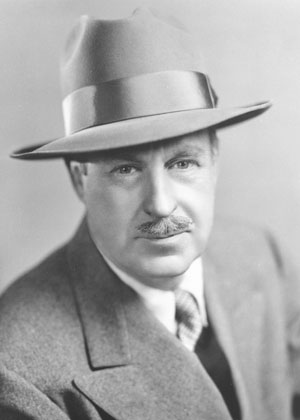
Pearson

“Long before the See It Now program, several prominent journalists—including the Washington-based syndicated columnist Drew Pearson—had become persistent and searching critics of McCarthy, his record, and his tactics.”

Pearson wrote critically about McCarthy beginning in February 1950–just days after the senator first claimed that communists had infiltrated the U.S. State Department.

Pearson noted that he had covered the State Department for about twenty years, during which time he had been “the career boys’ severest critic. However, knowing something about State Department personnel, it is my opinion that Senator McCarthy is way off base.”

In subsequent columns, Pearson raised questions about McCarthy’s tax troubles, his accepting suspicious campaign contributions, and his taking a $10,000 payment from a U.S. government contractor for a 7,000 word article.

“Pearson’s inquiries embarrassed and angered McCarthy, who began entertaining thoughts of doing him harm,” I write in Getting It Wrong. And in December 1950, McCarthy physically assaulted Pearson in the cloakroom of the fashionable Sulgrave Club on DuPont Circle in Washington, D.C. (Accounts vary: McCarthy said he slapped Pearson, hard, with an open hand. Pearson said the senator kneed him, twice, in the groin. Then-Senator Richard M. Nixon pulled McCarthy away from Pearson.)

The encounter at the Sulgrave anticipated McCarthy’s vicious verbal attack on Pearson, declaring from the Senate floor that the columnist was the “diabolically” clever “voice of international communism” and the “sugar-coated voice of Russia.”

Pearson surely wasn’t the most enviable figure in American journalism. Media critic Jack Shafer in a column at Slate the other day called Pearson “one of the skuzziest journalists to ever write a story.”

Perhaps.

But the historical record is clear that if anyone in the news media “broke the ice” about McCarthy, it was Pearson. In 1950.

He posed critical and persistent challenges to McCarthy’s red-baiting ways when doing so really did take guts.

WJC

Related:

‘Getting It Wrong’ goes on WTIC talk radio

In Anniversaries, Debunking, Hurricane Katrina, Media myths, Media myths and radio, Washington Post, Watergate myth on September 12, 2010 at 11:38 am

I was interviewed about Getting It Wrong the other day by Ray Dunaway on WTIC AM radio in Hartford, where years ago I was a reporter for the Hartford Courant newspaper.

The interview was live, brisk, and wide-ranging, covering a number of topics discussed in Getting It Wrong, my new book which debunks 10 prominent media-driven myths–those dubious and improbable stories about the media that masquerade as factual.

Topics that Dunaway and I discussed included the media myths associated with the Washington Post and the Watergate scandal, with Edward R. Murrow and his 1954 program on Senator Joseph McCarthy, and with coverage of Hurricane Katrina’s aftermath in 2005.

Dunaway, a veteran talk-shown host in Connecticut (with whom I had never previously spoken), said in introducing the segment:

“There are a lot of things we believe growing up and some of these are very near and dear to my heart. One would be–and I think this is absolutely true–when I was in graduate school, everybody, especially on the print side, everybody wanted to be the next Carl Bernstein and Bob Woodward [of Watergate fame] and, you know, bring down a president. That was kind of their dream.”

He added:

“Anyhow, there’s a great book out now. And what you believe ain’t necessarily so. W. Joseph Campbell has written a book … called Getting It Wrong

“First of all,” Dunaway said in launching into the interview, “I must tell you how much I enjoyed the book. It was a trip down memory lane, but maybe in a different direction than I originally thought.”

He asked whether I wrote the book to “set the record straight a bit.”

“That’s exactly right,” I replied. “The book is not really a media-bashing book but really aligns itself with a central objective of news-gathering, which is to try to get it right. And the book does seek to set the record straight by offering reappraisals of some of the best-known stories in American journalism.”

I added:

“I think these stories live on because they do offer simplistic explanations and simplistic answers to very complex historical events. So it’s a way of distilling what went on in the past [in] a very digestible and understandable way.

“In the process of simplification, though, there are exaggerations made–and myths are born. And I think that’s a recurring theme in this book. … These stories are appealing stories. They’re delicious stories. They’re almost too good to be checked out, and I think that’s another reason why these have lived on.”

We spent some time discussing the heroic-journalist interpretation of Watergate–that the investigative reporting of Woodward and Bernstein in the Washington Post brought about President Richard Nixon’s resignation in 1974.

“Woodward and Bernstein–the Watergate story–is another example of the David-and-Goliath encounter,” another thread that runs through Getting It Wrong, I said, adding that Nixon’s fall in the Watergate scandal “was the consequence of his own criminal conduct and that was exposed through the convergence of many forces and factors.

“And the Washington Post, although it did some good reporting in the aftermath of the Watergate breakin in 1972–it wasn’t the decisive factor.

“Its reporting did not bring down Richard Nixon.”

Dunaway, who described Getting It Wrong as “well worth reading,” turned the interview to Hurricane Katrina and what I call “the myth of superlative reporting.”

The coverage of Katrina’s aftermath was highly exaggerated and represented “no high heroic moment for American journalism,” I pointed out.

We spoke about exaggerated estimated death tolls in New Orleans in Katrina’s wake–estimates of 10,000 fatalities or more that were offered by public officials including the city’s then-mayor, Ray Nagin.

I noted:

“Nagin’s estimate is another example of why journalists and reporters have an obligation to themselves and to their audiences to question sources closely. ‘How did you find that information, Mr. Mayor? Could we talk to people who came up with that estimate?’ I mean, not being credulous but being searching, and a bit skeptical.

“I think skepticism was absent in the aftermath of Hurricane Katrina, and the apocalyptic horror that the hurricane supposedly unleashed was absolutely untrue.”

Dunaway wrapped up the interview by calling the book “more of a learning experience than a critique.”

That was an interesting characterization with which to close an engaging and thoughtful interview.

WJC

Related:

Unpacking errors in a ‘history lesson in media freedom’

In Debunking, Media myths, Murrow-McCarthy myth on August 29, 2010 at 11:11 am

Confirming anew that prominent myths of American journalism travel far and all too well, a columnist for a South African newspaper recently offered “a brief history lesson in media freedom” that thoroughly mangled the legendary encounter between Edward R. Murrow and Senator Joseph McCarthy.

In offering her “lesson,” the columnist for the online Mail & Guardian wrote:

McCarthy in 1954

“You’ll remember Senator Joseph McCarthy as the one who made America scared of those nasty Communists ….

“He was so scary that the media, although not legally required to do so, practiced extreme self-censorship, and did not criticise McCarthy in an attempt to avoid accusations of trying to bring down the government.

“Thankfully,” she added, “a radio presenter called Edward Murrow, who famously ended his broadcasts with ‘goodnight, and good luck’, came along and said: ‘We must not confuse dissent with disloyalty … We are not descended from men who feared to write, to speak, to associate, and to defend causes that were, for the moment, unpopular.’ At which point everyone realised just how unpopular McCarthy was, and he didn’t last long after that.”

There’s just an astonishing amount of error to unpack in those paragraphs.

Prominent among them is the discussion of Murrow, who was more than just a “radio presenter.” His searing assessment of McCarthy and his communists-in-government witch-hunt was shown on television, on the CBS show See It Now that aired March 9, 1954.

By then, as I write in Getting It Wrong, my new book debunking media-driven myths, McCarthy’s “favorability ratings had been sliding for three months,” from a high of 53 percent in December 1953.

So Americans were turning against McCarthy well before Murrow’s show.

I note in Getting It Wrong, that “it wasn’t as if Americans in early 1954 were hoping for someone to step up and expose McCarthy, or waiting for a white knight like Murrow to tell them about the toxic threat the senator posed. By then, McCarthy and his tactics were well-known and he had become a target of withering ridicule—a sign of diminished capacity to inspire dread.”

I further write:

“Long before the See It Now program, several prominent journalists—including the Washington-based syndicated columnist Drew Pearson—had become persistent and searching critics of McCarthy, his record, and his tactics.”

Hardly did Pearson (not to mention several other American journalists) practice “extreme self-censorship” as McCarthy pressed flimsy claims that communists had infiltrated high into the U.S. government, the military, and the Democratic party.

Pearson in the 1950s was Washington’s most-feared muckraking columnist and he challenged and criticized McCarthy years before Murrow’s program.

In February 1950, just after McCarthy began making extreme charges about communists in government, Pearson ridiculed McCarthy as the “harum-scarum” senator and wrote that his allegations were “way off base.”

Pearson also reported in 1950 about McCarthy’s tax troubles in Wisconsin, the senator’s questionable campaign contributions, and the suspicious payment he accepted from Lustron Corporation, a manufacturer of prefabricated housing that had received millions in federal  government support.

Pearson was unrelenting in his scrutiny of McCarthy, who in typical fashion took to the Senate floor in mid-December 1950 to denounce  the columnist as the “diabolically” clever “voice of international communism.”

A few days before the speech, McCarthy had physically assaulted Pearson in the cloakroom of the exclusive Sulgrave Club on DuPont Circle in Washington.

I write in Getting It Wrong that accounts differed as to what happened at the Sulgrave, noting:

“Pearson said McCarthy pinned his arms to one side and kneed him twice in the groin. McCarthy said he slapped Pearson, hard, with his open hand. A third account, offered by a radio broadcaster friendly to McCarthy, said the senator slugged Pearson, a blow so powerful that it lifted Pearson three feet into the air.”

Richard Nixon, then a U.S. senator, intervened to break up McCarthy’s attack.

So as I note in Getting It Wrong, “the legendary status that came to be associated with the [Murrow] program obscured and diminished the contributions of journalists who took on McCarthy years earlier, at a time when doing so was quite risky.”

And that is the real lesson here.

WJC

Related:

Media ‘too scared’ to challenge Joe McCarthy? Hardly

In Debunking, Media myths, Murrow-McCarthy myth, Newspapers on July 14, 2010 at 3:01 pm

It’s commonplace in American journalism to argue that it took the power and resolve of none other than Edward R. Murrow to end the witch-hunting ways of Senator Joseph McCarthy.

That meme is a durable media-driven myth, one of 10 debunked in my new book, Getting It Wrong. The meme resurfaced the other day in a column in the San Francisco Chronicle.

The column, which discussed the on-air poise of CNN’s Rachel Madow, invoked Murrow in saying the newsman’s “takedown of Sen. Joe McCarthy, was not really news–everybody in Washington knew what was going on, how vile and stupid McCarthy was; the media was just too scared to print it, possibly because politicians were too scared to challenge McCarthy, the ruiner of lives.”

How’s that?

The news media were “too scared” to take on McCarthy?

That’s scarcely what the historical record shows.

As I discuss in Getting It Wrong, Murrow was very late in taking on McCarthy, doing so in a 30-minute report on the CBS See It Now program in March 1954.

That was years after the muckraking columnist Drew Pearson challenged McCarthy’s extreme charges that communists had infiltrated the U.S. government, the military, and the Democratic party.

Pearson

Pearson ridiculed McCarthy as the “harum-scarum” senator and labeled his allegations “way off base.” Pearson’s characterizations came in February 1950, shortly after McCarthy began making little-documented charges about communists in government.

Pearson was unrelenting in his scrutiny of McCarthy, poking into the senator’s tax troubles in Wisconsin and his accepting questionable payments from a government contractor.

McCarthy was so annoyed by Pearson’s probing that he threatened the columnist at a Gridiron Club dinner in Washington, D.C., in May 1950. On that occasion, McCarthy placed a hand on Pearson’s arm and muttered:

“Someday I’m going to get a hold of you and really break your arm….”

As I write in Getting It Wrong, the verbal threat was a prelude to a brief but violent encounter between McCarthy and Pearson at the fashionable Sulgrave Club in Washington. The Sulgrave occupies a Beaux-Arts mansion at DuPont Circle and in the 1950s, I write, “it was a hush-hush meeting place for Washington socialites and powerbrokers.”

McCarthy and Pearson were guests at a dinner party at the Sulgrave in December 1950. They were seated at the same table and traded gibes and insults throughout the evening.

Time magazine wrote that Pearson and McCarthy were “the two biggest billygoats in the onion patch, and when they began butting, all present knew history was being made.”

After dinner, McCarthy cornered Pearson in the Sulgrave’s coat-check room.

“Accounts differ about what happened,” I write. “Pearson said McCarthy pinned his arms to one side and kneed him twice in the groin. McCarthy said he slapped Pearson, hard, with his open hand. A third account, offered by a radio broadcaster friendly to McCarthy, said the senator slugged Pearson, a blow so powerful that it lifted Pearson three feet into the air.”

Then-Senator Richard Nixon, also a guest at the dinner party, intervened to break up the encounter.

Pearson was hardly alone in taking on McCarthy.

In September 1951, the New York Post published a bare-knuckled, 17-part series about McCarthy and his ways. The installments of the Post‘s unflattering and searching series appeared with the logo “Smear Inc.”

The first installment in the series said in part:

“McCarthy has raced to the fore with breakneck speed. In the course of his careening, reckless, headlong drive down the road to political power and personal fame, he has smashed the reputations of countless men, destroyed Senate careers, splattered mud on the pages of 20 years of national history, confused and distracted the public mind, bulldozed press and radio.”

That characterization was to echo 2½ years later, in the content of Murrow’s See It Now program about McCarthy.

So, no, the press wasn’t “too scared to print” what a menace McCarthy was. As I write in Getting It Wrong, by March 1954, Americans weren’t “waiting for a white knight like Murrow to tell them about the toxic threat the senator posed.”

They already knew, from sources other than Murrow.

WJC

Related:

‘Persuasive and entertaining’: WSJ reviews ‘Getting It Wrong’

In Cronkite Moment, Debunking, Furnish the war, Jessica Lynch, Media myths, Murrow-McCarthy myth, New York Times, Reviews, Spanish-American War, War of the Worlds, Washington Post, Watergate myth on July 12, 2010 at 6:05 am

Today’s Wall Street Journal reviews Getting It Wrong, characterizing as “persuasive and entertaining” my new book debunking 10 prominent media-driven myths.

The review–which appears beneath the headline “Too good to check”–is clever and engaging, and opens this way:

“Hello, city desk, get me rewrite. Here’s the lead: Many of the landmark moments in American journalism are carefully nurtured myths—or, worse, outright fabrications.

“William Randolph Hearst never said, ‘You furnish the pictures, and I’ll furnish the war.’ Orson Welles’s ‘War of the Worlds’ radio broadcast didn’t panic America. Ed Murrow’s ‘See It Now’ TV show didn’t destroy Sen. Joseph McCarthy. JFK didn’t talk the New York Times into spiking its scoop on the Bay of Pigs invasion. Far from being the first hero of the Iraq War, captured Army Pvt. Jessica Lynch was caught sobbing ‘Oh, God help us’ and never fired a shot.

“These fables and more are lovingly undressed in W. Joseph Campbell’s persuasive and entertaining ‘Getting It Wrong.’ With old-school academic detachment, Mr. Campbell, a communications professor at American University, shows how the fog of war, the warp of ideology and muffled skepticism can transmute base journalism into golden legend.”

The reviewer, Edward Kosner, author of the memoir It’s News to Me, also discusses the myth of the “Cronkite Moment,” writing, “Television icons are central to two of Mr. Campbell’s dubious cases: Murrow and his successor as the patron saint of TV news, Walter Cronkite.”

Kosner notes–as I do in Getting It Wrong–that at least some of the myths confronted in the book will likely survive their debunking.

“For all Mr. Campbell’s earnest scholarship,” Kosner writes, “these media myths are certain to survive his efforts to slay them. Journalism can’t help itself—it loves and perpetuates its sacred legends of evil power-mongers, courageous underdogs, dread plagues and human folly.”

Well said.

And, alas, he may be right. Some of the myths almost certainly will live on. As I write in the introduction to Getting It Wrong, they “may prove resistant to debunking. They may still be widely believed despite the contrary evidence marshaled against them.

“The most resilient myths,” I further write, “may be those that can be distilled to a catchy, pithy phrase like: ‘If I’ve lost Cronkite, I’ve lost Middle America.’ Such quotations are neat, tidy, and easily remembered. Cinematic treatments influence how historical events are collectively remembered and can harden media-driven myths against debunking. The motion picture All the President’s Men, which cast Robert Redford and Dustin Hoffman in the lead roles of Washington Post reporters [B0b] Woodward and [Carl] Bernstein, has helped ensure that the journalists and their newspaper would be regarded as central to cracking the Watergate scandal.”

Kosner closes the review with a humorous observation, writing:

“At the end of the book, Mr. Campbell offers some remedies for media mythologizing, urging journalists, among other things, ‘to deepen their appreciation of complexity and ambiguity.’ Good luck with that, professor.'”

Heh, heh. Nice touch.

WJC

Related:

Puncturing media myths: A case for modest media influence

In Cronkite Moment, Debunking, Jessica Lynch, Media myths, Murrow-McCarthy myth, Washington Post, Watergate myth on July 7, 2010 at 2:02 pm

Getting It Wrong: Ten of the Greatest Misreported Stories in American Journalism punctures prominent media-driven myths—false, dubious, and improbable stories about the news media that masquerade as factual.

The 10 tales debunked in Getting It Wrong often ascribe power, significance, and sometimes great courage to the news media and their practitioners. The book dismantles the legend of Edward R. Murrow’s crushing the menace of McCarthyism, of Walter Cronkite’s effectively ending a faraway and unpopular war, and of Bob Woodward and Carl Bernstein’s toppling Richard Nixon’s corrupt presidency.

Those stories, I write, “are compelling and exert an enduring allure; to expose them as exaggerated or untrue is to take aim at the self-importance of American journalism.”

I further write:

“To identify these tales as media myths is to confront the reality that the news media are not the powerful agents they, and many others, assume them to be.”

Indeed, it is quite rare for any news report to trigger a powerful, immediate, and decisive reaction akin to President Lyndon Johnson’s purported woe-is-me response to Cronkite’s televised assessment about Vietnam in 1968: “If I’ve lost Cronkite, I’ve lost Middle America.” (Or words to that effect.)

Researchers long ago dismissed the notion that the news media can create profound and immediate effects, as if absorbing media messages were akin to receiving potent drugs via a hypodermic needle.

Debunking media-driven myths thus enhances the case for modest or limited media effects. Getting It Wrong points out that “too often the ubiquitous presence of the news media is mistaken for power and influence.” Robert J. Samuelson, a columnist who writes on economics issues for Newsweek and the Washington Post, has described this fallacy notably well.

“Because the media are everywhere—and inspire much resentment—their influence is routinely exaggerated,” Samuelson wrote in Newsweek in 2003. “The mistake is in confusing visibility with power, and the media are often complicit in the confusion. We [in the news media] embrace the mythology, because it flatters our self-importance.”

What’s more, the news media nowadays are too diverse and too splintered—into print, broadcast, cable, satellite, and online options—to exert much collective or sustained influence on policymakers and broader audiences.

And as Herbert Gans, a sociologist who has written widely about the news media, once noted:

“If news audiences had to respond to all the news to which they are exposed, they would not have time to live their own lives. In fact, people screen out many things, including news, that could interfere with their own lives.”

That’s for sure. Large numbers of Americans ignore the news altogether: They are beyond media influence in any case. Nearly 20 percent of American adults go newsless on a typical day, according to a study conducted in 2008 by the Pew Research Center for the People & the Press.

The newsless option is particularly striking among young adults, 18-to-24-years-old. Thirty-four percent of that cohort goes newsless, according to Pew Research. (That proportion represents a substantial increase from 1998 when 25 percent of the 18-to-24-year-old cohort shunned the news.)

Media power tends to be modest, nuanced, diffused, and situational. And overstated.

Debunking media-driven myths helps place media influence in a more coherent, more rational context.

WJC

A version of this post first appeared at the University of California Press blog.

Murrow, McCarthy and ‘the guts to say enough is enough’

In Debunking, Media myths, Murrow-McCarthy myth on July 5, 2010 at 3:42 pm

The heroic tale of Edward R. Murrow’s taking on, and supposedly ending, Senator Joseph McCarthy’s communists-in-government witch-hunt is the stuff of legend.

Murrow in 1954

It’s no surprise that the story–so rich and delicious in its assertion of media power–would resurface on the Fourth of July. A guest column yesterday in the Los Angeles Daily News, a regional newspaper in southern California, invoked the tale, stating:

“The 1950s were disgraced by Joseph McCarthy. The senator from Wisconsin bullied hundreds of witnesses with reckless charges of communism until CBS newsman Edward R. Murrow and a patrician lawyer from Boston, Joseph Welch, had the guts to say enough is enough.”

Welch was lead counsel for the Army during the Army-McCarthy hearings in Congress in 1954. In what perhaps was the most dramatic and memorable moment of the hearings, Welch confronted the red-baiting senator, telling him:

“You’ve done enough. Have you no sense of decency, sir? At long last, have you left no sense of decency?”

The hearings were a disaster for the senator, who was censured by the Senate late in 1954 and fell into political eclipse.

There is little doubt, though, that Murrow’s contributions to McCarthy’s decline and fall have been dramatically overstated.

The claim that Murrow and his See It Now program on the senator in March 1954 “ended Joe McCarthy’s reign of terror is,”  I write in my new book, Getting It Wrong, “a compelling story, one of the best-known in American journalism.

“It also is a media-driven myth.”

Interestingly, the media myth took hold despite Murrow’s protestations.

“In the days and weeks after the See It Now program,” I note in Getting It Wrong, “Murrow said he recognized his accomplishments were modest, that at best he had reinforced what others had long said about McCarthy.”

I also write that “the evidence is overwhelming that … Murrow in fact was very late in confronting McCarthy, that he did so only after other journalists had challenged the senator and his tactics for months, even years.”

Notably, the muckraking journalist Drew Pearson had written critically of McCarthy and his reckless charges about communists in government years before Murrow took to the air with his show about McCarthy.

And in September 1951, the New York Post published a bare-knuckled, 17-part series about McCarthy and his ways. The installments of the Post‘s series appeared with the logo “Smear Inc.”

The first article in the series–which is little-remembered in the historiography of the media and McCarthy–said in part:

“McCarthy has raced to the fore with breakneck speed. In the course of his careening, reckless, headlong drive down the road to political power and personal fame, he has smashed the reputations of countless men, destroyed Senate careers, splattered mud on the pages of 20 years of national history, confused and distracted the public mind, bulldozed press and radio.”

That characterization was to echo 2½ years later, on Murrow’s See It Now program about McCarthy.

So, no, it’s not accurate to say Murrow had “the guts to say enough is enough” about McCarthy.

By March 1954, taking on McCarthy hardly was a gutsy thing to do.

WJC

Related:

‘Junk food of jornalismo’: Diário writes up ‘Getting It Wrong’

In Bay of Pigs, Cronkite Moment, Debunking, Furnish the war, Media myths, Media myths and radio, Murrow-McCarthy myth, Reviews, Watergate myth on June 28, 2010 at 2:49 pm

Today’s edition of the venerable  Portuguese newspaper Diário de Notícias includes a write up about Getting It Wrong, my new book about prominent media-driven myths–those false, dubious, improbable stories about the news media that masquerade as factual.

With the help of the online translation site Babelfish, I was able to make out a good deal of the Diário review, which says in part:

“W. Joseph Campbell in Getting it Wrong: Ten of the Greatest Misreported Stories in American Journalism, published the University of California Press, [says] these ‘myths can be thought as junk food of jornalismo.'”

The Diário article mentions several media myths addressed and debunked in Getting It Wrong, including those of William Randolph Hearst’s purported vow to “furnish the war” with Spain; the 1938 radio dramatization of the War of the Worlds which supposedly sowed panic across the United States; the notion that Edward R. Murrow’s 1954 See It Now television program abruptly halted Senator Joseph McCarthy’s communists-in-government witch-hunt, and the myth that the New York Times suppressed its coverage of the run-up to the Bay of Pigs invasion in 1961.

Diário characterizes as one of the book’s “more concrete” examples “the Watergate case,” in which reporters for the Washington Post are credited with having toppled the corrupt presidency of Richard Nixon.

Media myths, the articles notes, are not innocuous; ” they can distort the perception of the power and function of jornalismo” because “they tend to give the media” more power and influence than they rightly deserve. It also says that myths can “minimize the complexity of the historical events for simplistic interpretations.” Both of those are important points raised in Getting It Wrong.

The review closes by taking up the suggestion I offer in the conclusion of Getting It Wrong, namely that there are more media myths to debunk.

“By no means do the media myths examined on these pages represent a closed universe,” I write in the book’s closing passage. “Others surely will assert themselves. They may tell of great deeds by journalists, or of their woeful failings. They may well hold appeal across the political spectrum, offering something for almost everyone. They may be about war, or politics, or biomedical research.

“Predictably, they will be delicious tales, easy to remember, and perhaps immodest and self-congratulatory. They probably will offer vastly simplified accounts of history, and may be propelled by cinematic treatment.  They will be media-driven myths, all rich candidates for debunking.”

WJC

Related:

‘Getting It Wrong’ launched at Newseum

In Cronkite Moment, Debunking, Furnish the war, Media myths, Murrow-McCarthy myth, Spanish-American War, Washington Post, Watergate myth on June 20, 2010 at 2:09 pm

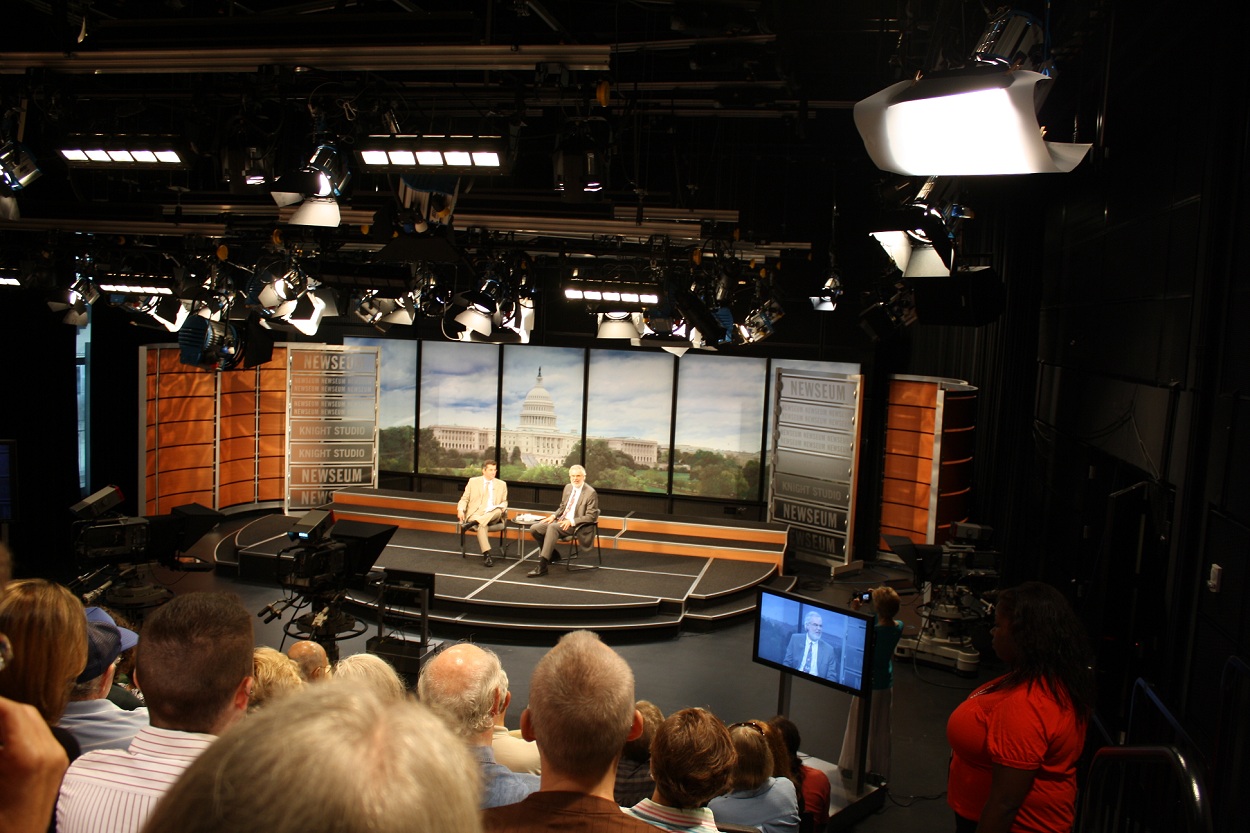
Newseum program, audience view

Getting It Wrong, my new book about media-driven myths, was launched at a terrific program yesterday at the Newseum, the $450 million museum of news in downtown Washington, D.C.

The Newseum’s John Maynard moderated a brisk “Inside Media” talk, during which I reviewed the myths of:

  • William Randolph Hearst’s purported vow to “furnish the war” with Spain,
  • Edward R. Murrow‘s  1954 See It Now television program that supposedly ended Senator Joseph R. McCarthy’s communists-in-government witch-hunt,
  • the so-called “Cronkite moment” of 1968,
  • the heroic-journalist of Watergate, and
  • the supposedly superlative reporting in the immediate aftermath of Hurricane Katrina‘s landfall in 2005.

The audience (see photo, above) posed several intriguing questions about the book. Among them was whether I thought the media myths confronted in Getting It Wrong would now be forever buried.

It’s probably too soon to say, given the book’s recent publication. But I mentioned in my reply that I’ve been struck by how dearly some myths are held.

The myth of the “Cronkite moment” is an example, I said: It seems quite difficult for some people to believe that Walter Cronkite’s program on Vietnam in February 1968 was not of decisive effect.

The “Cronkite moment” may live on, and continue to be embraced, despite the weight of the evidence that Cronkite’s television report about Vietnam was of scant importance in revising policy or in shaping the president’s thinking about reelection.

At the book launch

A question was posed about how media myths emerge, and I noted that they arise from several sources, including an urge to identify examples of media power. Another factor is  what I call “complexity-avoidance”–the appeal of simplified explanations for complex historical events.

It is, after all, far easier to believe that Hearst and his “yellow press” brought on the Spanish-American War in 1898, I said, than it is to grasp the complexities of the failed diplomacy among Spain, Cuba, and the United States that gave rise to that conflict. It is far easier to believe that the Washington Post brought down Richard Nixon’s corrupt presidency, I said, than it is to sort through tangled lines of investigation of the Watergate scandal that ultimately forced Nixon from office.

Even then, I said, Nixon may have served out his term if not for the tape-recordings he made of his private Oval Office conversations. Those tapes, which the U.S. Supreme Court forced Nixon to produce in 1974, revealed his guilty role in the Watergate coverup.

I also was asked whether there are other media myths to bust.

Indeed there are, I said.

Getting It Wrong may deserve a sequel and suggested as candidates for a follow-on book the dubious phenomenon of “Pharm Parties” and the question of whether Cronkite really was “the most trusted man in America.”

Book signing at Newseum

I signed copies of Getting It Wrong following the “Inside Media” program, and then toasted the book’s publication at a reception sponsored by the Newseum and American University’s School of Communication.

The School’s dean, Larry Kirkman, offered generous remarks in his toast at the reception, which was attended by AU colleagues, former students, past research assistants, and friends and family.

WJC

Related:

Photo credits:

  • Ruxandra Giura (audience view)
  • Bruce Guthrie