W. Joseph Campbell

Posts Tagged ‘New York Times’

Recalling who gave us the ‘manufactured heroism’ of Jessica Lynch

In Debunking, Jessica Lynch, Media myths, Watergate myth on August 22, 2011 at 5:09 am

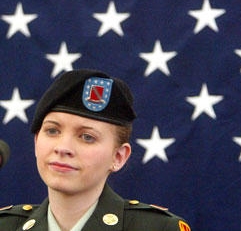
Lynch: No hero, she

I’ve noted how remarkable it is that the Washington Post so thoroughly eludes censure for placing the bogus hero-warrior tale about Jessica Lynch into the public domain during the first days of the Iraq War.

Confirmation of that observation came yesterday in an otherwise thoughtful essay in the New York Times about the deference Americans across the political spectrum tend to pay the military.

The essay described the Lynch case not as a stunning example of errant journalism but as “an instrument of propaganda.”

The essay, written by William Deresiewicz, asserts that in 2003, “we were treated to the manufactured heroism of Jessica D. Lynch, the young supply clerk who was rescued from an Iraqi hospital a few days after her capture by enemy forces (both events turning out to be far less cinematic than initially put out) and who finally felt compelled to speak out against her own use as an instrument of propaganda.”

Great line, “manufactured heroism.”

But who really was responsible for the “manufactured heroism”?

Deresiewicz avoids saying.

He fails to identify the Washington Post as solely responsible for placing the hero-warrior tale about Lynch into worldwide circulation.

He doesn’t say that the Post’s botched story about Lynch’s purported heroics was picked up by news organizations around the world, turning the 19-year-old Army private into the best-known American solider of the Iraq War.

WaPo's botched hero-warrior story

It was the Post, citing otherwise unnamed “U.S. officials,” that offered up the electrifying tale about how Lynch “fought fiercely and shot several enemy soldiers after Iraqi forces ambushed” her unit, the 507th Maintenance Company, in Nasiriyah on March 23, 2003.

It was the Post that reported Lynch “continued firing at the Iraqis even after she sustained multiple gunshot wounds and watched several other soldiers in her unit die around her” in the fighting.

None of it was true, however.

Lynch never fired a shot in Iraq. Her weapon jammed during the ambush. Her shattering injuries were suffered in the crash of a Humvee as it fled the attack.

It wasn’t long before the Post’s erroneous report about Lynch’s derring-do began to unravel.

But as I discuss in my latest book, Getting It Wrong, the newspaper in the years since has never fully explained how it got the Lynch story so badly wrong.

Nor has the Post ever identified the sources who led it so badly astray.

And why has the Post sidestepped blame for the botched Lynch narrative? Why isn’t the newspaper more routinely cited in essays, such as Deresiewicz’s, that invoke the Lynch case?

It’s principally because details of the Lynch case have been subordinated to a far more sinister narrative that says the Pentagon conjured the hero-warrior tale about the waif-like young woman in order to bolster popular support for the Iraq War.

It’s a perversely appealing narrative — and it’s quite false.

As Vernon Loeb, one of the Post reporters who shared a byline on the botched Lynch story in 2003, has said:

“Our sources for that story were not Pentagon sources.”

Loeb also said, in an interview that aired on NPR’s Fresh Air program in mid-December 2003:

“I just didn’t see the Pentagon trying to create a hero where there was none. I mean …they never showed any interest in doing that, to me.”

Loeb said the story was provided by “some really good intelligence sources” in Washington, D.C., adding:

“We wrote a story that turned out to be wrong because intelligence information we were given was wrong. That happens quite often.”

As I note in Getting It Wrong, Loeb on another occasion was quoted in the New York Times as saying:

“Far from promoting stories about Lynch, the military didn’t like the story.”

What’s more, the notion the Pentagon’s made up the story  — and somehow fed it to the Post — to bolster popular support for the war doesn’t make much sense. After all, the American public in overwhelming numbers supported the war in its early days and months.

But it’s clear that if not for the Post, the “manufactured” tale of Lynch’s heroism never would have circulated as it did.

Far from being an “instrument of propaganda,” the Lynch hero-warrior narrative is a case of bungled reporting that has never been adequately explained, let alone corrected.

WJC

Recent and related:

Media myth infiltrates NYTimes ‘Learning Network’

In 1897, Debunking, Furnish the war, New York Times, Spanish-American War on August 13, 2011 at 12:06 am

The New York Times’ Learning  Network” blog declares says it provides “teaching and learning materials and ideas” based on the newspaper’s archival content.

Its entry yesterday was pegged to the 113th anniversary of the effective end of the Spanish-American War — and offered up a hoary media myth in discussing newspaper coverage of the conflict.

The Times item stated:

Support for the Spanish-American War was stirred by sensationalist accounts of Spanish wrongdoing in the newspapers of [William] Randolph Hearst and Joseph Pulitzer; according to legend, Hearst told an illustrator covering the war, ‘You furnish the pictures and I will furnish the war.'”

It’s highly debatable whether much support for the war was generated by the newspapers of Hearst and Pulitzer. There is considerable evidence to suggest that their newspapers had little if any agenda-setting effect on the administration of President William McKinley on the question of going to war with Spain over Cuba in 1898.

And it’s virtually certain that Hearst’s purported vow to “furnish the war” is apocryphal.

As I discuss in my latest book, Getting It Wrong, the anecdote about “furnish the war” is a hardy media myth that lives on despite concerted attempts to dismantle and debunk it.

The vow supposedly was contained in a telegram sent to the artist, Frederic Remington, who was in Cuba on assignment for Hearst’s New York Journal. Remington and the correspondent Richard Harding Davis were there to cover the rebellion against Spain’s harsh colonial rule — a rebellion that gave rise in 1898 to the Spanish-American War.

Remington and Davis reached Havana in early January 1897; Remington stayed just six days.

Before leaving for New York by passenger steamer, Remington supposedly cabled Hearst, stating:

“Everything is quiet. There will be no war. I wish to return.”

Hearst is said to have replied:

Please remain. You furnish the pictures, and I’ll furnish the war.”

But Remington didn’t remain in Cuba.

He promptly returned to New York, where his sketches received prominent display in Hearst’s Journal. They appeared beneath such flattering headlines as:

“Cuban War Sketches Gathered in the Field by Frederic Remington; The Gifted Artist, Visiting Cuba Especially for the Journal.”

That’s scarcely the kind of tribute Hearst would have given a wayward artist who ignored instructions to “remain” in Cuba.

I further note in Getting It Wrong that the myth about Hearst’s vow “lives on despite an irreconcilable internal inconsistency: It would have been absurd for Hearst to vow to ‘furnish the war’ because war — specifically, the Cuban rebellion against Spain’s colonial rule — was the very reason Hearst sent Remington to Cuba in the first place.”

Anyone reading U.S. newspapers in early 1897 “would have been well aware,” I point out, “that Cuba was a theater of a nasty war” of rebellion.

Not only that, but the artifacts — the telegrams reputedly exchanged by Remington and Hearst — have never surfaced. Spanish censors closely monitored incoming and outgoing telegraphic traffic in Havana and they surely would have intercepted and called attention to Hearst’s incendiary message, had it been sent.

For those and other reasons, the tale about the Remington-Hearst exchange is surely apocryphal — a myth too often presented as fact.

The “Learning Network” isn’t off the hook by couching its reference to the purported Remington-Hearst exchange as “legend.” If the blog had doubts about the veracity of Heart’s purported vow, then it ought not have mentioned it in the first place.

WJC

Recent and related:

He ‘did a Zhou Enlai’

In Cronkite Moment, Debunking, Media myths, New York Times on July 26, 2011 at 10:15 am

Cohen (NYTimes photo)

Roger Cohen, a twice-a-week foreign affairs columnist for the New York Times, stirred murmured commentary not long by defending Rupert Murdoch as a phone-hacking scandal swirled around the tycoon’s media holdings in Britain.

“If you add everything up,” Cohen wrote about the tough, old media mogul, “he’s been good for newspapers over the past several decades, keeping them alive and vigorous and noisy and relevant.”

Maybe Cohen was being contrarian. Or maybe he didn’t quite grasp what the scandal says about Murdoch and his corporate management.

In a more recent column, Cohen revealed that he’s not fully up to speed with the revised interpretation of Zhou Enlai’s famous comment in 1972 that “it’s too early” to discern the implications of upheaval in France.

The conventional interpretation is that Zhou was speaking about the French Revolution that began in 1789.

As such, his comment suggests a sagacity and a long view of history seldom matched by Western leaders.

Recent evidence has emerged, however, that says Zhou was referring not to the French Revolution but to the more recent political unrest that rocked France in 1968.

The new evidence was offered last month by Charles W.  (Chas) Freeman Jr., a retired U.S. diplomat who a was present when Zhou made the comment during President Richard Nixon’s visit to China in February 1972.

Freeman discussed the context of Zhou’s remark last month at a panel discussion in Washington, D.C. London’s Financial Times was first to report on the revised interpretation that Freeman offered about Zhou’s comment.

In a subsequent interview with me, Freeman said that Zhou made the remark during a discussion about revolutions that had failed or succeeded.

He pointed out that it was clear from the context that Zhou’s “too early to say” comment was in reference to upheaval in France in May 1968, not the years of turmoil that began in 1789.

Freeman described Zhou’s misinterpreted comment as “one of those convenient misunderstandings that never gets corrected,” adding that “it conveniently bolstered a stereotype … about Chinese statesmen as far-sighted individuals who think in longer terms than their Western counterparts.”

The misconstrued comment fit nicely with “what people wanted to hear and believe,” Freeman said, “so it took” hold.

And it’s not infrequently repeated.

Cohen invoked the conventional interpretation late last week, in a column that began this way:

“When I asked Gen. David H. Petraeus what the biggest U.S. mistake of the past decade has been, he did a Zhou Enlai on the French Revolution number to the effect that it was too early to say.

“The outgoing commander in Afghanistan and incoming Central Intelligence Agency chief is adept at politics,” Cohen wrote, “one reason he’s the object of the sort of political speculation once reserved for Gen. Colin L. Powell, who was the face of the military to most Americans before Petraeus assumed that role later in the post-9/11 era.”

The passage, “he did a Zhou Enlai,” suggests how irresistible Zhou’s misconstrued remark really is — a quality that’s typical of quotations that seem just too highly polished.

“Turns of phrase that sound too neat and tidy often are too perfect to be true,” I write in my latest book, Getting It Wrong, which addresses and debunks 10 prominent media-driven myths.

Among the myths is the remark attributed to President Lyndon B. Johnson, who after watching Walter Cronkite’s pessimistic, on-air assessment about the Vietnam War supposedly said:

“If I’ve lost Cronkite, I’ve lost Middle America.”

Or something to that effect.

Versions vary markedly.

But as I discuss in Getting It Wrong, the anecdote is almost certainly apocryphal.

Johnson wasn’t in front of a television when Cronkite’s special report about Vietnam aired on CBS television on February 27, 1968.

The president wasn’t lamenting the supposed loss of Cronkite’s support, either.

Rather, Johnson was on the campus of the University of Texas at Austin, offering light-hearted banter at the 51st birthday party of a longtime political ally, Governor John Connally.

At about the time Cronkite was saying the U.S. war effort was “mired in stalemate,” Johnson was quipping:

“Today you are 51, John. That is the magic number that every man of politics prays for — a simple majority.”

WJC

Recent and related:

More media myths from CounterPunch

In Bay of Pigs, Debunking, Furnish the war, Jessica Lynch, Media myths, Washington Post, Watergate myth on July 24, 2011 at 8:30 am

CounterPunch touts itself as “America’s best political newsletter.”

It’s building a reputation for indulging in media-driven myths, too.

Since mid-March, essays posted at CounterPunch have:

CounterPunch has indulged yet again in media myth, in a commentary in its weekend edition about Rupert Murdoch’s troubled media empire.

CounterPunch claimed the tough old media mogul has “surpassed William Randolph Hearst,” press baron of the 19th and early 20th centuries, “in practicing yellow journalism.”

The commentary invoked the hoary media myth about Hearst’s purported vow to “furnish the war” with Spain.

According to CounterPunch, Hearst said: “Get me the photos and I’ll get you the war.”

That was, CounterPunch added, “Hearst’s 1898 dictum to help start the Spanish-American War.”

Provocative tale. But it’s pure media myth.

Hearst’s vow is almost surely apocryphal, for reasons I discuss in my myth-busting book, Getting It Wrong, which came out last year.

Among the reasons:  The telegram that supposedly contained Hearst’s vow — a cable sent to artist Frederic Remington, on assignment to Cuba — has never turned up.

More significantly, as I point out Getting It Wrong, the anecdote about Hearst’s purported vow suffers from “an irreconcilable internal inconsistency.”

That is, it would have been absurd and illogical for Hearst to have vowed to “furnish the war” because war — specifically, the Cuban rebellion against Spain’s colonial rule — was the reason he sent Remington to Cuba in the first place.

In addition, the Spanish colonial authorities who ruled Cuba closely controlled and censored incoming and outgoing telegraphic traffic: They surely would have intercepted and called attention to Hearst’s incendiary telegram, had it been sent.

But in fact, there was, as I write in Getting It Wrong, no chance that telegrams would have flowed freely between Remington in Cuba and Hearst in New York.

So “furnish the war” (or, “provide the war”) wasn’t at all Hearst’s “dictum to help start the Spanish-American War.”

That Hearst helped bring on the war with Spain is a media myth, too.

It’s a myth dismantled in my 2001 book, Yellow Journalism: Puncturing the Myths, Defining the Legacies, in which I pointed out that the yellow press of Hearst and his rival, Joseph Pulitzer, “is not to blame for the Spanish-American-War.

“It did not force — it could not have forced — the United States into hostilities with Spain over Cuba in 1898.

“The conflict was, rather, the result of a convergence of forces far beyond the control or direct influence of even the most aggressive of the yellow newspapers, William Randolph Hearst’s New York Journal.”

The proximate cause of the war was the humanitarian crisis created by Spain’s bungled attempts to quell a rebellion that had begun in Cuba in 1895 and had spread across the island by 1897, when Remington arrived in Havana on assignment for Hearst.

WJC

Recent and related:

The digital age ‘equivalent of the OJ Simpson trial’? Not quite

In Debunking, Media myths on July 7, 2011 at 9:02 am

Anthony mug shot

The stunning acquittal of Casey Anthony on the most serious charges in the slaying of her 2-year-old daughter has invited comparisons to the outcome of O.J. Simpson’s double-murder trial in 1995.

Those comparisons are mostly misleading.

The “Media File” blog of the Reuters news agency, for example, likened the Anthony verdict to the digital age “equivalent of the OJ Simpson trial.”

Simpson was found not guilty in October 1995 of the stabbing deaths of his former wife, Nicole, and her friend, Ron Goldman.

“Media File,” which was one of several outlets to detect parallels in the two cases, noted:

“Word of the verdict spread like wildfire … making a return to a normal life for newly-famous Anthony as unlikely as it was for already-famous Simpson 16 years ago.”

The blog also declared:

“Just as some greeted the Simpson verdict with tears and disbelief, there was much the same reaction about the Anthony verdict, including other mothers and daughters who railed against the verdict on the courthouse steps.

“Unlike OJ, who was accused of stabbing his [former] wife and one of her friends to death in a fit of jealous rage, there didn’t seem to be even the smallest cheering section for Anthony. Then again she was accused of murdering her two-year-old daughter, whose skeletal remains were found near the family home with duct tape dangling from her skull.

“Anthony’s defense was considerably less adamant than Simpson’s ‘100% not guilty’ plea, but, like Simpson, she did not take the stand in her own defense.”

While interesting, the parallels are mostly superficial and unrevealing.

The Anthony proceedings in Florida hardly were in the league of the O.J. trial in Los Angeles.

Casey Anthony, unlike Simpson, was no national celebrity before she was tried on charges of killing her daughter, Caylee.

As Marcia Clark, the prosecutor who lost the Simpson trial, said of Anthony:

“She never wowed the nation with her athletic prowess, shilled in countless car commercials, or entertained in film comedies.” Simpson had been a star football player, a pitchman for the Hertz car rental company, and a supporting actor in movies such as The Naked Gun.

Race — a central, defining factor in Simpson’s trial — was absent in the Anthony trial.

As such, the verdict in her case, surprising though it was, prompted nothing akin to the divisive, clashing reactions that greeted Simpson’s acquittal: Many whites reacted with shock and disbelief while many blacks cheered the outcome.

Significantly, the Anthony case produced nothing akin to the moment at the end of the Simpson trial, when the country held its collective breath and awaited the verdicts.

The Simpson jury deliberated less than four hours before deciding the case on October 2, 1995.  The hapless judge who presided over the 134-day trial, Lance Ito, announced that the verdicts would be read the following day, at 10 a.m. Pacific time, 1 p.m. Eastern.

As that hour approached on October 3, 1995, the country seemed almost to shut down. The New York Times reported that for 10 minutes, from 1 p.m. to 1:10 p.m. Eastern, “people didn’t work. They didn’t go to math class. They didn’t make phone calls. They didn’t use the bathroom. They didn’t walk the dog.

“They listened to the O.J. Simpson verdicts,” in what the newspaper accurately called “an eerie moment of national communion, in which the routines and rituals of the country were subsumed by an unquenchable curiosity.

“Millions of people in millions of places seemed to spend 10 spellbinding minutes doing exactly the same thing.”

Those minutes represented an exceptional occasion of collective anticipation, an almost incomparable moment.

For the collective anticipation they generated, the final moments in the Simpson case were rivaled perhaps only by the first manned lunar landing in July 1969.

WJC

Recent and related:

Newspapers vital to democracy? Where’s the proof?

In Debunking, Media myths, Newspapers on June 28, 2011 at 11:19 am

It’s a truism — a media myth, even — that independent-minded newspapers are “a vital bulwark” to democracy. It’s a claim easily made but supported by little persuasive evidence.

Hedges

Chris Hedges, a former New York Times foreign correspondent, is the latest commentator to invoke the “vital bulwark” conceit, offering it up in a lengthy essay posted yesterday at Truthdig.com.

Hedges’ is an angst-ridden ode to newspapering. He writes: “The day The New York Times and other great city newspapers die, if such a day comes, will be a black day for the nation.”

Why is that?

Hedges claims that a “democracy survives when its citizens have access to trustworthy and impartial sources of information, when it can discern lies from truth, when civic discourse is grounded in verifiable fact.”

But in saying so, Hedges offers more assertion than evidence.

Media pluralism is a marker of democratic governance, not its essential precondition.

The countries that New York-based Freedom House ranks highest in measures of press freedom are functioning democracies.

Democratic rule enables media pluralism, not the other way round.

What’s more, the American experience with even nominally impartial news media has been relatively brief. Democratic governance emerged, evolved, and became consolidated in America despite the absence of “trustworthy and impartial sources of information” that Hedges extols.

American media history has been defined mostly by a vigorously partisan press.

And of course, unabashedly partisan newspapers still characterize the media landscape of such well-established democracies as Britain.

The ethos of detached impartiality news coverage began to emerge in the United States in the late 19th century, as I discuss in my 2006 book, The Year That Defined American Journalism. But that approach to newsgathering took years to develop, years to become the normative standard in American journalism.

Detached impartiality is taught nowadays in journalism schools. It is the dominant professional paradigm. But that doesn’t mean it’s rigorously respected or routinely practiced.

Nor is much of the content of American newspapers necessarily vital to the functioning of a democracy. As Jack Shafer pointed out in a memorable commentary a couple of years ago:

“Even an excellent newspaper carries only a few articles each day that could honestly be said to nurture the democratic way. Car bomb in Pakistan? Drug war in Mexico? Flood in North Dakota? Murder in the suburbs? Great places to get Thai food after midnight? A review of the Britney Spears concert? New ideas on how to serve leftover turkey? The sports scores? The stock report? Few of these stories are likely to supercharge the democratic impulse.”

A little-studied phenomenon of American democratic life is that of going newsless, of choosing to avoid the news, impartial or not.

According to data compiled by the Pew Research Center and released last year, 17 percent of adult Americans  receive no news on a typical day. They eschew the news despite ready access to a variety of news-delivery platforms, both traditional and digital.

More than 25 percent of American of adults younger than 30 say they go newsless, according to Pew. In the 18-to-24 age cohort, 31 percent say they go without the news.

And yet American democracy functions, if not flourishes, in its messy, often-frustrating ways.

No doubt some slice of “newsless” population is turned off by perceived distortion in the content offered by the nominally impartial, even-handed news media.

Just 20 percent of respondents in the Pew study said they believed all or most of what they read in the New York Times; 25 percent said they believed all or most of what they read in the Wall Street Journal.

That figure for “your daily newspaper” was 21 percent, Pew reported.

So even if they nominally strive for even-handedness and impartiality, leading U.S. newspapers face steep believability problems.

Hedges, it’s interesting to recall, is no model of the impartial journalist.

He notes in his essay that he left the Times because of his “vocal and public opposition to the war in Iraq,” saying he “cared more about truth than news.”

WJC

Recent and related:

Appearance decisive in politics? Revisiting the Kennedy-Nixon debate

In Debunking, Media myths on June 23, 2011 at 4:04 am

First presidential debate, 1960

The power of the image in presidential politics was never better demonstrated than in September 1960.

That was when John F. Kennedy supposedly won the first-ever televised debate between U.S. presidential candidates because he appeared so poised, rested, and telegenic compared to his sweaty, haggard-looking rival, Richard M. Nixon.

Most television viewers thought so, supposedly.

But people who listened to the debate on radio had a distinctly different impression: They thought Nixon won the encounter.

So goes one of the most delicious, enduring, and often-repeated myths about the American media and politics, which was served up yesterday in a commentary posted online yesterday by Canadian-based Troy Media.

The commentary declared:

“The major story of the first televised presidential debate in 1960 became the photogenic appeal of John F. Kennedy versus the sickly look of his opponent, Richard Nixon. … Radio listeners, who heard the debate but hadn’t seen it, gave the victory to Nixon. But a large majority of television viewers recognized Kennedy as the winner.”

The myth of viewer-listener disagreement — that television viewers and radio listeners had starkly different impressions of the inaugural presidential debate — was destroyed (or ought to have been) in research published in 1987 by David L. Vancil and Sue D. Pendell.

They noted that reports of viewer-listener disagreement were thin, flawed, and anecdotal, and the few surveys that hinted at a viewer-listener disconnect were too small and unrepresentative to allow for confident assessments.

Vancil and Pendell concluded:

“The relationship of substance and appearance is complex, and the effects of electronic media on political communication surely deserve attention. However, there is little merit in speculation based upon unsupported anecdotes of the first Kennedy-Nixon debate.”

Vancil and Pendell’s research also challenged the notion that Nixon’s haggard look much contributed to views about the debate.

“Appearance problems, such as Nixon’s perspiring brow, could have had a negative impact on viewer perceptions,” they wrote, “but it is also possible for viewers to be sympathetic to such problems, or to interpret them as evidence of attractive or desirable qualities.”

They added: “Even if viewers disliked Nixon’s physical appearance, the relative importance of this factor is a matter of conjecture.”

It’s revealing to note that a good deal of post-debate commentary deemed the encounter a draw.

For example, James Reston, then the Washington bureau chief for the New York Times, wrote shortly after the debate: “Who took the first round is a matter of individual opinion. My own view is that Kennedy gained more than Nixon, but it was a fielder’s choice, settling nothing.”

But the Washington Post saw it another way, stating in a post-debate editorial:

“Of the two performances, Mr. Nixon’s was probably the smoother. He is an accomplished debater with a professional polish, and he managed to convey a slightly patronizing air of a master instructing a pupil.”

Right after the Kennedy-Nixon encounter, the Associated Press conducted an unscientific survey of 100 Americans in 10 major U.S. cities and reported that most respondents said they weren’t influenced by the exchanges.

“Only a few persons,” the AP reported, “said they had actually switched from one candidate to the other because of the debate.”

And it was hardly the case that “a large majority of television viewers recognized Kennedy as the winner” of the debate, as the Troy Media commentary claimed.

A Gallup poll conducted during the week after the debate and released October 11, 1960, reported that 43 percent of voters thought Kennedy “did the better job” in the debate; 23 percent thought Nixon was better, and 29 percent said both candidates were about the same. Five percent offered no opinion.

The survey, moreover, detected no marked shift of support to Kennedy, post-debate. The survey reported Kennedy to be narrowly ahead, by 49 percent to 46 percent, with 5 percent undecided.

“The prudent reader can see,” George Gallup, head of the polling organization, stated in reporting those results, “that polling accuracy has not reached the degree of accuracy required to say with certainty which candidate is ahead in a close race such as the present one.”

WJC

Recent and related:

NYT’s Keller and the dearth of viewpoint diversity in newsrooms

In Debunking, Jessica Lynch, Media myths, New York Times on June 20, 2011 at 4:36 pm

I enjoy Bill Keller‘s column in the New York Times Sunday magazine, not so much for strength of argument and depth of reporting as for its tendency to offer grist to Media Myth Alert.

Keller of the Times

Keller’s assertion a few months ago that the Times corrects errors of fact when it detects them prompted me to point out that the Times hadn’t corrected an erroneous reference in January to the Army-McCarthy hearings.

And I’m still waiting for that correction.

In his most recent column, Keller poked at Sarah Palin, the former Alaska governor who’s flirting with the notion of making a run for president. Ill-fated that would be.

But Keller’s column — especially its opening observation — revealed more about the dearth of intellectual diversity and contrarian thinking in American journalism than it did about the limited appeal of Sarah Palin.

Keller, the Times executive editor, wrote blithely:

“If the 2012 election were held in the newsrooms of America and pitted Sarah Palin against Barack Obama, I doubt Palin would get 10 percent of the vote. However tempting the newsworthy havoc of a Palin presidency, I’m pretty sure most journalists would recoil in horror from the idea.”

Keller’s probably correct.

Ten percent of the U.S. newsroom vote may even be a generous assessment.

But rather than consider the implications of such intellectual lopsidedness, Keller breezily wrote that “watching Palin answer a question is like watching a runaway train struggling to stay on the rails, and fact-checking her is like fishing with dynamite.”

OK, that’s amusing.

But in acknowledging and then sidestepping the larger matter of viewpoint diversity in the newsroom, Keller left a more compelling issue unaddressed.

A broad-based ongoing discussion about the dearth of intellectual diversity in the newsroom — why so few American journalists self-identify as politically conservative — would be beneficial to American journalism.

As I note in my latest book, Getting It Wrong, which came out last year, intellectual diversity and contrarian thinking are objectives that deserve to be vigorously promoted in American newsrooms.

“It is certainly not inconceivable,” I write in Getting It Wrong, “that a robust newsroom culture that embraces viewpoint diversity, encourages skepticism, invites challenges to dominant narratives, and rewards contrarian thinking would have helped thwart publication of embarrassing tales such as the Washington Post’s ‘fighting to the death’ story about Jessica Lynch.”

The Post’s bogus front-page story in 2003 about Lynch’s supposed battlefield heroics in Iraq catapulted her to international fame and celebrity. The newspaper has never fully explained how it botched the Lynch story and has never identified the anonymous sources that led it astray.

To its credit, the Post has raised the issue of limited intellectual diversity in the newsroom.

Notably, Deborah Howell, the newspaper’s former ombudsman, wrote in mid-November 2008 that more “conservatives in newsrooms and rigorous editing would be two” ways to confront what she termed “the perception of bias” in political coverage. (The week before, Howell had reported a “tilt” in the Post’s 2008 campaign coverage, in Obama’s favor.)

In her column about perception bias, Howell wrote:

“I’ll bet that most Post journalists voted for Obama. I did. There are centrists at The Post as well. But the conservatives I know here feel so outnumbered that they don’t even want to be quoted by name in a memo.”

Tellingly, Howell quoted Tom Rosenstiel of the Project for Excellence in Journalism as saying:

“The perception of liberal bias is a problem by itself for the news media. It’s not okay to dismiss it. Conservatives who think the press is deliberately trying to help Democrats are wrong.

“But conservatives are right that journalism has too many liberals and not enough conservatives. It’s inconceivable that that is irrelevant.”

Rosenstiel called for “more intellectual diversity among journalists” and was further quoted by Howell as saying:

“More conservatives in newsrooms will bring about better journalism.”

I wonder what Keller would say to that.

I offer it as grist for one of his columns.

WJC

Many thanks to Instapundit
Glenn Reynolds for linking to this post

Recent and related:

On Gingrich, JFK, and the appearance factor in presidential debates

In Debunking, Media myths on June 13, 2011 at 11:19 am

First presidential debate, 1960

The first televised presidential debate set a standard for American politics.

A myth-encrusted standard.

John F. Kennedy supposedly won that debate in September 1960 because he looked so much more rested and telegenic than his rival, Richard M. Nixon. There is, however, scant evidence to support that notion, which was revived yesterday in a commentary at the Daily Caller blog.

The commentary suggested that Newt Gingrich’s beleaguered presidential campaign might find a spark during tonight’s debate in New Hampshire among seven Republicans seeking the presidency.

In 1960, the Daily Caller commentary stated, “then-Sen. John F. Kennedy reportedly spent the day of his big debate against Vice President Richard Nixon getting a sun tan and resting. Nixon, on the other hand, spent the day rigorously campaigning (he also didn’t wear makeup). It worked for Kennedy who, thanks to the advent of TV, ‘won’ the debate. A rested Gingrich might likewise perform well in Monday’s debate in New Hampshire.”

Gingrich’s hopes to win the presidency probably were destroyed with last week’s mass departure of top campaign staffers and advisers. But his long-shot candidacy is of scant interest to Media Myth Alert. Far more compelling is the Daily Caller’s claim about the presidential debate in September 1960.

It’s important to note that most commentary in the debate’s immediate aftermath called the Kennedy-Nixon encounter a draw.

For example, James Reston, then the Washington bureau chief for the New York Times, wrote in a post-debate column: “Who took the first round is a matter of individual opinion. My own view is that Kennedy gained more than Nixon, but it was a fielder’s choice, settling nothing.”

The Washington Post, on the other hand, said in a post-debate editorial:

“Of the two performances, Mr. Nixon’s was probably the smoother. He is an accomplished debater with a professional polish, and he managed to convey a slightly patronizing air of a master instructing a pupil.”

The St. Louis Post-Dispatch hedged in its assessment, declaring: “We should not say that anybody won. … They both looked pretty young to us.”

Immediately after the Kennedy-Nixon encounter, the Associated Press conducted an unscientific survey in 10 major U.S. cities and reported that most respondents said they hadn’t been influenced by the exchanges. “Only a few persons,” according to AP, “said they had actually switched from one candidate to the other because of the debate.”

In the months afterward, Nixon’s sweaty brow and haggard appearance during the debate emerged as factors supposedly decisive to the outcome of the encounter — and to the 1960 election. Such claims, however, rest on more on conjecture than compelling evidence.

David L. Vancil and Sue D. Pendell wrote in a revealing journal article published in 1987 that “the inference that appearance problems caused Nixon’s loss, or Kennedy’s victory [in the debate], is classic post hoc fallacy.

“Appearance problems, such as Nixon’s perspiring brow, could have had a negative impact on viewer perceptions, but it is also possible for viewers to be sympathetic to such problems, or to interpret them as evidence of attractive or desirable qualities.”

That is, Nixon’s sweating under hot television lights could have stirred viewers empathy, making them feel more kindly toward the Republican candidate. It’s a plausible supposition.

Vancil and Pendell also wrote:

“Even if viewers disliked Nixon’s physical appearance, the relative importance of this factor in viewers’ selection of a debate winner is a matter of conjecture.”

A Gallup poll conducted during the week following the debate and released October 11, 1960, reported that 43 percent of voters thought Kennedy “did the better job” in the debate, which was the first of four during the 1960 fall campaign. Twenty-three percent thought Nixon was better; 29 percent said both candidates were about the same. Five percent offered no opinion.

But the poll did not specifically address the appearance of either candidate; nor did the poll detect a sharp swing of support to Kennedy. The survey reported Kennedy to be narrowly ahead, by 49 percent to 46 percent, with 5 percent undecided.

That result represented a slight change from a Gallup survey taken just before the debate, which reported Nixon leading by 47 percent to 46 percent.

But Gallup termed the post-debate shift too slight to be meaningful.

“The prudent reader can see,” George Gallup, head of the polling organization, stated in reporting the results, “that polling accuracy has not reached the degree of accuracy required to say with certainty which candidate is ahead in a close race such as the present one.”

By the way, Kennedy didn’t take off the day of the debate to rest and work on his tan, as the Daily Caller commentary said. The Chicago Tribune reported that Kennedy received “a boisterous welcome” in an appearance that afternoon at a carpenters union convention in Chicago, the debate’s host city.

WJC

Recent and related:

Why they get it wrong

In Bay of Pigs, Cronkite Moment, Debunking, Furnish the war, Jessica Lynch, Media myths, New York Times, Newspapers, Washington Post, Watergate myth on June 3, 2011 at 6:49 am

It’s striking how several well-known journalists and news outlets have indulged over last six months in media-driven myths, those dubious tales about the news media that masquerade as factual.

The lineup of myth-indulgers is impressive and, among others, includes:

  • Bill Keller, executive editor of the New York Times, who rubbed shoulders with the Bay of Pigs suppression myth in a column in the Times in January. The suppression myth holds that at the behest of President John F. Kennedy, the Times killed or emasculated its report about the pending Bay of Pigs invasion in 1961. That tale is unfounded, as I discuss in my latest book, Getting It Wrong.
  • Mother Jones magazine which, in its May/June cover story by Rick Perlstein, offered up a rare two-fer — two media myths discussed in a single article. One of the myths was the hoary and surely apocryphal tale about William Randolph Hearst and his reputed vow to “furnish the war” with Spain. The other was about the so-called the “Cronkite Moment” of 1968, in which Walter Cronkite’s on-air assessment that the U.S. military was “mired in stalemate” in Vietnam was so powerful as to alter U.S. policy.
  • Keith Olbermann, the acerbic cable television commentator who, as he quit his prime-time Countdown show in January, referred to the  “exaggerated rescue” of Army private Jessica Lynch in the early days of the Iraq War. Such claims, raised as long ago as 2003, were unsubstantiated by an inquiry of the Defense Department’s inspector general who found the rescue operation was found to have been “a valid mission” to recover Lynch, a prisoner of war, “under combat conditions.”

What accounts for such lapses by prominent journalists and their outlets? Why do these and other media-driven myths often find their way into news reports and commentaries?

Some media myths are just too good not to be true; they almost are too good to take time to check out. The tale about Hearst’s vowing to “furnish the war” certainly falls into this category. It shouldn’t be at all difficult to locate references to the dubious character of the anecdote, which has been the subject of repeated debunking over the years.

Likewise, it can be far easier to invoke a media myths that to commit to the tedium of research and legwork. Media myths are convenient, readily at hand. Poking into their details takes time, and a willingness to challenge what are accepted as consensus narratives.

As I noted in discussing Keller’s column that invoked the Bay of Pigs suppression myth:

“Had Keller consulted the newspaper’s database of reporting about the run-up to the Bay of Pigs invasion in April 1961, he would have found that the Times reported in detail, if not always accurately, about the preparations to infiltrate a U.S.-trained brigade of Cuban exiles in an attempt to topple Fidel Castro.”

Similarly, some media myths (such as the illusory “Cronkite Moment“) may be too ingrained, too dearly held by journalists, ever to be uprooted or thoroughly repudiated.

Unlearning such tales is no small challenge, after all. The conundrum of unlearning was addressed a few months ago in a Wall Street Journal column, which noted:

“For adults, one of the most important lessons to learn in life is the necessity of unlearning. We all think that we know certain things to be true beyond doubt, but these things often turn out to be false and, until we unlearn them, they get in the way of new understanding.”

Media myths also can be convenient means of scoring political points. The two-fer in Mother Jones magazine, for example, were presented as part of a sneering attack about “fact-free” Republicans.

Moreover, media myths — the most prominent of them, anyway — resonate in contemporary contexts.

History, it has been said, is “what we decide to remember,” and journalism history is not an exception. Recalling and celebrating the memory of Cronkite’s supposedly telling truth to power about Vietnam — or of Bob Woodward and Carl Bernstein’s bringing down a corrupt presidency — is to offer reassurance to contemporary journalists at a time of confusion and upheaval in their field.

Deciding to remember such mythical tales is understandable if not justifiable, given that those tales bring solace and reassurance amid sweeping uncertainty.

WJC

Recent and related: