W. Joseph Campbell

Posts Tagged ‘News’

Keller no keeper of the flame on famous NYT motto

In 1897, Anniversaries, Debunking, New York Times, Newspapers, Year studies, Yellow Journalism on February 11, 2011 at 8:56 am

Keller

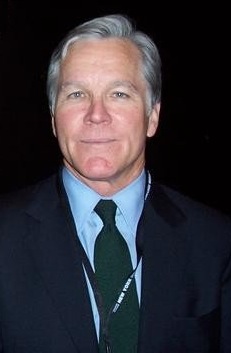
Bill Keller, executive editor of the New York Times, made clear the other day he doesn’t fully understand the derivation and significance of his newspaper’s famous, 114-year-old motto, “All the News That’s Fit to Print.”

And he didn’t seem particularly comfortable with the slogan coined (most likely) by Adolph Ochs, who in 1896 acquired the then-beleaguered Times and eventually led the newspaper to preeminence in American journalism.
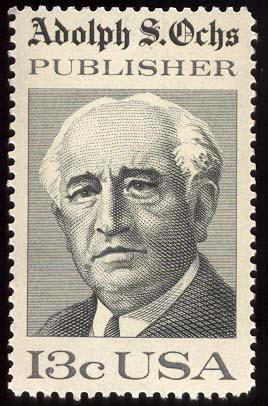
Ochs, commemorated

Sure, the motto’s smug and overweening, elliptical and easily parodied. But it is the most recognizable motto in American journalism, and it evokes a time now passed when slogans helped define and distinguish U.S. newspapers.

In an appearance not long ago at the National Press Club in Washington, Keller was asked about “All the News That’s Fit to Print,” which took a permanent place of prominence on the newspaper’s front page on February 10, 1897.

Keller rather sniffed at it, saying the motto “harkens back to a day when the aim of the newspaper was to be comprehensive.”

According to a transcript of his remarks, Keller said that nowadays the Times is “going to tell you maybe only a little bit, but a little bit about everything.

“And I think that slogan describes an aspiration, or a mindset. Now we tend to be more selective, and try to give you more depth, to tell you the stories that are not obvious.”

Actually, “All the News That’s Fit to Print” was framed a riposte to activist-oritented yellow journalism that flared in New York City in the closing years of the 19th century.

Ochs clearly meant the slogan to be a rebuke to the flamboyant ways of the  New York Journal of William Randolph Hearst and the New York World of Joseph Pulitzer. Their newspapers were the leading exemplars of the yellow press in fin-de-siècle urban America.

As I wrote in my 2006 book, a year study titled The Year That Defined American Journalism: 1897 and the Clash of Paradigms, the motto was, and remains, a daily rejection of flamboyant, self-promoting journalism.

And as the Times pointed out in 1935 in its obituary about Ochs, the motto “has been much criticized, but the criticisms deal usually with the phraseology rather than with its practical interpretation, and the phraseology was simply an emphatic announcement that The Times was not and would not be what the nineties called a yellow newspaper.”

I further noted in The Year That Defined American Journalism that the Times, at its 50th anniversary in 1901, “referred to ‘All the News That’s Fit to Print’ as its ‘covenant.’ One-hundred years later, a columnist for the Wall Street Journal aptly identified the motto as the ‘leitmotif not merely for the Times, but also, by a process of osmosis and emulation, for most other general-interest papers in the country, as well as for much of the broadcast media.'”
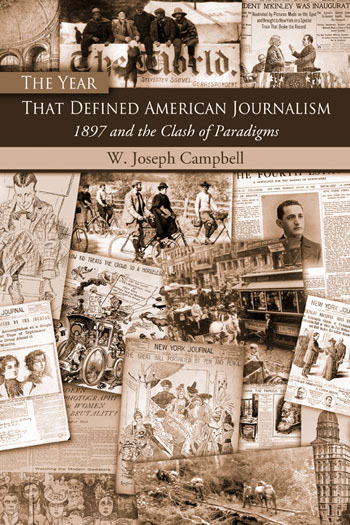
So, no, the motto wasn’t an assertion of intent to be comprehensive — although the Times surely carried a lot of news in the late 1890s. Thirty or more articles, many of them a paragraph or two in length, usually found places on its front page back then.

Ochs’ slogan was more than a daily slap at yellow journalism.

It also represents “a daily and lasting reminder of the Times’ triumph in a momentous … clash of paradigms that took shape in 1897—a clash that helped define the modern contours of American journalism,” as I noted in The Year That Defined American Journalism.

That clash pitted three rival, incompatible models for the future of American journalism.

“As suggested by its slogan,” I wrote, “the Times offered a detached, impartial, fact-based model that embraced the innovative technologies emergent in the late nineteenth century but eschewed extravagance, prurience, and flamboyance in presenting the news.

“Extravagance, prurience, and flamboyance were features typically associated with yellow journalism, a robust genre which, despite its controversial and self-indulgent ways, seemed to be irresistibly popular in 1897. The leading exemplar of yellow journalism was … Hearst’s New York Journal, which in 1897 claimed to have developed a new kind of journalism, a paradigm infused by a self-activating ethos that sidestepped the inertia of government to ‘get things done.’

“The Journal called its model the ‘journalism of action’ or the ‘journalism that acts,’ and declared it represented ‘the final state in the evolution of the modern newspaper.’

“The third rival paradigm,” I wrote, “was more modest and idiosyncratic than those of the Times and Journal. If improbable, it was nonetheless an imaginative response to the trends of commercialization in journalism. The paradigm was an anti-journalistic literary model devised and promoted by J. Lincoln Steffens, who in late 1897 became city editor of the New York Commercial Advertiser, then New York’s oldest newspaper.”

That model, Steffens said, was predicated on the notion “that anything that interested any of us would interest our readers and, therefore, would be news if reported interestingly.”

The Times ultimately prevailed in the three-sided rivalry that emerged in 1897, and “All the News That’s Fit to Print” lives on as a reminder of the outcome of that momentous clash of paradigms.

WJC

Recent and related:

114 years on the front page

In 1897, Anniversaries, New York Times, Newspapers, Yellow Journalism on February 9, 2011 at 7:37 am

Tomorrow makes 114 years on the front page for the best-known slogan in American journalism.

114 years on the front

The slogan, of course, is “All the News That’s Fit to Print,” which first appeared February 10, 1897, in the upper left corner (the left ear) of the front page New York Times.

I’ve called them the most famous seven words in American journalism and they have been endlessly parodied and analyzed since 1897. Even admirers of the Times have conceded that “All the News That’s Fit to Print” is “overweening” and even “elliptical.”

As I discussed in my 2006 book, The Year That Defined American Journalism: 1897 and the Clash of Paradigms, the motto has given rise to some lofty claims over the years. In 1901, at the 50th anniversary of its founding, the Times referred to “All the News That’s Fit to Print” as its “covenant.”

In 2001, a columnist for the Wall Street Journal described the motto as the “leitmotif not merely for the Times, but also, by a process of osmosis and emulation, for most other general-interest papers in the country, as well as for much of the broadcast media.”

Adolph Ochs began using the slogan soon after acquiring control of the then-beleaguered Times in August 1896. At first, Ochs made use of “All the News That’s Fit to Print” as an advertising and marketing device.

The slogan’s debut came in early October 1896, spelled out in a row of red lights on an advertising sign the Times had rented at New York’s Madison Square.

Four months later, without fanfare or explanation, the slogan appeared in the “left ear” of the front page. It has appeared in that place of prominence ever since.

In touting “All the News That’s Fit to Print,” Ochs clearly sought to distance the Times from the yellow press of William Randolph Hearst and Joseph Pulitzer. Their flamboyant newspapers dominated New York City’s media landscape in the late 1890s.

Ochs was nothing if not aggressive in promoting the Times and in seeking to position the newspaper as a sober counterweight to the activism and excesses of the yellow press.

To that end, he launched in late October 1896 a contest inviting readers to propose “a phrase more expressive of the Times’ policy” than “All the News That’s Fit to Print,” which by then had taken a modest place in a corner of the Times’ editorial page.

The Times promised to pay $100 to the person who proposed in ten words or fewer a slogan deemed better than “All the News That’s Fit to Print.”

The motto contest, cheesy though it may seem today, stirred a fair amount of attention–and reader interaction–in 1896.

Among the thousands of entries sent to the Times were such clunky suggestions as “All the News Worth Telling,” “All the News That Decent People Want,” and “The Fit News That’s Clean and True.”

Among the others:

“Full of meat, clean and neat.”

“Instructive to all, offensive to none.”

“The people’s voice, good the choice.”

“Aseptic journalism up to date.”

“Yours neatly, sweetly, and completely.”

As I wrote in The Year That Defined American Journalism: “Before the contest ended, the Times altered the stakes by making clear it would not abandon ‘All the News That’s Fit to Print.’

“The Times,” I wrote, “justified this change of heart by saying no phrase entered in the contest was more apt and expressive than ‘All the News That’s Fit to Print.’ The $100 prize would be awarded, to the person adjudged to have submitted the best entry. But the motto would not be changed.”

But the entries kept rolling in. Other suggestions included:

“Bright as a star and there you are.”

“All the news to instruct and amuse.”

“Pure in purpose, diligent in service.”

“You do not want what the New-York Times does not print.”

“All that’s new, true, and clever.”

Another entry was inspired by rival titles in fin-de-siècle New York:

“Out heralds The Herald, informs The World, extinguishes The Sun.” (That suggestion is evocative of the slogan of New York Newsday, a tabloid that ceased publication in 1995 after 10 years:  “On top of the News, ahead of the Times.”)

As the motto contest neared its close in early November 1896, the Times noted that that some people had “sent in diagrams and even pictures.

“While these exhibit both skill and thought,” the newspaper said, “they cannot be accepted, because they are not wanted.”

A committee of Times staffers winnowed the entries to 150 semi-finalists, which were submitted to Richard Watson Gilder, editor of The Century magazine. Gilder selected these as finalists:

  • Always decent; never dull.
  • The news of the day; not the rubbish.
  • A decent newspaper for decent people.
  • All the world’s news, but not a school for scandal.

As I wrote in The Year That Defined American Journalism, Gilder noted “that terms of the contest had changed from the original intent of selecting a slogan that ‘more aptly express the distinguishing characteristics of the New-York Times’ to the more theoretical task of determining which entry ‘would come nearest to it in aptness.’”

That entry, Gilder determined, had been submitted by D.M. Redfield of New Haven, Connecticut. Redfield’s suggestion:

“All the world’s news, but not a school for scandal.”

Catchy, that.

WJC

Many thanks to Jim Romenesko for linking to this post

Recent and related:

JHistory: ‘Getting It Wrong’ deserves to be ‘required reading’

In Bay of Pigs, Bra-burning, Cronkite Moment, Debunking, Hurricane Katrina, Media myths, New York Times, Newspapers, Reviews, War of the Worlds, Washington Post, Watergate myth on February 7, 2011 at 9:51 am

JHistory, the listserv devoted to issues in journalism history, posted yesterday a very insightful and favorable review of my latest book, Getting It Wrong, saying it “should be required reading for journalism students as well as journalists and editors.”

Getting It Wrong “reinforces the necessity of healthy skepticism; a commitment to fully understanding the implications of one’s research; and the importance of cultivating diverse, credible sources and viewpoints for probing, quality journalism,” the review says.

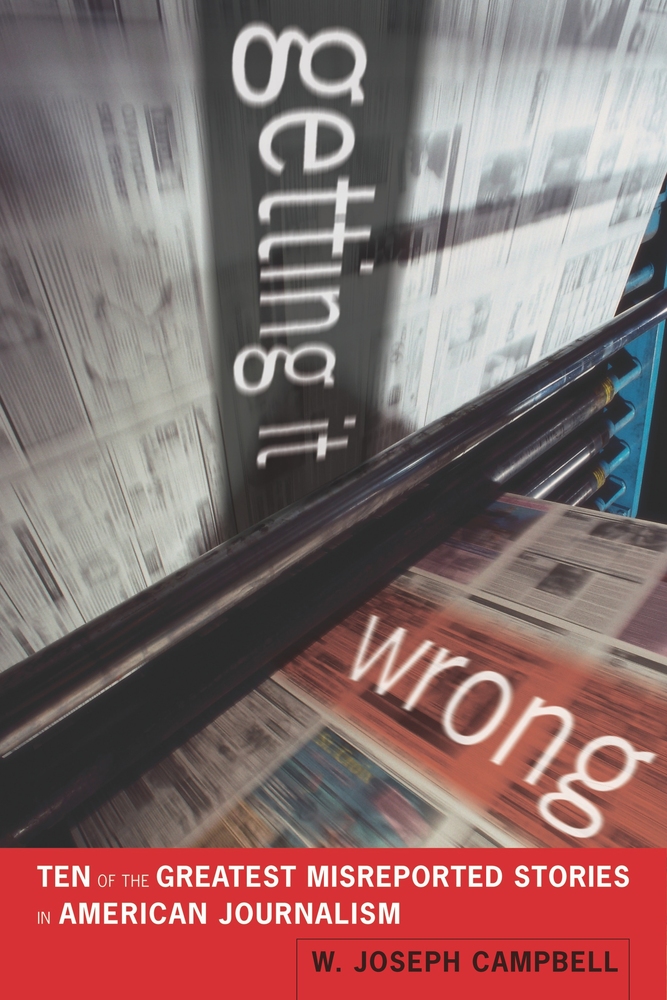
Getting It Wrong, which was published in summer 2010 by University of California Press, addresses and debunks 10 prominent media-driven myths — those dubious tales about and/or by the news media that masquerade as factual.

The reviewer for JHistory, Jeanette McVicker of SUNY-Fredonia, says Getting It Wrong is a “compelling book” that “generated a minor sensation in journalism circles all summer, with good reason.”

McVicker, whom I do not know, notes:

“In each chapter, Campbell delivers pithy, well-researched correctives for each sensational claim.

“No,” she writes, “Orson Welles’s ‘War of the Worlds‘ radio broadcast did not induce a national panic in October 1938. Yes, there was symbolic bra burning in the Freedom Trash Can at the 1968 protest of the Miss America pageant in Atlantic City, but no mass stripping of undergarments by wild women’s liberationists. No, the Kennedy administration did not request the New York Times to spike or delay a report on the imminent Bay of Pigs invasion: ‘utter fancy,’ Campbell writes.”

McVicker adds:

“The deconstruction of these cherished media myths by Campbell’s archival, source-driven research is praiseworthy, and makes for fascinating reading.”

She further notes:

“In most of these examples, the devastating legacy of the mythmaking media machine continues far beyond attempts to backpedal and correct the erroneous reporting: sensational stories tend to remain in public consciousness for years and sometimes decades.”

Indeed.

Getting It Wrong, McVicker adds, “demonstrates with tremendous force how discrete instances of media reporting and mythmaking have built up a golden age fallacy of journalism’s self-importance, and his work goes a long way toward deflating such heroic myths and consensus-narratives at the heart of modern journalism history.”

Her principal challenge to Getting It Wrong lies in my view that stripping away and debunking prominent media myths “enhances a case for limited news media influence. Media power tends to be modest, nuanced, diffused, and situational.”

Too often, I write, “the ubiquitous presence of the news media is mistaken for power and influence. … The influence of the news media is typically trumped by other forces.”

It’s an accurate assessment, especially given that media myths — such as the notion that investigative reporting by the Washington Post brought down Richard Nixon’s corrupt presidency in the Watergate scandal — often seek to “ascribe power, significance, and sometimes great courage to the news media and their practitioners.”

Puncturing media myths thus serves to deflate the notion of sweeping media power.

McVicker tends to disagree, writing that “it is surely not the case that the combined effects of such narratives are ‘modest, nuanced, diffused, and situational.'”

She notes as an example “the ongoing legacy of mainstream media’s failure to hold members of the Bush administration accountable during the buildup to the invasion of Iraq, a devastating correlate to Campbell’s spot-on analysis of the distorted, erroneous reporting of what was happening in the streets of New Orleans following Hurricane Katrina.”

There is, though, a fair amount of evidence that the news media were neither gullible nor comatose in the run-up to the war in Iraq, that tough questions were raised of the Bush administration’s pre-war plans.

While the notion of a docile news media has hardened into conventional wisdom about the pre-war coverage, that view has been challenged, notably by David Gregory of NBC News, who has asserted:

“I think the questions were asked [in the run-up to the war].  I think we pushed. I think we prodded. I think we challenged the president. I think not only those of us the White House press corps did that, but others in the rest of the landscape of the media did that.

“If there wasn’t a debate in this country” about going to war in Iraq, Gregory has said, “then maybe the American people should think about, why not?  Where was Congress? Where was the House? Where was the Senate? Where was public opinion about the war?”

I find quite telling this observation, offered in 2007 by Reason magazine:

“The ‘we should have done more to head off this war’ arguments assumes too much, exaggerates the media’s power to influence, removes the onus from politicians and infantilizes news consumers. … many in the media did ask tough questions of the administration, but the public wasn’t paying much attention.”

That the news media were comatose in the run-up to the Iraq War may be yet another media-driven myth.

WJC

Recent and related:


Campbell’s

book should be required reading for journalism students as well as

journalists and editors, for it reinforces the necessity of healthy

skepticism; a commitment to fully understanding the implications of one’s

research; and the importance of cultivating diverse, credible sources and

viewpoints for probing, quality journalism. There is an even greater lesson

here, however, pertinent for all readers: consistent with the rise of

“modern” journalism from the late 1800s to the present, the institution of

journalism has bolstered itself with narratives celebrating its own

strategic importance to society, even when the narratives turn out to be

fictions.

Pepco the rude

In Media myths, Washington Post on February 2, 2011 at 10:31 am

It’s no media myth: Pepco personnel can be downright rude to their customers.

Pepco is the bungling utility company that sells electricity to 778,000 households in and near Washington, D.C.

Pepco’s inability to keep the lights on during winter and summer storms, and its agonizing slowness in restoring power when the lights do go out, has stirred intense and richly deserved criticism from customers and politicians.

The criticism swelled anew in the aftermath of a snowstorm a week ago that brought some 8 inches of heavy snow to the Washington area and knocked out power to more than 200,000 Pepco customers. (The Washington Post noted that the utility “issued a series of promises about when service would be restored, and it did not keep them.”)

My place in suburban Maryland was without power for 44 hours, forcing a retreat to a local hotel.

Before dawn today, power went off again in the neighborhood. A light rain was falling, but that wasn’t enough to knock out the lights.

At the end of the otherwise darkened street I could see the flashing yellow lights of a Pepco repair truck. So I walked down to inquire about what was a puzzling outage.

“Good morning,” I said as I stepped across a snowbank and approached a helmeted Pepco worker standing near the truck.

“What was that?” the Pepco guy asked.

“I said, ‘Good morning.'”

“Good morning.”

“What are we looking at?” I asked Pepco guy. “Is this likely to be a brief outage or something more extended?”

“What do you mean, ‘more extended’?” Pepco guy asked.

“We were without power for 44 hours last week. That’s extended.”

Pepco guy replied, “I haven’t been home since Wednesday,” when the  snowstorm hit.

There was an abrupt and dismissive edge to his comment. He wasn’t seeking sympathy. He was suggesting my questions were inappropriate. Out of line. Trivial.

And I resented it.

“Well, you’re paid to do this work,” I said. “We pay Pepco to provide electricity, and they don’t do it very well.” Or reliably.

I asked again: “Are we looking at a brief outage, or something more extended?”

“We’ll have it on as soon as we can,” Pepco guy replied.

“What does that mean?” I asked.

“Within an hour,” he said, finally.

Thanks, I said, and walked back home — annoyed by Pepco guy’s rude responses, and wondering why he was so reluctant to be forthcoming.

If the repairs were minor, as they turned out to be, why not simply say so? Why attempt to shift the focus by injecting a curt and irrelevant comment — “I haven’t been home since Wednesday”? Why not respond directly, and in a professional manner, to what was a reasonable, straightforward, and polite inquiry?

The lights did come back on, in less than an hour. But the annoyance lingered.

Pepco does itself no favors when its personnel treat inquiring customers as if they were little more than nuisances. Customers pay for what they expect will be reliable electric service — and not surprisingly they will seek answers when the lights go out without warning or apparent cause.

Pepco says it has a five-year service-improvement plan that’s to cost $318 million. Five years is a prolonged period, given the extent and frequency of the utility’s service failings.

In any case, it shouldn’t take anywhere near five years for Pepco to commit to improving customer relations, to commit to training its personnel in properly fielding queries from people who pay the bill.

WJC

Recent:

Serving up Watergate, très simple

In Debunking, Media myths, Washington Post, Watergate myth on February 1, 2011 at 9:23 am

The simplified storyline of the Watergate scandal goes this way:

Two young, diligent reporters for the Washington Post, Bob Woodward and Carl Bernstein, obtained from their secretive “Deep Throat” source information that incriminated President Richard Nixon and brought about his downfall.

That essentially is the “heroic-journalist” interpretation of Watergate — a reductive and misleading trope to which I devote a chapter in my latest book, Getting It Wrong.

I write in Getting It Wrong that “to explain Watergate through the lens of the heroic-journalist is to abridge and misunderstand the scandal and to indulge in a particularly beguiling media-driven myth.”

Yahoo!News yesterday served up that très simple version of Watergate in an article about Julian Assange of Wikileaks. The item Yahoo! posted online referred to Mark Felt, formerly the second-ranking official at the FBI, saying he “supplied information about the role of Richard Nixon and his top aides in the Watergate scandal to Washington Post reporters Bob Woodward and Carl Bernstein and came to be known as ‘Deep Throat.’

“That series of leaks ultimately felled the Nixon presidency.”

Uh, no, it didn’t.

What Felt/”Deep Throat” told Woodward did not topple Nixon.

According to All the President’s Men, Woodward and Bernstein’s book about their Watergate reporting, Woodward turned to “Deep Throat” “only to confirm information that had been obtained elsewhere and to add some perspective.”

(Bernstein, by the way, never met Felt until shortly before Felt’s death in 2008. Felt disclosed in 2005 that he had been the “Deep Throat” source.)

Nixon’s fall was the result of his criminal conduct in attempting to cover up the signal crime of Watergate, the break-in at the headquarters of the Democratic National Committee in June 1972.

As I write in Getting It Wrong, the simplified, mediacentric interpretation of Watergate “minimizes the far more decisive forces that unraveled the scandal and forced Nixon from office.”

To topple a president and roll up a scandal of the dimensions of Watergate required, I write, “the collective if not always the coordinated forces of special prosecutors, federal judges, both houses of Congress, the Supreme Court, as well as the Justice Department and the FBI.

“Even then, Nixon likely would have served out his term if not for the audiotape recordings he secretly made of most conversations in the Oval Office of the White House. Only when compelled by the Supreme Court did Nixon surrender those recordings, which captured him plotting the cover-up and authorizing payments of thousands of dollars in hush money.”

Against that tableau of subpoena-wielding investigative authorities, the contributions of Woodward and Bernstein fades into relative insignificance.

So why has the heroic-journalist meme become the most familiar storyline of Watergate? Why is it so endlessly appealing?

Complexity-avoidance.

Watergate, after all, was a sprawling scandal. Twenty-one men associated with Nixon’s presidency or his reelection campaign in 1972 were convicted of Watergate-related crimes. Nineteen went to jail.

The heroic-journalist interpretation provides a passage through the intricacies of Watergate, offering what I call “a proxy for grasping the scandal’s essence while avoiding its forbidding complexity.”

Contributing to the durability of the heroic-journalist meme is the cinematic treatment of All the President’s Men, a 1976 film based on Woodward and Bernstein’s best-selling book.

All the President’s Men the movie focuses on Woodward and Bernstein while mostly ignoring, and even at times denigrating, the contributions of investigative agencies like the FBI.

All the President’s Men has held up quite well in the 35 years since its release. It surely is the most-watched movie ever made about Watergate.

But as I point out in Getting It Wrong, All the President’s Men the movie allows no interpretation other than the work of Woodward and Bernstein brought about the first-ever resignation of a U.S. president.

Woodward

Even Woodward has challenged that très simple version.

He declared in an interview several years ago with American Journalism Review:

To say that the press brought down Nixon, that’s horseshit.”

WJC

Recent and related:

‘Yellow journalism’ turns 114

In 1897, Anniversaries, Debunking, Media myths, Newspapers, Spanish-American War, Yellow Journalism on January 30, 2011 at 8:21 am

It is a little-recognized, never-celebrated anniversary in American journalism, granted.

Wardman of the Press

But tomorrow marks 114 years since the term “yellow journalism” first appeared in print, in the old New York Press, edited by the austere Ervin Wardman (left).

The phrase “the Yellow Journalism” appeared in a small headline on the editorial page of the Press on January 31, 1897. The phrase also appeared that day in the newspaper’s editorial page gossip column, “On the Tip of the Tongue.”

Yellow journalism” quickly caught on, as a sneer to denigrate what then was called the “new journalism” of the New York Journal of William Randolph Hearst and the New York World of Joseph Pulitzer. By the end of March 1897, references to “yellow journalism” had appeared in newspapers in Providence, Richmond, and San Francisco.

In the decades since then, “yellow journalism” has become a widely popular if nebulous term — derisive shorthand for vaguely denouncing sensationalism and journalistic misconduct of all kinds, real and imagined.

“It is,” as I noted in my 2001 book Yellow Journalism: Puncturing the Myths, Defining the Legacies, “an evocative term that has been diffused internationally, in contexts as diverse as Greece and Nigeria, as Israel and India.”

Precisely how Wardman and the Press landed on the phrase “yellow journalism” isn’t clear.

The newspaper’s own, brief discussion of the term’s derivation was unhelpful and unrevealing: “We called them Yellow because they are Yellow,” it said in 1898 about the Journal and the World.

In the 1890s, the color yellow sometimes was associated with decadent  literature, which may have been an inspiration to the Harvard-educated Wardman, a figure now largely lost to New York newspaper history.

Wardman was tall and stern-looking. He once was described as showing his “Calvinistic ancestry in every line of his face.” He did little to conceal his contempt for Hearst and Hearst’s journalism.

His disdain was readily apparent in the columns of the Press, of which Wardman became editor in chief in 1896 at the age of 31. (The Press is long defunct; it is not to be confused with the contemporary alternative weekly of the same title.)

Wardman’s Press took to taunting Hearst, Hearst’s mother, and Hearst’s support for Democratic candidate William Jennings Bryan in the 1896 presidential election. The New York Journal was virtually alone among New York newspapers in supporting Bryan’s “free silver” candidacy.

The Press disparaged Hearst, then 34, as a mama’s boy, as “Billy” and “little Willie.” It referred to the Journal as “our silverite, or silver-wrong, contemporary.”

The Press also experimented with pithy blasts on the editorial page to denounce “new journalism.”

“The ‘new journalism,’” the Press said in early January 1897 “continues to think up a varied assortment of new lies.”

Later in the month, the Press asked in a single-line editorial comment:

“Why not call it nude journalism?”

It clearly was a play on “new journalism” and meant to suggest the absence of “even the veneer of decency.”

Before long, Wardman and the Press seized upon the phrase “yellow-kid journalism,” which evoked the Hearst-Pulitzer rivalry over a popular cartoon character known as the “Yellow Kid.”

Both the Journal and the World at the time were publishing versions of the kid.

Yellow kid poster (Library of Congress)

At the end of January 1897, the phrase “yellow-kid journalism” was modified  to “the Yellow Journalism,” and the sneer was born.

After landing on that evocative pejorative, Wardman turned to it often, invoking the term in brief editorial comments and asides such as: “The Yellow Journalism is now so overripe that the little insects which light upon it quickly turn yellow, too.”

The diffusion of “yellow journalism” was sealed when the Journal embraced the term in mid-May 1898, during the Spanish-American War. With typical immodesty, the newspaper declared:

“… the sun in heaven is yellow—the sun which is to this earth what the Journal is to American journalism.”

WJC

From an essay originally posted at Media Myth Alert January 31, 2010

Many thanks to Jim Romenesko for linking to this post

Recent and related:

Fact-checking Keller on NYT-Bay of Pigs suppression myth

In Anniversaries, Bay of Pigs, Debunking, Media myths, New York Times on January 28, 2011 at 11:57 am

'Publish it did'

In an article to be published Sunday, Bill Keller, executive editor of the New York Times, rubs shoulders with a tenacious media myth linked to the newspaper’s reporting in the run-up to the Bay of Pigs invasion nearly 50 years ago.

I devote a chapter to the New York Times-Bay of Pigs suppression myth in my latest, mythbusting book, Getting It Wrong.

The suppression myth has it that the Times, at the request of President John F. Kennedy, suppressed or emasculated its reporting about the pending Bay of Pigs invasion of Cuba.

But as I discuss in Getting It Wrong, in the 10 days before the ill-fated assault, the Times published several detailed reports on its front page discussing an invasion and exiles’ calls to topple Fidel Castro. And, I note, there is no evidence that Kennedy either asked or persuaded the Times to suppress, hold back, or dilute any of its pre-invasion reporting.

“The anecdote about the Times’ self-censorship is potent, compelling, instructive, and timeless,” I write in Getting It Wrong . “It also is apocryphal, a media-driven myth.”

Keller, though, repeats the myth in a lengthy article to run in the Times Sunday magazine about his newspaper’s dealings with Julian Assange, head of Wikileaks, which not long ago disclosed the contents of thousands of classified U.S. diplomatic cables.

Keller invokes the Bay of Pigs as an example of the newspaper’s having erred “on the side of keeping secrets.”

He writes:

“I’m the first to admit that news organizations, including this one, sometimes get things wrong. We can be overly credulous (as in some of the prewar reporting about Iraq’s supposed weapons of mass destruction) or overly cynical about official claims and motives. We may err on the side of keeping secrets (President Kennedy reportedly wished, after the fact, that The Times had published what it knew about the planned Bay of Pigs invasion, which possibly would have helped avert a bloody debacle) or on the side of exposing them. We make the best judgments we can.”

Had Keller consulted the newspaper’s database of reporting about the run-up to the Bay of Pigs invasion in April 1961, he would have found that the Times reported in detail, if not always accurately, about the preparations to infiltrate a U.S.-trained brigade of Cuban exiles in an attempt to topple Fidel Castro.

The invasion failed, and the anti-Castro exiles were mostly killed or captured. The foreign policy debacle came less than three months into Kennedy’s presidency.

As I write in Getting It Wrong, “the notion that Kennedy asked or persuaded the Times to suppress, hold back, or dilute any of its reports about the pending Bay of Pigs invasion is utter fancy. There is no evidence that Kennedy or his administration knew in advance about the Times report of April 7, 1961, a front-page article that lies at the heart of this media myth” (see image, above).

The report was filed from Miami by veteran Timesman Tad Szulc who, I write, “pieced together the outline of CIA-backed plans to attempt to topple Castro with an invasion force of Cuban exiles who had been trained in Guatemala.”

The invasion plans, Szulc found, were an open secret in Miami. “It was,” he was later to say, “the most open operation which you can imagine.”

On April 6, 1961, Szulc filed a dispatch to New York, reporting that 5,000 to 6,000 Cuban exiles had been trained in a plan to overthrow Castro, that invasion plans were in their final stages, and that the operation had been organized and directed by the CIA.

Szulc’s dispatch report ran more than 1,000 words and, I write in Getting It Wrong, “set off a flurry of intense consultations among senior editors.” Their deliberations revolved around three elements: Szulc’s characterization that the invasion was imminent, the reference to the operation being CIA-directed, and the prominence the report should receive on the Times front page.

In the end, the references to the invasion’s imminence were dropped; it was more prediction than fact, as James Reston, the Times Washington bureau chief at time, pointed out. (The invasion was launched April 17, 1961, 11 days after Szulc filed his dispatch.)

The reference to CIA also was dropped, in favor of the more nebulous terms phrases, “U.S. officials” and “U.S. experts. The then-managing editor, Turner Catledge, later wrote that the decision was based on the reality the government had more than a few intelligence agencies, “and I was hesitant to specify the CIA when we might not be able to document the charge.”

As for the report’s prominence, the decision was to publish Szulc’s story on the front page, beneath a single-column headline, instead of a four-column headline. Given that the invasion wasn’t deemed imminent, a four-column headline was difficult to justify.

I write in Getting It Wrong that although “the headline size was modified, Szulc’s report hardly can be said to have been played down. It certainly had not been spiked, diluted, or emasculated. Szulc’s report, as Catledge wrote, made ‘perfectly clear to any intelligent reader that the U.S. government was training an army of Cuban exiles who intended to invade Cuba.'”

As Timesman Harrison Salisbury wrote in Without Fear or Favor, his insider’s account of the Times:

“The government in April 1961 did not … know that The Times was going to publish the Szulc story, although it was aware that The Times and other newsmen were probing in Miami. … The action which The Times took [in editing Szulc’s report] was on its own responsibility,” the result of internal discussions and deliberations recognizable to anyone familiar with the give-and-take of newsroom decision-making.

But most important, as Salisbury pointed out, “The Times had not killed Szulc’s story. … The Times believed it was more important to publish than to withhold.

“Publish it did.”

As for Kennedy’s remark, that he wished the Times “had run everything on Cuba”: The comment was vague and self-serving, an attempt to deflect blame from his administration’s first-rate foreign policy disaster.

Besides, what was it that the Times supposedly held back? The president didn’t specify.

Nor does Keller.

WJC

Many thanks to Instapundit Glenn Reynolds for linking to this post

Recent and related:

.[i] Szulc’s report, as Catledge wrote, made “perfectly clear to any intelligent reader that the U.S. government was training an army of Cuban exiles who intended to invade Cuba.” 


[i] Arthur Schlesinger, the historian and Kennedy adviser, claimed that Szulc’s story had been “emasculated” by Times editors. See “Rebuttal Is Made by Schlesinger,” New York Times (14 June 1966): 15.

On the thin contributions of media rabble-rousers

In Debunking, Jessica Lynch, Media myths, Yellow Journalism on January 26, 2011 at 6:39 am

The departure of the bombastic Keith Olbermann from MSNBC’s primetime lineup is no an occasion for mourning.

But it’s to be regretted.

A little.

So suggested Bret Stephens yesterday in hisWall Street Journal column about Olbermann, who abruptly left his “Countdown” show at the end of last week.

Stephens pointed out:

“The ‘Countdown’ host did away with the old-fashioned liberal snigger and replaced it with a full-frontal snarl. Put simply, Mr. Olbermann had a genuine faith in populism, something liberals more often preach than practice.”

Stephens also offered this intriguing observation:

“America does better when its political debates descend, as they so often do on (or between) MSNBC and Fox News, into honest brawls.”

He may be right, although I wish he had elaborated on that point.

The observation about “honest brawls” reminded me of the insults and brickbats that American newspaper editors of the 1890s routinely exchanged in print. These were vigorous, lusty,  often vicious exchanges — and there really was little memorable or lasting about them. Save, perhaps, for an epithet or two.

Like that of “yellow journalism.”

Wardman, father to a sneer

As I discussed in my 2001 book, Yellow Journalism: Puncturing the Myths Defining the Legacies, the epithet emerged in late January 1897, during the failed campaign of Ervin Wardman, a New York newspaper editor, to drive a stake into the heart of the upstart journalism of William Randolph Hearst and, to a lesser extent, of Joseph Pulitzer.

Yellow journalism” took hold and spread quickly in 1897; it lives on today, as a vague but handy smear especially favored by letter-writers to newspapers.

Trouble is, the sneer “yellow journalism” is so ill-defined and flabby that it has become synonymous with journalistic sins of all kinds — exaggeration, sensationalism, hype, plagiarism, what have you.

And the trouble with media rabble-rousers like Olbermann is that their commentary often lacks wit and nuance, and tends to be superficial. It’s not deft, typically, and it’s unheard of for them to invoke media-driven myths–those dubious stories about the news media that masquerade as factual.

I address and debunk 10 prominent media-driven myths in my latest book, Getting It Wrong.

On his way out, in announcing his abrupt departure, Olbermann indulged in media myth. He described as “exaggerated” the rescue of Army private Jessica Lynch in Iraq in 2003. Hyped, maybe a bit. But the Lynch rescue, conducted by a U.S. special operations force under combat conditions, was not exaggerated.

As I note in Getting It Wrong, the Defense Department’s inspector general reported in 2007 that the rescue of Lynch from an Iraqi hospital was “a valid mission” to recover a prisoner of war.

There was no evidence to suggest that the rescue “was a staged media event” even though it was videotaped, as such missions often are.

Olbermann had on other occasions invoked the media myth surrounding Edward R. Murrow, whom he sought to emulate by borrowing the legendary broadcaster’s sign-off, “Good night, and good luck.”

In November, Olbermann referred to Murrow as “a paragon of straight reporting” while claiming the American press “stood idly by” as Senator Joseph R. McCarthy pursued his communists-in-government witch-hunt.

On March 9, 1954, during a 30-minute CBS television show called See It Now, “Murrow slayed the dragon,” Olbermann declared.

As I point out in Getting It Wrong, neither Murrow nor his producer, Fred Friendly, embraced the dragon-slaying interpretation. (Friendly wrote in his memoir, Due to Circumstances Beyond Our Control: “To say that the Murrow broadcast of March 9, 1954, was the decisive blow against Senator McCarthy’s power is as inaccurate as it is to say that Joseph R. McCarthy … single-handedly gave birth to McCarthyism.”)

And it’s quite clear that the American press did not stand “idly by” as the scourge of McCarthyism emerged.

As I point out in Getting It Wrong:

“Long before the See It Now program, several prominent journalists—including the Washington-based syndicated columnist Drew Pearson—had become persistent and searching critics of McCarthy, his record, and his tactics.”

By the time Murrow took on McCarthy in March 1954, Americans weren’t waiting for a white knight to tell them about the toxic threat the senator posed.

Thanks to the work of Pearson and other journalists, they already knew.

WJC

Recent and related:

24/7 news cycle no new phenomenon

In Debunking, Media myths, Newspapers, Spanish-American War on January 25, 2011 at 8:31 am

A recent commentary in the Wall Street Journal about the 24/7 news cycle offered a telling point that the Internet “has made real-time reporting more prevalent, but it certainly didn’t invent it.”

The commentary’s author, Peter Funt, also noted that “the notion that nonstop news coverage is something new, some recent innovation developed as a product of the Internet and utilities such as Twitter, is bogus.”

Bogus, indeed.

The 24/7 news cycle is no phenomenon exclusive to the digital century. It is hardly novel, and it’s tiresome to hear journalists cite the nonstop news cycle as if it were — and as if it were a cause and excuse for error and superficial reporting.

I grow impatient with claims such as this:

“There was a time that the people we watched on T.V. for informative news were trustworthy and generally provided a pretty good snapshot of the days’ activities, breaking in when there truly was ‘breaking news.’ … With the advent of  cable T.V.  and the eventual cable-based ‘News’ networks, and then the Internet, we have become a nation addicted to a 24 hour news cycle.”

Not only does such a claim smack of indulgence in the “golden age” fallacy, it offers no evidence of a national addiction to nonstop news.

Adult Americans on average spent 70 minutes a day, getting the news, according a study last year by the Pew Research Center. While that figure is up from an average of 67 minutes in 2008, it is down from an average of 74 minutes in 1994–before the emergence of social media, and even before the popular advent of the Internet’s World Wide Web.

Pew also reported last year that 17 percent of adult Americans go “newsless” on a typical day. That is, they avoid getting the news despite the variety of options and platforms offered by media technologies.

That a significant percentage of the populates chooses to go newsless is, I write in my latest book, Getting It Wrong, among the reasons to question whether the news media exert broad influence in American life.

“Large numbers of Americans are beyond media influence,” I note in Getting It Wrong, which addresses and debunks 10 prominent media-driven myths.

Choosing to go newsless may signal that a segment of the adult population has little trust or faith in the U.S. news media and their content. It’s also an effective response, too, to nonstop news: They ignore it. Turn it off.

In any event, it’s quite clear the 24/7 news cycle goes back decades.

As I’ve noted from time to time at Media Myth Alert, large-city newspapers of the late 19th century were known would produce many “extra” editions to report fresh elements of important, breaking news.

Extras not uncommon in 1898

During the Spanish-American War in 1898, for example, William Randolph Hearst’s New York Evening Journal published as many as 40 extra editions a day. On such occasions, deadline pressures had to have been intense.

Wire service journalism long has been acquainted with immediate deadlines. Indeed, beating the competition and being first with the news are priorities that define — and have defined — news agencies such as the Associated Press and Reuters.

Deadlines arrive every second in the fast-paced wire service world. And so it was, long before the Internet’s emergence.

(As Michael Oreskes, senior managing editor of the Associated Press, noted in a letter to the Wall Street Journal about Funt’s piece, a book published in 1957 about the old United Press news agency was titled A Deadline Every Minute.)

There are plenty of other examples of news outlets built around speed and immediacy.

CNN launched a headline news channel in 1982. As Funt noted, “All-news radio began in the early 1960s at stations like WAVA in Washington, D.C., and WINS in New York, where it was refined to become the nonstop reporting format that remains popular today.”

I remember listening as a kid to Philadelphia’s KYW news radio in the mid-1960s. KYW’s history says that it was “the second all-news station in the country.”

Then as now, KYW emphasizes news all the time, even though content does become repetitive.

So, no, the 24-hour-a-day news cycle is not new. Speed and time pressures are traditional elements of daily journalism.

They are, as Funt correctly noted, “integral to the very definition of news.”

WJC

Recent and related:

Who, or what, brought down Nixon?

In Debunking, Media myths, Washington Post, Watergate myth on January 24, 2011 at 10:26 am

Who brought him down?

The easy, but wrong, answer to the question of who or what brought down Richard Nixon’s corrupt presidency in the Watergate scandal is: Bob Woodward and Carl Bernstein of the Washington Post.

As I point out in my latest book, Getting It Wrong, that interpretation has become “ready short-hand for understanding Watergate and its denouement, a proxy for grasping the scandal’s essence while avoiding its forbidding complexity.

“How the Post and its reporters uncovered Watergate is deeply ingrained in American journalism as one of the field’s most important and self-reverential stories.”

It’s also a prominent media-driven myth–a well-known but dubious or improbable tale about the news media that masquerades as factual.

What I call the heroic-journalist interpretation of Watergate offers a convenient, accessible, easy-to-grasp version of what was a sprawling and intricate scandal.

“But to explain Watergate through the lens of the heroic-journalist,” I write in Getting It Wrong, “is to abridge and misunderstand the scandal and to indulge in a particularly beguiling media-driven myth. The heroic-journalist interpretation minimizes the far more decisive forces that unraveled the scandal and forced Nixon from office.”

Britain’s Spectator magazine takes up the Watergate question in an article about fallout from the phone-hacking scandal that has swept up Rupert Murdoch’s London tabloid, the Sunday News of the World.

To its credit, Spectator sidestepped the heroic-journalist myth in declaring:

“Everyone who remembers the Watergate scandal remembers Bob Woodward and Carl Bernstein’s reporting. Brilliant though it was, the Nixon administration was destroyed not by the Washington Post, but by Sam Ervin’s Senate committee, which had the powers parliamentary select committees ought to have to issue subpoenas and compel witnesses to talk or go to jail for contempt.”

While commendable in eschewing the mythical heroic-journalist interpretation, the Spectator commentary overstated the importance of the Senate select committee on Watergate, which was chaired by Sam Ervin of North Carolina and took testimony during the spring and summer of 1973.

Rather than destroying Nixon’s presidency, the select committee had the effect of training public attention on the crimes of Watergate and, in the testimony it elicited, offered a way to determine whether Nixon had a guilty role in the scandal.

The select committee’s signal contribution to unraveling Watergate came in producing the revelation that Nixon had secretly tape-recorded conversations with top aides in the Oval Office of the White House.

The tapes, I note in Getting It Wrong, “proved crucial to the scandal’s outcome.”

They constituted Nixon’s “deepest secret,” Stanley Kutler, Watergate’s leading historian, has written.

The revelation about their existence set off a year-long effort to force Nixon to turn over the tapes, as they promised to clear or implicate him in the scandal.

Nixon resisted surrendering the tapes until compelled by the U.S. Supreme Court, in a unanimous decision in July 1974.

The tapes revealed his guilty role in seeking to block the FBI investigation of the Watergate’s seminal crime, the breakin in June 1972 at the offices of the Democratic national committee in Washington.

Nixon resigned in August 1974.

In the final analysis, then, who or what brought down Richard Nixon?

Certainly not Woodward and Bernstein. Not the Senate select committee, either.

The best answer is that rolling up a scandal of the dimension and complexity of Watergate “required the collective if not always the coordinated forces of special prosecutors, federal judges, both houses of Congress, the Supreme Court, as well as the Justice Department and the FBI,” as I write in Getting It Wrong.

“Even then,” I add, “Nixon likely would have served out his term if not for the audiotape recordings he secretly made of most conversations in the Oval Office of the White House. Only when compelled by the Supreme Court did Nixon surrender those recordings,” making inevitable the early end of his presidency.

WJC

Recent and related: