W. Joseph Campbell

Posts Tagged ‘Orson Welles’

Discussing ‘Getting It Wrong’ with AU alums

In Cinematic treatments, Cronkite Moment, Debunking, Media myths, Media myths and radio, War of the Worlds, Washington Post, Watergate myth on June 30, 2010 at 10:35 pm

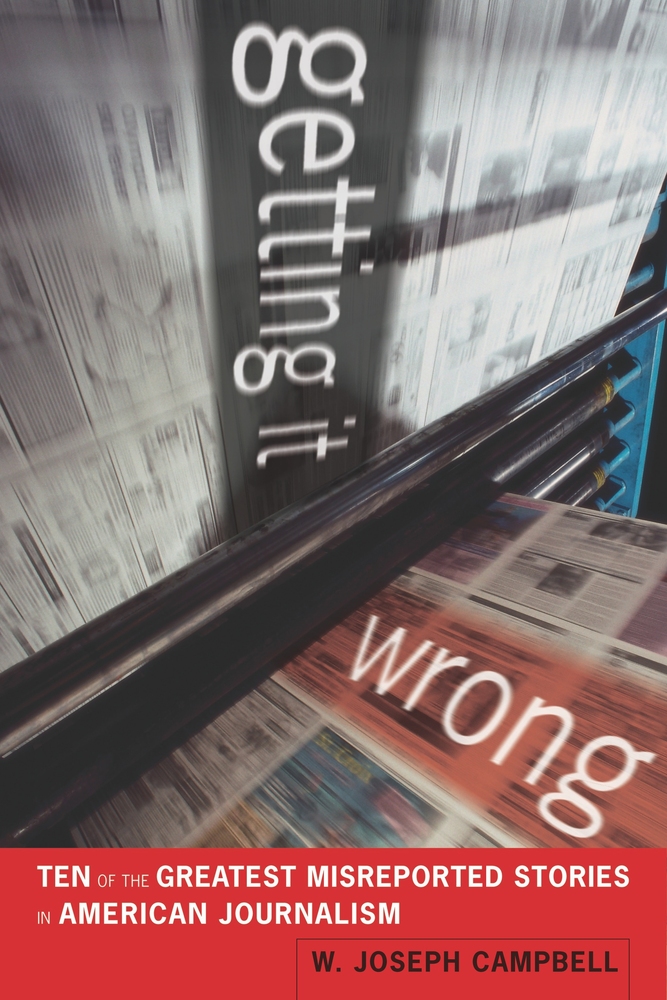
I met in Cleveland’s Little Italy neighborhood last night with a terrific group of American University alumni, at a program that featured a discussion of Getting It Wrong, my new book about media-driven myths.
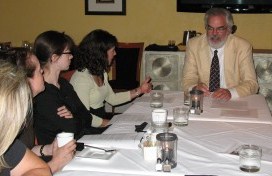
With AU alums in Cleveland

The gathering was the second of the Cleveland area alumni chapter, which is ably led by Neil T. Young, Anthony Vacanti, and Antoinette Bacon. I was privileged to talk with the group about the book, which addresses and debunks 10 prominent media myths–those false, dubious, improbable stories about the news media that masquerade as factual.

We met at Michaelangelo’s, a fine Italian restaurant where the service is superb. Our discussion about Getting It Wrong was conducted seminar style and featured my fairly lengthy review of the heroic-journalist myth of Watergate–the notion that the intrepid investigative reporting by the Washington Post brought down Richard Nixon’s corrupt presidency.

I described how the book All the President’s Men and the cinematic version by the same title helped solidify the notion that the Post and its reporters Bob Woodward and Carl Bernstein were central to unraveling the Watergate scandal.

The book and the movie have had the effect of focusing on the Post reporters while ignoring or overlooking the far more significant contributions of federal prosecutors, federal judges, bipartisan congressional panels, and ultimately the U.S. Supreme Court in identifying Nixon’s efforts to obstruct justice in the scandal.

“Against that backdrop,” I said, “the news media were decidedly modest factors” in Watergate’s outcome.

Orson Welles

We also discussed the War of the Worlds myth–that Orson Welles’ 1938 radio dramatization of an invasion from Mars was so realistic that tens of thousands of Americans were convulsed in panic and fled their homes in hysteria. The program was imaginative entertainment–and was recognized as such by listeners in overwhelming numbers, I pointed out.

In addition, we talked about the so-called “Cronkite Moment” of February 1968, when CBS anchorman Walter Cronkite offered a downbeat analysis of the U.S. war effort in Vietnam, saying the military was “mired in stalemate.”

Supposedly, Cronkite’s assessment came as an epiphany to President Lyndon Johnson who, it is said, snapped off the television set upon hearing the anchorman’s “mired in stalemate” characterization and said, “If I’ve lost Cronkite, I’ve lost Middle America.”

Or words to that effect.

In reality, I pointed out, the president wasn’t in front of a television set that night.

He was in Austin, Texas, at the 51st birthday party of Governor John Connally. And even if Johnson had seen the Cronkite report on videotape, the anchorman’s assessment really was no epiphany, because the president in the days and weeks immediately afterward hewed to a hawkish line on Vietnam.

Questions from the alums were quite thoughtful. Among them was a query about the common threads may be found in the myths debunked in Getting It Wrong.

A thoughtful and perceptive question, that.

And indeed there are some shared characteristics of media myths.

Many myths are reductive, in that they offer simplistic explanations for complex historical events. That factor certainly helps explains the tenacity of the heroic-journalist myth of Watergate and the “Cronkite Moment.” It is far easier to characterize the news media as prime movers in the outcomes of Watergate and Vietnam than it is to grapple with the complexities and nuances of those landmark events, I said.

Additionally, media myths tend to be delicious stories–stories almost too good to be disbelieved. And that certainly holds for Watergate, the “Cronkite Moment,” and the War of the Worlds dramatization.

And media myths tend to be ways to assert the notion that the news media are powerful and influential forces in American society.

But as I write in Getting It Wrong, media power “tends to be modest, nuanced, diffused, and situational” and altogether “too often the ubiquitous presence of the news media is mistaken for power and influence.”

Moreover, I write, “The American media these days are far too splintered and diverse—print, broadcast, cable, satellite, online—to exert much in the way of collective and sustained influence on policymakers or media audiences.”

WJC

Related:

‘Junk food of jornalismo’: Diário writes up ‘Getting It Wrong’

In Bay of Pigs, Cronkite Moment, Debunking, Furnish the war, Media myths, Media myths and radio, Murrow-McCarthy myth, Reviews, Watergate myth on June 28, 2010 at 2:49 pm

Today’s edition of the venerable  Portuguese newspaper Diário de Notícias includes a write up about Getting It Wrong, my new book about prominent media-driven myths–those false, dubious, improbable stories about the news media that masquerade as factual.

With the help of the online translation site Babelfish, I was able to make out a good deal of the Diário review, which says in part:

“W. Joseph Campbell in Getting it Wrong: Ten of the Greatest Misreported Stories in American Journalism, published the University of California Press, [says] these ‘myths can be thought as junk food of jornalismo.'”

The Diário article mentions several media myths addressed and debunked in Getting It Wrong, including those of William Randolph Hearst’s purported vow to “furnish the war” with Spain; the 1938 radio dramatization of the War of the Worlds which supposedly sowed panic across the United States; the notion that Edward R. Murrow’s 1954 See It Now television program abruptly halted Senator Joseph McCarthy’s communists-in-government witch-hunt, and the myth that the New York Times suppressed its coverage of the run-up to the Bay of Pigs invasion in 1961.

Diário characterizes as one of the book’s “more concrete” examples “the Watergate case,” in which reporters for the Washington Post are credited with having toppled the corrupt presidency of Richard Nixon.

Media myths, the articles notes, are not innocuous; ” they can distort the perception of the power and function of jornalismo” because “they tend to give the media” more power and influence than they rightly deserve. It also says that myths can “minimize the complexity of the historical events for simplistic interpretations.” Both of those are important points raised in Getting It Wrong.

The review closes by taking up the suggestion I offer in the conclusion of Getting It Wrong, namely that there are more media myths to debunk.

“By no means do the media myths examined on these pages represent a closed universe,” I write in the book’s closing passage. “Others surely will assert themselves. They may tell of great deeds by journalists, or of their woeful failings. They may well hold appeal across the political spectrum, offering something for almost everyone. They may be about war, or politics, or biomedical research.

“Predictably, they will be delicious tales, easy to remember, and perhaps immodest and self-congratulatory. They probably will offer vastly simplified accounts of history, and may be propelled by cinematic treatment.  They will be media-driven myths, all rich candidates for debunking.”

WJC

Related:

‘Good narrative trumps good history’

In 1897, Cinematic treatments, Furnish the war, Media myths, Reviews, Yellow Journalism on May 28, 2010 at 1:53 pm

The Shotgun Blog today quotes an excerpt from my recent review of Evan Thomas’ disappointing new book, The War Lovers, and offers this telling observation:

“A good narrative trumps good history about nine times out of ten.”

The Shotgun Blog excerpt carries the headline, “You Furnish the Myth, We’ll Furnish the History,” and includes this passage from my review of War Lovers:

“Thomas embraced the media-driven myth of William Randolph Hearst’s purported vow to furnish the war with Spain–a vow supposedly contained in a telegram to the artist Frederic Remington, on assignment in Cuba” in 1897.

The Remingt0n-Hearst anecdote almost certainly is apocryphal, as I discuss in my 2001 book, Yellow Journalism: Puncturing the Myths, Defining the Legacies.

I revisit the anecdote in the first chapter of my soon-to-be-published book, Getting It Wrong, which debunks 10 prominent media-driven myths—false, dubious, or improbable stories about the news media that masquerade as factual.

The Shotgun Blog’s observation about good narrative routinely trumping good history is worthy of rumination, as it does often seem to be the case. It is a topic that I address in Getting It Wrong.

A reason narratives like the Remington-Hearst anecdote triumph is that they are succinct, savory, and easily remembered–as are many media-driven myths.

The Remington-Hearst anecdote is almost too good to be false, a narrative so delicious that it deserves to be true.

The anecdote lives on “despite a nearly complete absence of supporting documentation,” I note in Getting It Wrong, adding:

“It lives on even though telegrams supposedly exchanged by Remington and Hearst have never turned up. It lives on even though Hearst denied ever sending such a message.

“It lives on despite an irreconcilable internal inconsistency: It would have been absurd for Hearst to vow to ‘furnish the war’ because war—specifically, the Cuban rebellion against Spain’s colonial rule—was the very reason Hearst sent Remington to Cuba in the first place.

“Anyone reading U.S. newspapers in early 1897 would have been well aware that Cuba was a theater of a nasty war. By then, the Cuban rebellion had reached island-wide proportion and not a single province had been pacified by Spain’s armed forces.”

What pressed the “furnish the war” anecdote unequivocally into the public consciousness–what sealed the narrative’s triumph over history, if you will–was Citizen Kane, the 1941 motion picture based loosely on Hearst’s life and times.

Kane was not a commercial success, in part because of Hearst’s attempts to block its release, but the film is consistently ranked by critics among the finest ever made, as I note in Getting It Wrong.

A scene early in the film shows Charles Foster Kane, the newspaper tycoon who invites comparisons to Hearst, at his desk, tie untied, quarreling with his former guardian. They are interrupted by Kane’s business manager, “Mr. Bernstein,” who reports that a cable a just arrived from a correspondent in Cuba.

Bernstein reads the contents and Kane, who is played superbly by Orson Welles, dictates a reply that paraphrases Hearst’s purported vow.

Orson Welles

“You provide the prose poems,” Kane says, “and I’ll provide the war.”

Bernstein congratulates Kane on a splendid and witty reply.

Saying he rather likes it himself, Kane instructs Bernstein to send it at once.

WJC

Related:

‘A debunker’s work is never done’

In Bay of Pigs, Bra-burning, Cronkite Moment, Debunking, Furnish the war, Media myths, Murrow-McCarthy myth, New York Times, Reviews, War of the Worlds, Washington Post, Watergate myth, Yellow Journalism on May 21, 2010 at 6:14 pm

So notes the inestimable media critic Jack Shafer in his review of my forthcoming book, Getting It Wrong, posted today at slate.com.

And what a generous, engaging, and insightful review it is.

Under the headline “The Master of Debunk,” Shafer notes that “the only way to debunk an enshrined falsehood is with maximum reportorial firepower.

“Toting big guns and an itchy trigger-finger is American University professor W. Joseph Campbell, whose new book Getting It Wrong: Ten of the Greatest Misreported Stories in American Journalism flattens established myths that you were brought up to believe were true.”

Shafer’s review specifically discusses a variety of media-driven myths, including William Randolph Hearst’s purported vow to “furnish the war” with Spain; the so-called “Cronkite moment” that supposedly altered President Lyndon Johnson’s Vietnam policy; the Bay of Pigs suppression myth that erroneously says President John F. Kennedy persuaded the New York Times to spike a story about the pending U.S.-backed invasion of Cuba, and the heroic-journalist myth of Watergate.

Shafer rightly points out that “a debunker’s work is never done” and to that end notes my recent post at Media Myth Alert about Evan Thomas’ new book, The War Lovers. The book embraces myths of the yellow press period in American journalism, including the Hearst vow.

Shafer thoughtfully considers the tenacity of media-driven myths, writing:

“Some myths endure because the stories are so compelling, like the Hearst tale and the alleged mayhem caused by Orson Welles’ [War of the Worlds] broadcast. Others survive because our prejudices nourish them (“crack babies,” bra burners) or because pure repetition has drummed them into our heads, smothering the truth in the process.

“The best tonic for the brain fever caused by media myths is an open mind and a free inquiry,” he writes.

Shafer wraps up the review by invoking this observation, by Jonathan Rauch:

“It is the error we punish, not the errant.”

Shafers adds:

“Of course when you do such a good job punishing the error, as Campbell does, you don’t need to bother with the errant.”

WJC

Related:

Check out new trailer for ‘Getting It Wrong’

In 1897, Debunking, Furnish the war, Media myths, Spanish-American War, War of the Worlds, Yellow Journalism on May 8, 2010 at 3:45 pm

Here’s the book trailer for Getting It Wrong, my forthcoming book that addresses, and debunks, 10 prominent media-driven myths.

Getting It Wrong will be published this summer by University of California Press.

WJC

Advance pub for ‘Getting It Wrong’

In 1897, Cronkite Moment, Debunking, Media myths, War of the Worlds, Washington Post on April 28, 2010 at 3:47 pm

The online site of the School of Communication here at American University posts today a Q-and-A with me about Getting It Wrong, my forthcoming book that debunks 10 prominent media-driven myths.

Topics addressed include the Remington-Hearst/furnish the war anecdote; the War of the Worlds/mass hysteria myth, and the “Cronkite moment“/”I’ve lost Middle America” meme.

And while the topic is not considered in Getting It Wrong, I also mention the “pharm parties” myth, in which young people are said to take pills of any kind from their parents’ medicine cabinets. They supposedly show up at a party and dump the purloined pills into a large, common bowl. Then they are purported to take turns scooping out and swallowing handfuls of the medications, not knowing what they’re taking, in the supposed pursuit of a drug-induced high.

Jack Shafer, media critic for slate.com, has done fine work in knocking down the “pharm party” meme.

Here are excerpts from the Q-and-A:

Q: “Myth busting” can upset people who have accepted, or even benefited from, the myth. Have you gotten any negative feedback?

A:  Not really. Not so far. I do know that some people wonder “who cares?” about some of the myths debunked in Getting It Wrong. The Hearst—”furnish the war” myth, after all, is more than 100 years old. But I emphasize in the book that media-driven myths are neither innocuous nor trivial. They can, and do, promote stereotypes. They can deflect attention or blame away from the makers of flawed policies. They can, and often do, offer an exaggerated sense of the power and influence of the news media. Plus, debunking myths is a pursuit that’s aligned with a fundamental objective of mainstream American journalism—that of getting it right.

Q: What’s next?

A: I’d like to think there’s a sequel to Getting It Wrong. The universe of media-driven myths isn’t confined to 10, after all. There are more to confront. Also, in fall 2010, I’ll be teaching a “wild card” course in the University’s General Education program titled “Media Myth and Power.” The course will consider several of the myths debunked in Getting It Wrong.

A tip of the chapeau to Michael Wargo of the School of Communication for putting together the Q-and-A, which follows the writeup about the book that appeared April 11 in the “Outlook” section of the Washington Post.

WJC

Movies about journalists: Another list, another myth

In Cinematic treatments, Debunking, Furnish the war, Media myths, Newspapers, Washington Post, Watergate myth on April 17, 2010 at 6:31 pm

The blog True/Slant includes a ranking today of the 10 best-ever movies about journalism, and the Bogart film, Deadline U.S.A., tops the list.

This 10-best lineup was inspired by the series of newspapering movies running at Film Forum in Manhattan.

Absence of Malice (which I thought was dreadfully stereotypical), ranked second on the True/Slant list; The Paper was third, and All the President’s Men, the best-known movie about the Watergate scandal, was fourth.

Almost predictably, the description about All the President’s Men said:  “Robert Redford and Dustin Hoffman play Washington Post reporters Carl Bernstein and Bob Woodward, who reported the Watergate scandal and brought down a President. One of the few movies that makes journalism look like something worth doing.”

So there we are again–the hoary claim resurfaces that Nixon was “brought down” by the reporting of the intrepid Post reporters.

It’s what I call the heroic-journalist myth, and it’s addressed, and debunked, in Getting It Wrong, my forthcoming book about media-driven myths.

I note in the book, which is due out this summer, that heroic-journalist myth of Watergate is one of the most appealing and self-reverential stories in American media history.

It is striking indeed how routinely and even off-handedly Bernstein and Woodward are credited with the accomplishment, especially when the record of Watergate shows that the Post’s reporting had at best a marginal effect on forcing Nixon’s resignation in 1974.

Other forces and factors were far more decisive to the denouement of Watergate. As Howard Kurtz, the Post’s media reporter, has written:

“Despite the mythology, The Post didn’t force Richard Nixon from office—there were also two special prosecutors, a determined judge, bipartisan House and Senate committees, the belated honesty of [former White House lawyer] John Dean and those infamous White House tapes.”

Nixon’s White House tapes were crucial to the outcome. He resigned the presidency shortly after the Supreme Court ordered him to turn over the tapes subpoenaed by the Watergate special prosecutor.

One of the tapes undeniably showed Nixon participating in the coverup of the burglary at Democratic national headquarters, the signal crime of the Watergate scandal.

I also note in Getting It Wrong that motion pictures have a way of solidifying media-driven myths in the public’s consciousness.

“High-quality cinematic treatments,” I write, “are powerful agents of media myth-making, and can enhance a myth’s durability.”

And so what’s my top movie about newspapering? The 1941 Orson Welles masterpiece, Citizen Kane.

And that’s probably because I get such a laugh every time I watch the scene that paraphrases William Randolph Hearst‘s purported vow “to furnish the war” with Spain.

That may be the hardiest media myth of all.

A sleeper in my lineup of best movies about journalism is John Ford’s 1962 Western, The Man Who Shot Liberty Valence.

Why Liberty Valence?

Solely because of the movie’s greatest line, which is so applicable to media myth-making:

“This is the West, sir. When the legend becomes fact, print the legend.”

WJC

The spoof in Georgia: Evocative of the ‘War of the Worlds’?

In Media myths, War of the Worlds on March 16, 2010 at 10:17 am

A mock newscast reporting that Russia was invading the former Soviet republic of Georgia stirred frightened reactions that have been likened to the panic and hysteria supposedly caused by Orson Welles’ famous War of the Worlds radio dramatization in 1938.

Welles

The televised spoof in Georgia “was evidently intended as political satire, but the depiction was sufficiently realistic—and memories of the brief war between Russia and Georgia in August 2008 still sufficiently vivid—that viewers headed for the doors before they could absorb the point,” the New York Times said over the weekend.

The anchorman on privately owned Imedi television was shown fumbling papers during the videotaped fake newscast Saturday night,  “as if juggling the chaos of a breaking news story,” the Times reported.

The anchor said fighting had broken out on the streets of Tbilisi, the capital, and that “Russian bombers were airborne and heading for Georgia, that troops were skirmishing to the west and that a tank battalion was reported to be on the move,” according to the Times.

The program was identified as fictitious before the broadcast, the Times said, adding that “viewers who tuned in later would have had to rely on [visual] clues. The fighting in the video was taking place in the summer, for example, not in March.”

The report stirred frenzied reactions, not unlike the War of the Worlds radio broadcast in 1938, in which listeners who tuned in late were prone to believing the dramatization was a real-time Martian invasion.

As it became clear the televised spoof had disturbed and frightened its viewers, Imedi placed a disclaimer on the screen, alerting viewers that the program was a simulation.

The panic lasted about 15 minutes, the Times reported.

Afterward, a knot of demonstrators gathered outside the television station to protest the fake newscast.

A Georgia news outlet in a report posted online today quoted Imedi’s general director, a former political associate of the country’s president, as saying the spoof was intended to underscore the external threats that Georgia face.

Russian forces invaded Georgia in August 2008 and seemed for a time poised to topple the elected government of President Mikheil Saakashvili.

The long-ago War of the Worlds program, which aired over CBS radio on Halloween eve, supposedly was so realistic in its accounts of invading Martians wielding deadly heat rays that newspapers said Americans by the tens of thousands—even the hundreds of thousands—were convulsed in panic.

But as I write in Getting It Wrong, my forthcoming book about media-driven myths, “the panic and mass hysteria so readily associated with The War of The Worlds program did not occur on anything approaching nationwide dimension.

“While many Americans were frightened by the program, most listeners, overwhelmingly, were not.”

But the reaction in Georgia may not have been overstated, given the undeniable threat posed by Russia.

Even so, the TV satire appears to have been as misguided as it was crude and unprofessional. An inexcusably thoughtless use of the airwaves.

WJC

A clever show it was

In Media myths, Media myths and radio on October 31, 2009 at 3:31 pm

The War of the Worlds dramatization  holds appeal to this day.

Orson Welles monument in Grovers Mill, N.J.

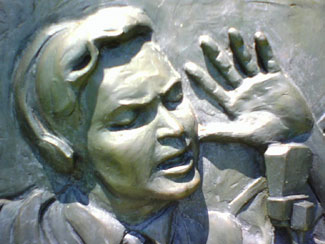
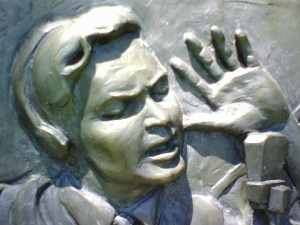
A monument in Grovers Mill, N.J., commemorates Welles and his adaptation of War of the Worlds

The show was work of Orson Welles and his Mercury Theatre on the Air troupe who cleverly used signature elements of radio of the 1930s to create a splendidly clever program. Most listeners recognized it for what it was: An ingenious radio play about a Martian invasion on the eve of Halloween.

The Mercury Theatre on the Air version was set in New Jersey and New York City. The vanguard of the invading Martians landed in Grovers Mill, N.J., still a rural community near Princeton. The War of the Worlds dramatization is commemorated in Grovers Mill by a monument that depicts scenes from the program — including young Orson Welles at the microphone.

Welles was 23 when he made the program. He went on to greater fame as director and star of 1941 motion picture Citizen Kane.