W. Joseph Campbell

Posts Tagged ‘Pulitzer’

Media myth and Truthout

In 1897, Debunking, Media myths, Newspapers, Spanish-American War, Yellow Journalism on February 3, 2011 at 6:47 am

It’s at least faintly ironic that an online news site called Truthout — which asserts an embrace of “equality, democracy, human rights, accountability and social justice” — would post a reference to one of American journalism’s most enduring and delicious media myths.
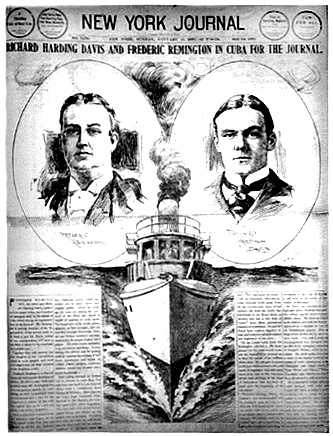
Not Hearst's doing

In its serializing a book by radio host Thom Hartmann, Truthout the other day indulged in the myth that William Randolph Hearst vowed to “furnish the war” with Spain in 1898 — and then made good on the supposed pledge.

The installment Truthout posted Monday said Hearst “had cabled his artist correspondent to Cuba, Frederick[sic] Remington, ‘You provide the pictures, and I’ll provide the war.’

“Hearst came through on his end of the deal, and the Spanish-American War—started largely by his newspapers and the public sentiment they controlled ….”

As I discuss in my latest book, Getting It Wrong, the anecdote about Hearst’s vow is almost certainly apocryphal — a media-driven myth.

And so is the notion that Hearst’s newspapers fomented the Spanish-American War.

In the first chapter of Getting It Wrong, I note that the Remington-Hearst tale remains popular “despite a nearly complete absence of supporting documentation. It lives on even though telegrams supposedly exchanged by Remington and Hearst have never turned up. It lives on even though Hearst denied ever sending such a message.”

Moreover, I write:

The anecdote endures “despite an irreconcilable internal inconsistency: It would have been absurd for Hearst to vow to ‘furnish the war’ because war—specifically, the Cuban rebellion against Spain’s colonial rule—was the very reason Hearst sent Remington to Cuba in the first place.”

Given the context of Remington’s assignment, a vow to “furnish the war” simply would have been incongruous, and illogical.

Had Hearst sent such an inflammatory telegram, it surely would have been intercepted by Spanish censors, who controlled incoming and outgoing cable traffic in Cuba. Spanish authorities undoubtedly would have called attention to what would have been a clear case of Hearst’s meddling.

So it’s highly improbable that a cable containing a vow to “furnish the war” would have flowed without interruption between Hearst in New York and Frederic Remington in Havana. (Had the cable been sent, it would have been in mid-January 1897, near the end of Remington’s lone pre-war visit to Cuba.)

Moreover, no one who repeats the purported vow seems to note, or much care, that Hearst denied having sent such a message and Remington, a prominent artist of the American West, apparently never spoke about it.

The related myth — that Hearst’s newspapers brought on the conflict with Spain — is just as hardy as “furnish the war.” Like many media myths, it offers a reductive, simplistic, and easy-to-remember version of a complex historical event.

The Spanish-American War, quite simply, was not caused by the contents of Hearst’s newspapers, of which he had three at the time — two in New York City, one in San Francisco.

As I discuss in my 2001 book, Yellow Journalism: Puncturing the Myths, Defining the Legacies:

“The yellow press [of Hearst and Joseph Pulitzer] is not to blame for the Spanish-American-War. It did not force—it could not have forced—the United States into hostilities with Spain over Cuba in 1898. The conflict was, rather, the result of a convergence of forces far beyond the control or direct influence of even the most aggressive of the yellow newspapers, William Randolph Hearst’s New York Journal.”

Besides, no one who asserts that the yellow press was responsible for the war with Spain can persuasively demonstrate just how the often-exaggerated contents of Hearst and Pulitzer’s newspapers were decisive in the declaration of war in April 1898.

“If the yellow press did foment the war,” I wrote in Yellow Journalism, then “researchers should be able to find some hint of, some reference to, that influence in the personal papers and the reminiscences of policymakers of the time.

“But neither the diary entries of cabinet officers nor the contemporaneous private exchanges among American diplomats indicate that the yellow newspapers exerted any influence at all.”

When it was discussed within the administration of President William McKinley, the yellow press was dismissed as a nuisance or disdained at as a complicating factor.

The truth is that the yellow press neither drove, shaped, nor  crystallized U.S. policy vis-à-vis Spain in 1898.

Put another way: Hearst did not follow through on a vow he never made.

WJC

Recent and related:

‘Yellow journalism’ turns 114

In 1897, Anniversaries, Debunking, Media myths, Newspapers, Spanish-American War, Yellow Journalism on January 30, 2011 at 8:21 am

It is a little-recognized, never-celebrated anniversary in American journalism, granted.

Wardman of the Press

But tomorrow marks 114 years since the term “yellow journalism” first appeared in print, in the old New York Press, edited by the austere Ervin Wardman (left).

The phrase “the Yellow Journalism” appeared in a small headline on the editorial page of the Press on January 31, 1897. The phrase also appeared that day in the newspaper’s editorial page gossip column, “On the Tip of the Tongue.”

Yellow journalism” quickly caught on, as a sneer to denigrate what then was called the “new journalism” of the New York Journal of William Randolph Hearst and the New York World of Joseph Pulitzer. By the end of March 1897, references to “yellow journalism” had appeared in newspapers in Providence, Richmond, and San Francisco.

In the decades since then, “yellow journalism” has become a widely popular if nebulous term — derisive shorthand for vaguely denouncing sensationalism and journalistic misconduct of all kinds, real and imagined.

“It is,” as I noted in my 2001 book Yellow Journalism: Puncturing the Myths, Defining the Legacies, “an evocative term that has been diffused internationally, in contexts as diverse as Greece and Nigeria, as Israel and India.”

Precisely how Wardman and the Press landed on the phrase “yellow journalism” isn’t clear.

The newspaper’s own, brief discussion of the term’s derivation was unhelpful and unrevealing: “We called them Yellow because they are Yellow,” it said in 1898 about the Journal and the World.

In the 1890s, the color yellow sometimes was associated with decadent  literature, which may have been an inspiration to the Harvard-educated Wardman, a figure now largely lost to New York newspaper history.

Wardman was tall and stern-looking. He once was described as showing his “Calvinistic ancestry in every line of his face.” He did little to conceal his contempt for Hearst and Hearst’s journalism.

His disdain was readily apparent in the columns of the Press, of which Wardman became editor in chief in 1896 at the age of 31. (The Press is long defunct; it is not to be confused with the contemporary alternative weekly of the same title.)

Wardman’s Press took to taunting Hearst, Hearst’s mother, and Hearst’s support for Democratic candidate William Jennings Bryan in the 1896 presidential election. The New York Journal was virtually alone among New York newspapers in supporting Bryan’s “free silver” candidacy.

The Press disparaged Hearst, then 34, as a mama’s boy, as “Billy” and “little Willie.” It referred to the Journal as “our silverite, or silver-wrong, contemporary.”

The Press also experimented with pithy blasts on the editorial page to denounce “new journalism.”

“The ‘new journalism,’” the Press said in early January 1897 “continues to think up a varied assortment of new lies.”

Later in the month, the Press asked in a single-line editorial comment:

“Why not call it nude journalism?”

It clearly was a play on “new journalism” and meant to suggest the absence of “even the veneer of decency.”

Before long, Wardman and the Press seized upon the phrase “yellow-kid journalism,” which evoked the Hearst-Pulitzer rivalry over a popular cartoon character known as the “Yellow Kid.”

Both the Journal and the World at the time were publishing versions of the kid.

Yellow kid poster (Library of Congress)

At the end of January 1897, the phrase “yellow-kid journalism” was modified  to “the Yellow Journalism,” and the sneer was born.

After landing on that evocative pejorative, Wardman turned to it often, invoking the term in brief editorial comments and asides such as: “The Yellow Journalism is now so overripe that the little insects which light upon it quickly turn yellow, too.”

The diffusion of “yellow journalism” was sealed when the Journal embraced the term in mid-May 1898, during the Spanish-American War. With typical immodesty, the newspaper declared:

“… the sun in heaven is yellow—the sun which is to this earth what the Journal is to American journalism.”

WJC

From an essay originally posted at Media Myth Alert January 31, 2010

Many thanks to Jim Romenesko for linking to this post

Recent and related:

On the thin contributions of media rabble-rousers

In Debunking, Jessica Lynch, Media myths, Yellow Journalism on January 26, 2011 at 6:39 am

The departure of the bombastic Keith Olbermann from MSNBC’s primetime lineup is no an occasion for mourning.

But it’s to be regretted.

A little.

So suggested Bret Stephens yesterday in hisWall Street Journal column about Olbermann, who abruptly left his “Countdown” show at the end of last week.

Stephens pointed out:

“The ‘Countdown’ host did away with the old-fashioned liberal snigger and replaced it with a full-frontal snarl. Put simply, Mr. Olbermann had a genuine faith in populism, something liberals more often preach than practice.”

Stephens also offered this intriguing observation:

“America does better when its political debates descend, as they so often do on (or between) MSNBC and Fox News, into honest brawls.”

He may be right, although I wish he had elaborated on that point.

The observation about “honest brawls” reminded me of the insults and brickbats that American newspaper editors of the 1890s routinely exchanged in print. These were vigorous, lusty,  often vicious exchanges — and there really was little memorable or lasting about them. Save, perhaps, for an epithet or two.

Like that of “yellow journalism.”

Wardman, father to a sneer

As I discussed in my 2001 book, Yellow Journalism: Puncturing the Myths Defining the Legacies, the epithet emerged in late January 1897, during the failed campaign of Ervin Wardman, a New York newspaper editor, to drive a stake into the heart of the upstart journalism of William Randolph Hearst and, to a lesser extent, of Joseph Pulitzer.

Yellow journalism” took hold and spread quickly in 1897; it lives on today, as a vague but handy smear especially favored by letter-writers to newspapers.

Trouble is, the sneer “yellow journalism” is so ill-defined and flabby that it has become synonymous with journalistic sins of all kinds — exaggeration, sensationalism, hype, plagiarism, what have you.

And the trouble with media rabble-rousers like Olbermann is that their commentary often lacks wit and nuance, and tends to be superficial. It’s not deft, typically, and it’s unheard of for them to invoke media-driven myths–those dubious stories about the news media that masquerade as factual.

I address and debunk 10 prominent media-driven myths in my latest book, Getting It Wrong.

On his way out, in announcing his abrupt departure, Olbermann indulged in media myth. He described as “exaggerated” the rescue of Army private Jessica Lynch in Iraq in 2003. Hyped, maybe a bit. But the Lynch rescue, conducted by a U.S. special operations force under combat conditions, was not exaggerated.

As I note in Getting It Wrong, the Defense Department’s inspector general reported in 2007 that the rescue of Lynch from an Iraqi hospital was “a valid mission” to recover a prisoner of war.

There was no evidence to suggest that the rescue “was a staged media event” even though it was videotaped, as such missions often are.

Olbermann had on other occasions invoked the media myth surrounding Edward R. Murrow, whom he sought to emulate by borrowing the legendary broadcaster’s sign-off, “Good night, and good luck.”

In November, Olbermann referred to Murrow as “a paragon of straight reporting” while claiming the American press “stood idly by” as Senator Joseph R. McCarthy pursued his communists-in-government witch-hunt.

On March 9, 1954, during a 30-minute CBS television show called See It Now, “Murrow slayed the dragon,” Olbermann declared.

As I point out in Getting It Wrong, neither Murrow nor his producer, Fred Friendly, embraced the dragon-slaying interpretation. (Friendly wrote in his memoir, Due to Circumstances Beyond Our Control: “To say that the Murrow broadcast of March 9, 1954, was the decisive blow against Senator McCarthy’s power is as inaccurate as it is to say that Joseph R. McCarthy … single-handedly gave birth to McCarthyism.”)

And it’s quite clear that the American press did not stand “idly by” as the scourge of McCarthyism emerged.

As I point out in Getting It Wrong:

“Long before the See It Now program, several prominent journalists—including the Washington-based syndicated columnist Drew Pearson—had become persistent and searching critics of McCarthy, his record, and his tactics.”

By the time Murrow took on McCarthy in March 1954, Americans weren’t waiting for a white knight to tell them about the toxic threat the senator posed.

Thanks to the work of Pearson and other journalists, they already knew.

WJC

Recent and related:

The elusive ‘defining moment’ in investigative journalism

In Cinematic treatments, Debunking, Media myths, New York Times, Newspapers, Washington Post, Watergate myth on January 9, 2011 at 8:59 am

The Financial Times of London has asserted that the Watergate reporting of the Washington Post stands as the “defining moment” in investigative reporting–a claim I challenged yesterday.

Not the Post's doing

The notion that the Post and its reporters Bob Woodward and Carl Bernstein brought down Richard Nixon’s corrupt presidency in the Watergate scandal is a hardy meme–and is one of 10 prominent media-driven myths I debunk in my latest book, Getting It Wrong.

The heroic-journalist trope has been driven principally the cinematic version of Woodward and Bernstein’s book about their Watergate reporting, All the President’s Men. The movie’s inescapable message was that the work of reporters brought about Nixon’s resignation in 1974.

But even principals at the Post over the years have dismissed the heroic-journalist interpretation of Watergate.

So if not Watergate, what then was the “defining moment” in investigative reporting?

And how’s “defining moment” to be defined, anyway? The essay in the Financial Times didn’t say.

I argue that the “defining moment” in investigative reporting would have to be that collection of reports recognized years afterward as a landmark in journalism, for having exposed corruption or misconduct. The reports would have been so significant as to have changed government policy and/or altered practices among journalists.

Not many media investigations have had such profound and lasting effect. As Jack Shafer of slate.com has correctly noted:

“Too many journalists who wave the investigative banner merely act as the conduit for other people’s probing.” That is, they often feed off government-led investigations. Woodward and Bernstein did so, to an extent.

A review of the Pulitzer Prizes awarded for investigative reporting over the past 25 years turns up impressive and intriguing candidates. But most winners of the Pulitzer for investigative journalism are local and decidedly narrow in focus and impact; none of them meets my definition of “defining moment.”

The Post won the 2008 Pulitzer for public service for its outstanding reports about abuses at the Walter Reed Army hospital. The first installment of the Post series described the venerable institution as “a holding ground for physically and psychologically damaged outpatients.”

It was a shameful scandal that led to much soul-searching, some reforms, and a few broken careers in Army medicine. The series projected a faint whiff of controversy, too, because conditions at Walter Reed had been the subject of somewhat similar reporting two years earlier by salon.com.

The Boston Globe in 2003 won the public service Pulitzer for its reports about sexual abuse among Roman Catholic priests–a series that seems to have stood up well over time and perhaps qualifies as landmark in investigative reporting.

But is it widely recognized and remembered as such? I don’t think so.

A few media historians have identified the so-called “Arizona Project” in the 1970s as landmark investigative journalism.

The Arizona Project brought together reporters and editors from 23 newspapers, in response to a call by the Investigative Reporters and Editors organization to conduct a collaborative inquiry into the bombing death of Don Bolles, an investigative reporter for the Arizona Republic.

The project produced 40 articles about organized crime in Arizona.

David Sloan and Lisa Mullikin Parcell wrote in their book, American Journalism: History, Principles, Practices that the Arizona Project “was a defining moment in the history of investigative reporting–a rare instance when normally competitive journalists set aside their egos, stepped outside their news organizations, and cooperated on a dramatic and startling story.”

But in all, the Arizona Project produced mixed results.

It didn’t lead to a succession of similar joint ventures by journalists. Prominent news organizations such as the Post and the New York Times declined to participate. And critics said the undertaking smacked of a kind of arrogant vigilantism by journalists.

The Financial Times in its essay published Friday mentioned in addition to the Watergate reporting by the Post a few other works of outstanding investigative journalism.

It said the journalistic “exposures such as The Sunday Times on the effects of Thalidomide in the 1970s, The Guardian on bribery scandals in British Aerospace in 2003 and The New Yorker’s revelations about abuses in Iraq’s Abu Ghraib prison in 2004″ have prominent places on “a long roll of honor” in investigative journalism.

Intriguing cases, all. But are they recognized as landmarks? Maybe.

Tarbell (Library of Congress)

How about the muckraking period early in the 20th century–notably Ida Tarbell’s two-year exposé of Standard Oil, published in McClure’s magazine from 1904 to 1906? That work certainly is recognized as memorable, as a landmark, even.

But its effects tend to have been overstated. Tarbell’s work, detailed and searching though it was, did not bring about the breakup of Standard Oil, as is often claimed.

The breakup came years after Tarbell’s series, when the U.S. Supreme Court ruled in 1911 that Standard Oil had violated antitrust laws.

In the end, we have a few candidates but no overwhelming favorite for the “defining moment” in investigative journalism. And perhaps that’s not so surprising.

Like most works of journalism, investigative reporting tends to be time-specific and of transient importance–and short-lived in its effects.

WJC

Recent and related:

Anniversary journalism and media-driven myths in 2011

In Anniversaries, Bay of Pigs, Debunking, Media myths, New York Times, Newspapers on January 1, 2011 at 7:21 am

NY Times front page, April 7, 1961

“Anniversary journalism” has the appeal of being irresistible and easily done.

Typically, a reporter targets an upcoming anniversary (preferably, the occasion is divisible by 5 or 10), sells the idea to an editor, and cobbles together a story recalling the event. Easily done, but as the Independent newspaper in London has observed, not always very compelling.

We’ll surely see a lot of “anniversary journalism” in 2011.

The year, after all, brings the 10th anniversary of terrorist attacks of September 11, the 100th anniversary of the death of Joseph Pulitzer, and the 150th anniversary of the start of the American Civil War.

Media Myth Alert will be especially interested in 2011 in the 50th anniversary of the botched Bay of Pigs invasion of Cuba, which gave rise to the durable New York Times-Bay of Pigs suppression myth.

In the run-up to the anniversary in April of the Bay of Pigs invasion, we’ll no doubt see frequent references to this media-driven myth.

As I discuss in Getting It Wrong, my mythbusting book that came out in 2010, the suppression myth has it that the New York Times bowed to pressure from the White House of President John F. Kennedy and “spiked,” or self-censored, its detailed report about the pending Bay of Pigs invasion of Cuba.

The purported self-censorship took place about 10 days before the invasion– which failed utterly in its objective of toppling the Cuban revolutionary leader, Fidel Castro.

But as I point out in Getting It Wrong, the Times did not suppress its reports about the pending invasion of Cuba.

It did not censor itself.

The Times’ reports about preparations for the invasion were in fact fairly detailed–and prominently displayed on the front page in the days before the invasion.

The run-up to the Bay of Pigs was no one-day story. A succession of articles before the invasion “kept expanding the realm of what was publicly known about a coming assault against Castro,” I write.

To be sure, not all pre-invasion news reports were accurate or on-target. Much of the reporting was piecemeal.

But overall, the reports in the Times and other U.S. newspapers let readers know that something was afoot in the Caribbean, that an assault on Castro was in the works.

“Indeed,” I write in Getting It Wrong, “the coverage helped strip away the fiction circulated by the Kennedy administration that the invasion was strictly a Cuban affair.”

The suppression myth largely centers around a dispatch that a veteran Times correspondent, Tad Szulc, filed on April 6, 1961.

Supposedly, the Kennedy administration learned of the contents of Szulc’s dispatch about the pending invasion and urged that it be suppressed.

In his book The Powers That Be, David Halberstam offered a graphic, though exaggerated, account of Kennedy’s calling James Reston of the Times, saying the newspaper risked having blood on its hands were the article published.

Such a conversation never happened, according to Reston and others quoted in Harrison Salisbury’s Without Fear or Favor, an insider’s account of the Times and its history.

Moreover, as I note in Getting It Wrong:

“The Kennedy Library in Boston says that the White House telephone logs reveal no calls were placed to Reston” or other Times executives on April 6, 1961.

Szulc’s story was published on the front page on April 7, 1961 (see image, above).

I argue in Getting It Wrong that that the suppression myth likely stems from confusion over an episode in October 1962, when Kennedy did ask the Times to delay publication of a sensitive report.

That came during the Cuban Missile Crisis, when Reston was prepared to report that nuclear-tipped Soviet weapons had been deployed in Cuba. With the prospect of a nuclear exchange seemingly in the balance, the Times complied with the president’s request.

Kennedy took office in 1961–a year with more than a few significant anniversaries. In 1961, Berlin Wall went up, the Soviets put the first man into space, Hemingway killed himself, and Adolf Eichmann‘s war-crimes trial was convened in Israel.

And the Times suppression myth took hold.

WJC

Recent and related:

On the high plateau of media distrust

In 1897, Debunking, Hurricane Katrina, Media myths, New York Times, Newspapers, Yellow Journalism on September 30, 2010 at 10:22 am

A Gallup poll released yesterday suggested that distrust of the news media has reached a high plateau among American adults.

Fifty-seven percent of Gallup’s respondents, the most ever, said they had little or no trust in the “mass media … when it comes to reporting the news fully, accurately, and fairly.” A year ago, the little-to-no trust response rate was 55 percent; in 2008 it was 56 percent.

As Andrew Malcolm noted at his engaging Top of the Ticket blog, the new “record high” in media distrust was reached “by one lousy percentage point.”

Even so, there’s little comfort in having reached such a plateau. And the factors accounting for a pronounced level of popular distrust are several–and hardly unfamiliar.

Surely one reason is that it’s commonplace to bad-mouth the news media as unreliable and unfair. Media-bashing has long been in fashion–and the news media are prone to beat up on themselves, and their rivals.

A commentary posted yesterday at the Atlantic blog put it well in saying that “media voices increasingly distinguish themselves by telling us not to trust the rest of the mainstream media. Think about all of the mass media today that tells us how stupid mass media is.”

True enough. That has to have an effect.

But the news media have long indulged in aiming brickbats and insults at one another. For the news media, media-bashing has long been an irresistible pasttime.

The ever-appealing and often-invoked epithet “yellow journalism” dates after all to 1897–and the efforts of a New York newspaper editor to find a pithy and imaginative way to denigrate what then was called the “new journalism” of William Randolph Hearst and Joseph Pulitzer.

Traditional and new, the media are everywhere these days and their ubiquity no doubt fosters some disdain and contempt. A hint of that contempt can be detected in the recent Pew Research Center’s news-consumption survey, which reported that 17 percent of American adults go newsless on a typical day.

Although the news media are everywhere, a sizable portion of the population has little use for them.

Going newsless can’t be easily accomplished, given the variety of readily accessible platforms by which news is delivered. But the going-newsless option is especially pronounced among American adults younger than 30: Pew’s report said 27 percent of that cohort gets no news on a typical day.

The prominent and well-documented fabrication scandals of several years ago doubt have contributed to the plateau of media distrust. The journalistic fraud committed by Jayson Blair of the New York Times and Jack Kelley of USA Today, among others, surely has left a bad taste for the media among many news consumers.

The inclination to distrust the media surely was reinforced by the highly exaggerated news coverage of Hurricane Katrina’s aftermath in New Orleans in 2005.

As I write in Getting It Wrong, my new book that debunks prominent media-driven myths, the Katrina coverage was “no high, heroic moment in American journalism. … On crucial details, journalists erred badly, and got it wrong. In the days following Katrina’s landfall, news reports described apocalyptic horror that the hurricane supposedly had unleashed.”

And that reporting was steeped in error.

The fifth anniversary of Katrina’s landfall was an occasion to revisit just how shoddy the news coverage was in the storm’s aftermath. And that anniversary fell shortly before Gallup conducted its annual media-trust survey.

Gallup said 1,019 adults were interviewed by telephone in a random survey conducted September 13-16. (The sampling error was plus or minus four percentage points, meaning the level of distrust could be as great as 61 percent, or as narrow as 53 percent.)

Mundane factors probably contribute to the plateau of distrust as well. Staff cuts at many U.S. newspaper, including the unsung heroes manning copy desks, have been blamed for an increase grammar, spelling, and factual errors.

It’s not that newspapers ever were mostly free of such lapses. Anecdotally at least, they seem more frequent and conspicuous. The ombudsman, or reader’s representative, at the Washington Post suggested as much last year in writing that growing numbers of readers were calling on him “to complain about typos and small errors” appearing in the newspaper.

And it’s become a cliché to say that such small-bore errors undermine credibility–or, perhaps more accurately, encourage media distrust.

And then there is the matter of limited viewpoint diversity in American newsrooms, a point I raise in Getting It Wrong.

Few journalists for mainstream national media “consider themselves politically conservative,” I note, referring to surveys conducted in 2004 and 2008 for the Washington-based Committee of Concerned Journalists. The surveys found that the overwhelming majority of national correspondents for U.S. news media considered themselves to be politically “moderate” or “liberal.”

Interestingly, Gallup reported that “Democrats and liberals remain far more likely than other political and ideological groups to trust the media and to perceive no bias.”

Viewpoint diversity in newsrooms “is an issue not much discussed in American journalism,” I write in Getting It Wrong. “But it is hardly irrelevant.”

Especially when distrust of the news media has found such a high plateau.

WJC

Recent and related:

Obama, journalism history, and ‘folks like Hearst’

In 1897, Debunking, Media myths, Yellow Journalism on September 29, 2010 at 9:45 am

President Obama stirred a fair amount of comment and criticism by declaring in a recent interview with Rolling Stone magazine that Fox News pursues a point of view that’s “ultimately destructive” to the country’s “long-term growth.”

As if Fox News, or any news organization, had such power.

And Obama offered another comment that signaled a less-than-profound grasp of American journalism history.

Media baron W.R. Hearst

That came when he invoked William Randolph Hearst, the much-misunderstood practitioner of activist yellow journalism who came to prominence in the 1890s. Obama said:

“We’ve got a tradition in this country of a press that oftentimes is opinionated. The golden age of an objective press was a pretty narrow span of time in our history. Before that, you had folks like Hearst who used their newspapers very intentionally to promote their viewpoints.”

Hearst, though, was something of an exception among newspaper publishers; there haven’t been many “folks like Hearst” in American journalism. Certainly not in the late 19th and early 20th centuries, the most innovative period of Hearst’s years as a press baron.

Hearst arrived in New York City from San Francisco in 1895 and promptly shook a media landscape dominated by the likes of James Gordon Bennett Jr., the often-absent owner of the New York Herald; Joseph Pulitzer, the ailing and churlish proprietor of the New York World, and Charles A. Dana, the prickly force behind the New York Sun.

They all were past their prime, and their newspapers were in decline.

As I discussed in my 2006 book, The Year That Defined American Journalism: 1897 and the Clash of Paradigms, Hearst’s entry into New York City journalism was something of “a seismic event.”

By late 1897, he had developed and began pursuing a robust and fairly progressive view of journalism, maintaining that newspapers had a duty and obligation to inject themselves conspicuously into public life, to fill the void left by government inaction and incompetence.

Hearst called this the “journalism of action” or the “journalism that acts.” It was journalism with a social conscience.

His New York Journal insisted in editorials that a newspaper’s duty should not be “confined to exhortation.”

Instead, the Journal declared, when “things are going wrong” the newspaper should step in and “set them right, if possible.”

Hearst’s “journalism of action” embraced an element of what we would recognize as consumer protection. In the aftermath of a snowstorm that swept New York late in January 1897, the Journal set up a relief effort, saying, “The time has come to help the poor who starve, who freeze. Charity’s hand is almost empty.”

There was no more stunning manifestation of Hearst’s activist vision of journalism than the jailbreak his Journal pulled off in Havana in October 1897, freeing a 19-year-old political prisoner named Evangelina Cisneros.

She had been jailed without trial for more than a year in a prison for women. Spanish authorities who then ruled Cuba spurned Hearst’s editorial campaign for Cisneros’ release.

In late August 1897 he sent Karl Decker, a reporter in the Journal‘s Washington bureau, to Havana, with instructions to win Cisneros’ freedom. And with the quiet help of U.S. diplomats in Cuba, and the vital assistance of a clandestine smuggling network in Havana, Decker broke Cisneros from prison.

Cisneros

She soon was smuggled out of Cuba and welcomed to New York City in a delirious reception organized by Hearst and the Journal.

It was American journalism’s greatest escape narrative. And it demonstrated the breathtaking scope and potential of the “journalism of action.”

Freeing Cisneros, the Journal declared, was “epochal” and a “supreme achievement of the journalism of action.” (Illicit “jail-breaking journalism” was more like it, scoffed the Chicago Times-Herald.)

Eventually, though, Hearst’s interest in developing the “journalism of action” was supplanted by his soaring, and mostly unfulfilled, political ambitions.

In 1902, Hearst was elected to the first of two terms in Congress.

He sought, but lost, the Democratic nomination for president in 1904. He lost the New York gubernatorial race in 1906. And he twice ran unsuccessfully for New York City mayor.

What’s more, I write in The Year That Defined American Journalism, “Hearst never completely shook the reputation of a spoiled little rich kid, and the ‘journalism of action’ surely suffered because of his personality.”

In his comment about “folks like Hearst,” Obama also seemed to embrace a version of the “golden age” fallacy, that there was a time in American journalism when newspapers were paragons of objectivity.

That’s a myth, really.

“Objectivity”–or what Richard Taflinger of Washington State University has succinctly termed “the detached and unprejudiced gathering and dissemination of news”–is a normative value or ambition in American journalism.

But it has never been practiced on anything approaching a sustained basis.

WJC

Recent and related:

My many thanks to fivefeetoffury and to Jim Romenesko for linking to this post.

Getting it right about ‘yellow journalism’

In 1897, Debunking, Media myths, Yellow Journalism on August 19, 2010 at 11:16 am

“Yellow journalism” is an evocative sneer that has morphed over the decades.

Hearst's New York Evening Journal, April 1898

The term these days is sometimes invoked as an off-hand description for sensational treatment of the news. Or, more broadly, it’s used to describe egregious journalistic misconduct of almost any kind.

Or, as AlterNet blog noted in a post yesterday, “sometimes, yellow journalism is seen as synonymous with [William Randolph] Hearst, himself.”

But that’s really an imprecise characterization of a robust genre practiced by Hearst and others in the late 19th century.

As I wrote in my 2001  book, Yellow Journalism: Puncturing the Myths, Defining the Legacies, yellow journalism was defined by these features and characteristics:

  • the frequent use of multicolumn headlines that sometimes stretched across the front page.
  • a variety of topics reported on the front page, including news of politics, war, international diplomacy, sports, and society.
  • the generous and imaginative use of illustrations, including photographs and other graphic representations such as locator maps.
  • bold and experimental layouts, including those in which one report and illustration would dominate the front page. Such layouts sometimes were enhanced by the use of color.
  • a tendency to rely on anonymous sources, particularly in dispatches of leading reporters.
  • a penchant for self-promotion, to call attention frequently to the newspaper’s accomplishments. This tendency was notably evident in crusades against monopolies and municipal corruption.

Given those defining features, I wrote in Yellow Journalism that the genre “certainly could not be called predictable, boring, or uninspired—complaints of the sort that are frequently raised about U.S. newspapers of the early twenty-first century.”

Moreover, yellow journalism of a century or more ago was often criticized–but its salient features, including its bold typography, were often emulated. As such, it exerted a powerful influence in American journalism of the late 19th and early 20th centuries.

So it was much more than merely sensational.

But largely due to its association with Hearst–a toxic personality who ran the New York Journal and later turned the newspaper into a platform for a succession of failed campaigns for high public office–“yellow journalism” has mutated into the caricature that’s commonplace today.

The AlterNet post, which assails Rupert Murdoch and his recent $1 million donation to the Republicans, also says “yellow journalism” was “originally coined to describe the journalistic practices of Joseph Pulitzer….”

Not so.

As I discuss in Yellow Journalism, the epithet was devised in early 1897 to impugn the journalism of both Pulitzer and Hearst.

Yellow journalism” first appeared in print in the New York Press, which was edited by the austere Ervin Wardman, who once was described as revealing his “Calvinistic ancestry in every line of his face.”

The term appeared in Wardman’s newspaper on January 31, 1897, and quickly caught on, as a way to denigrate what then was called the “new journalism” of Hearst’s Journal and of Pulitzer‘s New York World.  By the end of March 1897, references to “yellow journalism” had appeared in newspapers in Providence, Richmond, and San Francisco.

A sneer thus had been born.

Precisely how Wardman and the Press landed on “yellow journalism” is not clear, however.

As I note in Yellow Journalism, the newspaper’s own brief discussion of the term’s origins was vague and unrevealing: “We called them Yellow because they are Yellow,” it said in 1898 about the Journal and the World.

In the 1890s, the color yellow sometimes was associated with depraved literature, which may have been an inspiration to the Harvard-educated Wardman, who plainly despised Hearst and Pulitzer, and editorially supported an ill-fated boycott of their newspapers in New York City in 1897.

Related:

Invoking media myths to score points

In 1897, Debunking, Furnish the war, Media myths, Spanish-American War, Yellow Journalism on July 23, 2010 at 8:25 am

Media-driven myths, those improbable tales about the news media that masquerade as factual, endure for a number of reasons–not the least of which is their value in scoring points about contemporary American journalism.

Evidence of that impulse appears today in a commentary posted at the Moderate Voice blog. The commentary assails conservative publisher Andrew Breitbart as a latter-day practitioner of “yellow journalism” and invokes what are media myths in making that claim.

“At the turn of the 19th century,” the commentary says, “Joseph Pulitzer and William Randolph Hearst ‘created a frenzy’ among the U.S. citizenry that pushed us into the Spanish-American War. Historians accuse Hearst of trying to boost his circulation by advocating war.”

In support of that dubious claim–most historians scoff at the notion that Pulitzer and Hearst “pushed us into” war with Spain–the Moderate Voice commentary offers the hoary tale of Hearst’s purported vow, supposedly contained in a telegram to the artist Frederic Remington, that stated:

“You furnish the pictures and I’ll furnish the war.”

Well, where to begin in unpacking the errors in such sweeping claims?

For starters, Hearst and Pulitzer were prominent in the 1880s and 1890s, not at “the turn of the 19th century.”

More significant, there is little evidence that the newspapers of Hearst and Pulitzer–the New York Journal and New York World, specifically–“created a frenzy” in the run-up to the Spanish-American War in 1898.

As I wrote in my 2001 book, Yellow Journalism: Puncturing the Myths, Defining the Legacies, Hearst and Pulitzer exerted no more than limited agenda-setting influence on the U.S. press in the run-up to the war.

As I noted in Yellow Journalism:

“A significant body of research indicates that newspapers in small-town and rural America scoffed at, condemned, and ignored the exaggerated and fanciful reports appearing in New York City’s yellow journals before and after the Maine’s destruction” in Havana harbor in mid-February 1898.

The mysterious destruction of the battleship U.S.S. Maine killed more than 260 Navy sailors and officers, and helped propel the war with Spain.

Moreover, I noted, “claims that the yellow press fomented the Spanish-American War contain almost no discussion about how, specifically, that influence was brought to bear” inside the administration of President William McKinley.

“There is,” I wrote in Yellow Journalism, “almost no evidence that the content of the yellow press, especially during the decisive weeks following the Maine’s destruction, shaped the thinking, influenced the policy formulation, or informed the conduct of key White House officials.”

The pithy “furnish the war” vow is almost certainly apocryphal, as I discuss in Getting It Wrong, my new book debunking 10 media-driven myths.

I note in Getting It Wrong that the purported vow has gained “unique status as an adaptable, hardy, all-purpose anecdote, useful in illustrating any number of media sins and shortcomings.

“It has been invoked to illustrate the media’s willingness to compromise impartiality, promote political agendas, and indulge in sensationalism.” The Moderate Voice commentary accomplishes all three.

I further note in Getting It Wrong that the tale about Hearst’s vow lives on “despite a nearly complete absence of supporting documentation. It lives on even though the telegram that supposedly contained Hearst’s vow has never turned up. It lives on even though Hearst denied ever sending such a message.”

Additionally, the tale endures in the face of what I call “an irreconcilable internal inconsistency.” It would have been illogical and absurd for Hearst to vow to “furnish the war” because war—specifically, the islandwide Cuban rebellion against Spain’s colonial rule—was the very reason Hearst sent Remington to Cuba in the first place.

Remington was in Cuba in early 1897, at a time when anyone reading U.S. newspapers would have been well aware that Cuba was a theater of a nasty war. By then, Spain had sent nearly 200,000 soldiers in a failed attempt to put down the rebellion, which gave rise in April 1898 to the Spanish-American War.

WJC

Related:

War, the ‘apex of yellow journalism’? Not so

In Debunking, Jessica Lynch, Media myths, Spanish-American War on June 10, 2010 at 11:52 am

I’ve noted from time to time how some media-driven myths–those false, dubious, improbable stories about the news media that masquerade as factual–travel quite well, crossing linguistic barriers with frequency and ease.

Hearst's New York Evening Journal, 1898

One of the more hearty, adaptable, and internationally appealing media myths is that of American “yellow journalism,” and how its sensational and exaggerated content supposedly brought about the Spanish-American War in 1898.

That myth was debunked in my 2001 study, Yellow Journalism: Puncturing the Myths, Defining the Legacies. But it is probably too deliciously appealing, too neat and tidy, ever to die away.

Indeed, it popped up in an international way yesterday, in a commentary in the English-language edition of China’s Global Times. The commentary appeared beneath the headline, “Yellow journalism creeping into Chinese media,” and declared:

“The term yellow journalism was coined during … late 19th century when media barons William Randolph Hearst and Joseph Pulitzer’s respective newspapers, the New York Journal and the New York World, were in cutthroat competition. …

“The apex of US yellow journalism came when the two newspapers’ fear mongering and sensationalism led to the Spanish-American War in 1898.”

As I wrote in Yellow Journalism, the notion that the yellow press of Hearst and Pulitzer brought on the war with Spain over Cuba rests on a narrow, decidedly media-centric interpretation of the conflict’s causes.

That interpretation ignores, I noted, the “more relevant and immediate factors that give rise to armed conflict.

“In the case of the Spanish-American War,” I wrote in Yellow Journalism, “the policy objectives between the United States and Spain ultimately proved irreconcilable. Months of intricate diplomatic efforts ultimately failed to resolve what had become an intolerable state of affairs in Cuba, dramatized by the destruction of the [U.S. warship] Maine in a harbor under Spanish control and supervision.

“To indict the yellow press for causing the Spanish-American War is to misread the evidence and to ignore the intricacies of the diplomatic quandary that culminated in the spring of 1898 in an impasse that led to war.”

Failed diplomacy gave rise to the Spanish-American War, not the content of the yellow press of Hearst and Pulitzer.

Even so, it is intriguing how wartime can and does give rise to media-driven myths.

Of the 10 prominent myths addressed and debunked in my new book, Getting It Wrong, five of them (including the case of Jessica Lynch in the Iraq War) are related to conflict and upheaval.

I consider the linkage of war and media myth in Getting It Wrong, writing:

“That war can be a breeding ground for myth is scarcely surprising. The stakes in war are quite high, and the shock of combat is alien and unfamiliar to most people. Given their limited first-hand experience with war, media audiences usually find themselves in no position to challenge reports from the battlefield.

“The confusion and intensity inherent in warfare can lead journalists to place fragmented information that emerges from conflict into recognizable if sometimes misleading frames.

“In the process, distortion can arise and media myths can flourish.”

But unfamiliarity with warfare only partly explains the tenacity and international appeal of the myth that yellow journalism fomented the Spanish-American War.

Another, perhaps more important factor is that the anecdote outlines the purported extremes–the malevolent extremes–of media influence. That is, the news media can be so powerful that they can lead the country into war, if we’re not mindful.

Which is absurd.

WJC

Related: