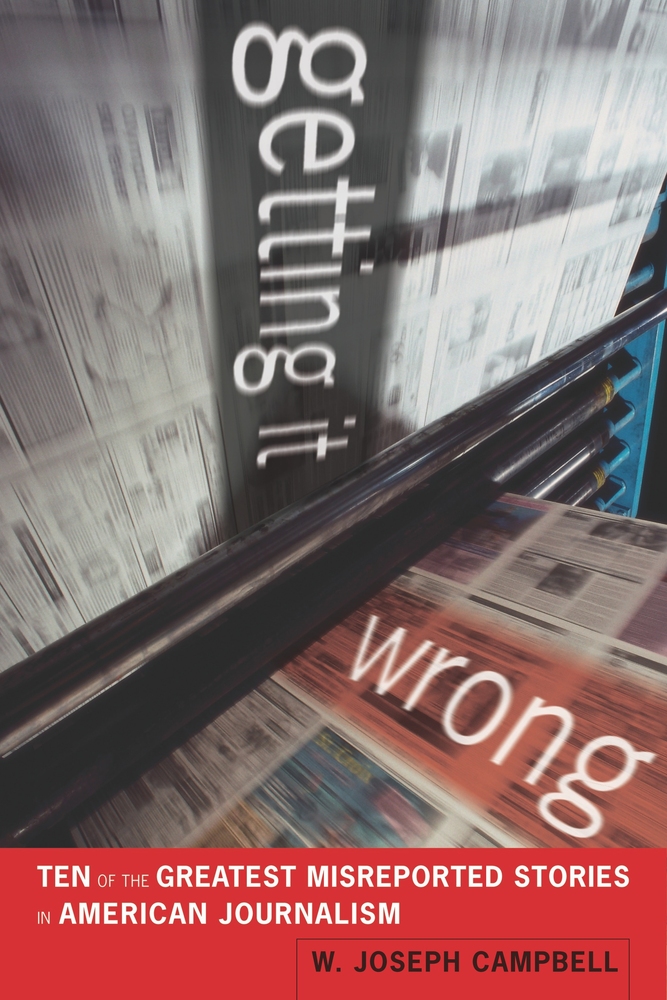
W. Joseph Campbell

Posts Tagged ‘Washington Post’

Carl Bernstein, disingenuous

In Debunking, Washington Post, Watergate myth on July 11, 2011 at 8:56 am

Carl Bernstein, he of Watergate fame, writes scathingly and at length in the latest Newsweek about the phone-hacking scandal that has shaken Rupert Murdoch’s media operations in Britain and prompted the closing of London’s largest Sunday tabloid, the News of the World.

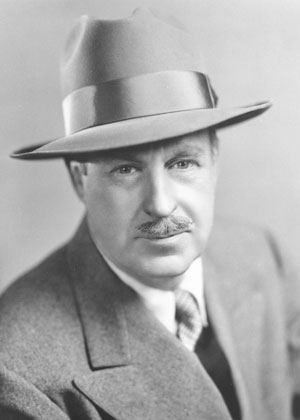
Bernstein (Newseum photo)

Inevitably, Bernstein invokes the Watergate scandal of 1972-74– but conveniently skips over the borderline illegal conduct he and his Washington Post colleague, Bob Woodward, engaged in, in asking federal grand jurors to break their oaths of secrecy and discuss Watergate testimony.

Bernstein writes in Newsweek that “it is impossible not to consider” the News of the World phone-hacking scandal “through the prism of Watergate.”

He adds:

“When Bob Woodward and I came up against difficult ethical questions, such as whether to approach grand jurors for information (which we did, and perhaps shouldn’t have), we sought executive editor Ben Bradlee’s counsel, and he in turn called in the company lawyers, who gave the go-ahead and outlined the legal issues in full.”

That story’s a lot messier than Bernstein lets on: The private entreaties to Watergate grand jurors in December 1972 angered the federal judge hearing the Watergate cases and nearly landed the reporters in jail.

As described in All the President’s Men, Bernstein and Woodward’s book about their Watergate reporting, none of the grand jurors was cooperative but the reporters’ overtures were reported to the federal prosecutors, who informed the chief judge of U.S. District Court in the District of Columbia, John J. Sirica.

The judge was livid.

According to All the President’s Men, Edward Bennett Williams, the Post’s top lawyer, went to lengths to persuade Sirica — known as “Maximum John” for the stern sentences he imposed — not to throw the book at the wayward reporters.

“John Sirica is some kind of pissed at you fellas,” Williams was quoted as saying in the book. “We had to do a lot of convincing to keep your asses out of jail.”

Being sent to jail would have interrupted and may well have ended their reporting on Watergate. (The myths surrounding Bernstein and Woodward’s work are discussed in my latest book, Getting It Wrong.)

It wasn’t as if Bernstein and Woodward and their editors at the Post were oblivious to the hazards of inviting grand jurors to violate their secrecy vows. They were well aware of the risks of what they described in All the President’s Men as “a seedy venture.”

The Post’s editors consulted on the scheme — among them Bradlee, Managing Editor Howard Simons, Metropolitan Editor Harry M. Rosenfeld — all entertained “private doubts” about approaching grand jurors.

The Post city editor, Barry Sussman, was described in All the President’s Men as fearing “that one of them, probably Bernstein, would push too hard and find a way to violate the law.

“Woodward wondered whether there was ever justification for a reporter to entice someone across the line of legality while standing safely on the right side himself. Bernstein, who vaguely approved of selective civil disobedience, was not concerned about breaking the law in the abstract. It was a question of which law, and he believed that grand-jury proceedings should be inviolate.”

But they went ahead anyway, desperate for leads in the slowly unfolding scandal.

Their overtures to the grand jurors drew a tongue-lashing from Sirica in open court on December 19, 1972.

“I want it understood by the person who approached members of the grand jury that the court regards this matter as extremely serious” and “at least potentially” contempt of court, Sirica said.

The judge, though, did not mention the reporters by name, saying only that the entreaties to grand jurors had been made by “a news media representative.”

Reporters covering the hearing buzzed with speculation as to whom Sirica was referring.

Bernstein and Woodward deflected suggestions that they had made the improper overtures. “We … engaged in our own cover-up,” Woodward was quoted as saying in Alicia Shepard’s Woodward and Bernstein: Life in the Shadow of Watergate.

The reporters wrote in All the President’s Men, which came out in 1974 just as Watergate was nearing its climax, that in seeking out the grand jurors, they “had chosen expediency over principle and, caught in the act, their role had been covered up.”

To be sure, their dubious conduct was not in the same league as the rank illegality of News of the World’s phone-hacking.

But Bernstein was more than a little disingenuous in soft-pedaling how he and Woodward solicited information from Watergate grand jurors.

WJC

Many thanks to Instapundit
Glenn Reynolds for linking to this post.

Recent and related:

WaPo eludes responsibility in bogus hero-warrior tale about Lynch

In Debunking, Jessica Lynch, Media myths, Washington Post on July 6, 2011 at 9:17 am

The Washington Post has the exclusive though obviously unwanted distinction of having brought the world the bogus story about Jessica Lynch and her battlefield heroics during the early days of the Iraq War.

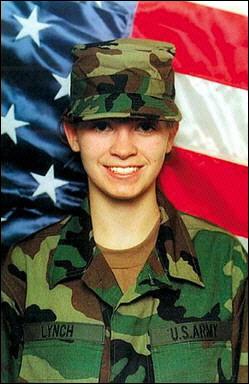
Private Lynch, 2003

But in what has been a remarkable case of deflected attention, the Post’s singular role in the botched hero-warrior tale about Lynch has been obscured in favor of a darker, more sinister narrative that the Pentagon concocted the story and fed it to the American public.

That version — the military made it up — has become the dominant narrative of the Lynch case and is predictably invoked whenever Lynch attracts the news media’s attention, as she did on the Fourth of July.

She was in Idaho then to give a talk at a Presbyterian camp. Her appearance drew local news coverage, including a report published yesterday in the Spokesman-Review newspaper of Spokane.

The Spokesman-Review account blithely repeated the dominant narrative about Lynch’s supposedly heroic deeds, stating without attribution:

“The military initially portrayed Lynch as a hero, saying she fought back until she ran out of ammunition.”

Which just isn’t so.

As Vernon Loeb, one of the Post reporters on the botched Lynch story has made clear, the Pentagon wasn’t the source of the hero-warrior tale.

“Far from promoting stories about Lynch,” Loeb has said, “the military didn’t like the story.”

The dominant narrative is a false narrative.

Loeb then was the Post’s defense correspondent. He shared a byline with Susan Schmidt on the sensational story about Lynch, which was published April 3, 2003, on the Post’s front page.

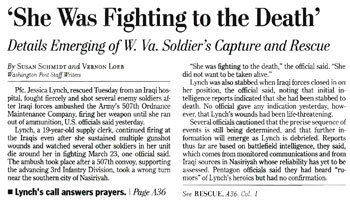
The Schmidt-Loeb report carried the headline:

“‘She was fighting to the death.'”

The story described how Lynch, then 19, supposedly had fought with Rambo-like ferocity in an ambush at Nasiriyah in southern Iraq, “even after she sustained multiple gunshot wounds and watched several other soldiers in her unit die around her.”

Lynch, a supply clerk in the Army’s 507th Maintenance Division, also was stabbed before being overwhelmed, according to the Post.

The newspaper cited otherwise unidentified “U.S. officials” for its sensational story, which was picked up and reported prominently by news organizations around the world.

The hero-warrior tale turned Lynch into the war’s best-known American soldier. But it wasn’t true.

Lynch hadn’t fired a shot in the ambush.

She was badly injured not from gunshots and stabbings, but in a Humvee that crashed fleeing the Iraqi attack.

In the years since, the Post  has not objected as the dominant narrative about the origins of the Lynch story has shifted to the Pentagon. The newspaper has said little, if anything, about the now-routine inclination to blame the military for the bogus tale.

Indeed, the newspaper has “never fully acknowledged or explained its extraordinary error about Jessica Lynch,” as I write in my latest book, Getting It Wrong.

It is certainly time for the Post to identify the “U.S. officials” who led it so badly astray on the Lynch story; doing so would clarify what role, if any, the Pentagon had in the derivation of the bogus tale.

Loeb has effectively absolved the Pentagon in the hero-warrior tale about Lynch, saying in an interview on NPR in December 2003:

“Our sources for that story were not Pentagon sources.

“And, in fact, I could never get anybody from the Pentagon to talk about those reports [about Lynch’s battlefield heroics] at all. I got indications that they had, in fact, received those intelligence reports, but the Pentagon was completely unwilling to comment on those reports at all.

“They wouldn’t say anything about Jessica Lynch.”

WJC

Recent and related:

The journos who saved us

In Cinematic treatments, Debunking, Media myths, Murrow-McCarthy myth, Washington Post, Watergate myth on July 5, 2011 at 12:49 pm

Murrow: Savior?

At their extreme, media-driven myths are hero-worshipping devices, invoked to venerate journalists as saviors.

Thankfully, such treatment is rare, and typically reserved for such journalists the legendary CBS newsman Edward R. Murrow and the Watergate reporting duo, Bob Woodward and Carl Bernstein.

Brian Unger, host of a history program on cable television, indulged in a bit of journalists-idolatry in compiling for an Entertainment Weekly blog a list of a dozen heroic figures from TV shows and the movies.

On the list was Ed Murrow, whom Unger praised for “saving us from someone who pretended to be a great American patriot, Sen. Joseph McCarthy.”

Also selected were Robert Redford and Dustin Hoffman, the movie stars who played Washington Post reporters Woodward and Bernstein in the film All the President’s Men. “Armed only with a pen,” Unger wrote, “they saved the country from itself.”

Journalists as saviors: Like most media-driven myths, the notion is simply too good to be true, too simplistic to be credible.

Murrow hardly took down Joe McCarthy in Murrow’s famous See It Now program on CBS in March 1954.

The show was aired four years after McCarthy began his communists-in-government witch-hunt, and four years after muckraking columnist Drew Pearson piercingly challenged and punctured many of McCarthy’s claims.

Pearson

The television critic for the New York Post, Jay Nelson Tuck, wrote that Murrow in the days after the show felt “almost a little shame faced at being saluted for his courage in the McCarthy matter. He said he had said nothing that … anyone might not have said without a raised eyebrow only a few years ago.”

Years later, Murrow’s CBS colleague, Eric Severaid, chafed at the misleading interpretation attached to the See It Now program on McCarthy which, he noted, “came very late in the day.”

Sevareid said: “The youngsters read back and they think only one person in broadcasting and the press stood up to McCarthy and this has made a lot of people feel very upset, including me, because that program came awfully late.”

As I write in my media myth-busting book, Getting It Wrong, Americans in early 1954 weren’t “hoping for someone to step up and expose McCarthy, or waiting for a white knight like Murrow to tell them about the toxic threat the senator posed.”

By then they knew, thanks to the work of journalists such as Pearson.

Murrow no more ended McCarthy’s witch-hunt than Woodward and Bernstein brought down Richard Nixon’s corrupt presidency in Watergate — and, as Unger wrote, “saved the country from itself.”

Whatever that means.

It is clear that Woodward and Bernstein’s contributions to unraveling the Watergate scandal of 1972-74 were modest, and pale in significance when compared to the work of such subpoena-wielding entities as special prosecutors, both houses of Congress, the Justice Department, the FBI.

“Even then,” I write in Getting It Wrong, Nixon “likely would have served out his term if not for the audiotape recordings he secretly made of most conversations in the Oval Office of the White House. Only when compelled by the Supreme Court did Nixon surrender those recordings, which captured him plotting” to obstruct justice in the Watergate scandal.

Interestingly, principals at the Washington Post over the years have scoffed at the mythical and mediacentric interpretation that the newspaper brought down Nixon.

In 2005, for example, Michael Getler, then the newspaper’s ombudsman, wrote in a column:

“Ultimately, it was not The Post, but the FBI, a Congress acting in bipartisan fashion and the courts that brought down the Nixon administration. They saw Watergate and the attempt to cover it up as a vast abuse of power and attempted corruption of U.S. institutions.”

Woodward, himself, declared in 2004, in an interview with American Journalism Review:

To say the press brought down Nixon, that’s horseshit.”

But undoubtedly it’s the film All the President’s Men that’s largely responsible for the heroic-journalist trope that Woodward and Bernstein took down Nixon and saved the country.

All the President’s Men easily is the most-viewed movie made about Watergate. And as I note in Getting It Wrong, it places “Woodward and Bernstein at the center of Watergate’s unraveling while denigrating the efforts of investigative agencies such as the FBI.

“The effect was to solidify and elevate the heroic-journalist myth, giving it dramatic power, and sustaining it in the collective memory.”

WJC

Recent and related:

False narrative accompanies Jessica Lynch to Idaho

In Debunking, Jessica Lynch, Media myths, Washington Post on July 4, 2011 at 7:12 am

Lynch in 2003

The false narrative that the Pentagon cynically concocted the tale of her battlefield derring-do in Iraq has accompanied Jessica Lynch to Idaho, where she is to deliver a speech today on the Fourth of July.

News reports in advance of Lynch’s appearance have said the Pentagon was the source of the erroneous report that she fought fiercely in an ambush in Nasiriyah in March 2003 — an engagement in which 11 American soldiers were killed.

But as I discuss in my media-mythbusting book, Getting It Wrong, the tale of Lynch’s purported heroics was thrust into the public domain not by the Pentagon but solely by the Washington Post.

The Post in a sensational, front-page story published April 3, 2003, said that Lynch, a 19-year-old supply clerk in the Army’s 507th Maintenance Company, had fought fiercely in the attack at Nasiriyah, suffering gunshot and stab wounds while firing round after round into the attacking Iraqis.

The Post’s article, which appeared beneath the bylines of Susan Schmidt and Vernon Loeb, was built almost entirely around anonymous sources identified only as “U.S. officials.”

One of the Schmidt-Loeb sources was quoted as saying of Lynch:

“‘She was fighting to the death. She did not want to be taken alive.'”

The article was thoroughly wrong. Bogus.

Schmidt and Loeb were misled by their sources, who to this day remain unidentified.

Lynch never fired a shot in the fighting in Nasiriyah.

She was neither shot nor stabbed.

According to her own account in a co-authored book, I Am a Soldier, Too, Lynch cowered in the back seat of a Humvee as it sped from the attack, praying, “Oh God help us. Oh God, get us out of here.”

The fleeing Humvee was struck by a rocket-propelled grenade, which sent the vehicle crashing into a disabled tractor-trailer just ahead. Lynch suffered shattering injuries; the four other soldiers in the Humvee were fatally injured.

Lynch was taken to an Iraqi hospital where she lingered near death before a U.S. special forces team rescued her on April 1, 2003.

The Post’s botched story by Schmidt and Loeb appeared two days later, beneath the headline:

“‘She was fighting to the death.'”

Over time, the singular role of the Post in the bogus hero-warrior story about Lynch has faded.

In its place has emerged the false narrative that the Pentagon made up the story to bolster popular support for the war.

But as I note in Getting It Wrong, the Pentagon wasn’t the Post’s source for the bogus hero-warrior tale.

We know that from an interview in December 2003 on NPR’s  Fresh Air show program. On that show, Loeb said he “could never get anybody from the Pentagon to talk about” Lynch’s purported heroics.

“They wouldn’t say anything about Jessica Lynch,” Loeb declared.

“I just didn’t see the Pentagon trying to create a hero where there was none,” he added. “I mean …they never showed any interest in doing that, to me.”

Loeb was unequivocal in saying:

“Our sources for that story were not Pentagon sources.”

Loeb said they were “some really good intelligence sources” in Washington, D.C., and added:

“We wrote a story that turned out to be wrong because intelligence information we were given was wrong. That happens quite often.”

Loeb on another occasion was quoted in the New York Times as saying:

“Far from promoting stories about Lynch, the military didn’t like the story.”

Despite Loeb’s exculpatory comments, the erroneous interpretation that the Pentagon concocted the story about Lynch’s heroics has taken hold and lives on — in part because it corresponds well to a view that the war in Iraq was a thoroughly botched affair.

The erroneous references to the Pentagon in advance stories about Lynch’s Fourth of July talk near Craigmont, Idaho, underscore anew why the Post ought to identify the sources who led it astray on Lynch’s supposed heroics.

By doing so, the Post will help to debunk a malicious false narrative and help set the record straight.

And after all, that’s what journalism is supposed to do.

WJC

Recent and related:

‘Sneakily patriotic’ movies that promote media myths

In Cinematic treatments, Debunking, Media myths, Murrow-McCarthy myth, Washington Post, Watergate myth on July 1, 2011 at 7:28 am

The film critic for Gannett News Service has identified in time for the Fourth of July weekend 10 movies he says are “sneakily patriotic.”

Meaning they promote patriotism indirectly, without a lot of flag-waving flamboyance.

The list, compiled by critic Bill Goodykoontz, includes Apollo 13, the dramatic 1995 movie about an ill-fated lunar mission that ended safely, and Miracle, the 2004 film about the gold medal-winning 1980 U.S. Olympics hockey team, a movie that does feature a fair amount of flag-waving.

Notably, two of the “sneakily patriotic” films have promoted and propelled media-driven myths — those dubious and improbable tales about news media that masquerade as factual.

Both myth-promoting movies push the extravagant notion that the news media are, or were, powerful and decisive forces in American political life. And both movies are discussed in my media myth-busting book, Getting It Wrong, which came out last year.

The myth-promoters are:

Goodykoontz, in describing the two movies, invokes their mythical aspects.

About All the President’s Men, Goodykoontz writes that Woodward and Bernstein’s “coverage of the Watergate break-in … led, ultimately, to the resignation of Richard Nixon.”

And Good Night, and Good Luck, he writes, “evokes an earlier era of media and how it could be used to stem the abuse of power.”

I point out in Getting It Wrong how movies can solidify media-driven myths in the public’s consciousness. “High-quality cinematic treatments,” I write, “are powerful agents of media myth-making, and can enhance a myth’s durability.”

The cinematic version of All the President’s Men solidified what I call the heroic-journalist myth of Watergate — the simplistic notion that Woodward and Bernstein’s investigative reporting brought down Richard Nixon’s corrupt presidency.

All the President’s Men, I write, allows no interpretation other than it was the work of Woodward and Bernstein that “set in motion far-reaching effects that brought about the first-ever resignation of a U.S. president.”

But to embrace that interpretation, I further write in Getting It Wrong, “is to abridge and misunderstand the scandal and to indulge in a particularly beguiling media-driven myth.”

The heroic-journalist interpretation serves to diminish and ignore the far more powerful forces that unraveled the scandal and forced Nixon from office.

Those forces, I write, “included special prosecutors, federal judges, both houses of Congress, the Supreme Court, as well as the Justice Department and the FBI.

“Even then, Nixon likely would have served out his term if not for the audiotape recordings he secretly made of most conversations in the Oval Office of the White House. Only when compelled by the Supreme Court did Nixon surrender those recordings, which captured him” plotting to obstruct justice in the Watergate scandal.

When considered against the tableau of subpoena-wielding authorities, the contributions of Woodward and Bernstein pale in significance and consequence.

A somewhat similar dynamic is at work in Good Night, and Good Luck.

The movie, which was released in black and white to lend a 1950s feel, permits no other conclusion than Murrow’s See It Now program about McCarthy single-handedly ended the senator’s communists-in-government witch-hunt.

Murrow’s show detailing McCarthy’s loathsome and bullying tactics was aired in March 1954 — long after other journalists had confronted the senator and, in some cases, paid a heavy price for doing so.

Among those journalists was the muckraking columnist Drew Pearson, who took aim at McCarthy in February 1950, not long after the senator began his red-baiting campaign.

By the end of that year, McCarthy had physically assaulted Pearson and denounced him from the Senate floor as the “diabolically” clever “voice of international communism,” a “prostitute of journalism,” and the “sugar-coated voice of Russia.”

In the Senate speech excoriating Pearson, McCarthy aimed a threat at Adam Hat Stores Inc., the principal sponsor of the columnist’s Sunday night radio program.

McCarthy said that “anyone who buys from a store that stocks an Adams hat is unknowingly contributing at least something to the cause of international communism by keeping this communist spokesman on the air.”

Within a week, Adam Hat announced the end of its sponsorship of Pearson’s program.

Pearson may not have had the finest reputation in 1950s American journalism. Jack Shafer, the media critic for Slate.com, wrote last year that Pearson was “one of the skuzziest journalists to ever write a story.”

But Pearson took on McCarthy years before Murrow — and long before it was safe. He certainly was “sneakily patriotic” in doing so.

WJC

Recent and related:

List of flubs by pols incomplete without Biden’s Watergate gaffe

In Debunking, Media myths, Washington Post, Watergate myth on June 30, 2011 at 10:55 am

The gaffe-prone vice president, Joe Biden, claimed in a speech aboard a few months ago that the Washington Post “brought down” Richard Nixon’s corrupt presidency in the Watergate scandal.

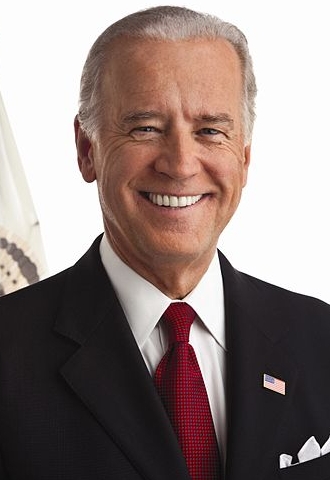
Gaffe-prone

That’s a media myth — a misreading of history that not even the Post embraces.

While Biden’s blunder didn’t receive much media attention at the time, the flub merited inclusion in Time magazine’s lineup of memorable mischaracterizations of American history offered by leading U.S. politicians.

In a posting yesterday, the magazine’s “Swampland” politics blog offered what it termed were nine “epically wrong politician accounts of yesteryear.”

The “Swampland” lineup included two flubs by Michele Bachmann, the Republican congresswoman running for president — that the battles of Lexington and Concord were fought in New Hampshire and that John Quincy Adams was among America’s founding fathers.

Biden made the “Swampland” lineup for his laughable statement that President Franklin D. Roosevelt went on television and spoke to Americans after the stock market crash of 1929. Roosevelt didn’t become president until 1933 and television wasn’t pervasive in American households until the 1950s.

While perhaps not as delicious as the FDR-market crash gaffe, Biden’s ahistoric flub about the Post and Watergate would have rounded out the “Swampland” list at 10.

Its inclusion would’ve underscored how unraveling a scandal as complex as Watergate required far more investigative clout than any news organization could muster.

Although it won a Pulitzer Prize in 1973, the Post’s Watergate-related reporting was scarcely enough to turn a sitting president from office. Nixon resigned in August 1974.

Biden’s mischaracterization of Watergate was astonishing and the “Swampland” list is incomplete without mentioning the blunder. The vice president told an audience in Moscow in March:

“In my country it was a newspaper, not the FBI, or the Justice Department, it was a newspaper, the Washington Post that brought down a President for illegal actions.”

It didn’t.

As I write in my latest book, Getting It Wrong,to argue that the Post and the dogged reporting of its reporters Bob Woodward and Carl Bernstein took down Nixon “is to abridge and misunderstand the scandal and to indulge in a particularly beguiling media-driven myth.”

I note that rolling up a scandal of the sweep and dimension of Watergate “required the collective if not always the coordinated forces of special prosecutors, federal judges, both houses of Congress, the Supreme Court, as well as the Justice Department and the FBI.”

And even then, I write, “Nixon likely would have served out his term if not for the audiotape recordings he secretly made of most conversations in the Oval Office of the White House.

“Only when compelled by the Supreme Court did Nixon surrender those recordings, which captured him plotting the cover-up” of Watergate’s signal crime — the break-in at the headquarters of the Democratic National Committee in June 1972.

So against the tableau of subpoena-wielding authorities, the contributions of the Post in Watergate fade in significance.

Those contributions were not decisive, as top officials at the Post have noted over the years.

Katharine Graham, the newspaper’s publisher during and after the Watergate years, said in 1997, at a program marking the scandal’s 25th anniversary:

“Sometimes people accuse us of bringing down a president, which of course we didn’t do. The processes that caused [Nixon’s] resignation were constitutional.”

Ben Bradlee,who was the Post’s executive editor during Watergate, said on the “Meet the Press” interview show in 1997:

“[I]t must be remembered that Nixon got Nixon. The Post didn’t get Nixon.”

And Woodward himself has disputed the mediacentric interpretation of Watergate, declaring in 2004 in an interview with American Journalism Review:

To say the press brought down Nixon, that’s horseshit.”

WJC

Recent and related:

WaPo’s latest ‘missed’ opportunity evokes Jessica Lynch case

In Debunking, Jessica Lynch, Washington Post on June 26, 2011 at 9:11 am

Patrick Pexton has been hesitant and a bit baffling in three-plus months as the Washington Post’s ombudsman.

His choice of topics — he recently discussed the Post’s coverage of women’s sports — suggests he’s no Michael Getler, who set a rather hard-nosed standard in five years as ombudsman, and no Deborah Howell, who poked at the ideological lopsidedness of the Post’s newsroom.

But Pexton gets moderately tough in his column published today, criticizing the Post for fumbling the case of Jose Antonio Vargas, an undocumented immigrant who was a Post reporter for several years and kept his status mostly a secret.

A Post editor, Patrick Perl, knew that Vargas was an undocumented immigrant but kept quiet about it.

Vargas recently submitted to the Post a lengthy, first-person essay about his status and time as a reporter there. For reasons not entirely clear, the newspaper in mid-June abruptly spiked the piece.

So Vargas took his account to the New York Times, which published it in today’s magazine.

In his column about the Vargas case, Pexton asks:

“Why would The Post punt to a rival a riveting, already edited story that could provoke national discussion on immigration — an issue that sorely needs it — and that also included possibly illegal, and perhaps forgivable, conduct by a former Post reporter and current member of management?

“Beats the heck out of many in The Post’s newsroom,” Pexton adds, “and beats the heck out of me.”

He adds that in the Vargas matter, the Post “missed an opportunity to tell a great and compelling story, and to air and take responsibility for some internal dirty laundry. It’s that kind of act that earns you the lasting respect of your readers. It keeps their trust.”

It’s a ringing line with which to close a column.

It’s also an observation that evokes another messy case the Post has never thoroughly addressed: It never has come clean about its bogus hero-warrior story about Jessica Lynch, a story that became an international sensation in the early days of the Iraq War.

Lynch was a shy 19-year-old private, a supply clerk in the Army’s 507th Maintenance Company. Elements of her unit were caught in a deadly ambush in southern Iraq in March 2003.

The Post reported that Lynch fought fiercely in the attack, “even after she sustained multiple gunshot wounds and watched several other soldiers in her unit die around her” before being taken prisoner. She also was stabbed in the attack, the Post reported, but fought the Iraqis until she ran out of ammunition.

The Post quoted an otherwise anonymous “U.S. official” as saying: “She was fighting to the death. She did not want to be taken alive.”

Private Lynch

But in fact Lynch never fired a shot in the ambush.

Lynch was neither shot nor stabbed.

She suffered shattering injuries was badly injured in the crash of a Humvee fleeing the attack.

Lynch was treated at an Iraqi hospital from where she was rescued by a U.S. commando team on April 1, 2003. The Post’s bogus hero-warrior story came out two days later.

In the years since, the newspaper has never fully explained how it got the hero-warrior story so utterly wrong; nor has it dealt adequately with fallout from the Lynch case.

As I note in my media myth-busting book, Getting It Wrong, the Post had the temerity, in a follow-up article published in June 2003, to blame the U.S. military and the administration of President George Bush for failing to correct an error for which the Post, alone, was responsible.

“Neither the Pentagon nor the White House publicly dispelled the more romanticized initial version of her capture,” the Post said in the follow-up article — as if the “romanticized initial version” wasn’t the Post’s, alone.

So why still fuss about the Post and its botched the story about Lynch?

For at least two compelling and somewhat related reasons.

One is the false narrative that has come to define the Lynch case — a narrative that says the Pentagon planted the bogus hero-warrior tale in order to bolster support for the war at home.

That narrative endures even though Vernon Loeb, one of the reporters on the original Lynch story, has said the Pentagon wasn’t the source for the hero-warrior tale.

“I could never get anybody from the Pentagon to talk about those reports [of Lynch’s battlefield derring-do] at all,” Loeb said on an NPR program in late 2003, adding:

“They wouldn’t say anything about Jessica Lynch.”

The other reason it still matters is that a former White House operative named Jim Wilkinson was fingered as the Post’s source in Where Men Win Glory: The Odyssey of Pat Tillman, a book by Jon Krakauer.

In the book, Krakauer referred to Wilkinson as a “master propagandist” and said he “deserves top billing for creating the myth of Jessica Lynch.”

But the book offered no specific source for its claims about Wilkinson, who at the time of Lynch’s capture and rescue was director of strategic communications for General Tommy Franks, then the commander of U.S. forces in Iraq.

I spoke with Wilkinson last year and he disputed Krakauer’s account as “factually incorrect” and insisted that “not one shred of evidence” links him to leaking the erroneous report to the Post.

Wilkinson also said:

“Tommy Franks would have killed me” had he been the Post’s source for the erroneous report about Lynch.

Wilkinson’s denial has a ring of validity, particularly his point about Franks.

The Post could swiftly resolve this lingering messiness by identifying the anonymous sources who led it astray on the Lynch story. The newspaper should feel no obligation to sources who caused it to err so badly.

Identifying those sources would reveal whether indeed the Pentagon planted the hero-warrior tale, and would clarify Wilkinson’s role, if any, in the Lynch case. And it would, as Pexton might say, represent “an opportunity to tell a great and compelling story” that would earn the respect of readers.

WJC

Recent and related:

‘Getting It Wrong’ at ‘Reader’s Corner’ tonight

In Cronkite Moment, Debunking, Hurricane Katrina, Media myths, Washington Post, Watergate myth on June 24, 2011 at 6:02 am

I’ll be discussing my latest book, Getting It Wrong, in a half-hour interview that airs tonight at 7:30 (Eastern) on “Reader’s Corner,” a program of Boise State University public radio, KBSX 91.5 FM.

The host is the university’s president, Bob Kustra, an engaging interviewer who taped the show with me last week.

We discussed a number of the media-driven myths debunked in Getting It Wrong, including, in some detail, the mythical “Cronkite Moment” of 1968.

That was when CBS News anchor Walter Cronkite supposedly swung U.S. policy in Vietnam with his on-air assessment that the American military was “mired in stalemate” and that negotiations were a prospective way out of Southeast Asia.

The assessment, I write in Getting It Wrong, “supposedly was so singularly potent that it is has come to be remembered as the ‘Cronkite moment.'”

At the White House, President Lyndon Johnson supposedly watched Cronkite’s program about Vietnam — a special, hour-long report that aired February 27, 1968. Upon hearing Cronkite’s “mired in stalemate” statement, Johnson is said to have leaned over, snapped off the television set, and told an aide or aides:

“If I’ve lost Cronkite, I’ve lost Middle America.”

Or words to that effect. Versions vary. Markedly.

As I point out in Getting It Wrong, however, Johnson didn’t see the Cronkite report when it aired. The president wasn’t at the White House, either.

He was on the campus of the University of Texas at Austin, offering light-hearted banter at the 51st birthday party of Governor John Connally, one of the president’s long-time political allies.

About the time Cronkite intoned his “mired in stalemate” assessment, Johnson was saying this, about Connally’s age:

“Today you are 51, John. That is the magic number that every man of politics prays for—a simple majority.”

It’s difficult to imagine how Johnson was much moved by a show he didn’t see.

Even if the president did watch the Cronkite report at some later date on videotape — and there’s no evidence he did — it’s clear that Johnson did not take the anchorman’s assessment to heart. “Mired in stalemate” was no epiphany for the president.

Indeed, just three days after the Cronkite program aired, Johnson vowed in remarks at a testimonial dinner in Texas that the United States would “not cut and run” from Vietnam.

“We’re not going to be Quislings,” the president said, invoking the surname of a Norwegian politician who helped the Nazis take over his country. “And we’re not going to be appeasers….”

I noted in the interview with Kustra, that Cronkite until late in his life pooh-poohed the notion his assessment about Vietnam represented a pivotal moment.

In his memoir published in 1997, Cronkite wrote that his “mired in stalemate” assessment posed for Johnson “just one more straw in the increasing burden of Vietnam.”

But by 2006, three years before his death, Cronkite had come to embrace the conventional interpretation of the presumptive “Cronkite Moment,” saying in an interview with Esquire:

“To be honest, I was rather amazed that my reporting from Vietnam had such an effect on history.”

Among other topics, Kustra and I discussed the hero-journalist myth of Watergate (the notion that the dogged reporting of Bob Woodward and Carl Bernstein for the Washington Post brought down Richard Nixon’s presidency) and the woefully exaggerated reporting that characterized coverage of Hurricane Katrina’s aftermath in New Orleans.

I also noted during the interview that Getting It Wrong is best regarded as aligned with the fundamental imperative of newsgathering — that of getting it right, of seeking to obtain the most accurate version of events as possible.

WJC

Appearance decisive in politics? Revisiting the Kennedy-Nixon debate

In Debunking, Media myths on June 23, 2011 at 4:04 am

First presidential debate, 1960

The power of the image in presidential politics was never better demonstrated than in September 1960.

That was when John F. Kennedy supposedly won the first-ever televised debate between U.S. presidential candidates because he appeared so poised, rested, and telegenic compared to his sweaty, haggard-looking rival, Richard M. Nixon.

Most television viewers thought so, supposedly.

But people who listened to the debate on radio had a distinctly different impression: They thought Nixon won the encounter.

So goes one of the most delicious, enduring, and often-repeated myths about the American media and politics, which was served up yesterday in a commentary posted online yesterday by Canadian-based Troy Media.

The commentary declared:

“The major story of the first televised presidential debate in 1960 became the photogenic appeal of John F. Kennedy versus the sickly look of his opponent, Richard Nixon. … Radio listeners, who heard the debate but hadn’t seen it, gave the victory to Nixon. But a large majority of television viewers recognized Kennedy as the winner.”

The myth of viewer-listener disagreement — that television viewers and radio listeners had starkly different impressions of the inaugural presidential debate — was destroyed (or ought to have been) in research published in 1987 by David L. Vancil and Sue D. Pendell.

They noted that reports of viewer-listener disagreement were thin, flawed, and anecdotal, and the few surveys that hinted at a viewer-listener disconnect were too small and unrepresentative to allow for confident assessments.

Vancil and Pendell concluded:

“The relationship of substance and appearance is complex, and the effects of electronic media on political communication surely deserve attention. However, there is little merit in speculation based upon unsupported anecdotes of the first Kennedy-Nixon debate.”

Vancil and Pendell’s research also challenged the notion that Nixon’s haggard look much contributed to views about the debate.

“Appearance problems, such as Nixon’s perspiring brow, could have had a negative impact on viewer perceptions,” they wrote, “but it is also possible for viewers to be sympathetic to such problems, or to interpret them as evidence of attractive or desirable qualities.”

They added: “Even if viewers disliked Nixon’s physical appearance, the relative importance of this factor is a matter of conjecture.”

It’s revealing to note that a good deal of post-debate commentary deemed the encounter a draw.

For example, James Reston, then the Washington bureau chief for the New York Times, wrote shortly after the debate: “Who took the first round is a matter of individual opinion. My own view is that Kennedy gained more than Nixon, but it was a fielder’s choice, settling nothing.”

But the Washington Post saw it another way, stating in a post-debate editorial:

“Of the two performances, Mr. Nixon’s was probably the smoother. He is an accomplished debater with a professional polish, and he managed to convey a slightly patronizing air of a master instructing a pupil.”

Right after the Kennedy-Nixon encounter, the Associated Press conducted an unscientific survey of 100 Americans in 10 major U.S. cities and reported that most respondents said they weren’t influenced by the exchanges.

“Only a few persons,” the AP reported, “said they had actually switched from one candidate to the other because of the debate.”

And it was hardly the case that “a large majority of television viewers recognized Kennedy as the winner” of the debate, as the Troy Media commentary claimed.

A Gallup poll conducted during the week after the debate and released October 11, 1960, reported that 43 percent of voters thought Kennedy “did the better job” in the debate; 23 percent thought Nixon was better, and 29 percent said both candidates were about the same. Five percent offered no opinion.

The survey, moreover, detected no marked shift of support to Kennedy, post-debate. The survey reported Kennedy to be narrowly ahead, by 49 percent to 46 percent, with 5 percent undecided.

“The prudent reader can see,” George Gallup, head of the polling organization, stated in reporting those results, “that polling accuracy has not reached the degree of accuracy required to say with certainty which candidate is ahead in a close race such as the present one.”

WJC

Recent and related:

NYT’s Keller and the dearth of viewpoint diversity in newsrooms

In Debunking, Jessica Lynch, Media myths, New York Times on June 20, 2011 at 4:36 pm

I enjoy Bill Keller‘s column in the New York Times Sunday magazine, not so much for strength of argument and depth of reporting as for its tendency to offer grist to Media Myth Alert.

Keller of the Times

Keller’s assertion a few months ago that the Times corrects errors of fact when it detects them prompted me to point out that the Times hadn’t corrected an erroneous reference in January to the Army-McCarthy hearings.

And I’m still waiting for that correction.

In his most recent column, Keller poked at Sarah Palin, the former Alaska governor who’s flirting with the notion of making a run for president. Ill-fated that would be.

But Keller’s column — especially its opening observation — revealed more about the dearth of intellectual diversity and contrarian thinking in American journalism than it did about the limited appeal of Sarah Palin.

Keller, the Times executive editor, wrote blithely:

“If the 2012 election were held in the newsrooms of America and pitted Sarah Palin against Barack Obama, I doubt Palin would get 10 percent of the vote. However tempting the newsworthy havoc of a Palin presidency, I’m pretty sure most journalists would recoil in horror from the idea.”

Keller’s probably correct.

Ten percent of the U.S. newsroom vote may even be a generous assessment.

But rather than consider the implications of such intellectual lopsidedness, Keller breezily wrote that “watching Palin answer a question is like watching a runaway train struggling to stay on the rails, and fact-checking her is like fishing with dynamite.”

OK, that’s amusing.

But in acknowledging and then sidestepping the larger matter of viewpoint diversity in the newsroom, Keller left a more compelling issue unaddressed.

A broad-based ongoing discussion about the dearth of intellectual diversity in the newsroom — why so few American journalists self-identify as politically conservative — would be beneficial to American journalism.

As I note in my latest book, Getting It Wrong, which came out last year, intellectual diversity and contrarian thinking are objectives that deserve to be vigorously promoted in American newsrooms.

“It is certainly not inconceivable,” I write in Getting It Wrong, “that a robust newsroom culture that embraces viewpoint diversity, encourages skepticism, invites challenges to dominant narratives, and rewards contrarian thinking would have helped thwart publication of embarrassing tales such as the Washington Post’s ‘fighting to the death’ story about Jessica Lynch.”

The Post’s bogus front-page story in 2003 about Lynch’s supposed battlefield heroics in Iraq catapulted her to international fame and celebrity. The newspaper has never fully explained how it botched the Lynch story and has never identified the anonymous sources that led it astray.

To its credit, the Post has raised the issue of limited intellectual diversity in the newsroom.

Notably, Deborah Howell, the newspaper’s former ombudsman, wrote in mid-November 2008 that more “conservatives in newsrooms and rigorous editing would be two” ways to confront what she termed “the perception of bias” in political coverage. (The week before, Howell had reported a “tilt” in the Post’s 2008 campaign coverage, in Obama’s favor.)

In her column about perception bias, Howell wrote:

“I’ll bet that most Post journalists voted for Obama. I did. There are centrists at The Post as well. But the conservatives I know here feel so outnumbered that they don’t even want to be quoted by name in a memo.”

Tellingly, Howell quoted Tom Rosenstiel of the Project for Excellence in Journalism as saying:

“The perception of liberal bias is a problem by itself for the news media. It’s not okay to dismiss it. Conservatives who think the press is deliberately trying to help Democrats are wrong.

“But conservatives are right that journalism has too many liberals and not enough conservatives. It’s inconceivable that that is irrelevant.”

Rosenstiel called for “more intellectual diversity among journalists” and was further quoted by Howell as saying:

“More conservatives in newsrooms will bring about better journalism.”

I wonder what Keller would say to that.

I offer it as grist for one of his columns.

WJC

Many thanks to Instapundit
Glenn Reynolds for linking to this post

Recent and related: