W. Joseph Campbell

Posts Tagged ‘Washington Post’

Myth-busting at Busboys and Poets

In Media myths, Washington Post, Watergate myth on July 8, 2010 at 9:47 pm

It was a fine event last night at the Busboys and Poets restaurant/bookstore in the lively U Street corridor in Washington, D.C.
Despite the staggering, record-setting heat (temperatures reached 102 degrees in the capital), an engaging audience showed up for my talk about Getting It Wrong, my new book that busts 10 prominent media-driven myths.

I opened with a detailed look at what I called a “uniquely Washington historical event,” the Watergate scandal that toppled Richard Nixon’s corrupt presidency in 1974. Specifically, I described how the “heroic-journalist” interpretation has become the dominant narrative of Watergate–that is, how two young, intrepid reporters for the Washington Post brought Nixon down.

That interpretation, I said, represents a fundamental misreading of history, one that ignores the far more important and crucial contributions of subpoena-wielding authorities such as special prosecutors, bipartisan congressional panels, federal investigators, and ultimately the U.S. Supreme Court.

“Against that tableau, newspapers—including the Post— were  decidedly modest factors” in determining Watergate’s outcome, I said. “Journalism’s contribution to Nixon’s fall was hardly decisive.”

Even principals of the Post have said as much over the years, I noted, quoting Katharine Graham, the newspaper’s publisher during the Watergate period who said:

“Sometimes people accuse us of bringing down a president, which of course we didn’t do. The processes that caused [Nixon’s] resignation were constitutional.”

Complexity-avoidance, I said, helps explain the tenacity of the heroic-journalist interpretation of Watergate: Like many media myths, the heroic-journalist meme minimizes the intricacy of historical events in favor of simplistic, and misleading, interpretations.

It is far easier to focus on the exploits of the Washington Post reporters than it is to try to grapple with the intricacies and complexities of what was a sprawling scandal, I noted.

I also discussed media myths of the “Cronkite Moment” of 1968; the “crack babies” scare of the 1980s and 1990s, and the misreporting that characterized the aftermath of Hurricane Katrina‘s landfall in New Orleans in 2005.

Members of the audience posed a number of very thoughtful questions, including one about why the “crack baby” scare became so widespread.
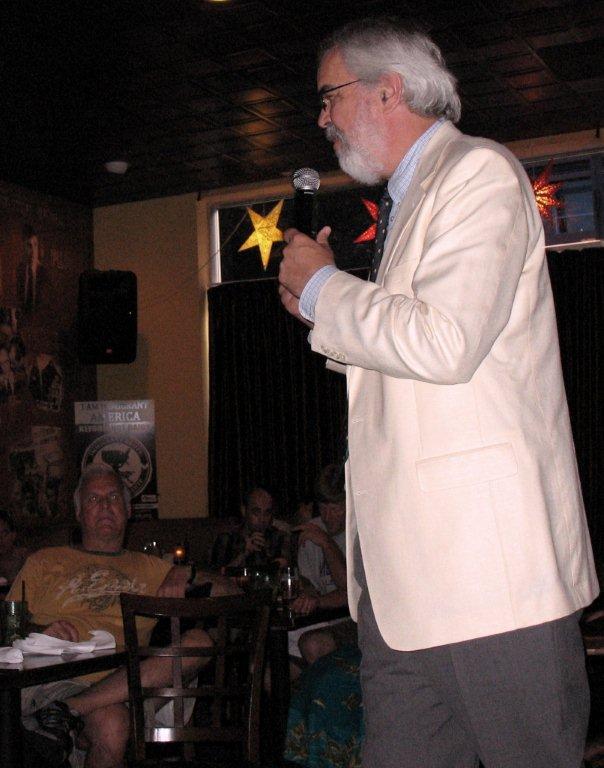
At Busboys and Poets

It was propelled in part, I said, by hurried, anecdotal reporting.

Reporters and columnists pushed too eagerly on preliminary and inconclusive research about children born to women who took crack cocaine during pregnancy. The horrors that some journalists predicted—that “crack babies” would grow up to be a vast, permanently dependent class, a so-called “bio-underclass” of staggering dimension—proved to be quite wrong.

Part of the explanation for the wide embrace of “crack baby” myth, I said, was that it offered something for everyone,” as the magazine Mother Jones once put it.

I write in Getting It Wrong that the crack baby phenomenon “inspired fearful commentary across political and ideological boundaries.” It was “a rare social issue that had appeal across the political spectrum—appeal that made the phenomenon especially powerful, compelling, notable, and tenacious.

“For conservatives, the specter of crack babies underscored the importance of imposing stiff penalties in the country’s war on drugs. And penalties were stiffened for crack possession during the second half of the 1980s. For liberals, meanwhile, crack babies represented an opportunity to press for costly assistance programs aimed at helping crack users and their children.”

One of the best questions of the evening was about whether media audiences aren’t complicit in perpetuating media myths, whether media consumers have a role in myth-busting.

There is, I replied, plenty of room for media audiences to develop and hone a sense of skepticism, especially about news reports that seem too neat and tidy. Stories that seem too delicious, or too over the top, may prove to be inaccurate.

This also is the case with succinct turns of phrase. Quotations that “sound too neat and tidy,” I write in Getting It Wrong, “often are too perfect to be true.”

WJC

Related:

Movies, and a myth, for the Fourth

In Anniversaries, Cinematic treatments, Media myths, Washington Post, Watergate myth on July 4, 2010 at 12:28 pm

The online site movieviral.com today offers a top 10 listing of what it terms the “best movies that involve July 4th, politics, and other historic events in US history.”

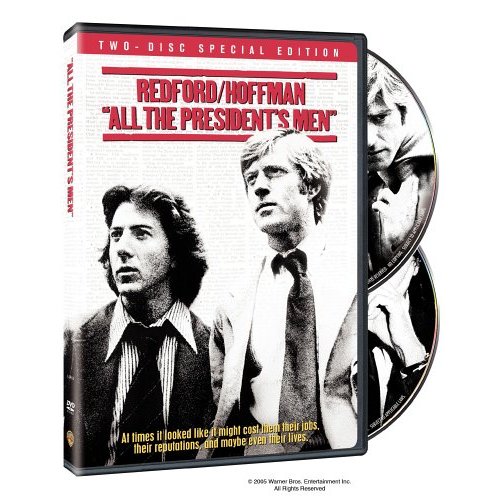
The list–yes, another list of favorite movies–merits attention here principally because of the inclusion of All the President’s Men. The movie–as I discuss in Getting It Wrong, my new book debunking prominent media-driven myths–helped solidify the notion that two young and intrepid reporters for the Washington Post brought down Richard Nixon’s corrupt presidency in the Watergate scandal.

The movieviral.com post says that All the President’s Men “follows Washington Post reporters Bob Woodward (Robert Redford) and Carl Bernstein (Dustin Hoffman) as they uncover what would become known as Watergate, thus ending the political career of President Nixon.”

Woodward and Bernstein did not “uncover” the Watergate scandal, although the notion they did, I write in Getting It Wrong, “is deeply ingrained in American journalism as one of the field’s most important and self-reverential stories.”

And as Edward Jay Epstein wrote years ago in a superb essay about the news media and Watergate, “the FBI, the federal prosecutors, the [federal] grand jury, and the Congressional committees … unearthed and developed all the actual evidence and disclosures of Watergate.”

Indeed, Woodward and Bernstein did not uncover the defining and decisive elements of the Watergate scandal—the cover-up and the payment of hush money to the burglars who were arrested at Democratic national headquarters in June 1972. Nor did Woodward and Bernstein uncover the existence of the audiotaping system that Nixon had installed in the Oval Office, which proved so critical in forcing the president’s resignation.

The Senate Select Committee on Watergate–not Woodward and Bernstein–disclosed the existence of the White House tapes that captured Nixon’s complicity in the coverup. Special federal prosecutors on Watergate pressed for their release. And the U.S. Supreme Court in 1974  unanimously ordered Nixon to turn over key tapes that had been subpoenaed by the special prosecutor.

Those were pivotal events that led to Nixon’s resignation in August 1974.

As I write in Getting It Wrong, against the tableau of prosecutors, courts, federal investigators, and bipartisan congressional panels, “the contributions of Woodward and Bernstein were modest, and certainly not decisive.

“Principals at the Post have acknowledged as much. Katharine Graham, the newspaper’s doughty publisher, often insisted the Post did not topple Nixon.”

Indeed, as Graham said at a program in 1997 marking the scandal’s 25th anniversary, “The processes that caused [Nixon’s] resignation were constitutional.”

Woodward has concurred, albeit in earthier terms.  “To say that the press brought down Nixon, that’s horseshit,” he said in 2004 in an interview with American Journalism Review.

The movieviral.com roster includes a particularly fine selection in the musical comedy 1776, which, as the site says, “follows the Second Continental Congress for the three months in the hot 1776 summer [when] it deliberated and eventually signed the Declaration of Independence.”

1776 is engaging and entertaining, and I always try to find time to watch at least a portion of the movie on the Fourth. I’ll do so today.

WJC

Related:

Wha?? A casino at Gettysburg?? Absurd and insulting

In Anniversaries, Washington Post on July 3, 2010 at 11:44 am

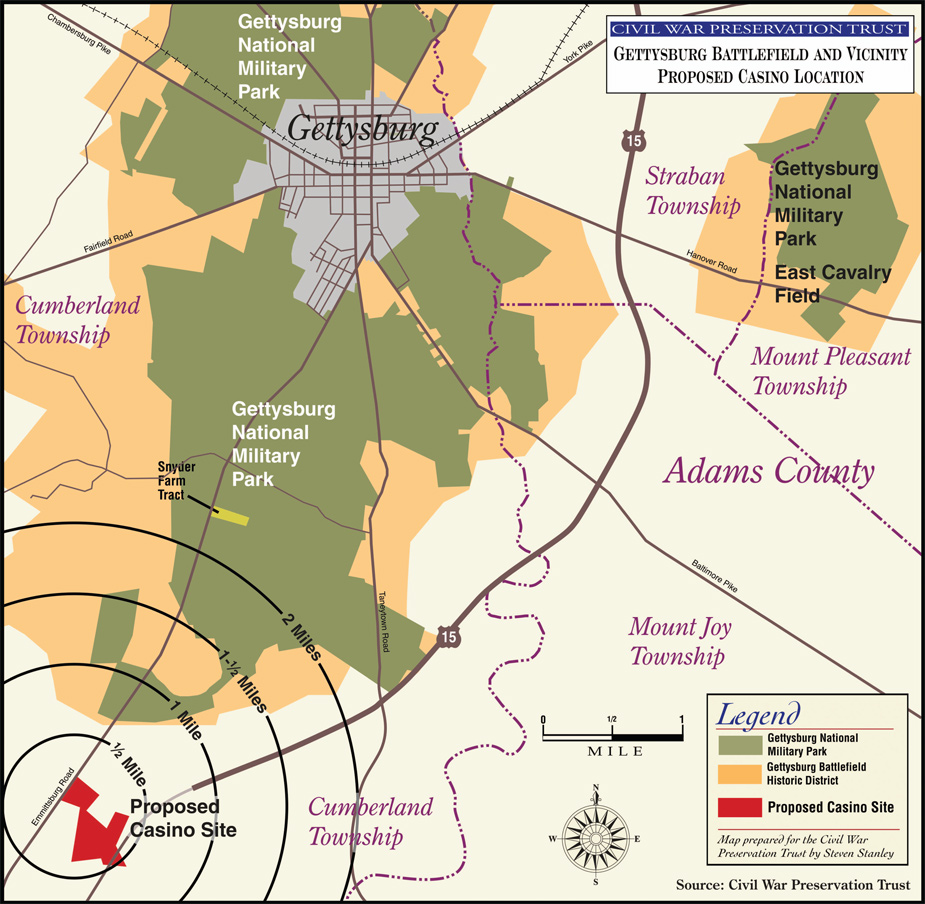
Today is the 147th anniversary of the conclusion of the Civil War battle at Gettysburg, a fitting time to comment about the absurd and insulting proposal to build a casino just south of the national military park.

There is no media-driven myth to address here. Instead, it’s the troubling prospect of planting a $75 million  commercial establishment, featuring 600 slot machines and 50 gaming tables, near the battlefield where 158,000 Union and Confederate troops clashed during the first three days of July 1863.

More than 50,000 men were killed and wounded in what was the war’s bloodiest battle.

The casino’s sponsors  offer the hoary if not chimeric arguments that gaming would bring “hundreds of new jobs to southern Adams County” and “generate tax revenues to support local municipal projects without raising property taxes.”

Such arguments, even if accurate, are readily trumped by the singular importance of Gettysburg to U.S. history.

More than 270 historians have expressed their opposition to the casino, asserting in a letter to the Pennsylvania gaming authority that while the state offers many prospective gaming sites, there is  only one Gettysburg.

According to the Washington Post, historians who have signed the letter opposing the casino include James McPherson, Edwin C. Bearss, and Garry Wills. “A coalition of six historical organizations, jointly representing more than 35,000 historians and researchers, has also joined in the effort,” the Post‘s “A House Divided” blog has reported.

Among those organizations is the Civil War Preservation Trust, which has pointed out:

“A casino conflicts with the heritage-based economy of Gettysburg, with its meaning in American history today, and with its future relevance.”

McPherson, who wrote Battle Cry of Freedom, the superb single-volume history of the Civil War, is notably prominent, and assertive, in opposing among the casino. He has said of the proposed gaming site, which lies beyond the boundaries of Gettysburg National Military Park:

“This ground is as hallowed as any other part of the Gettysburg battlefield, and the idea of a casino near the fields and woods where men from the North and the South gave the last full measure of devotion is simply outrageous.”

As the “House Divided” blog has noted, “This is round two of an attempt to locate a casino near Gettysburg. In 2006, after a deluge of public criticism of another proposed casino also near the battlefield, the Pennsylvania Gaming Control Board turned that applicant down.

“The principle investor involved in the latest bid for a casino license, Gettysburg native and business owner David LeVan, was also involved in the first attempt.”

LeVan’s group, Mason-Dixon Resort & Casino, says at its online site that the casino would “be isolated from Gettysburg.”

But that hardly would be the case. Rather than isolated, the casino would be at the battlefield’s southern periphery.

The Philadelphia Inquirer has reported that the state’s gaming control board may reach a decision on the casino proposal by year’s end.

The renewed casino fight at Gettysburg represents another chapter in the long, never-ending, and not always successful effort to protect Civil War battlegrounds.

I wrote about this broad struggle more than 20 years ago for the Hartford Courant newspaper. My notes from that time include an interview with the then-superintendent of the Gettysburg National Military Park, John R. Earnst.

I spoke with Earnst about the commercial establishments that by then had encroached on the northern reaches of the Gettysburg battlefield.

“I think that we can say without fear of contradiction that when [visitors] come here and find the kind of development that’s occurred, they’re surprised,” Earnst said in the interview in 1988, adding:

“I’m not saying many of them react negatively to that. But they are surprised. They were expecting to find a town that is historic in appearance, that has buildings that relate back to the Civil War. What they find adjacent to the park is something different.”

A casino at the southern edge of the battlefield surely would qualify as “something different.” More than that, it would be crass, insensitive, and egregiously out of place.

WJC

Related:


‘Getting It Wrong’ goes Majic

In Bay of Pigs, Bra-burning, Debunking, Furnish the war, Jessica Lynch, Media myths, Media myths and radio, New York Times, War of the Worlds, Washington Post, Watergate myth on July 1, 2010 at 11:34 am

I did an engaging and entertaining in-studio interview yesterday on the Lanigan & Malone show, one of the most popular radio programs in Cleveland, the gritty city where I cut my teeth, journalistically, years ago.

On the air with Lanigan (center) and Malone

The show airs on WMJI, Majic 105.7 FM, and I spoke with hosts John Lanigan and Jimmy Malone about several media-driven myths addressed and debunked in my new book, Getting It Wrong.

They included the case of Jessica Lynch, the waiflike Army private whom the Washington Post elevated to hero status in a sensational but utterly erroneous report early in the Iraq War in 2003.

The Post depicted Lynch as having “fought fiercely” in the Iraqi ambush at Nasiriyah of the Army’s 507th Maintenance Company. The newspaper said Lynch had “shot several enemy soldiers” and kept “firing her weapon until she ran out of ammunition.”

Walters

The Lynch case, I said during the Lanigan & Malone interview, appears to have centered around a case of mistaken identity. It wasn’t Lynch who had fought heroically at Nasiriyah. It was most likely Donald Walters, a cook-sergeant in Lynch’s unit who, after running out of ammunition, was captured by Iraqi irregulars and executed.

I pointed out during the interview how war and conflict can readily give rise to myth and misunderstanding. Indeed, half the chapters in Getting It Wrong are related to warfare, including the book’s first chapter, the myth of William Randolph Hearst’s infamous vow to “furnish the war” with Spain.

We moved on to discuss the myth that widespread panic and mass hysteria characterized the reactions to the 1938 radio dramatization of The War of the Worlds, then jumped to a discussion of the myth of superlative reporting of Hurricane Katrina’s aftermath in September 2005, and considered at some length about what I call the “nuanced myth” of bra-burning.

“Bra-smoldering,” I said, would be a more accurate characterization of what happened during the women’s liberation protest at Atlantic City in September 1968. My research shows that bras and other items were set afire, if briefly, during the demonstration against that year’s Miss America pageant.

“All these are ruined,” Lanigan said at one point about the myths debunked in Getting It Wrong.

We also discussed the Bay of Pigs-New York Times suppression myth. That myth centers around a telephone call President John F. Kennedy supposedly placed to the Times publisher or top editors in April 1961, asking that the newspaper hold off on reporting about the pending CIA-supported invasion of Cuba.

There is no evidence, I said, that Kennedy ever placed such a call. (Or even had time to place such a call.)

What appears to have happened is that the Bay of Pigs-suppression myth has become confounded with the 1962 Cuban missile crisis, during which Kennedy did call the Times to request a delay on a report about nuclear-tipped missiles the Soviets had deployed on the island.

As the interview wrapped up, Lanigan said he’s “sure there will be another” volume, a sequel, to Getting It Wrong.

“It’s a good book,” he said afterward. “I’m glad he did it.”

WJC

Related:

Discussing ‘Getting It Wrong’ with AU alums

In Cinematic treatments, Cronkite Moment, Debunking, Media myths, Media myths and radio, War of the Worlds, Washington Post, Watergate myth on June 30, 2010 at 10:35 pm

I met in Cleveland’s Little Italy neighborhood last night with a terrific group of American University alumni, at a program that featured a discussion of Getting It Wrong, my new book about media-driven myths.

With AU alums in Cleveland

The gathering was the second of the Cleveland area alumni chapter, which is ably led by Neil T. Young, Anthony Vacanti, and Antoinette Bacon. I was privileged to talk with the group about the book, which addresses and debunks 10 prominent media myths–those false, dubious, improbable stories about the news media that masquerade as factual.

We met at Michaelangelo’s, a fine Italian restaurant where the service is superb. Our discussion about Getting It Wrong was conducted seminar style and featured my fairly lengthy review of the heroic-journalist myth of Watergate–the notion that the intrepid investigative reporting by the Washington Post brought down Richard Nixon’s corrupt presidency.

I described how the book All the President’s Men and the cinematic version by the same title helped solidify the notion that the Post and its reporters Bob Woodward and Carl Bernstein were central to unraveling the Watergate scandal.

The book and the movie have had the effect of focusing on the Post reporters while ignoring or overlooking the far more significant contributions of federal prosecutors, federal judges, bipartisan congressional panels, and ultimately the U.S. Supreme Court in identifying Nixon’s efforts to obstruct justice in the scandal.

“Against that backdrop,” I said, “the news media were decidedly modest factors” in Watergate’s outcome.

Orson Welles

We also discussed the War of the Worlds myth–that Orson Welles’ 1938 radio dramatization of an invasion from Mars was so realistic that tens of thousands of Americans were convulsed in panic and fled their homes in hysteria. The program was imaginative entertainment–and was recognized as such by listeners in overwhelming numbers, I pointed out.

In addition, we talked about the so-called “Cronkite Moment” of February 1968, when CBS anchorman Walter Cronkite offered a downbeat analysis of the U.S. war effort in Vietnam, saying the military was “mired in stalemate.”

Supposedly, Cronkite’s assessment came as an epiphany to President Lyndon Johnson who, it is said, snapped off the television set upon hearing the anchorman’s “mired in stalemate” characterization and said, “If I’ve lost Cronkite, I’ve lost Middle America.”

Or words to that effect.

In reality, I pointed out, the president wasn’t in front of a television set that night.

He was in Austin, Texas, at the 51st birthday party of Governor John Connally. And even if Johnson had seen the Cronkite report on videotape, the anchorman’s assessment really was no epiphany, because the president in the days and weeks immediately afterward hewed to a hawkish line on Vietnam.

Questions from the alums were quite thoughtful. Among them was a query about the common threads may be found in the myths debunked in Getting It Wrong.

A thoughtful and perceptive question, that.

And indeed there are some shared characteristics of media myths.

Many myths are reductive, in that they offer simplistic explanations for complex historical events. That factor certainly helps explains the tenacity of the heroic-journalist myth of Watergate and the “Cronkite Moment.” It is far easier to characterize the news media as prime movers in the outcomes of Watergate and Vietnam than it is to grapple with the complexities and nuances of those landmark events, I said.

Additionally, media myths tend to be delicious stories–stories almost too good to be disbelieved. And that certainly holds for Watergate, the “Cronkite Moment,” and the War of the Worlds dramatization.

And media myths tend to be ways to assert the notion that the news media are powerful and influential forces in American society.

But as I write in Getting It Wrong, media power “tends to be modest, nuanced, diffused, and situational” and altogether “too often the ubiquitous presence of the news media is mistaken for power and influence.”

Moreover, I write, “The American media these days are far too splintered and diverse—print, broadcast, cable, satellite, online—to exert much in the way of collective and sustained influence on policymakers or media audiences.”

WJC

Related:

‘Junk food of jornalismo’: Diário writes up ‘Getting It Wrong’

In Bay of Pigs, Cronkite Moment, Debunking, Furnish the war, Media myths, Media myths and radio, Murrow-McCarthy myth, Reviews, Watergate myth on June 28, 2010 at 2:49 pm

Today’s edition of the venerable  Portuguese newspaper Diário de Notícias includes a write up about Getting It Wrong, my new book about prominent media-driven myths–those false, dubious, improbable stories about the news media that masquerade as factual.

With the help of the online translation site Babelfish, I was able to make out a good deal of the Diário review, which says in part:

“W. Joseph Campbell in Getting it Wrong: Ten of the Greatest Misreported Stories in American Journalism, published the University of California Press, [says] these ‘myths can be thought as junk food of jornalismo.'”

The Diário article mentions several media myths addressed and debunked in Getting It Wrong, including those of William Randolph Hearst’s purported vow to “furnish the war” with Spain; the 1938 radio dramatization of the War of the Worlds which supposedly sowed panic across the United States; the notion that Edward R. Murrow’s 1954 See It Now television program abruptly halted Senator Joseph McCarthy’s communists-in-government witch-hunt, and the myth that the New York Times suppressed its coverage of the run-up to the Bay of Pigs invasion in 1961.

Diário characterizes as one of the book’s “more concrete” examples “the Watergate case,” in which reporters for the Washington Post are credited with having toppled the corrupt presidency of Richard Nixon.

Media myths, the articles notes, are not innocuous; ” they can distort the perception of the power and function of jornalismo” because “they tend to give the media” more power and influence than they rightly deserve. It also says that myths can “minimize the complexity of the historical events for simplistic interpretations.” Both of those are important points raised in Getting It Wrong.

The review closes by taking up the suggestion I offer in the conclusion of Getting It Wrong, namely that there are more media myths to debunk.

“By no means do the media myths examined on these pages represent a closed universe,” I write in the book’s closing passage. “Others surely will assert themselves. They may tell of great deeds by journalists, or of their woeful failings. They may well hold appeal across the political spectrum, offering something for almost everyone. They may be about war, or politics, or biomedical research.

“Predictably, they will be delicious tales, easy to remember, and perhaps immodest and self-congratulatory. They probably will offer vastly simplified accounts of history, and may be propelled by cinematic treatment.  They will be media-driven myths, all rich candidates for debunking.”

WJC

Related:

‘Getting It Wrong’ on the road in Oberlin, OH

In Cronkite Moment, Debunking, Furnish the war, Media myths, Murrow-McCarthy myth, Spanish-American War, War of the Worlds, Watergate myth, Yellow Journalism on June 27, 2010 at 8:40 am

I gave a talk yesterday about Getting It Wrong to an engaging audience at the college bookstore in Oberlin, Ohio.

The talk was facilitated quite well by Kira McGirr, the bookstore’s tradebook manager, and covered such topics as William Randolph Hearst’s purported vow to “furnish the war” with Spain at the end of the 19th century, the myth of the “Cronkite Moment” of February 1968, and the heroic-journalist myth of Watergate.

We also discussed the media-driven myth of “crack babies” and the famous 1938 radio dramatization of The War of the Worlds, which supposedly was so dramatic that tens of thousands of Americans were seized by panic and mass hysteria.

One of Kira’s questions was how long it may take before the myths discussed and debunked in Getting It Wrong to be excised from history books. It’s a very good question, and difficult to say for sure.

I responded by saying some of the myths–such as those of Watergate and the War of the Worldsare so appealing, delicious, and ingrained that they may never be totally uprooted.

The same probably goes for Hearst’s purported vow: That anecdote has been around since 1901 and likely is too appealing ever to be utterly debunked. What’s more, the “furnish the war” tale is a neat, tidy, reductive way of explaining the causes of the Spanish-American War:  Hearst, the war-mongering publisher, is to blame.

It’s far easier to blame Hearst than it is to grapple with the complexities of the diplomatic demarche in 1897-98 that failed to resolve differences among Spain, Cuba, and the United States: Failed diplomacy, not the contents of Hearst’s yellow press, led to the Spanish-American War.

We also discussed how high-quality cinematic treatments can press media myths into the public consciousness.

That certainly was the case with All the President’s Men, the most-viewed movie about Watergate, in which Robert Redford and Dustin Hoffman played the starring roles of Washington Post reporters Bob Woodward and Carl Bernstein.

The film depicted the reporters as central, indeed crucial, to cracking the Watergate scandal, I noted. For many Americans,  All the President’s Men is an important way of learning about Watergate. As I write in Getting It Wrong: “More than thirty-five years later, what remains most vivid, memorable, and accessible about Watergate is the cinematic version of All the President’s Men.”

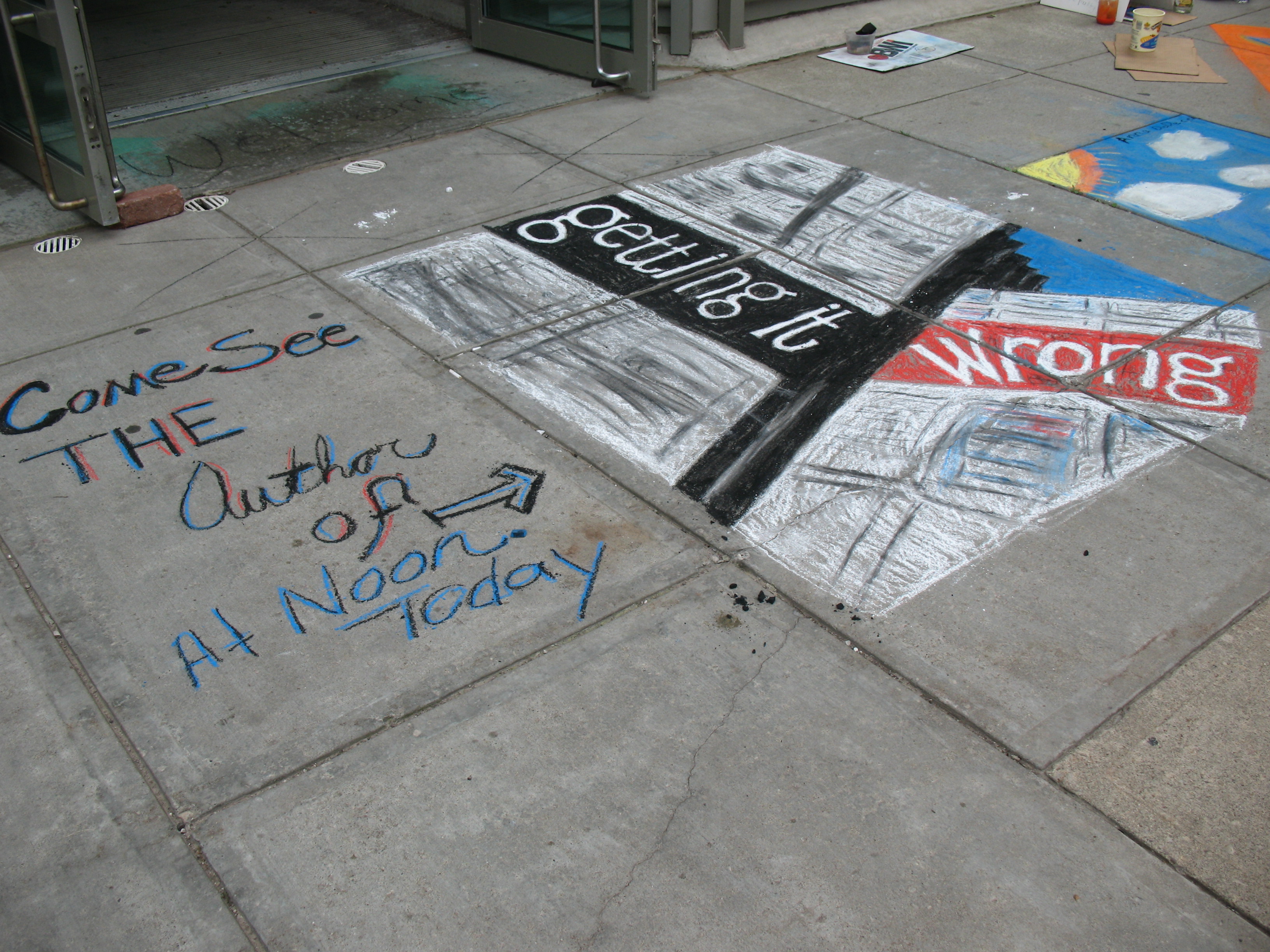
The book talk coincided with Oberlin’s fifth annual Chalk Walk event, at which artists and aspiring artists draw often-elaborate pastel images on the sidewalks in the heart of town.

One of Kira’s colleagues, Amanda Turner, drew a fine rendering of the cover of Getting It Wrong at the entrance to the bookstore (see photo).

Amanda, Kira, and I posed for the photo below.
Several former classmates of mine at Oberlin Firelands High School (class of 1970) also attended the book talk.

WJC

Related:

Photo credit: Ann-Marie C. Regan (Chalk Walk images)

Media myths and their spinoffs: The case of Watergate

In Debunking, Media myths, Washington Post, Watergate myth on June 23, 2010 at 3:53 pm

Prominent media-driven myths, the subject of my new book, Getting It Wrong, can be self-sustaining: That is, they can and do give rise to subsidiary media myths.

The heroic-journalist myth of Watergate is a notable example of this tendency. It has given rise to particularly tenacious, though appealing, subsidiary myth.

The  heroic-journalist myth has it that the intrepid investigative reporting of Bob Woodward and Carl Bernstein of the Washington Post brought down Richard Nixon’s corrupt presidency in the Watergate scandal.

Nixon resigns, 1974

As I write in Getting It Wrong:

“The heroic-journalist has become the most familiar storyline of Watergate—ready short-hand for understanding Watergate and its denouement, a proxy for grasping the scandal’s essence while avoiding its forbidding complexity. How the Post and its reporters uncovered Watergate is deeply ingrained in American journalism as one of the field’s most important and self-reverential stories.”

Except that it’s exaggerated.

“The heroic-journalist interpretation” of Watergate, I write in Getting It Wrong, “minimizes the far more decisive forces that unraveled the scandal and forced Nixon from office.” Those forces were typically subpoena-wielding and including federal prosecutors, the FBI, bipartisan Congressional committees, and ultimately the U.S. Supreme Court.

In the end, the contributions of the Washington Post to the scandal’s outcome were modest, and certainly not decisive. Over the years, principals at the Post have emphasized as much. For example, Katharine Graham, the newspaper’s doughty publisher, insisted the Post did not topple Nixon.

“Sometimes people accuse us of bringing down a president, which of course we didn’t do,” Graham said in 1997, at a program in Washington marking the scandal’s twenty-fifth anniversary. “The processes that caused [Nixon’s] resignation were constitutional,” she said.

In earthier terms, Woodward has concurred, telling American Journalism Review in 2004:

“To say that the press brought down Nixon, that’s horseshit.”

Nonetheless, the heroic-journalist myth lives on. It’s a robust myth, little-restrained in its reach and infiltration, and highly resistant to debunking. It is retold in textbooks, in classrooms, in newsrooms.

And it has spun off a durable subsidiary myth, one that revolves around the hoopla associated with Woodward and Bernstein: Their book about their reporting, All the President’s Men, was a best-seller. Its cinematic version was a box office success and, quite likely, is the most-viewed film ever about Watergate.

The book and the movie made journalism seem sexy, and caused enrollments at college and university journalism programs to soar.

Supposedly.

As I write in Getting It Wrong, “there is no evidence to support the notion that enrollments in journalism programs surged because of Woodward, Bernstein … and All the President’s Men. The subsidiary myth lives on despite its thorough repudiation in scholarly research.”

A study financed by the Freedom Forum media foundation and released in 1995 reported that “growth in journalism education result[ed] not from specific events as Watergate … but rather to a larger extent from the appeal of the field to women, who ha[d] been attending universities in record numbers. The growth also in part reflect[ed] the applied nature of the field and its link to specific job skills.”

Seven years earlier, Maxwell E. McCombs reported in the Gannett Center Journal that “the boom in journalism education was underway at least five years before” the Watergate scandal broke in 1972.

McCombs, a veteran mass communication scholar, further wrote:

“It is frequently, and wrongly, asserted that the investigative reporting of Woodward and Bernstein provided popular role models for students, and led to a boom in journalism school enrollments. The data … reveal, however, that enrollments already had doubled between 1967 and 1972….”

Despite such solid scholarly research, the subsidiary myth lives on.

It’s a neat and tidy tale, the notion that the exploits of Woodward and Bernstein were a profound stimulus to enrollments in collegiate journalism programs. Like many other media myths, it’s a tale almost too good not to be true.

WJC

A version of this post first appeared at the University of California Press blog.

Launching ‘Getting It Wrong’ at Newseum

In Bay of Pigs, Bra-burning, Cronkite Moment, Debunking, Furnish the war, Jessica Lynch, Media myths, Murrow-McCarthy myth, War of the Worlds, Washington Post, Watergate myth on June 14, 2010 at 6:28 am

My new book, Getting It Wrong, will be launched Saturday, June 19, at an “Inside Media” program at the Newseum, the $450 million museum of news in downtown Washington, D.C.

The program will begin at 2:30 p.m. in the Knight TV Studio on the third level and will feature a discussion with the Newseum’s John Maynard, followed by audience Q-and-A.

I’ll be signing copies of Getting It Wrong afterward.

The book addresses, and debunks, 10 prominent media-driven myths–stories about and/or by the news media that are widely believed and often retold but which, on close inspection, proved to be apocryphal or wildly exaggerated.

Here is a brief description about each of the 10 myths:

  1. Remington-Hearst: William Randolph Hearst’s famous vow, “you furnish the pictures, I’ll furnish the war,” is almost certainly apocryphal.
  2. War of Worlds: The notion that the War of Worlds radio dramatization in 1938 caused nationwide panic and mass hysteria is exaggerated.
  3. Murrow-McCarthy: Edward R. Murrow’s famous See It Now program in March 1954 did not end Senator Joseph McCarthy’s communists-in-government witch-hunt; Murrow in fact was very late to take on McCarthy.

    Murrow in 1954

  4. Bay of Pigs: The New York Times did not suppress its reporting in the run-up to the ill-fated Bay of Pigs invasion in April 1961.
  5. Cronkite-Johnson: Walter Cronkite’s special report on Vietnam in February 1968 did not prompt an immediate reassessment of U.S. war policy.
  6. Bra-burning: Humor columnist Art Buchwald helped spread the notion that feminist demonstrators dramatically burned their bras at a Miss America protest in September 1968.
  7. Watergate: The Washington Post’s intrepid reporters, Carl Bernstein and Bob Woodward, did not bring down Richard Nixon’s corrupt presidency. That they did is a trope that knows few bounds.
  8. Crack babies: The much-feared “bio-underclass” of children born to women who smoked crack cocaine during their pregnancies never materialized.
  9. Jessica Lynch: The Washington Post’s erroneous reporting about Jessica Lynch early in the Iraq War gave rise to several myths about her capture and rescue.
  10. Hurricane Katrina: News coverage of Katrina’s aftermath in New Orleans in early September 2005 was marred by wild exaggerations of extreme, Mad Max-like violence.

As I write in Getting It Wrong, the myths debunked “are among American journalism’s best-known stories. Most of them are savory tales. And at least some of them seem almost too good to be false.”

I further write that because it “takes on some of the most treasured stories in American journalism,” Getting It Wrong is “a work with a provocative edge. It could not be otherwise.”

WJC

Related:

‘Commentary’ reviews ‘Getting It Wrong’

In Cronkite Moment, Debunking, Murrow-McCarthy myth, Reviews, Washington Post, Watergate myth on June 4, 2010 at 11:27 am

The June 2010 number of Commentary magazine includes a fine, favorable, and thoughtful review of Getting It Wrong, my new book about media-driven myths.

The reviewer, Andrew Ferguson, who writes the “Press Man” column for Commentary, says of Getting It Wrong:

“It may be the best book about journalism in recent memory; it is certainly the most subversive.”

A wonderful, telling line, that.

He also writes:

“Campbell does what journalists, and most journalism professors, seldom think to do when they exchange the oft-repeated tales: he checks them out. And through a pitiless accretion of detail, he dissolves them one by one.

“As he reveals, Edward R. Murrow did not ‘bring down Joe McCarthy’ with his famous 1954 episode of See It Now; Campbell looked up the poll numbers and found that McCarthy’s favorability ratings were in free fall well before Murrow took to the air.

“No, Cronkite did not turn the public against the Vietnam War with an on-air editorial in February 1968: five months earlier, Gallup had registered that a plurality of Americans, 47 percent, agreed that the war was a mistake.

“And no, Woodward and Bernstein were not responsible for uncovering the entirety of the Watergate scandal; as reporters, they had pretty much run out of scoops by October 1972, when congressional investigators, criminal prosecutors, and other newspapers took over the story and drove it till President Nixon’s resignation in August 1974.

“And no, the bestselling author David Halberstam, who promoted each of these stories with unfailing pomposity, was not a reliable chronicler of even the most recent past.”

Ferguson wraps up his review by writing:

“Journalism’s myths about journalism, you’ll notice, are self-aggrandizing. They cast the journalist as hero. No wonder they’re so popular… among journalists. We warm ourselves by such tales, draw compensation and comfort from them, which is why they’re taught in our trade schools as elements of basic training.”

WJC

Related: