W. Joseph Campbell

Posts Tagged ‘Washington Post’

WaPo move to new quarters stirs retelling of hero-journalist myth

In Debunking, Error, Media myths, Newspapers, Scandal, Washington Post, Watergate myth on December 14, 2015 at 10:34 am

Sometimes it doesn’t take much to stir up a media myth.

Consider, for example, the recent move of the Washington Post to new quarters in the capital — a move the newspaper reported on to absurd excess.

Leaving prompts myth-telling

Leaving this mythical place

The Guardian newspaper of London took up the development today in a report online, posted beneath the headline: “Washington Post bids farewell to office where it broke Watergate.”

The Guardian described the Post’s former home on 15th Street NW as the place “where Woodward and Bernstein exposed the Watergate scandal and brought down president Richard Nixon.” It’s almost as if any excuse will do to trot out the bromide that the Bob Woodward and Carl Bernstein, through their dogged reporting for the Post, exposed the crimes of Watergate and forced Nixon’s resignation in 1974.

Untenable though it is, the heroic-journalist trope has become the dominant narrative of Watergate — an engaging but simplified account of the country’s gravest political crisis that not even principals at the Post have embraced.

Woodward, for example, once told an interviewer for American Journalism Review:

To say the press brought down Nixon, that’s horseshit.”

On another occasion, Woodward declared that “the mythologizing of our role in Watergate has gone to the point of absurdity, where journalists write … that I, single-handedly, brought down Richard Nixon. Totally absurd.”

And Katharine Graham, the Post’s publisher during Watergate, said in 1997: “Sometimes people accuse us of bringing down a president, which of course we didn’t do. The processes that caused [Nixon’s] resignation were constitutional.”

True enough. So why does the myth persist? What explains its tenacity in the face of denial, repudiation, and debunking?

An important explanation is that the epic scandal has become so distant that few Americans can accurately describe what took place.

The heroic-journalist interpretation makes Watergate accessible.

As I discussed in my media-mythbusting book, Getting It Wrong, that explanation strips away the scandal’s daunting complexity, does away with the intricate investigations that slowly exposed high-level misconduct, leaving the Post, Woodward, and Bernstein as celebrated stand-ins “for understanding Watergate and its denouement.”

It’s a trope that reassures journalists, too, reminding them in these unsettled times that the work of their predecessors supposedly had significant and memorable consequences. As the inimitable media critic Jack Shafer wrote the other day, journalists are “sentimental creatures who draw on the past to self-mythologize.”

To indulge in the heroic-journalist trope is to indulge in dubious history. As I noted in Getting It Wrong, “to explain Watergate through the lens of the heroic-journalist is to abridge and misunderstand the scandal and to indulge in a particularly beguiling media-driven myth. The heroic-journalist interpretation minimizes the far more decisive forces that unraveled the scandal and forced Nixon from office.”

Rolling up a scandal of the dimensions of Watergate, I wrote, “required the collective if not always the coordinated forces of special prosecutors, federal judges, both houses of Congress, the Supreme Court, as well as the Justice Department and the FBI.

“Even then, Nixon likely would have served out his term if not for the audiotape recordings he secretly made of most conversations in the Oval Office of the White House. Only when compelled by the Supreme Court did Nixon surrender those recordings, which captured him plotting the cover-up” of Watergate’s signal crime — the break-in at the headquarters of the Democratic National Committee in June 1972.

Guardian was not alone in recalling the heroic-journalist myth as the Post staff decamped a short distance to an address on K Street NW.

In a dispatch last week, the French new agency, Agence France-Presse, described the Post’s erstwhile home as “the scene of groundbreaking reporting on the Watergate scandal by young reporters Bob Woodward and Carl Bernstein, leading to the resignation of President Richard Nixon in 1974.”

The Post’s reporting, in fact, was quite marginal to Wategate’s outcome.

WJC

More from Media Myth Alert:

Why is he biopic worthy? Movie planned about Watergate’s ‘Deep Throat’ source

In Cinematic treatments, Debunking, Media myths, Scandal, Washington Post, Watergate myth on November 27, 2015 at 7:22 am

The best-known anonymous source of the Watergate scandal, a former senior FBI official code-named “Deep Throat,” would receive hero’s treatment in a planned biopic, the shooting for which reportedly is to begin in March.

The movie is to be called Felt, the name of the “Deep Throat” source, W. Mark Felt, who cut a checkered career in government service.

Besides being a secret, high-level source for Bob Woodward of the Washington Post, Felt in the early 1970s was the agency’s acting associate director. In that role, he authorized several burglaries as part of the FBI’s investigations into the radical Weather Underground.

Early this month, the Hollywood press was abuzz about the planned Felt biopic. The show business daily, Variety, said the film would be “a spy thriller” in which Felt wages an “isolated and dangerous struggle against the White House.” Shooting the film is to begin in March, Variety said, and Liam Neeson and Diane Lane may fill lead roles.

Felt: Biopic worthy?

Felt: Biopic worthy?

All of which prompts inevitable questions: Why is Mark Felt, who died in 2008, biopic worthy? Even if the movie never makes it to production, why should Felt be considered a hero?

He was no noble figure. Felt was convicted in 1980 of felony charges related to the warrantless break-ins, known in the FBI as “black bag jobs,” and fined $5,000. He was not sentenced to prison for the crimes.

The year after his conviction, Felt was granted an unconditional pardon by President Ronald Reagan.

In its obituary about the former FBI official, the Los Angeles Times recalled that tears welled in Felt’s eyes as he acknowledged on the witness stand having approved secret break-ins by FBI agents between May 1972 and May 1973 — “roughly the same time he was talking to Woodward about Watergate.”

Felt and co-defendant Edward S. Miller justified the warrantless entries on grounds of national security.

The prosecutor in the case, John W. Nields Jr., said at the trial that FBI agents who conducted the breakins Felt approved had entered residences in New York City  and New Jersey, “dressed in old clothes or disguised as telephone repairmen,” according to a New York Times report about the trial.

The agents picked locks or paid cash to landlords to obtain keys, Nields said, and they “searched every room in the home, methodically looking through desks, closets, clothing and private papers for clues to the whereabouts of the Weathermen. With a camera that could be concealed in an attaché case, the agents photographed diaries, love letters, address books and other documents.”

Nields said Reagan’s pardon of Felt and Miller came as a surprise. “Nobody spoke to me about it,” the New York Times quoted him as saying. “I would warrant that whoever is responsible for the pardons did not read the record of the trial and did not know the facts of the case.”

Felt was hardly acting altruistically in passing Watergate-related information to Woodward; their periodic meetings included six in a parking garage in suburban Virginia. I argued in my media-mythbusting book, Getting It Wrong, that the contributions of Woodward and his Post colleague Carl Bernstein in uncovering the Watergate scandal were modest at best and that their reporting in no way can be thought of as having forced President Richard Nixon to resign.

In leaking to Woodward, Felt sought to undercut the acting director, L. Patrick Gray III, and thereby enhance Felt’s chances of being named to the bureau’s top position, as Max Holland persuasively argued in his book, Leak: Why Mark Felt Became Deep Throat. The book makes clear Felt was motivated by ambition in the internal struggle at the FBI to replace J. Edgar Hoover, the long-serving director who died in May 1972.

Felt lost out, and retired in 1973.

Perhaps Felt the movie will collapse in its preliminary stages, which is the fate of many Hollywood projects. A biopic about Mark Felt is a bad idea in any case.

WJC


The hero-journalist trope: Watergate’s go-to mythical narrative

In Cinematic treatments, Debunking, Error, Media myths, Media myths and radio, Reviews, Washington Post, Watergate myth on October 23, 2015 at 6:10 pm

The Watergate scandal of the 1970s produced America’s gravest political crisis of the 20th century.

Nixon got Nixon

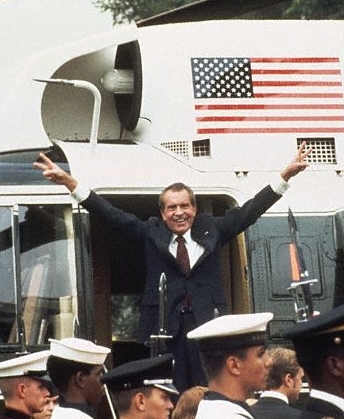
Nixon quits

And yet, because Watergate was such an intricate thicket of lies, deceit, and criminality — and because it unfolded more than 40 years ago — a sure understanding of the scandal can be defiantly elusive. Collective memory about the many lines of investigation that unwound Watergate and forced Richard Nixon to resign the presidency has inevitably grown faint.

What endures is the heroic-journalist trope, Watergate’s dominant popular narrative, which rests on the notion that dogged reporting by Bob Woodward and Carl Bernstein of the Washington Post exposed Nixon’s criminal misconduct and forced his resignation. It has become the go-to explanation about how Watergate was exposed, and it is an endlessly appealing interpretation.

It also is a prominent media-driven myth.

Which takes us to a movie review posted today at the online site of WTOP, the all-news radio station in Washington, D.C.

The review discusses the perversely named Truth, a new motion picture that celebrates former CBS News anchor Dan Rather and producer Marla Mapes who in 2004 used fraudulent documents to claim President George W. Bush dodged wartime service in Vietnam. (Because it stars Robert Redford in Rather’s role, Truth has invited comparisons — not all of them favorable — to All the President’s Men, the 1976 film in which Redford played Woodward of the Post.) 

The WTOP reviewer has little truck with the Truth story line, saying it “would have been far better … to paint the characters as fallen figures who admit they screwed up, rather than misunderstood scapegoats who were taken down by The Man.”

Fair enough. But then, to demonstrate how assiduous journalists ought to proceed, the review reaches for the heroic-journalist trope of Watergate and declares:

“If Woodward and Bernstein ran the story too early — before they had actual proof from reliable sources — Nixon would have stayed in office, the Watergate would simply be a fancy hotel, and ‘All the President’s Men’ would not exist.”

The reference to “the story” is puzzling, given that the reporting of Watergate went far beyond a single article in the Washington Post. The scandal produced extensive news reporting over many months, from the burglary in June 1972 at the headquarters of the Democratic National Committee at the Watergate complex in Washington to the resignation of Nixon in August 1974, following disclosures that he had approved a plan to cover up the break-in.

And to assert that “Nixon would have stayed in office” if not for Woodward and Bernstein is to be decidedly in error — and to indulge in a powerful myth of American journalism.

It is a tempting trope, to be sure. As I wrote in my media-mythbusting book, Getting It Wrong, the heroic-journalist interpretation offers “ready short-hand for understanding Watergate and its denouement, a proxy for grasping the scandal’s essence while avoiding its forbidding complexity.”

Not even Woodward has embraced the heroic-journalist myth. He once told an interviewer for American Journalism Review:

To say the press brought down Nixon, that’s horse shit.”

And in an interview with the PBS “Frontline” program, Woodward said “the mythologizing of our role in Watergate has gone to the point of absurdity, where journalists write … that I, single-handedly, brought down Richard Nixon. Totally absurd.”

He’s right: Woodward and Bernstein did not topple Nixon’s corrupt presidency.

Their reporting did win a Pulitzer Prize in 1973. But Woodward and Bernstein did not break the most crucial stories of Watergate.

They did not, for example, disclose the extent to which the Nixon administration covered up of the crimes of Watergate. Nor did they reveal the existence of the secret White House audio tapes, the contents of which were decisive to Watergate’s outcome.

The so-called “Smoking Gun” tape captured Nixon’s approving a plan on June 23, 1972, to divert the FBI’s investigation of the Watergate break-in. The tape’s release sealed the president’s fate.

Without the tapes, Nixon likely would have served out his term.

WJC

More from Media Myth Alert:

Jorge Ramos, media myth-teller

In Debunking, Error, Media myths, Newspapers, Scandal, Washington Post, Watergate myth on September 5, 2015 at 12:30 pm

Jorge Ramos, the Univision anchorman, demonstrated recently that he is a self-important showboat in disrupting a news conference convened by presidential candidate Donald Trump.

Ramos also has demonstrated a taste for media myth.

In a commentary posted yesterday at the online site of AM, a newspaper in Mexico, Ramos invoked the myth that the Washington Post brought down the corrupt presidency of Richard Nixon in its reporting of the Watergate scandal.

He wrote, according to the Google translation from Spanish, that among “the best examples of journalism” was the Washington Post’s “forcing Nixon to resign” in 1974.

Ramos made a similar claim on the ABC News “This Week” program Sunday, stating:

“I think that, as a reporter, many times, you have to take a stand. … And the best examples of journalism that I have — Edward R. Murrow against McCarthy; Cronkite during the Vietnam War, or the Washington Post reporters forcing the resignation of Richard Nixon — that’s when reporters challenge those who are in power.”

Of course, though, the Post did not force Nixon’s resignation.

Not even principals at the Post during the Watergate period embraced that notion.

For example, the Post’s publisher during Watergate, Katharine Graham, said 1997:

“Sometimes people accuse us of bringing down a president, which of course we didn’t do. The processes that caused [Nixon’s] resignation were constitutional.”

Bob Woodward, one of the Post’s lead Watergate reporters, concurred, albeit in earthier terms. He told an interviewer in 2006:

To say the press brought down Nixon, that’s horseshit.”

And Ben Bradlee, the Post’s executive editor during Watergate, said on “Meet the Press” in 1997 that “it must be remembered that Nixon got Nixon. The Post didn’t get Nixon.”

Bradlee was referring to the White House audio tapes which Nixon secretly made and which revealed the president’s guilty role in seeking to thwart the FBI’s investigation into the break-in of Democratic National Committee headquarters in Washington in June 1972. The break-in touched off the scandal — and the country’s gravest political crisis of the 20th century.

As I discussed in my media-mythbusting book, Getting It Wrong:

“How the Post and its reporters uncovered Watergate is deeply ingrained in American journalism as one of the field’s most important and self-reverential stories.”

But it is a simplistic and decidedly misleading interpretation, one that minimizes the more powerful and decisive forces that unraveled the scandal and ended Nixon’s corrupt presidency.

“To roll up a scandal of” the dimensions of Watergate, I wrote in Getting It Wrong, “required the collective if not always the coordinated forces of special prosecutors, federal judges, both houses of Congress, the Supreme Court, as well as the Justice Department and the FBI.

“Even then, Nixon likely would have served out his term if not for the audiotape recordings he secretly made of most conversations in the Oval Office of the White House.”

Only when compelled by the Supreme Court did Nixon surrender those recordings — effectively ending his presidency.

WJC

More from Media Myth Alert:

The Woodward, Bernstein stories that ‘toppled’ Nixon: And they were?

In Media myths, Furnish the war, Spanish-American War, Washington Post, Debunking, Watergate myth, Newspapers, Reviews, Quotes, Scandal, Error on July 19, 2015 at 4:26 pm

Media myths sometimes make appearances in odd and baffling ways. As non-sequiturs, even.

Take, for example, this pithy mischaracterization of Watergate, offered a number of years ago by the New York media critic, Michael Wolff:

Nixon got Nixon

Nixon’s tapes got Nixon

“The Washington Post didn’t like [Richard] Nixon — and because of that bad blood we got Watergate.”

As I pointed out soon after Wolff’s observation was posted at Newser.com, such an interpretation is absurd. Nixon and the Post may not have much liked each other, but bad blood had nothing to do with how the Watergate scandal unfolded from 1972-74.

Nixon’s resignation in August 1974 was the culmination not of the Post’s reporting but of the collective investigative efforts by a variety of agencies and entities, including bipartisan panels of both houses of Congress, special prosecutors, federal judges, the FBI, and, ultimately, the U.S. Supreme Court, which compelled Nixon’s release of the telltale evidence of Watergate — the secret tape recordings he had made of private conversations in the Oval Office.

The so-called “smoking gun tape” captured Nixon obstructing justice by approving a plan to divert the FBI investigation into the signal crime of Watergate — the break-in in June 1972 of the Democratic National Committee’s headquarters.

If not for evidence of criminality captured on the tapes, Nixon probably would have survived the scandal.

Which brings us to the Christian Science Monitor’s review of Being Nixon: A Man Divided, a new biography by Evan Thomas. The review was posted online the other day and contained this erroneous and baffling statement:CSM small logo_65x45

“Even the Woodward and Bernstein stories in The Washington Post that toppled Nixon, bolstered by the subsequent best-selling book and Robert Redford movie (‘All the President’s Men’), are, for many current readers, as remote as D-Day or Pearl Harbor.”

The “toppled” passage is erroneous because the reporting by Bob Woodward and Carl Bernstein for the Post assuredly did not bring down Nixon. Woodward, in fact, has insisted on that point from time to time: For example, he told an interviewer in 2004:

To say the press brought down Nixon, that’s horseshit.”

The “toppled” passage is baffling because Thomas makes no such claim in his book. Indeed, he seems careful not to indulge in media-driven myths. (As I noted at the time at Media Myth Alert, Thomas’ 2010 book, The War Lovers, repeated one of American journalism’s best-known myths, the purported vow of William Randolph Hearst to “furnish the war” with Spain.)

According to the book’s index, “Woodward” is mentioned on six pages in Being Nixon; “Bernstein” appears on four pages. None of those pages contains the mythical claim that their reporting forced Nixon’s resignation. (“Topple” or “toppled” appear not at all in the book.)

So it is rather baffling that the Monitor’s review would state that claim so matter-of-factly. It’s not as if the book’s content led the reviewer astray.

Moreover, it is revealing and instructive to consider what were the most important Watergate articles by Woodward and Bernstein.

I noted in my media-mythbusting book, Getting It Wrong, that as “the scandal slowly unfolded in the summer and fall of 1972, Woodward and Bernstein progressively linked White House officials to a secret fund used to finance the burglary [at the Democratic headquarters]. The Post was the first news organization to establish a connection between the burglars and the  White House, the first to demonstrate that campaign funds … were used to fund the break-in, the first to implicate the former attorney general John Mitchell in the scandal, and the first to link [senior Nixon aide H.R.] Haldeman to Watergate.”

But those articles, separately or collectively, were hardly enough to threaten Nixon’s presidency. They weren’t “stories … that toppled Nixon.”

In any case, Woodward and Bernstein’s reporting notably failed to disclose what were decisive elements of the scandal — the Nixon administration’s efforts to cover up the crimes of Watergate and the existence of the secret White House tapes.

WJC

More from Media Myth Alert:

Who chased Nixon from office? Not Woodward, Bernstein

In Debunking, Error, Media myths, Newspapers, Reviews, Washington Post, Watergate myth on June 2, 2015 at 2:16 pm

The National Journal offered an intriguing discussion yesterday about what it called “the background briefing racket,” in which government officials meet with reporters to “spew their clever lines of lies and spin, and declare it all ‘on background'” — meaning they aren’t linked by name to what they said.

It is a racket that allows officials to evade accountability.

But what most interested Media Myth Alert was this passage in the article, written by veteran Washington journalist Ron Fournier:

Did he know he was 'Deep Throat'?

The ambitious Mark Felt

“When reporters call the shots, anonymous sources are vital to uncovering government secrets and wrongdoing (Bob Woodward and Carl Bernstein used Mark Felt and other whistleblowers to chase Richard Nixon out of office).”

Woodward and Bernstein chased Nixon out of office?

Not quite.

Woodward and Bernstein were the Washington Post’s lead reporters on Watergate scandal of 1972-74, but their work hardly can be said to have forced Nixon to resign the presidency.

As Woodward, himself, has said:

To say that the press brought down Nixon, that’s horseshit.”

And as I pointed out in my media-mythbusting book, Getting It Wrong, rolling up a scandal of the complexity and dimension of Watergate “required the collective if not always the coordinated forces of special prosecutors, federal judges, both houses of Congress, the Supreme Court, as well as the Justice Department and the FBI.

“Even then, Nixon likely would have served out his term if not for the audiotape recordings he secretly made of most conversations in the Oval Office of the White House. Only when compelled by the Supreme Court did Nixon surrender those recordings,” which captured him approving a plan to deflect the FBI’s investigation into the signal crime of Watergate — the foiled burglary in mid-June 1974 at the headquarters of the Democratic National Committee.

The Post did not disclose the existence of the White House tapes. Nor did the Post reveal the White House coverup of the crimes of Watergate.

So to assert, even in an off-handed way, that Woodward and Bernstein were pivotal or central to chasing Nixon from the White House is to misread history and indulge in one of American journalism’s most tenacious media myths.

A couple of other points about the parenthetical phrase, “Bob Woodward and Carl Bernstein used Mark Felt and other whistleblowers to chase Richard Nixon out of office.”

Bernstein never met Mark Felt during Watergate scandal, nor for many years afterward. Felt was the secret source and senior FBI official known as “Deep Throat,” with whom Woodward periodically conferred in 1972 and 1973, sometimes in a parking garage in the Rosslyn section of Arlington, Virginia.

But not until 2008, late in Felt’s life, was Bernstein introduced to him.

Also, Felt was no whistleblower, not in a high-minded, altruistic sense. As Christopher Hitchens pointed out almost 10 years ago in a review of Woodward’s book about Felt, Watergate represented “the single most successful use of the news media by an anonymous unelected official with an agenda of his own.” Meaning Felt’s own kind of “background briefing racket.”

Max Holland’s book, Leak: Why Mark Felt Became Deep Throat, argues persuasively that Felt was no principled whistleblower.

He was driven by the internal struggle at the FBI to replace J. Edgar Hoover, who died in May 1972. Felt in leaking to Woodward sought to undercut the acting director, L. Patrick Gray III, and thereby enhance Felt’s chances of being named to the bureau’s top position.

Self-advancement was his principal motive. He failed, and retired in 1973.

It deserves mentioning that Felt was no hero, no noble figure.

As I note in Getting It Wrong, Felt authorized burglaries as part of the FBI’s investigations into leftists associated with the radical Weather Underground. He was convicted in 1980 of felony charges related to the break-ins, but was pardoned the following year by President Ronald Reagan.

WJC

More from Media Myth Alert:

NY Times ‘suppression myth’ makes appearance in ‘Freedom of Speech’

In Media myths, Furnish the war, Cronkite Moment, Bay of Pigs, Debunking, Watergate myth, New York Times, Quotes, Error on May 20, 2015 at 5:02 pm

The tale about the New York Times suppressing its own reporting in the runup to the Bay of Pigs invasion of Cuba isn’t necessarily the most popular of media myths.

NYT_BayofPigs_front

It made page one

It’s not recounted as frequently as, say, the mythical Cronkite Moment of 1968 or the dubious tale about William Randolph Hearst’s vow to “furnish the war” with Spain in 1898.

But the Times-Bay of Pigs suppression myth is a tale tenacious as it is delicious, and it makes a cameo appearance in Freedom of Speech: Mightier than the Sword, a recently published book by a former Timesman, David K. Shipler.

The suppression myth, which is addressed and debunked in my 2010 book, Getting It Wrong: Ten of the Greatest Misreported Stories in American Journalism, has it that the Times bowed to pressure from the administration of President John F. Kennedy and spiked, killed, or otherwise sanitized a detailed report about the pending invasion.

Shipler invokes the suppression tale this way:

“The most famous and catastrophic case of journalists’ abandoning their role in getting the facts out was the Times‘s decision to water down advance information on the Bay of Pigs invasion of Cuba.” He doesn’t say what the Times supposedly held back, or just how that was “catastrophic.”

But he does claim that “a full-throated disclosure might have helped derail the plan, saving lives and preventing a humiliating defeat.”

Speculation aside, Shipler’s right that the ill-fated invasion was a humiliating defeat for the Kennedy administration: A brigade of U.S.-trained foes of the regime of Fidel Castro landed on the beaches of southern Cuba in April 1961 and was rolled up within three days.

But Shipler’s claim about the Times’ having watered down “advance information” is supported by no relevant or persuasive evidence. He cites none in the endnotes of his book.

The Times article that rests at the heart of this media myth was neither suppressed, killed, nor eviscerated.

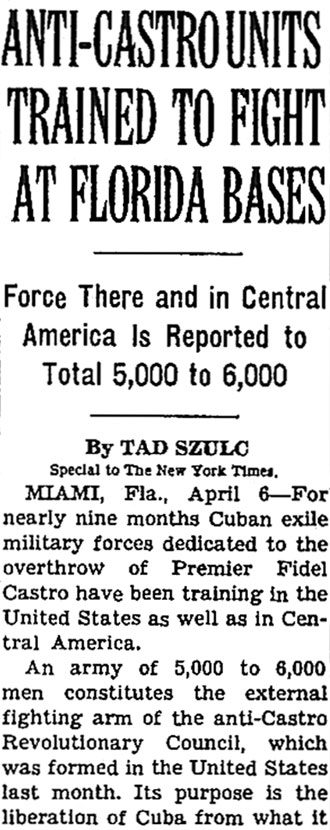
That article (see above) was written by a veteran correspondent, Tad Szulc, who reported from Miami that 5,000 to 6,000 Cuban exiles had received military training for a mission to topple Castro’s communist regime; the actual number of invaders was closer to 1,400.

Overstatement was hardly the article’s most controversial or memorable element.

Supposedly, editors at the Times caved in to pressure from the White House and emasculated Szulc’s report, removing key elements about the invasion plans.

That Kennedy intervened in the Times’ editorial decisionmaking in April 1961 is widely believed, and lives on as a cautionary tale, as Shipler suggests.

But as I discussed in Getting It Wrong, “the notion that Kennedy asked or persuaded the Times to suppress, hold back, or dilute any of its reports about the pending Bay of Pigs invasion is utter fancy. There is no evidence that Kennedy or his administration knew in advance” about Szulc’s dispatch, which was filed April 6, 1961.

The article was published the following day, above the fold on the Times front page.

In his book Without Fear or Favor, an insider’s look at the Times, Harrison Salisbury offered a detailed account about the handling of Szulc’s dispatch.

“The government in April 1961,” Salisbury wrote, “did not … know that The Times was going to publish the Szulc story, although it was aware that The Times and other newsmen were probing in Miami. …. The action which The Times took [in editing Szulc’s report] was on its own responsibility,” the result of internal discussions and deliberations.

The editing was cautious but hardly unreasonable.

A reference to the invasion’s imminence was removed, which served to improve the story’s accuracy. The anti-Castro exile force launched its assault on April 17, 1961, 10 days after Szulc’s report appeared, an interval that hardly connotes “imminence.”

References to the CIA’s role in training the Cuban exiles were omitted from the story in favor of the more nebulous terms “U.S. officials” and “U.S. experts.” Turner Catledge, then the Times managing editor, said the U.S. government had more than a few intelligence agencies, “more than most people realize, and I was hesitant to specify the CIA when we might not be able to document the charge.”

An entirely defensible editorial decision.

The prominence given Szulc’s report was modified, from a planned four-column display to a single column. If the invasion was not believed imminent, then a four-column headline was difficult to justify, Catledge reasoned.

Those decisions were judicious, and certainly not unreasonable.

“Most important,” as Salisbury wrote, “The Times had not killed Szulc’s story. … The Times believed it was more important to publish than to withhold. Publish it did.”

On the front page.

What’s often ignored is that Szulc’s article of April 7, 1961, was no one-off story. It scarcely was the Times’ last word about invasion plans.

As I noted in Getting It Wrong, “Subsequent reporting in the Times, by Szulc and others, kept expanding the realm of what was publicly known about a coming assault against Castro.” Not all the reports were accurate in all their details, but the combined effect was to signal something important was afoot.

For example, on April 8, 1961, the Times published a front-page article about the exiles and their eagerness to topple Castro.

The article appeared beneath the headline, “Castro Foe Says Uprising Is Near,” and quoted the president of the U.S.-based umbrella group of exiles, the Cuban Revolutionary Council.

The following day, the Times front page included a report by Szulc describing how Cuban exile leaders were attempting to paper over differences in advance of what was termed the coming “thrust against Premier Fidel Castro.”

The “first assumption” of the leaders’ plans, Szulc wrote, “is that an invasion by a ‘liberation army,’ now in the final stages of training in Central America and Louisiana, will succeed with the aid of internal uprising in Cuba. It is also assumed that a provisional ‘government in arms’ will be established promptly on the island.”

That essentially was the plan to topple Castro.

Three days later, James Reston, then the newspaper’s Washington bureau chief, wrote in a column that considered the moral dimensions of an assault on the Castro regime. Reston’s column said that “while the papers have been full of reports of U.S. aid to overthrow Castro, the moral and legal aspects of the question have scarcely been mentioned.”

Other news organizations, including the Miami Herald and New York Herald Tribune, reported on pre-invasion preparations as well, all of which prompted Pierre Salinger, Kennedy’s press secretary, to recall in a memoir a few years later:

“To declare in mid-April of 1961 that I knew nothing of the impending military action against Cuba except what I read in the newspapers or heard on the air was to claim an enormous amount of knowledge.”

WJC

More from Media Myth Alert:

Celebrities pushing media myths: Cavett’s turn in NYTimes

In Cronkite Moment, Debunking, Error, Media myths, New York Times, Quotes, Scandal, Washington Post, Watergate myth on April 27, 2015 at 6:46 am

It’s striking how prominent politicians, entertainers, and celebrities contribute to the recycling and, thus, the solidifying of media-driven myths, those hoary and exaggerated tales that often tell of magnificent deeds by journalists.

During his vice presidency, gaffe-prone Joe Biden went to Moscow and repeated the heroic-journalist trope of Watergate, about how, in his words, “it was a newspaper, not the FBI, or the Justice Department, it was a newspaper, the Washington Post that brought down a President for illegal actions.”

DickCavett

Cavett: Pushing the Cronkite myth

He was referring to the resignation of President Richard M. Nixon in August 1974.

The claim is absurd, but it has resonance across the political spectrum. Last year, for example, Rush Limbaugh, the voluble conservative talk-radio host, indulged in the heroic-journalist myth, declaring on his show last year that Bob Woodward’s Watergate reporting for the Washington Post “destroyed the Nixon presidency.”

That’s an interpretation not even Woodward embraces. He once told an interviewer: “To say the press brought down Nixon, that’s horse shit.”

Now comes Dick Cavett, the former television talk show host, who in a shrill and shallow commentary posted recently at the New York Times online site, recycles the media myth of the “Cronkite Moment” of 1968, when an analysis of the CBS News anchorman about the Vietnam War supposedly brought an epiphany to President Lyndon B. Johnson.

Cavett writes in what is a sneering and superficial assessment of the Vietnam conflict:

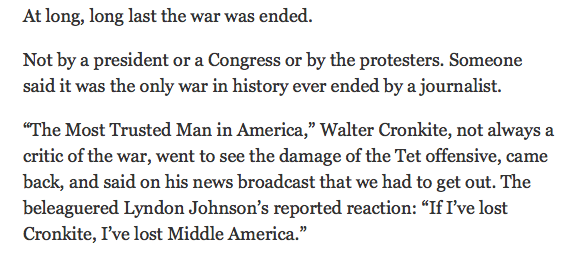
“At long, long last the war was ended.

“Not by a president or a Congress or by the protesters. Someone said it was the only war in history ever ended by a journalist.

“‘The Most Trusted Man in America,’ Walter Cronkite, not always a critic of the war, went to see the damage of the Tet offensive, came back, and said on his news broadcast that we had to get out. The beleaguered Lyndon Johnson’s reported reaction: ‘If I’ve lost Cronkite, I’ve lost Middle America.'”

Cavett commentary_NYT

From Cavett’s commentary

So let’s unpack that bundle of myth and exaggeration.

The reference to “only war in history ever ended by a journalist” sounds much like David Halberstam’s hyperbolic and unsourced claim in his book, The Powers That Be, that Cronkite’s analysis about Vietnam “was the first time in history a war had been declared over by an anchorman.”

Moreover, the notion that Cronkite reigned as America’s “most trusted man” rests more on advertising by CBS News, his employer, than on persuasive empirical evidence such as representative survey samples.

As for Cavett’s claim that Cronkite “said on his news broadcast that we had to get out” — well, that’s not what Cronkite said.

The claim refers to Cronkite’s special report about Vietnam, which CBS aired on February 27, 1968. At the close of the program, Cronkite said the U.S. war effort in Vietnam was “mired in stalemate” and that negotiations might prove to be a way out.

It was hardly a call for withdrawal.

Johnson in Texas, February 27, 1968

Johnson with Connolly: Not watching Cronkite

It was in fact a tepid reiteration of the thinking prevalent in the news media at the time: The war was stalemated. The New York Times had been saying as much periodically for months.

Finally, there’s no compelling evidence that President Lyndon Johnson reacted to Cronkite’s assessment by declaring in a flash of insight:

“If I’ve lost Cronkite, I’ve lost Middle America.”

As I discuss in my media-mythbusting book, Getting It Wrong, Johnson did not see the Cronkite report when it aired, and there is no evidence he saw it on videotape at some later date.

Johnson that night was on the campus of the University of Texas at Austin, attending a black-tie birthday party for his longtime political ally, Texas Governor John Connolly.

About the time Cronkite’s was intoning his tired “mired in stalemate” observation, the president was making light of Connolly’s age.

“Today, you are 51, John,” he said. “That is the magic number that every man of politics prays for—a simple majority.”

WJC

More from Media Myth Alert:

Katharine Graham, the ‘Economist,’ and bringing down Nixon

In Debunking, Error, Media myths, New York Times, Washington Post, Watergate myth on April 16, 2015 at 6:30 pm

With a bit of routine fact-checking, news organizations usually can sidestep the embarrassment of trading in prominent media myths.

But, no: The narrative power of many media myths often makes them too good to check. And so the myth gets retold.

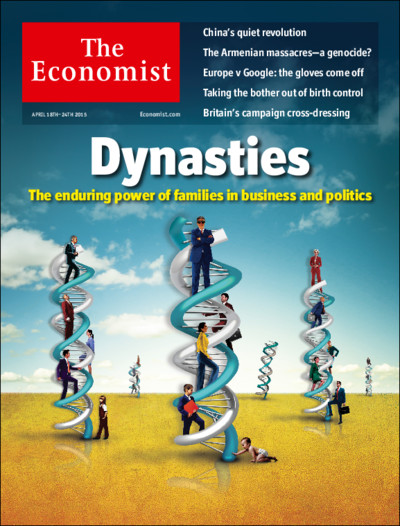
Consider the latest issue of Britain’s Economist newsmagazine. In an extended report about family-run companies, the Economist offers up the simplistic and ever-appealing myth that Richard Nixon’s corrupt presidency was brought low in the 1970s by the Washington Post, then owned by Katharine Graham and family.

Economist cover“Under her iron reign,” the Economist says of Graham, “the Washington Post brought down President Nixon with its investigation into the Watergate break-in and challenged the New York Times for the title of America’s most illustrious newspaper.”

The last claim, about challenging the New York Times, might have been true, for a while. But no more. And there’s no way the Post brought down” Nixon.

Katharine Graham herself said as much, at the 25th anniversary of the break-in in June 1972 of Democratic National Committee headquarters at the Watergate complex in Washington, D.C., the scandal’s seminal crime.

Speaking at an event in suburban Virginia, at the original Newseum (humble predecessor to the $450 million edifice on Pennsylvania Avenue), Graham insisted that the Post had not toppled Nixon.

“Sometimes,” she said, “people accuse us of bringing down a president, which of course we didn’t do. The processes that caused [Nixon’s] resignation were constitutional.”

Graham’s comment is not difficult to track down. It’s in my 2010 mythbusting book, Getting It Wrong, and I have incorporated the quote in many blog posts at Media Myth Alert, including those here, here, here, and here.

Graham was quite right about the processes that forced Nixon’s resignation (he quit in August 1974 in the face of certain impeachment by the U.S. House of Representatives).

And over the years, Graham’s views have been echoed by other principals at the newspaper.

Ben Bradlee, the executive editor during and after the Watergate period, likewise rejected the notion that the Post’s Watergate reporting brought down the president, saying in 1997 that “it must be remembered that Nixon got Nixon. The Post didn’t get Nixon.” (Bradlee was referring to the many hours of White House tapes which Nixon secretly made and which revealed the president’s active role in seeking to block the FBI’s investigation of the seminal crime of Watergate — the break-in at the DNC headquarters.)

Howard Kurtz, formerly the newspaper’s media reporter, wrote in 2005:

“Despite the mythology, The Post didn’t force Richard Nixon from office ….”

And Bob Woodward, one of the newspaper’s lead reporters on Watergate, once told American Journalism Review:

To say the press brought down Nixon, that’s horseshit.”

It is revealing to consider what critical disclosures the Post missed in its Watergate reporting.

It notably did not disclose the White House cover up of the Watergate crimes. It likewise failed to reveal the existence of Nixon’s White House tapes. Indeed, as I noted in Getting It Wrong, the contributions of Woodward and his reporting partner Carl Bernstein to the outcome of Watergate “were modest, and certainly not decisive.”

Far more important, I wrote, were “the collective if not always the coordinated forces of special prosecutors, federal judges, both houses of Congress, the Supreme Court, as well as the Justice Department and the FBI.”

And even then, despite the forces arrayed against him, Nixon probably would have survived Watergate and served out his term as president if not for the tapes — the existence of which was revealed by Alexander Butterfield, a former Nixon aide, before a U.S. Senate select committee in July 1973.

Its latest issue is not the first in which the Economist has indulged in Watergate mythology. In October, shortly after his death, the newsmagazine published a tribute to Bradlee, beneath a headline that read:

“The editor who toppled Nixon.”

That mythical claim appeared in the text of the eulogy as well.

WJC

More from Media Myth Alert:

WaPo still unable to keep details straight about Jessica Lynch case

In Debunking, Error, Jessica Lynch, Media myths, Newspapers, Washington Post on January 10, 2015 at 2:15 pm

The newspaper that brought us the bogus story about the battlefield heroics of Jessica Lynch during the Iraq War has goofed again in recounting details about the case.

Private Lynch

Lynch: Never fired a shot

The Washington Post — which erroneously claimed in early April 2003 that Lynch had fought fiercely despite being shot and stabbed in the ambush of her unit — mistakenly described in a blog post yesterday the circumstances of Lynch’s subsequent rescue from captivity.

Lynch was a supply clerk in the 507th Maintenance Company, which was attacked in Nasiriyah on March 23, 2003. Lynch, who never fired a shot in the ambush, was severely injured in the crash of a Humvee as she and four colleagues tried to escape. She was neither shot nor stabbed.

She was taken prisoner and held nine days at an Iraqi hospital before being rescued by a U.S. special operations team on April 1, 2003.

Two days later, the Post published its bogus, front-page report about Lynch’s purported derring-do on the battlefield, a story that cited otherwise anonymous “U.S. officials” and appeared beneath the headline:

“‘She was fighting to the death.'”

Yesterday, the Post’sCheckpoint” Web log erred in asserting that Lynch was one of several U.S. soldiers “held in captivity for 22 days before being rescued by Marines.” Lynch was not among those prisoners and her rescuers were special operations forces.

The “Checkpoint” post focused on about a talk given at a conference in San Antonio by Shoshana Johnson, who was shot in the ankles in the Nasiriyah ambush and also taken prisoner. Her rescue from captivity came more than a week after the operation that freed Lynch.

Conflating the cases of Lynch and Johnson obviously is not an error as significant as the Post’s report of April 3, 2003, which said Lynch “continued firing at the Iraqis even after she sustained multiple gunshot wounds and watched several other soldiers in her unit die around her in fighting” at Nasiriyah.

Still, the erroneous “Checkpoint” report is sloppy, and signals continued inattention to detail about the Lynch case.

One might think, given the embarrassment of the botched “fighting to the death” story, that Post reporters would be especially mindful about the details of the Lynch case.

And yet, the “Checkpoint” writeup wasn’t the first time in recent years that the newspaper has erred in referring to Lynch.

The Post invoked the Lynch case in 2010, in a movie review that disingenuously blamed the Pentagon for the bogus tale about Lynch’s heroics. Nearly seven weeks later, the newspaper published a belated and awkwardly worded correction about the review’s erroneous passage.

It is worth noting that the Post has never fully accounted for its botched hero-warrior story in 2003. It has never disclosed the identities of the anonymous sources who provided the salient details for a story so electrifying that was picked up by news organizations around the world.

The Post’s unwillingness to identify its sources contributed to the tenacity of a toxic narrative that the Pentagon concocted the story and somehow fed it to the Post in a crude attempt to boost U.S. public support for the war.

As I discuss in my media-mythbusting book, Getting It Wrong, Vernon Loeb, who shared a byline on the Post’s hero-warrior story about Lynch, has said unequivocally that the anonymous sources were not Pentagon officials.

In an interview on NPR in December 2003, Loeb declared:

“Our sources for that story were not Pentagon sources.”

Loeb, who then covered the military for the Post, made clear he “could never get anybody from the Pentagon to talk about” the Lynch case.

“They wouldn’t say anything about Jessica Lynch,” Loeb said, adding:

“I just didn’t see the Pentagon trying to create a hero where there was none. I mean … they never showed any interest in doing that, to me.”

If not Pentagon sources, then who were they? It’s well past time for the Post to identify them.

WJC

More from Media Myth Alert: