Keller
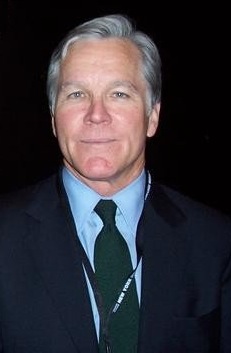
Bill Keller, executive editor of the New York Times, made clear the other day he doesn’t fully understand the derivation and significance of his newspaper’s famous, 114-year-old motto, “All the News That’s Fit to Print.”
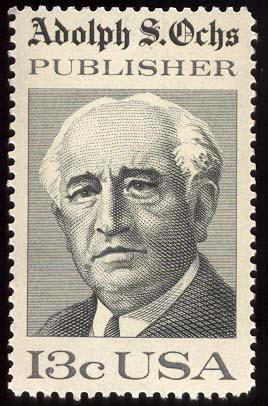
And he didn’t seem particularly comfortable with the slogan coined (most likely) by Adolph Ochs, who in 1896 acquired the then-beleaguered Times and eventually led the newspaper to preeminence in American journalism.
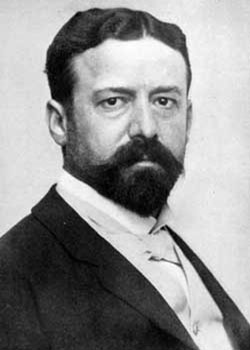
Ochs, commemorated
Sure, the motto’s smug and overweening, elliptical and easily parodied. But it is the most recognizable motto in American journalism, and it evokes a time now passed when slogans helped define and distinguish U.S. newspapers.
In an appearance not long ago at the National Press Club in Washington, Keller was asked about “All the News That’s Fit to Print,” which took a permanent place of prominence on the newspaper’s front page on February 10, 1897.
Keller rather sniffed at it, saying the motto “harkens back to a day when the aim of the newspaper was to be comprehensive.”
According to a transcript of his remarks, Keller said that nowadays the Times is “going to tell you maybe only a little bit, but a little bit about everything.
“And I think that slogan describes an aspiration, or a mindset. Now we tend to be more selective, and try to give you more depth, to tell you the stories that are not obvious.”
Actually, “All the News That’s Fit to Print” was framed a riposte to activist-oritented yellow journalism that flared in New York City in the closing years of the 19th century.
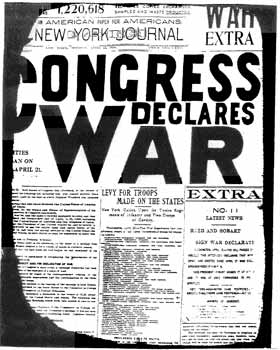
Ochs clearly meant the slogan to be a rebuke to the flamboyant ways of the New York Journal of William Randolph Hearst and the New York World of Joseph Pulitzer. Their newspapers were the leading exemplars of the yellow press in fin-de-siècle urban America.
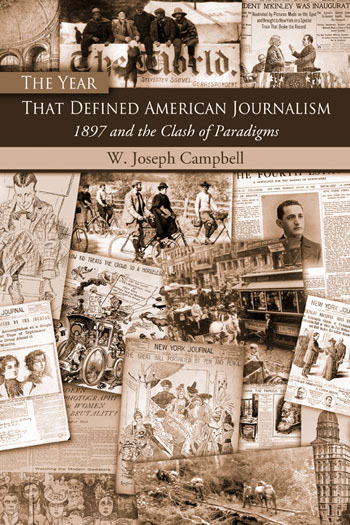
As I wrote in my 2006 book, a year study titled The Year That Defined American Journalism: 1897 and the Clash of Paradigms, the motto was, and remains, a daily rejection of flamboyant, self-promoting journalism.
And as the Times pointed out in 1935 in its obituary about Ochs, the motto “has been much criticized, but the criticisms deal usually with the phraseology rather than with its practical interpretation, and the phraseology was simply an emphatic announcement that The Times was not and would not be what the nineties called a yellow newspaper.”
I further noted in The Year That Defined American Journalism that the Times, at its 50th anniversary in 1901, “referred to ‘All the News That’s Fit to Print’ as its ‘covenant.’ One-hundred years later, a columnist for the Wall Street Journal aptly identified the motto as the ‘leitmotif not merely for the Times, but also, by a process of osmosis and emulation, for most other general-interest papers in the country, as well as for much of the broadcast media.'”
 So, no, the motto wasn’t an assertion of intent to be comprehensive — although the Times surely carried a lot of news in the late 1890s. Thirty or more articles, many of them a paragraph or two in length, usually found places on its front page back then.
Ochs’ slogan was more than a daily slap at yellow journalism.
It also represents “a daily and lasting reminder of the Times’ triumph in a momentous … clash of paradigms that took shape in 1897—a clash that helped define the modern contours of American journalism,” as I noted in The Year That Defined American Journalism.
That clash pitted three rival, incompatible models for the future of American journalism.
“As suggested by its slogan,” I wrote, “the Times offered a detached, impartial, fact-based model that embraced the innovative technologies emergent in the late nineteenth century but eschewed extravagance, prurience, and flamboyance in presenting the news.
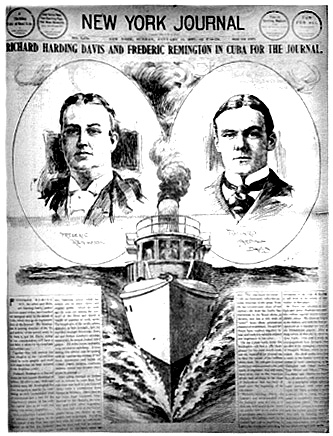
“Extravagance, prurience, and flamboyance were features typically associated with yellow journalism, a robust genre which, despite its controversial and self-indulgent ways, seemed to be irresistibly popular in 1897. The leading exemplar of yellow journalism was … Hearst’s New York Journal, which in 1897 claimed to have developed a new kind of journalism, a paradigm infused by a self-activating ethos that sidestepped the inertia of government to ‘get things done.’
“The Journal called its model the ‘journalism of action’ or the ‘journalism that acts,’ and declared it represented ‘the final state in the evolution of the modern newspaper.’
“The third rival paradigm,” I wrote, “was more modest and idiosyncratic than those of the Times and Journal. If improbable, it was nonetheless an imaginative response to the trends of commercialization in journalism. The paradigm was an anti-journalistic literary model devised and promoted by J. Lincoln Steffens, who in late 1897 became city editor of the New York Commercial Advertiser, then New York’s oldest newspaper.”
That model, Steffens said, was predicated on the notion “that anything that interested any of us would interest our readers and, therefore, would be news if reported interestingly.”
The Times ultimately prevailed in the three-sided rivalry that emerged in 1897, and “All the News That’s Fit to Print” lives on as a reminder of the outcome of that momentous clash of paradigms.
Recent and related:
- NYTimes practices ‘yellow journalism’? How so?
- Fact-checking Keller on New York Times-Bay of Pigs suppression myth
- Two myths and today’s New York Times
- 24/7 news cycle no new phenomenon
- On ‘transformational moments’ that journalists see
- More than merely sensational
- ‘War Lovers’: A myth-indulging disappointment
- Hearst ‘pushed us into war’: How’d he do that?
- On Hearst, yellow journalism, and war
- Blaming assassination on overheated commentary: No new tactic
- A debunker’s work is never done



 Media Myth Alert
1897, Commentary, Debunking, Fact-checking, Hearst, History, Insults, Journalism, Media, New journalism, New York Press, News, Opinion, Pulitzer, Spanish-American War, Yellow Journalism
‘Yellow journalism’ turns 114
In 1897, Anniversaries, Debunking, Media myths, Newspapers, Spanish-American War, Yellow Journalism on January 30, 2011 at 8:21 amIt is a little-recognized, never-celebrated anniversary in American journalism, granted.
Wardman of the Press
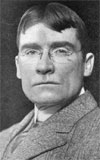
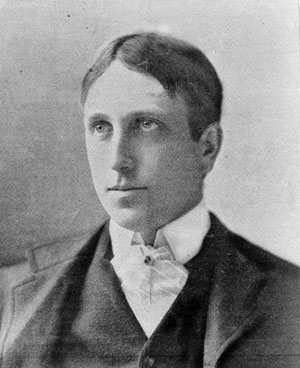
But tomorrow marks 114 years since the term “yellow journalism” first appeared in print, in the old New York Press, edited by the austere Ervin Wardman (left).
The phrase “the Yellow Journalism” appeared in a small headline on the editorial page of the Press on January 31, 1897. The phrase also appeared that day in the newspaper’s editorial page gossip column, “On the Tip of the Tongue.”
“Yellow journalism” quickly caught on, as a sneer to denigrate what then was called the “new journalism” of the New York Journal of William Randolph Hearst and the New York World of Joseph Pulitzer. By the end of March 1897, references to “yellow journalism” had appeared in newspapers in Providence, Richmond, and San Francisco.
In the decades since then, “yellow journalism” has become a widely popular if nebulous term — derisive shorthand for vaguely denouncing sensationalism and journalistic misconduct of all kinds, real and imagined.
“It is,” as I noted in my 2001 book Yellow Journalism: Puncturing the Myths, Defining the Legacies, “an evocative term that has been diffused internationally, in contexts as diverse as Greece and Nigeria, as Israel and India.”
Precisely how Wardman and the Press landed on the phrase “yellow journalism” isn’t clear.
The newspaper’s own, brief discussion of the term’s derivation was unhelpful and unrevealing: “We called them Yellow because they are Yellow,” it said in 1898 about the Journal and the World.
In the 1890s, the color yellow sometimes was associated with decadent literature, which may have been an inspiration to the Harvard-educated Wardman, a figure now largely lost to New York newspaper history.
Wardman was tall and stern-looking. He once was described as showing his “Calvinistic ancestry in every line of his face.” He did little to conceal his contempt for Hearst and Hearst’s journalism.
His disdain was readily apparent in the columns of the Press, of which Wardman became editor in chief in 1896 at the age of 31. (The Press is long defunct; it is not to be confused with the contemporary alternative weekly of the same title.)
Wardman’s Press took to taunting Hearst, Hearst’s mother, and Hearst’s support for Democratic candidate William Jennings Bryan in the 1896 presidential election. The New York Journal was virtually alone among New York newspapers in supporting Bryan’s “free silver” candidacy.
The Press disparaged Hearst, then 34, as a mama’s boy, as “Billy” and “little Willie.” It referred to the Journal as “our silverite, or silver-wrong, contemporary.”
The Press also experimented with pithy blasts on the editorial page to denounce “new journalism.”
“The ‘new journalism,’” the Press said in early January 1897 “continues to think up a varied assortment of new lies.”
Later in the month, the Press asked in a single-line editorial comment:
“Why not call it nude journalism?”
It clearly was a play on “new journalism” and meant to suggest the absence of “even the veneer of decency.”
Before long, Wardman and the Press seized upon the phrase “yellow-kid journalism,” which evoked the Hearst-Pulitzer rivalry over a popular cartoon character known as the “Yellow Kid.”
Both the Journal and the World at the time were publishing versions of the kid.
Yellow kid poster (Library of Congress)
At the end of January 1897, the phrase “yellow-kid journalism” was modified to “the Yellow Journalism,” and the sneer was born.
After landing on that evocative pejorative, Wardman turned to it often, invoking the term in brief editorial comments and asides such as: “The Yellow Journalism is now so overripe that the little insects which light upon it quickly turn yellow, too.”
The diffusion of “yellow journalism” was sealed when the Journal embraced the term in mid-May 1898, during the Spanish-American War. With typical immodesty, the newspaper declared:
“… the sun in heaven is yellow—the sun which is to this earth what the Journal is to American journalism.”
WJC
From an essay originally posted at Media Myth Alert January 31, 2010
Many thanks to Jim Romenesko for linking to this post
Recent and related:
Share this: