W. Joseph Campbell

Archive for 2020|Yearly archive page

Even in a pandemic, media myths play on

In 'Napalm girl', Cronkite Moment, Debunking, Error, Media myths, Photographs, Scandal, Television, Watergate myth on April 26, 2020 at 10:33 am

The U.S. news media have scarcely distinguished themselves in reporting the coronavirus pandemic that has killed more than 54,000 Americans since spreading from Wuhan, China, early this year. Criticism abounds about the substance and tone of the media’s reporting.

Not surprisingly, a Gallup poll late last month ranked the media last among American leaders and institutions in their response to the coronavirus.
Watergate myth will never die

Even amid a pandemic, peddling media myths — those prominent stories about and/or by the media that are widely believed and often retold but which, under scrutiny, dissolve as apocryphal — has proven irresistible to some news outlets.

Familiar media myths about the presumptive “Cronkite Moment” of 1968, the exaggerated influence of the “Napalm Girl” photograph of 1972, and the hero-journalist trope of the Watergate scandal all have circulated in recent weeks.

Their appearance signals not only how ingrained these myths become in American media; it also suggests an eagerness among journalists to believe their field can project decisive influence.

Take, for example, a lengthy recent article in USA Today about staggering death tolls the country has endured before the coronavirus, in wars, disasters, and terrorist attacks.

The article mentioned the Vietnam War, which claimed 58,000 American lives, and said the conflict “had a notable turning point in the court of public opinion. It happened when CBS anchor Walter Cronkite said in a 1968 broadcast that he believed the war was, at best, a ‘stalemate.’ Weeks later, President Lyndon Johnson sensed he had lost public support and declined to seek reelection.”

No evidence was offered for the “turning point” claim; no evidence was presented for the presumptive link to Johnson’s not running for another term.

On both counts, in fact, the evidence runs the other way.

Cronkite’s editorial statement, delivered in late February 1968, that the Vietnam War was stalemated was hardly a novel interpretation. “Stalemate” had been in circulation for months to characterize the conflict.

As I pointed out in my media-mythbusting book, Getting It Wrong, polling by Gallup indicated that the turning point in public opinion came in Fall 1967, about 4 1/2 months before Cronkite’s “stalemate” assessment. By then, and for the first time, a plurality of Americans said it had been a mistake to send U.S. troops to fight in Vietnam.

Other appraisals similarly indicated the turning point came in the second half of 1967.

At the end of that year, for example, Don Oberdorfer, then a national correspondent for the Knight newspapers, described what he called “a time of switching” in Summer and Fall 1967, “when millions of American voters — along with many religious leaders, editorial writers and elected officials — appeared to be changing their views about the war.”

In a very real sense, then, Cronkite’s “stalemate” observation was a matter of his following, rather than leading, American public opinion as it turned against the war.

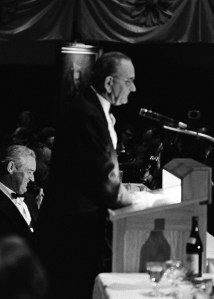
Additionally, the USA Today article suggested that in Cronkite’s “stalemate” assessment about the war, President Johnson “sensed he had lost public support and declined to seek reelection.” But Johnson did not see the Cronkite report when it aired; the President at the time was at a black-tie birthday party for a political ally, Governor John Connally, in Austin, Texas.

And there’s no certain evidence about when or whether he saw the Cronkite program on videotape at some later date.

Factors other than Cronkite’s program weighed more powerfully in discouraging Johnson from seeking reelection. Notably, he faced a serious internal challenge for the Democratic nomination from Senators Eugene McCarthy and Robert F. Kennedy. The latter entered the race for president after McCarthy’s surprisingly strong showing in the New Hampshire primary on March 12, 1968.

Faced with the prospect of humiliating defeats in primary elections after New Hampshire’s, Johnson quit the race.

The war Vietnam gave rise to other tenacious media myths, especially those associated with the “Napalm Girl” photograph taken in June 1972. The image showed a clutch of children fleeing a napalm strike on Trang Bang, their village in what then was South Vietnam.

Near the center of the photograph was a naked 9-year-old girl, screaming from her wounds.

It is said the photograph was so powerful that it swung U.S. public opinion against the war (in fact, as we’ve seen, it turned years before June 1972) and hastened an end to the conflict (in fact, the war went on till April 1975). Another myth of the “Napalm Girl” image was that it showed the effects of a U.S. aerial attack (also false: a warplane of the South Vietnamese Air Force dropped the napalm).

To that lineup of myth, the National Interest introduced another powerful effect — namely, that  the “Napalm Girl” image “helped turn public opinion against the use” of flame-throwers as weapons of war.
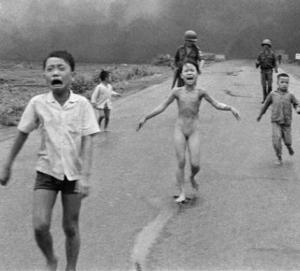
‘Napalm Girl,’ 1972 (Nick Ut/AP)

The post, however, offered no evidence of a linkage between the photograph and views about flamethrowers — which did not figure in the aerial attack at Trang Bang.

By email, I asked the editor of the National Interest for elaboration about the claim, saying: “I am interested in evidence such as public opinion polling that demonstrates or points to a linkage.”

I further wrote:

“I ask because I have addressed and disputed other claims about the photograph’s presumed impact — notably that it hastened an end to the Vietnam War, that it turned public opinion against the conflict, and that it showed the effects of a U.S. napalm attack on South Vietnam.”

The email was sent nearly three weeks ago. The editor has never replied.

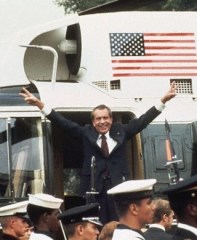
Then there’s the dominant narrative of Watergate, the ever-enticing notion that dogged reporting by Bob Woodward and Carl Bernstein for the Washington Post uncovered evidence that brought down Richard Nixon’s corrupt presidency. It’s a myth that has survived scoffing and rejection by principals at the Post — Woodward among them.

As he told an interviewer in 2004:

To say that the press brought Nixon, that’s horseshit.

In less earthier terms, Katharine Graham, the newspaper’s publisher during the Watergate scandal, insisted the Post did not topple Nixon. “Sometimes people accuse us of bringing down a president, which of course we didn’t do,” she said in 1997. “The processes that caused [Nixon’s] resignation were constitutional.”

As I pointed out in Getting It Wrong, credit for bringing down Nixon belongs to the federal investigators, federal judges, federal prosecutors, bipartisan congressional panels, the Supreme Court, and others who investigated the scandal and uncovered evidence of obstruction of justice that led to Nixon’s resignation in August 1974.

Against that tableau, I wrote, “the contributions of Woodward and Bernstein were at best modest, and certainly not decisive.”

And yet, the hero-journalist myth lives on — as suggested the other day in a column by the entertainment critic for the Lincoln Journal Star in Nebraska. The column presented a rundown about the top films with a journalism theme. Atop the critic’s list was All the President’s Men, the cinematic adaptation of Woodward and Bernstein’s eponymous, best-selling book.

It’s the “best newspaper picture ever,” the Journal Star critic wrote, declaring that movie showed how Woodward and Bernstein “ferreted out the Watergate scandal and brought down a president.”

And brought down a president.

Right.

The hero-journalist trope of Watergate knows few bounds. It’s surely one of those media myths that’s never going to die.

WJC

More from Media Myth Alert:

The ‘Cronkite Moment’ of 1968: Remembering why it’s a media myth

In Anniversaries, Cronkite Moment, Debunking, Media myths, Quotes, Television on February 27, 2020 at 7:03 pm

Cronkite in Vietnam, 1968

Fifty-two years ago tonight, CBS News anchorman Walter Cronkite presented a prime-time report about the war in Vietnam and declared in closing that the U.S. military effort was “mired in stalemate” and that negotiations might eventually offer a way out.

It was a tepid analysis, hardly novel. But over the years, Cronkite’s assessment has swelled in importance, taking on the aura of a vital, media-inspired turning point. It is so singularly important in American journalism that it has come to be called the “Cronkite Moment.

In reality it is a moment steeped in media myth.

Notable among the myths of the “Cronkite Moment” is that President Lyndon B. Johnson watched the program and, upon hearing the anchorman’s comment about “stalemate,” snapped off the television and told an aide or aides something to this effect:

“If I’ve lost Cronkite, I’ve lost Middle America.” (Versions vary.)

Cronkite’s remarks supposedly were an epiphany to the president, who realized his war policy was a shambles.

The account of the anchorman’s telling hard truth to power is irresistible to journalists, representing a memorable instance of media influence and power.

But Cronkite’s program on February 27, 1968, hardly had decisive effects. Here’s why (this rundown is adapted from a chapter about the “Cronkite Moment” in my media myth-busting book, Getting It Wrong):

Johnson: Didn’t see Cronkite show

  • Cronkite said nothing about Vietnam that hadn’t been said by leading journalists many times before. By early 1968, “stalemate” was a decidedly unoriginal — and fairly orthodox — way of characterizing the war effort.
  • Cronkite’s remarks were decidedly more temperate than other contemporaneous media assessments about the war. Four days before Cronkite’s program, for example, the Wall Street Journal said in an editorial that the U.S. war effort in Vietnam “may be doomed” and that “everyone had better be prepared for the bitter taste of defeat beyond America’s power to prevent.” Not long after Cronikte’s report, Frank McGee of NBC News declared the war was being lost if judged by the Johnson administration’s definition. Not stalemated. Lost.
  • Johnson did not see the Cronkite program when it aired. He was at a black-tie birthday party in Texas at the time (see photo nearby) and it is unclear whether, or when, he watched it afterward on videotape. The presumed impact of the “Cronkite Moment” rests in its sudden, unexpected, and profound effect on the president: Such an effect would have been absent, or sharply diluted, had Johnson seen the program on videotape at some later date.
  • In the days and weeks afterward, Johnson was conspicuously hawkish in public remarks about the war — as if, in effect, he had brushed aside Cronkite’s downbeat assessment while seeking to rally popular support for the war effort. At one point in March 1968, Johnson called publicly for “a total national effort” to win the war.
  • Until late in his life, Cronkite dismissed the notion that his pronouncement had much effect on Johnson: He considered its impact as akin to that of a straw on the back of a crippled camel. Cronkite invoked such an analogy in his 1997 memoir, A Reporter’s Life.
  • Long before Cronkite’s report, public opinion had begun to shift against the war. Polling data and journalists’ observations indicate that a turning point came in Fall 1967. Indeed, it can be said that Cronkite followed rather than led Americans’ changing views about Vietnam. As Daniel C. Hallin wrote in 1998: “Lyndon Johnson had essentially lost Mr. Average Citizen months before Cronkite’s broadcast.”
  • Johnson’s surprise announcement March 31, 1968, that he would not seek reelection to the presidency pivoted not on what Cronkite had said a month before but on the advice of an informal group of senior advisers, known as the “Wise Men.” The “Wise Men” met at the White House a few days before Johnson’s announcement and, to the president’s surprise, advised disengagement from Vietnam.

It is far easier to embrace the notion that Cronkite’s report 52 years ago altered the equation on Vietnam than it is to dig into its back story and understand it for what it was: A mythical moment of marginal influence in a war that lasted until 1975.

WJC

More from Media Myth Alert:


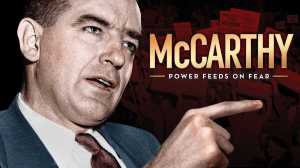
Flawed PBS ‘McCarthy’ doc notable for what it left out

In Anniversaries, Debunking, Media myths, Newspapers on January 26, 2020 at 5:08 pm

The PBS “American Experience” documentary about Joseph R. McCarthy, the notorious red-baiting U.S. senator of the early Cold War, aired earlier this month. I have puzzled about the program since.

Timing was a source of puzzlement. Why now? Why revisit the McCarthy story in January 2020? Anniversaries can be a convenient peg for such programs. But nothing in early January was memorably associated with the McCarthy saga.

So why now? The producers no doubt wanted to suggest that President Donald Trump, in his bluster, exaggerations, and combative demeanor, is reminiscent of McCarthy.

If that were the implication, the allusion was muddled. And under-developed. Which could be because Trump is a much more complex character than Joe McCarthy, an obscure, hard-drinking Republican senator from Wisconsin who seized on his communists-in-government campaign as a ticket to prominence.

PBS ‘McCarthy’ doc: Notable for what was omitted

So the documentary was notable for what it insinuated — and for what it left out.

It embraced a conventional if misleading interpretation that the American press was unwilling to stand up to McCarthy, reluctant to challenge his thinly sourced charges about communist infiltration of the federal government.

Indeed, the press of the time depicted as complicit with McCarthy’s tactics. Sam Tanenhaus, one of the on-camera authorities presented by PBS, said as much:

“McCarthy brought out the complicity in American journalists, that we like the troublemaker and the rabble-rouser and the theatrical, spectacular figure who says the thing you’re not supposed to say, who breaks the rules, who disregards the facts. That makes for really good copy. And that’s what happened, that’s what kept McCarthy going for a long time until it all fell apart, and then he was just discarded.”

In reality, not all prominent journalists of the time were inclined to excuse McCarthy’s theatrics and allegations.

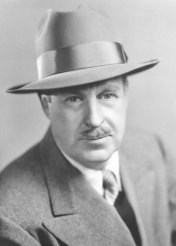
Notable among them — yet scarcely mentioned in the documentary — was Drew Pearson, an activsit, muckraking, Washington-based syndicated columnist. Pearson went after McCarthy just days after the senator launched his communists-in-government campaign, claiming in a speech in February 1950 to have names of 205 of communists in the State Department. (The number varied; McCarthy soon after claimed to have a list of 57 card-carrying communists in the agency.)

Pearson scoffed at McCarthy’s claims and wrote in a column in mid-February 1950:

“When the Senator from Wisconsin was finally pinned down, he could produce not 57 but only 4 names of State Department officials whom he claimed were Communists.” One of the four had long since been cleared, Pearson noted. Two of them had left the agency, and the fourth person had never worked for the State Department.

What’s more, Pearson wrote, McCarthy’s allegations were similar to disputed charges raised three years earlier by a Republican congressman from Michigan.

Drew Pearson

Pearson was intrusive, self-important, gossipy, and not an especially heroic figure; media critic Jack Shafer once described him “as one of the skuzziest journalists to ever write a story.” Even so, his persistent challenges to McCarthy deserved more recognition than PBS granted him.

The documentary’s lone reference to Pearson in the documentary was passing mention about his one-sided physical confrontation with McCarthy in December 1950 when the senator cornered him in the cloak room of the fashionable Sulgrave Club in Washington, D.C. McCarthy either kneed, slugged, or slapped Pearson: Contemporaneous accounts differed.

Pearson in his columns not only disputed the senator’s red-baiting claims. He called out McCarthy on other matters — including the senator’s tax troubles in Wisconsin and the suspicious financial contributions to his campaign for senate.

Pearson’s probing “embarrassed and angered McCarthy, who began entertaining thoughts of doing him harm,” I noted in my media-mythbusting book, Getting It Wrong. At a Gridiron Club dinner in Washington in May 1950, McCarthy approached Pearson, placed a hand on his arm, and muttered:

“Someday I’m going to get a hold of you and really break your arm.”

The threat was prelude to the brief but violent encounter at the Sulgrave.

The point here is that journalists were challenging McCarthy in the early days of his communists-in-government crusade. And Pearson was not alone.

Richard Rovere of the New Yorker also was an early critic of McCarthy.

Rovere was not mentioned in the documentary.

Nor was the New York Post’s 17-part series in 1951 about McCarthy and his tactics. The series carried the logo, “Smear, Inc.” and deplored what it termed McCarthy’s “careening, reckless, headlong drive down the road to political power and personal fame” in which he had “smashed the reputations of countless men.”

The documentary made only indirect reference to Post’s bare-knuckled series, noting that the newspaper’s editor, James Wechsler, was summoned before McCarthy’s subcommittee in 1953 in what Wechsler described as “a reprisal against a newspaper and its editor for their opposition to the methods of this committee’s chairman.”

Ignoring the journalists who stood up to and challenged McCarthy’s recklessness was a shortcoming of the documentary.

Another flaw was suggesting that Edward R. Murrow’s famous if myth-encrusted television report in March 1954 about McCarthy was timed to coincide with efforts by the administration of President Dwight D. Eisenhower to defang the senator.

It may have been, but PBS offered as support only the speculation of one of its on-camera authorities, Thomas Doherty.

“My thinking,” Doherty said, “is that Edward R. Murrow got some kind of informal signal from the Eisenhower administration, that this week in March [1954], is the week in which McCarthy’s career will basically be orchestrated to be over.”

Not until December 1954 was McCarthy censured by the Senate, a move that confirmed the disintegration of his political career.

McCarthy died of alcoholism-related illness in 1957. According to the documentary, senators accompanying McCarthy’s coffin on the flight from Washington to Wisconsin played poker on his flag-draped casket.

WJC

More from Media Myth Alert: