W. Joseph Campbell

Archive for the ‘Anniversaries’ Category

Online at BBC News: Recalling the derivation of ‘All the news that’s fit to print’

In 1897, Anniversaries, New York Times, Newspapers, Yellow Journalism on February 11, 2012 at 12:10 am

The most famous seven words in American journalism — “All the news that’s fit to print” — took a permanent place 115 years ago yesterday in the upper left corner, or left “ear,” of the New York Times masthead.

On front page for 115 years

And I recalled that occasion in a piece for the BBC News online site, writing:

“The motto appeared on the Times’ front page without notice, commentary, or fanfare. In the years since, the phrase has been admired as a timeless statement of purpose, interpreted as a ‘war cry’ for honest journalism, and scoffed at as pretentious, overweening, and impossibly vague.

“Even the Times hasn’t been entirely consistent in its embrace and interpretation of those seven words. In 1901, at the 50th anniversary of its founding, the Times referred to ‘All the news that’s fit to print’ as its ‘covenant. In 2001, a Times article commemorating the newspaper’s 150th anniversary said of the motto:

“’What, exactly, does it mean? You decide. The phrase has been debated, and endlessly parodied, both inside and outside the Times for more than a century.’

“On occasion, the motto has been taken far too seriously, as in 1960 when Wright Patman, a U.S. congressman from Texas, asked the Federal Trade Commission to investigate whether ‘All the news that’s fit to print’ amounted to false and misleading advertising.

“’Surely this questionable claim has a tendency to make the public believe, and probably does make the public believe, that the New York Times is superior to other newspapers,’ Patman wrote.

“The Trade Commission declined to investigate, saying: ‘We do not believe there are any apparent objective standards by which to measure whether “news” is or is not “fit to print.”’

“No matter how it’s interpreted, the motto certainly is remarkable in its permanence. One-hundred fifteen years on the front page has invested the motto with a certain gravitas. It often has been associated with fairness, restraint, and impartiality — objectives that nominally define mainstream American journalism.

“A commentary in the Wall Street Journal in 2001 addressed those sentiments, describing the motto as the ‘leitmotif not merely for the Times, but also, by a process of osmosis and emulation, for most other general-interest papers in the country, as well as for much of the broadcast media.

“Interestingly, the ‘leitmotif’ of American journalism had its origins in marketing and advertising.

“’All the news that’s fit to print’ first appeared on an illuminated advertising sign, spelled out in red lights above New York’s Madison Square in early October 1896. That was about six weeks after Adolph S. Ochs had acquired the newspaper in bankruptcy court.

“Ochs, patriarch of the family that still controls and publishes the Times, had come to New York from Tennessee. His task was to differentiate the Times from its larger, aggressive, and wealthier rivals — notably the yellow press of William Randolph Hearst and Joseph Pulitzer. It was a tall order, given the beleaguered status of the Times in New York’s crowded newspaper market.

“Ochs possessed a keen sense of promotion and turned to a number of techniques to call attention to the Times. The illuminated sign at Madison Square was one. An even more successful promotion was a contest inviting readers to propose a better motto.

“In late October 1896, the Times announced it was offering $100 for the phrase of ten words or fewer that ‘more aptly’ captured the newspaper’s ‘distinguishing characteristics’ than ‘All the news that’s fit to print.’

“Hundreds of entries poured in. …  As the contest unfolded in the fall of 1896, the Times amended the rules, making clear it would not abandon ‘All the news that’s fit to print’ but would still pay $100 for the best suggestion. And entries kept coming in.

“A committee of Times staff narrowed the field to 150, which in turn was winnowed to four by the motto contest judge, Richard W. Gilder, editor of The Century magazine. The finalists were:

  • “Always decent; never dull”
  • “The news of the day; not the rubbish”
  • “A decent newspaper for decent people”
  • “All the world’s news, but not a School for Scandal”

“The latter entry, Gilder determined, was the best of the lot, and the Times paid the prize money to the author of the phrase, D.M. Redfield of New Haven, Connecticut.

“What exactly prompted Ochs to move ‘All the news that’s fit to print’ to the front page 115 years ago is not entirely clear. But his intent was unmistakable — to throw down a challenge to the yellow press, a challenge that Ochs ultimately won. The Times has long outlived the New York newspapers of Hearst and Pulitzer.

“So the motto lives on as a reminder, as a daily rebuke to the flamboyant extremes of fin-de-siècle American journalism that helped inspire ‘All the news that’s fit to print.'”

WJC

Recent and related:

‘Yellow journalism’: The back story to a sneer, 115 years on

In 1897, Anniversaries, Spanish-American War, Yellow Journalism on January 31, 2012 at 6:35 am

Wardman: Gave us 'yellow journalism'

Yellow journalism” is a disparaging epithet often invoked in journalism, even though its derivation is little known.

This is the back story to a sneer that trips easily off the tongue with scorn and condescension.

The first verified use of the term was 115 years ago today, when “yellow journalism” appeared in the old New York Press.

The phrase “the Yellow Journalism” appeared in a small headline on the Press’ editorial page on January 31, 1897. The phrase also appeared that day in the newspaper;s editorial page gossip column, “On the Tip of the Tongue.”

Yellow journalism” was quickly embraced in American newspapering, as a way to disparage and denigrate the freewheeling practices of William Randolph Hearst and his New York Journal as well as Joseph Pulitzer and the New York World.

Within weeks of the first use of the term, references to “yellow journalism” had appeared in newspapers in Providence, Richmond, and San Francisco.

In the 115 years since then, “yellow journalism” has turned into a derisive if vague shorthand for denouncing sensationalism and journalistic misconduct of all kinds.

“It is,” I wrote in my 2001 book, Yellow Journalism: Puncturing the Myths, Defining the Legacies, “an evocative term that has been diffused internationally, in contexts as diverse as Greece and Nigeria, as Israel and India.”

I also noted that yellow journalism emerged in “a lusty, fiercely competitive, and intolerant time, when newspapers routinely traded brickbats and insults” and even threats.

Just how Wardman and the Press came up with “yellow journalism” is not clear.

The newspaper’s own, brief discussion of the term’s derivation was decidedly unrevealing. “We called them Yellow because they are Yellow,” the Press said in 1898 in a comment about the Journal and the World.

In the 1890s, the color yellow sometimes was associated with depraved literature, which may have been an inspiration to Wardman, an austere figure largely lost to New York newspaper history. (The New York Times said in 1923 in its obituary of Wardman: “Like many another anonymous worker in journalism, his name was not often conspicuously before the public, and he was content to sink his personality in that of the papers which he served.”)

Wardman, who earned a bachelor’s degree in three years at Harvard University, once was described as showing “Calvinistic ancestry in every line of his face.” He did little to conceal his contempt for Hearst and Hearst’s flamboyant style of journalism.

Disdain routinely spilled into the columns of the Press, of which Wardman became editor in chief in 1896 at the age of 31. (The Press ceased publication in 1916.)

The Press took to taunting Hearst, Hearst’s mother, and Hearst’s support for Democratic candidate William Jennings Bryan in the 1896 presidential election. Hearst’s Journal was virtually alone among New York newspapers in supporting Bryan’s “free silver” candidacy.

The Press taunted Hearst, then 34, as a mama’s boy and “little Willie.” It referred to the Journal as “our silverite, or silver-wrong, contemporary.”

The Press also experimented with pithy if stilted turns of phrase to denounce “new journalism,” Hearst’s preferred term to characterize his style of newspapering.

“The ‘new journalism,’” the Press said in early January 1897 “continues to think up a varied assortment of new lies.”

Later in the month, the Press asked in a single-line editorial comment:

“Why not call it nude journalism?”

It clearly was a play on “new journalism” and was meant to suggest the absence of “even the veneer of decency.”

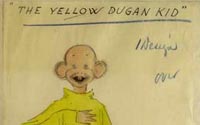
It wasn’t long before Wardman and the Press seized upon the phrase “yellow-kid journalism,” which evoked the Hearst-Pulitzer rivalry over a popular cartoon character known as the “Yellow Kid.” Both the Journal and the World at the time were publishing versions of the kid.

The Yellow Kid (Library of Congress)

At the end of January 1897, the phrase “yellow-kid journalism” was modified  to “the Yellow Journalism,” and the sneer was born.

Wardman turned often to this delicious pejorative, invoking it in a number of brief editorial comments such as:

“The Yellow Journalism is now so overripe that the little insects which light upon it quickly turn yellow, too.”

The diffusion of “yellow journalism” was confirmed when Hearst’s Journal embraced the term in mid-May 1898, during the Spanish-American War. With typical immodesty, it declared:

“… the sun in heaven is yellow—the sun which is to this earth what the Journal is to American journalism.”

WJC

Adapted from an essay posted in 2010 at Media Myth Alert.

Recent and related:

Sketches published 115 years ago undercut a tenacious media myth

In 1897, Anniversaries, Debunking, Furnish the war, Media myths, Spanish-American War on January 24, 2012 at 5:25 am

On assignment for Hearst

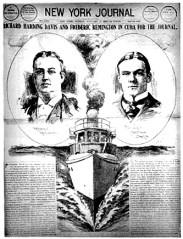
The artist Frederic Remington was back from Havana just a few days when on January 24, 1897, William Randolph Hearst’s New York Journal began publishing his sketches of the Cuban rebellion against Spanish colonial rule.

Remington later confided that he didn’t think much of the Journal’s reproduction techniques. But the newspaper played up Remington’s artwork, publishing them beneath an extravagant headline that read:

“Cuban War Sketches Gathered in the Field by Frederic Remington; The Gifted Artist, Visiting Cuba Especially for the Journal, Describes with Pen and Pencil Characters That Are Making the War Famous and Infamous.”

The prominent display given the sketches, and the Journal’s flattering references to the artist, serve to undercut a tenacious and prominent media-driven myth, an anecdote that ranks as one of the most popular in American journalism.

And that is the hoary tale that Hearst, in a telegraphic exchange with Remington, vowed to “furnish the war” with Spain.

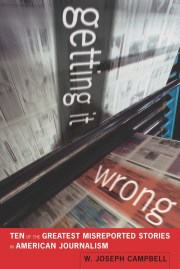
As I discuss in my latest book, Getting It Wrong, the exchange, if it happened, would have occurred on or about January 17, 1897, when Remington was preparing to leave Cuba and return to New York.

Hearst had sent Remington and the correspondent Richard Harding Davis to Cuba to report on the rebellion against Spanish rule, a vicious conflict that gave rise in 1898 to the Spanish-American War.

Remington and Davis didn’t get along and parted ways after only a few days in Cuba. According to legend, Remington before leaving sent a cable to Hearst that said:

Everything is quiet. There is no trouble here. There will be no war. I wish to return.”

In reply, Hearst supposedly told Remington:

Please remain. You furnish the pictures, and I’ll furnish the war.”

Remington left anyway, taking the passenger steamer Seneca to New York, arriving January 21, 1897. His Cuba sketches began appearing in the Journal 115 years ago today.

So how do those sketches help debunk the tale about Hearst’s vow “furnish the war”?

As I discuss in Getting It Wrong, the sketches “depict unmistakable (if unremarkable) scenes of a rebellion — a scouting party of Spanish cavalry with rifles at the ready; a cluster of Cuban non-combatants trussed and bound and being herded into Spanish lines; a scruffy Cuban rebel kneeling to fire at a small Spanish fort; a knot of Spanish soldiers dressing a comrade’s leg wound.”

Their subject matter effectively disputes the notion that Remington had found “everything … quiet” in Cuba.

Remington, 'gifted artist'

That the sketches were accompanied by glowing references to Remington as a “gifted artist” indicates that Hearst was not angry with Remington as he surely would have been had the artist left Cuba after being told “please remain.”

Indeed, it is difficult to believe Hearst would have been so generous in his compliments and ordered such prominent display of Remington’s work had the artist in fact disregarded Hearst’s instructions to stay in Cuba.

“Far from being irritated and displeased with Remington,” I write in Getting It Wrong, “Hearst was delighted with his work. He recalled years later that Remington and Richard Harding Davis, the celebrated writer who traveled to Cuba with the artist, ‘did their work admirably and aroused much indignation among Americans’ about Spanish rule of the island.”

The sole source of the “furnish the war” anecdote was James Creelman, who in January 1897 was neither with Hearst in New York nor with Remington in Cuba. Creelman then was in Spain, as the Journal’s “special commissioner,” or correspondent, on the Continent.

Creelman incorporated the anecdote about the Remington-Hearst exchange in a book of reminiscences, On the Great Highway, which was published in 1901. Creelman, a blustery, cigar-chomping egotist, did not say how he learned about the purported Remington-Hearst exchange, which he presumes to quote verbatim.

Hearst denied ever having sent such a message. Remington apparently never spoke about the supposed exchange.

The display Remington’s sketches received in Hearst’s Journal, and the newspaper’s compliments about the artist, are two of several compelling reasons for doubting the anecdote and treating it as a media myth.

Another reason is that the telegrams Remington and Hearst supposedly sent have never turned up.

The anecdote, moreover, is illogical on its face: It would have made no sense for Hearst to have vowed to “furnish the war” because war — the rebellion against Spanish rule — was the reason he sent Remington to Cuba in the first place.

WJC

Recent and related:

‘Getting It Wrong’ goes on ‘One Hour of Hope’

In Anniversaries, Cinematic treatments, Cronkite Moment, Debunking, Jessica Lynch, Media myths, Washington Post, Watergate myth on January 10, 2012 at 12:15 pm

I recently was on “One Hour of Hope,” a satirically named radio show in Gainesville, Florida, to speak about several of the media-driven myths debunked in my latest book, Getting It Wrong.

Among them are the heroic-journalist trope of Watergate, the so-called “Cronkite Moment” of 1968, and the battlefield derring-do misattributed to Jessica Lynch early in the Iraq War.

The host of “One Hour of Hope,” Doug Clifford, noted at the outset of the interview that 2012 marks the 40th anniversary of the Watergate scandal’s signal crime, the breakin in June 1972 at the headquarters of the Democratic National Committee.

I am sure the anniversary will give rise  to a resurgence of the heroic-journalist interpretation of Watergate, which holds that the dogged investigative reporting of Washington Post reporters Bob Woodward and Carl Bernstein uncovered the scandal and brought about President Richard M. Nixon’s resignation in August 1974.

That media myth has become the dominant narrative of Watergate, I noted during the radio interview, which aired on WSKY-FM.

The persistence of that misreading narrative, I said, can be traced to All the President’s Men, Woodward and Bernstein’s 1974 book about their Watergate reporting, and especially to the 1976 movie by the same title.

The movie, by focusing on the exploits of Woodward and Bernstein, projects the notion that the reporters, with help from a the stealthy, high-level source code-named “Deep Throat,” unearthed the evidence that forced Nixon to quit.

That, I said, is a very simplistic interpretation, “a serious misreading of history” that ignores the far more powerful forces and factors that combined to uncover evidence of Nixon’s culpability.

Those forces, I noted, were typically subpoena-wielding and included committees of both houses of Congress, the Justice Department, the FBI, and a federal judge in Washington named John Sirica.

(Interestingly, the Washington Post, in its obituary of Sirica, said the judge’s “persistence in searching for the facts while presiding over the Watergate cases led to President Nixon’s resignation.”)

The myth of the “Cronkite Moment” represents another serious misreading of history, I said.

Clifford summarized the purported “Cronkite Moment,” that President Lyndon Johnson, in reaction to the CBS News anchor Walter Cronkite’s pessimistic assessment of the Vietnam War, said, “If I’ve lost Cronkite, I’ve lost America.”

I noted that versions of what the president said vary markedly and also include:

  • “If I’ve lost Cronkite, I’ve lost Middle America.”
  • “If I’ve lost Cronkite, I’ve lost the country.”
  • “If I’ve lost Cronkite, I’ve lost the war.”

(Version variability of such magnitude, I write in Getting It Wrong, is a revealing marker of a media-driven myth.)

I noted in the interview that there’s no evidence Johnson saw Cronkite’s television report about Vietnam when it aired February 27, 1968. At the time, the president was attending a birthday party for Governor John Connally on the campus of the University of Texas at Austin.

Nor is there any credible evidence that Cronkite’s reporting about Vietnam influenced  Johnson’s decision, announced in late March 1968, not to seek reelection.

Clifford asked about reporting of the Jessica Lynch case, and I said the bogus tale of her battlefield heroics was largely due to “sloppy reporting by the Washington Post.”

I described the newspaper’s electrifying report, published April 3, 2003, that cited otherwise unidentified “U.S. officials” in saying Lynch had fought fiercely in the ambush of Army unit in Iraq, that she had kept firing at Iraqi attackers even as she suffered gunshot and stab wounds.

But none of that proved true. Lynch fired not a shot in the attack. She was wounded not in the firefight with the Iraqis but in the crash of her Humvee as it tried to flee the ambush.

I also noted in the interview how a “false narrative that the military made up the story” has come to define the Lynch tale.

One of the reporters on the Post’s botched story, I pointed out, has said that the Pentagon wasn’t the newspaper’s source, and also has said that far “from promoting stories about Lynch, the military didn’t like the story.”

The false narrative, I added, has had the additional effect of obscuring recognition of the heroics of Donald Walters, a cook-sergeant who apparently performed the heroics deeds wrongly attributed to Lynch.

Walters laid down covering fire as Lynch and others in their unit sought to escape. He was captured when he ran out of ammunition, and soon afterward executed.

Clifford said his show’s title, “One Hour of Hope,” is a satiric gesture; his once-weekly, 60-minute program leans left while much of the rest of the station’s talk-show content is conservative in political orientation.

WJC

Recent and related:

Taking stock: Top mythbusting posts of 2011

In Anniversaries, Bra-burning, Cronkite Moment, Debunking, Jessica Lynch, Media myths, Murrow-McCarthy myth, Quotes, Washington Post, Watergate myth on December 31, 2011 at 4:45 am

Reviewing the year in media-mythbusting reveals a number of memorable posts. Here are the Media Myth Alert five top writeups of 2011, with a roster of other mythbusting posts of note:

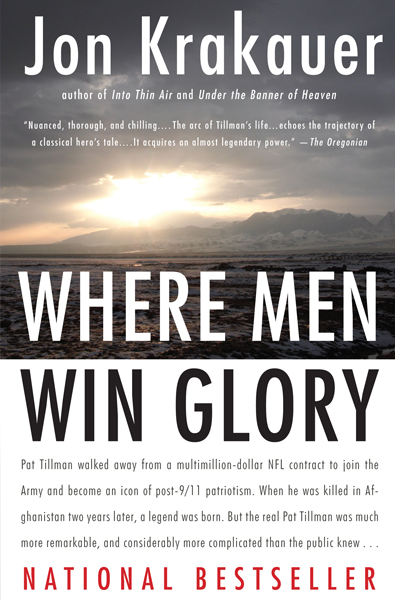
Krakauer retreats from Lynch-source claim (posted November 11): This post revealed author Jon Krakauer’s quiet retreat from claims in a 2009 book that Jim Wilkinson, a former White House official, was the source for the bogus Washington Post report about Jessica Lynch and her supposed battlefield heroics in the Iraq War in 2003.

The claims in Krakauer’s book were unattributed — and vigorously denied by Wilkinson, who sought a correction.

When it came, the correction was inserted unobtrusively in a new printing of the paperback edition of Krakauer’s book, Where Men Win Glory. It read:

“Earlier editions of this book stated that it was Jim Wilkinson ‘who arranged to give the Washington Post exclusive access’ to this leaked intelligence [about Jessica Lynch]. This is incorrect. Wilkinson had nothing to do with the leak.”

I’ve noted that the Post’s enduring silence about its sources on the Lynch story has allowed for the emergence not only of false allegations such as those about Wilkinson, but of a false narrative that the military concocted the tale about Lynch’s derring-do.

The false narrative  also has deflected attention from the soldier whose heroics apparently were misattributed to Lynch. He was Sgt. Donald Walters, a cook in Lynch’s unit.

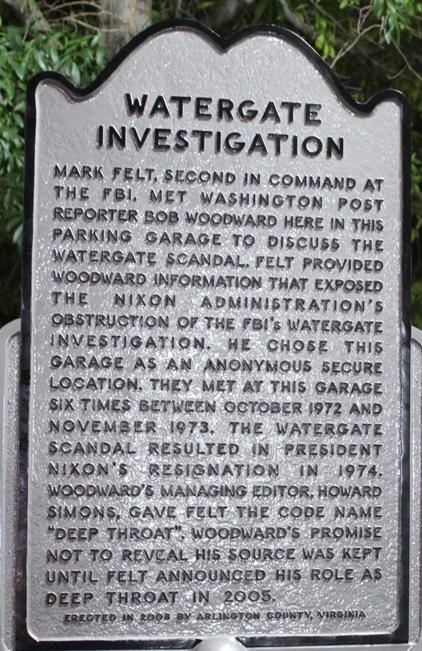
‘Deep Throat’ garage marker errs about Watergate source disclosures (posted August 18): A handsome historical marker went up in August outside the parking garage in Arlington, Virginia, where Bob Woodward of the Post conferred occasionally in 1972 and 1973 with his stealthy Watergate source, “Deep Throat.”

The marker, I pointed out, errs in describing the information Woodward received from the “Deep Throat” source, who in 2005 revealed himself as W. Mark Felt, formerly the FBI’s second in command.

The marker says:

“Felt provided Woodward information that exposed the Nixon administration’s obstruction of the FBI’s Watergate investigation.”

Which just isn’t so.

Such evidence, had “Deep Throat” offered it to Woodward, would have been so damaging and so explosive that it surely would have forced Richard Nixon to resign the presidency well before he did, in August 1974.

Felt didn’t have that sort of information — or (less likely) didn’t share it with Woodward.

I noted in my post about the marker that All the President’s Men, the book Woodward wrote with Carl Bernstein about their Watergate reporting, says Woodward’s conversations with “Deep Throat” were intended “only to confirm information that had been gathered elsewhere and to add some perspective.”

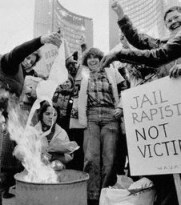
Bra-burning in Toronto: Confirmed (posted February 19): I ascertained in this post that an image of a bra-burning protest in Toronto in 1979 was no hoax, that the photograph was authentic.

I had not seen the photograph before it appeared in February with an article at the online site of  London’s Guardian newspaper.

I had doubts about the photo’s authenticity — given the periodic claims that no bras ever were burned at a feminist protest. The Toronto image, I suspected, might have been unethically altered.

Turns out that was not the case.

I tracked down one of the participants at the Toronto protest and she confirmed the bra-burning, saying by phone from Vancouver:

“The photo is authentic. Absolutely. It happened.”

The participant was Vicki Trerise, who appears at the far right in the photograph above.

The photograph shows a moment of demonstrative bra-burning, although Trerise said it “wasn’t a focal point” of the protest, which took place not far from Toronto’s City Hall.

The bra-burning came near the end of the demonstration, which was called to protest what the organizers said was an illogical report about rape, prepared by the Ontario Provincial Police.

Trerise said the demonstrators in Toronto were media-savvy and “knew that if they burned a bra, someone would take their picture.”

Suspect Murrow quote pulled at Murrow school (posted February 17): The online welcome page of the dean of the Edward R. Murrow College of Communication at Washington State University contained a quotation attributed to Murrow that’s only half-true.

Murrow

The quote reads:

“We must not confuse dissent with disloyalty. When the loyal opposition dies, I think the soul of America dies with it.”

As I’ve reported previously, the first portion of the quote was indeed spoken by Murrow, in his mythical 1954 television program that addressed Senator Joseph McCarthy’s red-baiting ways.

The second part of the quote — “When the loyal opposition dies, I think the soul of America dies with it” — is apocryphal.

In February, I found that the full quotation — accompanied by a facsimile of Murrow’s signature — was posted at the welcome page of Dean Lawrence Pintak of Murrow College at Washington State, Murrow’s alma mater.

I asked the dean what knew about the quote’s provenance, noting that I had consulted, among other sources, a database of historical newspapers which contained no articles quoting the “loyal opposition” passage.

Pintak referred my inquiry to an instructor on his faculty who, a few hours later, sent an email to the dean and me, stating:

“While [the ‘loyal opposition’ quotation] seems to reflect the Murrow spirit, the lack of evidence that he phrased it that way is indeed suspicious.”

He added: “I feel the evidence says no, Murrow did not say this.”

By day’s end, the suspect quote had been pulled from the welcome page. Just the authentic portion — “We must not confuse dissent with disloyalty” — remained posted there.

Mythmaking in Moscow: Biden says WaPo brought down Nixon (posted March 12): Joe Biden, the hapless U.S. vice president, repeated the dominant but misleading narrative about the Watergate scandal in March by telling an audience in Moscow that the Washington Post had “brought down” Richard Nixon’s corrupt presidency.

The gaffe-prone Biden told his audience:

“In my country it was a newspaper, not the FBI, or the Justice Department, it was a newspaper, the Washington Post that brought down a President for illegal actions.”

It’s a version of scandal that few serious historians accept. Not even the Washington Post buys into such a myth-encrusted interpretation.

Indeed, principals at the Post from time to time have sought to distance the newspaper from that misleading assessment.

For example, Katharine Graham, the newspaper’s publisher during and after the Watergate scandal, said in 1997, at a program marking the 25th anniversary of the scandal:

“Sometimes people accuse us of bringing down a president, which of course we didn’t do. The processes that caused [Nixon’s] resignation were constitutional.”

More recently, Michael Getler, then the newspaper’s ombudsman, wrote in 2005:

“Ultimately, it was not The Post, but the FBI, a Congress acting in bipartisan fashion and the courts that brought down the Nixon administration.”

Such comments are not the expressions of false modesty. Instead, they represent a more accurate reading of the history of Watergate than Biden offered up in Moscow.

Even so, in the run-up to the scandal’s 40th anniversary in 2012, the Watergate myth — the heroic-journalist trope — is sure to emerge often and insistently.

But the Post and its reporting of Watergate assuredly did not bring down Nixon, as I discuss in Getting It Wrong, my latest book which was published in 2010.

WJC

Many thanks to Instapundit
Glenn Reynolds for linking to this post.

Other memorable posts of 2011:

Virginia (of ‘Yes, Virginia’) tells of her famous letter, 97 years ago

In 1897, Anniversaries, New York Sun, Newspapers on December 23, 2011 at 4:55 am

Young Virginia O'Hanlon

In a newspaper database of the Library of Congress, I found a long-overlooked interview conducted 97 years ago with Virginia O’Hanlon, who as an 8-year-old in 1897 wrote the letter that prompted the most famous newspaper editorial in American journalism.

O’Hanlon said in the interview on Christmas Eve 1914 that she had sent her letter despite her father’s admonition:

“A newspaper has no time to waste on a little girl.”

The editorial that became a classic was published in the old New York Sun, in response to Virginia’s imploring: “Please tell me the truth. Is there a Santa Claus?”

The Sun in its timeless reply reassured young Virginia as well as generations of children who have read the editorial, which memorably declares:

“Yes, Virginia, there is a Santa Claus. He exists as certainly as love and generosity and devotion exist, and you know that they abound and give to your life its highest beauty and joy. Alas! how dreary would be the world if there were no Santa Claus. It would be as dreary as if there were no Virginias.”

The editorial’s closing passages were similarly reassuring in saying:

“No Santa Claus! Thank God! he lives, and he lives forever. A thousand years from now, Virginia, nay, ten times ten thousand years from now, he will continue to make glad the heart of childhood.”

In the interview with the Sun 97 years ago, Virginia O’Hanlon discussed her motivation in writing to the newspaper and her proud reaction when the essay was published — comments that offer revealing insight about the back story to the famous editorial.

“I think that I have never been so happy in my life as when the Sun told me that there was a Santa Claus and that he would live forever,” she said in the interview.

Virginia O’Hanlon was then 25-years-old and had been married 18 months to Edwin Malcolm Douglas. Her only child, Laura Virginia Douglas, was nine months old.

O’Hanlon said in the 1914 interview that she decided to write to the Sun in part because of its importance in her family’s household.

She said her father, Philip, “was always talking about the Sun and how you could always find what you wanted in the Sun, and how mother, who loved whist, wrote letters to the whist editor.”

O’Hanlon recalled telling her father: “I am going to write to the Sun and ask it to tell me the truth, the honest to goodness truth, about Santa Claus,” whose existence her schoolmates had scoffed at.

She added: “If the Sun says there isn’t any [Santa Claus] I’ll believe it; if it tells me Santa Claus is real I’ll make those girls at school sorry they ever teased me.

“Father laughed,” she recalled, quoting him as saying:

“The Sun is too busy writing about Presidents and Governors and important people, Virgina. … A newspaper has no time to waste on a little girl. Write if you want to, but don’t be disappointed if you never hear from your letter.”

“Well,” Virginia said, “I sat down and wrote a short letter, trying to say just what was in my heart. Day after day I looked for a letter in reply. I never for a minute thought the Sun would print a long editorial mentioning me by name and using my whole letter.

“Father teased me now and then,” she said, “but I kept hoping and finally” her letter was answered, in an essay published September 21, 1897, in the third of three columns of editorials.

(O’Hanlon indicated on another occasion that she wrote her letter shortly after her eighth birthday in July 1897. “My birthday was in July and, as a child, I just existed from July to December, wondering what Santa Claus would bring me,” she told an audience of Connecticut high school students in 1959. “I think I was a brat.”)

Word that the newspaper had published an editorial to answer her letter prompted Philip O’Hanlon to rush from their home on West 95th Street in Manhattan to buy a stack of that day’s Sun.

“Father hustled out and came back loaded down like a pack mule,” she said. “He scattered them all over town, I think, he was so proud.

“And me? It spoiled me for a while until I was big enough to understand that I, Virginia O’Hanlon, didn’t count for much in the editorial but that the important thing was the beautiful thoughts expressed by Mr. Church and the charming English in which he put his philosophy.”

She was referring to Francis P. Church, a veteran journalist who wrote the essay in the course of a day’s work, without an inkling it would become a classic.

His authorship was revealed by the Sun shortly after his death in April 1906.

The Sun’s editorial, O’Hanlon said in the interview, “was a wonderful thing in my life, and I mean it to be a wonderful thing in my baby’s. As soon as she masters her A B C’s, it will be the first thing she will read.”

The comment anticipated the commitment of her descendants who, over the years, have embraced the obligations associated with the much-remembered and often-reprinted editorial.

O’Hanlon’s grandchildren, notably, have become what the New York Times last year described as “ambassadors of the Christmas spirit, crossing the country to appear at events honoring her, and reading the letter and the response to children in schools and to their own children at home.”

Virginia O’Hanlon was 81 when she died in 1971. The Times reported her death on its front page.

But by then, though, the Sun had ceased to exist as an independent publication. It was merged with another New York newspaper, the World-Telegram, in January 1950.

WJC

Recent and related:

So it begins: Woodward, Bernstein, and excess in run-up to Watergate’s 40th

In Anniversaries, Debunking, Washington Post, Watergate myth on December 4, 2011 at 12:48 am

American journalists love anniversaries, so expect excess next year at the 40th anniversary of the Watergate break-in, which gave rise to the greatest scandal in U.S. politics — and to the media-driven myth that Washington Post journalists toppled a president.

Woodward: 40th anniversary honor

In fact, Watergate commemorative excess is already scheduled.

The Los Angeles Press Club announced the other day that it plans to recognize the Watergate reporting of Bob Woodward and Carl Bernstein at next year’s Southern California Journalism Awards program.

“Woodward and Bernstein’s series of articles for The Washington Post unraveled the biggest American political scandal to date, culminating in President Richard Nixon’s resignation in 1974. Four decades later, the stories still stand as a bellwether of investigative journalism,” the press club said in a news release.  “To mark the occasion, the Los Angeles Press Club will honor Woodward and Bernstein with the 2012 President’s Award.”

Woodward and Bernstein’s Watergate reporting won a Pulitzer Prize for the Post in 1973. But to say they “unraveled” Watergate is an exaggeration, a misreading of history.

As I discuss in my latest book, Getting It Wrong, the reporting of Woodward and Bernstein was at best a minor factor in bringing down Richard Nixon.

What ended Nixon’s presidency was the incontrovertible evidence of the president’s culpability in the crimes of Watergate — evidence captured on audiotapes that he secretly made of his conversations at the White House.

The decisive evidence — known as the “Smoking Gun” tape — revealed that Nixon at a meeting with his top aide, H.R. Haldemann, on June 23, 1972, sought to deflect or derail the FBI investigation into the break-in several days before at Democratic National headquarters  at the Watergate complex in Washington, DC.

The reporting of Woodward and Bernstein didn’t reveal the contents of that tape, which Watergate prosecutors had subpoenaed and which Nixon had refused to surrender until 1974, after the U.S. Supreme Court ordered him to do so.

Their reporting didn’t disclose the existence of Nixon’s taping system, either. It was revealed in July 1973, during hearings of the U.S. Senate Select Committee on Watergate.

In All the President’s Men, their book about their Watergate reporting, Woodward and Bernstein said they had received a tip about the taping system a few days before its existence was made public.

According to All the President’s Men, Ben Bradlee, then the Post‘s executive editor, suggested not expending much energy pursuing the tip. And Woodward and Bernstein didn’t.

What really “unraveled” Watergate, I write in Getting It Wrong, “was the collective if not always the coordinated forces of special prosecutors, federal judges, both houses of Congress, the Supreme Court, as well as the Justice Department and the FBI.

Even then, despite all that scrutiny and pressure, Nixon, I argue, “likely would have served out his term if not for the audiotape recordings he secretly made of most conversations in the Oval Office of the White House.”

Far more important the reporting of Woodward and Bernstein to the outcome of Watergate was the federal judge who presided at Watergate-related trials, John J. Sirica.

The Post acknowledged Sirica’s decisive role in unraveling Watergate in its obituary of the judge, published in 1992, shortly after his death.

The newspaper said Sirica’s “persistence in searching for the facts while presiding over the Watergate cases led to President Nixon’s resignation,” adding:

“Sirica’s order that tape recordings of White House conversations about the Watergate break-in be made available to prosecutors precipitated Nixon’s resignation in 1974. The tapes revealed that Nixon had approved plans for the Watergate coverup six days after the break-in at the Democratic National Committee’s headquarters in the Watergate complex by men who were working for the Committee to Reelect the President.

“In directing the White House to produce the tapes, Sirica set himself on a constitutional collision course with Nixon, who tried to invoke executive privilege and argue that the tapes were not subject to judicial scrutiny. But in a historic ruling, the U.S. Supreme Court upheld Sirica, ruling unanimously that the judiciary must have the last word in an orderly constitutional system.”

WJC

Recent and related:

The ‘War of the Worlds’ radio show produced a ‘Paul Revere effect’

In Anniversaries, Debunking, Media myths, Media myths and radio on October 31, 2011 at 5:15 pm

I call it the “Paul Revere” effect, and it helps explain the many reports of fright associated with the radio dramatization 73 years ago of The War of the Worlds, a clever program that told of a lethal Martian invasion of Earth.

The radio show aired October 30, 1938, and supposedly stirred panic and hysteria across the United States — a delicious narrative that I debunk in my latest book, Getting It Wrong, as a media-driven myth.

I also discuss in Getting It Wrong the seldom-examined “Paul Revere effect” associated with The War of the Worlds program, which was the work of Orson Welles and his “Mercury Theatre on the Air” troupe.

This effect occurred when well-intentioned people who had little more than an incomplete understanding of The War of the Worlds broadcast decided individually and on their own to warn others about what they thought was a sudden and terrible threat.

These self-motivated Paul Reveres, I write in Getting It Wrong, “burst into churches, theaters, taverns, and other public places, shouting that the country was being invaded or bombed, or that the end of the world was near.”

I note that it must “have been a cruel and unnerving way of receiving word of a supposedly calamitous event — to be abruptly disturbed in familiar settings by a vague reports offered by people who themselves clearly were terror-stricken.”

The unsuspecting recipients of these invariably garbled, second- and third-hand accounts of calamity had no immediate way of verifying the wrenching news they had heard. Unlike the audiences of Welles’ dramatization, they could not spin the radio dial to find out whether other networks were reporting an invasion from Mars.

Scrutiny of contemporaneous newspaper accounts reveals numerous cases of this false-alarm contagion. This meant that people who had not heard not a word of The War of the Worlds show were themselves fearstricken, if only briefly.

In New York, for example, some apartment houses “were hurriedly emptied by frantic listeners to the program and by those who heard second- and third-hand accounts multiplying the supposed peril,” the Newark Star-Eagle reported.

“Many of the panic-stricken did not hear the original broadcast but got their misinformation from others,” the newspaper said.

A Methodist church service in Indianapolis was disrupted that night “when an hysterical woman member of the congregation entered shortly after worship had begun,” the Indianapolis Star reported.

The woman rushed to the pulpit, telling the pastor, “Something so terrible has happened that I must interfere.”

She told worshippers that “New York has been destroyed” and added: “I believe the end of the world has come. I heard it over the radio.”

The pastor offered a short prayer and excused anyone who wanted to return home. Several members of the choir “doffed robes and went from the church, followed by a portion of the congregation,” the Star reported. But the service continued.

Soon, several members of the congregation returned, explaining sheepishly that the alarm had been caused by nothing more than a misunderstood radio show.

As I note in Getting It Wrong, it is impossible to estimate the cumulative effect of the false-alarm contagion that night. But the second- and third-hand accounts, spread Paul Revere-like, stirred some measure of evanescent apprehension among untold thousands of people who had not listened to the program.

It is tempting to suggest, I write, “that what radio-induced fear there was that night was mostly spread by credulous people who heard muddled and fragmentary accounts about the program and set about to alert others,” on their own.

WJC

Recent and related:

A counter-narrative: 9/11 did not ‘change everything’

In Anniversaries, Debunking, Media myths, New York Times, Newspapers, Washington Post on September 11, 2011 at 10:26 am

America’s news media have focused for days and more on the 10th anniversary of the terror attacks of September 11, 2001. The dominant, inevitable, yet misleading theme of the coverage: 9/11 “changed everything.”

“When Everything Changed,” the Washington Post declares on its front page today.

“The Day Everything Changed,” says the Star-Telegram of Fort Worth, Texas.

“A Decade of Change,” declares the Press of Atlantic City.

“Forever changed?” asks the lead headline in today’s Chattanooga Times Free Press.

That interrogative is inadvertently perceptive, suggesting as it does an important if largely ignored counter-narrative about 9/11:

It is striking how little, fundamentally, has changed in American life because of the attacks that killed nearly 3,000 people in lower Manhattan, at the Pentagon, and near Shanksville, Pennsylvania.

Airport check-ins, to be sure, are more imposing, grating, and intrusive than they were 10 years ago — suggestive of a broader if low-level and intermittent preoccupation with security matters.

But the hyperbolic, anniversary-driven coverage notwithstanding, the lives of most Americans seem not to have been dramatically or markedly altered by the vivid terror assaults 10 years ago.

Remember how the attacks were supposed to lead to a surge in patriotic sentiment? To a renewed commitment to religion and the spiritual side of life? To a deeper interest in news of the world? To a constant looking over one’s shoulder in anticipation of the next attack?

Polling data indicate that none of those responses to 9/11 was sustained or profound:

  • In June 2010, 59% of respondents to a Pew Research survey said they displayed the American flag at home, in the office, or on the car. That compares to 75% of the respondents  who said they did so in August 2002.
  • Pew Research data say that 36% of Americans attend religious services at least once a week, down from 42% in mid-November 2001.
  • In 2002, 48% of respondents to a Pew survey said they enjoyed keeping up with the news “a lot.”  In 2010, that response rate had ebbed to 45%.
  • Today’s Washington Post embeds revealing bits of survey data in its 16-page section devoted to the 9/11 anniversary. Particularly revealing was that 83% of residents in metropolitan Washington said no, they have not avoided a public event in recent years “because of concerns about terrorism.”

While the counter-narrative that 9/11 didn’t change everything has been obscure this year, it was somewhat in greater evidence at less-celebrated anniversaries of the attacks.

Two years ago, for example, the New York Times revisited predictions about how 9/11 would forever change Manhattan, and found them mostly empty and unfulfilled.

The Times article, “A Fortress City That Didn’t Come to Be,” recalled the expectations that emerged in the immediate aftermath of 9/11, writing:

“New York would become a fortress city, choked by apprehension and resignation, forever patrolled by soldiers and submarines. Another attack was coming. And soon.

“Tourists? Well, who would ever come again? Work in one of the city’s skyscrapers? Not likely. The Fire Department, gutted by 343 deaths, could never recuperate. …

“Eight years later, those presumptions are cobwebbed memories that never came to pass. Indeed, glimpses into a few aspects of the city help measure the gap between what was predicted and what actually came to be.”

“Cobwebbed memories that never came to pass.” A well-crafted passage, that — and an antidote, in a way, to the clichéd, “everything changed” coverage that has clouded the 10th anniversary of a terrible and infamous day.

After all, as columnist George Will wrote at the fifth anniversary of 9/11:

Nothing changes everything.”

WJC

Recent and related:

‘Kane’ at 70: ‘More relevant than ever’?

In Anniversaries, Cinematic treatments on September 10, 2011 at 9:53 am

In the year of its 70th anniversary, Orson Welles’ cinematic masterpiece Citizen Kane “is more relevant than ever,” says a polished, thoughtful essay posted yesterday at TechCentral, a South African site devoted to technology news and reviews.

Orson Welles in 'Kane'

In pressing the point about Kane’s relevance, the essay argues:

“Newspaper magnate Charles Foster Kane, sitting in his already-crumbling but unfinished Xanadu, is Colonel Gaddafi railing at the Libyan rebels from his exile or a doddering Rupert Murdoch stumbling over his words in front of the commission investigating the News of the World scandal.”

Those are telling observations, particularly the reference to the 80-year-old Murdoch and his excruciating, hapless performance before a Parliamentary commission hearing in July in London.

“Today,” the TechCentral essay adds, “you’ll see Citizen Kane’s influence in the strangest places,” including parodies in The Simpsons” television show.

As superb and influential as it was, Kane took liberties and in doing so helped popularize a powerful media-driven myth.

The movie was released in 1941 and was based loosely on the life and times of American media magnate William Randolph Hearst.

A rollicking scene early in Kane offers clear evidence that Hearst was the movie’s principal inspiration; the scene paraphrased Hearst’s purported vow, which he supposedly cabled to an artist in Cuba months before the Spanish-American War:

You furnish the pictures, and I’ll furnish the war.”

As I note in my latest book, Getting It Wrong, that scene in Kane “firmly and finally pressed Hearst’s purported vow to ‘furnish the war’ into the public’s consciousness.”

I also point out in Getting It Wrong that the anecdote about Hearst’s vow “is almost too good not to be true” and note that the “furnish the war” line “has made its way into countless textbooks of journalism.

“It [also] has figured in innumerable discussions about Hearst and about the news media and war. It has been repeated over the years by no small number of journalists, scholars, and critics of the news media such as Ben Bagdikian, Helen Thomas, Nicholas Lemann, and the late David Halberstam.”

Interestingly, “furnish the war” endures despite a near-total absence of supporting documentation. It lives on even though cable containing Hearst’s purported vow has never turned up.

It lives on even though Hearst denied ever sending such a message.

It lives on despite of what I call “an irreconcilable internal inconsistency”: It would have been absurd for Hearst to vow to “furnish the war” because war — specifically, the Cuban rebellion against Spanish rule — was the very reason Hearst sent the artist, Frederic Remington, to Cuba in the first place.

And Remington’s trip to Cuba came in January 1897 — more than 15 months before the start of the Spanish-American War.

Kane is no faithful portrait of Hearst.

As David Nasaw pointed out in The Chief, his admirably even-handed biographyof Hearst:

“Welles’ Kane is a cartoon-like caricature of a man who is hollowed out on the inside, forlorn, defeated, solitary because he cannot command the total obedience … of those around him. Hearst, to the contrary, never regarded himself as a failure, never recognized defeat, never stopped loving Marion [his mistress] or his wife.

“He did not, at the end of his life, run away from the world to entomb himself in a vast, gloomy, art-choked hermitage,” as portrayed in Citizen Kane.

WJC

Recent and related: