W. Joseph Campbell

Archive for the ‘Cinematic treatments’ Category

Mythmaking on Blu-ray?

In Cinematic treatments, Debunking, Media myths, Washington Post, Watergate myth on December 20, 2010 at 11:11 am

All the President’s Men, the most-seen movie about the Watergate scandal, may be released on Blu-ray early next year, according to a post yesterday at a blog sponsored by a Canadian newspaper.

“Word is that Warner Bros. will release the Watergate movie … in a feature loaded  Blu-ray book in February,” said the item at the Leader-Post newspaper in Saskatchewan.

Now at best, the Blu-ray version of All the President’s Men is of mild interest to Media Myth Alert. What caught the  eye, though, was this characterization in the Leader-Post item:

“The 1976 movie is perhaps the greatest ever on newspaper journalism. It tells the true story of how Washington Post reporters Carl Bernstein and Bob Woodward exposed the real story behind the break-in at Democratic Party offices in the Watergate building by Republican political operatives. Their exposé, fed by a mysterious source called ‘Deep Throat,’ led to the resignation of President Richard Nixon.”

I placed the words in bold for emphasis.

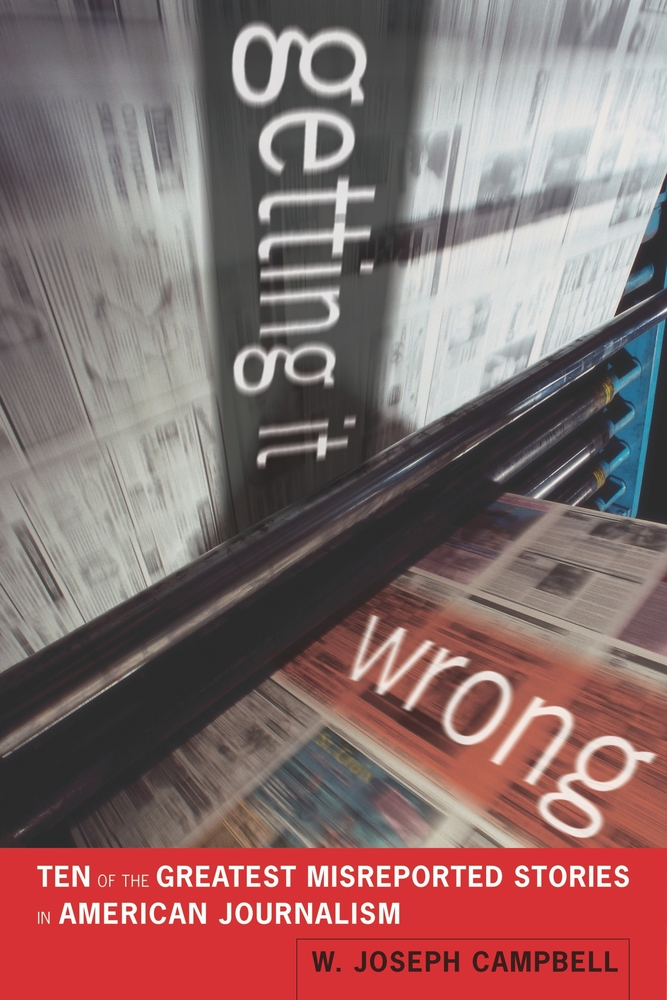
As I note in my latest book, Getting It Wrong, Woodward and Bernstein didn’t expose the Watergate scandal. It was at first a police beat story that spiraled into an intricate and sprawling scandal that sent to jail nearly 20 men associated with Nixon’s presidency or his 1972 reelection campaign.

And the reporting of Woodward and Bernstein didn’t lead to Nixon’s resignation.

As I point out in Getting It Wrong:

“To roll up a scandal of such dimension [as Watergate] required the collective if not always the coordinated forces of special prosecutors, federal judges, both houses of Congress, the Supreme Court, as well as the Justice Department and the FBI.

“Even then, Nixon likely would have served out his term if not for the audiotape recordings he secretly made of most conversations in the Oval Office of the White House. Only when compelled by the Supreme Court [in 1974] did Nixon surrender those recordings, which captured him plotting the cover-up and authorizing payments of thousands of dollars in hush money.”

Against the tableau of subpoena-wielding investigative authorities, the work of Woodward and Bernstein for the Washington Post fades into relative insignificance.

Even so, as I write in Getting It Wrong, the heroic-journalist interpretation of Watergate–the endlessly appealing notion that the  reporting of Woodward and Bernstein did bring down Nixon’s  presidency–“has become the most familiar storyline of Watergate.”

The heroic-journalist interpretation is, I note, “a proxy for grasping the scandal’s essence while avoiding its forbidding complexity.”

Perhaps the factor most important in propelling and solidifying the heroic-journalist meme of Watergate was the movie All the President’s Men, an adaptation of Woodward and Bernstein’s 1974 book by the same title.

“The book in fact had been written with the cinema in mind,” I write in Getting It Wrong, noting that the actor Robert Redford “had taken keen interest in the Woodward-Bernstein collaboration in reporting the scandal and encouraged the reporters to structure the book around their experiences.”

Redford paid $450,000 for the rights to All the President’s Men, and he played Woodward in the movie.

The cinematic version of All the President’s Men focuses on the work of Woodward and Bernstein while mostly ignoring, and even denigrating, the efforts of investigative agencies like the FBI.

I further note that the movie All the President’s Men allows no interpretation other than it was the work Woodward and Bernstein that set in motion far-reaching effects that brought about the first-ever resignation of a U.S. president.

The movie, I write, helped ensure the heroic-journalist myth “would live on by offering a neat, tidy, and vastly simplified account the Watergate scandal, one that allowed viewers to sidestep the scandal’s complexity while engaging in an entertaining storyline.”

The myth is solidly entrenched in popular culture. It is one of the heartiest of media-driven myths, those dubious, media-centric tales that masquerade as factual.

The Blu-ray version of All the President’s Men may serve to introduce the myth of Watergate to yet another generation of movie-goers.

WJC

Recent and related:

‘You might bring down a government’: Sure, that happens

In Cinematic treatments, Debunking, Media myths, Washington Post, Watergate myth on December 11, 2010 at 7:49 am

From time to time, the Washington Post has sought to dismiss the notion that its Watergate reporting was decisive in bringing down the corrupt presidency of Richard Nixon.

Not the Post's work

In 1997, at the 25th anniversary of the break-in at Democratic headquarters–the scandal’s seminal crime–the newspaper’s publisher during the Watergate period, Katharine Graham, insisted it was not the Post that toppled Nixon.

“Sometimes people accuse us of bringing down a president, which of course we didn’t do,” she said on that occasion. “The processes that caused [Nixon’s] resignation were constitutional.”

In 2005, Michael Getler, then the newspaper’s ombudsman, wrote in a column: “Ultimately, it was not The Post, but the FBI, a Congress acting in bipartisan fashion and the courts that brought down the Nixon administration.”

Still, the notion that the Post was decisive in Wategate’s outcome pops up occasionally. Political writer Dana Milbank, for example, referred in a column early this year to how the newspaper “took down a president.”

And yesterday, a blog item at the Post online site asserted that the newspaper’s Watergate reporters, Bob Woodward and Carl Bernstein, had brought Nixon down. (Update: The item, an essay, was published Sunday, December 11, in the book section of the Post.)

The essay praised the cinematic version of Woodward and Bernstein’s book, All the President’s Men, and stated:

“I just re-watched ‘All the President’s Men,’ which I do every year or so, and, every time, I marvel at how interesting Woodward and Bernstein’s lives were at The Post, and how well the film explains the reporting process, its doggedness and randomness, and how great an excuse it is to get out in the world and ask every seemingly obvious question you can think of (What books did the man check out?), because you never know, you might bring down a government that has it coming.

“When I watch that movie,” the writer added, “I also think about how mundane my own ‘writing life’ can be.”

As it often is for journalists.

But to write “bring down a government that has it coming” — that’s to indulge in a media-driven myth, the beguiling heroic-journalist myth of Watergate.

As I note in my latest book, Getting It Wrong:

“The heroic-journalist interpretation minimizes the far more decisive forces that unraveled the scandal and forced Nixon from office” in 1974.

Even so, that interpretation has become the dominant popular narrative of Watergate–a David vs. Goliath storyline in which the courageous reporting of Woodward and Bernstein exposed the crimes of the Nixon administration.

The movie All the President’s Men is a central reason the heroic-journalist trope lives on.

All the President’s Men, which starred Robert Redford as Woodward and Dustin Hoffman as Bernstein, was released in April 1976, as the wounds of Watergate had slowly begun to close.

“The movie,” I write in Getting It Wrong, “suggested their reporting was more hazardous than it was, that by digging into Watergate, Woodward and Bernstein exposed themselves to not insignificant risk and peril.

“To an extent far greater than the book, the cinematic version of All the President’s Men placed Woodward and Bernstein at the center of Watergate’s unraveling while denigrating the efforts of investigative agencies such as the FBI.”

The effect, I add, “was to solidify and elevate the heroic-journalist myth, giving it dramatic power, and sustaining it in the collective memory.”

And it has become a particularly tenacious and defining media-driven myth.

WJC

Recent and related:

My thanks to Jim Romenesko for linking to this post.

Woah, WaPo: Mythmaking in the movies

In Cinematic treatments, Debunking, Jessica Lynch, Media myths, Washington Post, Watergate myth on December 8, 2010 at 12:09 pm

I was traveling last week and only recently caught up with the eye-opening recent editorial in the Washington Post that took to task the makers of Fair Game, a just-released movie about the Valerie Plame-CIA leak affair, which stirred a lot of misplaced fury seven years ago.

The Post editorial is eye-opening in a revealing way, describing Fair Game as “full of distortions–not to mention outright inventions.”

Even more revealing–and pertinent to Media Myth Alert–was this observation:

“Hollywood has a habit of making movies about historical events without regard for the truth; ‘Fair Game’ is just one more example. But the film’s reception illustrates a more troubling trend of political debates in Washington in which established facts are willfully ignored.”

That’s akin to the point I make in my latest book, Getting It Wrong, about how cinema can propel and solidify media-driven myths.

On that point, I write in Getting It Wrong:

“High-quality cinematic treatments are powerful agents of media myth-making, and can enhance a myth’s durability.

“Untold millions of Americans born after 1954 were introduced to the Murrow-McCarthy confrontation through Good Night, and Good Luck, a critically acclaimed film released in 2005 that cleverly promoted the myth that Murrow stood up to McCarthy when no one else would or could.”

Good Night, and Good Luck is but one example of cinema’s mythmaking capacity.

Not surprisingly, comments made online about the Post editorial were largely critical. Said one: “You just reminded me why I stopped reading the Washington Post editorials and began subscribing to the New York Times.”

Said another: “This editorial proves the thesis that The Post is willing to go to any length to suck up to the power elite in order to maintain access to the same.”

And another, more perceptive comment read:

“The myth-making in ‘Fair Game’ is no more or less egregious than it was in ‘All the President’s Men.’ Hollywood loves simplistic story lines (which is why the likes of John Sirica and Archibald Cox were nowhere to be found in ‘ATPM’).”

Now that’s an excellent point.

As I note in Getting It Wrong:

“The 1976 cinematic version of All the President’s Men solidified the notion that young, diligent reporters for the Washington Post brought down President Richard Nixon. That myth of Watergate may be stronger than ever, given that All the President’s Men is the first and perhaps only extended exposure many people have to the complex scandal that was Watergate.

“Thanks in part to Hollywood, the heroic-journalist myth of Watergate has become the most familiar and readily accessible explanation about why Nixon left office in disgrace.”

Indeed, All the President’s Men has been a significant contributor to the misleading yet dominant popular narrative of Watergate, that the reporting of Post reporters Bob Woodward and Carl Bernstein uncovered evidence that forced Nixon’s resignation. The movie focuses on the reporters and their work, ignoring the more significant contributions of Sirica, a federal judge, and Cox, a special prosecutor, in unraveling the Watergate scandal.

As bold as it may have been, the Post editorial about Hollywood and Fair Game might have gone farther and ruminated about the effects of All the President’s Men.  Still, it was a telling and impressive commentary.

I not infrequently take the Post to task at Media Myth Alert, usually for its unwillingness to confront its singular role in thrusting the Jessica Lynch case into the public domain. The Post, I’ve argued, ought to disclose the sources for its electrifying but bogus story about Lynch’s supposed battlefield heroics in Iraq.

The newspaper’s unwillingness to do so has allowed the false popular narrative that the Pentagon concocted the story to emerge and become dominant. Even one of the reporters on the Lynch story has said, “Our sources for that story were not Pentagon sources.”

But for its clear-eyed editorial about Fair Game, the Post deserves a tip of the chapeau.

WJC

Recent and related:

In Wikileaks, a hint of Watergate? Not so much

In Cinematic treatments, Debunking, Media myths, New York Times, Washington Post, Watergate myth on December 1, 2010 at 12:30 pm

It was just a matter of time before someone found a hint of Watergate in the recent, massive Wikileaks disclosures of sensitive U.S. diplomatic traffic.

Voilá. A commentary posted today at examiner.com invokes such a linkage in arguing that leaked cables describing Afghan President Hamid Karzai’s misconduct underscore the importance of turning him from office.

The commentary refers to Bob Woodward and Carl Bernstein, who reported on Watergate for the Washington Post, and asserts that Wikileaks disclosures “add to the well-documented trail of President Karzai’s abuse of Presidential power and his incessant attempts to exceed his constitutional authority.

Nixon quits, August 1974

“I have written before and shall point out again,” the commentary’s author stated, “that there is … the same amount of evidence derived from open source intelligence alone to impeach Karzai as Woodward and Bernstein had amassed to force Nixon to resign.”

Of keen interest to Media Myth Alert is not so much Karzai’s brazenness but the extravagant claim about the Watergate reporting of Woodward and Bernstein, that they “amassed” evidence to “force” Nixon’s resignation. He quit in 1974.

As I point out in my latest book, Getting It Wrong, their reporting had at best only a marginal effect on the outcome of the scandal, in which 19 men associated with Nixon’s presidency or his 1972 reelection campaign went to jail.

“To roll up a scandal of such dimension,” I write in Getting It Wrong, “required the collective if not always the coordinated forces of special prosecutors, federal judges, both houses of Congress, the Supreme Court, as well as the Justice Department and the FBI.”

Efforts of that dimension were required to uncover evidence implicating Nixon and his top aides in what was a sprawling scandal.

And even then, Nixon likely would have served out his second term if not for secret audiorecordings he made of many conversations in the Oval Office–conversations that captured his guilty role in authorizing a coverup of the Watergate scandal.

“Only when compelled by the Supreme Court,” I note, “did Nixon surrender those recordings, which captured him plotting the cover-up and authorizing payments of thousands of dollars in hush money.”

So against that tableau, the contributions of Woodward, Bernstein, and the Washington Post recede to minor significance: They were not decisive to the outcome of Watergate.

But because the scandal was so intricate, and because it is no longer a day-to-day preoccupation, the details have become blurred and what I call the “heroic-journalist” interpretation has taken hold as the dominant popular narrative of Watergate.

And that’s the endlessly appealing notion–propelled by the mediacentric motion picture All the President’s Men–that Woodward and Bernstein’s tireless and dogged reporting brought down Nixon.

The heroic-journalist interpretation, I write in Getting It Wrong, “has become the most familiar storyline of Watergate,” noting that it’s “ready short-hand for understanding Watergate and its denouement, a proxy for grasping the scandal’s essence while avoiding its forbidding complexity.”

It’s a view that’s widely held. Even the New York Times, the keenest rival of the Washington Post, has embraced the heroic-journalism interpretation of Watergate.

Interestingly, though, principals at the Post have over the years disputed the notion the newspaper was decisive in Nixon’s fall.

Katharine Graham, the newspaper’s publisher during and after the Watergate period, said in 1997, at the 25th anniversary of the foiled burglary at Democratic national headquarters that touched off the Watergate scandal:

“Sometimes people accuse us of bringing down a president, which of course we didn’t do. The processes that caused [Nixon’s] resignation were constitutional.”

And Woodward, himself, has concurred, if in earthier terms.  In an interview several years ago with American Journalism Review, Woodward declared:

To say that the press brought down Nixon, that’s horseshit.”

WJC

Recent and related:

That made-up Watergate line resonates abroad

In Cinematic treatments, Cronkite Moment, Debunking, Furnish the war, Murrow-McCarthy myth, Newspapers, Washington Post, Watergate myth on November 30, 2010 at 9:38 am

Watergate’s most famous made-line up — “follow the money,” which was a cinematic invention not the revealing words of guidance — is often invoked by U.S. news outlets. Surprisingly, it resonates as well in news media abroad.

“Follow the money” is often attributed to “Deep Throat,” the stealthy, anonymous source to whom Bob Woodward of the Washington Post frequently turned during the newspaper’s Watergate investigation.

But the phrase “follow the money” never figured in the Post’s Watergate coverage, which is the topic of a chapter in my mythbusting book, Getting It Wrong.

What’s more, a search of the electronic archive of all issues of the Post from June 1, 1972, to October 1, 1974, the period embracing the Watergate scandal, produced no returns for the phrase “follow the money.”

The line, however, was uttered in the cinematic version of All the President’s Men by the character who played “Deep Throat.” The movie, which was released in 1976, was an adaptation of Woodward and Carl Bernstein’s book by the same title.

The most likely inventor of “follow the money” was the screenwriter of All the President’s Men, William Goldman.

Testimony to the line’s impressive adaptability abroad appeared yesterday in an item posted at a South Africa news outlet called the Daily Maverick. The item included this passage:

“‘Follow the money,’ as the informant ‘Deep Throat’ famously told Bob Woodward and Carl Bernstein during the Watergate scandal.”

The line also popped up not long ago in Le Devoir, a French-language daily newspaper in Quebec. The article in Devoir stated:

“Comme Deep Throat disait dans l’affaire du Watergate: follow the money.” [As Deep Throat said in the Watergate affair: follow the money.]

So why does this made-up line from a long-ago motion picture possess such international appeal?

In a way, “follow the money” is like media-driven myths that have gained popularity abroad–among them, the mythical Cronkite Moment, the Murrow-McCarthy tale, the famous “furnish the war” vow attributed to William Randolph Hearst. And, of course, the heroic-journalist myth, according to which the investigative reporting of Woodward and Bernstein brought down Richard Nixon’s corrupt presidency in the Watergate scandal.

They are decidedly American tales that offer reductive, mediacentric interpretations of important historical moments.  News outlets abroad–intrigued as they often are by American culture and politics–are scarcely immune from the temptation to offer up these tales. Or pithy lines like “follow the money,” which sums up fairly well an important path of inquiry in the Watergate scandal.

Pithiness can be a powerful propellant of movie lines–and media myths.

Besides, these tales are straightforward, unambiguous, and as such memorable. They can be readily invoked to make a telling point, usually about the power and importance of the news media.

But often, that message is misleading.

As I write in Getting It Wrong, “media-driven myths are neither trivial nor innocuous. They can and do have adverse consequences. Notably, they tend to distort understanding about the role and function of journalism in American society, conferring on the news media far more power and influence than they necessarily wield.”

Media myths, I add, “often emerge from an eagerness to find influence and lasting significance in what journalists do….”

Debunking these myths helps to place media influence in a more coherent context.

WJC

Recent and related:

Cinematic treatments can solidify media myths

In Cinematic treatments, Cronkite Moment, Debunking, Media myths, Murrow-McCarthy myth, Newspapers, Washington Post, Watergate myth on November 14, 2010 at 7:12 am

In this, the last of three installments drawn from an interview with Newsbusters about Getting It Wrong, the discussion turns to whether new media are effective in thwarting the spread of media-driven myths.

I express doubts about that prospect.

The Newsbusters interview was conducted by Lachlan Markay, who described Getting It Wrong as “exhaustively researched and painstakingly even-handed.” The interview transcript is accessible here.

NEWSBUSTERS: Looking forward, do new media present an opportunity to debunk these myths, before they get started?

CAMPBELL: You would think that it would, and I think there has been some evidence that that’s the case, but then there are other myths that just seem to defy debunking newer myths.

Jack Shafer at Slate.com has done some interesting work in looking at the so-called … “pharm parties” in which young people would raid their medicine cabinets of their parents and just take whatever medication they could find, bring them to a party, and then dump them in a communal bowl, and sort of play Russian roulette with these drugs–by the handful take them, and see what kind of effect that they have.

And it seems to be an urban legend that’s just taken hold, and it’s appeared in newspapers, periodically, around the country–San Francisco to DC–and there seems to be no evidence to support this other than the notion that police have heard that this kind of stuff goes on. And Shafer’s written a number of columns at Slate that insist that no one has ever seen this happen, no one has ever attended a pharm party, there’s never been any kind of first person documentation.

And yet, the story is too good not to be true, and it lives on.

So you would think that the Internet would have been more effective by now in knocking down that kind of story. It hasn’t.

NB: So these myths, then, get started because newspapers have disregarded their own–or not just newspapers, but any media has disregarded its own standards of journalism.

CAMPBELL: You could see that in some cases, yeah, I suppose that’s true. [But] I don’t think they’re going at this whole hog and saying, we’re just going to forget about our standards and go at this story just because it sounds so good.

NB: Or, put differently, if those standards were followed to a T, some of these myths might never have taken shape.

CAMPBELL: Yeah, that’s probably true.

NB: A lot of these myths are ingrained in our culture. They’re part of American history, included in textbooks. The Woodward and Bernstein example comes to mind. You have movies, for instance, All the President’sMen , or Good Night, and Good Luck with Edward R. Murrow–does pop culture, or culture in general, play a larger part in perpetuating these myths? Is this something that journalists create on their own, or is it out of their hands and American culture sees these magnificent stories, and sort of adopts them as their own?

CAMPBELL: I think the dynamic that leads to the solidification of media myths is a very interesting one. It’s kind of complex, but I think that some of the points that you’ve mentioned are very central to that process of solidifying a myth–sort of the national consciousness. Cinema does a very good job of doing that.

Cinematic treatments help solidify in the minds of people the supposed reality of some of these exchanges, of some of these encounters, of some of these moments.

…. the cinematic treatment of Woodward and Bernstein in All the President’s Men I think really helped solidify the notion that those two guys were central to bringing down Richard Nixon. In fact, the movie, as clever and well-done as it is, leads to no other interpretation but that. It had to be those guys. …

As a nation we do tend to remember things cinematically. I’m not the first one to say that. Others have looked at it more closely than I have and have made that determination. It’s a fair statement. Good Night, and Good Luck introduced a whole new generation of Americans to the notion that Edward R. Murrow was the one who did in Joe McCarthy, with his 30-minute television program.

NB: Do you have students who come in and say, “I saw Good Night and Good Luck and it inspired me to pursue a career in journalism”?

CAMPBELL: You know, I haven’t heard it said quite that way. But they do think that that movie is well done.

NB: The romanticism of journalism appeals to the students.

CAMPBELL: Exactly. And more students have seen All the President’s Men than have read the book, by far. … But cinema really is a factor that propels and solidifies these myths.

End of part three

‘Follow the money’: A made-up Watergate line

In Cinematic treatments, Debunking, Media myths, Newspapers, Washington Post, Watergate myth on November 6, 2010 at 6:52 am

“Follow the money” is one of the most memorable phrases of Watergate-era American journalism.

And it’s a made-up line.

That hasn’t prevented it from being invoked, as it was yesterday in a blog post at the online financial site, MarketWatch.

The item discussed how the Washington Post continues to be buoyed by its Kaplan education-testing service unit, saying:

“If Kaplan’s business ever went south, the Washington Post Co. would be in big trouble—and the flagship newspaper would likely become a shadow of its former self.”

No doubt.

The MarketWatch item closed by invoking the “follow the money” phrase, stating:

“The Post family had better pray that nothing unsettles Kaplan’s business. Kaplan is their lifeblood and future. As the Post preached during its glory days, the Watergate investigations of the 1970s, follow the money.”

The attempt to offer a cute closing line misfired. “Follow the money” never figured in the newspaper’s Watergate coverage–which is the topic of a chapter in my latest book, Getting It Wrong.

A search of the electronic archive of all issues of the Post from June 1, 1972, to October 1, 1974, the period embracing the Watergate scandal, produced no returns for the phrase “follow the money.”

The line, however, was uttered in the cinematic version of All the President’s Men by the anonymous and mysterious source code-named “Deep Throat.” The movie dramatized the Watergate reporting of Post reporters Bob Woodward and Carl Bernstein and was based on their non-fiction book by the same title.

But the phrase “follow the money” doesn’t appear in the book.

As I noted in a blog post last month, the line was “kind of made up for the movie,” according to an item at the online site of National Public Radio.

That item quoted an NPR research librarian as saying that newsman Daniel Schorr once asked her “to find the phrase ‘follow the money’ in the book All The President’s Men.

The librarian was further quoted as saying that she “went through the book page by page,” finding that the “phrase does not appear there.

“And then in talking to Bob Woodward and the screenwriter, William Goldman, Dan discovered that [the phrase is] actually kind of made up for the movie.”

I also noted that former Nixon speechwriter William Safire offered in 1997 a somewhat more detailed version of the anecdote, writing in the New York Times Sunday Magazine that Woodward and Goldman blamed each other for having invented the line.

“The screenplay was written by William Goldman,” Safire wrote. “When Schorr called him, the famed screenwriter at first insisted that the line came from the book; when proved mistaken about that, he said: ‘I can’t believe I made it up. I was in constant contact with Woodward while writing the screenplay. I guess he made it up.”’

Safire wrote that Schorr “then called Woodward, who could not find the phrase in his exhaustive notes of Watergate interviews. The reporter told Schorr he could no longer rely on his memory as to whether Deep Throat had said the line and was inclined to believe that Goldman had invented it.”

(New York Times columnist Frank Rich wrote in 2005 that Goldman took credit for coming up with “follow the money.”)

The Post in an article last summer praised All the President’s Men, which was released in 1976, saying the movie had “held up not only as a taut, well-made thriller but as the record itself of the Watergate scandal that transpired four years earlier.”

The Post article also stated:

“It barely matters that the film’s most iconic piece of dialogue–‘Follow the money’– was never spoken in real life.”

How so, it barely matters?

It certainly does matter. The memorable, often-quoted but phony line is emblematic of the exaggerations that characterize the movie.

Far from being “the record itself of the Watergate scandal,” the cinematic version of All the President’s Men presented “a neat, tidy, and vastly simplified account” of the scandal, I write in Getting It Wrong. It’s a version “that allowed viewers to sidestep the scandal’s complexity while engaging in an entertaining storyline.”

The movie version helped cement the heroic-journalist myth of Watergate by leaving the inescapable but erroneous impression that Woodward and Bernstein were central to unraveling the scandal and to forcing the resignation of a president.

WJC

Recent and related:

Many thanks to fivefeetoffury and
to Ed Driscoll for linking to this post.

Suspicious Murrow quote reemerges

In Cinematic treatments, Debunking, Media myths, Murrow-McCarthy myth, Newspapers on October 25, 2010 at 10:06 am

A comment of uncertain authenticity but attributed to legendary broadcast journalist Edward R. Murrow resurfaced the other day, in an item posted at the online site of the Salem-News a news service in Oregon.

Witch-hunting senator

The item included this passage:

“As Edward R. Murrow noted, ‘We must not confuse dissent with disloyalty. When the loyal opposition dies, I think the soul of America dies with it.'”

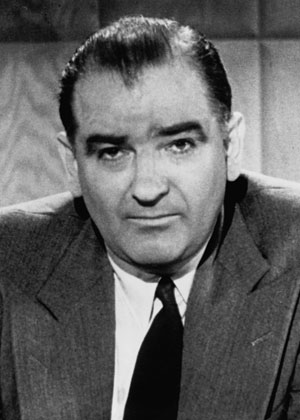
The first portion of the quote–“We must not confuse dissent with disloyalty”–is genuine. Murrow uttered the line during the closing portion of his myth-enveloped television report in March 1954 about Senator Joseph R. McCarthy (above) and his witch-hunting ways.

The second part– “When the loyal opposition dies, I think the soul of America dies with it”–is highly suspect.

Murrow didn’t say it during his program about McCarthy, the mythical elements of which I address in my new book, Getting It Wrong.

Here’s what Murrow said on that occasion, immediately after his remark about not confusing “dissent with disloyalty”:

“We must remember always that accusation is not proof and that conviction depends upon evidence and due process of law.”

That’s not  even remotely suggestive of “When the loyal opposition dies, I think the soul of America dies with it.”

So it’s pretty certain that “We must not confuse dissent with disloyalty” was not followed by “When the loyal opposition dies, I think the soul of America dies with it.”

This dubious Murrow quotation has been the topic of a previous discussion at Media Myth Alert. I noted then that if the quotation were genuine–if Murrow really said it–then its derivation shouldn’t be too difficult to determine.

But its derivation remains unknown.

I’ve searched the “historical newspapers” database for the suspect quote. The database includes the New York Times, Washington Post, Chicago Tribune, and Los Angeles Times; no articles quoting “the loyal opposition” passage were returned.

As I’ve noted previously, a search of the LexisNexis database produced a few returns–and none dated before 2001. And none stated when and where Murrow supposedly made the comment.

Among the LexisNexis returns was a book review published in 2003 in the Washington Post. The review invoked “the loyal opposition” passage and said Murrow made the remark “half a century ago, at the height of the McCarthy era.” But exactly when and where was left unsaid.

I couldn’t find “the loyal opposition” passage in A.M. Sperber’s hefty biography of Murrow; nor could I locate it in Bob Edwards’ more recent and much thinner treatment.

The 2005 movie Good Night and Good Luck, which revisited the Murrow-McCarthy encounter, didn’t invoke the quote, either. The line is not to be found in the film’s script.

So why bother running this down? What’s the point?

Several reasons offer themselves.

As I point out in Getting It Wrong, there is intrinsic value in correcting the historical record, in insisting on “a demarcation between fact and fiction.” As is the case with many media-driven myths, the suspect quotation seems too neat, too tidy to be authentic.

Falsely attributing quotations is unsavory, off-putting, and distorts the historical record. The Murrow-McCarthy encounter is myth-choked as it is, in that it’s widely believed that the Murrow show in 1954 stopped the senator’s witch-hunt in its tracks.

What’s more, the dubious Murrow quote seems to possess particular relevance and resonance today. But to invoke without knowing its derivation is an abuse of history.

WJC

Recent and related:

Doing more than casting ‘doubt’ on Hearst’s famous vow

In 1897, Cinematic treatments, Debunking, Furnish the war, Media myths, Newspapers, Spanish-American War, Yellow Journalism on October 9, 2010 at 7:15 am

In a thoughtful essay posted the other day about “Hollywood and the Power of Myth,” the director of new media at the Wharton School invoked my research into William Randolph Hearst’s purported vow to “furnish the war” with Spain, saying that I’ve cast “doubt” on the often-repeated anecdote.

I like to think that I’ve pretty much demolished that tale.

The Wharton new media director is Kendall Whitehouse, who referred in his essay to my 2000 article in Journalism and Mass Communication Quarterly that challenges the Hearstian vow as improbable. In that article, I wrote that the anecdote deserved “relegation to the closet of historical imprecision.”

I revisited the tale in my latest book, Getting It Wrong, which debunks 10 prominent media-driven myths–dubious and improbable stories about the news media that masquerade as factual.

Chapter One in Getting It Wrong is devoted to the Hearstian tale, which I flatly describe as a media-driven myth, calling it “perhaps the hardiest myth in American journalism.”

I note:

“Hearst’s famous vow to ‘furnish the war’ has achieved unique status as an adaptable, hardy, all-purpose anecdote, useful in illustrating any number of media sins and shortcomings. It has been invoked to illustrate the media’s willingness to compromise impartiality, promote political agendas, and indulge in sensationalism. It has been used, more broadly, to suggest the media’s capacity to inject malign influence into international affairs.”

Its versatility and its pithiness are two of the reasons the Hearstian myth has lived on.

The anecdote stems from Hearst’s assigning Frederic Remington, the famous artist of the American West, to Cuba, to draw illustrations for the New York Journal of the island-wide rebellion against Spanish colonial rule. Remington and the writer Richard Harding Davis, who also was on Hearst’s payroll, reached Cuba in January 1897. (Both are shown in the front-page image above.)

Remington was in Cuba six days before returning to New York. He suffered in the tropical heat and didn’t along with the self-important Davis, who called the rotund Remington “a large, blundering bear.”

Before returning, the media myth has it, Remington sent Hearst a telegram stating:

“Everything is quiet. There is no trouble here. There will be no war. I wish to return.”

Hearst supposedly cabled the artist reply: “Please remain. You furnish the pictures, and I’ll furnish the war.”

In most tellings of the anecdote, Hearst supposedly made good on his promise and brought on the war with Spain, which was declared 15 months later.

The Remington-Hearst anecdote is riven with flaw and incongruity. For starters, Hearst at least twice denied ever having sent such a message. And Remington apparently never discussed the anecdote.

Moreover, as I write in Getting It Wrong, “the anecdote lives on despite a nearly complete absence of supporting documentation. It lives on even though telegrams supposedly exchanged by Remington and Hearst have never turned up.”

And it lives on despite what I call “an irreconcilable internal inconsistency.” That is, it would have been absurd for Hearst to have vowed to “furnish the war” because war—specifically, the Cuban rebellion against Spain’s colonial rule—was the very reason Hearst sent Remington and Davis to Cuba in the first place.

“Anyone reading U.S. newspapers in early 1897 would have been well aware that Cuba was a theater of a nasty war,” I write in Getting It Wrong. “By then, the Cuban rebellion had reached islandwide proportions and not a single province had been pacified by Spain’s armed forces.”

Despite those and other flaws, the tale lives on as too good to check out, too good not to be true.

And as I note in Getting It Wrong:

“What firmly and finally pressed Hearst’s purported vow to ‘furnish the war’ into the public’s consciousness was Citizen Kane, the 1941 motion picture that was based loosely on Hearst’s life and times.”

In a scene early in the film, Orson Welles in the role of Charles Foster Kane, a newspaper tycoon who readily invites comparisons to Hearst, paraphrases the purported Remington-Hearst exchange.

Whitehouse noted in his essay: “Rightly or wrongly, Orson Welles’s … Citizen Kane has largely shaped our popular perception of William Randolph Hearst.” True enough.

Kane certainly helped solidify a robust media-driven myth.

WJC

Recent and related:

How late was Ed Murrow in taking on Joe McCarthy?

In Cinematic treatments, Media myths, Murrow-McCarthy myth on September 28, 2010 at 4:25 pm

Murrow in 1954

Edward R. Murrow, the “white knight” of American broadcasting, is often credited with having ended the communists-in-government witch-hunt of Senator Joseph McCarthy at the height of the Cold War.

Murrow supposedly demolished the McCarthy scourge in a 30-minute television program, See It Now, that aired on CBS on March 9, 1954. The show made notably effective use of footage of the senator’s words, actions, and sometimes-bizarre conduct.

By doing that show, it is said, Murrow stood up to McCarthy when no one else would–or dared.

That, however, is a media-driven myth–a dubious tale about the news media that masquerades as factual.

As I write in my new myth-busting book, Getting It Wrong, Murrow was very late in confronting McCarthy, doing so long after other journalists–among them muckraking columnist Drew Pearson–had become persistent and searching critics of the senator, his record, and his tactics.

Pearson wrote critically about McCarthy as early as February 1950–just days after the senator first raised claims about communists having infiltrated the U.S. State Department.

Pearson also raised searching questions years before Murrow’s program about McCarthy’s tax troubles, his accepting suspicious campaign contributions, and his taking a $10,000 payment from a U.S. government contractor for a 7,000 word article.

McCarthy, I write, “had no more relentless, implacable, or scathing foe in the news media than Drew Pearson.”

And there were other journalists, too, who challenged McCarthy and his ways long before Murrow’s See It Now program in 1954.

So undeniably, Murrow’s on-air takedown of McCarthy was belated.

But it wasn’t quite as late as historian Alan Brinkley suggested in a post yesterday at the Speakeasy blog, sponsored by the Wall Street Journal.

Brinkley wrote:

“Anyone who saw the George Clooney film ‘Good Night, and Good Luck,’ about Edward R. Murrow’s decision to attack Joe McCarthy in 1954, will remember the pervasive fear, indeed terror, of employees of CBS who have hidden their leftist political views. (Even Murrow waited until after the Army-McCarthy hearings began before he took on McCarthy.)”

That last bit isn’t correct.

The Army-McCarthy hearings were convened in April 1954, six or so weeks after Murrow’s program, and ran until June 1954. The Museum of Broadcast Communications in Chicago has called the hearings “the first nationally televised congressional inquiry.” And they led to McCarthy’s censure by the Senate in late 1954.

“What made the real difference” in toppling McCarthy, Fred Friendly, Murrow’s producer, later wrote, “wasn’t the Murrow program but the fact that ABC decided to run the Army-McCarthy hearings. People saw the evil right there on the tube. ABC helped put the mirror up to Joe McCarthy.”

The Clooney film that Brinkley mentioned, Good Night, and Good Luck, was an imaginative and clever cinematic treatment of Murrow’s See It Now program about McCarthy. The film came out in 2005 and included archival footage from Murrow’s show.

“While the movie never explicitly said as much,” I write in Getting It Wrong, “it left an inescapable impression that Murrow courageously and single-handedly stopped McCarthy. Many reviewers saw it that way, too.”

For example, the film critic for the Chicago Sun-Times, Roger Ebert, said Good Night, and Good Luck was about “a group of professional newsmen who with surgical precision remove a cancer from the body politic. They believe in the fundamental American freedoms, and in Sen. Joseph McCarthy they see a man who would destroy those freedoms in the name of defending them. … The instrument of his destruction is Edward R. Murrow, a television journalist above reproach.”

But Murrow wasn’t such a “white knight.”

As I note in Getting It Wrong, Murrow claimed a master’s degree he never earned, added five years to his age in his employment application at CBS, and in 1956 privately counseled Adlai Stevenson, the Democratic presidential candidate, on techniques of speaking before a television camera.

Such lapses today, I write in Getting It Wrong, would “almost surely disqualify Murrow, or any journalist, from prominent positions in America’s mainstream news media.”

WJC

Recent and related: