W. Joseph Campbell

Archive for the ‘Media myths’ Category

Chris Matthews invokes the ‘if I’ve lost Cronkite’ myth in NYT review

In Cronkite Moment, Debunking, Media myths, New York Times, Quotes, Reviews on July 9, 2012 at 7:29 am

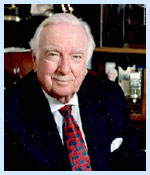
The New York Times lined up Chris Matthews, voluble host of cable television’s Hardball program, to review Douglas Brinkley’s Cronkite, the new biography about legendary CBS News anchorman Walter Cronkite.
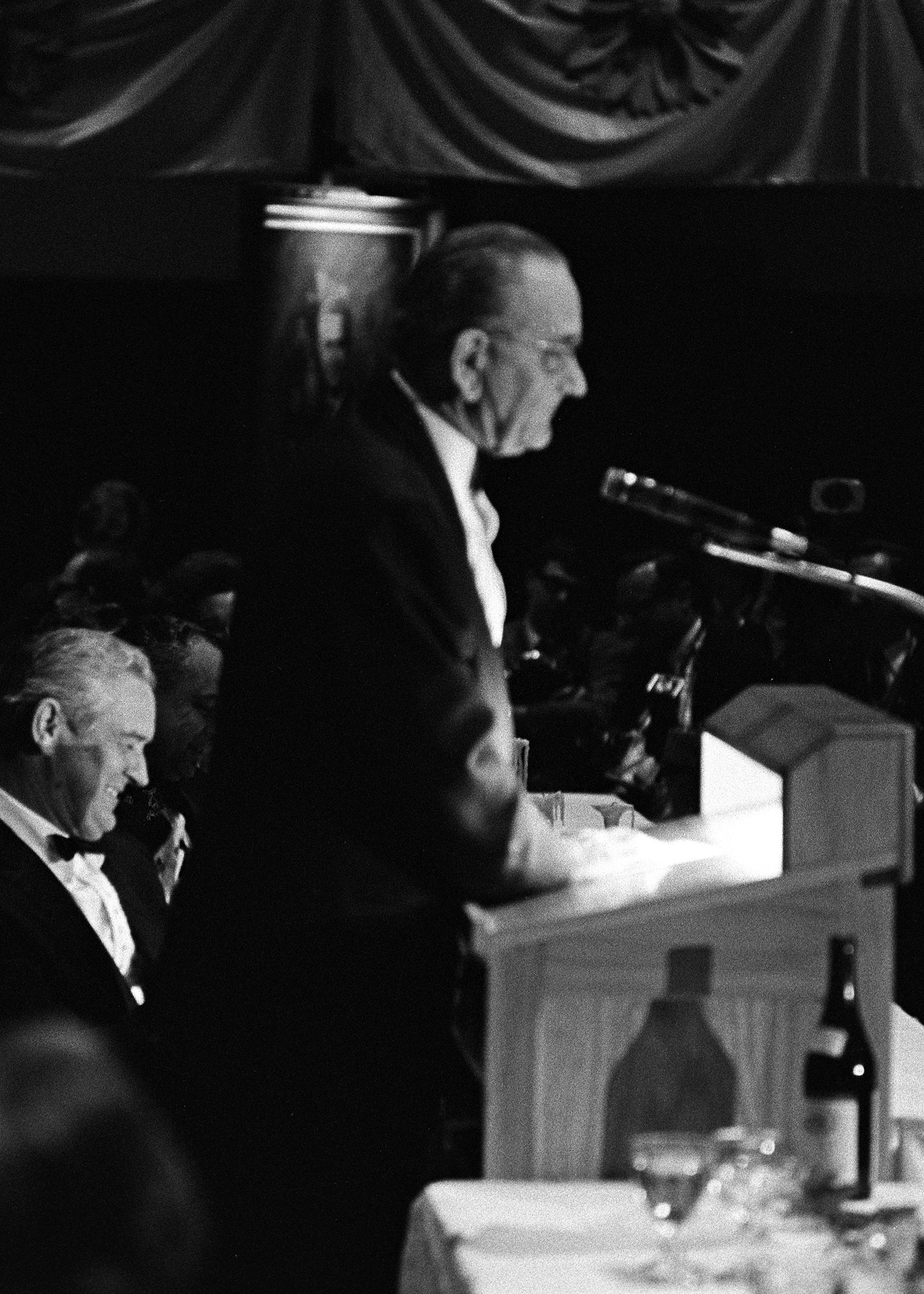
LBJ wasn’t watching Cronkite’s report

Matthews turned in a fluffy review, published yesterday, that invoked one the American journalism’s best-known media myths — the claim that President Lyndon B. Johnson was dramatically moved by Cronkite’s on-air assessment about the war in  Vietnam.

“Cronkite never shied away from telling hard truths,” Matthews writes in his review. “Recall his half-hour ‘Report From Vietnam’ on Feb. 27, 1968, in which he declared the Vietnam War a ‘stalemate.’ It was a verdict the veteran war correspondent didn’t relish delivering, but Cronkite, who had recently returned from reporting on the Tet offensive, now believed that the war was unwinnable and indefensible.”

Matthews then repeats Brinkley’s thinly supported claim that Cronkite’s “stalemate” pronouncement had “seismic” effects.

Matthews adds, presumably as evidence of such an effect: “President Johnson reportedly said, ‘If I’ve lost Cronkite, I’ve lost the country.'”

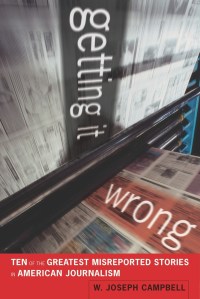
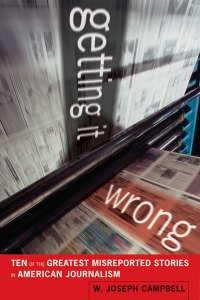
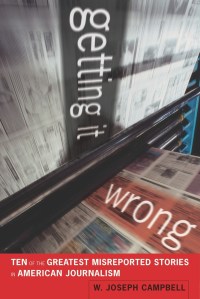
But as I discuss in my latest book, Getting It Wrong, there’s no persuasive evidence that Johnson ever uttered such a remark.

Indeed, the president’s purported comment is defined by what I call acute version variability. That is, there is no agreed-upon version of what Johnson supposedly said in reacting to Cronkite’s “stalemate” assessment.

Other versions include:

“If I’ve lost Cronkite, I’ve lost Middle America.”

“If I’ve lost Cronkite, I’ve lost the war.”

“If I’ve lost Cronkite, I’ve lost the American people.”

“If I’ve lost Cronkite, I’ve lost the nation.”

And so on. (The Richmond Dispatch in a review published yesterday of Cronkite said Johnson exclaimed: “My God, if I’ve lost Cronkite, I’ve lost the country.”)

As I’ve noted previously at Media Myth Alert, if anyone’s words should be captured with precision, they ought to be the president’s. Especially on matters as critical as support for war policy. The wide variance as to what Johnson supposedly said is, then, a marker of a media myth.

Even more injurious to the case that Cronkite’s pronouncement was of great significance is that Johnson didn’t see the program when it was broadcast.

The president was not at the White House on February 27, 1968; nor was he in front of a television set when Cronkite’s program aired.

And about the time Cronkite intoned his “stalemate” assessment, Johnson was offering light-hearted remarks in Austin, Texas, at the 51st birthday party of Texas Governor John Connally (see photo, above).

“Today you are 51, John,” the president said. “That is the magic number that every man of politics prays for — a simple majority.”

I further note in Getting It Wrong that there is no compelling evidence that Johnson saw the Cronkite program later, on videotape.

Even if he had, Cronkite’s characterization of the was as a “stalemate” would have come as old news to the president. What Cronkite said about Vietnam on February 27, 1968, hardly earth-shaking, stunning, or original.

In no way did it alter the course of the war or influence American policy.

If anything, Cronkite’s observation about a “stalemate” was a rehash of what other news organizations, such as the New York Times, had been saying for months.

For example, the Times said in a news analysis published July 4, 1967:

“Many officers believe that despite the commitment of 466,000 United States troops now in South Vietnam … the military situation there has developed into a virtual stalemate.”

And in a report from Saigon that appeared on August 7, 1967, the Times noted:

“‘Stalemate’ is a fighting word in Washington. President Johnson rejects it as a description of the situation in Vietnam. But it is the word used by almost all Americans here, except the top officials, to characterize what is happening.”

So why bother calling out Matthews for casually invoking the central component of the mythical “Cronkite Moment”?

Doing so serves to highlight how insidious the myth has become, how blithely it is marshalled to support the notion that courageous and motivated journalists can do marvelous things.

Doing so also demonstrates anew that not even prominent and presumably fact-checked news organizations such as the Times are resistant to the intrusion of hoary media myths.

And doing so indicates that at least some high-profile contemporary journalists possess a shaky command of the history of their field.

WJC

Many thanks to Instapundit
Glenn Reynolds for linking to this post

Recent or related:

Renewing the Hearst-Remington association in a $200,000 grant

In 1897, Debunking, Furnish the war, Media myths, Quotes, Spanish-American War on July 8, 2012 at 10:10 am

The most tenacious myth in American journalism tells of a purported exchange of telegrams in January 1897 between  newspaper magnate William Randolph Hearst and the artist Frederic Remington.

Remington

Supposedly, in answering Remington’s telegram, Hearst vowed to “furnish the war” with Spain, which broke out 15 months later, in April 1898.

Despite repeated efforts to debunk it, the tale about Hearst’s reckless vow lives on — a story just too delicious to be discarded.

So I found intriguing the news the other day that the Hearst Foundations — which Hearst set up in the 1940s — have agreed to a $200,000 grant to the Frederic Remington Art Museum in Ogdensburg, N.Y.

Most of the money, $150,000, is to put toward extensive restoration work on the museum’s main building, which dates to 1810. The remainder, $50,000, is for educational purposes, if matched by the museum before year’s end.

Hearst

The grant — the foundations’ second to the Remington museum since 2009 — represents a reminder and a renewal of sorts of the long ago Hearst-Remington association.

In early 1897, Remington and the writer Richard Harding Davis arrived in Cuba on assignment from Hearst’s New York Journal to cover the rebellion against Spanish colonial rule, the conflict that gave rise to the Spanish-American War.

It was a coup for the Journal to have lined up talent such as Remington and Davis, who were paid handsomely for what was to be a month-long assignment.

It was during that assignment when the purported exchange of the telegrams supposedly took place — an exchange described by neither Hearst nor Remington, but by James Creelman, a Hearst correspondent who was in Madrid at the time.

The tale of Hearst’s vow is almost surely apocryphal, for reasons I discuss in my latest book, Getting It Wrong.

Among the reasons (typically overlooked) is that Hearst denied having sent such a message. Remington, apparently, never discussed the anecdote, which Creelman recounted, without documentation, in a memoir published in 1901.

Further reason for doubting the tale is that Spanish authorities controlled incoming and outgoing telegraphic traffic from Havana. They surely would have intercepted and called attention to Hearst’s incendiary message to Remington, had it been sent.

Additionally, the anecdote rests on irreconcilable illogic. As I write in Getting It Wrong, it “would have been absurd for Hearst to vow to ‘furnish the war’ because war— specifically, the Cuban rebellion against Spain’s colonial rule — was the very reason Hearst sent Remington to Cuba in the first place.

“Anyone reading U.S. newspapers in early 1897 would have been well aware that Cuba was a theater of a nasty war. By then, the Cuban rebellion had reached island-wide proportion and not a single province had been pacified by Spain’s armed forces.”

Hearst’s Journal gave prominent display to Remington’s sketches beginning in late January 1897, following the artist’s return to New York after a stay in Cuba of just six days.

The Journal gushed over Remington’s work, introducing his sketches with extravagant headlines such as:

“War Sketches Gathered in the Field by Frederic Remington; The Gifted Artist, Visiting Cuba Especially for the Journal, Describes with Pen and Pencil Characters That Are Making the War Famous and Infamous.”

Remington, though, grumbled that his work did not reproduce well in Hearst’s newspaper.

The artist returned to Cuba for Hearst in June 1898, to cover the Cuban campaign of the Spanish-American War. He did not distinguish himself.

Overweight and ailing, Remington suffered in the Cuban summer. He seldom was near the front and became what biographers Peggy and Harold Samuels termed “the chronicler of the battle’s rear.”

Remington died in 1909. The museum devoted to his work was established in Ogdensburg in 1923.

The museum’s executive director, Ed LaVarnway, said by phone yesterday that the Hearst Foundations’ grants to the museum weren’t made in recognition of the late 19th century association between Hearst and Remington.

But Hearst representatives knew about those connections and about the anecdote about the purported exchange of telegrams, he said.

Vital to securing the latest grant, LaVarnway noted, was Gilbert C. Maurer, a Hearst Foundations director and a benefactor of St. Lawrence University in Canton, N.Y., Remington’s hometown. Canton is 18 miles from Ogdensburg.

He “was in the museum’s corner,” LaVarnway said of Maurer, formerly the chief operating officer of Hearst Corp., which William Randolph Hearst established 125 years ago.

WJC

Recent or related:

10 weeks on: Still no word from WaPo about apparent digital scrubbing of Lynch articles

In Debunking, Jessica Lynch, Media myths, Washington Post on July 6, 2012 at 7:45 am

Where’s the digital version?

The Washington Post ombudsman noted in a column last month that it is “increasingly difficult for iconoclastic, questioning voices to be heard, whether left, right or center.”

The ombudsman, Patrick Pexton, urged the Post and other news organizations “to seek out and cover the unconventional and outsider voices — whether citizen or expert, whether right, center or left. They’re out there; we just have to listen.”

Trouble is, Pexton, himself, doesn’t always much care for “questioning voices” — such as the questions that I’ve raised with him periodically for the past 10 weeks.

Those questions relate to the apparent digital scrubbing of the Post’s botched reporting about Jessica Lynch and her purported heroics early in the Iraq War.

The Post on April 3, 2003, published a stunning report on its front page (see above) about the supposed heroism of Lynch, a 19-year-old Army supply clerk, during an ambush at Nasiriyah in southern Iraq.

The Post’s report said Lynch had fought fiercely and “continued firing at the Iraqis even after she sustained multiple gunshot wounds and watched several other soldiers in her unit die around her” in the fighting, which took place March 23, 2003.

The electrifying report — which the Post headlined “She was fighting to the death” — was picked up by news organizations around the world.

But soon it became apparent that the Post’s hero-warrior story was utterly wrong in all important details. Lynch never fired a shot in Iraq; she was neither shot nor stabbed, as the Post had reported, but badly injured in the crash of a Humvee as it fled the ambush.

The botched hero-warrior story is unavailable at the Post’s online site. Until a few weeks ago, clicking on a link to that report did turn up the story’s headline, byline, and publication detail. But otherwise, it was an empty link: It contained no content.

Now, not even the headline, byline, and publication date are available. The link opens to a page that declares in large headlines: “Page Not Found” and “We’re unable to locate the page you requested.”

So changes recently have been made that expunge any reference to the hero-warrior story.

I pointed this out in an email to Pexton a week ago. He has not replied.

In his most recent correspondence with me, an email sent May 30, Pexton wrote:

“This is a stickier problem than I initially thought. It could be as innocent as the Post has moved masses amount of files three times in the past ten years to different servers. Or it could be deliberate.  …  I have one newsroom employee researching this and an IT person checking on it. When I have an answer, I’ll let you know.”

Pexton turned prickly in that email, making clear he did not appreciate my turning to social media to call attention to this matter.

He expressed objections to the Twitter message I sent on May 25, calling attention to a blog post of the same day that four weeks had passed and the Post had offered no explanation for the apparent scrubbing of the Lynch  content.

“Tweeting about your frustration over the time it is taking is a disincentive for me to push harder on it,” Pexton wrote in his email of May 30. “Most readers are polite and understanding. Why should I put your request ahead of others when you choose to coerce and bully?”

Coerce and bully? C’mon. My inquiries about the Lynch stories are much more akin to the “questioning voices” that Pexton has encouraged the Post to seek out and embrace.

More than five weeks have since passed he sent that prickly email. Pexton has offered no explanation as to why the Lynch content has been excised from the Post’s online site.

“I will get an answer for you if it is obtainable and I will let you know when I do,” he wrote on May 30. “That’s the best I can do. If that’s not to your liking, then I apologize but that is your issue, not mine.”

Woah. It’s not important to him whether the Post has scrubbed digital reminders of an acutely embarrassing story?

The Post, after all, called out Vanity Fair in April for digitally scrubbing a flattering profile of the wife of  Bashar al-Asad, Syria’s dictator. At that time, the Post described Vogue’s removal of the digital version of the profile as “an almost-unheard-of step for a mainstream media organization.”

Interestingly, some Lynch-related content from 2003 remains freely available online — notably this article, at the Post’s link-rich Iraq War archive.

I’ve asked Pexton: Would the Post and its readers not be better served by being consistent about its Lynch-related content?

And I have suggested to him that “my request can be distilled thusly:

“Why is some Lynch-related content from 2003 freely available online (see here), while content more embarrassing to the Post (see empty links here, here, and here) not available? Shouldn’t those empty links be restored, and added to the Post’s link-rich Iraq War archive, where Lynch’s name and image already appear?”

He has given no direct responses to those questions.

So what’s to be concluded, 10 weeks after my initial inquiry to Pexton?

Not unlike Vanity Fair, the Post appears to have scrubbed the digital reminders of an embarrassing misstep, of a high-profile story that the newspaper got utterly wrong.

It’s also pretty clear the Post has no interest in making freely available online its botched reporting about Jessica Lynch.

It’s pretty clear, too, that Pexton doesn’t eagerly follow through on his rhetoric about the value and importance of “iconoclastic, questioning voices.”

WJC

Many thanks to Instapundit
Glenn Reynolds for linking to this post.

Recent or related:

‘Getting It Wrong’ receives major shout-out in ‘New Yorker’
In Cronkite Moment, Debunking, Media myths, Murrow-McCarthy myth, Reviews on July 5, 2012 at 1:30 pm

The “critic at large” essay in the latest number of the New Yorker includes references to my myth-busting latest book, Getting It Wrong.

Cronkite: His ‘moment’ wasn’t so special

The essay by Louis Menand is largely a searching review of Cronkite, the recent, so-so biography about legendary CBS News anchorman, Walter Cronkite.

Menand calls the book “long and hastily written.”

He discusses in detail the so-called “Cronkite Moment” of February 27, 1968, when Cronkite’s on-air assessment that the Vietnam War was stalemated supposedly was so powerful that it influenced American war policy and moved American public opinion. The Cronkite biography says as much.

But Menand scoffs at the notion the “Cronkite Moment” was very important at all, writing:

“The trouble with this inspiring little story is that most of it is either invented or disputed.”

He specifically refers to Getting It Wrong in dismissing the supposed effects of Cronkite’s pronouncement about the war — notably, that Cronkite’s assessment prompted President Lyndon B. Johnson to declare something to the effect of, “If I’ve lost Cronkite, I’ve lost Middle America.”

Menand notes that Johnson did not see the Cronkite report about Vietnam when it aired, pointing out that the president was in Austin, Texas, “attending a birthday celebration for Governor John Connally. … There is no solid evidence that Johnson ever saw the show on tape, either, though the White House did tape it.”

Further drawing on Getting It Wrong, which includes a chapter debunking the mythical “Cronkite Moment,” Menand writes that even after Cronkite “stalemate” assessment, “Johnson’s speeches on Vietnam … were as hawkish as ever.

“Not only is there little evidence that the broadcast had an effect on Johnson; there is little evidence that it had an effect on public opinion.” And that’s certainly true.

Menand also notes that the author of the Cronkite biography, Douglas Brinkley, “implies that it was Cronkite’s commentary that emboldened the [Wall Street] Journal to criticize the war, but the Journal editorial appeared four days before the broadcast.”

The Journal’s editorial of February 23, 1968, said “everyone had better be prepared for the bitter taste of a defeat [in Vietnam] beyond America’s power to prevent.”

The editorial was strong stuff. And it undeniably preceded Cronkite’s on-air assessment which, given the times, was tepid and unoriginal. Leading U.S. news organizations such as the New York Times, had taken to calling the war a “stalemate” months before Cronkite’s program.

As Menand observes: “In 1968, you did not need an anchorman to know which way the wind blew” on Vietnam.

Menand’s essay also challenges the notion that Cronkite was “the most trusted man in America,” dissecting a 1972 survey that rated the anchorman more trustworthy than the leading national politicians of the time. Not much of a comparison, that. As media critic Jack Shafer wrote in 2009, shortly after Cronkite’s death, the anchorman’s score in the survey “seemed impressive until you considered the skunks polled alongside him.”

Menand touches on Edward R. Murrow’s famous program in 1954 that addressed the smears and bullying tactics of the red-baiting U.S. senator, Joseph R. McCarthy. Menand notes that Getting It Wrong describes how Murrow’s televised assessment of McCarthy came “very late in the day.” By 1954, Menand writes, “McCarthy had been hunting witches for four years….”

He also offers a thoughtful and telling assessment about why media myths take hold.

“Journalism and history,” Menand writes, “are about getting things right. But the past has many uses, and one of them is to inspire the present. … More honorably, if not necessarily more accurately, we imagine our predecessors as nobler and braver than our small selves — as men and women who stuck up for principle and, by their righteousness, moved the world.”

That’s well said, and offers revealing insight about the tenacity of such myths as the “Cronkite Moment.”

WJC

Recent or related:

Further reason to pan Aaron Sorkin’s ‘Newsroom’: It embraces media myths

In Cronkite Moment, Debunking, Media myths, Murrow-McCarthy myth, Reviews on June 26, 2012 at 6:19 am

Aaron Sorkin’s preachy new HBO series, The Newsroom, has, deservedly, received some harsh reviews.

Among the most delicious of those critiques was the New Yorker’s observation that The Newsroom is “so naïve it’s cynical.” And the New York Times said that “at its worst, the show chokes on its own sanctimony.”

Naïve and sanctimonious: Two solid reasons to avoid The Newsroom, which presumes to offer a behind-the-scenes dramatization of a high-pressure cable news program.

Another reason to pan the show is its embrace of hoary media myths.

The embrace of myth came late in the first episode on Sunday, when Sam Waterston, who plays cable news chief Charlie Skinner, offers advice to Will McAvoy, the prickly and thoroughly unlikable anchorman played by Jeff Daniels.

“Anchors having an opinion isn’t a new phenomenon,” Waterston/Skinner tells Daniels/McAvoy. “Murrow had one, and that was the end of McCarthy. Cronkite had one, and that was the end of Vietnam.”

The references were to Edward R. Murrow, whose 30-minute program on CBS about Senator Joseph R. McCarthy in 1954 is often but erroneously credited with bringing down the Red-baiting senator, and to Walter Cronkite’s 30-minute report about Vietnam in 1968 which is often but erroneously described as a turning point in America’s war in Southeast Asia.

Both tales are media-driven myths — compelling and prominent stories about the news media that are widely believed and often retold but which, under scrutiny, dissolve as improbable or wildly exaggerated.

The Murrow and the Cronkite anecdotes are both addressed in my 2010 mythbusting book, Getting It Wrong.

I note in the book how Murrow was very late in confronting the McCarthy menace, doing so only months and years after other journalists had repeatedly directed attention to the senator’s bullying tactics and his ready use of the smear.

Among those journalists was Drew Pearson, an aggressive, Washington-based syndicated columnist who became a persistent and searching critic of McCarthy days after the senator launched his communists-in-government witch-hunt in February 1950.

That was four years before Murrow’s program.

Pearson’s scathing columns so angered McCarthy that the senator assaulted Pearson following a dinner party at the hush-hush Sulgrave Club in Washington in December 1950.

“Accounts differ about what happened,” I write in Getting It Wrong. “Pearson said McCarthy pinned his arms to one side and kneed him twice in the groin. McCarthy said he slapped Pearson, hard, with his open hand. A third account, offered by a radio broadcaster friendly to McCarthy, said the senator slugged Pearson, a blow so powerful that it lifted Pearson three feet into the air.”

That encounter certainly would be fodder for cable TV.

In any event, by March 1954, when Murrow turned his attention to McCarthy, the senator’s character and tactics were quite well-known.

“To be sure,” I write in Getting It Wrong, “it wasn’t as if Americans in early 1954 were hoping for someone to step up and expose McCarthy, or waiting for a white knight like Murrow to tell them about the toxic threat the senator posed.”

Thanks to the work of Pearson and other journalists, Americans knew.

Cronkite’s report about Vietnam aired on February 27, 1968, and closed with the CBS News anchorman asserting that the U.S. military was “mired in stalemate” and that negotiations might prove to be the way out of the morass.

Those observations were supposedly so powerful and insightful that they have come to be known as the “Cronkite Moment.”

In fact, though, Cronkite’s observations were scarcely novel or revealing. By the time his report aired, “stalemate” had been used by U.S. news organizations for months to characterize the war in Vietnam.

Not only that, but U.S. public opinion had grown dubious about the war long before the presumptive “Cronkite Moment.”

Cronkite’s commentary did little to turn Americans, or the administration of President Lyndon B. Johnson, against the war.

Cronkite often said as much, likening the program’s effect on policymakers to that of a straw. (Late in his life, though, Cronkite came to embrace the purported potency of his 1968 commentary.)

So why bother about — and why blog about — the embrace of media myth on Sorkin’s tiresome, eyeroll-inducing show?

A couple of reasons present themselves.

The blithe, casual reference on The Newsroom to Murrow and Cronkite helps insinuate the media myths in popular consciousness.  It reinforces their tenacity.

Embracing the myths serves also to promote the “golden age” fallacy, the appealing but exaggerated belief that there really was a time when American broadcast news produced giants — hallowed figures of the likes of Murrow and Cronkite who, in the contemporary media landscape, are nowhere to be found.

It is an enticing notion. But it’s flawed and misleading — and vastly overstates the contributions, and opinions, of Murrow and Cronkite.

WJC

Recent or related:

The media myths of Watergate: Part Five

In Anniversaries, Cinematic treatments, Debunking, Media myths, Scandal, Washington Post, Watergate myth on June 21, 2012 at 6:32 am

This is the last of five posts addressing prominent media-driven myths about the Watergate scandal, which began unfolding 40 years ago this week with the foiled burglary at the headquarters in Washington of the
Democratic National Committee.
This installment address the often-stated claim that enrollments in college journalism programs in the United States
soared in the aftermath of Watergate.

Watergate made Gerald Ford president — and made journalism seem sexy

It’s a subsidiary myth of Watergate, that the reporting exploits of Bob Woodward and Carl Bernstein of the Washington Post — made legendary by the cinematic adaptation of their book, All the President’s Men — turned journalism into glamorous and alluring profession.

So alluring and heroic were the depictions of Woodward and Bernstein as they, ahem, toppled a corrupt president that young adult Americans in the 1970s thronged to collegiate journalism programs.

A commentary last week in Post made just that point, declaring that the film had “inspired a generation of journalism school students.” Similarly, a recent essay at Gawker.com said the glowing accounts of Woodward and Bernstein’s work “helped swell enrollments at journalism schools across the nation as eager young college graduates came to view reporting not as a lowly trade but as a noble profession.”

But it’s a media myth that Watergate stimulated journalism school enrollments — a myth that endures despite its thorough repudiation by scholarly research.

As I discuss in my 2010 book, Getting It Wrong (which includes a chapter confronting what I call the heroic-journalist myth of Watergate), two scholarly studies about enrollments in collegiate journalism programs found no evidence that Watergate was much of a stimulus.

Enrollment data are reasonably good proxies as they would surely have reflected heightened interest in careers in the profession. If Watergate and All the President’s Men inspired broad interest in careers in journalism, evidence of the stimulus should be apparent in surging j-school enrollments.

But the evidence just isn’t there.

A study conducted for the Freedom Forum media foundation and released in 1995 found that “growth in journalism education” resulted “not from specific events as Watergate … but rather to a larger extent from the appeal of the field to women, who have been attending universities in record numbers. The growth also in part reflects the applied nature of the field and its link to specific job skills.”

The study’s authors, Lee Becker and Joseph Graf, stated flatly that “students didn’t come rushing to the university because they wanted to follow in the footsteps of Woodward and Bernstein ….”

A separate study, conducted by a senior journalism scholar, Maxwell E. McCombs, reported in 1988 that “the boom in journalism education was underway at least five years before” the Watergate break-in in 1972.

McCombs wrote:

“It is frequently, and wrongly, asserted that the investigative reporting of Woodward and Bernstein provided popular role models for students, and led to a boom in journalism school enrollments. The data … reveal, however, that enrollments already had doubled between 1967 and 1972.”

I point out in Getting It Wrong that the notion that Watergate reporting made journalism appealing and sexy lives on “because it seems irresistibly logical and straightforward— too obvious, almost, not to be true.”

Watergate’s presumed stimulus on journalism school enrollments is an attractive and simplistic construct, easy to grasp, and easy to remember.

And such characteristics — easy to grasp, easy to remember — often are propellants. Propellants of media-driven myths.

WJC

Recent or related:

The media myths of Watergate: Part Four

In Anniversaries, Cinematic treatments, Debunking, Media myths, Newspapers, Quotes, Reviews, Washington Post, Watergate myth on June 20, 2012 at 7:40 am

This is the fourth of five posts addressing prominent media-driven myths about the Watergate scandal, which began unfolding 40 years ago this week, with
the foiled burglary at the headquarters
in Washington of the Democratic National Committee.
This installment addresses the notion that the Watergate reporting of Bob Woodward and Carl Bernstein
placed the reporters in grave danger.

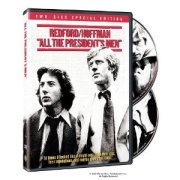
No film or documentary about Watergate has been seen more often by more people than All the President’s Men, the 1976 adaptation of the eponymous book by the Washington Post’s lead reporters on the scandal, Bob Woodward and Carl Bernstein.

The movie won rave reviews. The New York Times called it “a spellbinding detective story” and “an unequivocal smash-hit — the thinking man’s Jaws.”

The Post once immodestly described All the President’s Men as “journalism’s finest 2 hours and 16 minutes” and “the best film ever made about the craft of journalism.”

For all its glowing notices, All the President’s Men was often sluggish in pacing. More than a few scenes showed reporters at their desk, talking into telephones and banging away at typewriters.

Hardly gripping cinema.

But a measure of drama and menace was injected near the close of the movie (see video clip below).

http://www.youtube.com/watch?feature=player_embedded&v=NVNU5jkOwzU

That came when Woodward’s stealthy, high-level “Deep Throat” source, at a meeting in a darkened parking garage, grimly warns the wide-eyed reporter, played by Robert Redford:

“Your lives are in danger.”

But was it even true? Had Woodward and Bernstein, in their reporting about the misdeeds of men close to President Richard Nixon, unknowingly put their lives on the line? Were they targeted by Nixon’s henchmen? Or was this just dramatic license by Hollywood?

The movie leaves such questions hanging. The Woodward/Redford character informs the Bernstein character (played by Dustin Hoffman) about what “Deep Throat” said, and together they confer with the Post’s executive editor character (Jason Robards) — in the middle of the night, in the middle of the editor’s lawn.

But the movie closes before resolving the question of the hazards the reporters faced.

So were their lives really in danger?

Nope.

Not according to the book, All the President’s Men.

The book discusses a late-night meeting between Woodward and “Deep Throat” in mid-May 1973 when the source — W. Mark Felt, a senior official at the FBI, as it turned out — advised the reporter to “be cautious.”

Woodward returned to his apartment and invited Bernstein to stop by. When he did, Woodward typed out a message and handed it to his colleague:

Everyone’s life is in danger.”

Bernstein gave a curious look and Woodward typed another note:

Deep Throat says electronic surveillance is going on and we had better watch it.”

Who was doing the surveillance? Bernstein asked in long hand.

“C-I-A,” Woodward silently mouthed.

For a time afterward, the reporters and senior editors at the Post took precautions to avoid the suspected surveillance of their activities.

Woodward and Bernstein wrote in All the President’s Men that they “conferred on street corners, passed notes in the office, avoided telephone conversations.”

But soon, they said, “it all seemed rather foolish and melodramatic” and they went back to their routines.

No evidence, they wrote, was ever found “that their telephones had been tapped or that anyone’s life had been in danger.”

At a program last week at the Newseum, Woodward said he took Felt’s warning “too literally. I think he was speaking metaphorically” about the hazards.

“I think it was an overreaction,” Woodward said.

On another occasion — an online chat five years ago — Woodward said the “most sinister pressure” he and Bernstein felt during Watergate “was the repeated denial” by Nixon’s White House “of the information we were publishing” as the scandal deepened.

Also in that chat, Woodward said of the cinematic version of All the President’s Men:

“The movie is an incredibly accurate portrait of what happened.”

Oh, sure, it is.

Even that Post review, which called the movie journalism’s finest 2 hours and 16 minutes, noted that All the President’s Men “over-glamorizes reporting, oversimplifies editing and makes power appear the only proper subject for a newsman’s pen.”

WJC

Recent or related:

The media myths of Watergate: Part Three

In Anniversaries, Debunking, Media myths, Newspapers, Quotes, Washington Post, Watergate myth on June 19, 2012 at 5:25 am

This is the third of five posts addressing prominent media-driven myths about the Watergate scandal, which began
unfolding 40 years ago this week with the foiled burglary at the headquarters in Washington of the Democratic National Committee.
This installment discusses the most famous made-up line of Watergate.

“Follow the money.” It’s the best-known, most popular turn-of-phrase associated with the Watergate scandal of 1972-74.

Felt: Never said it

It’s often said that “follow the money” was sage counsel offered by the stealthy, high-level “Deep Throat” source with whom Bob Woodward of the Washington Post periodically met as the scandal unfolded.

The guidance to “follow the money” supposedly proved crucial in understanding and unraveling the labyrinthine scandal that was Watergate.

Except that it really wasn’t.

“Deep Throat” never advised Woodward to “follow the money.”

The passage appears in no Watergate-related article or editorial in the Post until June 1981, nearly seven years after Nixon’s resignation. It doesn’t appear, either, in All the President’s Men, the book Woodward and his Post colleague, Carl Bernstein, wrote about their Watergate reporting.

Follow the money” was written into the screenplay of All the President’s Men, the cinematic adaptation of Woodward and Bernstein’s book.

The line was spoken by Hal Holbrook, the actor who played “Deep Throat” in the movie. (The real “Deep Throat” was self-revealed in 2005 to have been W. Mark Felt, a senior FBI official.)

Holbrook in All the President’s Men turned in a marvelous performance as a twitchy, conflicted, chain-smoking “Deep Throat.”

‘All the President’s Men,’ the movie

He delivered the line, “follow the money,” with such raspy assurance and conviction that it seemed for all the world to be vital to understanding the scandal that began unfolding 40 years ago.

Follow the money” is certainly Watergate’s most memorable and mythical phrase; it is so pithy and emphatic that it seems almost too good not to be true.

Indeed, “follow the money” tends to be treated with reverence by news media. A “credo,” it’s been called.

Take, for example, a recent post at the “Daily Intel” blog of New York Magazine. The blog post began by invoking the famous phrase, with emphasis:

Follow the money. The pithy investigative advice Woodward and Bernstein attributed to Deep Throat is still brilliant and important, whatever else the Watergate reporters may have embellished.”

Brilliant and important?

Made up is more like it.

But even if Woodward had been counseled to “follow the money,” the advice neither would have unraveled the Watergate scandal nor led him to Nixon.

Besides, Woodward and Bernstein already were on the money trail.

One of their most important stories was in reporting that a $25,000 check to Nixon’s reelection campaign had been deposited in the bank account of one of the Watergate burglars.

The scandal, though, was much more than Nixon’s improper use of campaign funds. The president was forced to resign because he obstructed justice by approving a plan to cover up the burglary at the Democratic National Committee.

The simplified, follow-the-money construct not only is inaccurate and misleading: It serves to deflect attention from the array of forces that combined to expose Nixon’s crimes.

As I note in my 2010 book Getting It Wrong, rolling up a scandal of Watergate’s depth and dimension required “the collective if not always the coordinated forces of special prosecutors, federal judges, both houses of Congress, the Supreme Court, as well as the Justice Department and the FBI.

“Even then,” I write, “Nixon likely would have served out his term if not for the audiotape recordings he secretly made of most conversations in the Oval Office of the White House.

“Only when compelled by the Supreme Court did Nixon surrender those recordings, which captured him plotting the cover-up” that cost him the presidency.

WJC

Recent or related:

The media myths of Watergate: Part Two

In Anniversaries, Debunking, Media myths, Newspapers, Scandal, Washington Post, Watergate myth on June 18, 2012 at 5:42 am

This is the second of five posts addressing prominent media-driven myths about the Watergate scandal, which began unfolding 40 years ago this week with
the foiled burglary at the headquarters in Washington
of the Democratic National Committee.
This installment discusses the notion
that the 
Washington Post “uncovered” the Watergate story.

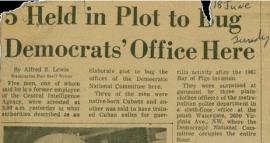
Post’s Watergate story, June 18, 1972 (Ransom Center, University of Texas)

Watergate was America’s gravest political scandal. It began as a police beat story.

News of the scandal’s seminal crime — the thwarted break-in of June 17, 1972, at the headquarters of the Democratic National Committee at the Watergate complex in Washington, D.C. — was circulating within hours.

The opening paragraph of the Posts front-page report about the burglary, published 40 years ago today, made it clear that details had come from investigating authorities. The paragraph read:

“Five men, one of whom said he is a former employee of the Central Intelligence Agency, were arrested at 2:30 a.m. yesterday in what authorities described as an elaborate plot to bug the offices of the Democratic National Committee here.”

So it can’t be said the Post “uncovered” the Watergate story.

Nor can it be said that the newspaper “uncovered” crucial elements of the deepening scandal, which ultimately forced President Richard Nixon to resign the presidency in August 1974.

Take, for example, Nixon’s secret audiotaping system at the White House.

Existence of the tapes was disclosed in July 1973 to a bipartisan select committee of the U.S. Senate (see video clip below).

http://youtu.be/MeQXopJ5U-Q

The tapes were decisive to Watergate’s outcome; Watergate’s leading historian, Stanley I. Kutler, has characterized them as “the gift of the gods.”

The so-called “smoking gun” tape revealed that Nixon had approved a plan to divert the FBI’s investigation of the break-in of DNC headquarters.

He did so in a conversation June 23, 1972, with his top aide, H.R. Haldeman. The contents of the “smoking gun” tape were made public in early August 1974, shortly after the U.S. Supreme Court ordered Nixon to turn it over to investigators.

The “smoking gun” tape sealed Nixon’s fate and led to his resigning the presidency.

(As Kutler has noted, Nixon-White House tapes “released in 1997 clearly reveal” that the president knew about “hush money” payments to the Watergate burglars.)

Interestingly, the Post’s Watergate reporters, Bob Woodward and Carl Bernstein, later claimed to have had a solid lead about Nixon’s taping system — a lead they did not pursue.

They mentioned in their book, All the President’s Men, that Woodward had spoken about the tip with Ben Bradlee, then the Post’s executive editor.

Bradlee advised: “See what more you can find out, but I wouldn’t bust one on it.”

And they didn’t.

Had they, Woodward and Bernstein may well have broken a pivotal story about the scandal.

Principals at the Post often have said that the newspaper’s reporting kept the Watergate story alive during the summer and fall of 1972, a time when few other news organizations seemed interested in pursuing the scandal.

Leonard Downie, who succeeded Bradlee as executive editor, renewed that claim in a recent commentary in the Post.

For “several months after the Watergate burglary in 1972,” Downie wrote, “Woodward, Bernstein and their colleagues on the local news staff of The Post were alone on the story.

“We were ignored and doubted by the rest of the news media and most of the country, and under heavy fire from the Nixon administration and its supporters.”

It’s a heroic interpretation.

But it’s not entirely accurate.

As I point out in my 2010 book, Getting It Wrong, “The Post may well have led other newspapers on the Watergate story — principally was because Watergate at first was a local story, based in Washington, D.C.

“But rival news organizations such as Los Angeles Times and New York Times did not ignore Watergate as the scandal slowly took dimension during the summer and fall of 1972.”

The Los Angeles Times, for example, published a first-person account in early October 1972 of Alfred C. Baldwin III, a former FBI agent who acted as a lookout man in the Watergate burglary.

Significantly, the New York Times was the first news organization to report the payment of hush money to the burglars, a pivotal disclosure in mid-January 1973. The Times report made clear that efforts were under way to cover up and conceal the roles of others in the scandal.

John Dean, Nixon’s former counsel, recalled in a memoir published years later that the Times report about hush-money payments “hit home!”

The disclosure, Dean wrote, “had everyone concerned and folks in the White House and at the reelection committee were on the wall.”

And as Edward Jay Epstein pointed out in a classic essay in 1974, the Post and other newspapers were joined during the summer of 1972 by the General Accounting Office, the investigative arm of Congress, and Common Cause, a foundation that seeks accountability in government office, in directing attention to the scandal.

Moreover, George McGovern, Nixon’s hapless Democratic challenger for the presidency in 1972, not infrequently invoked Watergate in his campaign appearances. At one point in the summer of 1972, McGovern charged that Nixon was “at least indirectly responsible” for the Watergate burglary.

So in the summer and fall of 1972, the Post was one of several institutions seeking to delineate the reach and contours of Watergate.

The Post, as I note in Getting It Wrong, “was very much not alone.”

WJC

Recent or related:

The media myths of Watergate: Part One

In Anniversaries, Cinematic treatments, Debunking, Media myths, Newspapers, Reviews, Scandal, Washington Post, Watergate myth on June 17, 2012 at 6:00 am

This is the first of five posts addressing prominent media-driven myths about the Watergate scandal, which began unfolding 40 years ago with the foiled burglary at the headquarters in Washington of the Democratic National Committee. This installment discusses the tenacious myth
that reporting by the 
Washington Post brought down
Richard Nixon’s corrupt presidency
.

Other posts in this series
may be accessed here, here, here, and here.

For years, the dominant narrative of Watergate has been that the dogged reporting of Bob Woodward and Carl Bernstein for the Washington Post revealed the crimes that forced Richard Nixon to resign the presidency in August 1974.

That’s also a media-driven myth — the heroic-journalist myth, as I called it in my 2010 book, Getting It Wrong.

I note in Getting It Wrong that the media-centric heroic-journalist construct “has become the most familiar storyline of Watergate,” serving as “ready short-hand for understanding Watergate and its denouement, a proxy for grasping the scandal’s essence while avoiding its forbidding complexity.”

The misdeeds of Watergate were many. Twenty men associated with Nixon’s presidency or his 1972 reelection campaign went to jail for crimes such as perjury, obstruction of justice, and conspiracy.

Three powerful and related factors have propelled and solidified the heroic-journalist trope in the popular consciousness.

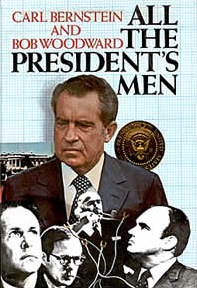
One factor was Woodward and Bernstein’s engaging book about their Watergate reporting, All the President’s Men, which came out in June 1974, just as the scandal was nearing culmination.

As Stanley I. Kutler, Watergate’s preeminent historian, has written, All the President’s Men “offered a journalistic brief to the nation as it prepared to understand and judge for itself” the growing evidence of Nixon’s guilt.

All the President’s Men was quite the success, holding the top spot on the New York Times’ non-fiction best-seller list for 15 weeks — through the climatic days of Watergate and beyond.

“The book’s impeccable timing,” I write in Getting It Wrong, served to “promote an impression that Woodward and Bernstein were central to Watergate’s ultimate outcome.”

The book that helped promote a myth

That impression was deepened in the cinematic version of All the President’s Men, which was released to great fanfare and rave reviews in April 1976.

The movie placed Woodward and Bernstein at the center of Watergate’s unraveling — and minimized or ignored the far more decisive contributions of subpoena-wielding investigators.

Indeed, rolling up a scandal of Watergate’s dimension and complexity required the collective efforts of special prosecutors, federal judges, both houses of Congress, the Supreme Court, as well as the Justice Department and the FBI.

And even then, as I write in Getting It Wrong, Nixon likely would have survived the scandal and served out his term if not for the audiotape recordings he secretly made of conversations in the Oval Office of the White House.

Only when compelled by the Supreme Court did Nixon surrender the recordings, which captured him approving a plan to divert the FBI’s investigation into Watergate’s seminal crime, the break-in June 17, 1972, at the headquarters of the Democratic National Committee.

The third factor in pressing the heroic-journalist myth firmly into the popular consciousness was the 30-year guessing game about the identity of Woodward’s stealthy, high-level source whom a Post editor code-named “Deep Throat.”

Speculation about the identity of “Deep Throat” came not infrequently and was often prominent. The guessing game offered periodic reminders about the Post and its Watergate coverage. The speculation effectively kept Woodward and Bernstein in the public eye far longer than they otherwise might have.

In 2005, W. Mark Felt, formerly second in command at the FBI, disclosed that he had been the “Deep Throat” source — giving rise to yet another round of reminiscing about the heroic journalists  of Watergate.

Such preening was misplaced, of course.

As Max Holland, author of Leak, a recent book about Watergate and “Deep Throat,” has aptly put it:

“Federal prosecutors and agents never truly learned anything germane from The Washington Posts [Watergate] stories — although they were certainly mortified to see the fruits of their investigation appear in print. … The government was always ahead of the press in its investigation of Watergate; it just wasn’t publishing its findings.”

Interestingly, principals at the Post have periodically scoffed at and rejected the heroic-journalist narrative.

For example, Katharine Graham, the Post’s publisher during and after Watergate, said at a program in 1997 marking the scandal’s 25th anniversary:

“Sometimes people accuse us of bringing down a president, which of course we didn’t do. The processes that caused [Nixon’s] resignation were constitutional.”

And Woodward  complained in 1996 that “the mythologizing of our role in Watergate has gone to the point of absurdity, where journalists write … that I, single-handedly, brought down Richard Nixon.

“Totally absurd.”

Indeed. To explain Watergate through the lens of the heroic-journalist is to simplify and misunderstand the scandal. It is to misread history and indulge in a beguiling media-driven myth.

WJC

Recent or related: