Here’s the book trailer for Getting It Wrong, my forthcoming book that addresses, and debunks, 10 prominent media-driven myths.
Getting It Wrong will be published this summer by University of California Press.
I received two advance copies of Getting It Wrong this afternoon. My wife says they look great, so that’s got to be the final word on that matter.
They do look very good.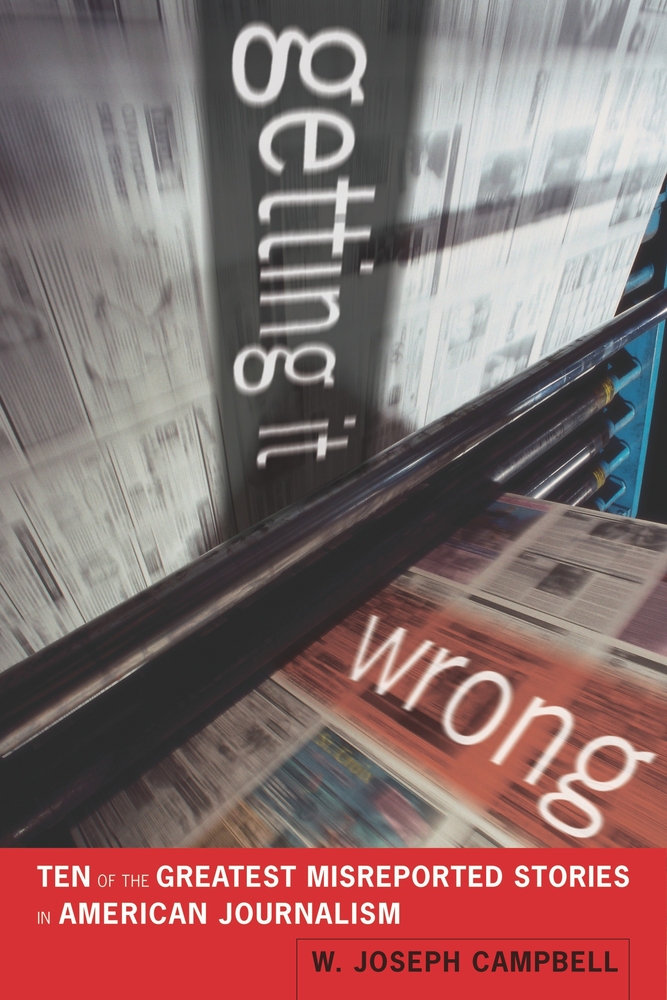
I had a feeling the advances were being delivered when the UPS truck rolled up in front of the house.
Getting It Wrong–which addresses and debunks 10 prominent media-driven myths–is being published by University of California Press. Reed Malcolm, the acquisition editor with whom I worked, enclosed a generous note, saying copies of the book are en route to warehouses on the East and West coasts.
Getting It Wrong should be on sale next month.
The book‘s opening chapter, which revisits William Randolph Hearst’s purported vow to “furnish the war” with Spain in the late 19th century, is available here.
Getting It Wrong has already attracted a measure of attention. I guest-blogged about the book at the Washington Post‘s “Political Bookworm” site and the newspaper’s “Outlook” section carried a short writeup about last month about three myths the book debunks.
It’s striking how a measure of fame still attaches to Jessica Lynch, the Army private thrust into the international spotlight seven years ago by an erroneous report in the Washington Post about her heroism in Iraq.
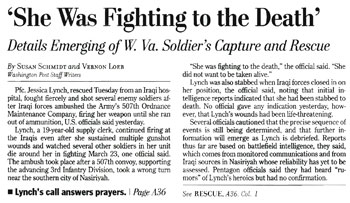
The Post's erroneous story
As I write in Getting It Wrong, my forthcoming book about media-driven myths, the “international spotlight … has never fully receded” from Lynch, a waif-like 19-year-old whom the Post misidentified as having fought fiercely after supposedly being shot and stabbed.
As it turned out, Lynch never fired a shot in anger in Iraq. She suffered neither gunshot nor stab wounds. She was severely injured, in the crash of a fleeing Humvee.
Lynch was taken captive by Iraqis and placed in a hospital, from where she was rescued by a U.S. special operation team.
The Post‘s botched report about her derring-do on the battlefield appears to have been a case of mistaken identity: It wasn’t Lynch who had fought heroically; it was most likely Sergeant Donald Walters, who was in Lynch’s unit and who was captured by Iraqi irregulars, and executed.
Walters never received anything near to the attention that was bestowed upon Lynch.
Further evidence of that came yesterday, with reports of a new show on cable’s Bio Channel that will feature William Shatner of Star Trek fame catching up with people who had won sudden fame and attention. (Bio formerly was the Biography Channel.)
Lynch was mentioned by name in writeups about the program, to be called Shatner’s Aftermath and to premiere in the fall. TV Guide said today that six episodes of Shatner’s Aftermath have been ordered.
The Post’s erroneous article about Lynch was published in early April 2003—and was picked up by news organizations around the world.
Lynch’s photograph appeared on the cover of Time and Newsweek magazines.
She insisted she was no hero. But no matter.
She accepted a book deal estimated at $1 million, half of which reportedly went to her biographer, Rick Bragg, a former New York Times correspondent. She went on morning and evening television shows to promote the book, I Am a Soldier, Too, which Bragg completed in time for publication on November 11, 2003—Veterans Day.
Lynch inspired a television movie, Saving Jessica Lynch. She was offered tuition-free education at West Virginia University. And she was named “West Virginian of the year” in 2003.
Although the frenzy long ago subsided, Lynch still pops up in the news from time to time. She still attracts a spotlight.
For example, NBC’s Today show in December 2009 featured the Lynch as one of the “buzziest” people in the news during the first decade of the 21st century.
In 2007, Lynch testified at a much-publicized hearing of the House Committee on Oversight and Government Reform. And she later wrote a first-person article for Glamour magazine.
She said in the Glamour article: “I don’t know why the military and the media tried to make me a legend.”
As I point out in Getting It Wrong, the story of Lynch’s heroics was a media-driven myth. The U.S. military was loath to promote the case. In fact, one of the Post reporters who worked on the erroneous article told NPR’s Fresh Air program in late 2003:
“I could never get anybody from the Pentagon to talk about those reports [of Lynch’s supposed heroism] at all. I got indications that they had, in fact, received those intelligence reports, but the Pentagon was completely unwilling to comment on those reports at all. They wouldn’t say anything about Jessica Lynch.”
NPR’s “Tell Me More” program yesterday became the latest national news outlet to revisit the “crack baby” scare of the late 1980s and 1990s, and pronounce it all had been overblown.
As in the recent Washington Post retrospective about “crack babies,” NPR failed to confront the news media’s central role in promoting and spreading what one leading researcher has called a “fantasy panic.”
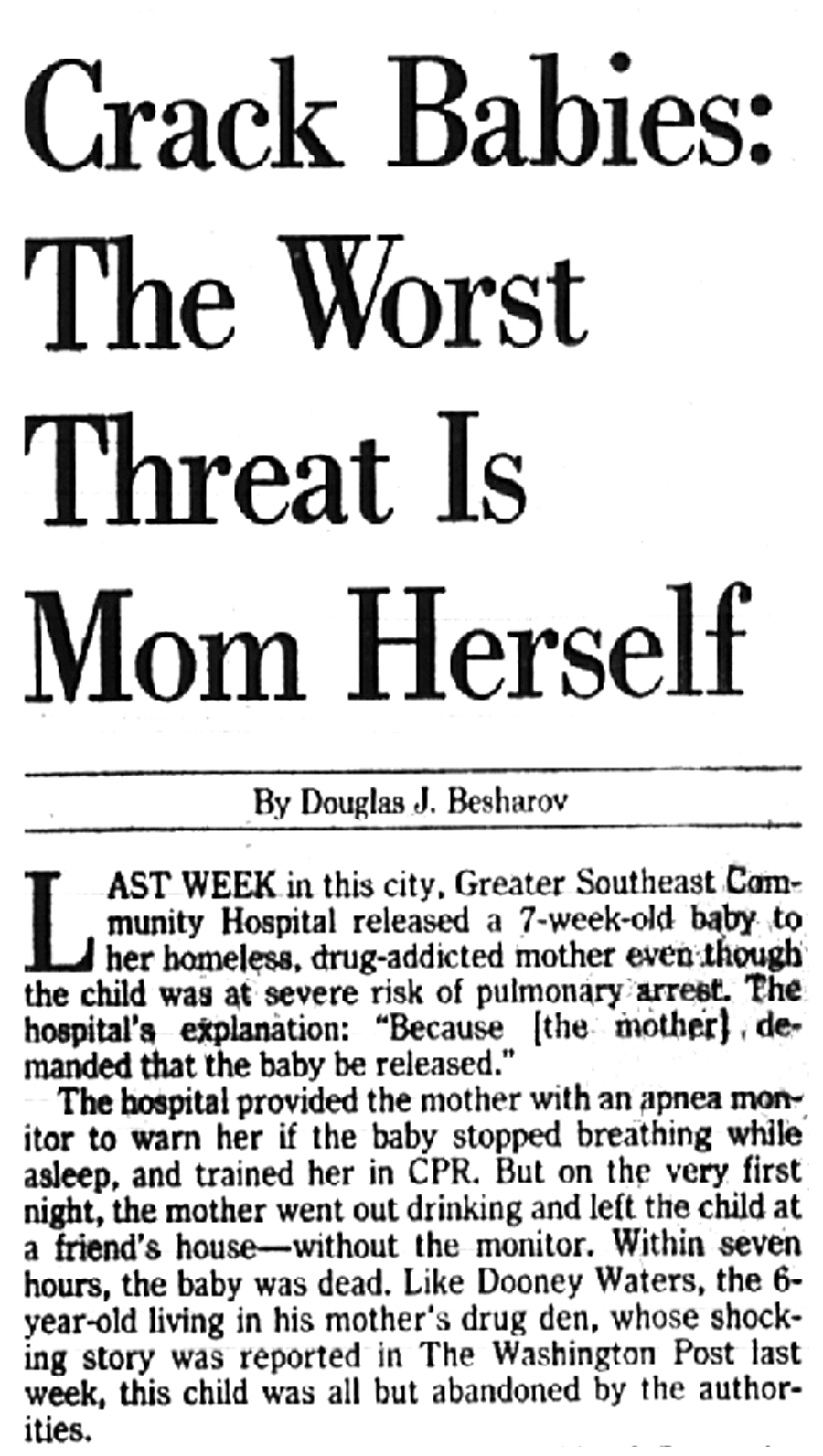
Washington Post, 1989
That turn of phrase inspired the title of the chapter about “crack babies” in Getting It Wrong, my forthcoming book that confronts and debunks 10 media-driven myths.
Getting It Wrong is being published this summer by University of California Press.
The crack-baby myth centers around the notion that women who took cocaine during pregnancy would give birth to children so mentally and physically deficient that they would constitute a helpless, dependent “bio-underclass,” as syndicated columnist Charles Krauthammer put it in 1989.
In Getting It Wrong, I call attention “to the risks of anecdote-driven reporting, which characterized news coverage of the crack baby phenomenon.
“Disturbing images and heart-wrenching descriptions of helpless newborns supposedly damaged by their mothers’ toxic indulgence were,” I write, “frequent and irresistible elements of the coverage. Anecdotes were fuel for a powerful but misleading storyline.”
Yesterday’s “Tell Me More” segment on “crack babies” overlooked all that, referring vaguely to “all manner of pronouncements about how children who were exposed to crack in utero were destined to a life of physical and mental disability.”
The program’s description at the “Tell Me More” online site ignored the news coverage, saying instead that “the nation’s health specialists panicked over the growing number of so-called ‘crack babies’—children exposed to crack cocaine in utero. These children were said to be doomed to lives of physical and mental disability.”
The panic, though, was largely media-driven, as I discuss in Getting It Wrong.
The “Tell Me More” segment–which noted that “children who [had been] exposed to crack cocaine before birth are proving these worst case scenarios were all wrong”–did include an intriguing, media-related passage.
That came late in the show, when Dr. Carl Bell, a clinical professor of psychiatry and public health at the University of Illinois-Chicago, spoke of “media epidemiology.”
He said:
“I think it’s important for society to move away from what I refer to as media epidemiology and media hypotheses and making all these generalizations about things because frequently they’re flat out wrong, as it shows.”
I asked Bell by email to elaborate on “media epidemiology.”
He replied, stating:
“‘Media epidemiology’ is a term I began using about two years ago to describe how the public gets its understanding about epidemiology of various public health issues from the media, which of course is the absolutely wrong place to get such information as the media does not report on the common but on the uncommon which is defined as news.
“For example, ten years ago the homicide rates in Chicago were 1,000 but because of a lot of work done in public health in the city the homicide rates are down to 500, but the media keeps referring to the ‘homicide epidemic’ in Chicago; thereby misleading the public with their ‘media epidemiology.'”
It, too, is’ an interesting turn-of-phrase–and may help explain why the news media sometimes get it wrong in reporting on issues of science and public health.
A commentary today at the Huffington Post blog salutes trailblazing, rule-breaking American women–including the elusive “bra-burners” of the 1960s.
The commentary reads in part:
“From Revolutionary War icon Betsy Ross to World War II’s Rosie the Riveter, from sexually liberated 1920s femme fatale Louise Brooks to bra-burning feminists in the 1960s, from anti-slavery orator Sojourner Truth to controversial civil rights activist Angela Davis, American history is filled with female archetypes who pushed against the barriers of repression and social convention.”
True enough: History indeed counts many “female archetypes who pushed against the barriers of repression and social convention.”
But as for those “bra-burning feminists in the 1960s”–just who were they?
The commentary doesn’t say, leaving an implication that bra-burning was widespread, and even commonplace, during the 1960s.
Which just isn’t so.
 I devote a chapter to bra-burning in Getting It Wrong, my forthcoming book about media-driven myths.
In that chapter, I trace the diffusion of the “bra-burning” epithet to the aftermath of the Miss America pageant at Atlantic City, N.J., on September 7, 1968.
That afternoon, about 100 women gathered on the Atlantic City boardwalk to protest the pageant as degrading to women.
A highlight of the afternoon came when demonstrators tossed into a barrel what they called “instruments of torture,” including brassieres, girdles, high-heeled shoes, and such magazines as Playboy and Cosmopolitan. The protesters dubbed the barrel the Freedom Trash Can.
The protest organizers, who included the feminist and former child actor Robin Morgan, have long insisted that the bras and other contents of the Freedom Trash Can were not set afire during the protest.
But the notion that bras had been set ablaze in flamboyant protest became a misleading legacy of that long-ago afternoon–an image promoted and spread by columnists Harriett Van Horne and Art Buchwald.
Neither of them was at the protest.
Two days afterward, Van Horne wrote in her column that there had been a bonfire in a Freedom Trash Can.
“With screams of delight,” she said of the protesters, “they consigned to the flames such shackling, demeaning items as girdles, bras, high-heeled slippers, hair curlers and false eyelashes.”
As I write in Getting It Wrong, this highly imaginative characterization was taken up a few days later by Art Buchwald in his nationally syndicated column.
Buchwald, who by then was American journalism’s leading humor columnist, wrote with tongue in cheek that he had been “flabbergasted to read that about 100 women had picketed the Miss America pageant in Atlantic City against ‘ludicrous beauty standards that had enslaved the American woman.’”
He also wrote:
“The final and most tragic part of the protest took place when several of the women publicly burned their brassieres.”
And he closed the column by writing:
“If the women in Atlantic City wanted to picket the Miss America beauty pageant because it is lily-white, that is one thing, and if they wanted to picket because it is a bore, that is also a legitimate excuse. But when they start asking young American women to burn their brassieres and throw away their false eyelashes, then we say dissent in this country has gone too far.”
And an embryonic media-driven myth had begun to emerge.
Recent and related:
I had a chance today to thumb through The War Lovers, the widely reviewed new book by Evan Thomas about the run-up to Spanish-American War.
But I didn’t buy it. It’s a myth-indulging disappointment.
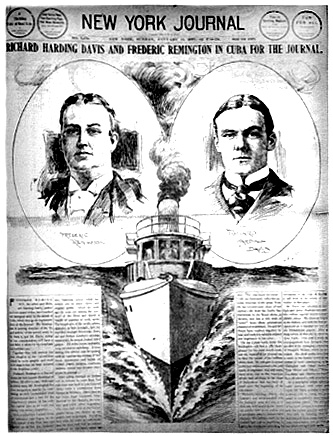
Remington in Cuba
In sections of the book about the yellow press period at the end of the 19th century, Thomas ignored–or was unaware of–recent scholarship that has cast serious doubt on anecdotes he included.
Notably, Thomas embraced the media-driven myth of William Randolph Hearst’s purported vow to “furnish the war” with Spain–a vow supposedly contained in a telegram to the artist Frederic Remington, on assignment in Cuba.
It is perhaps American journalism’s best-known tale. But as I wrote in my 2001 book, Yellow Journalism: Puncturing the Myths, Defining the Legacies, the anecdote almost certainly is apocryphal.
It lives on despite a nearly complete absence of supporting documentation. It lives on even though the telegram Hearst’s reputedly sent has never turned up. It lives on even though Hearst denied ever sending such a message.
And it lives on despite an obvious and irreconcilable internal inconsistency: It would have been absurd for Hearst to have vowed to “furnish the war” because war—specifically, the Cuban rebellion against Spain’s colonial rule—was the reason Hearst sent Remington to Cuba in the first place.
Remington was there in early 1897, at a time when anyone reading U.S. newspapers would have been quite aware that Cuba for two years had been a theater of a very nasty war. By 1897, Spain had sent nearly 200,000 soldiers to Cuba in a failed attempt to put down the rebellion, which in 1898 gave rise to the Spanish-American War.
Thomas–whose biography at Amazon.com says he “is one of the most respected historians and journalists writing today”–overlooked almost all of that.
He cited as his authority James Creelman, the pompous, hyperbolic reporter for Hearst’s New York Journal who recounted the anecdote, without documentation, in his 1901 memoir, On the Great Highway.
Creelman presented the “furnish the war” anecdote in an admiring way, saying it demonstrated how Hearst’s “yellow journalism” had an eye toward the future and was good at anticipating events. But over the years, the vow has taken on the more sinister overtones, of the sort that Thomas invoked in his book.
The anecdote’s evolution over the past 110 years is discussed in Chapter One of Getting It Wrong, my forthcoming book on media-driven myths.
Creelman, by the way, wasn’t with Remington in Cuba in early 1897. He wasn’t in New York with Hearst, either. Creelman was in Europe, as the Journal‘s special correspondent on the continent. So he would not have had first-hand knowledge about the “furnish the war” telegram, had Hearst sent it to Remington in Cuba.
Thomas indulged in another myth of yellow journalism, one that centers around what I call the greatest escape narrative in American media history.
In what also is known as the case of “jail-breaking journalism,” Hearst’s Journal organized the escape in 1897 of a 19-year-old Cuban political prisoner named Evangelina Cisneros.
By then, she had been held in a Havana jail, without trial, for 15 months on suspicion of conspiring to kill a senior Spanish military officer. Cisneros claimed the officer had made her the target of unwelcome sexual advances.
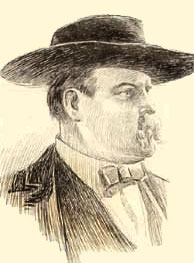
As I described in my 2006 book, a year-study titled The Year That Defined American Journalism: 1897 and the Clash of Paradigms, Hearst sent a reporter named Karl Decker to Cuba, ostensibly as the Journal correspondent in Havana.
In reality, Decker was under orders to organize the rescue of Cisneros.
With the quiet help of U.S. diplomatic personnel in Cuba, and with the vital support of a clandestine smuggling network in Havana, Decker succeeded: He and two accomplices broke Cisneros out of jail in early October 1897. She was smuggled aboard a passenger steamer to New York City, where Hearst organized a delirious reception for her.
Thomas claimed that Decker, in articles the Journal published about jailbreak, “neglected to inform readers that he had bribed the guards, who arranged the theater of the escape as a way to save face.”
Decker
Such claims have circulated since 1897, mostly as a way to denigrate the Journal and its brazen accomplishment. Decker did say he tried, but failed, to bribe the jailer.
As is noted in The Year That Defined American Journalism, the evidentiary record to support the claim that bribes were paid is very, very thin.
“No one has identified to whom bribes were paid, how much, by what method, and how the purported payoffs secured the enduring silence of the authorities,” I wrote, adding:
“The allegations or suspicions of bribery rest more on assertion—and newspaper rivals’ contempt for the Journal—than on specific, persuasive documentation.”
It’s a good story, though. Like many media-driven myths, the Decker-bribery tale is delicious and enticing.
But it withers under scrutiny.
Two dozen men and women bared torsos and marched in Farmington, Maine, yesterday, prompting a snarky commentary in the Bangor Daily News about social protests–and bra-burning.
“In the 1960s and 1970s there was that whole Vietnam War issue and the sexual revolution to boot. There were lots of things to protest and stand for,” the commentary declared, adding:
“During that time I believe there were more than a few college-age women who burned their bras. Some believe young women tossed their bras into burning trash cans as a protest of the Vietnam War, but others stand firm that the first ‘bra burning’ incident actually occurred in 1968 at a demonstration against the Miss America contest.”
Like many discussions about bra-burning–a topic addressed in Getting It Wrong, my forthcoming book about media-driven myths–the commentary is more than a bit tangled and confused.
As I write in Getting It Wrong, the notion of bra-burning took hold in the days after the Miss America pageant at Atlantic City, N.J., on September 7, 1968.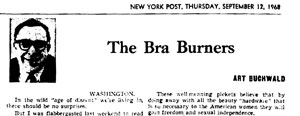
“Early that afternoon,” I write, “about 100 women from New York City, New Jersey, Boston, Washington, D.C., and elsewhere arrived by bus at the Atlantic City boardwalk.
“They were, according to the New York Times, ‘mostly middle-aged careerists and housewives’ and they set up a picket line at Kennedy Plaza, across from the Convention Center. They were there, as one participant declared, ‘to protest the degrading image of women perpetuated by the Miss America pageant,’ which took place that night inside the Convention Center.”
A highlight of their protest came when the demonstrators tossed into a barrel what they called “instruments of torture,” including brassieres, girdles, high-heeled shoes, and magazines such as Playboy and Cosmopolitan. The protesters dubbed the barrel the Freedom Trash Can.
The protest organizers, who included the activist and former child actor Robin Morgan, have long insisted that bras and other contents of the Freedom Trash Can were not set afire during the protest.
But the notion that bra-burning was a dramatic element of the demonstration at Atlantic City was driven by syndicated columnists, including Harriett Van Horne.
Soon after the protest, Van Horne wrote that the protesters had been “scarred by consorting with the wrong men. Men who do not understand the way to a woman’s heart, i.e., to make her feel utterly feminine, desirable and almost too delicate for this hard world. … No wonder she goes to Atlantic City and burns her bra.”
Van Horne was not at the protest, however. Nor was Art Buchwald, then American journalism’s preeminent humorist, who played on the bra-burning trope in a column published in the Washington Post and other newspapers.
With tongue in cheek, Buchwald wrote that he had been “flabbergasted to read that about 100 women had picketed the Miss America pageant in Atlantic City against ‘ludicrous beauty standards that had enslaved the American woman.’”
He added: “The final and most tragic part of the protest took place when several of the women publicly burned their brassieres.”
As I note in Getting It Wrong, Buchwald’s “characterization of the protest at Atlantic City introduced the notion of flamboyant bra-burning to a national audience, conjuring as it did a powerful mental image of angry women setting fire to bras and twirling them, defiantly, for all … to see.”
But as for the claim in the Bangor Daily News commentary that “more than a few college-age women … burned their bras” in the 1960s and 1970s, well, the supporting evidence just isn’t there.
When the Daily Show’s Jon Stewart weighed on the Apple-Gizmodo dust-up over the lost prototype of a next generation iPhone, it was akin to Walter Cronkite’s taking to the air to criticize the U.S. war effort in Vietnam in 1968.
Or so says an item posted yesterday at the tech-news blog DVICE.
Stewart the other night called out Apple over the police search at the home of the Gizmodo editor who had blogged about the iPhone prototype, which an Apple employee reportedly had lost at a bar.
In a segment about the Gizmodo controversy, Stewart in mock lament asked of Apple: “Are you becoming the Man?”
He also said in skewering Apple: “I mean, if you want to break down someone’s door, why don’t you start with AT&T, for god’s sake? They make your amazing phone unusable as a phone.”
In reaching–overreaching–for significance, DVICE said of Stewart’s segment:
“Is that a paradigm we feel shifting? It reminds us of when President Lyndon Johnson got dissed by Walter Cronkite in a scathing report on the futility of the Vietnam War, with Johnson saying, ‘If I’ve lost Cronkite, I’ve lost Middle America.'”
Interesting analogy.
Trouble is, there’s no documented evidence of Johnson ever having said anything of the sort.
The Cronkite-Johnson anecdote is one of 10 media-driven myths that I address, and debunk, in my forthcoming book, Getting It Wrong.
The anecdote–often called the “Cronkite moment“–centers around the special report on Vietnam that aired February 27, 1968, on CBS. At the end of the program, Cronkite declared the U.S. military effort in Vietnam was “mired in stalemate” and suggested a negotiated settlement would be the only way out.
Legend has it that Johnson watched the program at the White House and, upon hearing Cronkite’s editorial comment, snapped off the television and said to an aide or aides:
“If I’ve lost Cronkite, I’ve lost Middle America.”
Or words to that effect. Versions vary.
But as I note in Getting It Wrong, Johnson wasn’t in Washington when the Vietnam special was shown. He was in Austin, Texas, at the 51st birthday party of Governor John Connally–and did not see the Cronkite program.
As such, I write:

Johnson in Austin, February 27, 1968
“Johnson did not have—could not have had—the abrupt yet resigned reaction that so often has been attributed to him.”
Moreover, I add, “Johnson’s supposedly downbeat, self-pitying reaction to Cronkite’s on-air assessment clashes sharply with the president’s aggressive characterization about the war. Hours before the Cronkite program, Johnson delivered a little-recalled but rousing speech on Vietnam, a speech cast in Churchillian terms. It seems inconceivable that Johnson’s views would have pivoted so swiftly and dramatically, upon hearing the opinion of a television news anchor, even one as esteemed as Cronkite.”
I further write in Getting It Wrong that even if the president had “later heard—or heard about—Cronkite’s assessment, it was no epiphany for Johnson. Not long after the program, Johnson gave a rousing, lectern-pounding speech in which he urged a ‘total national effort’ to win the war in Vietnam.”
So Johnson “got dissed” by Cronkite? One might say that, but Johnson didn’t care. Or even know about it. Not immediately.
And more important, Cronkite’s comments made no significant difference to Johnson and his Vietnam policy.
The online site of the School of Communication here at American University posts today a Q-and-A with me about Getting It Wrong, my forthcoming book that debunks 10 prominent media-driven myths.
Topics addressed include the Remington-Hearst/furnish the war anecdote; the War of the Worlds/mass hysteria myth, and the “Cronkite moment“/”I’ve lost Middle America” meme.
And while the topic is not considered in Getting It Wrong, I also mention the “pharm parties” myth, in which young people are said to take pills of any kind from their parents’ medicine cabinets. They supposedly show up at a party and dump the purloined pills into a large, common bowl. Then they are purported to take turns scooping out and swallowing handfuls of the medications, not knowing what they’re taking, in the supposed pursuit of a drug-induced high.
Jack Shafer, media critic for slate.com, has done fine work in knocking down the “pharm party” meme.
Here are excerpts from the Q-and-A:
Q: “Myth busting” can upset people who have accepted, or even benefited from, the myth. Have you gotten any negative feedback?
A: Not really. Not so far. I do know that some people wonder “who cares?” about some of the myths debunked in Getting It Wrong. The Hearst—”furnish the war” myth, after all, is more than 100 years old. But I emphasize in the book that media-driven myths are neither innocuous nor trivial. They can, and do, promote stereotypes. They can deflect attention or blame away from the makers of flawed policies. They can, and often do, offer an exaggerated sense of the power and influence of the news media. Plus, debunking myths is a pursuit that’s aligned with a fundamental objective of mainstream American journalism—that of getting it right.
Q: What’s next?
A: I’d like to think there’s a sequel to Getting It Wrong. The universe of media-driven myths isn’t confined to 10, after all. There are more to confront. Also, in fall 2010, I’ll be teaching a “wild card” course in the University’s General Education program titled “Media Myth and Power.” The course will consider several of the myths debunked in Getting It Wrong.
A tip of the chapeau to Michael Wargo of the School of Communication for putting together the Q-and-A, which follows the writeup about the book that appeared April 11 in the “Outlook” section of the Washington Post.
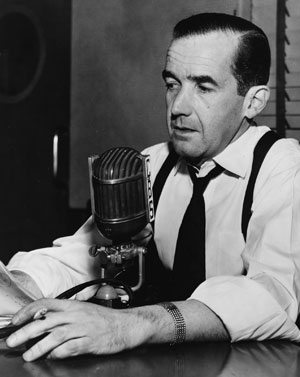
The Poughkeepsie Journal notes the 45th anniversary today of the death of legendary broadcast journalist Edward R. Murrow.
Murrow died April 27, 1965, at his farm near Pawling, N.Y., about 20 miles from Poughkeepsie. Murrow, a chainsmoker, fell victim to lung cancer. He had just turned 57.
Chainsmoking Ed Murrow
Inevitably, the Poughkeepsie Journal tribute–which carried the headline, “Journalism hero Edward R. Murrow lives on”–recalled Murrow’s famous See It Now documentary program in March 1954. That was when he took on the red-baiting Republican senator from Wisconsin, Joseph R. McCarthy.
The newspaper’s article said Murrow’s program on McCarthy “is credited for exposing the senator’s tactics by using clips of his own words, and helped lead to the senator’s downfall.”
The program’s mythical dimensions are addressed in my forthcoming book, Getting It Wrong, in which I note:
“See It Now that night was powerful television. More accurately, it was a hearty serving of advocacy journalism. … Murrow and his See It Now team assembled a series of film clips that was decidedly unflattering to McCarthy.”
I also write:
“McCarthy’s oddball appearance and mannerisms—his hulking, menacing presence, his nutty laugh, his five o’clock shadow, his careless grooming that allowed strands of thinning, greasy hair to creep down his forehead—were among the most revealing and most unforgettable moments of the program.”
But did the show expose McCarthy’s tactics?
Not at all.
McCarthy had burst upon the national scene four years earlier, claiming in a series of speeches that scores of communists, communist sympathizers, or persons of risk were embedded in the U.S. State Department.
His charges were almost immediately challenged by Drew Pearson, a nationally syndicated muckraking columnist based in Washington, D.C.
“The Senator from Wisconsin has been a healthy watchdog of some government activities, but the alleged communists which he claims are sheltered in the State Department just aren’t,” Pearson wrote in February 1950, more than four years before Murrow’s program on McCarthy.
So did the See It Now show “helped lead to the senator’s downfall,” as the Poughkeepsie Journal claims?
Not so much.
By the time Murrow took to the air to confront McCarthy, the senator’s favorability ratings had already hit the skids.
As I write in Getting It Wrong, “it wasn’t as if Americans in early 1954 were hoping for someone to step up and expose McCarthy, or waiting for a white knight like Murrow to tell them about the toxic threat the senator posed.”
Thanks to Pearson, and other journalists, they knew.

 Media Myth Alert