The New York Times yesterday announced it was ending “On Language,” a quirky and popular column that has appeared 32 years in its Sunday magazine.
For 30 years, it was the venue for the sometimes-obscure, sometimes-brilliant work of William Safire, a Pulitzer Prize-winning columnist who died in 2009.
Of the column’s passing, the incumbent writer of “On Language” stated that time had come “to bid adieu, after some 1,500 dispatches from the frontiers of language.”
That vague and unsatisfactory explanation notwithstanding, the end of “On Language” offers an occasion to revisit, and offer a tip of the chapeau to, Safire’s laudable effort to call attention to a prominent media myth — that famous, often-invoked but totally made-up line of Watergate, “follow the money.”

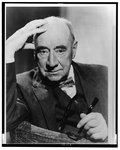
Safire, 2006
In an “On Language” column titled “Follow the Proferring Duck” and published August 3, 1997, Safire wrote:
“Who first said ‘Follow the money’? Everybody knows the answer: ‘Deep Throat,’ the anonymous source quoted by Bob Woodward and Carl Bernstein in their book ‘All the President’s Men.’ Those three words from a mysterious Administration official whose identity is unknown even today impelled the young journalists to money laundered in Mexico and ultimately to payments to burglars and a Nixon White House slush fund.
“But wait,” Safire added, “thanks to Daniel Schorr, the National Public Radio commentator … we now have a new and disconcerting take on the origin of the famous phrase.”
Safire explained that Schorr had searched All the President’s Men for the phrase, and had failed to find it.
“Nor was it in any of the Watergate reporting in the Washington Post,” Safire wrote. The line first appeared in the cinematic version of All the President’s Men. It was spoken by the actor Hal Holbrook, who played the stealthy “Deep Throat” character.
“The screenplay was written by William Goldman,” Safire noted. “When Schorr called him, the famed screenwriter at first insisted that the line came from the book; when proved mistaken about that, he said: ‘I can’t believe I made it up. I was in constant contact with Woodward while writing the screenplay. I guess he made it up.’
“Schorr then called Woodward, who could not find the phrase in his exhaustive notes of Watergate interviews. The reporter told Schorr he could no longer rely on his memory as to whether Deep Throat had said the line and was inclined to believe that Goldman had invented it.”
Safire added:
“If the line was indeed a fiction, as it seems to be, what does that portend for its nonfictional source? Schorr only poses the question, but the irony is this:
“When recently asked on ‘Meet the Press’ what the lasting legacy of Watergate was after a quarter-century, Ben Bradlee of the Washington Post (brilliantly portrayed in the movie by Jason Robards Jr.) replied with the words of William Goldman: ‘Follow the money.'”
Indeed, the transcript of the program shows Bradlee did say that.
(In 2005, W. Mark Felt came forward to say was Watergate’s “Deep Throat.” Not long afterward, Goldman took credit for having written “follow the money” into the screenplay.)
If anything, “follow the money” has become more popular — and invoked more often — in the years since Safire wrote the column.
As I’ve noted at Media Myth Alert, “follow the money” is pithy, punchy, and easily remembered; like many other media myths, it is readily applicable.
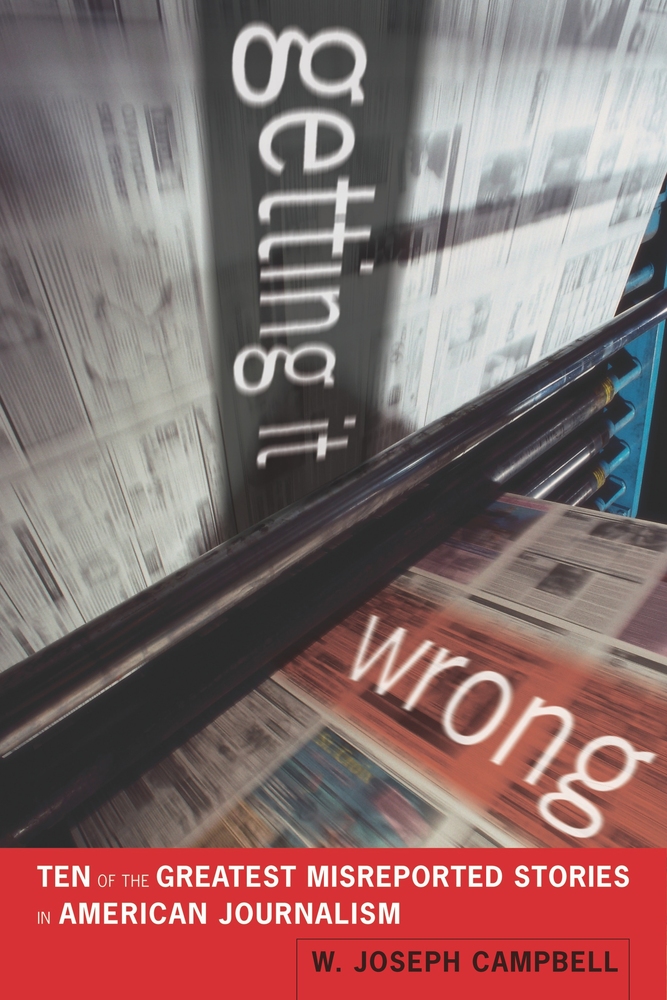
And as I write in my latest book, Getting It Wrong:
“Turns of phrase that sound too neat and tidy often are too perfect to be true.” William Randolph Hearst’s pithy vow to “furnish the war” with Spain is a particularly telling example.
“Follow the money” lives on for other reasons, too. After all, it supposedly represented vital guidance in rolling up the Watergate scandal.
Its purported decisiveness certainly helps explain why the line crossed so smoothly from the silver screen to the vernacular.
But Watergate, of course, was more than a matter of identifying, pursuing, and explaining a money trail. In the end, Richard Nixon’s attempts to obstruct justice by covering up the break-in at headquarters Democratic national committee headquarters in 1972 was what brought down his presidency.
Safire, by the way, had been a speechwriter for Nixon during his presidency. And Safire used an “On Language” column in 1984 to challenge another hardy media myth — that Nixon ran for president in 1968 claiming to have a “secret plan” to end the war in Vietnam.
Recent and related:
- A debunker’s work is never done
- A history lesson not to miss? No, but it’s entertaining
- Keller no keeper of the flame on famous NYT motto
- Two myths and today’s New York Times
- NYTimes flubs the correction
- Who, or what, brought down Nixon?
- Follow the tenspot
- Suspect Murrow quote pulled at Murrow school
- The Post ‘took down a president’? That’s a myth
- Didn’t: A Watergate primer
- ‘Exquisitely researched and lively’





 Media Myth Alert
Bay of Pigs, Commentary, Cuba, Debunking, Fact-checking, Getting It Wrong, History, Journalism, Keller, Media, Media-driven myths, New York Times, News, Research
Fact-checking Keller on NYT-Bay of Pigs suppression myth
In Anniversaries, Bay of Pigs, Debunking, Media myths, New York Times on January 28, 2011 at 11:57 am'Publish it did'
In an article to be published Sunday, Bill Keller, executive editor of the New York Times, rubs shoulders with a tenacious media myth linked to the newspaper’s reporting in the run-up to the Bay of Pigs invasion nearly 50 years ago.
I devote a chapter to the New York Times-Bay of Pigs suppression myth in my latest, mythbusting book, Getting It Wrong.
The suppression myth has it that the Times, at the request of President John F. Kennedy, suppressed or emasculated its reporting about the pending Bay of Pigs invasion of Cuba.
But as I discuss in Getting It Wrong, in the 10 days before the ill-fated assault, the Times published several detailed reports on its front page discussing an invasion and exiles’ calls to topple Fidel Castro. And, I note, there is no evidence that Kennedy either asked or persuaded the Times to suppress, hold back, or dilute any of its pre-invasion reporting.
“The anecdote about the Times’ self-censorship is potent, compelling, instructive, and timeless,” I write in Getting It Wrong . “It also is apocryphal, a media-driven myth.”
Keller, though, repeats the myth in a lengthy article to run in the Times Sunday magazine about his newspaper’s dealings with Julian Assange, head of Wikileaks, which not long ago disclosed the contents of thousands of classified U.S. diplomatic cables.
Keller invokes the Bay of Pigs as an example of the newspaper’s having erred “on the side of keeping secrets.”
He writes:
“I’m the first to admit that news organizations, including this one, sometimes get things wrong. We can be overly credulous (as in some of the prewar reporting about Iraq’s supposed weapons of mass destruction) or overly cynical about official claims and motives. We may err on the side of keeping secrets (President Kennedy reportedly wished, after the fact, that The Times had published what it knew about the planned Bay of Pigs invasion, which possibly would have helped avert a bloody debacle) or on the side of exposing them. We make the best judgments we can.”
Had Keller consulted the newspaper’s database of reporting about the run-up to the Bay of Pigs invasion in April 1961, he would have found that the Times reported in detail, if not always accurately, about the preparations to infiltrate a U.S.-trained brigade of Cuban exiles in an attempt to topple Fidel Castro.
The invasion failed, and the anti-Castro exiles were mostly killed or captured. The foreign policy debacle came less than three months into Kennedy’s presidency.
As I write in Getting It Wrong, “the notion that Kennedy asked or persuaded the Times to suppress, hold back, or dilute any of its reports about the pending Bay of Pigs invasion is utter fancy. There is no evidence that Kennedy or his administration knew in advance about the Times report of April 7, 1961, a front-page article that lies at the heart of this media myth” (see image, above).
The report was filed from Miami by veteran Timesman Tad Szulc who, I write, “pieced together the outline of CIA-backed plans to attempt to topple Castro with an invasion force of Cuban exiles who had been trained in Guatemala.”
The invasion plans, Szulc found, were an open secret in Miami. “It was,” he was later to say, “the most open operation which you can imagine.”
On April 6, 1961, Szulc filed a dispatch to New York, reporting that 5,000 to 6,000 Cuban exiles had been trained in a plan to overthrow Castro, that invasion plans were in their final stages, and that the operation had been organized and directed by the CIA.
Szulc’s dispatch report ran more than 1,000 words and, I write in Getting It Wrong, “set off a flurry of intense consultations among senior editors.” Their deliberations revolved around three elements: Szulc’s characterization that the invasion was imminent, the reference to the operation being CIA-directed, and the prominence the report should receive on the Times front page.
In the end, the references to the invasion’s imminence were dropped; it was more prediction than fact, as James Reston, the Times Washington bureau chief at time, pointed out. (The invasion was launched April 17, 1961, 11 days after Szulc filed his dispatch.)
The reference to CIA also was dropped, in favor of the more nebulous terms phrases, “U.S. officials” and “U.S. experts. The then-managing editor, Turner Catledge, later wrote that the decision was based on the reality the government had more than a few intelligence agencies, “and I was hesitant to specify the CIA when we might not be able to document the charge.”
As for the report’s prominence, the decision was to publish Szulc’s story on the front page, beneath a single-column headline, instead of a four-column headline. Given that the invasion wasn’t deemed imminent, a four-column headline was difficult to justify.
I write in Getting It Wrong that although “the headline size was modified, Szulc’s report hardly can be said to have been played down. It certainly had not been spiked, diluted, or emasculated. Szulc’s report, as Catledge wrote, made ‘perfectly clear to any intelligent reader that the U.S. government was training an army of Cuban exiles who intended to invade Cuba.'”
As Timesman Harrison Salisbury wrote in Without Fear or Favor, his insider’s account of the Times:
“The government in April 1961 did not … know that The Times was going to publish the Szulc story, although it was aware that The Times and other newsmen were probing in Miami. … The action which The Times took [in editing Szulc’s report] was on its own responsibility,” the result of internal discussions and deliberations recognizable to anyone familiar with the give-and-take of newsroom decision-making.
But most important, as Salisbury pointed out, “The Times had not killed Szulc’s story. … The Times believed it was more important to publish than to withhold.
“Publish it did.”
As for Kennedy’s remark, that he wished the Times “had run everything on Cuba”: The comment was vague and self-serving, an attempt to deflect blame from his administration’s first-rate foreign policy disaster.
Besides, what was it that the Times supposedly held back? The president didn’t specify.
Nor does Keller.
WJC
Many thanks to Instapundit Glenn Reynolds for linking to this post
Recent and related:
[i] Arthur Schlesinger, the historian and Kennedy adviser, claimed that Szulc’s story had been “emasculated” by Times editors. See “Rebuttal Is Made by Schlesinger,” New York Times (14 June 1966): 15.
Share this: