W. Joseph Campbell

Archive for the ‘Newspapers’ Category

Editor’s little-noted memoir offers intriguing insight about WaPo’s Watergate reporters

In Media myths, Newspapers, Scandal, Washington Post, Watergate myth on December 21, 2013 at 6:12 am

It’s mentioned on few if any “books of the year” lists, but the recent memoir by a former Washington Post editor offers revealing insights about the newspaper’s lead Watergate reporters, describing how one of them, Carl Bernstein, was such a slacker that he was nearly dismissed in the early 1970s.

Rosenfeld memoir_coverThe memoir, From Kristallnacht to Watergate, is Harry Rosenfeld’s telling of his long career in newspapering. He was the Post’s metropolitan editor during Watergate and managed Bernstein and Bob Woodward, who in 1972 and 1973 were the newspaper’s lead reporters on the unfolding scandal.

Rosenfeld’s memoir adds dimension to the ample, mostly glowing public record about Bernstein and Woodward, who have been celebrated over the years as heroic journalists whose dogged reporting brought down the presidency of Richard Nixon.

Or so the media myth has it.

Rosenfeld comes close in his book to embracing the myth of Watergate, stating that the Post “played a key role in assisting the ship of state to stay the course while navigating through the stormy waters of a constitutional crisis” that brought Nixon’s resignation in 1974. He makes scant acknowledgement of the more powerful investigative forces — congressional and judicial — that combined to uncover Nixon’s criminal misconduct and bring an end to his presidency.

As I discuss in my media mythbusting book, Getting It Wrong, the contributions of Woodward and Bernstein to Watergate’s outcome were modest at best.

Rosenfeld writes with evident pride about Woodward and the “intensity of his work habits.” By the time the Watergate scandal broke in 1972, Rosenfeld says, Woodward “had established himself as a fully qualified reporter, sharper than most and more ambitious and hardworking than any.”

The most delicious passages of Rosenfeld’s book discuss Bernstein’s troubled times at the Post during the period before and shortly after the break-in in June 1972 at the headquarters in Washington of the Democratic National Committee, the signal crime of the Watergate scandal.

Bernstein, he writes, routinely antagonized his editors, was known for missing deadlines while regularly logging many hours of unapproved overtime, and was notorious for failing to submit expense reports. He also had a tendency on assignments to rent cars that he was slow to return, running up late charges for the Post.

Bernstein (Newseum photo)

Bernstein (Newseum photo)

After such a caper in the summer of 1972, the Post’s executive editor, Ben Bradlee, and its managing editor, Howard Simons, wanted Rosenfeld to fire Bernstein. He had “yet again rented a car and left it stranded in a parking lot for days, with costly rental fees mounting by the hour,” Rosenfeld writes.

But Rosenfeld demurred, telling the editors that dismissing Bernstein made no sense when, “‘for once in his life, Carl is producing the goods'” in reporting on the unfolding Watergate scandal. Bernstein kept his job.

Rosenfeld had laid groundwork for dismissing Bernstein in 1971, after the reporter had failed to submit an article about the port of Norfolk, VA, despite his many promises to produce the story.

Rosenfeld sat in on what he called “a heart-to-heart” conversation between Bernstein and his then-editor, Kevin Klose, who later became dean of the College of Journalism at the University of Maryland.

After the heart-to-heart, Rosenfeld wrote in a memorandum that it had been made clear to Bernstein “‘that he either begins to be a productive reporter or he and the Post better go separate ways and that if cannot soon come to grips with his responsibilities to his job, that I would move against him on negligence of duty. …'”

Bernstein, Rosenfeld wrote in the memorandum, “‘understood that if he could not become productive and that if he and his editors continued to be antagonistic all the time, it would be better for him to leave. He said that … I would see a much changed man.’

“That new man,” Rosenfeld says, “clearly emerged in Watergate — a full year after his pledge. In the course of Watergate, the tiger changed his stripes, the leopard his spots, and Joshua commanded the sun not to set and the moon to stand still. The transformation was that epic. …. If he had persisted in his old ways … he almost surely would have been fired, for which the legal groundwork had been laid.”

Still, Bernstein’s redemption was less than total. Even when doing his best work, Rosenfeld notes in the book, Bernstein “still managed to remain irritating.”

So why, more than 40 years afterward,  is all of this important?

As Rosenfeld notes, it is “worth contemplating” how Bernstein — who remains one of America’s best-known and most outspoken journalists — nearly missed having an “historic role” in the Watergate story. Rosenfeld’s memoir also demonstrates how unpopular Bernstein was in the Post’s newsroom.

More important is that Rosenfeld’s unflattering characterizations, which clearly are offered not in hostility, bring some depth to the almost-reflexive characterizations of Bernstein as heroic, as a superstar. The unflattering material helps to deepen and round out the biography in a way that Woodward and Bernstein certainly did not do in their bestselling 1974 book, All the President’s Men.

Finally, the passages about Bernstein serves as a reminder that the most engaging memoirs are those not sanitized. Although the book has not received wide attention, Rosenfeld’s memoir is commendable for its candor about Bernstein.

WJC

More from Media Myth Alert:

Final thoughts on a flawed PBS documentary

In Debunking, Error, Media myths, Media myths and radio, Newspapers, War of the Worlds on November 9, 2013 at 1:51 pm

It’s testimony to the program’s flaws and tedium that public discussion about the PBS “American Experience” documentary largely faded away within days if not hours after it was broadcast. The documentary revisited the famous radio dramatization of The War of the Worlds which aired 75 years ago and told of Martians mounting lethal attack on the United States.

Hyping the reaction

Did not

So realistic was the radio show that it supposedly pitched tens of thousands of listeners into panic and mass hysteria.

That, of course, makes for a timeless story, and  is a critical reason why the program is recalled and discussed unlike any other radio show. But the reports of panic and hysteria loosed by the radio show were grossly exaggerated by the newspapers of the day. As I discuss in my mythbusting book, Getting It Wrong, whatever fear the program may have stirred, it did not rise to the level of nationwide panic and hysteria.

Eleven days ago, PBS revisited The War of the Worlds dramatization in a documentary notable for failing to confront the most important and intriguing questions about radio program: Did it set off panicked reactions across the country when it aired on October 30, 1938? If not, why is it so widely believed that it had such powerful and immediate effects?

In ducking those central questions, the documentary was an opportunity lost.

The PBS ombudsman, Michael Getler, said as much in a column last week, saying he was “in agreement with the judgment of W. Joseph Campbell, the well-known critic and author of ‘Getting It Wrong: Ten of the Greatest Misreported Stories in American Journalism’ who headlined his comment:  ‘PBS squanders opportunity to offer “content that educates” in “War of the Worlds” doc.’”

The PBS documentary prompted other criticism, too — including its use of cheesy recreated dialog spoken by actors clad in period clothing.

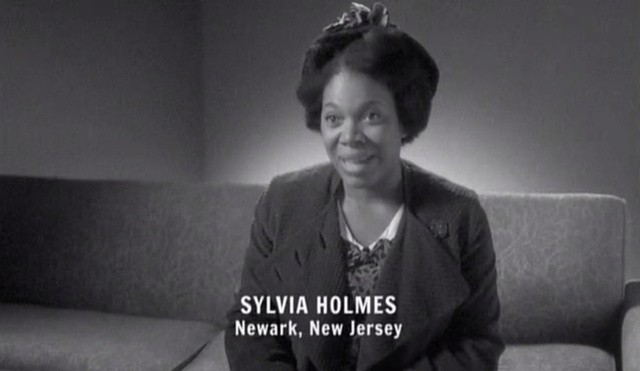
One of the actors played the part of a “Sylvia Holmes” from Newark, New Jersey, who supposedly was pitched into panic by The War of the Worlds radio show. The documentary, however, did not disclose that “Sylvia Holmes” was a pseudonymous character, whose “remarks” were taken from The Invasion From Mars, a flawed book about the radio show published in 1940. (That book intentionally obscured the identities of “Holmes” and other interview subjects.)

As I pointed out at Media Myth Alert last week, PBS editorial standards say that its programming content “should embrace the highest commitment to excellence, professionalism, intellectual honesty and transparency. In its news and information content, accuracy should be the cornerstone.”

Offering up a pseudonymous character and failing to identify her as such seemed to skirt those standards.

'Sylvia Holmes'

The pseudonymous ‘Sylvia Holmes’

Getler in a column yesterday said he didn’t think so. “The producers could have somehow pointed out that Sylvia Holmes was not a real name,” he wrote, adding:

“But I don’t view this as a war crime or as a spiritual violation of PBS standards. Whatever her real name, she was a real person.”

It’s sloppy, though. It’s slyly misleading, and it’s hardly in keeping with a commitment to transparency. As such, it’s another dent in a documentary that was full of them.

Getler reiterated in his column yesterday that the documentary’s “biggest flaw was failing to deal more thoroughly with the role that the press played after the broadcast in suggesting there was more panic than was actually the case. That, in my view, would have contributed to a more contextual public understanding of what actually happened in 1938.”

That’s quite true. But the documentary was more deeply flawed than that. Its makers, after all, ignored recent research that has impugned the notion The War of the Worlds program stirred mass panic.

And in dodging the central questions of The War of the Worlds program, the documentary ended up confused and meandering, not knowing for sure what it was supposed to do. So it turned out to be part tribute to the radio program; part tribute to the radio show’s director and star, Orson Welles;  part rumination about America of the late 1930s, and part digression about life on Mars.

At least it won’t be regarded as a definitive treatment about what was a clever, memorable, and mythical radio dramatization.

WJC

More from Media Myth Alert:

The ombudsman agrees: PBS ‘War of the Worlds’ doc was missed opportunity

In Anniversaries, Debunking, Error, Jessica Lynch, Media myths, Media myths and radio, Newspapers, War of the Worlds, Washington Post on November 1, 2013 at 4:00 pm
Getler

Getler

Not many news organizations these days have internal critics, usually known as ombudsmen or “reader representatives.” Michael Getler, the ombudsman for PBS, is the best of them.

He’s a straightshooter, tough but fairminded.

Getler was often outstanding in five years as ombudsman at the Washington Post, notably calling out the newspaper’s botched reporting about Jessica Lynch’s mythical battlefield exploits early in the Iraq War.

Lynch was a 19-year-old Army private whom the Post catapulted to international fame in a story in April 2003 that claimed she fought fiercely in an ambush in Iraq, firing at her attackers despite being shot and stabbed and seeing comrades “die around her.” Lynch was taken prisoner, the Post, reported, only after running out of ammunition.

The electrifying story, which the Post based on otherwise unidentified “U.S. officials,” was wrong in every important detail. In his analyses, Getler was withering and incisive.

The hero-warrior story about Lynch, he wrote, “had an odor to it almost from the beginning, and other news organizations blew holes in it well before The Post did….”

Why, he asked in one of his columns, did the information in the Post’s hero-warrior story “remain unchallenged for so long?

“What were the motivations (and even the identities) of the leakers and sustainers of this myth, and why didn’t reporters dig deeper into it more quickly?” Getler asked.

Excellent questions, which the Post never has deigned to address.

In 2005, Getler became the first ombudsman at PBS, to help ensure “that PBS upholds its own rigorous standards of journalistic ethics for both online and on-air content.”

I was in touch with Getler by email weeks before PBS aired its recent turgid documentary about the famous radio dramatization in 1938 of The War of the Worlds, which told of a Martian invasion of the United States.

I described to Getler my concerns that the documentary would embrace the media myth that The War of the Worlds program set off mass panic and nationwide hysteria on the night it was aired. I also asked about how the documentary would present or characterize recent scholarship that has impugned the panic-and-hysteria interpretation.

My concerns were heightened because pre-broadcast material that PBS posted online said “perhaps a million [people] or more” were  “plunged into panic, convinced that America was under a deadly Martian attack.”

Getler forwarded my queries to Mark Samels, executive producer of the PBS “American Experience” series. Soon after, Getler told me that Samels said he was “not going to respond to someone who has not seen the program.” This was seven weeks before the documentary aired.

(Getler also noted that he did not speak for PBS and has no “pre-broadcast role” at the organization.)

I subsequently sent an email directly to Samels, reiterating my concerns.

Samels never replied.

Immediately after the documentary was shown Tuesday evening, I posted a commentary at Media Myth Alert saying the program represented a squandered opportunity to revisit The War of the Worlds dramatization in a searching and educational way.

PBS,  I wrote, “could have confronted head-on the question of whether the radio show … really did provoke hysteria and mass panic in the United States. That’s the conventional wisdom, and it makes for a deliciously good yarn — that Americans back then were so skittish or doltish or unaccustomed to electronic media that they readily believed the story of the lethal Martian invasion of Earth, as described in The War of the Worlds broadcast.”

But PBS failed to raise searching questions or offer revealing insight about the famous radio show; instead, it presented a tedious program that claimed upwards “of a million people” were convinced, “if only briefly, that the United States was being laid waste by alien invaders.”

No explanation was offered during the program as to how the makers of the documentary arrived at such a dubious figure.

Getler yesterday posted a thoughtful and insightful critique about the documentary. Notably, he pointed out that shortly before the program ended, “the narrator, just casually in his final summing up, includes this sentence:  ‘Ultimately, the very extent of the panic would come to be seen as having been exaggerated by the press.'”

“Really!” Getler wrote. “Is that not part of the real story? Is that not worth more than a sentence at the end of an hour-long program? Could that be described by some as burying the lead?”

“Burying the lead” is journalese for failing to assign prominence to the most important information of a news report.

And he’s right: PBS buried the lead in its War of the Worlds documentary.

Big time.

Getler also wrote:

“I find myself in agreement with the judgment of W. Joseph Campbell, the well-known critic and author of ‘Getting It Wrong: Ten of the Greatest Misreported Stories in American Journalism’ who headlined his comment:  ‘PBS squanders opportunity to offer “content that educates” in “War of the Worlds” doc.'”

Getler’s column closed with comments — at long last — from Samels, who stated:

“Our film does not say that people panicked, nor does the script include the phrase ‘mass hysteria.'”

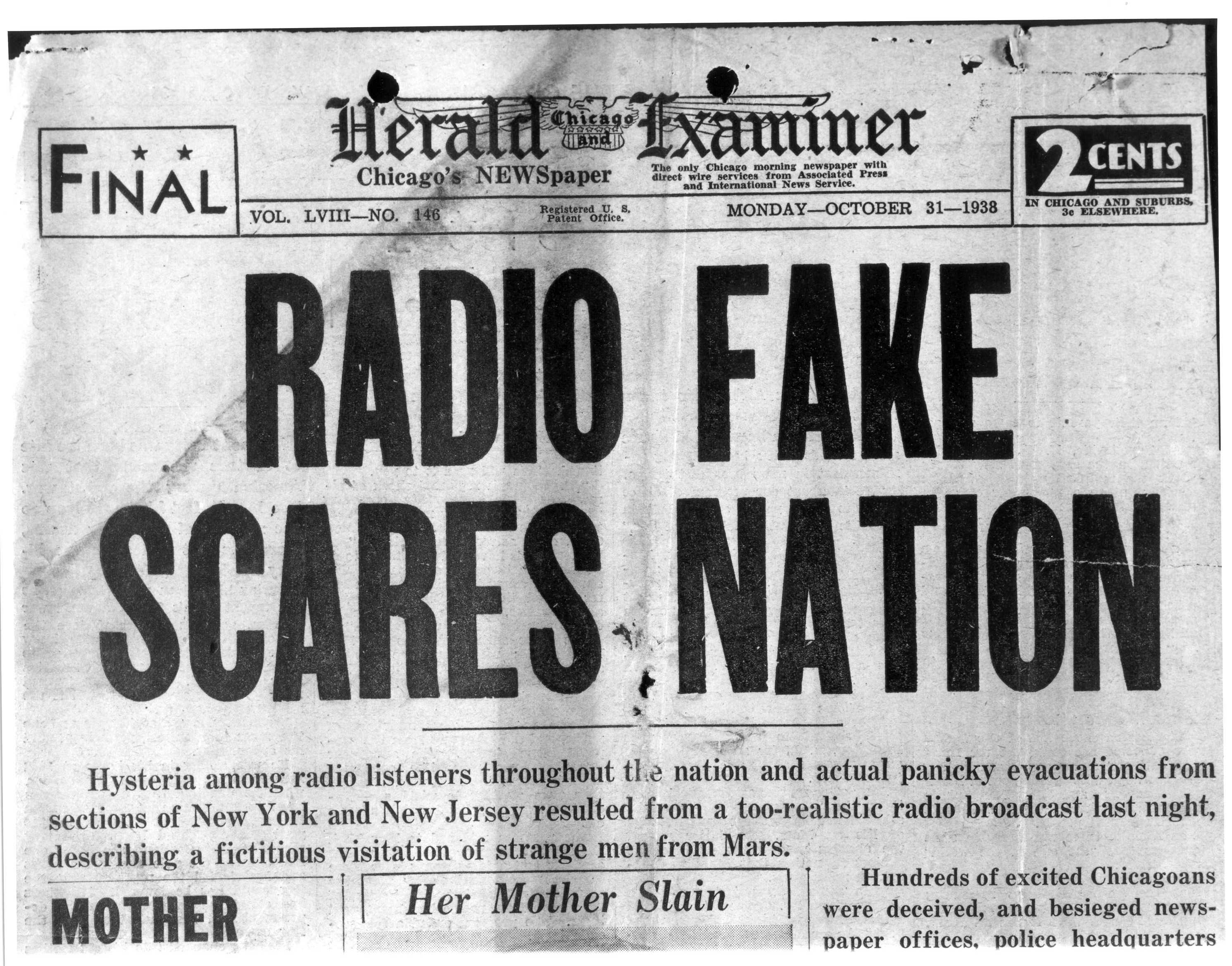
Ah, but the documentary invoked “chaos” to describe reactions to The War of the Worlds radio program. And as Getler noted in his critique, the documentary displayed “several banner newspaper headlines” published the day after 1938 dramatization. The effect was to suggest that the radio show had spread panic across the country.

Which assuredly it had not.

Those headlines made such declarations as:

  • “Radio Listeners in Panic, Taking War Drama as Fact”
  • “Radio ‘Martian Attack’ Terrorizes U.S. Hearers, Thousands in Panic”WOW Newspaper
  • “Radio Fake Scares Nation”

And of course, PBS did claim in the documentary that “upwards of a million people” were convinced, if briefly, the country was under Martian attack — an estimate Samels in his comments said was taken from Hadley Cantril’s 1940 book, The Invasion From Mars.

But Cantril estimated that 1 million to 1.2 million people may have been “frightened” or “disturbed” or “excited” by what they heard. He did not exactly say those listeners were “convinced” the country was under Martian attack. And as I point out in Getting It Wrong, Cantril did not estimate how many listeners acted on their fear or excitement.

Being “frightened” or “disturbed” is hardly synonymous with being “panic-stricken.”

In any event, there are more recent and more discerning sources than Cantril’s problematic, 73-year-old book about The War of the Worlds program. But Samels and the documentary’s producer ignored those sources.

Another matter about the PBS documentary awaits Getler’s consideration.

This has to do with the program’s recreated dialog, in which actors dressed in period clothing gave voice to reactions that contemporaneous listeners of the radio program had described in letters.

One of the actors spoke the words of a “Sylvia Holmes” of Newark, New Jersey.

'Sylvia Holmes'

‘Sylvia Holmes’

“Holmes” was presented in the documentary as someone deeply frightened by the radio show.

But her remarks on the PBS documentary were drawn from Cantril’s 1940 book. As media historian Michael Socolow has pointed out, Cantril did not use real names in the book. Indeed, Cantril wrote:

“All names of respondents used in the text, are fictitious and identifying characteristics are disguised, but the true flavor of the case studies is preserved.”

So “Sylvia Holmes” is a pseudonym. And in a posting at Twitter that addressed Socolow’s point, PBS seemed to say it knew that. Left unclear, though, is why the documentary presented a fictitious name as if it were real.

PBS editorial standards say that programming “content should embrace the highest commitment to excellence, professionalism, intellectual honesty and transparency. In its news and information content, accuracy should be the cornerstone.”

In offering viewers the comments of the pseudonymous “Sylvia Holmes,” PBS may have skirted its cornerstone guidance.

WJC

More from Media Myth Alert:

Feeling like 1995

In Media myths, Newspapers, Scandal, Washington Post, Watergate myth on October 3, 2013 at 12:27 pm

These days have evoked 1995 in more than a few respects.

The sale of the Washington Post closed Tuesday; the new owner is Jeff Bezos, who in July 1995 began selling books at Amazon.com, in near-total obscurity.

Amazon since then has made Bezos a multibillionaire and he has recently talked about leading the sometimes-arrogant Post to a new golden era, a vague reference to the Post’s mythologized reporting of the Watergate scandal 40 years ago.

The episode today in which a woman tried to rammed her car into a barricade near the White House, setting off a wild and deadly chase that ended near the Capitol, was faintly evocative of the night in May 1995 when an intruder scaled a fence near the White House, unloaded pistol in hand. “I’m here to see the president!” he shouted before being shot and wounded by a secret service agent.

Today also marks the 18th anniversary of the acquittal of O.J. Simpson in the slayings of his former wife and her friend. Simpson’s trial lasted more than nine months and its related controversies spread like a stain across 1995.

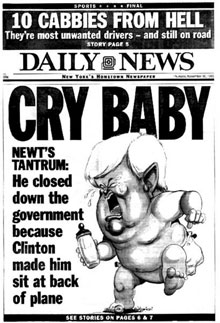
Crybaby Newt_1995NYDN

Recalling 1995: Newt and the shutdown (New York Daily News)

The strongest allusions to 1995 are of course to be found in the partial shutdown of the federal government — the first since the closures of November 14-19, 1995, and of December 16, 1995, to January 6, 1996.

The shutdowns, then and now, are alike in their effects — government workers sent home, federal landmarks and national parks closed — but differ notably in their immediate causes.

As the Wall Street Journal has noted, “The sticking points during that 1995-96 fight centered on demands from Republicans … for cuts in spending on entitlements such as Medicare, the health-care program for retirees, as well as other nondefense spending.” They also pressed President Bill Clinton to agree to balance the federal budget within seven years.

The second and longer shutdown took shape when Clinton and the Congressional Republicans, led by Speaker Newt Gingrich, differed over how to calculate whether the budget would be balanced in seven years, as the Journal pointed out.

The confrontations had improbable effects.

They allowed Clinton to steady his shaky administration; much of 1995 had been a time of missteps and gaffes for Clinton. He was reduced, for example, to insisting on his relevancy as a president amid a political landscape where Gingrich and the Republicans were ascendant following sweeping victories in midterm elections in 1994.

The government shutdowns of 1995 brought confirmation of Gingrich’s pricklinesss and volatility. One of the most remarkable moments of the government closure was his ill-considered outburst on November 15, 1995.

At a breakfast meeting with journalists, Gingrich acknowledged that a measure of personal pique was behind his toughening up the spending bill that Clinton vetoed to set in motion the furlough of 800,000 government employees.

Gingrich complained that Clinton had passed up an opportunity to negotiate the budget issues aboard Air Force One the week before, during a long trip home from Israel, where the president and congressional leaders had attended the funeral of Yitzhak Rabin.

Not only that, but Gingrich complained that he and Senate Majority Leader Bob Dole were forced to leave the Air Force One by the rear stairs after landing at Andrews Air Force base in Maryland.

“This is petty,” Gingrich said at the breakfast meeting. But “you land at Andrews and you’ve been on the plane for twenty-five hours [for the round trip to Israel] and nobody has talked to you and they ask you to get off the plane by the back ramp. . . . You just wonder, where is their sense of manners? Where is their sense of courtesy?”

The perceived slights and rude treatment, Gingrich said, were “part of [the reason] why you ended up with us sending down a tougher” spending measure, making Clinton’s veto and the government shutdown a certainty.

The outburst turned Gingrich into the petulant poster boy of the government shutdown. The New York Daily News caricatured him as a wailing toddler, stamping his foot in anger. Gingrich’s favorability ratings, which had been ebbing throughout 1995, fell further during the shutdowns.

Clinton may have steadied his presidency during the shutdowns. But he also engaged in conduct that would bring his administration to the brink of ruin.

On the night of Gingrich’s outburst, Clinton and Monica S. Lewinsky, a White House intern then 22-years-old, had their first sexual encounter at the White House — the first in a series of furtive liaisons that would lead, improbably, to Clinton’s impeachment three years later.

WJC

More from Media Myth Alert:

Arrogance: WaPo won’t correct dubious claim about Nixon ‘secret plan’ for Vietnam

In Debunking, Error, Media myths, Newspapers, Washington Post on August 13, 2013 at 8:44 am
A landmark?

Arrogant

Finally, after more than 2½ weeks, the Washington Post’s reader representative” replied to my email pointing to a dubious claim in the newspaper’s front-page obituary last month about journalist Helen Thomas.

The Post said in the obituary that Thomas once “asked President Richard M. Nixon point-blank” about “his secret plan to end the Vietnam War.”

I asked the obituary’s author, Patricia Sullivan, and the newspaper’s reader representative, Doug Feaver, to identify when Thomas posed such a question.

Neither has done so.

Instead, Feaver asserted in his recent email to me: “I see nothing here that deserves a correction.”

Talk about arrogance.

At issue here are two related matters.

One is the Post’s assertion in the obituary published July 21 that Thomas once asked Nixon about his “secret plan” for Vietnam.

The other is the broader notion that Nixon in 1968 ran for president saying he had a “secret plan.”

To the first point: There is no question about what the Post wrote. And there is no evidence that Thomas ever posed such a question.

The nearest approximation came at a news conference in late January 1969, when Thomas asked Nixon  about his “peace plan” for Vietnam. She did not ask about a “secret plan.”

Feaver in his email to me noted that the obituary did not place the phrase “secret plan” inside quotation marks.

As if that matters at all.

With or without quotation marks, the Post made a claim in the obituary that it hasn’t been able to back up.

Moreover, in asserting the dubious claim about a “secret plan,” the Post effectively has embraced the persistent but historically inaccurate notion about the 1968 election campaign.

That notion is that Nixon said he had a plan to end the war but wouldn’t disclose what he had in mind. Sullivan, the author of the Thomas obituary, has embraced this notion, stating in an email to me in late July:

“I recall the Nixon years and his promise during his candidacy that he had a plan to end the Vietnam War, which he would not explain in detail. Hence it was dubbed his ‘secret plan’ to end the war, and is widely referenced as such in the news articles of the time, many of which I reviewed while writing this obit (in 2008).”

But that’s just not so: News reports of the time did not “widely” refer to Nixon’s having a “secret plan,” as a search of a full-content database of historical newspapers reveals.

The database covers 1968 and includes content of the Post and several other leading U.S. dailies. Searching the database for “Nixon” and “secret plan” or “secret plans” produces no evidence at all to support the notion that Nixon in 1968 touted or otherwise campaigned on a “secret plan.”

Likewise, the leading book-length treatments of the 1968 presidential campaign — Theodore White’s The Making of a President, 1968, and Joe McGinniss’ The Selling of the President say nothing about Nixon’s “secret plan.” (Searching the books’ contents through Amazon.com turned up no reference to “secret plan.”)

Had the purported “secret plan” been an issue of any consequence during the 1968 campaign, the country’s leading newspapers and those books about the election surely would have discussed it.

It should be noted that Nixon was asked publicly in late March 1968 about a “secret plan” for Vietnam. He replied that he had “no gimmicks or secret plans.”

He also said: “If I had any way to end the war, I would pass it on to President [Lyndon] Johnson.” (Nixon’s comments were made a few days before Johnson announced he would not seek reelection.)

So the challenge to the Post remains: If it can identify an occasion when Thomas asked Nixon about a “secret plan,” please do so. That would represent a modest but interesting contribution to historians’ understanding of Nixon’s 1968 campaign pledges about the Vietnam War. It would suggest that journalists at the time were openly suspicious about his prospective war policy.

If, on the other, the Post cannot back up the “secret plan” claim — a claim clearly stated in its obituary — then a correction should be made.

WJC

Many thanks to Instapundit
Glenn Reynolds for linking to this post

More from Media Myth Alert:

WaPo, Bezos, and owning up to errors ‘quickly and completely’

In Debunking, Error, Jessica Lynch, Media myths, Newspapers, Washington Post on August 6, 2013 at 7:02 am

Yesterday’s stunning news that billionaire Jeff Bezos is buying the Washington Post for $250 million came with a sidebar of sorts — his smoothly written and reassuring letter to the newspaper’s employees.

Jeff_Bezos_2005

Jeff Bezos, buying WaPo

Among other sentiments, Bezos, who has never been a journalist, wrote:

“We will continue to follow the truth wherever it leads, and we’ll work hard not to make mistakes. When we do, we will own up to them quickly and completely.”

In seeking to fulfill the objective of owning up to errors, the Post can make a start by correcting, or clarifying, a suspect claim embedded in its obituary last month about longtime White House reporter Helen Thomas.

The Post said in the obituary that Thomas had once “asked President Richard M. Nixon point-blank” about “his secret plan to end the Vietnam War.”

No sourcing was given for that assertion, which was intended to suggest how Thomas and her “pointed queries often agitated the powerful.”

In fact, there appears to be no evidence that Thomas ever asked Nixon about “his secret plan to end the Vietnam War.”

The nearest approximation to Thomas’s having posed such a question came on January 27, 1969, when she asked Nixon at a White House news conference:

“Mr. President, what is your peace plan for Vietnam?” She did not ask about a secret plan.

This is more than hair-splitting. It matters because a fairly tenacious media myth has grown up around the notion that Nixon in 1968 campaigned for the presidency while touting a “secret plan” to end the Vietnam War.

That claim is made rather often, despite its being historically inaccurate.

As I’ve noted at Media Myth Alert, leading newspapers in 1968 made almost no reference at all to Nixon and a “secret plan.” In an article published in the Los Angeles Times in late March 1968, Nixon was quoted as saying he had “no gimmicks or secret plans” for ending the war.

The article further quoted Nixon as saying:

“If I had any way to end the war, I would pass it on to President [Lyndon] Johnson.” (Nixon’s comments came a few days before Johnson’s surprise announcement that he would not seek reelection.)

I’ve pointed all this out to the author of the obituary, Patricia Sullivan, and to the newspaper’s “reader’s representative,” Doug Feaver, but neither correction nor clarification has been forthcoming.

In fact, Feaver has made no reply to separate email I sent to him on July 24 and July 31.

As I told Feaver, if the Post can point to an occasion when Thomas asked Nixon “point-blank” about having a “secret plan” on Vietnam, then that would represent an intriguing though modest contribution to the understanding about Nixon’s campaign in 1968. More specifically, it would indicate that journalists at the time suspected Nixon was less than forthcoming about his intended war policy.

But if, on the other hand, the Post cannot identify such an occasion, then a correction seems in order.

Instead of responding, or writing a correction, the Post has been stonewalling.

That’s not at all the sort of response that Bezos has encouraged at Amazon.com, the online retailer he founded in the mid-1990s. Bezos has long sought to position Amazon as “the world’s most consumer-centric company.”

Bezos’ letter to Post employees hinted at the importance he attaches to customer-centrism. The letter said in part that the newspaper’s “touchstone will be readers, understanding what they care about … and working backwards from there.”

I’d be surprised if Bezos, who as owner will not run the paper, did not seek to instill a greater sense of customer service at the Post. I’d be even more surprised if the Post’s famously arrogant newsroom eagerly embraced such an objective.

WJC

More from Media Myth Alert:

WaPo, Helen Thomas, and Nixon’s ‘secret plan’

In Debunking, Error, Media myths, Newspapers, Washington Post on July 21, 2013 at 11:55 am

Today’s Washington Post carries a lengthy obituary about Helen Thomas, lauding the 92-year-old former White House reporter who died yesterday for her “unparalleled experience covering the presidency.”

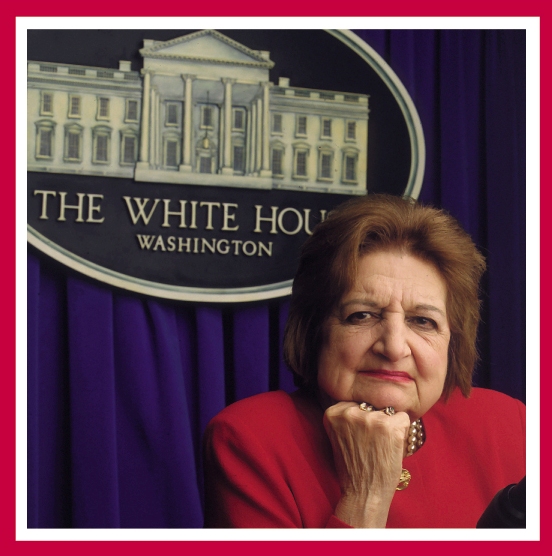
A glowing tribute to Helen Thomas

WaPo’s glowing tribute to Helen Thomas

What caught the eye of Media Myth Alert was the Post’s unsourced claim that Thomas had once asked President Richard M. Nixon “point-blank what his secret plan to end the Vietnam War was.” I sent an email yesterday to Patricia Sullivan, author of Thomas obituary, asking about the unsourced claim; she has not replied.

The only proximate reference I could find to Thomas’s having posed such a question was at a White House news conference on January 27, 1969. Given her seniority, Thomas was granted the first question.

“Mr. President,” she asked, “what is your peace plan for Vietnam?” Peace plan, not secret plan.

According to a transcript of the news conference that the Washington Post published the following day, Nixon focused his response on the Vietnam peace talks then underway in Paris.

The issue here is greater than a possible error in a glowing tribute — so glowing that the obituary waits until the 12th paragraph to mention Thomas’ ugly remarks about Jews, which ended her career in 2010.

The notion that Nixon campaigned for the presidency in 1968 on a “secret plan” to end the Vietnam War is a hoary assertion that circulates still, often invoked as telling evidence of Nixon’s duplicity. The claim is of thin grounding.

Helen Thomas embraced the tale, though, writing in her wretched 2006 book, Watchdogs of Democracy?:

“Throughout that campaign in 1968 … Nixon said he had a ‘secret’ plan to end the war. Reporters never got to ask him what it was. Not until he got into the White House did we learn it was Vietnamization — to try to turn the fighting over to the South Vietnamese.”

But Nixon was asked during the campaign whether he had a secret plan to end the war.  According to a report published by the Los Angeles Times on March 28, 1968, Nixon replied that he had “no gimmicks or secret plans.”

He also said: “If I had any way to end the war, I would pass it on to President [Lyndon] Johnson.” (Nixon’s comments were made a few days before Johnson announced he would not seek reelection.)

A fairly detailed assessment of the “secret war” tale was published in 2000 by William Safire, a columnist for the New York Times and a former Nixon speechwriter. Safire wrote:

“That sinister phrase — secret plan — has resonance to veteran rhetoricians and students of presidential campaigns. In the 1968 primaries, candidate Richard Nixon was searching for a way to promise he would extricate the U.S. from its increasingly unpopular involvement in Vietnam. The key verb to be used was end, though it would be nice to get the verb win in some proximity to it.

“One speechwriter came up with the formulation that ‘new leadership will end the war and win the peace in the Pacific.’ Nixon made it part of his stump speech, and the juxtaposition of end and win — though it did not claim to intend to win the war, but only the peace ….

“When a U.P.I. reporter pressed Nixon for specifics, the candidate demurred; the reporter wrote that it seemed Nixon was determined to keep his plan secret, though he did not quote Nixon as having said either secret or plan. But …  it became widely accepted that Nixon had said, ‘I have a secret plan to end the war.'”

The lead paragraph of the United Press International report to which Safire referred stated:

“Former Vice President Richard M. Nixon vowed Tuesday [March 5, 1968] that if elected president, he would ‘end the war’ in Vietnam. He did not spell out how.”

It does sound a bit slippery, a bit Nixonian. But it’s no claim of a “secret plan.” So there seems little substance to the notion, which Thomas embraced in her book, that Nixon campaigned in 1968 on a “secret plan” to end the war.

WJC

More from Media Myth Alert:

The Nixon tapes: A pivotal Watergate story that WaPo missed

In Anniversaries, Error, Media myths, Newspapers, Scandal, Washington Post, Watergate myth on July 14, 2013 at 8:45 am

Forty years ago this week, Alexander Butterfield told a U.S. Senate select committee investigating the Watergate scandal that President Richard Nixon had installed a secret audiotaping system in his offices.

Butterfield’s disclosure was one of the most decisive moments in the Watergate. It focused the scandal’s multiple investigations into a months-long pursuit of the tapes — one of which clearly revealed Nixon’s role in attempting to cover up the crimes of Watergate. That revelation forced his resignation in August 1974.

The disclosure of Nixon’s audiotaping system was a major story which the Washington Post — often and inaccurately credited with having “uncovered” or “broken” the Watergate scandal — missed badly.

How the Post fumbled that story makes for an intriguing sidebar at the anniversary of Butterfield’s stunning disclosure. The newspaper’s lead Watergate reporters, Bob Woodward and Carl Bernstein, described in a book about their reporting how leads about the taping system were not pursued.

The book, All the President’s Men, says that Woodward had found out about private testimony that Butterfield had given to staff members of the select committee and he called Ben Bradlee, the Post’s executive editor, for guidance.

The call to Bradlee was on a Saturday night. After outlining what he knew, Woodward, according to the book, said:

“We’ll go to work on it, if you want.”

In reply, Bradlee is quoted as saying with some slight irritation, “Well, I don’t know.”

How would you rate the prospective story? Woodward asked him.

“B-plus,” Bradlee replied.

Woodward figured a B-plus wasn’t much, according to the book.

“See what more you can find out, but I wouldn’t bust one on it,” Bradlee is quoted as instructing Woodward.

And Woodward didn’t “bust one.”

Two days later, on July 16, 1973, Butterfield made his reluctant disclosure at a public session of the Senate select committee.

The following day, according to All the President’s Men, Bradlee conceded that the lead about the taping system was “more than a B-plus.”

The anecdote from All the President’s Men is suggestive of the overall minor role that the Post played in uncovering Watergate. As I point out in my media-mythbusting book, Getting It Wrong, unraveling a scandal of the dimension of Watergate “required the collective if not always the coordinated forces of special prosecutors, federal judges, both houses of Congress, the Supreme Court, as well as the Justice Department and the FBI.

“Even then, Nixon likely would have served out his term if not for the audiotape recordings he secretly made of most conversations in the Oval Office of the White House. Only when compelled by the Supreme Court did Nixon surrender those recordings, which captured him plotting the cover-up” of Watergate’s signal crime, the breakin in June 1972 at the headquarters of the Democratic National Committee.

All the President’s Men was revealing in other ways about the work and conduct of Woodward and Bernstein. Media critic Jack Shafer, in a column in 2004, revisited a number of reporting flaws and ethical lapses that Woodward and Bernstein acknowledged in their book.

It’s a roster of transgressions that is too-little remembered.

WJC

More from Media Myth Alert:

Mistaking conspiracy for sloppy history in Hearst’s ‘vow’ to ‘furnish the war’

In 1897, Debunking, Furnish the war, Media myths, Newspapers, Spanish-American War, Yellow Journalism on June 29, 2013 at 3:31 pm

The media myth of William Randolph Hearst’s vow to “furnish the war” with Spain has proved irresistible in a number of ways.

Hearst in the late 1890s

Hearst, activist publisher

The vow has been invoked as evidence of the sketchy character of Hearst, an activist newspaper publisher whose “yellow journalism” brought him prominence in the closing years of the 19th century.

The vow has been cited to illustrate the potential malignant power of the news media — that at their worst, they can bring on a war.

And in a column in the weekend issue of the Wall Street Journal, the vow is offered as evidence of how conspiracy theories can double back on their makers.

Or something like that.

The fuzzy conspiracy argument is advanced by Amanda Foreman, an historian who writes the Journal’s “historically speaking” column. The latest column is of interest to Media Myth Alert in that it offers an unusual twist to Hearst’s mythical vow.

Not that Foreman is all that persuasive in advancing her conspiracy argument. What she sees as conspiracy looks a lot like sloppy history.

Like all media myths, the “furnish the war” anecdote has some factual scaffolding. But Foreman misstates a key factual element in the tale, which stems from a reputed exchange of telegrams between Hearst and the artist Frederic Remington, who went to Cuba in early 1897 for Hearst’s New York Journal.

Remington’s assignment was to draw sketches of the island-wide Cuban rebellion against Spanish rule. Soon, supposedly, the artist sought permission to return to New York, saying in a telegram that “everything is quiet.”

Hearst, in reply, is said to have told Remington:

“Please remain. You furnish the pictures, and I’ll furnish the war.”

Remington left Cuba anyway, and his sketches of the Cuban rebellion began appearing in the Journal in late January 1897.

Foreman in her column writes that Hearst was both “peddler and victim of the same conspiracy theory.”

span-am war_journal

Wasn’t the Journal’s war

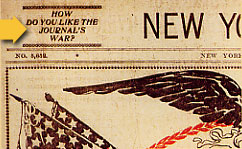
She says he promoted the notion that he fomented the conflict with Spain by proclaiming in the New York Journal in May 1898: “How do you like the Journal’s war?” But in that epigram, the Journal was taunting its rivals, not claiming responsibility for the war — an important distinction that will be discussed in some detail below.

Foreman writes that “when critics started labeling Hearst a warmonger, he became the victim of his own success” of having advanced the notion he had fomented the war.

She then introduces the “furnish the war” vow, calling it “a fictitious communiqué” that “remains the single-most quoted proof that Hearst engineered the Spanish-American War.”

Foreman says the “chief problem” with the Remington-Hearst anecdote “is that Remington was nowhere near Cuba at the time.”

But Remington was in Cuba before the war — for six days in January 1897. That he was there, on assignment for Hearst, is a component of the factual scaffolding of the “furnish the war” tale, which entered the public domain in 1901, in a book by James Creelman.

He was a journalist known for hyperbole and bluster. And he recounted the anecdote without documentation, writing:

“Some time before the destruction of the battleship Maine in the harbor of Havana [in February 1898], the New York Journal sent Frederic Remington, the distinguished artist, to Cuba. He was instructed to remain there until the war began; for ‘yellow journalism’ was alert and had an eye for the future.”

Creelman then described the purported Remington-Hearst exchange of telegrams, invoking it to praise the aggressive, anticipatory character of Hearst’s “yellow journalism.” Only years later did Creelman’s unsourced anecdote become popular as evidence of Hearst’s perfidy.

While Hearst for a time in 1898 may have thought that he had brought about the war with Spain, supporting evidence is not to be found in the pithy epigram that Foreman cites.

As I discuss in my 2001 book, Yellow Journalism: Puncturing the Myths, Defining the Legacies, context and timing matter in evaluating the epigram, which appeared in the upper-left corner, or left ear, of the New York Journal on May 8, 9, and 10, 1898.

The epigram

The Journal’s taunt

In asking “How do you like the Journal’s war?” Hearst’s newspaper, I wrote, was not boasting but “mocking the claims” of its rivals — notably the anti-war New York Evening Post, which in an editorial published April 30, 1898, accused the Journal of fomenting the war.

The following day, U.S. naval vessels destroyed a Spanish squadron in Manila Bay in the war’s first major engagement.

First reports of the naval battle appeared in U.S. newspapers on May 2, 1898. That day on its editorial page, the Journal published the portion of the Evening Post editorial accusing the Journal of fomenting the war. That assertion was derided in a headline spread across the Journal’s editorial page, which stated:

“Some People Say the Journal Brought on This War. How Do You Like It as Far as It’s Gone[?] ”

The headline and the epigram that appeared at the Journal’s left ear a few days later (“How do you like the Journal’s war?”) clearly were snarky retorts aimed at the Evening Post in the aftermath of a stunning U.S. naval victory.

When it did specifically address the notion of fomenting the war, Hearst’s Journal was far more oblique and ambiguous. For example, the newspaper stated in early May 1898:

“This war has been called a war brought on by the New York Journal and the press which it leads. This is merely another way of saying that the war is the war of the American people, for it is only as a newspaper gives voice to the American spirit that it can be influential with the American masses. The Journal is powerful with the masses because it believes in them — because it believes that on issues of national policy, their judgment is always likely to be sounder than that of the objecting few.”

The statement hardly qualifies as a ringing assertion of responsibility for bringing on the war.

WJC

More from Media Myth Alert:

‘Strategy for peace’ and blocking the schoolhouse door: Recalling a crowded week in June 1963

In Anniversaries, Newspapers, Photographs, Quotes, Television, Year studies on June 6, 2013 at 5:56 am

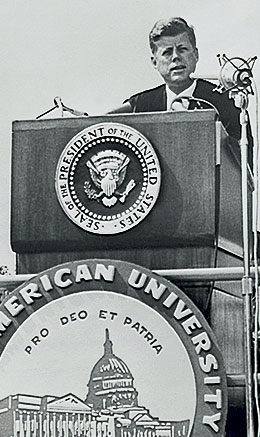
Monday marks the 50th anniversary of President John F. Kennedy’s “strategy for peace” commencement address at American University, a speech delivered at the height of the Cold War in which he called for a rapprochement with the Soviet Union.

JFK_AU_speech

Kennedy, June 10, 1963

The speech often is ranked among the finest of its kind.

Speaking to about 10,000 people out-of-doors on a 90-degree day in Washington, D.C., Kennedy announced that talks would soon begin in Moscow on a comprehensive nuclear test ban treaty. He also said the United States would suspend atmospheric testing as long as other nuclear powers did the same.

Fifty years on, the speech is still recalled for such passages as: “[W]e must labor on— not towards a strategy of annihilation but towards a strategy of peace.”

And:

“Let us examine our attitude toward peace itself. Too many of us think it is impossible. Too many think it unreal. But that is a dangerous, defeatist belief. It leads to the conclusion that war is inevitable, that mankind is doomed, that we are gripped by forces we cannot control.”

Those sentiments represented something of a modest departure from the rhetoric common at the time. Kennedy spoke at American University less than eight months after the Cuban Missile Crisis, which brought the United States and Soviet Union to the brink of a nuclear exchange.

The speech was not without significance: The talks Kennedy announced on June 10, 1963, led fairly quickly to a limited test-ban treaty with the Soviets and British.

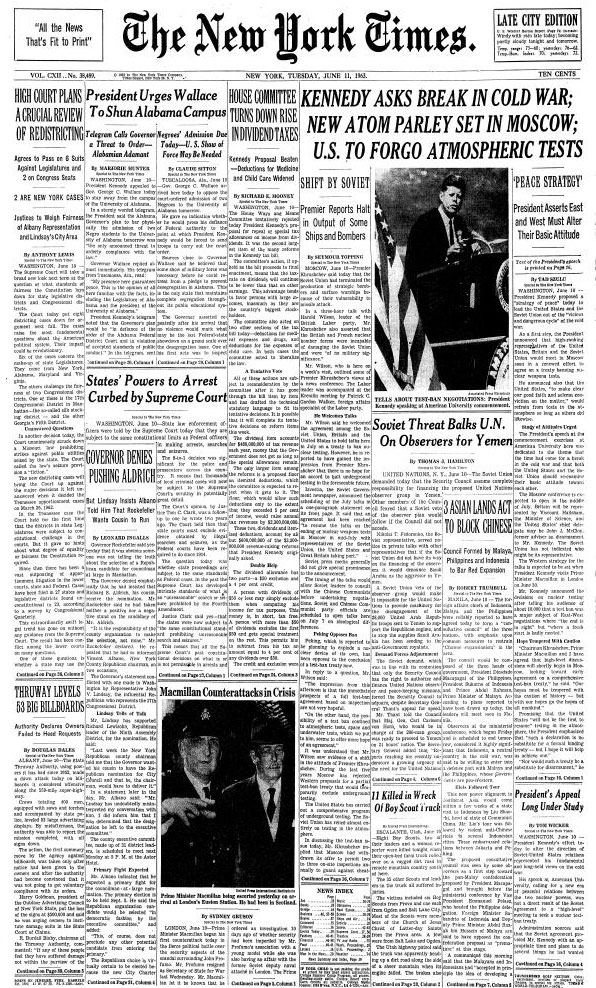
Interestingly, Kennedy’s address was in short order crowded off the front pages. His “strategy for peace” remarks hardly dominated the news that week.

Indeed, few weeks arguably have been as packed with such a variety of major and memorable news events as June 9-15, 1963.

Kennedy’s commencement speech received prominent treatment for a day or two in U.S. newspapers. Then it was overtaken by some of the most dramatic moments of the Civil Rights era — among them, Governor George Wallace’s stand at the schoolhouse door, symbolically blocking the desegregation of the University of Alabama.

It has been said that the “drama of the nation’s division over desegregation came sharply into focus” that day, June 11, 1963.

In the face of the governor’s defiance, Kennedy federalized the Alabama National Guard. After reading a bitter statement denouncing the “unwelcomed, unwanted, unwarranted and force-induced intrusion upon the campus of the University of Alabama,” Wallace stepped aside. Two black students were allowed to register for classes.

NYT-front_11June1963_full

New York Times front, June 11, 1963

Kennedy referred to the confrontation in Alabama in a radio and television speech that night in which he proposed that Congress pass civil rights legislation to end discrimination in voting, enhance educational opportunities, and ensure access to restaurants, hotels, and other public places.

The resulting legislation became the Civil Rights Act of 1964.

Also on June 11, 1963,  an Associated Press correspondent in South Vietnam, Malcolm Browne, took one of the iconic images of the long war in Southeast Asia — that of a Buddhist monk who had set himself afire in downtown Saigon, to protest the government’s religious oppression.

“It was clearly theater staged by the Buddhists to achieve a certain political end,” Browne later said. “At the same time, there was a human element to it that was just horrifying, because the sequence of pictures showed the initial shock of the flames touching his face, and so forth. He never cried out or screamed ….”

The following day, Civil Rights leader Medgar Evers was shot to death outside his home in Mississippi. Byron De La Beckwith was tried three times for Evers’ killing, most recently in 1994 when he was convicted and sentenced to life in prison. The other two trials ended in hung juries.

Evers, an Army veteran who had fought in World War II, was buried at Arlington National Cemetery.

The space race, as it was known, seldom was far from the news in 1963. At the close of the crowded week, the Soviets were preparing to launch Vostok 6. On board was Valentina Tereshkova, destined to become the first woman in space.

The flight lifted off on June 16, 1963, and lasted nearly 71 hours. Tereshkova’s 49 Earth orbits more than doubled the most compiled to that point by any American astronaut.

And 20 years would pass before the first American woman flew in space. She was Sally Ride, a mission specialist aboard the space shuttle Challenger in 1983.

The crowded week 50 years ago was a microcosm of the Cold War era, what with nuclear arms, civil rights, Southeast Asia, and the U.S.-Soviet space race all prominently in the news.

Even so, why does it much matter to look back on that week in June?

Doing so offer some useful and interesting perspective, given that we tend to think we live in such busy and momentous times.

Taking a look back also reveals how unsettled the country seemed to be in 1963, given the violence and the confrontations in the South, the Cold War rivalry with the Soviets, the strife in Vietnam.

So looking back to the crowded week in June tells us the 1960s were churning well before the climatic and tumultuous year of 1968.

One wouldn’t immediately have recognized this in mid-June 1963, but dominance was shifting in the news media, flowing from newspapers  to television.

Confirmation of this transition came in late November 1963 with wall-to-wall television coverage of the Kennedy assassination and its aftermath. “Even television’s critics had to admit that the medium had been transformed into an even more powerful force,” media historian David Davies wrote in a book of the postwar decline of American newspapers.

Nineteen sixty-three was pivotal for the news media.

WJC

More from Media Myth Alert: