W. Joseph Campbell

Archive for the ‘Newspapers’ Category

A counter-narrative: 9/11 did not ‘change everything’

In Anniversaries, Debunking, Media myths, New York Times, Newspapers, Washington Post on September 11, 2011 at 10:26 am

America’s news media have focused for days and more on the 10th anniversary of the terror attacks of September 11, 2001. The dominant, inevitable, yet misleading theme of the coverage: 9/11 “changed everything.”

“When Everything Changed,” the Washington Post declares on its front page today.

“The Day Everything Changed,” says the Star-Telegram of Fort Worth, Texas.

“A Decade of Change,” declares the Press of Atlantic City.

“Forever changed?” asks the lead headline in today’s Chattanooga Times Free Press.

That interrogative is inadvertently perceptive, suggesting as it does an important if largely ignored counter-narrative about 9/11:

It is striking how little, fundamentally, has changed in American life because of the attacks that killed nearly 3,000 people in lower Manhattan, at the Pentagon, and near Shanksville, Pennsylvania.

Airport check-ins, to be sure, are more imposing, grating, and intrusive than they were 10 years ago — suggestive of a broader if low-level and intermittent preoccupation with security matters.

But the hyperbolic, anniversary-driven coverage notwithstanding, the lives of most Americans seem not to have been dramatically or markedly altered by the vivid terror assaults 10 years ago.

Remember how the attacks were supposed to lead to a surge in patriotic sentiment? To a renewed commitment to religion and the spiritual side of life? To a deeper interest in news of the world? To a constant looking over one’s shoulder in anticipation of the next attack?

Polling data indicate that none of those responses to 9/11 was sustained or profound:

  • In June 2010, 59% of respondents to a Pew Research survey said they displayed the American flag at home, in the office, or on the car. That compares to 75% of the respondents  who said they did so in August 2002.
  • Pew Research data say that 36% of Americans attend religious services at least once a week, down from 42% in mid-November 2001.
  • In 2002, 48% of respondents to a Pew survey said they enjoyed keeping up with the news “a lot.”  In 2010, that response rate had ebbed to 45%.
  • Today’s Washington Post embeds revealing bits of survey data in its 16-page section devoted to the 9/11 anniversary. Particularly revealing was that 83% of residents in metropolitan Washington said no, they have not avoided a public event in recent years “because of concerns about terrorism.”

While the counter-narrative that 9/11 didn’t change everything has been obscure this year, it was somewhat in greater evidence at less-celebrated anniversaries of the attacks.

Two years ago, for example, the New York Times revisited predictions about how 9/11 would forever change Manhattan, and found them mostly empty and unfulfilled.

The Times article, “A Fortress City That Didn’t Come to Be,” recalled the expectations that emerged in the immediate aftermath of 9/11, writing:

“New York would become a fortress city, choked by apprehension and resignation, forever patrolled by soldiers and submarines. Another attack was coming. And soon.

“Tourists? Well, who would ever come again? Work in one of the city’s skyscrapers? Not likely. The Fire Department, gutted by 343 deaths, could never recuperate. …

“Eight years later, those presumptions are cobwebbed memories that never came to pass. Indeed, glimpses into a few aspects of the city help measure the gap between what was predicted and what actually came to be.”

“Cobwebbed memories that never came to pass.” A well-crafted passage, that — and an antidote, in a way, to the clichéd, “everything changed” coverage that has clouded the 10th anniversary of a terrible and infamous day.

After all, as columnist George Will wrote at the fifth anniversary of 9/11:

Nothing changes everything.”

WJC

Recent and related:

Talking media myths on ‘Community Voices’

In Debunking, Media myths, Media myths and radio, Newspapers, Washington Post, Watergate myth on September 3, 2011 at 3:14 pm

The exaggerated tales of Watergate, Hurricane Katrina, and crack babies were the principal media myths I discussed the other day in an interview on KPCW Radio in Utah.

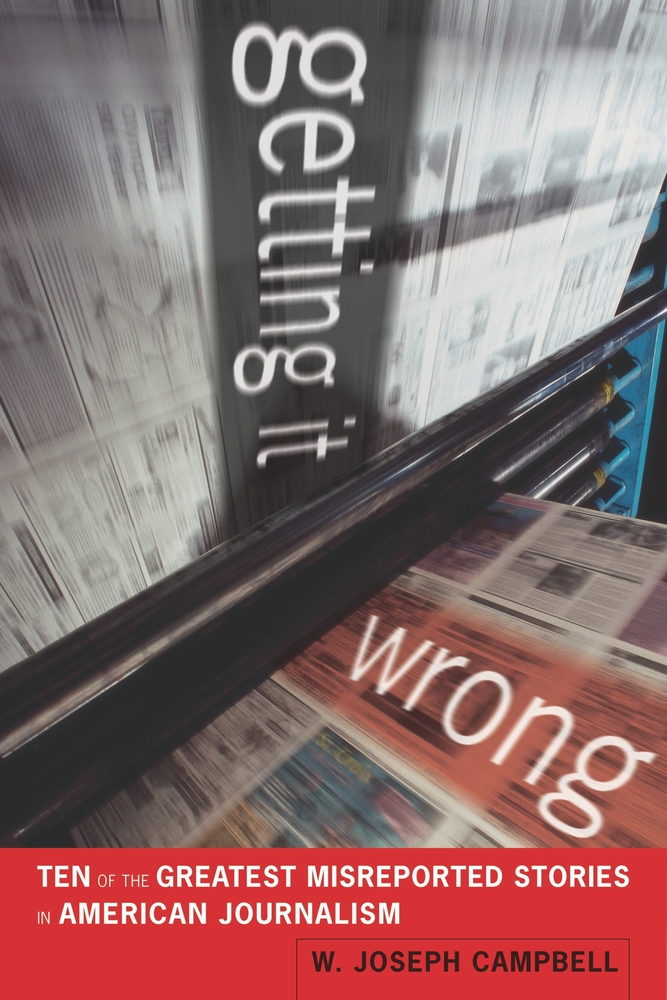
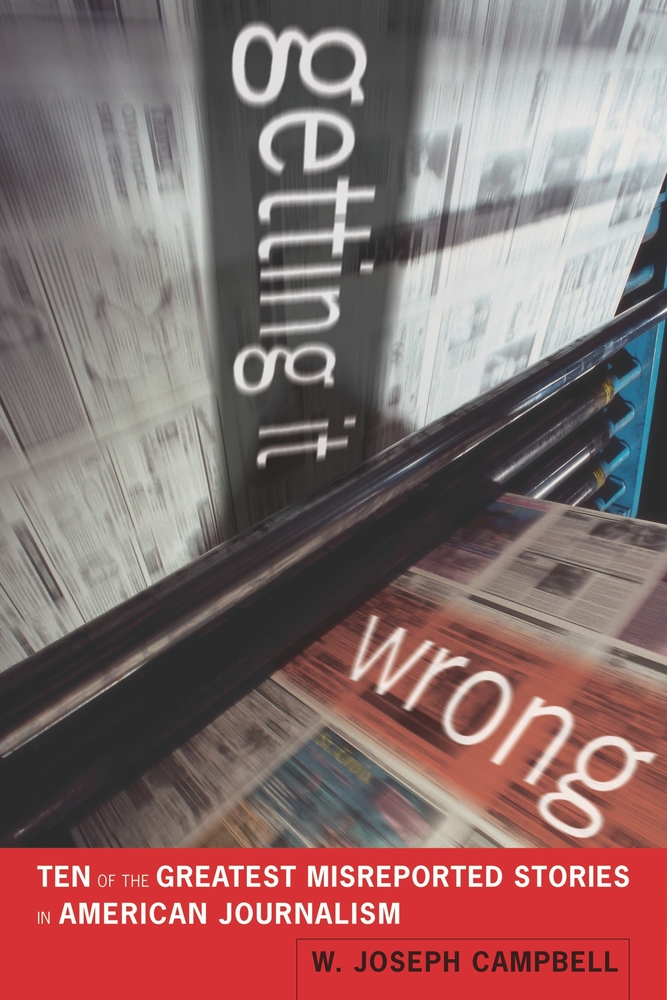
The interview focused on those chapters of my latest book, Getting It Wrong, and was conducted by Larry Warren and Linda Gorton on their  “Community Voices” show.

I noted early in the interview that the “animating force” in American journalism is to get the story right and that Getting It Wrong “is associated with that ethos of truth-telling, of seeking to get the story right.”

The interviewers quickly turned to Watergate, asking whether the reporting of Bob Woodward and Carl Bernstein for the Washington Post was what indeed drove President Richard Nixon to resign in 1974.

“That is the dominant narrative of Watergate,” I pointed out, adding that’s also a very simplistic explanation for rolling up what was a complex scandal.

“To unravel the complexity and the intricacy of Watergate,” I said, “took all kinds of forces, most of them subpoena-wielding — federal prosecutors, the FBI, bipartisan panels of both houses of Congress, ultimately Supreme Court, which forced Richard Nixon to surrender the evidence which clearly showed that he had conspired with top aides to try to cover up the investigation into the Watergate break-in, the signal crime of the scandal.

“Against that backdrop, the contributions of Woodward and Bernstein fade into relative insignificance,” I said.

Another reason that Watergate’s dominant narrative focuses so squarely on Woodward, Bernstein, and the Washington Post is, I said, the cinematic version of the reporters’ book, All the President’s Men.

It surely is the most-watched movie ever made about Watergate, and “it really does focus,” I noted, “on the work of Woodward and Bernstein to the exclusion” of the forces and factors that were truly decisive in bringing down Nixon’s corrupt presidency.

“I think we know,” Warren interjected, “that you’re not going to be invited to Mr. Woodward’s for dinner anytime soon.”

“You know,” I replied, Woodward “has said something to the effect of, ‘to say the press brought down Richard Nixon is total nonsense.’ He used earthier terms to make that point.”

The reference to Woodward’s comment in an interview in 2004 with American Journalism Review in which he asserted:

To say the press brought down Nixon, that’s horse shit.”

I also discussed the notion that news coverage of Hurricane Katrina was superlative, that it supposedly “demonstrated the value and importance of traditional news media, both print and broadcast, at a time of disaster. And Hurricane Katrina was no small storm. It was no [Hurricane] Irene, that’s for sure.”

But I added:

“The coverage of Hurricane Katrina was no high heroic moment in American journalism because, on many important elements of that story, the news media got it badly wrong.”

The hurricane’s death toll was “wildly exaggerated,” I noted, adding that the “apocalyptic reports that the news media put out in the days after Hurricane Katrina’s landfall proved to be largely untrue.

“There were no snipers firing at medical personnel, no snipers firing at [rescue] helicopters. No bodies stacked up like cordwood, no children with their throats slashed. No roving gangs preying on tourists. No sharks plying the flood waters of New Orleans.

“All these reports were out there,” I said, but in the end “none of them was verified or substantiated.”

The erroneous and exaggerated reports of violence in post-Katrina New Orleans in some cases had the effect of delaying the arrival and delivery of aid to the storm-stricken city, I noted.

The social disaster that the news media anticipated in the purported — and widely misreported — “crack baby” epidemic never took place, I pointed out.

More than one news commentator, I said, described as a “bio-underclass” the generation that would come of age after having been exposed to crack cocaine in the womb. These children supposedly would be so mentally and physically deformed as to be forever dependent on the state.

“The news media were spectacularly wrong about the crack baby epidemic,” I said, noting that news reports in the late 1980s and early 1990s “pushed very hard on preliminary evidence suggesting there was a powerful linkage between taking crack during pregnancy and subsequent deformities in children.”

To their discredit, I added, the news media never went back in a sustained and systematic way to undertake to dismantle the crack-baby myth — “even after consensus had taken hold among scientists and biomedical researchers that [prenatal] exposure to crack was not this destructive force that preliminary research had suggested.”

WJC

Recent and related:

No ‘rock-em,’ no ‘sock-em’: What ails WaPo

In Debunking, Jessica Lynch, Media myths, Newspapers, Washington Post, Watergate myth on August 7, 2011 at 1:59 am

The ombudsman of the Washington Post, Patrick Pexton, weighs in today with platitudes and hang-wringing about the newspaper. He mostly misses the mark.

Pexton writes in his column that the Post’s “future lies not with the rich; it lies with the citizenry.

“This newspaper must be the one source of high-quality, probing Washington news that readers in this region and across the country can look to for holding their government accountable. This publication must be for all Americans.”

Oh, brother.

But wait: Here’s more vague abstraction:

“The Post,” Pexton writes, “can’t be a liberal publication or a conservative one. It must be hard-hitting, scrappy and questioning — skeptical of all political figures and parties and beholden to no one. It has to be the rock-’em-sock-’em organization that is passionate about the news. It needs to be less bloodless and take more risks when chasing the story and the truth.”

A “rock-’em-sock-’em organization,” eh? Well, that’s useful guidance.

In his five or so months as ombudsman, Pexton hasn’t dared touch the electrified third rail about the Post, which one of his predecessors, Deborah Howell, gamely if belatedly addressed.

That’s a decided lack of intellectual diversity in the Post’s newsroom. In mid-November 2008, shortly after Barack Obama was elected president, Howell wrote in her ombudsman column:

“I’ll bet that most Post journalists voted for Obama. I did. There are centrists at The Post as well. But the conservatives I know here feel so outnumbered that they don’t even want to be quoted by name in a memo.”

Howell’s column quoted Tom Rosenstiel of the Project for Excellence in Journalism as saying that “conservatives are right that journalism has too many liberals and not enough conservatives. It’s inconceivable that that is irrelevant.”

In Obama's thrall

The lack of intellectual diversity often shows in the Post’s report. Even casual reading signals that the newspaper remains in the thrall of Obama, despite his clearly failing presidency.

Obama scarcely gets “rock-’em-sock-’em” treatment from the Post.

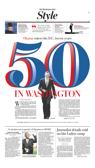
Last Wednesday, for example, the Post’s once-edgy “Style” section devoted most of its front page to a cheery feature about the meaning of Obama’s turning 50-years-old.

“On Thursday,” the article gushed, “President Obama — one of American history’s most precocious achievers — joins the ranks of Washington 50-somethings ….”

But what ails the Post goes well beyond its routinely tender treatment of Obama.

The Post’s local report is superficial, a diet of eye-rolling, feel-good features. The newspaper carries little staff-produced national coverage. Its international report is undistinguished, especially compared to that of the New York Times.

Moreover, the Post offers few notable cases of investigative journalism any more.

It has won two Pulitzer Prizes for investigative reporting in 25 years, which has to be considered meager for a newspaper that reputedly brought down Richard Nixon’s corrupt presidency with its relentless digging into the Watergate scandal.

But as I discuss in my latest book, Getting It Wrong, the Post-Watergate trope, of course, is a powerful media-driven myth.

I’d be remiss were I to fail to note that the Post never has come clean about how it erred so utterly in offering the world the bogus hero-warrior tale about Jessica Lynch in the early days of the Iraq War.

Lynch, the Post reported on its front page on April 3, 2003, “fought fiercely and shot several enemy soldiers after Iraqi forces ambushed the Army’s 507th Ordnance Maintenance Company, firing her weapon until she ran out of ammunition, U.S. officials said yesterday.”

But none of the derring-do attributed to Lynch was true, and the Post has never explained who led it so badly astray.

Moreover, the staff cuts and buyouts of recent years left few notable characters on the newspaper’s staff.

Gone are such colorful figures as the erudite and pugnacious Henry Allen, a Pulitzer winner who left the Post after throwing punches at a staff writer who called him a c—sucker.

Now there was “rock-’em-sock-’em,” old school variety.

WJC

Many thanks to Instapundit
Glenn Reynolds for linking to this post.

Recent and related:

Juan Williams’ new book repeats Spanish-American War myth

In Debunking, Media myths, Newspapers, Spanish-American War, Yellow Journalism on July 27, 2011 at 8:58 am

The new book by Juan Williams, the political analyst clumsily dismissed by NPR last year, offers some history of American journalism.

Some inaccurate history of American journalism.

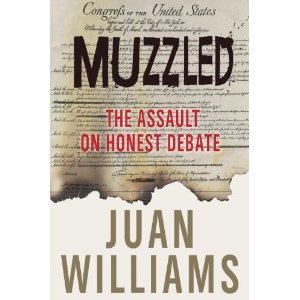
The book, Muzzled: The Assault on Honest Debate, repeats the hoary media myth that the yellow press of William Randolph Hearst and Joseph Pulitzer brought on the Spanish-American War of 1898.

That’s a facile, media-centric interpretation endorsed by few if any serious historians of the conflict.

According to an excerpt of Muzzled posted at the online site of Fox News,  Williams writes:

“Hearst and Pulitzer became infamous for starting a real war. They whipped up so much anger at Spain through inflammatory stories about Spain’s handling of American vessels that they incited the United States to go to war with Spain in the Spanish-American War.”

Williams also says of Hearst and Pulitzer:

“Their coverage of the news, from crime to political scandals to war, was a study in sensationalized accounts, including outright distortion and lies, in a battle to sell more papers in New York City.”

Hearst and Pulitzer were bitter rivals, to be sure. But anyone who has spent much time reading their newspapers of the mid- and late-1890s can only be impressed by the vigor and breadth of their report.

As media historian John D. Stevens wrote in his study of sensationalism and New York City journalism, it is “tempting to caricature the yellow papers as being edited for janitors and clerks.”

But in fact they “published a fair amount of sober financial, political, and diplomatic information,” Stevens wrote. They were much more than merely sensational.

If the newspapers of Hearst and Pulitzer titillated, Stevens noted, they also informed.

In any case, they certainly cannot be blamed for bringing on the Spanish-American War.

As I wrote in my 2001 book, Yellow Journalism: Puncturing the Myths, Defining the Legacies:

The yellow press “did not force — it could not have forced— the United States into hostilities with Spain over Cuba in 1898. The conflict was, rather, the result of a convergence of forces far beyond the control or direct influence of even the most aggressive of the yellow newspapers, William Randolph Hearst’s New York Journal.”

Claims that the yellow press brought on the war, I wrote, “are exceedingly media-centric, often rest on the selective use of evidence, and tend to ignore more relevant and immediate factors that give rise to armed conflict.”

Those factors centered around a diplomatic impasse between the United States and Spain over Spanish colonial rule of Cuba — the scene of an islandwide rebellion that had begun in 1895.

In a failed attempt to put down the rebellion, Spanish authorities ordered thousands of Cubans, mostly old men, women, and children, into garrison towns where they could offer neither support nor supplies to the Cuban rebels.

The authorities called the policy “reconcentration,” and it gave rise to malnutrition and disease: Unknown tens of thousands of Cuban non-combatants died from illness and starvation.

The human rights disaster on Cuba “inevitably stirred outrage and condemnation in the United States,” I wrote in Yellow Journalism. The conditions on Cuba were in 1897 and early 1898 a frequent topic of reporting in the American press — included, but not limited to, the newspapers of Hearst and Pulitzer.

A leading historian of that period, Ivan Musicant, has quite correctly observed that the abuses and suffering caused by reconcentration “did more to bring on the Spanish-American War than anything else the Spanish could have done.”

The yellow press reported on, but certainly did not create, the devastating effects of Spain’s ill-considered and destructive policy.

So to indict Hearst and Pulitzer, as Williams does, for supposedly “starting” the Spanish-American War is to misread the evidence and do disservice to a keener understanding of the much-maligned genre of yellow journalism.

WJC

Recent and related:

Newspapers vital to democracy? Where’s the proof?

In Debunking, Media myths, Newspapers on June 28, 2011 at 11:19 am

It’s a truism — a media myth, even — that independent-minded newspapers are “a vital bulwark” to democracy. It’s a claim easily made but supported by little persuasive evidence.

Hedges

Chris Hedges, a former New York Times foreign correspondent, is the latest commentator to invoke the “vital bulwark” conceit, offering it up in a lengthy essay posted yesterday at Truthdig.com.

Hedges’ is an angst-ridden ode to newspapering. He writes: “The day The New York Times and other great city newspapers die, if such a day comes, will be a black day for the nation.”

Why is that?

Hedges claims that a “democracy survives when its citizens have access to trustworthy and impartial sources of information, when it can discern lies from truth, when civic discourse is grounded in verifiable fact.”

But in saying so, Hedges offers more assertion than evidence.

Media pluralism is a marker of democratic governance, not its essential precondition.

The countries that New York-based Freedom House ranks highest in measures of press freedom are functioning democracies.

Democratic rule enables media pluralism, not the other way round.

What’s more, the American experience with even nominally impartial news media has been relatively brief. Democratic governance emerged, evolved, and became consolidated in America despite the absence of “trustworthy and impartial sources of information” that Hedges extols.

American media history has been defined mostly by a vigorously partisan press.

And of course, unabashedly partisan newspapers still characterize the media landscape of such well-established democracies as Britain.

The ethos of detached impartiality news coverage began to emerge in the United States in the late 19th century, as I discuss in my 2006 book, The Year That Defined American Journalism. But that approach to newsgathering took years to develop, years to become the normative standard in American journalism.

Detached impartiality is taught nowadays in journalism schools. It is the dominant professional paradigm. But that doesn’t mean it’s rigorously respected or routinely practiced.

Nor is much of the content of American newspapers necessarily vital to the functioning of a democracy. As Jack Shafer pointed out in a memorable commentary a couple of years ago:

“Even an excellent newspaper carries only a few articles each day that could honestly be said to nurture the democratic way. Car bomb in Pakistan? Drug war in Mexico? Flood in North Dakota? Murder in the suburbs? Great places to get Thai food after midnight? A review of the Britney Spears concert? New ideas on how to serve leftover turkey? The sports scores? The stock report? Few of these stories are likely to supercharge the democratic impulse.”

A little-studied phenomenon of American democratic life is that of going newsless, of choosing to avoid the news, impartial or not.

According to data compiled by the Pew Research Center and released last year, 17 percent of adult Americans  receive no news on a typical day. They eschew the news despite ready access to a variety of news-delivery platforms, both traditional and digital.

More than 25 percent of American of adults younger than 30 say they go newsless, according to Pew. In the 18-to-24 age cohort, 31 percent say they go without the news.

And yet American democracy functions, if not flourishes, in its messy, often-frustrating ways.

No doubt some slice of “newsless” population is turned off by perceived distortion in the content offered by the nominally impartial, even-handed news media.

Just 20 percent of respondents in the Pew study said they believed all or most of what they read in the New York Times; 25 percent said they believed all or most of what they read in the Wall Street Journal.

That figure for “your daily newspaper” was 21 percent, Pew reported.

So even if they nominally strive for even-handedness and impartiality, leading U.S. newspapers face steep believability problems.

Hedges, it’s interesting to recall, is no model of the impartial journalist.

He notes in his essay that he left the Times because of his “vocal and public opposition to the war in Iraq,” saying he “cared more about truth than news.”

WJC

Recent and related:

Why they get it wrong

In Bay of Pigs, Cronkite Moment, Debunking, Furnish the war, Jessica Lynch, Media myths, New York Times, Newspapers, Washington Post, Watergate myth on June 3, 2011 at 6:49 am

It’s striking how several well-known journalists and news outlets have indulged over last six months in media-driven myths, those dubious tales about the news media that masquerade as factual.

The lineup of myth-indulgers is impressive and, among others, includes:

  • Bill Keller, executive editor of the New York Times, who rubbed shoulders with the Bay of Pigs suppression myth in a column in the Times in January. The suppression myth holds that at the behest of President John F. Kennedy, the Times killed or emasculated its report about the pending Bay of Pigs invasion in 1961. That tale is unfounded, as I discuss in my latest book, Getting It Wrong.
  • Mother Jones magazine which, in its May/June cover story by Rick Perlstein, offered up a rare two-fer — two media myths discussed in a single article. One of the myths was the hoary and surely apocryphal tale about William Randolph Hearst and his reputed vow to “furnish the war” with Spain. The other was about the so-called the “Cronkite Moment” of 1968, in which Walter Cronkite’s on-air assessment that the U.S. military was “mired in stalemate” in Vietnam was so powerful as to alter U.S. policy.
  • Keith Olbermann, the acerbic cable television commentator who, as he quit his prime-time Countdown show in January, referred to the  “exaggerated rescue” of Army private Jessica Lynch in the early days of the Iraq War. Such claims, raised as long ago as 2003, were unsubstantiated by an inquiry of the Defense Department’s inspector general who found the rescue operation was found to have been “a valid mission” to recover Lynch, a prisoner of war, “under combat conditions.”

What accounts for such lapses by prominent journalists and their outlets? Why do these and other media-driven myths often find their way into news reports and commentaries?

Some media myths are just too good not to be true; they almost are too good to take time to check out. The tale about Hearst’s vowing to “furnish the war” certainly falls into this category. It shouldn’t be at all difficult to locate references to the dubious character of the anecdote, which has been the subject of repeated debunking over the years.

Likewise, it can be far easier to invoke a media myths that to commit to the tedium of research and legwork. Media myths are convenient, readily at hand. Poking into their details takes time, and a willingness to challenge what are accepted as consensus narratives.

As I noted in discussing Keller’s column that invoked the Bay of Pigs suppression myth:

“Had Keller consulted the newspaper’s database of reporting about the run-up to the Bay of Pigs invasion in April 1961, he would have found that the Times reported in detail, if not always accurately, about the preparations to infiltrate a U.S.-trained brigade of Cuban exiles in an attempt to topple Fidel Castro.”

Similarly, some media myths (such as the illusory “Cronkite Moment“) may be too ingrained, too dearly held by journalists, ever to be uprooted or thoroughly repudiated.

Unlearning such tales is no small challenge, after all. The conundrum of unlearning was addressed a few months ago in a Wall Street Journal column, which noted:

“For adults, one of the most important lessons to learn in life is the necessity of unlearning. We all think that we know certain things to be true beyond doubt, but these things often turn out to be false and, until we unlearn them, they get in the way of new understanding.”

Media myths also can be convenient means of scoring political points. The two-fer in Mother Jones magazine, for example, were presented as part of a sneering attack about “fact-free” Republicans.

Moreover, media myths — the most prominent of them, anyway — resonate in contemporary contexts.

History, it has been said, is “what we decide to remember,” and journalism history is not an exception. Recalling and celebrating the memory of Cronkite’s supposedly telling truth to power about Vietnam — or of Bob Woodward and Carl Bernstein’s bringing down a corrupt presidency — is to offer reassurance to contemporary journalists at a time of confusion and upheaval in their field.

Deciding to remember such mythical tales is understandable if not justifiable, given that those tales bring solace and reassurance amid sweeping uncertainty.

WJC

Recent and related:

Noting the anniversary of Twain’s ‘report of my death’ comment

In 1897, Anniversaries, Debunking, Media myths, Newspapers, Yellow Journalism on June 1, 2011 at 7:02 am

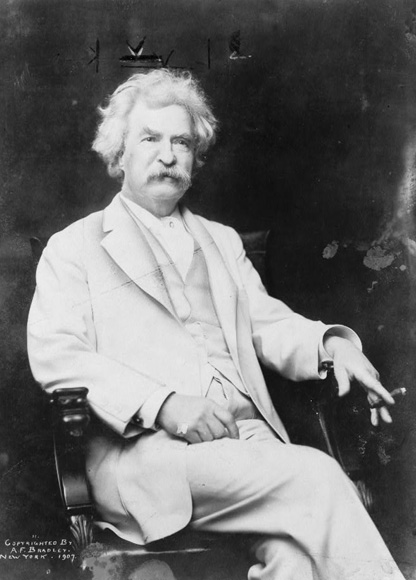
Tomorrow marks the 114th anniversary of Mark Twain‘s well-known, much-quoted, often-distorted observation: “The report of my death was an exaggeration.”

As is discussed in my 2006 book, The Year That Defined American Journalism, Twain’s remark was prompted by an article published June 1, 1897, in the New York Herald.

Mark Twain, 1907

The Herald, which then was regarded as one of the top daily newspapers in America, reported Twain, then 61, to be “grievously ill and possibly dying. Worse still, we are told that his brilliant intellect is shattered and that he is sorely in need of money.”

Twain was in London then, preparing to cover Queen Victoria’s Diamond Jubilee for William Randolph Hearst’s flamboyant New York Journal. That association allowed the Journal to puncture the Herald’s account as false.

In an article published June 2, 1897, beneath the headline, “Mark Twain Amused,” the Journal skewered the Herald’s story and offered Twain’s timeless denial: “The report of my death was an exaggeration.”

Twain’s line is often quoted as “the news of my death has been greatly exaggerated” and, sometimes, the Journal is said to have been the source for the erroneous report rather than the agent of its swift debunking.

According to the Journal, Twain said the likely source of the Herald’s error was the serious illness of his cousin, J.R. Clemens, who had been in London a few weeks before.

Ever eager to indulge in self-promotion, Hearst’s Journal enthusiastically embraced its brief association with Twain. Even so, it couldn’t have been much pleased with what the humorist filed about Victoria’s Jubilee.

As I wrote in The Year That Defined American Journalism, “Twain’s reporting about Victoria’s jubilee seemed half-hearted and hardly inspired. The spectacle was easily the most regal international story of 1897, and came at a time when the British empire was at or near its height. But Twain found the celebration overwhelming,” calling it “a spectacle for the kodak [camera], not the pen.”

Twain’s dispatch to the Journal also included this strange observation:

“I was not dreaming of so stunning a show. All the nations seemed to be filing by. They all seemed to be represented. It was a sort of allegorical suggestion of the Last Day, and some who live to see that day will probably recall this one if they are not too much disturbed in the mind at the time.”

Lining up Twain to cover the Jubilee was emblematic of Hearst’s inclination to spend lavishly to recruit big-name talent, if only for spot assignments.

Hearst was the leading practitioner of yellow journalism, or what he called the “journalism of action,” which embraced an activist vision for American newspapering.

His Journal argued that “a newspaper may fitly render any public service within its power. Acting on this principle, it has fed the hungry, brought criminals to justice and enforced by legal methods the responsibility of public officials.”

Not everyone was comfortable with or admired such an activist vision, especially as it came with such heavy and frequent doses of acute self-promotion.

Twain didn’t much like it, either. In his autobiography, he likened Hearstian yellow journalism to “that calamity of calamities.”

WJC

Related:

<!–[if !mso]> –> Twain’s reporting about Victoria’s jubilee seemed half-hearted and hardly inspired. The spectacle was easily the most regal international story of 1897, and came at a time when the British empire at or near its height. But Twain found the celebration overwhelming—“a spectacle for the kodak [camera], not the pen.”[i] His dispatch included this strange observation: “I was not dreaming of so stunning a show. All the nations seemed to be filing by. They all seemed to be represented. It was a sort of allegorical suggestion of the Last Day, and some who live to see that day will probably recall this one if they are not too much disturbed in mind at the time.”


[i]. Mark Twain, “The Great Jubilee As Described by the Journal’s Special Writers: Mark Twain’s Pen Picture of the Great Pageant in Honor of Victoria’s Sixtieth Anniversary,” New York Journal (23 June 1897): 1.

Every good historian a mythbuster

In Anniversaries, Cinematic treatments, Debunking, Media myths, Newspapers, Washington Post, Watergate myth on May 27, 2011 at 6:10 am

While researching studies of memorable or decisive years recently, I happened across a Washington Post review of The Year That Changed the World, a book about 1989.

I was impressed by this passage in the review:

The good historian is a mythbuster.”

Indeed.

Couldn’t agree more.

The reviewer, Gerard DeGroot, also wrote:

“The past is what happened, history what we decide to remember. We mine the past for myths to buttress our present.”

That’s well said, too. It’s a characterization that offers insight about the rise and diffusion of media-driven myths, 10 of which I debunk in my latest book, Getting It Wrong.

History often is what we decide to remember. And we tend to remember what’s most accessible, what’s most easy to remember.

Take, for example, the mediacentric interpretation of Watergate, the greatest political scandal in American history, a scandal that destroyed a presidency and sent nearly twenty men to jail.

The shorthand, easy-to-grasp version of Watergate is that Bob Woodward and Carl Bernstein of the Washington Post, aided immeasurably by a stealthy, high-level source code-named “Deep Throat,” brought down Richard Nixon’s corrupt presidency.

That’s also the mediacentric version of Watergate, the version journalists love to recall. It serves to remind them of the potential power of the news media.

But as I note in Getting It Wrong, the mediacentric interpretation is misleading and historically inaccurate; it “minimizes the far more decisive forces that unraveled the scandal and forced Nixon from office,” I write.

To roll up a scandal of Watergate’s dimensions, I add, “required the collective if not always the coordinated forces of special prosecutors, federal judges, both houses of Congress, the Supreme Court, as well as the Justice Department and the FBI.

“Even then,” I argue, “Nixon likely would have served out his term if not for the audiotape recordings he secretly made of most conversations in the Oval Office of the White House. Only when compelled by the Supreme Court did Nixon surrender those recordings, which captured him plotting the cover-up and authorizing payments of thousands of dollars in hush money.”

So why do we choose to remember the Woodward-Bernstein-mediacentric interpretation of Watergate? Why has it become the dominant narrative of the scandal? That it is shorn of complexity and easy to grasp is one reason.

A more powerful reason is to be found in the cinematic adaptation of All the President’s Men, Woodward and Bernstein’s book about their Watergate reporting.

The book came out in June 1974 as Watergate was approaching its climax, and was a best-seller.

All the President’s Men was an even greater success in its screen adaptation. It was released 35 years ago this spring and surely ranks as the most-viewed movie about Watergate.

To an extent “far greater than the book,” I write in Getting It Wrong, “the cinematic version of All the President’s Men placed Woodward and Bernstein at the center of Watergate’s unraveling while denigrating the efforts of investigative agencies such as the FBI.

“The effect,” I add, “was to solidify and elevate” the heroic-journalist myth of Woodward and Bernstein, “giving it dramatic power, and sustaining it in the collective memory.”

For contemporary journalists who confront sustained and sweeping upheaval in their field, the mediacentric myth of Watergate is comforting,  reassuring.

Recalling the myth and treating it as authentic serves to buttress the present against the riptide of change.

WJC

Recent and related:

News media indispensable to democracy? Some evidence would be nice

In Debunking, Media myths, Newspapers, Washington Post, Yellow Journalism on May 1, 2011 at 9:49 am

The Washington Post ombudsman invokes in his column today the defining conceit of American journalism: That without truth-telling reporters and editors, democracy would be imperiled.

Or, as he puts it, rather simplistically:

“What we do is report, write and edit stories. We take and publish photographs (and now video, too). We publish the stories and images as news through compelling design and graphics. And, in columns and blogs, we analyze the news. Through this painstaking process, we reveal truths. The country cannot long survive as a democracy, or as a capitalist economy, without this kind of independent journalism.”

But how does the ombudsman, Patrick B. Pexton, know that? What evidence does he offer to buttress the notion that the news media are indispensable bulwarks of democracy and capitalism?

None. He presents the self-congratulatory claim about journalism’s value as self-evident.

It is true that robust journalism and media pluralism are hallmarks of democratic governance.

But democratic rule typically enables independent journalism rather than the other way round.

We see this phenomenon across the world: Whenever the heavy hand of authoritarian rule is lifted, non-official news media flourish, usually as partisan platforms. It’s a point I made in my first book, The Emergent Independent Press in Benin and Côte d’Ivoire, which examined the rise of media pluralism in two states in Francophone West Africa.

But emergent independent journalism, or well-established journalism, isn’t a variable essential to a thriving democracy. I’m reminded of a superb essay on this topic that the inestimable media critic Jack Shafer wrote in 2009 for slate.com.

As Shafer correctly pointed out:

“Democracy thrived in the United States in the 1800s, long before the invention of what we call quality journalism. Between 1856 and 1888, when most newspapers were crap and controlled by, or beholden to, a political party, voter turnout hovered around 80 percent for presidential elections. Compare that with the 55.3 percent and 56.8 percent turnouts in the 2004 and 2008 presidential elections.”

And party-oriented journalism lasted well beyond 1888. It stretched through the period of the yellow press at the end of the 19th century and early 20th century. The leading newspapers of those days were often overtly partisan.

The leading practitioner of yellow journalism, William Randolph Hearst, turned his newspapers into a platform for his mostly unfulfilled political objectives. He unsuccessfully sought the Democratic nomination for president and the governorship of New York, ambitions that were boosted by, but not contingent upon, his activist-oriented newspapers.

Shafer’s column also noted:

“Could it be that deep-dish reporting that uncovers governmental malfeasance and waste … doesn’t promote activism or participation? Could it be that such exposés end up souring the public on democracy and other institutions?”

It’s an interesting point. Aggressive, searching journalism that offers a stream of reporting about the flaws, shortcomings, and corruption in democratic institutions also may be a reason many adult Americans have tired of the news and have turned it off completely.

According to data compiled by the Pew Research Center and released last year, 17 percent of adult Americans go newsless on a typical day. That is, they eschew the news despite ready access to a variety of news-delivery options and platforms, both traditional and digital.

The going-newsless phenomenon in a news-drenched society is highest among 18-to-24-years-old; 31 percent of those young Americans go without the news on a typical day.

“Large numbers of Americans are beyond media influence,” I note in my latest book, Getting It Wrong, which addresses and debunks 10 prominent media-driven myths.

So how are news outlets so vital to American democracy when so many Americans ignore them completely? Pexton’s assertion about the indispensable character of the media ignores such complexity.

Pexton’s claim is the kind of thin platitude that serves to reassure journalists in a time of great upheaval in the field, a time when the direction of the profession is uncertain, when the longevity of once-superior newspapers like the Washington Post is in doubt.

WJC

Many thanks to Instapundit
Glenn Reynolds, and Little Miss Attila,
for linking to this post

Recent and related:

Canada’s CBC invokes Bay of Pigs suppression myth

In Anniversaries, Bay of Pigs, Debunking, Media myths, New York Times, Newspapers on April 17, 2011 at 2:38 am

CBC News in Canada invoked the hardy New York Times-Bay of Pigs suppression myth this weekend in a lengthy online article recapping the failed invasion of Cuba, which was launched 50 years ago today.

The suppression myth has it that the Times, at the behest of President John F. Kennedy, spiked or emasculated its detailed report about invasion preparations.

But as I discuss in Getting It Wrong, my media-mythbusting book that came out last year, neither Kennedy nor anyone in his administration asked or lobbied the Times to kill or tone down the pre-invasion report, which was published on the newspaper’s front page on April 7, 1961.

Moreover, the Times coverage of the pending invasion was not confined to that article.

As I point out in Getting It Wrong: “The suppression myth … ignores that several follow-up stories and commentaries appeared in the Times during the run-up to the invasion.”

The CBC, however, invoked the hoary suppression myth as if it were genuine. It declared, in reference to the Times report of April 7, 1961:

“The Times had actually played down their story at the direct request of Kennedy, something both he and The Times’ editors later regretted. Shortly after the invasion, Kennedy reportedly told a Times editor, ‘if you had printed more about the operation, you would have saved us from a colossal mistake.'”

No call to the Times

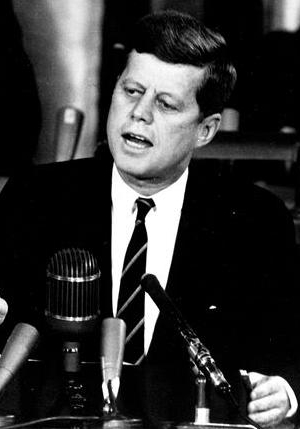
While Kennedy did not call on Times editors before the invasion, he did say on separate occasions in the months afterward that had the newspaper printed more details about the pending invasion, it “would have saved us from a colossal mistake.”

Of course, such comments were quite self-serving. I note in Getting It Wrong that they “represented an attempt to deflect blame for the debacle” at the Bay of Pigs, where the invasion force of CIA-trained exiles was rolled up within three days.

James (“Scotty”) Reston of the Times later characterized Kennedy’s comments as “a cop-out,” adding:

“It is ridiculous to think that publishing the fact that the invasion was imminent would have avoided this disaster. I am sure the operation would have gone forward” nonetheless.

I note in Getting It Wrong that the Times’ pre-invasion coverage cited no prospective date for the invasion. But the newspaper’s front-page reports in April 1961 unmistakably signaled that something was afoot, that an attempt to oust Castro by arms was forthcoming. And on April 17, 1961, at the Bay of Pigs in southern Cuba, the invasion force of some 1,400 exiles launched their ill-fated attack.

The Times wasn’t alone, either, in reporting about the pending invasion. Its competition on the pre-invasion story included the Miami Herald, the New York Herald Tribune, and Time magazine.

According to a critique published in May 1961 in The Reporter, a journalists’ trade publication, the pre-invasion story “was covered heavily if not always well” by the U.S. news media.

So what, then, accounts for the emergence and tenacity of the Times-Bay of Pigs suppression myth?

I write in Getting It Wrong that the myth’s most likely derivation lies in confusion with a separate episode during the Cuban Missile Crisis in October 1962, when Kennedy did ask the Times to hold off publishing a report about the Soviets having deployed nuclear-tipped weapons in Cuba.

On that occasion, when the prospect of a nuclear exchange seemed in the balance, the Times complied, holding off publication 24 hours.

“What likely has happened is that, over the years, distinctions between the separate incidents surrounding the Times and Cuba became blurred,” I write. “That is, it was mistakenly thought that Kennedy had called the Times executives about the newspaper’s coverage in the days before the Bay of Pigs invasion when, in fact, his call came on an entirely different matter in 1962.”

WJC

Recent and related: