W. Joseph Campbell

Archive for the ‘Newspapers’ Category

‘Kill the Irishman’: Glamorizing ’70s Cleveland underworld?

In Cinematic treatments, Media myths, Newspapers on March 2, 2011 at 7:14 am

A lawyer friend in Cleveland told me yesterday that a movie called Kill the Irishman is soon to be released. It’s about a dapper Cleveland mobster named Danny Greene who was  slain in a car-bombing in 1977.

I was quite surprised that the life and death Greene, a swaggering smalltime crime figure in a gritty rustbelt city, would win Hollywood’s attention after all these years. And with such comparative star power, no less: Kill the Irishman features roles by Christopher Walken, Val Kilmer, Paul Sorvino, and Vincent D’Onofrio.

Ray Stevenson plays Greene.

As cinema is wont to do, Kill the Irishman may end up glamorizing and mythologizing Greene and the violent Cleveland underworld of the second half of the 1970s. Publicity material for the movie suggests as much, referring as it does to “Greene’s heroic rise from a tough Cleveland neighborhood to become an enforcer in the local mob.”

I was in Cleveland then, a young reporter for the city’s morning newspaper, the Plain Dealer. The mob scene was murky, chaotic, and hardly glamorous; its figures were scarcely “heroic.”

It did churn up some flamboyant characters, though, including Greene and another rackets figure, Alex (Shondor) Birns, who was killed in a car bombing the night before Easter in March 1975.

I wrote the story about Birns’ bombing death — and Jim Flanagan, the newspaper’s inestimable night city editor, rewrote the lead to say:

“Alex (Shondor) Birns, Cleveland numbers racketeer, was blown to bits at 8 last night seconds after he entered his car parked behind a West Side bar.

“Police, who made the identification, said Birns was hurled through the roof of a 1975 light blue Lincoln Continental Mark IV. The upper torso was found beside the opened front passenger door.”

Blown to bits. Do newspapers still write crime stories that way?

Everyone believed Greene to have been behind Shondor Birns’ death, but no one could finger him.

And a lot of people suspected that it was a matter of time before Greene was killed, too. He flirted with both sides of the law after all. For a time at least, Greene was an informant for the FBI.

Part of Greene’s appeal rested on a catlike ability to dodge attempts on his life.

About six weeks after Birns was blown to bits, Greene survived the bombing of his house on Waterloo Road in Cleveland.

I wrote that story, too, along with a police beat reporter named Mairy Jayn Woge, who commuted to work in Cleveland from somewhere near Pittsburgh.

The article opened this way:

“Cleveland gangland figure Daniel J. (Danny) Greene yesterday survived the second bombing attempt on his life in seven years.

‘Greene, 45, was at his home … when a bomb was thrown through a downstairs window at 3:50 a.m. The explosion destroyed the building that Greene also used as an office to run an industrial consulting firm.”

I remember relishing that line, “Cleveland gangland figure.”

His luck and elusiveness notwithstanding, Greene began to seem more eccentric than significant. He was, as I came to understand it, less important than his reputation. He may have been elbowing his way into the gambling rackets, but Greene really wasn’t such a leading figure in the Cleveland underworld.

He was colorful, though.

Plain Dealer articles described Greene as revealing no fear after escaping the attempt on his life in 1975.

“After that bombing,” one article recalled, “Greene used to sit on a bench in front of his office in a trailer, conducting business and unafraid of being shot down.”

He was killed in October 1977, the victim of what the Plain Dealer called a “trojan horse” bombing. An explosive device packed into a car parked next to Greene’s Lincoln Continental was detonated remotely, killing Greene immediately.

Greene had just completed a visit to the dentist.

I was one of nine Plain Dealer staffers who worked on that story, which carried the headline, “Car bomb kills Danny Greene.” Flanagan, the night city editor, also was credited as having contributed to the report.

Flanagan, a hefty man of Irish descent who wore suspenders and had a heart of gold, was a veteran of Cleveland’s once-lusty newspaper scene. He worked for the afternoon Cleveland News before it folded, and afterward joined the Plain Dealer.

He was steeped in a detail-rich, tabloidesque writing style. And he took time to mentor young reporters, if they were willing. I still have copies of some of my stories that Flanagan rewrote, to which he usually attached detailed notes of explanation.

“Don’t waste space on the obvious,” one note began.

“Remember the old English lesson, avoid adjectives; move the sentence by verbs,” said another.

“Simplify, simplify, simplify,” Flanagan wrote in another note, adding, “Again, I stress using simple, declarative sentences and make your attribution down in the story.”

I suspect Flanagan wrote the sidebar to the story about Greene’s violent death. Either he or Bob Daniels, a gifted rewriteman who called just about everyone “coach.”

The sidebar began this way:

“Daniel John Patrick Greene had the quiet courtesy of an Irish butler but his shillelagh-bold eyes were those of a muscleman. …

“His manner was reserved and polite and he showed compassion for friends.

“But bombs burst around him so frequently and bullets were fired at him so often that his mere appearance in a saloon caused an uneasy atmosphere and a gradual emptying of the bar.”

Vivid writing, delightfully over the top. And it’s just the kind of stuff that Hollywood seems to love.

WJC

Recent and related:

‘Furnish the war’ finds a place in sports

In 1897, Debunking, Furnish the war, Media myths, Newspapers, Spanish-American War, Yellow Journalism on February 28, 2011 at 8:13 am

Hearst: Didn't say it

William Randolph Hearst’s famous vow to “furnish the war” with Spain is one of American journalism’s most enduring myths. It’s a stunningly hardy though dubious tale that has been deployed in discussing journalistic sins and shortcomings of all sorts.

As I write in my myth-debunking book Getting It Wrong, the Hearstian vow “has been invoked to illustrate the media’s willingness to compromise impartiality, promote political agendas, and indulge in sensationalism.

“It has been used, more broadly, to suggest the media’s capacity to inject malign influence into international affairs.”

It even has application in news about collegiate sports.

An online sports-news site, Bleacher Report, turned to “furnish the war” in a commentary posted yesterday about the whiff of scandal around Auburn University’s championship football program.

Hearst’s reputed vow was a way to set up the commentary, which defended the program from what it called “the incessant beating of the investigation drum by Auburn detractors” suspicious of player-recruitment violations.

Of interest to Media Myth Alert is the commentary’s total buy-in of the Hearst anecdote, which, as evidence offered in Getting It Wrong clearly shows, is counterfeit, a discredited media myth.

The Bleacher Report commentary declared:

“When photographer Frederic Remington was dispatched to Cuba in the late 1800s to document a war and found none, he sent a message to publisher William Randolph Hearst: ‘There is no war.’

“Hearst allegedly responded: ‘Please remain. You furnish the pictures and I’ll furnish the war.’

“In the ensuing months Hearst’s newspaper fanned the flames with sensationalized front page articles that were of dubious accuracy and in many cases patently false. His articles stirred passions among a readership that neither knew nor cared if the reports were accurate. His relentless attacks eventually helped push U.S. administration into declaring war on Spain.  Hearst got his war.

“Since October, the Auburn football program has endured a similar smear campaign. …”

Reasons for doubting that Hearst ever made such a vow are many, and include the anecdote’s breathtaking illogic.

War was the reason Hearst, owner of the flamboyant New York Journal, sent Remington (an artist, not a “photographer”) to Cuba in the first place. That war was the Cuban rebellion against Spain’s colonial rule, which began in February 1895.

Remington

Remington was in Cuba briefly in January 1897.

By that time, I note in Getting It Wrong, newspaper readers “would have been well aware that Cuba was a theater of a nasty war. By then, the Cuban rebellion had reached island-wide proportion and not a single province had been pacified by Spain’s armed forces.”

It would have made no sense for Hearst to vow to “furnish the war.”

In addition, Hearst denied having made such a statement. Remington, apparently, never discussed it. And the telegrams bearing the content of the purported Remington-Hearst exchange have never surfaced.

Moreover, as I point out in Getting It Wrong, “there was no chance” that the telegrams “would have flowed freely between Remington in Havana and Hearst in New York.

“Spanish control of the cable traffic in Havana was too vigilant and severe to have allowed such an exchange to have gone unnoticed and unremarked upon,” I write, adding:

“A vow such as Hearst’s to ‘furnish the war‘ surely would have been intercepted and publicized by Spanish authorities as a clear-cut example of Yankee meddling in Cuba.”

Like many media myths, the tale of the Hearstian vow is accessible, pithy, and easily recalled. It supposedly illuminates larger lessons about the news media — in this case, the media’s malign potential to bring about a war the country otherwise wouldn’t have fought.

Which is nonsense, and historically inaccurate.

The Spanish-American War of 1898 was hardly a matter of Hearst’s having “got his war.” Rather, the conflict was the consequence of an intractable, three-sided standoff.

Cuba’s rebels would settle for nothing short of political independence. Spain refused to grant self-rule to the most important remnant of its once-sprawling American empire. And the United States, for economic and humanitarian reasons, could no longer tolerate an inconclusive war just 90 miles from its shores.

Simply put, Hearst and newspaper content were non-factors in the decision to go to war.

WJC

Recent and related:

WaPo on ‘historically faulty’ films: Ignoring ATPM

In Cinematic treatments, Debunking, Newspapers, Reviews, Washington Post, Watergate myth on February 27, 2011 at 8:26 am

(Oscars.org)

Today’s Washington Post offers an insightful commentary about movies that won best-picture Oscars despite having taken liberties with historical truth.

The commentary notes that this year’s favorite for best picture, The King’s Speech, “won’t win any awards for historical accuracy.

“King George VI didn’t really stammer that badly, we’ve been told. Critics have also pointed out that Winston Churchill didn’t actually think it necessary for the king’s brother, Edward VIII, to abdicate the throne before marrying a divorced woman. We’ve also learned that Churchill was not nearly as fat as Timothy Spall portrays him … and that King George was far too plain and short to be played by the tall, handsome Colin Firth.”

What’s more, the Post notes:

“The Oscar voters have often favored historically faulty movies, with the inaccuracies ranging from minor details to outright fiction. In ‘Patton,’ 1970’s Best Picture, Axis and Allied powers fought each other in the same kind of tanks — American ones, manufactured after the war. ‘Braveheart’ in 1995 put Mel Gibson in a kilt, even though his character, William Wallace, was a lowland Scot (and only highlanders wore kilts).”

Good stuff.

Surely it’s not churlish to call out the Post for failing to include All the President’s Men in the discussion about historical inaccuracy in movie-making — even if All the President’s Men (or ATPM) didn’t win the best picture Oscar for the year in which it was released.

Rocky did.

All the President’s Men of course was a 1976 film about the Washington Post and its Watergate investigation, starring those dogged reporters, Bob Woodward and Carl Bernstein. It won four Oscars, including best supporting actor, for Jason Robards’ role as the Post executive editor, Ben Bradlee.

The movie — which was based on Woodward and Bernstein’s 1974 book by the same title — distorted, stretched, and otherwise toyed with historical accuracy in several ways, namely:

  • It embraced and solidified the mythical heroic-journalist interpretation of Watergate.
  • It minimized, even denigrated, the decisive contributions of investigative agencies in unraveling the crimes of Watergate.
  • It depicted Woodward and Bernstein as facing dangers far greater than they really encountered.
  • It introduced into the vernacular the made-up line, “follow the money,” which many people believe was advice crucial to uncovering the scandal.

Let’s examine those points in turn.

As I discuss in my latest book, Getting It Wrong, the cinematic version of All the President’s Men promoted the misleading interpretation that Woodward and Bernstein’s reporting was decisive in uncovering the crimes of Watergate and forcing the resignation of President Richard Nixon.

I write in Getting It Wrong:

All the President’s Men allows no other interpretation: It was the work Woodward and Bernstein that set in motion far-reaching effects that brought about the first-ever resignation of a U.S. president.”

I also note:

“To an extent far greater than the book, the cinematic version of All the President’s Men placed Woodward and Bernstein at the center of Watergate’s unraveling while denigrating the efforts of investigative agencies such as the FBI. The effect was to solidify and elevate the heroic-journalist myth, giving it dramatic power, and sustaining it in the collective memory.”

To roll up a scandal of the dimensions of Watergate, I point out in Getting It Wrong, “required the collective if not always the coordinated forces of special prosecutors, federal judges, both houses of Congress, the Supreme Court, as well as the Justice Department and the FBI.

“Even then,” I add, “Nixon likely would have served out his term if not for the audiotape recordings he secretly made of most conversations in the Oval Office of the White House. Only when compelled by the Supreme Court did Nixon surrender those recordings, which captured him” plotting to cover up the signal crime of Watergate — the 1972 break-in at headquarters of the Democratic National Committee.

The cinematic version of All the President’s Men includes few references to subpoena-wielding agencies and congressional panels that broke open the scandal.

In addition, the movie excessively dramatizes the risks and hazards to which Woodward and Bernstein were exposed in their Watergate reporting.

In a  scene near the close of the movie, Woodward’s shadowy, high-level source “Deep Throat” — superbly played by Hal Holbrook — says the reporters’ “lives are in danger.”

The warning, which injected drama into the movie’s sometimes-leaden pacing, also was mentioned in All the President’s Men the book.

But it was fairly quickly recognized to have been a false alarm.

For a while, Woodward, Bernstein, and senior Post editors took precautions to avoid what they suspected was electronic surveillance. But as Woodward recounted in his book The Secret Man, such measures “soon seemed melodramatic and unnecessary.

“We never found any evidence that our phones were tapped or that anyone’s life was in danger,” Woodward added.

The Holbrook/”Deep Throat” character in All the President’s Men pressed into the vernacular what may be Watergate’s most famous line — “follow the money.”

The line does not appear in Woodward and Bernstein’s book. Nor was it spoken in real life by the stealthy “Deep Throat,” whose identity was kept secret for more than 30 years. (In 2005, the former second-ranking official at the FBI, W. Mark Felt, disclosed that he had been Woodward’s high-level source.)

“Follow the money” was worked into the script of All the President’s Men by the screenwriter, William Goldman.

The Holbrook/”Deep Throat” character delivered the line  with such quiet authority that it’s not difficult to understand how “follow the money” crossed from the silver  screen to the vernacular, how the phrase has been widely embraced not only as plausible but understood as guidance that had been invaluable.

As I’ve noted, however, Watergate was far more complex than a matter of identifying, pursuing, and describing a money trail.

The best cinematic antidote to All the President’s Men has to be the 1999 spoof Dick, which includes an amusing if over-the-top skewering of Woodward and Bernstein as klutzy, antagonistic, and ultimately very lucky.

Dick the movie won no Oscars. But it’s great fun, and deserves to be seen more widely than it was in 1999.

WJC

Recent and related:

Is this bra-burning photo authentic?

In Bra-burning, Media myths, Newspapers, Photographs on February 15, 2011 at 8:21 am

Bra-burning in Toronto, 1979 (Bettmann/Corbis)

It is claimed from time to time that burning bras figured in no feminist protest of the late 1960s and 1970s. Bra-burning, it is sometimes said, was little more than a media-concocted myth.

But this photograph, taken near Toronto city hall in March 1979, suggests otherwise. (A larger version of the image is available here.)

Update: The photo is genuine.

The occasion was International Women’s Day and the demonstrators were protesting the contents of a controversial Ontario Provincial Police report about rape.

But why would protesters incensed about a police report burn bras? The connection seems elusive.

And that’s one reason why I wonder about the photo’s authenticity, whether it was improperly edited. I’m not saying it’s a hoax or a ruse; I’m saying I have reservations.

I’ve conducted a good deal of research about feminist bra-burning; my latest book, Getting It Wrong, offers evidence that — assertions to the contrary notwithstanding — bras were burned, briefly, at the famous women’s liberation protest in September 1968 against the Miss America pageant at Atlantic City.

That evidence “cannot be taken lightly, dismissed or ignored,” I write in Getting It Wrong, which debunks 10 prominent media-driven myths — those dubious stories about the news media that masquerade as factual.

I also acknowledge that the evidence of bra-burning at Atlantic City doesn’t corroborate the “widely held image of angry feminists demonstratively setting fire to their bras and tossing the flaming undergarments into a spectacular bonfire.”

I saw the image of bra-burning in Toronto for the first time last week, accompanying an article posted February 6 at the online site of the London Guardian. The image was credited to the Bettmann/Corbis photo archive.

The archive’s online record says the bra-burning photograph was taken in Toronto on March 8, 1979. Information about the photographer and place of publication are not available, however.

Corbis notes that it licenses photographs for sale; it doesn’t vouch for their authenticity.

The image of the Toronto protest certainly seems to pose a further challenge to claims that feminist bra-burning is a media myth. While the demonstrators in the photograph hardly look angry, their protest certainly seems flamboyant, what with flames leaping hungrily from the burn barrel.

The photograph suggests a vivid moment of demonstrative bra-burning.

But, then, maybe those flames are lapping a bit too hungrily at the dangling white bra.

Why hasn’t that bra yet caught fire?

And wouldn’t it have been more logical and emphatic to drop a copy of the controversial police report into the flaming burn barrel?

Interestingly, the leading Toronto newspapers of the time did not mention the bra-burning episode in their reports about the protest.

The Toronto Star of March 9, 1979, said that the demonstrators were outraged by the provincial police report, which had identified hitchhiking, alcohol consumption, and drug use as factors in many rapes.

“The [protesting] women lit sparklers and set a garbage can on fire as they booed the report’s findings,” the report in the Star said, identifying the demonstrators as members of Women Against Violence Against Women.

Lighted sparklers held aloft can be seen in the photograph; the placard shown in the image bears the acronym of Women Against Violence Against Women.

The report in Toronto’s Globe and Mail newspaper was more detailed — but likewise made no mention of the burning bra.

The Globe and Mail said the protest was “boisterous” and aimed at the police report, which the demonstrators dismissed as “‘dazzling in its illogic.'”

The newspaper also reported:

“The women carried signs saying: ‘Take a Rapist to Lunch — Charcoal Broiled’ and ‘Hookers Who Wink Go to the Clink! Men Who Rape Escape.’

“The women, after lighting a fire in a garbage can, to the obvious annoyance of about a dozen watchful constables, shouted: ‘Burn the rapists, burn the city, burn the OPP,” the acronym for Ontario Provincial Police.

The newspaper added: “The women charged that the OPP report was nothing less than state approval of rape and that no serious study of rape had even been done by the Government.

“The women then sang a surprisingly obscene song describing male domination of women and marched off, chanting anti-male slogans ….”

I spoke by phone the other day with Susan G. Cole, who was a member of Women Against Violence Against Women and who said she was at the protest in March 1979.

But Cole said she does not recall the bra-burning.

I shared with her a link to image posted at the Guardian site; Cole said she is not in the photograph but added that she recognized as prominent activists the women shown in the image. “We were so bright and energetic in those days,” Cole said, a bit wistfully.

Women Against Violence Against Women, Cole also said, was theatrical and very creative in its protests, adding that she is “not surprised that these guys were burning bras.”

She suggested that the Toronto demonstrators may have thought that if bras had not been flamboyantly set afire at Atlantic City in 1968, then “let’s do it now.”

I’ve tried without success to reach two of the women in the photograph. One is a lawyer in British Columbia, the other an activist in Toronto.

In the final analysis, if the image is authentic, then it represents impressive evidence of demonstrative bra-burning at a feminist protest in the 1970s. If it’s not, then it’s a well-done photo hoax, a composite that deserves unmasking.

WJC

Many thanks to FiveFeetofFury for linking to this post

Recent and related:

Keller no keeper of the flame on famous NYT motto

In 1897, Anniversaries, Debunking, New York Times, Newspapers, Year studies, Yellow Journalism on February 11, 2011 at 8:56 am

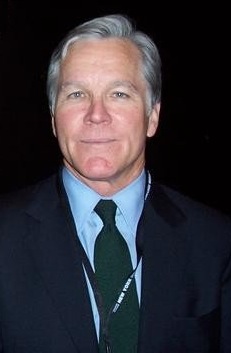
Keller

Bill Keller, executive editor of the New York Times, made clear the other day he doesn’t fully understand the derivation and significance of his newspaper’s famous, 114-year-old motto, “All the News That’s Fit to Print.”

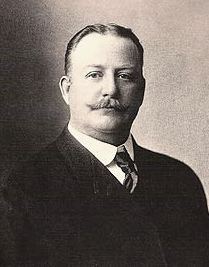
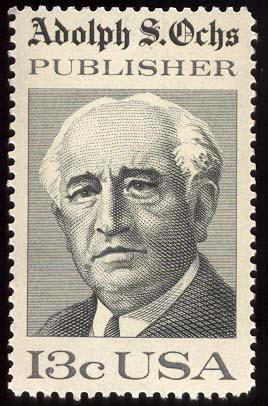
And he didn’t seem particularly comfortable with the slogan coined (most likely) by Adolph Ochs, who in 1896 acquired the then-beleaguered Times and eventually led the newspaper to preeminence in American journalism.

Ochs, commemorated

Sure, the motto’s smug and overweening, elliptical and easily parodied. But it is the most recognizable motto in American journalism, and it evokes a time now passed when slogans helped define and distinguish U.S. newspapers.

In an appearance not long ago at the National Press Club in Washington, Keller was asked about “All the News That’s Fit to Print,” which took a permanent place of prominence on the newspaper’s front page on February 10, 1897.

Keller rather sniffed at it, saying the motto “harkens back to a day when the aim of the newspaper was to be comprehensive.”

According to a transcript of his remarks, Keller said that nowadays the Times is “going to tell you maybe only a little bit, but a little bit about everything.

“And I think that slogan describes an aspiration, or a mindset. Now we tend to be more selective, and try to give you more depth, to tell you the stories that are not obvious.”

Actually, “All the News That’s Fit to Print” was framed a riposte to activist-oritented yellow journalism that flared in New York City in the closing years of the 19th century.

Ochs clearly meant the slogan to be a rebuke to the flamboyant ways of the  New York Journal of William Randolph Hearst and the New York World of Joseph Pulitzer. Their newspapers were the leading exemplars of the yellow press in fin-de-siècle urban America.

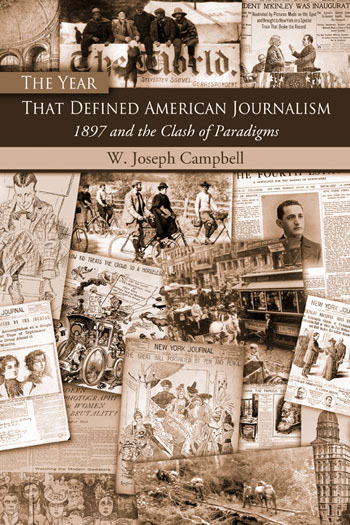
As I wrote in my 2006 book, a year study titled The Year That Defined American Journalism: 1897 and the Clash of Paradigms, the motto was, and remains, a daily rejection of flamboyant, self-promoting journalism.

And as the Times pointed out in 1935 in its obituary about Ochs, the motto “has been much criticized, but the criticisms deal usually with the phraseology rather than with its practical interpretation, and the phraseology was simply an emphatic announcement that The Times was not and would not be what the nineties called a yellow newspaper.”

I further noted in The Year That Defined American Journalism that the Times, at its 50th anniversary in 1901, “referred to ‘All the News That’s Fit to Print’ as its ‘covenant.’ One-hundred years later, a columnist for the Wall Street Journal aptly identified the motto as the ‘leitmotif not merely for the Times, but also, by a process of osmosis and emulation, for most other general-interest papers in the country, as well as for much of the broadcast media.'”

So, no, the motto wasn’t an assertion of intent to be comprehensive — although the Times surely carried a lot of news in the late 1890s. Thirty or more articles, many of them a paragraph or two in length, usually found places on its front page back then.

Ochs’ slogan was more than a daily slap at yellow journalism.

It also represents “a daily and lasting reminder of the Times’ triumph in a momentous … clash of paradigms that took shape in 1897—a clash that helped define the modern contours of American journalism,” as I noted in The Year That Defined American Journalism.

That clash pitted three rival, incompatible models for the future of American journalism.

“As suggested by its slogan,” I wrote, “the Times offered a detached, impartial, fact-based model that embraced the innovative technologies emergent in the late nineteenth century but eschewed extravagance, prurience, and flamboyance in presenting the news.

“Extravagance, prurience, and flamboyance were features typically associated with yellow journalism, a robust genre which, despite its controversial and self-indulgent ways, seemed to be irresistibly popular in 1897. The leading exemplar of yellow journalism was … Hearst’s New York Journal, which in 1897 claimed to have developed a new kind of journalism, a paradigm infused by a self-activating ethos that sidestepped the inertia of government to ‘get things done.’

“The Journal called its model the ‘journalism of action’ or the ‘journalism that acts,’ and declared it represented ‘the final state in the evolution of the modern newspaper.’

“The third rival paradigm,” I wrote, “was more modest and idiosyncratic than those of the Times and Journal. If improbable, it was nonetheless an imaginative response to the trends of commercialization in journalism. The paradigm was an anti-journalistic literary model devised and promoted by J. Lincoln Steffens, who in late 1897 became city editor of the New York Commercial Advertiser, then New York’s oldest newspaper.”

That model, Steffens said, was predicated on the notion “that anything that interested any of us would interest our readers and, therefore, would be news if reported interestingly.”

The Times ultimately prevailed in the three-sided rivalry that emerged in 1897, and “All the News That’s Fit to Print” lives on as a reminder of the outcome of that momentous clash of paradigms.

WJC

Recent and related:

114 years on the front page

In 1897, Anniversaries, New York Times, Newspapers, Yellow Journalism on February 9, 2011 at 7:37 am

Tomorrow makes 114 years on the front page for the best-known slogan in American journalism.

114 years on the front

The slogan, of course, is “All the News That’s Fit to Print,” which first appeared February 10, 1897, in the upper left corner (the left ear) of the front page New York Times.

I’ve called them the most famous seven words in American journalism and they have been endlessly parodied and analyzed since 1897. Even admirers of the Times have conceded that “All the News That’s Fit to Print” is “overweening” and even “elliptical.”

As I discussed in my 2006 book, The Year That Defined American Journalism: 1897 and the Clash of Paradigms, the motto has given rise to some lofty claims over the years. In 1901, at the 50th anniversary of its founding, the Times referred to “All the News That’s Fit to Print” as its “covenant.”

In 2001, a columnist for the Wall Street Journal described the motto as the “leitmotif not merely for the Times, but also, by a process of osmosis and emulation, for most other general-interest papers in the country, as well as for much of the broadcast media.”

Adolph Ochs began using the slogan soon after acquiring control of the then-beleaguered Times in August 1896. At first, Ochs made use of “All the News That’s Fit to Print” as an advertising and marketing device.

The slogan’s debut came in early October 1896, spelled out in a row of red lights on an advertising sign the Times had rented at New York’s Madison Square.

Four months later, without fanfare or explanation, the slogan appeared in the “left ear” of the front page. It has appeared in that place of prominence ever since.

In touting “All the News That’s Fit to Print,” Ochs clearly sought to distance the Times from the yellow press of William Randolph Hearst and Joseph Pulitzer. Their flamboyant newspapers dominated New York City’s media landscape in the late 1890s.

Ochs was nothing if not aggressive in promoting the Times and in seeking to position the newspaper as a sober counterweight to the activism and excesses of the yellow press.

To that end, he launched in late October 1896 a contest inviting readers to propose “a phrase more expressive of the Times’ policy” than “All the News That’s Fit to Print,” which by then had taken a modest place in a corner of the Times’ editorial page.

The Times promised to pay $100 to the person who proposed in ten words or fewer a slogan deemed better than “All the News That’s Fit to Print.”

The motto contest, cheesy though it may seem today, stirred a fair amount of attention–and reader interaction–in 1896.

Among the thousands of entries sent to the Times were such clunky suggestions as “All the News Worth Telling,” “All the News That Decent People Want,” and “The Fit News That’s Clean and True.”

Among the others:

“Full of meat, clean and neat.”

“Instructive to all, offensive to none.”

“The people’s voice, good the choice.”

“Aseptic journalism up to date.”

“Yours neatly, sweetly, and completely.”

As I wrote in The Year That Defined American Journalism: “Before the contest ended, the Times altered the stakes by making clear it would not abandon ‘All the News That’s Fit to Print.’

“The Times,” I wrote, “justified this change of heart by saying no phrase entered in the contest was more apt and expressive than ‘All the News That’s Fit to Print.’ The $100 prize would be awarded, to the person adjudged to have submitted the best entry. But the motto would not be changed.”

But the entries kept rolling in. Other suggestions included:

“Bright as a star and there you are.”

“All the news to instruct and amuse.”

“Pure in purpose, diligent in service.”

“You do not want what the New-York Times does not print.”

“All that’s new, true, and clever.”

Another entry was inspired by rival titles in fin-de-siècle New York:

“Out heralds The Herald, informs The World, extinguishes The Sun.” (That suggestion is evocative of the slogan of New York Newsday, a tabloid that ceased publication in 1995 after 10 years:  “On top of the News, ahead of the Times.”)

As the motto contest neared its close in early November 1896, the Times noted that that some people had “sent in diagrams and even pictures.

“While these exhibit both skill and thought,” the newspaper said, “they cannot be accepted, because they are not wanted.”

A committee of Times staffers winnowed the entries to 150 semi-finalists, which were submitted to Richard Watson Gilder, editor of The Century magazine. Gilder selected these as finalists:

  • Always decent; never dull.
  • The news of the day; not the rubbish.
  • A decent newspaper for decent people.
  • All the world’s news, but not a school for scandal.

As I wrote in The Year That Defined American Journalism, Gilder noted “that terms of the contest had changed from the original intent of selecting a slogan that ‘more aptly express the distinguishing characteristics of the New-York Times’ to the more theoretical task of determining which entry ‘would come nearest to it in aptness.’”

That entry, Gilder determined, had been submitted by D.M. Redfield of New Haven, Connecticut. Redfield’s suggestion:

“All the world’s news, but not a school for scandal.”

Catchy, that.

WJC

Many thanks to Jim Romenesko for linking to this post

Recent and related:

JHistory: ‘Getting It Wrong’ deserves to be ‘required reading’

In Bay of Pigs, Bra-burning, Cronkite Moment, Debunking, Hurricane Katrina, Media myths, New York Times, Newspapers, Reviews, War of the Worlds, Washington Post, Watergate myth on February 7, 2011 at 9:51 am

JHistory, the listserv devoted to issues in journalism history, posted yesterday a very insightful and favorable review of my latest book, Getting It Wrong, saying it “should be required reading for journalism students as well as journalists and editors.”

Getting It Wrong “reinforces the necessity of healthy skepticism; a commitment to fully understanding the implications of one’s research; and the importance of cultivating diverse, credible sources and viewpoints for probing, quality journalism,” the review says.

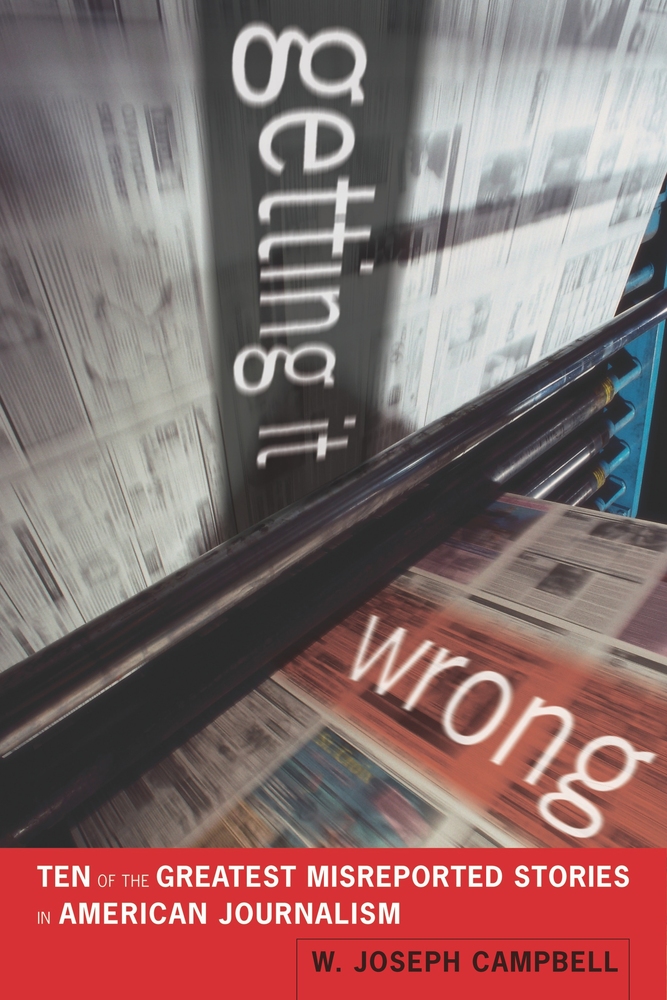
Getting It Wrong, which was published in summer 2010 by University of California Press, addresses and debunks 10 prominent media-driven myths — those dubious tales about and/or by the news media that masquerade as factual.

The reviewer for JHistory, Jeanette McVicker of SUNY-Fredonia, says Getting It Wrong is a “compelling book” that “generated a minor sensation in journalism circles all summer, with good reason.”

McVicker, whom I do not know, notes:

“In each chapter, Campbell delivers pithy, well-researched correctives for each sensational claim.

“No,” she writes, “Orson Welles’s ‘War of the Worlds‘ radio broadcast did not induce a national panic in October 1938. Yes, there was symbolic bra burning in the Freedom Trash Can at the 1968 protest of the Miss America pageant in Atlantic City, but no mass stripping of undergarments by wild women’s liberationists. No, the Kennedy administration did not request the New York Times to spike or delay a report on the imminent Bay of Pigs invasion: ‘utter fancy,’ Campbell writes.”

McVicker adds:

“The deconstruction of these cherished media myths by Campbell’s archival, source-driven research is praiseworthy, and makes for fascinating reading.”

She further notes:

“In most of these examples, the devastating legacy of the mythmaking media machine continues far beyond attempts to backpedal and correct the erroneous reporting: sensational stories tend to remain in public consciousness for years and sometimes decades.”

Indeed.

Getting It Wrong, McVicker adds, “demonstrates with tremendous force how discrete instances of media reporting and mythmaking have built up a golden age fallacy of journalism’s self-importance, and his work goes a long way toward deflating such heroic myths and consensus-narratives at the heart of modern journalism history.”

Her principal challenge to Getting It Wrong lies in my view that stripping away and debunking prominent media myths “enhances a case for limited news media influence. Media power tends to be modest, nuanced, diffused, and situational.”

Too often, I write, “the ubiquitous presence of the news media is mistaken for power and influence. … The influence of the news media is typically trumped by other forces.”

It’s an accurate assessment, especially given that media myths — such as the notion that investigative reporting by the Washington Post brought down Richard Nixon’s corrupt presidency in the Watergate scandal — often seek to “ascribe power, significance, and sometimes great courage to the news media and their practitioners.”

Puncturing media myths thus serves to deflate the notion of sweeping media power.

McVicker tends to disagree, writing that “it is surely not the case that the combined effects of such narratives are ‘modest, nuanced, diffused, and situational.'”

She notes as an example “the ongoing legacy of mainstream media’s failure to hold members of the Bush administration accountable during the buildup to the invasion of Iraq, a devastating correlate to Campbell’s spot-on analysis of the distorted, erroneous reporting of what was happening in the streets of New Orleans following Hurricane Katrina.”

There is, though, a fair amount of evidence that the news media were neither gullible nor comatose in the run-up to the war in Iraq, that tough questions were raised of the Bush administration’s pre-war plans.

While the notion of a docile news media has hardened into conventional wisdom about the pre-war coverage, that view has been challenged, notably by David Gregory of NBC News, who has asserted:

“I think the questions were asked [in the run-up to the war].  I think we pushed. I think we prodded. I think we challenged the president. I think not only those of us the White House press corps did that, but others in the rest of the landscape of the media did that.

“If there wasn’t a debate in this country” about going to war in Iraq, Gregory has said, “then maybe the American people should think about, why not?  Where was Congress? Where was the House? Where was the Senate? Where was public opinion about the war?”

I find quite telling this observation, offered in 2007 by Reason magazine:

“The ‘we should have done more to head off this war’ arguments assumes too much, exaggerates the media’s power to influence, removes the onus from politicians and infantilizes news consumers. … many in the media did ask tough questions of the administration, but the public wasn’t paying much attention.”

That the news media were comatose in the run-up to the Iraq War may be yet another media-driven myth.

WJC

Recent and related:


Campbell’s

book should be required reading for journalism students as well as

journalists and editors, for it reinforces the necessity of healthy

skepticism; a commitment to fully understanding the implications of one’s

research; and the importance of cultivating diverse, credible sources and

viewpoints for probing, quality journalism. There is an even greater lesson

here, however, pertinent for all readers: consistent with the rise of

“modern” journalism from the late 1800s to the present, the institution of

journalism has bolstered itself with narratives celebrating its own

strategic importance to society, even when the narratives turn out to be

fictions.

Media myth and Truthout

In 1897, Debunking, Media myths, Newspapers, Spanish-American War, Yellow Journalism on February 3, 2011 at 6:47 am

It’s at least faintly ironic that an online news site called Truthout — which asserts an embrace of “equality, democracy, human rights, accountability and social justice” — would post a reference to one of American journalism’s most enduring and delicious media myths.

Not Hearst's doing

In its serializing a book by radio host Thom Hartmann, Truthout the other day indulged in the myth that William Randolph Hearst vowed to “furnish the war” with Spain in 1898 — and then made good on the supposed pledge.

The installment Truthout posted Monday said Hearst “had cabled his artist correspondent to Cuba, Frederick[sic] Remington, ‘You provide the pictures, and I’ll provide the war.’

“Hearst came through on his end of the deal, and the Spanish-American War—started largely by his newspapers and the public sentiment they controlled ….”

As I discuss in my latest book, Getting It Wrong, the anecdote about Hearst’s vow is almost certainly apocryphal — a media-driven myth.

And so is the notion that Hearst’s newspapers fomented the Spanish-American War.

In the first chapter of Getting It Wrong, I note that the Remington-Hearst tale remains popular “despite a nearly complete absence of supporting documentation. It lives on even though telegrams supposedly exchanged by Remington and Hearst have never turned up. It lives on even though Hearst denied ever sending such a message.”

Moreover, I write:

The anecdote endures “despite an irreconcilable internal inconsistency: It would have been absurd for Hearst to vow to ‘furnish the war’ because war—specifically, the Cuban rebellion against Spain’s colonial rule—was the very reason Hearst sent Remington to Cuba in the first place.”

Given the context of Remington’s assignment, a vow to “furnish the war” simply would have been incongruous, and illogical.

Had Hearst sent such an inflammatory telegram, it surely would have been intercepted by Spanish censors, who controlled incoming and outgoing cable traffic in Cuba. Spanish authorities undoubtedly would have called attention to what would have been a clear case of Hearst’s meddling.

So it’s highly improbable that a cable containing a vow to “furnish the war” would have flowed without interruption between Hearst in New York and Frederic Remington in Havana. (Had the cable been sent, it would have been in mid-January 1897, near the end of Remington’s lone pre-war visit to Cuba.)

Moreover, no one who repeats the purported vow seems to note, or much care, that Hearst denied having sent such a message and Remington, a prominent artist of the American West, apparently never spoke about it.

The related myth — that Hearst’s newspapers brought on the conflict with Spain — is just as hardy as “furnish the war.” Like many media myths, it offers a reductive, simplistic, and easy-to-remember version of a complex historical event.

The Spanish-American War, quite simply, was not caused by the contents of Hearst’s newspapers, of which he had three at the time — two in New York City, one in San Francisco.

As I discuss in my 2001 book, Yellow Journalism: Puncturing the Myths, Defining the Legacies:

“The yellow press [of Hearst and Joseph Pulitzer] is not to blame for the Spanish-American-War. It did not force—it could not have forced—the United States into hostilities with Spain over Cuba in 1898. The conflict was, rather, the result of a convergence of forces far beyond the control or direct influence of even the most aggressive of the yellow newspapers, William Randolph Hearst’s New York Journal.”

Besides, no one who asserts that the yellow press was responsible for the war with Spain can persuasively demonstrate just how the often-exaggerated contents of Hearst and Pulitzer’s newspapers were decisive in the declaration of war in April 1898.

“If the yellow press did foment the war,” I wrote in Yellow Journalism, then “researchers should be able to find some hint of, some reference to, that influence in the personal papers and the reminiscences of policymakers of the time.

“But neither the diary entries of cabinet officers nor the contemporaneous private exchanges among American diplomats indicate that the yellow newspapers exerted any influence at all.”

When it was discussed within the administration of President William McKinley, the yellow press was dismissed as a nuisance or disdained at as a complicating factor.

The truth is that the yellow press neither drove, shaped, nor  crystallized U.S. policy vis-à-vis Spain in 1898.

Put another way: Hearst did not follow through on a vow he never made.

WJC

Recent and related:

‘Yellow journalism’ turns 114

In 1897, Anniversaries, Debunking, Media myths, Newspapers, Spanish-American War, Yellow Journalism on January 30, 2011 at 8:21 am

It is a little-recognized, never-celebrated anniversary in American journalism, granted.

Wardman of the Press

But tomorrow marks 114 years since the term “yellow journalism” first appeared in print, in the old New York Press, edited by the austere Ervin Wardman (left).

The phrase “the Yellow Journalism” appeared in a small headline on the editorial page of the Press on January 31, 1897. The phrase also appeared that day in the newspaper’s editorial page gossip column, “On the Tip of the Tongue.”

Yellow journalism” quickly caught on, as a sneer to denigrate what then was called the “new journalism” of the New York Journal of William Randolph Hearst and the New York World of Joseph Pulitzer. By the end of March 1897, references to “yellow journalism” had appeared in newspapers in Providence, Richmond, and San Francisco.

In the decades since then, “yellow journalism” has become a widely popular if nebulous term — derisive shorthand for vaguely denouncing sensationalism and journalistic misconduct of all kinds, real and imagined.

“It is,” as I noted in my 2001 book Yellow Journalism: Puncturing the Myths, Defining the Legacies, “an evocative term that has been diffused internationally, in contexts as diverse as Greece and Nigeria, as Israel and India.”

Precisely how Wardman and the Press landed on the phrase “yellow journalism” isn’t clear.

The newspaper’s own, brief discussion of the term’s derivation was unhelpful and unrevealing: “We called them Yellow because they are Yellow,” it said in 1898 about the Journal and the World.

In the 1890s, the color yellow sometimes was associated with decadent  literature, which may have been an inspiration to the Harvard-educated Wardman, a figure now largely lost to New York newspaper history.

Wardman was tall and stern-looking. He once was described as showing his “Calvinistic ancestry in every line of his face.” He did little to conceal his contempt for Hearst and Hearst’s journalism.

His disdain was readily apparent in the columns of the Press, of which Wardman became editor in chief in 1896 at the age of 31. (The Press is long defunct; it is not to be confused with the contemporary alternative weekly of the same title.)

Wardman’s Press took to taunting Hearst, Hearst’s mother, and Hearst’s support for Democratic candidate William Jennings Bryan in the 1896 presidential election. The New York Journal was virtually alone among New York newspapers in supporting Bryan’s “free silver” candidacy.

The Press disparaged Hearst, then 34, as a mama’s boy, as “Billy” and “little Willie.” It referred to the Journal as “our silverite, or silver-wrong, contemporary.”

The Press also experimented with pithy blasts on the editorial page to denounce “new journalism.”

“The ‘new journalism,’” the Press said in early January 1897 “continues to think up a varied assortment of new lies.”

Later in the month, the Press asked in a single-line editorial comment:

“Why not call it nude journalism?”

It clearly was a play on “new journalism” and meant to suggest the absence of “even the veneer of decency.”

Before long, Wardman and the Press seized upon the phrase “yellow-kid journalism,” which evoked the Hearst-Pulitzer rivalry over a popular cartoon character known as the “Yellow Kid.”

Both the Journal and the World at the time were publishing versions of the kid.

Yellow kid poster (Library of Congress)

At the end of January 1897, the phrase “yellow-kid journalism” was modified  to “the Yellow Journalism,” and the sneer was born.

After landing on that evocative pejorative, Wardman turned to it often, invoking the term in brief editorial comments and asides such as: “The Yellow Journalism is now so overripe that the little insects which light upon it quickly turn yellow, too.”

The diffusion of “yellow journalism” was sealed when the Journal embraced the term in mid-May 1898, during the Spanish-American War. With typical immodesty, the newspaper declared:

“… the sun in heaven is yellow—the sun which is to this earth what the Journal is to American journalism.”

WJC

From an essay originally posted at Media Myth Alert January 31, 2010

Many thanks to Jim Romenesko for linking to this post

Recent and related:

24/7 news cycle no new phenomenon

In Debunking, Media myths, Newspapers, Spanish-American War on January 25, 2011 at 8:31 am

A recent commentary in the Wall Street Journal about the 24/7 news cycle offered a telling point that the Internet “has made real-time reporting more prevalent, but it certainly didn’t invent it.”

The commentary’s author, Peter Funt, also noted that “the notion that nonstop news coverage is something new, some recent innovation developed as a product of the Internet and utilities such as Twitter, is bogus.”

Bogus, indeed.

The 24/7 news cycle is no phenomenon exclusive to the digital century. It is hardly novel, and it’s tiresome to hear journalists cite the nonstop news cycle as if it were — and as if it were a cause and excuse for error and superficial reporting.

I grow impatient with claims such as this:

“There was a time that the people we watched on T.V. for informative news were trustworthy and generally provided a pretty good snapshot of the days’ activities, breaking in when there truly was ‘breaking news.’ … With the advent of  cable T.V.  and the eventual cable-based ‘News’ networks, and then the Internet, we have become a nation addicted to a 24 hour news cycle.”

Not only does such a claim smack of indulgence in the “golden age” fallacy, it offers no evidence of a national addiction to nonstop news.

Adult Americans on average spent 70 minutes a day, getting the news, according a study last year by the Pew Research Center. While that figure is up from an average of 67 minutes in 2008, it is down from an average of 74 minutes in 1994–before the emergence of social media, and even before the popular advent of the Internet’s World Wide Web.

Pew also reported last year that 17 percent of adult Americans go “newsless” on a typical day. That is, they avoid getting the news despite the variety of options and platforms offered by media technologies.

That a significant percentage of the populates chooses to go newsless is, I write in my latest book, Getting It Wrong, among the reasons to question whether the news media exert broad influence in American life.

“Large numbers of Americans are beyond media influence,” I note in Getting It Wrong, which addresses and debunks 10 prominent media-driven myths.

Choosing to go newsless may signal that a segment of the adult population has little trust or faith in the U.S. news media and their content. It’s also an effective response, too, to nonstop news: They ignore it. Turn it off.

In any event, it’s quite clear the 24/7 news cycle goes back decades.

As I’ve noted from time to time at Media Myth Alert, large-city newspapers of the late 19th century were known would produce many “extra” editions to report fresh elements of important, breaking news.

Extras not uncommon in 1898

During the Spanish-American War in 1898, for example, William Randolph Hearst’s New York Evening Journal published as many as 40 extra editions a day. On such occasions, deadline pressures had to have been intense.

Wire service journalism long has been acquainted with immediate deadlines. Indeed, beating the competition and being first with the news are priorities that define — and have defined — news agencies such as the Associated Press and Reuters.

Deadlines arrive every second in the fast-paced wire service world. And so it was, long before the Internet’s emergence.

(As Michael Oreskes, senior managing editor of the Associated Press, noted in a letter to the Wall Street Journal about Funt’s piece, a book published in 1957 about the old United Press news agency was titled A Deadline Every Minute.)

There are plenty of other examples of news outlets built around speed and immediacy.

CNN launched a headline news channel in 1982. As Funt noted, “All-news radio began in the early 1960s at stations like WAVA in Washington, D.C., and WINS in New York, where it was refined to become the nonstop reporting format that remains popular today.”

I remember listening as a kid to Philadelphia’s KYW news radio in the mid-1960s. KYW’s history says that it was “the second all-news station in the country.”

Then as now, KYW emphasizes news all the time, even though content does become repetitive.

So, no, the 24-hour-a-day news cycle is not new. Speed and time pressures are traditional elements of daily journalism.

They are, as Funt correctly noted, “integral to the very definition of news.”

WJC

Recent and related: