W. Joseph Campbell

Archive for the ‘Reviews’ Category

‘Exquisitely researched and lively’

In Cronkite Moment, Debunking, Hurricane Katrina, Media myths, Reviews on September 16, 2010 at 9:40 am

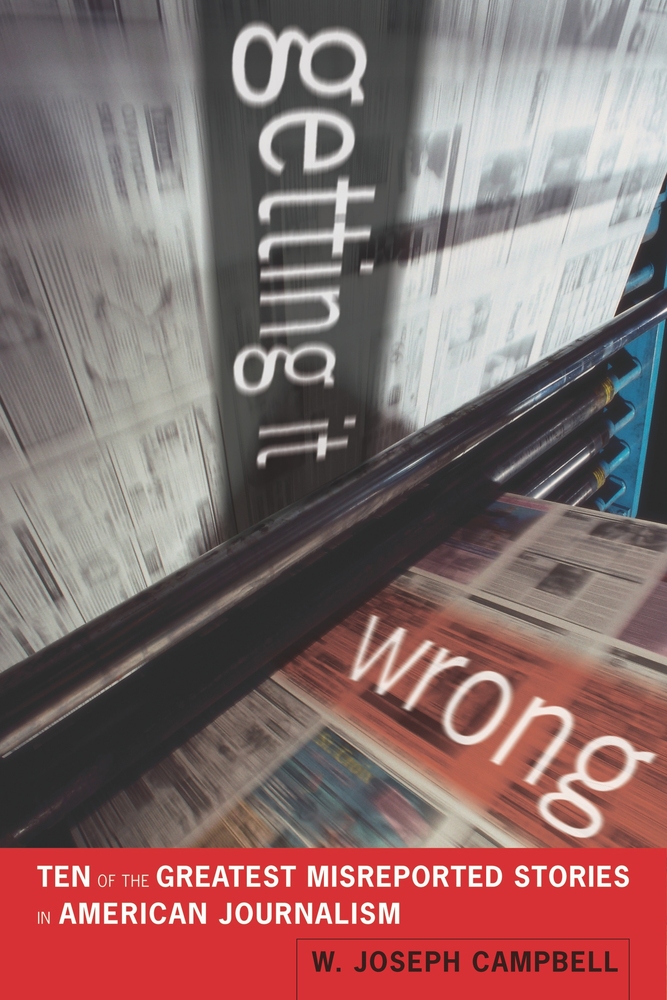
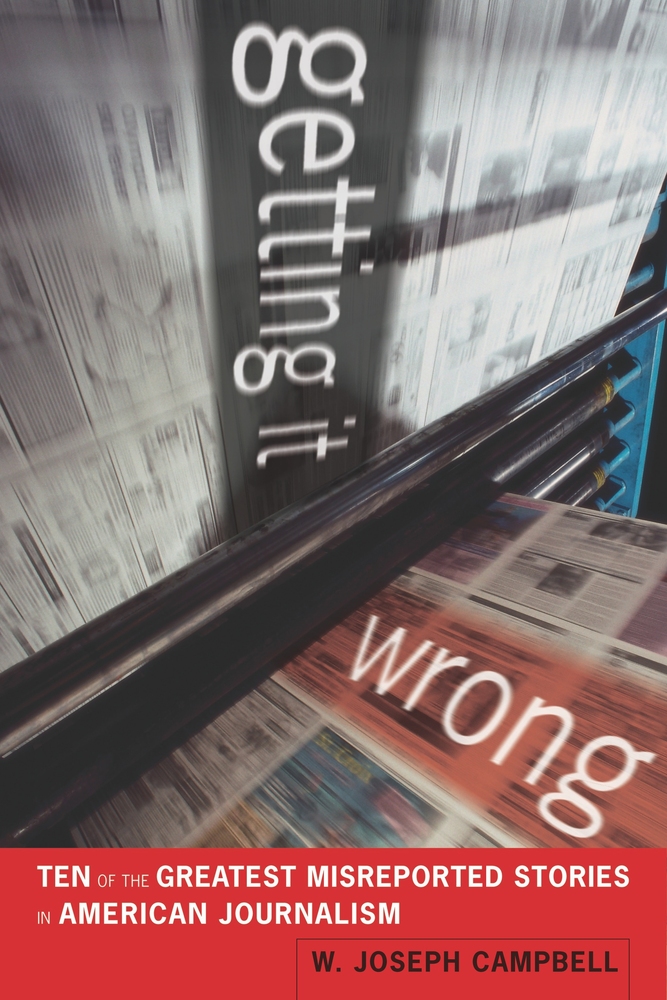
That’s the Denver Post‘s take on Getting It Wrong, my new book on media-driven myths which the newspaper recently reviewed.

The Post offers a discerning summary of the book, noting that it “takes a critical look at 10 stories that were either total fabrications or blown way out of proportion and yet became part of our popular culture.”

It also says Getting It Wrong offers “an exquisitely researched and lively look at an industry that too often shines the light on itself more than it does on events and public figures.”

And it notes, quite correctly:

“Much of the ‘wrong’ coverage through the years comes from the media’s self-congratulatory preening.”

The review points out that the sternest criticism in Getting It Wrong is reserved “for coverage, mainly by television, of the chaotic aftermath of Hurricane Katrina in New Orleans in 2005.

“Hyperactive reporters told tales of snipers roaming the streets, ‘hundreds’ of bodies stacked up in the Super Dome and babies being raped and murdered, none of which could be verified.

The upshot of the exaggerated coverage of the storm’s aftermath, the review notes, “was that rescue operations were hindered by fear, and prejudices of a watching public against poor people and minorities were confirmed.”

The review was written by Dick Kreck, a former reporter and columnist for the Post who has written three books. Kreck is an engaging storyteller and the go-to source for details about the lusty history of Denver journalism. (Full disclosure: Kreck spoke at a program at the Denver Post during last month’s convention of the Association for Education in Journalism and Mass Convention. I helped organize the program.)

Kreck opens the review of Getting It Wrong by declaring:

“Memo to media: Get over yourself. You’re not that important.”

He later cites a passage in Getting It Wrong quoting Robert Samuelson, a columnist who writes on economic issues for the Washington Post:

“Because the media are everywhere—and inspire much resentment—their influence is routinely exaggerated. The mistake is confusing visibility with power and the media are often complicit in the confusion. We [in the news media] embrace the mythology, because it flatters our self-importance.”

Getting It Wrong indeed offers a brief for modest media effects.

To bust media myths, I write in the book, “is to confront the reality that the news media are not the powerful agents they, and many others, assume them to be.

“It is exceedingly rare for any news report to trigger a powerful, immediate and decisive reaction akin to President Lyndon Johnson’s purported response to [Walter] Cronkite’s televised assessment about Vietnam: ‘If I’ve lost Cronkite ….’

“Researchers long ago dismissed the notion the news media can create such profound and immediate effects, as if absorbing media messages were akin to receiving potent drugs via a hypodermic needle,” I note, adding:

“Media power tends to be modest, nuanced, diffused, and situational.” And typically trumped by other, more powerful forces and factors.

WJC

Related:

‘Persuasive and entertaining’: WSJ reviews ‘Getting It Wrong’

In Cronkite Moment, Debunking, Furnish the war, Jessica Lynch, Media myths, Murrow-McCarthy myth, New York Times, Reviews, Spanish-American War, War of the Worlds, Washington Post, Watergate myth on July 12, 2010 at 6:05 am

Today’s Wall Street Journal reviews Getting It Wrong, characterizing as “persuasive and entertaining” my new book debunking 10 prominent media-driven myths.

The review–which appears beneath the headline “Too good to check”–is clever and engaging, and opens this way:

“Hello, city desk, get me rewrite. Here’s the lead: Many of the landmark moments in American journalism are carefully nurtured myths—or, worse, outright fabrications.

“William Randolph Hearst never said, ‘You furnish the pictures, and I’ll furnish the war.’ Orson Welles’s ‘War of the Worlds’ radio broadcast didn’t panic America. Ed Murrow’s ‘See It Now’ TV show didn’t destroy Sen. Joseph McCarthy. JFK didn’t talk the New York Times into spiking its scoop on the Bay of Pigs invasion. Far from being the first hero of the Iraq War, captured Army Pvt. Jessica Lynch was caught sobbing ‘Oh, God help us’ and never fired a shot.

“These fables and more are lovingly undressed in W. Joseph Campbell’s persuasive and entertaining ‘Getting It Wrong.’ With old-school academic detachment, Mr. Campbell, a communications professor at American University, shows how the fog of war, the warp of ideology and muffled skepticism can transmute base journalism into golden legend.”

The reviewer, Edward Kosner, author of the memoir It’s News to Me, also discusses the myth of the “Cronkite Moment,” writing, “Television icons are central to two of Mr. Campbell’s dubious cases: Murrow and his successor as the patron saint of TV news, Walter Cronkite.”

Kosner notes–as I do in Getting It Wrong–that at least some of the myths confronted in the book will likely survive their debunking.

“For all Mr. Campbell’s earnest scholarship,” Kosner writes, “these media myths are certain to survive his efforts to slay them. Journalism can’t help itself—it loves and perpetuates its sacred legends of evil power-mongers, courageous underdogs, dread plagues and human folly.”

Well said.

And, alas, he may be right. Some of the myths almost certainly will live on. As I write in the introduction to Getting It Wrong, they “may prove resistant to debunking. They may still be widely believed despite the contrary evidence marshaled against them.

“The most resilient myths,” I further write, “may be those that can be distilled to a catchy, pithy phrase like: ‘If I’ve lost Cronkite, I’ve lost Middle America.’ Such quotations are neat, tidy, and easily remembered. Cinematic treatments influence how historical events are collectively remembered and can harden media-driven myths against debunking. The motion picture All the President’s Men, which cast Robert Redford and Dustin Hoffman in the lead roles of Washington Post reporters [B0b] Woodward and [Carl] Bernstein, has helped ensure that the journalists and their newspaper would be regarded as central to cracking the Watergate scandal.”

Kosner closes the review with a humorous observation, writing:

“At the end of the book, Mr. Campbell offers some remedies for media mythologizing, urging journalists, among other things, ‘to deepen their appreciation of complexity and ambiguity.’ Good luck with that, professor.'”

Heh, heh. Nice touch.

WJC

Related:

‘Junk food of jornalismo’: Diário writes up ‘Getting It Wrong’

In Bay of Pigs, Cronkite Moment, Debunking, Furnish the war, Media myths, Media myths and radio, Murrow-McCarthy myth, Reviews, Watergate myth on June 28, 2010 at 2:49 pm

Today’s edition of the venerable  Portuguese newspaper Diário de Notícias includes a write up about Getting It Wrong, my new book about prominent media-driven myths–those false, dubious, improbable stories about the news media that masquerade as factual.

With the help of the online translation site Babelfish, I was able to make out a good deal of the Diário review, which says in part:

“W. Joseph Campbell in Getting it Wrong: Ten of the Greatest Misreported Stories in American Journalism, published the University of California Press, [says] these ‘myths can be thought as junk food of jornalismo.'”

The Diário article mentions several media myths addressed and debunked in Getting It Wrong, including those of William Randolph Hearst’s purported vow to “furnish the war” with Spain; the 1938 radio dramatization of the War of the Worlds which supposedly sowed panic across the United States; the notion that Edward R. Murrow’s 1954 See It Now television program abruptly halted Senator Joseph McCarthy’s communists-in-government witch-hunt, and the myth that the New York Times suppressed its coverage of the run-up to the Bay of Pigs invasion in 1961.

Diário characterizes as one of the book’s “more concrete” examples “the Watergate case,” in which reporters for the Washington Post are credited with having toppled the corrupt presidency of Richard Nixon.

Media myths, the articles notes, are not innocuous; ” they can distort the perception of the power and function of jornalismo” because “they tend to give the media” more power and influence than they rightly deserve. It also says that myths can “minimize the complexity of the historical events for simplistic interpretations.” Both of those are important points raised in Getting It Wrong.

The review closes by taking up the suggestion I offer in the conclusion of Getting It Wrong, namely that there are more media myths to debunk.

“By no means do the media myths examined on these pages represent a closed universe,” I write in the book’s closing passage. “Others surely will assert themselves. They may tell of great deeds by journalists, or of their woeful failings. They may well hold appeal across the political spectrum, offering something for almost everyone. They may be about war, or politics, or biomedical research.

“Predictably, they will be delicious tales, easy to remember, and perhaps immodest and self-congratulatory. They probably will offer vastly simplified accounts of history, and may be propelled by cinematic treatment.  They will be media-driven myths, all rich candidates for debunking.”

WJC

Related:

‘Regret the Error’ considers ‘Getting It Wrong’

In Cronkite Moment, Debunking, Jessica Lynch, Media myths, Reviews, Watergate myth on June 18, 2010 at 6:41 pm

Craig Silverman’s latest “Regret the Error” column, posted today at the Columbia Journalism Review online site, offers a searching discussion of my new book, Getting It Wrong, and notes, insightfully:

“Every society needs heroes and villains, and stories that help forge identity and community. That’s why myths exist in the first place. But the press has the ability and means to shape and disseminate the tales of champions and villains, to create and propagate stories that reinforce role and identity. Media-driven myths are particularly powerful, which in turn makes them even harder to debunk.”

Silverman is the author of the well-received 2007 book, Regret the Error: How Media Mistakes Pollute the Press and Imperil Free Speech. His column discussing Getting It Wrong begins this way:

“Journalism is a profession built on storytelling, so it’s no surprise that its history is filled with some remarkable tales. Think Woodward and Bernstein bringing down a president. Or Walter Cronkite’s 1968 CBS News special about Vietnam that caused President Lyndon Johnson to exclaim, ‘If I’ve lost Cronkite, I’ve lost Middle America.’ Think of Edward R. Murrow demolishing Senator [Joe] McCarthy’s communist witch hunt on television, or William Randolph Hearst telling his correspondent in Cuba, ‘You furnish the pictures, I’ll furnish the war.’

McCarthy

“Great stories, all of them. If only they were built on facts—the other thing our profession is supposed to revere. W. Joseph Campbell, a professor at American University and respected journalism scholar, smashes the above media-driven myths, along with a few more, in his new book, Getting It Wrong: Ten of the Greatest Misreported Stories in American Journalism.”

About the emergence of media-driven myths, Silverman quotes me as saying:

“The notion of media power both for good, as in the Watergate example, or for bad, as in the William Randolph Hearst example, is one of the driving forces behind media myths.”

Indeed. Media myths, I write in Getting It Wrong, often stem from “an eagerness to find influence and lasting significance in what journalists do and tend to extend credit where credit is not entirely due.”

I further note in the book that media myths can “be self-flattering, offering heroes … to a profession more accustomed to criticism than applause.”

Silverman’s column wraps up by considering how to combat media-driven myths, quoting me as underscoring the importance of viewpoint diversity in American media newsrooms.

“There is room for a newsroom culture that embraces diverse viewpoints, and I think that will help encourage skepticism … and negate the groupthink that tends to take hold in newsroom culture,” he quotes me as saying.

“Challenging the dominant narrative and encouraging contrarian thinking is a good thing.”

On that point, I write in Getting It Wrong:

“It is certainly not inconceivable that a robust newsroom culture that embraces viewpoint diversity, encourages skepticism, invites challenges to dominant narratives, and rewards contrarian thinking would have helped thwart publication of embarrassing tales such as the Washington Post’s ‘fighting to the death‘ story about Jessica Lynch.”

WJC

Related:

‘Commentary’ reviews ‘Getting It Wrong’

In Cronkite Moment, Debunking, Murrow-McCarthy myth, Reviews, Washington Post, Watergate myth on June 4, 2010 at 11:27 am

The June 2010 number of Commentary magazine includes a fine, favorable, and thoughtful review of Getting It Wrong, my new book about media-driven myths.

The reviewer, Andrew Ferguson, who writes the “Press Man” column for Commentary, says of Getting It Wrong:

“It may be the best book about journalism in recent memory; it is certainly the most subversive.”

A wonderful, telling line, that.

He also writes:

“Campbell does what journalists, and most journalism professors, seldom think to do when they exchange the oft-repeated tales: he checks them out. And through a pitiless accretion of detail, he dissolves them one by one.

“As he reveals, Edward R. Murrow did not ‘bring down Joe McCarthy’ with his famous 1954 episode of See It Now; Campbell looked up the poll numbers and found that McCarthy’s favorability ratings were in free fall well before Murrow took to the air.

“No, Cronkite did not turn the public against the Vietnam War with an on-air editorial in February 1968: five months earlier, Gallup had registered that a plurality of Americans, 47 percent, agreed that the war was a mistake.

“And no, Woodward and Bernstein were not responsible for uncovering the entirety of the Watergate scandal; as reporters, they had pretty much run out of scoops by October 1972, when congressional investigators, criminal prosecutors, and other newspapers took over the story and drove it till President Nixon’s resignation in August 1974.

“And no, the bestselling author David Halberstam, who promoted each of these stories with unfailing pomposity, was not a reliable chronicler of even the most recent past.”

Ferguson wraps up his review by writing:

“Journalism’s myths about journalism, you’ll notice, are self-aggrandizing. They cast the journalist as hero. No wonder they’re so popular… among journalists. We warm ourselves by such tales, draw compensation and comfort from them, which is why they’re taught in our trade schools as elements of basic training.”

WJC

Related:

‘Good narrative trumps good history’

In 1897, Cinematic treatments, Furnish the war, Media myths, Reviews, Yellow Journalism on May 28, 2010 at 1:53 pm

The Shotgun Blog today quotes an excerpt from my recent review of Evan Thomas’ disappointing new book, The War Lovers, and offers this telling observation:

“A good narrative trumps good history about nine times out of ten.”

The Shotgun Blog excerpt carries the headline, “You Furnish the Myth, We’ll Furnish the History,” and includes this passage from my review of War Lovers:

“Thomas embraced the media-driven myth of William Randolph Hearst’s purported vow to furnish the war with Spain–a vow supposedly contained in a telegram to the artist Frederic Remington, on assignment in Cuba” in 1897.

The Remingt0n-Hearst anecdote almost certainly is apocryphal, as I discuss in my 2001 book, Yellow Journalism: Puncturing the Myths, Defining the Legacies.

I revisit the anecdote in the first chapter of my soon-to-be-published book, Getting It Wrong, which debunks 10 prominent media-driven myths—false, dubious, or improbable stories about the news media that masquerade as factual.

The Shotgun Blog’s observation about good narrative routinely trumping good history is worthy of rumination, as it does often seem to be the case. It is a topic that I address in Getting It Wrong.

A reason narratives like the Remington-Hearst anecdote triumph is that they are succinct, savory, and easily remembered–as are many media-driven myths.

The Remington-Hearst anecdote is almost too good to be false, a narrative so delicious that it deserves to be true.

The anecdote lives on “despite a nearly complete absence of supporting documentation,” I note in Getting It Wrong, adding:

“It lives on even though telegrams supposedly exchanged by Remington and Hearst have never turned up. It lives on even though Hearst denied ever sending such a message.

“It lives on despite an irreconcilable internal inconsistency: It would have been absurd for Hearst to vow to ‘furnish the war’ because war—specifically, the Cuban rebellion against Spain’s colonial rule—was the very reason Hearst sent Remington to Cuba in the first place.

“Anyone reading U.S. newspapers in early 1897 would have been well aware that Cuba was a theater of a nasty war. By then, the Cuban rebellion had reached island-wide proportion and not a single province had been pacified by Spain’s armed forces.”

What pressed the “furnish the war” anecdote unequivocally into the public consciousness–what sealed the narrative’s triumph over history, if you will–was Citizen Kane, the 1941 motion picture based loosely on Hearst’s life and times.

Kane was not a commercial success, in part because of Hearst’s attempts to block its release, but the film is consistently ranked by critics among the finest ever made, as I note in Getting It Wrong.

A scene early in the film shows Charles Foster Kane, the newspaper tycoon who invites comparisons to Hearst, at his desk, tie untied, quarreling with his former guardian. They are interrupted by Kane’s business manager, “Mr. Bernstein,” who reports that a cable a just arrived from a correspondent in Cuba.

Bernstein reads the contents and Kane, who is played superbly by Orson Welles, dictates a reply that paraphrases Hearst’s purported vow.

Orson Welles

“You provide the prose poems,” Kane says, “and I’ll provide the war.”

Bernstein congratulates Kane on a splendid and witty reply.

Saying he rather likes it himself, Kane instructs Bernstein to send it at once.

WJC

Related:

‘A debunker’s work is never done’

In Bay of Pigs, Bra-burning, Cronkite Moment, Debunking, Furnish the war, Media myths, Murrow-McCarthy myth, New York Times, Reviews, War of the Worlds, Washington Post, Watergate myth, Yellow Journalism on May 21, 2010 at 6:14 pm

So notes the inestimable media critic Jack Shafer in his review of my forthcoming book, Getting It Wrong, posted today at slate.com.

And what a generous, engaging, and insightful review it is.

Under the headline “The Master of Debunk,” Shafer notes that “the only way to debunk an enshrined falsehood is with maximum reportorial firepower.

“Toting big guns and an itchy trigger-finger is American University professor W. Joseph Campbell, whose new book Getting It Wrong: Ten of the Greatest Misreported Stories in American Journalism flattens established myths that you were brought up to believe were true.”

Shafer’s review specifically discusses a variety of media-driven myths, including William Randolph Hearst’s purported vow to “furnish the war” with Spain; the so-called “Cronkite moment” that supposedly altered President Lyndon Johnson’s Vietnam policy; the Bay of Pigs suppression myth that erroneously says President John F. Kennedy persuaded the New York Times to spike a story about the pending U.S.-backed invasion of Cuba, and the heroic-journalist myth of Watergate.

Shafer rightly points out that “a debunker’s work is never done” and to that end notes my recent post at Media Myth Alert about Evan Thomas’ new book, The War Lovers. The book embraces myths of the yellow press period in American journalism, including the Hearst vow.

Shafer thoughtfully considers the tenacity of media-driven myths, writing:

“Some myths endure because the stories are so compelling, like the Hearst tale and the alleged mayhem caused by Orson Welles’ [War of the Worlds] broadcast. Others survive because our prejudices nourish them (“crack babies,” bra burners) or because pure repetition has drummed them into our heads, smothering the truth in the process.

“The best tonic for the brain fever caused by media myths is an open mind and a free inquiry,” he writes.

Shafer wraps up the review by invoking this observation, by Jonathan Rauch:

“It is the error we punish, not the errant.”

Shafers adds:

“Of course when you do such a good job punishing the error, as Campbell does, you don’t need to bother with the errant.”

WJC

Related:

CJR reviews ‘Getting It Wrong’

In Debunking, Media myths, Reviews on May 12, 2010 at 3:34 pm

The May/June number of Columbia Journalism Review contains a fine and insightful review of Getting It Wrong, my forthcoming book that addresses, and debunks, 10 prominent media-driven myths.

James Boylan, the reviewer, writes, perceptively:

“As W. Joseph Campbell shows, there are many ways to misreport. Sometimes it means getting the story wrong in the first place, sometimes misremembering the story, sometimes inflating it later for self-aggrandizement. The author’s ten case studies include examples of each.”

Boylan, who is founding editor of CJR, further writes:

“In each of these cases, the author debunks what is essentially historical hearsay. The value of these studies is less in the answers, which are telegraphed early on, than in the detailed and illuminating research Campbell has applied to each.”

WJC