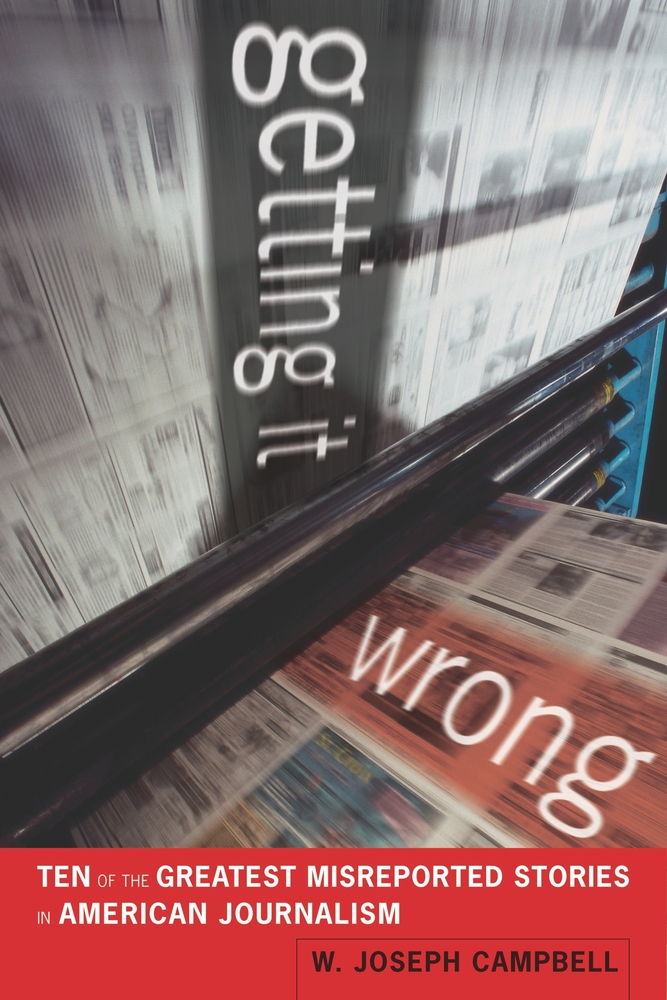
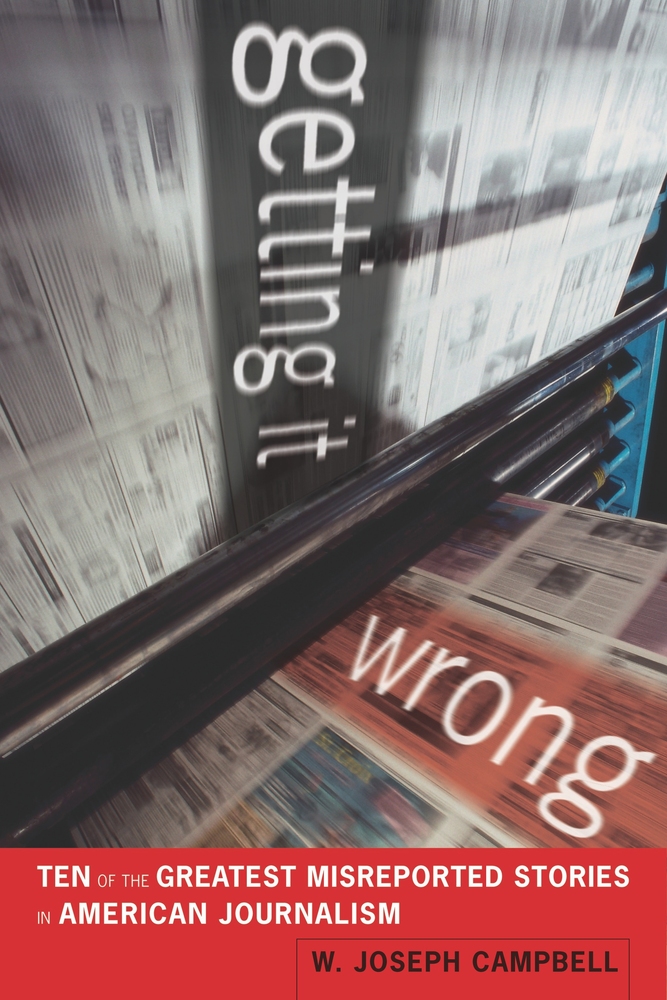
 The Society of Professional Journalists announced today that my media-mythbusting book, Getting It Wrong, is the winner of the 2010 Sigma Delta Chi award for Research about Journalism.
The award will be presented in September at the Excellence in Journalism convention in New Orleans.
Getting It Wrong, which was published last year by the University of California Press, debunks 10 prominent media-driven myths, which are dubious tales about the news media that masquerade as factual.
Here’s a summary of the 10 myths dismantled in Getting It Wrong:
- Remington-Hearst: William Randolph Hearst’s famous vow “to furnish the war” with Spain is almost certainly apocryphal.
- War of Worlds: The notion that the War of Worlds radio dramatization in 1938 caused nationwide panic and mass hysteria is exaggerated.
- Murrow-McCarthy: Edward R. Murrow’s famous See It Now program in March 1954 did not end Senator Joseph McCarthy’s communists-in-government witch-hunt; Murrow in fact was very late to take on McCarthy.
- Bay of Pigs: The New York Times did not suppress its reporting in the run-up to the ill-fated Bay of Pigs invasion in April 1961.
- Cronkite-Johnson: Walter Cronkite’s special report on Vietnam in February 1968 did not prompt an immediate reassessment or revision of U.S. war policy.
- Bra-burning: Humor columnist Art Buchwald helped spread the notion that feminist demonstrators dramatically burned their bras at a Miss America protest in September 1968.
- Watergate: The Washington Post’s intrepid reporters, Carl Bernstein and Bob Woodward, did not bring down Richard Nixon’s corrupt presidency. That they did is a trope that knows few bounds.
- Crack babies: The much-feared “bio-underclass” of children born to women who smoked crack cocaine during their pregnancies never materialized.
- Jessica Lynch: The Washington Post’s erroneous reporting about Jessica Lynch early in the Iraq War gave rise to several myths about her capture and rescue.
- Hurricane Katrina: News coverage of Katrina’s aftermath in New Orleans in early September 2005 was marred by wild exaggerations about extreme, Mad Max-like violence.
The “Research about Journalism” award recognizes “an investigative study about some aspect of journalism,” SPJ says, and “must be based on original research; either published or unpublished, and must have been completed during the 2010 calendar year. … Judges will consider value to the profession, significance of the subject matter, thoroughness of the research, and soundness of the conclusion.”
Recent and related:
- Chapter One of ‘Getting It Wrong’
- Check out new trailer for ‘Getting It Wrong’
- As if Hearst were ‘back with us,’ vowing to ‘furnish the war’
- Perceptive observations about Woodward, Bernstein, media power
- Watergate and revolutions: Indulging in media-power myths
- WaPo ‘played pivotal role’ in Watergate? Think again
- False narrative about Jessica Lynch and Pentagon surfaces anew
- Time for WaPo to disclose sources on dubious Lynch story
- Busting the NYTimes suppression myth, 50 years on
- Two myths and today’s New York Times
- Searing insight that wasn’t: Fox Business and the Cronkite Moment
- A cautionary note on early coverage of dramatic events
- Launching ‘Getting It Wrong’ at Newseum
- Talking media myths at the alma mater
- Media myths, the ‘junk food of journalism’
- Sniffing out media myths
- ‘Exquisitely researched and lively’
- ‘Getting It Wrong’ goes on Q-and-A






 Media Myth Alert
1897, Commentary, Debunking, Fact-checking, Hearst, History, Insults, Journalism, Media, New journalism, New York Press, News, Opinion, Pulitzer, Spanish-American War, Yellow Journalism
‘Yellow journalism’ turns 114
In 1897, Anniversaries, Debunking, Media myths, Newspapers, Spanish-American War, Yellow Journalism on January 30, 2011 at 8:21 amIt is a little-recognized, never-celebrated anniversary in American journalism, granted.
Wardman of the Press
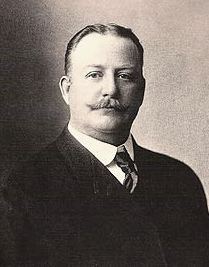
But tomorrow marks 114 years since the term “yellow journalism” first appeared in print, in the old New York Press, edited by the austere Ervin Wardman (left).
The phrase “the Yellow Journalism” appeared in a small headline on the editorial page of the Press on January 31, 1897. The phrase also appeared that day in the newspaper’s editorial page gossip column, “On the Tip of the Tongue.”
“Yellow journalism” quickly caught on, as a sneer to denigrate what then was called the “new journalism” of the New York Journal of William Randolph Hearst and the New York World of Joseph Pulitzer. By the end of March 1897, references to “yellow journalism” had appeared in newspapers in Providence, Richmond, and San Francisco.
In the decades since then, “yellow journalism” has become a widely popular if nebulous term — derisive shorthand for vaguely denouncing sensationalism and journalistic misconduct of all kinds, real and imagined.
“It is,” as I noted in my 2001 book Yellow Journalism: Puncturing the Myths, Defining the Legacies, “an evocative term that has been diffused internationally, in contexts as diverse as Greece and Nigeria, as Israel and India.”
Precisely how Wardman and the Press landed on the phrase “yellow journalism” isn’t clear.
The newspaper’s own, brief discussion of the term’s derivation was unhelpful and unrevealing: “We called them Yellow because they are Yellow,” it said in 1898 about the Journal and the World.
In the 1890s, the color yellow sometimes was associated with decadent literature, which may have been an inspiration to the Harvard-educated Wardman, a figure now largely lost to New York newspaper history.
Wardman was tall and stern-looking. He once was described as showing his “Calvinistic ancestry in every line of his face.” He did little to conceal his contempt for Hearst and Hearst’s journalism.
His disdain was readily apparent in the columns of the Press, of which Wardman became editor in chief in 1896 at the age of 31. (The Press is long defunct; it is not to be confused with the contemporary alternative weekly of the same title.)
Wardman’s Press took to taunting Hearst, Hearst’s mother, and Hearst’s support for Democratic candidate William Jennings Bryan in the 1896 presidential election. The New York Journal was virtually alone among New York newspapers in supporting Bryan’s “free silver” candidacy.
The Press disparaged Hearst, then 34, as a mama’s boy, as “Billy” and “little Willie.” It referred to the Journal as “our silverite, or silver-wrong, contemporary.”
The Press also experimented with pithy blasts on the editorial page to denounce “new journalism.”
“The ‘new journalism,’” the Press said in early January 1897 “continues to think up a varied assortment of new lies.”
Later in the month, the Press asked in a single-line editorial comment:
“Why not call it nude journalism?”
It clearly was a play on “new journalism” and meant to suggest the absence of “even the veneer of decency.”
Before long, Wardman and the Press seized upon the phrase “yellow-kid journalism,” which evoked the Hearst-Pulitzer rivalry over a popular cartoon character known as the “Yellow Kid.”
Both the Journal and the World at the time were publishing versions of the kid.
Yellow kid poster (Library of Congress)
At the end of January 1897, the phrase “yellow-kid journalism” was modified to “the Yellow Journalism,” and the sneer was born.
After landing on that evocative pejorative, Wardman turned to it often, invoking the term in brief editorial comments and asides such as: “The Yellow Journalism is now so overripe that the little insects which light upon it quickly turn yellow, too.”
The diffusion of “yellow journalism” was sealed when the Journal embraced the term in mid-May 1898, during the Spanish-American War. With typical immodesty, the newspaper declared:
“… the sun in heaven is yellow—the sun which is to this earth what the Journal is to American journalism.”
WJC
From an essay originally posted at Media Myth Alert January 31, 2010
Many thanks to Jim Romenesko for linking to this post
Recent and related:
Share this: