W. Joseph Campbell

Posts Tagged ‘Debunking’

Inflating the exploits of WaPo’s Watergate reporters

In Debunking, Media myths, Washington Post, Watergate myth on July 21, 2011 at 2:51 am

As it has receded in time and memory, the Watergate scandal of 1972-74 has become ever more prone to myth and misleading interpretation.

Bernstein in 2009 (Newseum photo)

That helps explain why Watergate’s dominant narrative centers on the reporting exploits of Carl Bernstein and Bob Woodward, two then-young reporters for the Washington Post.

It’s far simpler to focus on two star reporters — and to inflate their accomplishments — than it is to wrestle with the forbidding complexity of a scandal that sent 19 men to jail and forced the resignation of a sitting U.S. president, Richard Nixon.

That’s a point I make in my media myth-busting book, Getting It Wrong, which came out last year. “How the Post and its reporters uncovered Watergate,” I write, “is deeply ingrained in American journalism as one of the field’s most important and self-reverential stories.”

It’s a narrative that commands considerable appeal abroad as well.

Just yesterday, Britain’s Sky News channel became the latest news outlet to indulge in the heroic-journalist interpretation of Watergate, declaring in a report posted online that “Bernstein was one of two reporters who revealed US president Richard Nixon’s efforts to cover up a break-in at the Democratic National Committee headquarters.

“It led to the conviction of a number of White House officials and Mr Nixon’s eventual resignation,” Sky’s report said.

Well, no: Neither Bernstein nor Woodward “revealed” Nixon’s attempts to cover up the burglary at the Watergate complex in Washington, the scandal’s signal crime. And their reporting didn’t bring about Nixon’s downfall, either.

Nixon’s authorization of a cover-up — to obstruct justice by attempting to divert the FBI’s investigation of the break-in — wasn’t clearly demonstrated until July 1974.

That was when Nixon complied with the U.S. Supreme Court’s decision and surrendered audiotapes of key, Watergate-related conversations that he had secretly recorded in the Oval Office of the White House.

The tapes clearly showed the president had engaged in a cover-up, a revelation that led directly to his resigning in August 1974.

Bernstein and Woodward’s reporting had nothing to do with the forced disclosure of the incriminating audiotapes.

Nor did Bernstein and Woodward’s reporting disclose that the tapes existed.

That Nixon had made such recordings emerged in July 1973, during the Watergate investigation by a select committee of the U.S. Senate.

To call out the erroneous Sky News report about Bernstein and Woodward is not to pick nits.

Rather, it’s to insist on a more precise understanding of the Washington Post’s modest role in Watergate — and to note how routinely that role is exaggerated.

In other words, to call out the Sky News report is to insist on what Bernstein says is journalism’s fundamental objective — that of seeking “the best obtainable version of the truth.”

And the truth is, the Post’s reporting did not disclose the cover-up Nixon ordered; nor did the newspaper’s reporting force the president’s resignation.

To roll up a scandal of the dimension of Watergate, I point out in Getting It Wrong, “required the collective if not always the coordinated forces of special prosecutors, federal judges, both houses of Congress, the Supreme Court, as well as the Justice Department and the FBI.

“Even then,” I add, “Nixon likely would have served out his term if not for the audiotape recordings he secretly made of most conversations in the Oval Office of the White House.”

WJC

Recent and related:

Tarring Murdoch with Hearst’s evil ‘vow’ to ‘furnish the war’

In 1897, Debunking, Furnish the war, Media myths, Spanish-American War on July 20, 2011 at 8:28 am

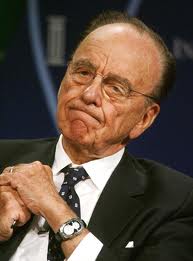
Rupert Murdoch’s much-anticipated hearing yesterday before a Parliament committee was hardly very dramatic — save for the assault on the tough old media mogul by a chucklehead wielding a shaving cream-pie.

The hearing, which centered around the misconduct of journalists formerly in Murdoch’s employ, was more farce and tedium than high-noon encounter that threatened Murdoch’s far-reaching media empire.

Murdoch, who is 80 and clearly doddering, even won a measure of sympathy as victim of the none-too-bright shaving cream-pie attack.

What was fairly remarkable was that in the hearing’s aftermath at least a couple of U.S. commentators turned credulously to a hoary media myth to make points about Murdoch’s supposedly evil ways.

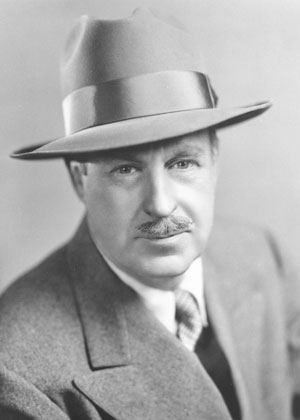
Hearst: Made no vow

The media myth is the tale that press baron William Randolph Hearst, in an exchange of telegrams with the artist Frederic Remington, vowed to “furnish the war” with Spain in the late 19th century.

I describe in my latest book, Getting It Wrong, why that tale is almost surely apocryphal for reasons that include Hearst’s denial and the improbable context in which his message supposedly was sent.

One of the pundits invoking the media myth was Milos Stehlik, a commentator on WBEZ, an FM radio station in Chicago.

Stehlik likened Murdoch to Hearst and Charles Foster Kane, the fictional media baron in Citizen Kane, the 1941 movie loosely based on Hearst’s life.

“Kane, Hearst and Murdoch … share a political activism which pretends to help the media-consuming masses while, in reality, mostly helped their own privileged class,” Stehlik declared, before invoking the “furnish the war” myth as if it were genuine.

“Hearst,” he said, “told artist Frederic Remington, who was in Cuba, to send dispatches about the war. Remington sent Hearst a telegram saying there was no war in Cuba. Hearst famously told Remington to just provide him the pictures, and he would furnish the war.”

Meanwhile in Seattle, Jon Talton, a newspaper columnist on economic issues, posted a commentary that began this way:

“Press lord Rupert Murdoch isn’t accused of doing anything some of his notorious forebears wouldn’t have attempted given the technology. ‘You supply the pictures and I’ll supply the war,’ William Randolph Hearst is said to have instructed his Cuba correspondents as he ginned up circulation on the eve of the Spanish-American War.”

If Hearst had made the vow, it wouldn’t have been “on the eve of the Spanish-American War,” as Talton wrote in his column for the Seattle Times. It would have been in January 1897 — 15 months before the war began.

That was when Remington arrived in Havana, on a brief assignment for Hearst’s New York Journal to draw sketches of the Cuban rebellion against Spanish colonial rule.

Remington soon tired of the assignment and, the myth has it, cabled Hearst, stating:

“Everything is quiet. There will be no war. I wish to return.”

Hearst, in New York, supposedly replied by stating:

“Please remain. You furnish the pictures, and I’ll furnish the war.”

The anecdote’s sole original source was a blustering, cigar-chomping journalist named James Creelman, who recounted the tale in his 1901 memoir, On the Great Highway.

Creelman, though, did not explain how he heard about the Remington-Hearst exchange. It couldn’t have been first hand because at the time Remington was in Cuba, Creelman was in Spain, on assignment for the Journal.

That means Creelman could only have learned about the tale second-hand or, as is more likely, just made it up.

Significantly, the context of the supposed Remington-Hearst exchange makes no sense.

I write in Getting It Wrong that “it would have been absurd for Hearst to vow to ‘furnish the war’ because war — specifically, the Cuban rebellion against Spain’s colonial rule — was the very reason Hearst sent Remington to Cuba in the first place.”

The rebellion was a vicious conflict that began in early 1895; by early 1897, it had reached islandwide proportion. As such, the rebellion attracted much attention in U.S. newspapers, including those published by Hearst.

So what may prompt pundits to turn credulously and not infrequently to the anecdote about Hearst and his supposed wickedness?

Because it’s arguably the most deliciously evil tale in journalism history, a tale that reveals Hearst’s ruthlessness and his warmongering. It’s a tale about journalism at its most sinister and malign, a tale wrapped in a dark and arrogant pledge to bring on a war the country otherwise wouldn’t have fought.

And these days, it’s a handy if indirect way of tarring Murdoch, by associating him with Hearst in the exclusive club of vile and villainous media magnates.

WJC

Many thanks to Instapundit
Glenn Reynolds for linking to this post

Recent and related:

A ‘fascinating and detailed exploration’

In Debunking, Media myths, War of the Worlds, Washington Post, Watergate myth on July 19, 2011 at 9:04 am

My media myth-busting book, Getting It Wrong,was reviewed recently by the Idaho Statesman, which called the work a “fascinating and detailed exploration.”

Getting It Wrong addresses and debunks 10 prominent media-driven myths, those dubious tales about the news media that masquerade as factual.

The Statesman’s review discusses in some detail the myths about the War of the Worlds radio broadcast in October 1938, which supposedly set off nationwide panic and mass hysteria, and about the Watergate scandal of 1972-74 which brought down Richard Nixon’s corrupt presidency.

The reviewer was Bob Kustra, president of Boise State University and the engaging host of the  Reader’s Corner, a weekly radio program about books and their authors. I was interviewed on Kustra’s show last month.

About the media myth of Watergate — the notion that intrepid reporters for the Washington Post broke or exposed the scandal and brought about Nixon’s resignation — Kustra writes:

“While Campbell acknowledges that most people believe two young and ambitious Washington Post reporters brought down a corrupt president, he deftly shows how journalism’s contribution to Nixon’s fall was modest at best.

“The president’s decline, he explains, was the consequence of his criminal conduct, which was exposed in the convergence of many forces. But it’s far easier to focus on two heroic journalists, says Campbell, than it is to grapple with the complexities of the Watergate scandal.

Nixon resigns: Not WaPo's doing

“Therein,” Kustra adds, “lies one of the reasons we are so likely to believe media myths — they offer simplistic answers to complex issues. They also lead us to believe the news media are very powerful and sometimes even dangerous forces in society.”

He also writes that the myths debunked in Getting It Wrong “are worth revisiting, and not just to set the record straight.

“Doing so offers important lessons on being discerning consumers of what we read and hear in the news.”

WJC

Recent and related:

Recalling Hearst to bash Murdoch: Superficial and off-target

In Debunking, Hurricane Katrina, Media myths, Spanish-American War, Yellow Journalism on July 18, 2011 at 12:26 am

Hearst: Murdoch's model?

The fallout from the phone-hacking scandal rocking Rupert Murdoch’s media holdings in Britain has prompted unflattering comparisons that the tough old media mogul is but a latter-day reincarnation of William Randolph Hearst, American press lord of the late 19th and early 20th centuries.

Trouble is, such comparisons are facile and no better than superficial. Hearst, for example, hardly established the international presence that Murdoch commands.

And these off-target comparisons have become an occasion to indulge in the hoary media myth that Hearst and his yellow press fomented the Spanish-American War in 1898.

The Sun Herald newspaper of Mississippi, a winner of the Pulitzer Prize for public service in 2006 for coverage of the Hurricane Katrina disaster on the Gulf Coast, did just that in an editorial published over the weekend.

“Not since William Randolph Hearst’s newspaper empire sensationalized news and gave a distinctive yellow tinge to journalism has the world seen the likes of Rupert Murdoch, the Australian/American media lord whose News Corporation has spread its tabloid brand in print and on the airwaves to so many corners of the globe,” the Sun Herald harrumphed in its editorial.

Of Hearst, the Sun Herald further stated:

“His newspapers were so powerful in molding public opinion that they were credited with pushing the United States into war with Spain in 1898.”

Really?

No.

As I pointed out in my 2001 book, Yellow Journalism: Puncturing the Myths, Defining the Legacies, critics who blame the yellow press of Hearst (and his rival, Joseph Pulitzer) for bringing on the war invariably fail to explain how the contents of those newspapers came to be transformed into policy and military action.

How did that work? What was the mechanism? Why was the yellow press so singularly powerful at that moment in American history?

In truth, as I’ve noted previously at Media Myth Alert, there was no mechanism by which the newspapers’ contents were translated into policy and a decision to go to war. They were not that powerful.

Had the newspapers of Hearst and Pulitzer brought about the war with Spain, then “researchers should be able to find some hint of, some reference to, that influence in the personal papers and the reminiscences of policymakers of the time,” I wrote in Yellow Journalism, adding:

“But neither the diary entries of Cabinet officers nor the contemporaneous private exchanges among American diplomats indicate that the yellow newspapers exerted any influence at all. When it was discussed within the McKinley administration, the yellow press was dismissed as a nuisance or scoffed at as a complicating factor.”

In short, senior officials in the administration of President William McKinley largely disregarded the content of what was called the yellow press. They did not turn to it for guidance or insight in policymaking.

Their thinking was not shaped by yellow journalism.

A variation of the Murdoch-Hearst criticism is to assail Murdoch — as a commentary  posted yesterday at Huffington Post put it — “the latest prime purveyor of so-called ‘yellow journalism’.”

The author, novelist Terence Clarke, declared that yellow journalism as practiced by Hearst and Pulitzer “sacrificed truth in favor of sensationalism in order simply to sell more papers.

“It was a business ploy, not an example of high journalistic ideals. Now, with Murdoch leading the way, journalism in many instances has fallen victim to the same wish for sales, and has descended, again, from the high ground it should occupy.”

Oh, spare us such superficiality.

The yellow press of Hearst and Pulitzer was much more than merely sensational.

Anyone who has spent much time reading through their newspapers of the late 19th century invariably comes away impressed with the aggressive and news-oriented approaches they took.

David Nasaw, author of a commendably even-handed biography of Hearst, pointed this out notably well, writing:

“Day after day, Hearst and his staff improved on their product. Their headlines were more provocative than anyone else’s, their drawings more lifelike … the writing throughout the paper outstanding, if, at times, a bit long-winded.”

Not only that, but Hearst was willing to spend lavishly to get the news. He, much more so than Pulitzer, was inclined to tap prominent writers, such as Mark Twain, and pay them well to cover important events for his New York Journal.

Hearst paid $3,000 to the novelist, playwright, and foreign correspondent Richard Harding Davis to spend a month for the Journal in Cuba in early 1897, writing reports about the Cuban rebellion that was the proximate cause of the Spanish-American War.

That sum is the equivalent today of more than $50,000.

Moreover, the yellow press of the late 19th century exerted a lasting and profound influence on American journalism history.

As I wrote in Yellow Journalism, the genre “was much decried but its salient features often were emulated.”

Yellow journalism “was appealing and distinctive in its typography, in its lavish use of illustrations, in its aggressive newsgathering techniques,” I noted, adding:

“To a striking degree, features characteristic of the yellow press live on in American journalism, notably in the colorful layouts that characterize the formerly staid titles that used to disparage the yellow press—titles such as the New York Times and Washington Post.”

WJC

Recent and related:

Imprecise, overwrought Watergate analogies emerge in Murdoch scandal

In Cinematic treatments, Debunking, Media myths, Washington Post, Watergate myth on July 17, 2011 at 3:00 am

Meeting his Watergate?

Watergate has become a frequent though imprecise point of reference for the reporting scandal that has battered Rupert Murdoch’s media holdings in Britain, prompting the closure of a leading Sunday tabloid, the resignation of two executives prominent in his news empire, and groveling apologies in print.

The scandal, which centers on illegal hacking of cell phone voicemail, has come to called Murdoch’s Watergate, a characterization embraced especially by Murdoch’s  enemies in America, hoping that this imbroglio may finally brings down the tough old media mogul.

The phone-hacking scandal is “a debacle that features Murdoch starring in the eerily similar role as the one Dick Nixon played,” declared Eric Boehlert in an essay posted the other day at Huffington Post.

Carl Bernstein, who teamed with Bob Woodward in covering Watergate for the Washington Post, has notably promoted the Murdoch-Watergate comparison.

In an essay titled “Murdoch’s Watergate?” and published recently in Newsweek, Bernstein wrote, not surprisingly:

“For this reporter, it is impossible not to consider these facts through the prism of Watergate. … The circumstances of the alleged lawbreaking within [Murdoch’s] News Corp. suggest more than a passing resemblance to Richard Nixon presiding over a criminal conspiracy in which he insulated himself from specific knowledge of numerous individual criminal acts while being himself responsible for and authorizing general policies that routinely resulted in lawbreaking and unconstitutional conduct.”

But it’s imprecise, premature, and a bit overwrought to liken the phone-hacking scandal to Watergate.

It’s no Watergate. Not yet, anyway. And it’s certainly not clear that Murdoch authorized policies that “routinely resulted in lawbreaking and unconstitutional conduct.”

Watergate was sui generis, an unprecedented constitutional crisis that led in to Nixon’s departure from office in disgrace in 1974. He was the first U.S. president ever to resign.

In addition, 19 men associated with Nixon’s presidency or his 1972 reelection campaign went to jail for Watergate-related crimes. (Woodward once called Watergate “an immensely complicated scandal with a cast of characters as varied as a Tolstoy novel.”)

Rolling up a scandal of such dimension required, as I note in my latest book, Getting It Wrong, “the collective if not always the coordinated forces of special prosecutors, federal judges, both houses of Congress, the Supreme Court, as well as the Justice Department and the FBI.”

Even then, Nixon likely would have survived and served out his term if not for the audiotape recordings he secretly made of most private conversations in the Oval Office of the White House. (Woodward has endorsed that interpretation as well. He said in an online chat at washingtonpost.com in 1997 that “if the tapes had never been discovered, or [Nixon] had burned them, he almost surely would not have had to resign, in my view.”)

Toppling Nixon was no certain outcome of Watergate, at least not in the first year or so of the slowly unfolding scandal. And bringing down Nixon wasn’t a consequence of the reporting of Woodward and Bernstein, hoary media myth notwithstanding.

The phone-hacking scandal — in which reporters and private investigators for Murdoch’s now-shuttered News of the World tabloid broke into the voicemail of scores of people — has been an occasion to conjure Watergate in another way. In a romanticized, glowing way that recalls Watergate as a golden age in American journalism.

The Houston Chronicle has given expression to the golden-age sentiment.

The newspaper declared in a tut-tutting editorial the other day that the phone-hacking scandal “is a very long way from the saga of All the President’s Men, the uplifting account of how two dogged young reporters, Bob Woodward and Carl Bernstein, with the backing of ethically responsible Washington Post management, broke the Watergate scandal in 1972 that led to the resignation of President Richard Nixon. It inspired a generation of new journalists to their mission and exhibited the finest aspects of the profession.”

All the President’s Men was Woodward and Bernstein’s 1974 book about their Watergate reporting. The book’s cinematic version came out in 1976 and helped solidify the mythical notion that the Post brought down Nixon.

It deserves noting that the Chronicle’s editorial errs in at least three respects.

One, the Post management was not always so “ethically responsible” during Watergate.

For example, top editors approved an ethically suspect scheme allowing Woodward and Bernstein to approach federal grand jurors hearing Watergate testimony and ask them to break their vows of secrecy. As the reporters wrote in All the President’s Men, the ill-advised overtures to grand jurors nearly landed them in jail.

Two, the Post did not break the Watergate scandal.

The signal crime of Watergate — the burglary in June 1972 at Democratic National Committee headquarters — was interrupted by police. Within hours, news was circulating of the arrest of five burglars at the Watergate complex in Washington, D.C.

The Post’s article about the break-in appeared beneath the byline of Alfred E. Lewis, a veteran police reporter, and it drew heavily on information from investigators.

In subsequent Watergate reporting, moreover, the Post exposed  neither the cover-up of crimes linked to the break-in, nor the payment of hush money to the burglars. Nor did it break the news about Nixon’s secret audiotapes.

Three, the claim that coverage of Watergate “inspired a generation of new journalists to their mission” is exaggerated.

Watergate produced no enrollment surge in journalism programs at American colleges and university. Enrollment growth in fact had begun well before Woodward and Bernstein wrote their first Watergate-related story in 1972.

Still, as I note in Getting It Wrong, the notion that Woodward and Bernstein inspired a generation of students to take up journalism “lives on despite its thorough repudiation in scholarly research.”

Like many media-driven myths, the tale of inspiration is almost too good not to be true.

WJC

Many thanks to Instapundit
Glenn Reynolds for linking to this post.

Recent and related:

BBC calls Hearst vow apocryphal, quotes it anyway

In 1897, Debunking, Furnish the war, Media myths, Spanish-American War, Yellow Journalism on July 15, 2011 at 10:28 am

Apocryphal but still quotable.

That’s how Britain’s venerable broadcaster, the BBC, treated the mythical anecdote about media titan William Randolph Hearst and his purported vow to “furnish the war” with Spain in the late 19th century.

In an article posted online yesterday, the BBC described Hearst as the “definitive [news] baron” and declared:

“He’s credited with the invention of tabloid journalism in the 1890s when his New York Journal began a bitter circulation war with Joseph Pulitzer’s New York World. He also had a reputation as a warmonger.

“‘You furnish the pictures and I’ll furnish the war,’ goes an apocryphal instruction he was supposed to have sent in a telegram to an illustrator in Havana.”

That’s right, the line is apocryphal. What, then, is the point in using it? As a none-too-clever, back-handed way of buttressing the dubious notion that Hearst and his newspapers were capable of fomenting a war?

That’s sloppy journalism from a leading international news organization.

As I discuss in my latest book, Getting It Wrong, Hearst’s purported vow to “furnish the war” with Spain is a particularly tenacious media-driven myth — a prominent but dubious tale about journalism that masquerades as factual.

I note that the tale about Hearst’s vow “has achieved unique status as an adaptable, hardy, all-purpose anecdote, useful in illustrating any number of media sins and shortcomings.

“It has been invoked to illustrate the media’s willingness to compromise impartiality, promote political agendas, and indulge in sensationalism. It has been used, more broadly, to suggest the media’s capacity to inject malign influence into international affairs.”

Hearst: Didn't say it

Reasons for doubting the presumptive Hearstian vow are many, I point out in Getting It Wrong, and include the fact that the telegram in which Hearst supposedly made the statement — in an exchange with the artist Frederic Remington, on assignment to Cuba — has never turned up.

Plus, Hearst denied making such a vow.

Not only that, but the anecdote lives on lives on despite what I call “an irreconcilable internal inconsistency.” That is, it would have been absurd for Hearst to vow to “furnish the war” because war— specifically, the Cuban rebellion against Spanish colonial rule— was the reason he sent Remington to Cuba in the first place.

The artist was in Cuba for just six days in January 1897. By that time, the Cuban rebellion — a war for political independence — had reached islandwide proportions. “Anyone reading U.S. newspapers in early 1897 would have been well aware that Cuba was a theater of a nasty war,” I write in Getting It Wrong.

Given the context, Hearst’s purported vow is utterly illogical.

And to invoke the anecdote knowing that it’s apocryphal is little short of disingenuous.

The BBC’s reference to Hearst’s being “credited with the invention of tabloid journalism in the 1890s” also is questionable.

Hearst’s style of flamboyant journalism certainly helped inspire the epithetyellow journalism,” but he was no father of tabloid journalism.

If anything, Hearst was a latecomer to that genre.

As David Nasaw wrote in The Chief, his admirably even-handed biography of Hearst, the press baron didn’t embrace the tabloid until the 1920s “because he was not comfortable with the format.

“He  had no interest in publishing a picture newspaper that had little room for political coverage, columns, cartoons, and the editorials he cared so much about.”

WJC

Many thanks to Instapundit
Glenn Reynolds for linking to this post.

Recent and related:

The ‘Cronkite Moment’ was fictive

In Cronkite Moment, Debunking, Media myths on July 8, 2011 at 8:01 am

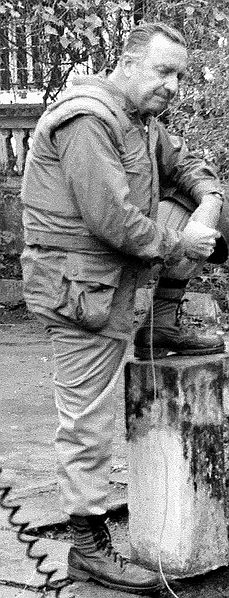
Cronkite in Vietnam

The mythical “Cronkite Moment” of 1968 offers supposedly timeless and irresistible lessons for journalists about the importance of telling truth to power and about the media’s potential to wield decisive influence.

Trouble is, the “Cronkite Moment” is fictive: It had little of the impact so often ascribed to it — impact of the kind described yesterday by Paul Fanlund, editor of the Capital Times in Madison, Wisconsin.

He wrote at a Capital Times blog:

“One has to be of a certain age, or a student of history, to know Walter Cronkite’s impact on Vietnam. In 1968, the famed broadcaster, who had been privately pro-war, pronounced on air that the war was no longer winnable, prompting President Lyndon Johnson to remark, ‘If I’ve lost Cronkite, I’ve lost the country.'”

Unpacking that paragraph reveals that it’s exaggerated in three ways.

One is that Cronkite (as he himself claimed for many years) had little if any “impact” on the war in Vietnam.

Two, Cronkite did not say on air that “the war was no longer winnable.” He said, in a special report broadcast on February 27, 1968, that the U.S. military was “mired in stalemate” in Vietnam and that negotiations might offer America a way out.

Three, Cronkite’s on-air assessment about Vietnam did not prompt President Lyndon Johnson to declare, “If I’ve lost Cronkite, I’ve lost the country.” Or anything akin to such a remark.

As I discuss in my media myth-busting book, Getting It Wrong, Johnson did not see the Cronkite program when it aired. And there is no evidence the president watched the show later, on videotape.

Moreover, Johnson was not in front of a television set when the Cronkite report about Vietnam was broadcast.

He was on the campus of the University of Texas at Austin, offering light-hearted remarks at the 51st birthday party of Governor John Connally, a long-time political ally.

About the time Cronkite was intoning his “mired in stalemate” assessment, Johnson wasn’t bemoaning his failed Vietnam policy; he wasn’t bemoaning the loss of Cronkite’s support.

He was jesting about Connally’s age.

“Today,” Johnson said, “you are 51, John. That is the magic number that every man of politics prays for—a simple majority.”

Even if he had watched the Cronkite report, it’s unlikely Johnson would have been much moved by the “mired in stalemate” assessment. It was hardly an original observation.

Leading U.S. news outlets such as the New York Times had invoked “stalemate” periodically in the months before the Cronkite program.

For example, in a news analysis published July 4, 1967, the Times said of the war effort:

“Many officers believe that despite the commitment of 466,000 United States troops now in South Vietnam … the military situation there has developed into a virtual stalemate.”

In a report from Saigon that was published August 7, 1967, the Times noted:

“‘Stalemate’ is a fighting word in Washington. President Johnson rejects it as a description of the situation in Vietnam. But it is the word used by almost all Americans here, except the top officials, to characterize what is happening. They use the word for many reasons ….”

By the end of February 1968, “stalemate” had been often used, and had become a rather tame assessment.

Far more assertive was the Wall Street Journal, which, in an editorial published four days before Cronkite’s report, said the U.S. war effort in Vietnam “may be doomed” and that “everyone had better be prepared for the bitter taste of defeat beyond America’s power to prevent.”

Interestingly, Cronkite disputed the notion his report about Vietnam had much impact.

He said in his 1997 memoir that his “mired in stalemate” assessment represented for Johnson “just one more straw in the increasing burden of Vietnam.” It was an analogy Cronkite repeatedly made.

“I think our broadcast simply was another straw on the back of a crippled camel,” he said in an interview on CNN in 1999.

But late in his life, Cronkite began to embrace the purported power of the “Cronkite Moment.” He said in 2006, in an interview with Esquire:

“To be honest, I was rather amazed that my reporting from Vietnam had such an effect on history.”

A case of believing one’s own clippings.

As I note in Getting It Wrong:

“Under scrutiny, the ‘Cronkite moment’ dissolves as illusory — a chimera, a media-driven myth.

“That it does is not so surprising. Seldom, if ever, do the news media exert truly decisive influences in decisions to go to war or to seek negotiated peace. Such decisions typically are driven by forces and factors well beyond the news media’s ability to shape, alter, or significantly influence.

“So it was in Vietnam, where the war ground on for years after the ‘Cronkite moment.'”

WJC

Recent and related:

The digital age ‘equivalent of the OJ Simpson trial’? Not quite

In Debunking, Media myths on July 7, 2011 at 9:02 am

Anthony mug shot

The stunning acquittal of Casey Anthony on the most serious charges in the slaying of her 2-year-old daughter has invited comparisons to the outcome of O.J. Simpson’s double-murder trial in 1995.

Those comparisons are mostly misleading.

The “Media File” blog of the Reuters news agency, for example, likened the Anthony verdict to the digital age “equivalent of the OJ Simpson trial.”

Simpson was found not guilty in October 1995 of the stabbing deaths of his former wife, Nicole, and her friend, Ron Goldman.

“Media File,” which was one of several outlets to detect parallels in the two cases, noted:

“Word of the verdict spread like wildfire … making a return to a normal life for newly-famous Anthony as unlikely as it was for already-famous Simpson 16 years ago.”

The blog also declared:

“Just as some greeted the Simpson verdict with tears and disbelief, there was much the same reaction about the Anthony verdict, including other mothers and daughters who railed against the verdict on the courthouse steps.

“Unlike OJ, who was accused of stabbing his [former] wife and one of her friends to death in a fit of jealous rage, there didn’t seem to be even the smallest cheering section for Anthony. Then again she was accused of murdering her two-year-old daughter, whose skeletal remains were found near the family home with duct tape dangling from her skull.

“Anthony’s defense was considerably less adamant than Simpson’s ‘100% not guilty’ plea, but, like Simpson, she did not take the stand in her own defense.”

While interesting, the parallels are mostly superficial and unrevealing.

The Anthony proceedings in Florida hardly were in the league of the O.J. trial in Los Angeles.

Casey Anthony, unlike Simpson, was no national celebrity before she was tried on charges of killing her daughter, Caylee.

As Marcia Clark, the prosecutor who lost the Simpson trial, said of Anthony:

“She never wowed the nation with her athletic prowess, shilled in countless car commercials, or entertained in film comedies.” Simpson had been a star football player, a pitchman for the Hertz car rental company, and a supporting actor in movies such as The Naked Gun.

Race — a central, defining factor in Simpson’s trial — was absent in the Anthony trial.

As such, the verdict in her case, surprising though it was, prompted nothing akin to the divisive, clashing reactions that greeted Simpson’s acquittal: Many whites reacted with shock and disbelief while many blacks cheered the outcome.

Significantly, the Anthony case produced nothing akin to the moment at the end of the Simpson trial, when the country held its collective breath and awaited the verdicts.

The Simpson jury deliberated less than four hours before deciding the case on October 2, 1995.  The hapless judge who presided over the 134-day trial, Lance Ito, announced that the verdicts would be read the following day, at 10 a.m. Pacific time, 1 p.m. Eastern.

As that hour approached on October 3, 1995, the country seemed almost to shut down. The New York Times reported that for 10 minutes, from 1 p.m. to 1:10 p.m. Eastern, “people didn’t work. They didn’t go to math class. They didn’t make phone calls. They didn’t use the bathroom. They didn’t walk the dog.

“They listened to the O.J. Simpson verdicts,” in what the newspaper accurately called “an eerie moment of national communion, in which the routines and rituals of the country were subsumed by an unquenchable curiosity.

“Millions of people in millions of places seemed to spend 10 spellbinding minutes doing exactly the same thing.”

Those minutes represented an exceptional occasion of collective anticipation, an almost incomparable moment.

For the collective anticipation they generated, the final moments in the Simpson case were rivaled perhaps only by the first manned lunar landing in July 1969.

WJC

Recent and related:

WaPo eludes responsibility in bogus hero-warrior tale about Lynch

In Debunking, Jessica Lynch, Media myths, Washington Post on July 6, 2011 at 9:17 am

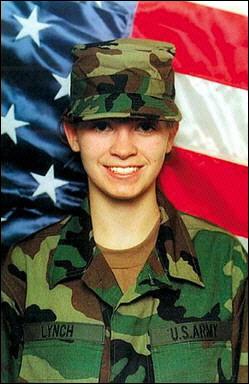
The Washington Post has the exclusive though obviously unwanted distinction of having brought the world the bogus story about Jessica Lynch and her battlefield heroics during the early days of the Iraq War.

Private Lynch, 2003

But in what has been a remarkable case of deflected attention, the Post’s singular role in the botched hero-warrior tale about Lynch has been obscured in favor of a darker, more sinister narrative that the Pentagon concocted the story and fed it to the American public.

That version — the military made it up — has become the dominant narrative of the Lynch case and is predictably invoked whenever Lynch attracts the news media’s attention, as she did on the Fourth of July.

She was in Idaho then to give a talk at a Presbyterian camp. Her appearance drew local news coverage, including a report published yesterday in the Spokesman-Review newspaper of Spokane.

The Spokesman-Review account blithely repeated the dominant narrative about Lynch’s supposedly heroic deeds, stating without attribution:

“The military initially portrayed Lynch as a hero, saying she fought back until she ran out of ammunition.”

Which just isn’t so.

As Vernon Loeb, one of the Post reporters on the botched Lynch story has made clear, the Pentagon wasn’t the source of the hero-warrior tale.

“Far from promoting stories about Lynch,” Loeb has said, “the military didn’t like the story.”

The dominant narrative is a false narrative.

Loeb then was the Post’s defense correspondent. He shared a byline with Susan Schmidt on the sensational story about Lynch, which was published April 3, 2003, on the Post’s front page.

The Schmidt-Loeb report carried the headline:

“‘She was fighting to the death.'”

The story described how Lynch, then 19, supposedly had fought with Rambo-like ferocity in an ambush at Nasiriyah in southern Iraq, “even after she sustained multiple gunshot wounds and watched several other soldiers in her unit die around her.”

Lynch, a supply clerk in the Army’s 507th Maintenance Division, also was stabbed before being overwhelmed, according to the Post.

The newspaper cited otherwise unidentified “U.S. officials” for its sensational story, which was picked up and reported prominently by news organizations around the world.

The hero-warrior tale turned Lynch into the war’s best-known American soldier. But it wasn’t true.

Lynch hadn’t fired a shot in the ambush.

She was badly injured not from gunshots and stabbings, but in a Humvee that crashed fleeing the Iraqi attack.

In the years since, the Post  has not objected as the dominant narrative about the origins of the Lynch story has shifted to the Pentagon. The newspaper has said little, if anything, about the now-routine inclination to blame the military for the bogus tale.

Indeed, the newspaper has “never fully acknowledged or explained its extraordinary error about Jessica Lynch,” as I write in my latest book, Getting It Wrong.

It is certainly time for the Post to identify the “U.S. officials” who led it so badly astray on the Lynch story; doing so would clarify what role, if any, the Pentagon had in the derivation of the bogus tale.

Loeb has effectively absolved the Pentagon in the hero-warrior tale about Lynch, saying in an interview on NPR in December 2003:

“Our sources for that story were not Pentagon sources.

“And, in fact, I could never get anybody from the Pentagon to talk about those reports [about Lynch’s battlefield heroics] at all. I got indications that they had, in fact, received those intelligence reports, but the Pentagon was completely unwilling to comment on those reports at all.

“They wouldn’t say anything about Jessica Lynch.”

WJC

Recent and related:

The journos who saved us

In Cinematic treatments, Debunking, Media myths, Murrow-McCarthy myth, Washington Post, Watergate myth on July 5, 2011 at 12:49 pm

Murrow: Savior?

At their extreme, media-driven myths are hero-worshipping devices, invoked to venerate journalists as saviors.

Thankfully, such treatment is rare, and typically reserved for such journalists the legendary CBS newsman Edward R. Murrow and the Watergate reporting duo, Bob Woodward and Carl Bernstein.

Brian Unger, host of a history program on cable television, indulged in a bit of journalists-idolatry in compiling for an Entertainment Weekly blog a list of a dozen heroic figures from TV shows and the movies.

On the list was Ed Murrow, whom Unger praised for “saving us from someone who pretended to be a great American patriot, Sen. Joseph McCarthy.”

Also selected were Robert Redford and Dustin Hoffman, the movie stars who played Washington Post reporters Woodward and Bernstein in the film All the President’s Men. “Armed only with a pen,” Unger wrote, “they saved the country from itself.”

Journalists as saviors: Like most media-driven myths, the notion is simply too good to be true, too simplistic to be credible.

Murrow hardly took down Joe McCarthy in Murrow’s famous See It Now program on CBS in March 1954.

The show was aired four years after McCarthy began his communists-in-government witch-hunt, and four years after muckraking columnist Drew Pearson piercingly challenged and punctured many of McCarthy’s claims.

Pearson

The television critic for the New York Post, Jay Nelson Tuck, wrote that Murrow in the days after the show felt “almost a little shame faced at being saluted for his courage in the McCarthy matter. He said he had said nothing that … anyone might not have said without a raised eyebrow only a few years ago.”

Years later, Murrow’s CBS colleague, Eric Severaid, chafed at the misleading interpretation attached to the See It Now program on McCarthy which, he noted, “came very late in the day.”

Sevareid said: “The youngsters read back and they think only one person in broadcasting and the press stood up to McCarthy and this has made a lot of people feel very upset, including me, because that program came awfully late.”

As I write in my media myth-busting book, Getting It Wrong, Americans in early 1954 weren’t “hoping for someone to step up and expose McCarthy, or waiting for a white knight like Murrow to tell them about the toxic threat the senator posed.”

By then they knew, thanks to the work of journalists such as Pearson.

Murrow no more ended McCarthy’s witch-hunt than Woodward and Bernstein brought down Richard Nixon’s corrupt presidency in Watergate — and, as Unger wrote, “saved the country from itself.”

Whatever that means.

It is clear that Woodward and Bernstein’s contributions to unraveling the Watergate scandal of 1972-74 were modest, and pale in significance when compared to the work of such subpoena-wielding entities as special prosecutors, both houses of Congress, the Justice Department, the FBI.

“Even then,” I write in Getting It Wrong, Nixon “likely would have served out his term if not for the audiotape recordings he secretly made of most conversations in the Oval Office of the White House. Only when compelled by the Supreme Court did Nixon surrender those recordings, which captured him plotting” to obstruct justice in the Watergate scandal.

Interestingly, principals at the Washington Post over the years have scoffed at the mythical and mediacentric interpretation that the newspaper brought down Nixon.

In 2005, for example, Michael Getler, then the newspaper’s ombudsman, wrote in a column:

“Ultimately, it was not The Post, but the FBI, a Congress acting in bipartisan fashion and the courts that brought down the Nixon administration. They saw Watergate and the attempt to cover it up as a vast abuse of power and attempted corruption of U.S. institutions.”

Woodward, himself, declared in 2004, in an interview with American Journalism Review:

To say the press brought down Nixon, that’s horseshit.”

But undoubtedly it’s the film All the President’s Men that’s largely responsible for the heroic-journalist trope that Woodward and Bernstein took down Nixon and saved the country.

All the President’s Men easily is the most-viewed movie made about Watergate. And as I note in Getting It Wrong, it places “Woodward and Bernstein at the center of Watergate’s unraveling while denigrating the efforts of investigative agencies such as the FBI.

“The effect was to solidify and elevate the heroic-journalist myth, giving it dramatic power, and sustaining it in the collective memory.”

WJC

Recent and related: