W. Joseph Campbell

Posts Tagged ‘Distortion’

The military’s ‘fabrication’? No, Jessica Lynch was WaPo’s story

In Jessica Lynch, Media myths, Washington Post on January 5, 2012 at 9:15 am

A passage in a recent  essay at a Washington Post blog demonstrates just how insidious the notion is that the military made up the hero-warrior tale about Army private Jessica Lynch in the early days of the Iraq War.

The Post’s higher education blog, “College Inc.,” cited “the fabrication of the story of Jessica Lynch” as an example of “a serious problem in the military’s relationship with the civilian world.” (The essay discussed what the author called the “shrill insistence by the military on its own virtue.”)

Lynch in 2003

The author, a Naval Academy professor named Bruce Fleming, also invoked the case of Pat Tillman — an Army Ranger killed slain by friendly fire in Afghanistan — in asserting:

“This is lying to the people the military is meant to protect, and who pay for it. It is absolutely, completely, unacceptable. Yet it now has become common.”

Strong stuff.

But it’s exceedingly the top in the case of Jessica Lynch: The claim that the military made up the tale of her battlefield heroics is seriously misstated. And more than faintly ironic, given that it was the Washington Post that reported Lynch had “gone down firing,” that she had fought ferociously in the ambush of her unit, the 507th Maintenance Company, in southern Iraq in March 2003.

It was the Post — citing otherwise anonymous “U.S. officials” — that claimed Lynch had “shot several enemy soldiers” in the ambush.

It was the Post that said Lynch “continued firing at the Iraqis even after she sustained multiple gunshot wounds and watched several other soldiers in her unit die around her” in the fighting.

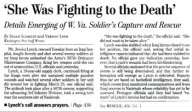
It was the Post that placed the electrifying heroic-warrior tale about Lynch on its front page of April 3, 2003, beneath a headline that read:

“‘She was fighting to the death.'”

It was the Post — alone — that placed the story into the public domain.

And none of it was true.

Lynch was neither shot nor stabbed. She suffered shattering injuries in the crash of a Humvee as it attempted to flight the ambush. But she fired not a shot in the attack.

Lynch was taken prisoner, but rescued nine days later from an Iraqi hospital by U.S. special forces.

The Post for its part has never fully explained how it got so utterly wrong a story that was picked up by news organizations around the world, turning the unsuspecting Lynch into the best-known Army private of the war.

However, as I point out in my latest book, Getting It Wrong, we know from one of the Post reporters on the Lynch story that the military wasn’t pushing the hero-warrior story.

That reporter, Vernon Loeb, said in an interview on NPR’s Fresh Air program in December 2003:

“Our sources for that story were not Pentagon sources.”

He also said in the interview:

“They wouldn’t say anything about Jessica Lynch.”

Loeb added:

“I just didn’t see the Pentagon trying to create a hero where there was none. I mean …they never showed any interest in doing that, to me.”

On another occasion, Loeb was quoted in a commentary in the New York Times as saying:

“Far from promoting stories about Lynch, the military didn’t like the story.”

The author of the Times commentary was Mark Bowden, who wrote the critically acclaimed Black Hawk Down, a book about the failed U.S. military mission in Somalia in 1998 1993. Of the Lynch case, Bowden said in his commentary:

“There is no doubt that the American media took these bits and pieces from the fog of war and assembled them into a heroic tale. … This is how the media works today, for better or worse. It happens without any prompting from the Pentagon.”

What, then, explains the persistence of the false narrative that military concocted the hero-warrior tale about Lynch?

Part of the answer lies in a dim understanding about the military and its ways. Few Americans have much first-hand knowledge about the armed services and warfare. Such limited familiarity can lead to the embrace of flawed narratives and misleading caricatures.

The Post’s erroneous account of Lynch as a female Rambo pouring lead into attacking Iraqis was cinematic — and more than vaguely reminiscent of scenes in the 1996 motion picture Courage Under Fire.

Another part of the answer lies in the news media’s tendency to shift blame away from major mistakes. As media critic Jack Shafer has pointed out:

“The rotten truth is that media organizations are better at correcting trivial errors of fact — proper spellings of last names, for example — than they are at fixing a botched story.”

The false narrative that the military concocted the Lynch tale has enabled the Post to dodge accountability for a botched story still oozes venom, suspicion, and misunderstanding.

The newspaper’s unwillingness to set the record straight by  identifying the sources that led it awry has given rise to false claims, including those about the military’s “fabrication.”

WJC

Many thanks to Instapundit Glenn Reynolds, and to smalldeadanimals.com and Blackfive.net, for linking to this post.

Recent and related:

‘Salon’ offers up repudiated Lynch-source claim

In Debunking, Jessica Lynch, Washington Post on December 21, 2011 at 8:47 am

The fallout is unending from the botched Washington Post story about Jessica Lynch’s heroics early in the Iraq War.

The online news and commentary site Salon offered up the other day the discredited claim that the hero-warrior tale about Jessica Lynch was the work of a former White House communications official named Jim Wilkinson.

Salon asserted, without attribution, that Wilkinson was known “for inventing the false story of Jessica Lynch,” a 19-year-old Army supply clerk whom the Post erroneously said had fought fiercely in the ambush of her unit in Iraq in March 2003.

The Post’s electrifying report was published April 3, 2003, and picked up by news organizations around the world. The story soon proved utterly wrong in its most important details, notably that Lynch had never fired a shot in the attack.

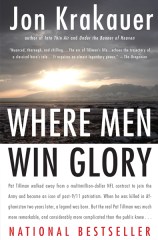
Salon’s claim about Wilkinson was an echo of a since-repudiated assertion in Jon Krakauer’s 2009 book, Where Men Win Glory: The Odyssey of Pat Tillman.

Krakauer claimed — without attribution — that Wilkinson was the Post’s source on the Lynch story. Krakauer asserted that Wilkinson was  “a master propagandist” and “the guy who deserved top billing for creating the myth of Jessica Lynch.”

Wilkinson — who at the time was director of strategic communications for the commander of U.S. forces in Iraq, General Tommy Franks — vigorously denied he was the newspaper’s source.

The Post has never identified the sources who led it so badly awry on the Lynch report.

Wilkinson said he discussed corrections with Krakauer late last year. The unflattering claims about him were removed in a recent paperback printing of Where Men Win Glory, which included a footnote, saying:

“Earlier editions of this book stated that it was Jim Wilkinson ‘who arranged to give the Washington Post exclusive access’ to this leaked intelligence [about Jessica Lynch]. This is incorrect. Wilkinson had nothing to do with the leak.”

Salon’s claim about Wilkinson was included in a commentary posted Monday, that scoffed at speculation that former U.S. Secretary of State Condoleezza Rice might seek the Republican nomination for vice president.

Asked by email about Salon’s claim about his “inventing” the Lynch hero-warrior tale, Wilkinson replied:

“Craziness! Wish they would leave me alone.”

The author of the Salon commentary, Alex Pareene, said by email yesterday that he had relied on Krakauer’s book in offering the claim about Wilkinson.

Pareene also said:

“I was unaware of Krakauer’s correction, and it’s worth an explanatory note.”

He later appended a footnote to his commentary, citing Krakauer’s rollback and stating that Wilkinson “apparently isn’t responsible for falsifying [Lynch’s] actions or leaking that false story to the press.”

So now, how about some transparency from the Washington Post?

By disclosing the identities of its sources on the Lynch case, the Post would help put an end to the erroneous speculation of the kind that has injured Wilkinson’s reputation.

Disclosing its sources also would puncture the false narrative that the U.S. military concocted the story about Lynch’s heroics in a cynical and devious attempt to bolster popular support in the United States for the war in Iraq.

As I point out in my latest book, Getting It Wrong, one of the Post reporters on the botched report about Lynch has said flatly, “Our sources for that story were not Pentagon sources.”

What’s more, public opinion polls in the early days of the Iraq War showed “there was little reason for morale-boosting among Americans,” I write in Getting It Wrong, adding:

“It may be little-recalled now, but the U.S.-led invasion of Iraq was widely supported by the American public. Polling data from March and April 2003, the opening days and weeks of the war, show an overwhelming percentage of Americans supported the conflict and believed the war effort, overall, was going well.”

WJC

Recent and related:

Lynch blames ‘military, media’ for bogus hero story, ignores WaPo

In Debunking, Jessica Lynch, Media myths, Washington Post on December 19, 2011 at 8:09 am

Jessica Lynch has blamed the “military and the media” for the bogus story about her battlefield heroics in the opening days of the Iraq War — but ignored mentioning the Washington Post, which was solely responsible for circulating the erroneous if electrifying tale.

Lynch’s remarks were made in an as-told-to article posted yesterday at the Daily Beast, an online site affiliated with Newsweek magazine.

“Though I didn’t know it at the time,” she said, “the military and the media labeled me a hero. They said I’d gone down guns blazing, like Rambo, when really my rifle had jammed and I hadn’t shot a soul.”

She was referring to the hero-warrior tale the Washington Post thrust into the public domain in a sensational, front-page report on April 3, 2003.

The Post said Lynch, then a 19-year-old Army private, had fought fiercely in the ambush of her unit, the 507th Maintenance Company, at Nasariyah in March 2003.

The botched hero-warrior story

The Post referred anonymously to “U.S. officials” in reporting that Lynch shot several enemy soldiers” in the ambush and “continued firing at the Iraqis even after she sustained multiple gunshot wounds and watched several other soldiers in her unit die around her” in the fighting.

The hero-warrior tale — published beneath the headline “‘She was fighting to the death'” — made terrific copy, and news organizations around the world picked up the story.

As I note in my latest book, Getting It Wrong, Lynch became the best-known Army private of the war.

But the story soon proved thoroughly in error. Lynch never fired a shot in the ambush. She was neither shot nor stabbed. She suffered shattering injuries in the crash of a Humvee as it attempted to flee the ambush.

The bogus story clearly wasn’t the work of multiple news organizations. It was the Post’s story, exclusively.

The Post has never fully explained how it got the dramatic story about Lynch so utterly wrong; nor has the newspaper disclosed the identity of its sources on the bogus story.

Its silence about the sources has allowed a false narrative to fester and spread — namely, that the military concocted the story about Lynch’s heroics and fed it to the Post in a cynical attempt to bolster popular support in the United States for the war in Iraq.

That version, though quite vague, has proved very popular, as suggested by Lynch’s comments posted at the Daily Beast.

But we know from one of the Post reporters on the botched hero-warrior story that the Pentagon wasn’t the newspaper’s source.

The reporter, Vernon Loeb, told NPR in mid-December 2003: “Our sources for that story were not Pentagon sources.”

He also said in the NPR interview that military officials “wouldn’t say anything about Jessica Lynch.

“I’ve never believed that at least as far as the story we wrote goes, that it was a Pentagon attempt to create a hero there.”

Loeb said that “we basically told our readers that day what basically the U.S. intelligence community was telling senior members of the U.S. government. It just kind of goes back to the old adage, you know, that initial reports from the battlefield are almost always wrong.”

It bears repeating: Responsibility for spreading the erroneous account lies neither with the “military” nor with the “media”; it rests solely with the Washington Post.

WJC

Recent and related:

ABC News invokes false narrative of Jessica Lynch case

In Debunking, Jessica Lynch, Media myths, Washington Post on December 17, 2011 at 10:22 am

ABC News yesterday invoked the false derivation of the hero-warrior myth about Jessica Lynch, declaring that “the U.S. government portrayed her as a fearless heroine who had gone down fighting” early in the Iraq War.

Not so. The Washington Post did that.

The Post — alone — placed the bogus tale about Lynch and her battlefield derring-do into the public domain in April 2003, in an electrifying, front-page article that was picked up by news organizations around the world.

The “U.S. government” — specifically, the Pentagon — was loath to embrace the tale about Lynch and her heroics.

Indeed, as one of the Post reporters on the botched report about Lynch later said:

“Our sources for that story were not Pentagon sources.”

The reporter, Vernon Loeb, also said in an interview on NPR: “They wouldn’t say anything about Jessica Lynch.”

Loeb and another Post reporter, Susan Schmidt, had reported on April 3, 2003, that Lynch fought fiercely in the ambush of her unit, the 507th Maintenance Company, on March 23, 2003. Neither Loeb nor Schmidt was with Lynch’s unit; no journalist was.

Loeb and Schmidt wrote that Lynch “shot several enemy soldiers” and  “continued firing at the Iraqis even after she sustained multiple gunshot wounds and watched several other soldiers in her unit die around her in fighting” at Nasiriyah, in southern Iraq.

Loeb and Schmidt quoted a source, to whom they referred as a “U.S. official,” as saying:

“She was fighting to the death. She did not want to be taken alive.”

Though dramatic, and even cinematic, the Post report was utterly wrong.

Lynch had not fired a shot in the ambush; her weapon jammed. Lynch was neither shot nor stabbed; she suffered shattering injuries in the crash of a Humvee as it tried to escape the ambush.

The Post has never fully explained how it botched the hero-warrior story about Lynch. It has never disclosed the identities of the anonymous sources that led it so badly awry on the Lynch story.

The murkiness of the newspaper’s sourcing has not only encouraged the rise of the false narrative, which ABC News cited in asserting, without attribution, that the “U.S. government portrayed” Lynch as a hero.

The Post’s obscure sourcing also has given rise to false allegations. The author Jon Krakauer, for example, wrongly accused Jim Wilkinson, a communications official in the administration of President George Bush, of having “arranged to give the Washington Post exclusive access” to the Lynch hero-warrior tale.

Krakauer called Wilkinson a “master propagandist” who “deserves top billing for creating the myth of Jessica Lynch.”

Krakauer has since quietly rescinded those allegations, which he had included in his 2009 book, Where Men Win Glory: The Odyssey of Pat Tillman.

Another upshot of the false narrative is that it has obscured wide recognition of a real hero at Nasiriyah, a sergeant in Lynch’s unit named Donald Walters.

Sgt. Walters

As I write in my latest book, Getting It Wrong, Walters’ battlefield heroics were likely misattributed to Lynch, owing to mistranslation of Iraqi radio transmissions from the battlefield.

“During the ambush in Nasiriyah,” I write, “… Walters either stayed behind, or was left behind, to lay down covering fire as his fellow soldiers tried to make their escape. Walters fought his attackers in a fashion that the Post attributed to Lynch.”

I point out that the most detailed account of Walters’ bravery appears in Richard Lowry’s fine study of the fighting at Nasiriyah, Marines in the Garden of Eden.

Lowry wrote that Walters killed “several Iraqis before he was surrounded and captured” by Iraqi irregulars, the Fedayeen, and executed.

“We will never really know the details of Walters’ horrible ordeal,” Lowry wrote. “We do know that he risked his life to save his comrades and was separated from the rest of the convoy, deep in enemy territory.

“We know that he fought until he could no longer resist.”

The Post, though, has shown scant interest in Walters’ heroism.

A database search of Post articles published since April 2003 revealed just four stories in which Walters was mentioned. None of those articles discussed in any detail his bravery at Nasiriyah.

WJC

Recent and related:

‘Yes, Virginia’: History does trump TV animation

In 1897, Debunking, Media myths on December 9, 2011 at 11:28 am

CBS is to air tonight its vapid Christmas season special, “Yes Virginia,” which is based on the old New York Sun’s timeless editorial reply to an 8-year-old girl, who in 1897 inquired about the existence of Santa Claus.

The charmless, animated CBS program takes great liberties with the real back story to the “Yes, Virginia” editorial, which was published in the Sun on September 21, 1897, in the third of three columns on editorials.

The Sun’s editorial was a response to young Virginia O’Hanlon who shortly after her 8th birthday in July 1897 wrote to the newspaper, imploring:

“Please tell me the truth; is there a Santa Claus?”

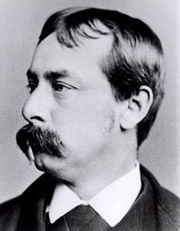
Francis P. Church

The Sun’s reply, written by a retiring editorial writer named Francis P. Church, said in part:

“Yes, Virginia, there is a Santa Claus. He exists as certainly as love and generosity and devotion exist, and you know that they abound and give to your life its highest beauty and joy. Alas! how dreary would be the world if there were no Santa Claus. It would be as dreary as if there were no Virginias.”

In the CBS interpretation, Virginia is waddling, round-headed, and strangely obsessed with the existence of Santa Claus.

Church, the editorial’s author, is depicted as scowling, abrupt, hard-hearted.

Neither portrayal is convincing, neither is realistic.

Church is cast as the editor of the Sun, which is shown as a tabloid newspaper. Church wasn’t editor; he was an editorial writer. And the Sun of 1897 was no tabloid.

What’s more, the CBS show had Virginia writing her letter, and the Sun publishing its reply, in December, as Christmas approached.

Not so.

As I discussed in my 2006 book, The Year That Defined American Journalism: 1897 and the Clash of Paradigms, Virginia wrote the letter in the summer of 1897. The Sun published its editorial-reply on page 6 of its issue of September 21, 1897.

What became the famous essay in American journalism was, in its first appearance, inconspicuous and obscure: It certainly was not introduced with large headlines on the front page, as the CBS show has it.

Its headline posted a timeless question:

“Is There A Santa Claus?”

The editorial was no instant sensation. It was not an immediate hit. And the Sun did not reprint the editorial every year at Christmastime, as is commonly believed.

Indeed, it took years for the newspaper to embrace “Is There A Santa Claus?”

As I noted in The Year That Defined American Journalism, it wasn’t until the mid-1920s when the Sun began routinely publishing the essay in its editorial columns at Christmastime.

What helped kept the editorial alive were the newspaper’s readers.

They found it memorable. They found joy, solace, and inspiration in the passages of “Is There A Santa Claus?”

In untold numbers over the years, readers asked the Sun to reprint the essay.

A letter-writer told the newspaper in 1926 that the editorial offered “fine relief from the commercialism and unsentimental greed” of the Christmas season.

In 1940, a writer to the Sun likened the essay to “a ray of hope on the path to human understanding in our troubled times.”

The CBS program hints at none of that. It offers no indication that the editorial’s fame rests at least in part on generations of readers who, collectively, proved to be far more perceptive than editors of the Sun in identifying the essay’s significance and enduring appeal.

If anything, the tedious CBS show demonstrates anew that history’s back story is often far richer, and far more interesting, than TV fare.

There’s of course little surprise in that observation. As Richard Bernstein wrote in 1989 in a terrific essay about movies and history:

“There are, after all, times when the facts speak far more dramatically than any fictionalized account of them ever could.”

WJC

Recent and related:

Ignore new Jefferson-paternity study, see accuracy suffer

In Debunking, Media myths on October 20, 2011 at 9:53 am

The mainstream news media have largely shunned a significant new book that disputes the notion Thomas Jefferson had a long, loving relationship with a slave, Sally Hemings.

The drawbacks of ignoring the book, The Jefferson-Hemings Controversy: A Report of the Scholars Commission, are suggested by a Politico item posted yesterday.

Politico asserted:

“Most historians have concluded that, as a widower, Jefferson may have had as many as six children with Hemings, maintaining a 38-year relationship with her until his death in 1826.”

“Most historians”?

That’s a stretch, as The Jefferson-Hemings Controversy suggests.

It’s a collaborative work of 13 scholars, 12 of whom are either historians of Jefferson and his times or experts on politics and government. The outlier, as it were, is a biochemist, an expert on DNA testing.

The members of the scholars commission — empaneled by the Thomas Jefferson Heritage Society, which seeks to protect the reputation of the third president — describe in the book their collective credentials, writing:

“Most of us have studied Thomas Jefferson and his era for at least two decades, and we have held teaching or research appointments at Harvard, Yale, Stanford, Brown, Virginia, North Carolina, Kentucky, Indiana, Bowdoin, and many other respected institutions of higher learning.”

They also state that “after a careful review of all of the evidence, the commission agrees unanimously that the allegation [against Jefferson] is by no means proven. … With the exception of one member … our individual conclusions range from serious skepticism about the charge to a conviction that it is almost certainly false.”

But it’s “by no means proven.”

And yet media reports, such as that in Politico, typically treat the purported Jefferson-Hemings relationship as if it were settled history.

An important reason for the misinterpretation stems from DNA test results reported in 1998. The tests were widely misreported as identifying Jefferson as the father of Hemings’ youngest son, Eston.

The results were published in the journal Nature, which placed this erroneous headline above the article:

“Jefferson fathered slave’s last child.”

The Nature headline and its misreported findings had significant agenda-setting power.

The scholars commission, which was chaired by Robert Turner of the University of Virginia, note in the book that “much of the public has been misled about the significance of the DNA tests … reported in the journal Nature in November 1998.

“While the tests were professionally done by distinguished experts, they were never designed to prove, and in fact could not have proven, that Thomas Jefferson was the father of any of Sally Hemings’ children.”

The Jefferson-Hemings Controversy addresses the DNA evidence in some detail, noting that the tests “did no more than establish that Eston Hemings’ father was almost certainly a Jefferson.”

A Jefferson.

More than two dozen Jefferson men, including Thomas, could have been the father.

By then, though, Thomas Jefferson was 64-years-old — scarcely a leading paternity candidate.

The Jefferson-Hemings Controversy offers an intriguing hypothesis about why the DNA tests of 1998 were so widely misunderstood.

“Most Americans,” the book points out, “learned about DNA testing during the period leading up to and during the 1995 murder trial of O.J. Simpson, and they read in USA Today and other major papers than DNA ‘genetic fingerprints’ are ‘99.9 accurate’ or even ‘99.99 percent accurate.’

“When the Jefferson-Hemings story broke [nearly] four years later, it was not surprising that many people assumed scientists had matched Thomas Jefferson’s DNA with that of Sally Hemings’ children, and conclusively established Jefferson’s paternity by this remarkable new technology.

“But that is clearly not the case.”

WJC

Recent and related:

‘DNA evidence is all in’ on Jefferson? Got that wrong

In Debunking, Media myths on October 19, 2011 at 12:02 pm

Nearly 13 years have passed since the release of DNA testing evidence that was widely misreported as evidence that Thomas Jefferson had fathered children by a purported slave-mistress, Sally Hemings.

Jefferson (Library of Congress)

That evidence was scarcely so conclusive or definitive.

The testing in 1998 identified the third president as one of more than two dozen Jefferson men who may have been the father of Hemings’ youngest child, Eston.

One of more than two dozen Jefferson men.

Misrepresentations and mischaracterizations of the DNA evidence persist, as suggested by a commentary posted yesterday at the online site of U.S. News and World Report.

The commentary, written by Jamie Elizabeth Stiehm, asserted:

“After his beloved wife Martha died, Jefferson took as his mistress … a beautiful girl named Sally Hemings, decades years [sic] younger than he. At his stately Monticello in Virginia, his mountaintop, he was literally master of all he saw. That meant his two white daughters, horses, gardens, fields, a library of books, fine clothes, and the best of wines he chose during his Paris days.

“Never forget the 100 slaves Jefferson owned to make the wheels of wealthy planter life go round. Among them were the Hemings children born to Sally Hemings — his own, but never recognized as such by Jefferson, even informally. They were the only four slaves he later set free, however, probably by a pact he kept with Sally Hemings. (And the DNA evidence is all in.)”

The “DNA evidence is all in”?

Not so.

As a recently published scholarly study about the controversy notes, the DNA tests “were never designed to prove, and in fact could not have proven, that Thomas Jefferson was the father of any of Sally Hemings’ children.

“The tests merely establish a strong probability that Sally Hemings’ youngest son, Eston, was fathered by one of the more than two dozen Jefferson men in Virginia at the time, seven of whom there is documentary evidence to believe may well have been at Monticello when Eston was conceived.”

One of more than two dozen Jefferson men.

Thomas Jefferson was 64 and ailing at the time Eston Hemings was conceived; Jefferson’s advanced age and infirmities make him an improbable paternity candidate.

The scholarly study, titled The Jefferson-Hemings Controversy: Report of the Scholars Commission, also says:

“The problem [in misinterpreting the DNA evidence] lies not only with a news media prone to over simplifying and sensationalizing complex stories.  Numerous prominent scholars have contributed to the misunderstanding by characterizing the DNA study as ‘confirming’ or ‘clinching’ the case for Thomas Jefferson’s paternity.”

Stiehm’s unsourced and uncritical commentary adds to the confusion.

She stumbles on another point, too, in stating that Hemings’ children “were the only four slaves [Thomas Jefferson] later set free.”

That’s wrong.

Robert Turner, a University of Virginia professor who edited The Jefferson-Hemings Controversy, says that “Thomas Jefferson legally freed (manumitted) seven slaves that we know of.”

They included  Sally Hemings’ brothers, Robert and James, as well as  Burwell Colbert, a son of Sally’s sister, Bett; Sally’s brother, John, and Joseph Fossett, a son of Sally’s sister, Mary.

Jefferson also freed Sally’s youngest children, Madison and Eston, Turner notes.

The reference in The Jefferson-Hemings Controversy to the news media’s “over simplifying and sensationalizing complex stories” deserves additional comment.

Complexity-avoidance often characterizes news coverage, as I note in my latest book, Getting It Wrong.

“All too often,” I write, “the news media seem complexity-adverse and exceedingly eager to simplify and synthesize.

“This tendency is explained in part by the tyranny of deadlines and the limitations of on-air time and newsprint space. Even so, few important events can be explained without recognizing and acknowledging their context and intricacies.”

That certainly holds for the Jefferson-Hemings controversy. News reports and commentary about the matter almost invariably embrace the simplistic but wholly unproven narrative that Jefferson took a slave as a years-long mistress.

WJC

Recent and related:

‘Kane’ at 70: ‘More relevant than ever’?

In Anniversaries, Cinematic treatments on September 10, 2011 at 9:53 am

In the year of its 70th anniversary, Orson Welles’ cinematic masterpiece Citizen Kane “is more relevant than ever,” says a polished, thoughtful essay posted yesterday at TechCentral, a South African site devoted to technology news and reviews.

Orson Welles in 'Kane'

In pressing the point about Kane’s relevance, the essay argues:

“Newspaper magnate Charles Foster Kane, sitting in his already-crumbling but unfinished Xanadu, is Colonel Gaddafi railing at the Libyan rebels from his exile or a doddering Rupert Murdoch stumbling over his words in front of the commission investigating the News of the World scandal.”

Those are telling observations, particularly the reference to the 80-year-old Murdoch and his excruciating, hapless performance before a Parliamentary commission hearing in July in London.

“Today,” the TechCentral essay adds, “you’ll see Citizen Kane’s influence in the strangest places,” including parodies in The Simpsons” television show.

As superb and influential as it was, Kane took liberties and in doing so helped popularize a powerful media-driven myth.

The movie was released in 1941 and was based loosely on the life and times of American media magnate William Randolph Hearst.

A rollicking scene early in Kane offers clear evidence that Hearst was the movie’s principal inspiration; the scene paraphrased Hearst’s purported vow, which he supposedly cabled to an artist in Cuba months before the Spanish-American War:

You furnish the pictures, and I’ll furnish the war.”

As I note in my latest book, Getting It Wrong, that scene in Kane “firmly and finally pressed Hearst’s purported vow to ‘furnish the war’ into the public’s consciousness.”

I also point out in Getting It Wrong that the anecdote about Hearst’s vow “is almost too good not to be true” and note that the “furnish the war” line “has made its way into countless textbooks of journalism.

“It [also] has figured in innumerable discussions about Hearst and about the news media and war. It has been repeated over the years by no small number of journalists, scholars, and critics of the news media such as Ben Bagdikian, Helen Thomas, Nicholas Lemann, and the late David Halberstam.”

Interestingly, “furnish the war” endures despite a near-total absence of supporting documentation. It lives on even though cable containing Hearst’s purported vow has never turned up.

It lives on even though Hearst denied ever sending such a message.

It lives on despite of what I call “an irreconcilable internal inconsistency”: It would have been absurd for Hearst to vow to “furnish the war” because war — specifically, the Cuban rebellion against Spanish rule — was the very reason Hearst sent the artist, Frederic Remington, to Cuba in the first place.

And Remington’s trip to Cuba came in January 1897 — more than 15 months before the start of the Spanish-American War.

Kane is no faithful portrait of Hearst.

As David Nasaw pointed out in The Chief, his admirably even-handed biographyof Hearst:

“Welles’ Kane is a cartoon-like caricature of a man who is hollowed out on the inside, forlorn, defeated, solitary because he cannot command the total obedience … of those around him. Hearst, to the contrary, never regarded himself as a failure, never recognized defeat, never stopped loving Marion [his mistress] or his wife.

“He did not, at the end of his life, run away from the world to entomb himself in a vast, gloomy, art-choked hermitage,” as portrayed in Citizen Kane.

WJC

Recent and related:

The Zhou misinterpretation

In Debunking, Media myths on August 31, 2011 at 11:17 am

It’s been debunked, but even so the tale lives on about Chinese premier Zhou Enlai’s  taking a long and sage view of history in saying in 1972 that it was “too early” to assess the implications of the French revolution, which began in 1789.

A commentary today at Time magazine’s “Global Spin” blog effectively testifies to the enduring appeal of Zhou misinterpretation.

The  commentary considered the wider implications of the fall of Moammar Khadafy’s regime in Libya and, in closing, invoked the conventional version of Zhou’s remark, stating:

“[T]o borrow from Chinese leader Zhou Enlai’s 1972 answer when asked about the historical significance of the French Revolution, when it comes to Libya’s grander significance, it may simply be ‘too early to tell.'”

Zhou’s comment — made during a discussion in China with President Richard M. Nixon — was about political upheaval in France in 1968, not the French Revolution, according to Charles W. (Chas) Freeman Jr., a former U.S. diplomat who was Nixon’s interpreter on the trip and who was present at the conversation.

First to debunk the Zhou misinterpretation was London’s Financial Times, which quoted Freeman’s remarks at a panel discussion in June in Washington, D.C.

In a subsequent interview with me, Freeman said it was “absolutely clear” from the context of the conversation that Zhou’s “too early to say” comment was in reference to the turmoil of 1968.

Freeman described Zhou’s remark as “a classic of the genre of a constantly repeated misunderstanding that has taken on a life of its own.”

He’s quite right about that. It long ago took on life of its own.

Further evidence of that is offered in a superficial commentary by McClatchy newspapers about the effects of the terrorist attacks of September 11, 2001.

The commentary asserted that the United States is “in some ways a very different country.

“How different?

“First, a story: It’s said that when President Richard Nixon made his groundbreaking visit to Communist China in 1972, he asked Premier Zhou Enlai what he thought about the French Revolution.

“It’s unclear if Zhou thought Nixon was asking about the political upheaval of 1789 or the Paris student demonstrations just four years earlier. In any case he replied: ‘Too soon to tell.'”

Well, no: It’s not unclear what Zhou meant, as Freeman’s recollections demonstrate.

The Zhou misinterpretation, moreover, was inspiration for a clever and amusing observation the other day, in a blog post by Gideon Rachman of the Financial Times.

Rachman’s post considered the legacy at the International Monetary Fund of Dominique Straus-Khan, the agency’s former director-general known as “DSK.”

He resigned in May after being arrested in New York on felony sex charges. Those charges recently were dropped.

“Sometimes,” Rachman noted, “an early exit is good for your legacy.”

He added:

“So, DSK’s legacy? As Zhou Enlai never said about the French Revolution: too early to tell.”

“As Zhou Enlai never said.”

Wonderful.

WJC

Recent and related:

No, really: Ray Nagin sought out for advice on hurricane prep

In Debunking, Hurricane Katrina, Media myths on August 28, 2011 at 2:37 am

What a joke.

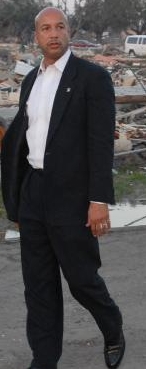
Nagin in New Orleans

As Hurricane Irene churned toward the East Coast of the United States, MSNBC brought on Ray Nagin, the former mayor of New Orleans, for insights about storm preparations.

In introducing Nagin, MSNBC anchor Martin Bashir declared:

“Former New Orleans Mayor Ray Nagin joins us to explain what leaders must do to avoid the mistakes that were made six years ago” when Hurricane Katrina battered the Gulf Coast.

Nagin, a preparedness authority?

Hardly.

Not only did Nagin fumble the local response to Hurricane Katrina (remember the yellow school buses, all neatly parked and submerged by flood waters?). He contributed significantly to the terribly misleading notion that in the storm’s aftermath, the city was swept by mayhem and lawlessness.

As I point out in my media mythbusting book, Getting It Wrong, Nagin offered up  what proved to be highly exaggerated estimates of Katrina-related deaths in New Orleans.

He said the toll could reach 10,000.

Deaths attributed to the hurricane in Louisiana were a little more than 1,000.

What’s more, I note in Getting It Wrong, “Nagin and the city’s police commissioner, Eddie Compass, were sources for some of the most shocking and exaggerated reports about the disaster.”

During an appearance on Oprah Winfrey’s television talk show on September 6, 2005, Nagin said “hundreds of armed gang members” were terrorizing storm evacuees inside the Louisiana Superdome.

Nagin said conditions at the Superdome had deteriorated to “an almost animalistic state” and evacuees “in that frickin’ Superdome for five days, watching dead bodies, watching hooligans killing people, raping people.”

Nagin was winging it on national television. And smearing his city in the process.

(It deserves noting that Nagin was criticized in a bipartisan Congressional report about the responses to Katrina. The report, issued in 2006 and titled A Failure of Initiative, pointed out that the mayor had “repeated unsubstantiated rumors before the national media, creating an exaggerated image of utter lawlessness.”)

As I note in Getting It Wrong, Nagin’s descriptions “were widely reported — and proved to be almost totally without foundation. In all, six people died in the Superdome during the Katrina aftermath. None of those deaths was related to violent crime.”

Interestingly, Compass was asked months afterward why he had depicted post-Katrina New Orleans as swept by mayhem and terror.

He offered this strange reply:

“I didn’t want people to think we were trying to cover anything up,” he said. “So I repeated things without being substantiated, and it caused a lot of problems.”

Compass was forced to resign within a few weeks of his appearance on Oprah. Nagin, though, was reelected in 2006 to a four-year term as mayor. He left office in 2010.

He’s out now with a self-published book, Katrina’s Secrets: Storms after the Storm (Volume I). In it, Nagin stokes the undocumented claims about violence inside the Superdome in the hurricane’s aftermath.

According to an essay written by Brendan McCarthy of the New Orleans Times-Picayune and posted at nola.com, Nagin claims in the book to have had “private conversations” with “several” women who said they were raped there.

McCarthy’s post quotes Nagin’s book as stating:

“The political and media spin later claimed that many of the rapes were basically the figment of our collective imagination. This ensured that anyone who was raped would not come forward to face unfair, invasive scrutiny while being forced to defend their credibility.”

McCarthy’s post also quotes Compass’ successor, Warren Riley, as having said in 2010:

“The stories that people had died in the Superdome, that people were being raped — there’s not one iota of evidence to show that anyone was killed or raped in the Dome.”

WJC

Recent and related: