W. Joseph Campbell

Posts Tagged ‘History’

Lynch heroics not ‘the Pentagon’s story’; it was WaPo’s

In Debunking, Jessica Lynch, Media myths, Washington Post on May 12, 2011 at 9:50 am

Private Lynch: No hero-warrior

The mythical tale that the Pentagon concocted the story about Jessica Lynch’s battlefield heroics early in the Iraq War probably is just too delicious ever to be thoroughly debunked and forgotten.

The tale about the Pentagon’s purported fabrication turned up today in a syndicated column published by the Modesto Bee.

The column deplored the exaggerated early accounts of the slaying of terror mastermind Osama bin Laden. Initial reports offered by the Obama administration inaccurately described bin Laden as having used one of his wives as a shield during the Navy SEALS’ dramatic raid on his lair in Pakistan.

“To their credit,” wrote the columnist, Bob Franken, “Obama administration leaders quickly owned up, which is far better than some of the cover-ups attempted during the Bush years.”

Franken then invoked the Lynch case, writing: “In April 2003, she was captured after being seriously injured in southern Iraq. News media at the time bought the Pentagon’s story that PFC Lynch had been badly wounded and taken prisoner after she had blazed away during a firefight.”

Franken,  formerly a correspondent for CNN, also wrote: “The truth, as she acknowledged after her release, is that her injuries were the result of a Humvee crash that occurred as she and the others in her unit tried to flee.”

For starters, let’s check the date: Lynch was captured March 23, 2003, after Iraqis ambushed elements of Lynch’s unit, the 507th Maintenance Company, in Nasiriyah. She was rescued by a U.S. special forces team April 1, 2003.

More important, though, the Pentagon wasn’t the source for the hero-warrior tale about Jessica Lynch. It wasn’t “the Pentagon’s story.”

The story was thrust into the public domain exclusively by the Washington Post, which reported on April 3, 2003, that Lynch had fought fiercely in the ambush at Nasariyah, ” firing at the Iraqis even after she sustained multiple gunshot wounds and watched several other soldiers in her unit die around her….”
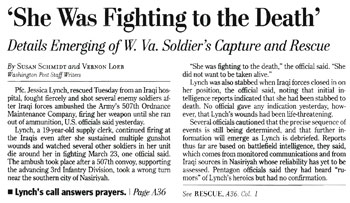
Above this dramatic story, the Post ran the headline: “‘She was fighting to the death.'”

The story was utterly false.

Lynch never fired a shot during the ambush; her weapon jammed.

She was neither shot nor stabbed, although the Post reported she had been so wounded. Lynch suffered shattering injuries in the crash of the Humvee, as Franken’s column mentions.

We know from Vernon Loeb, who shared a byline with Susan Schmidt on the original, inaccurate Lynch story, that the Pentagon wasn’t the source for that report.

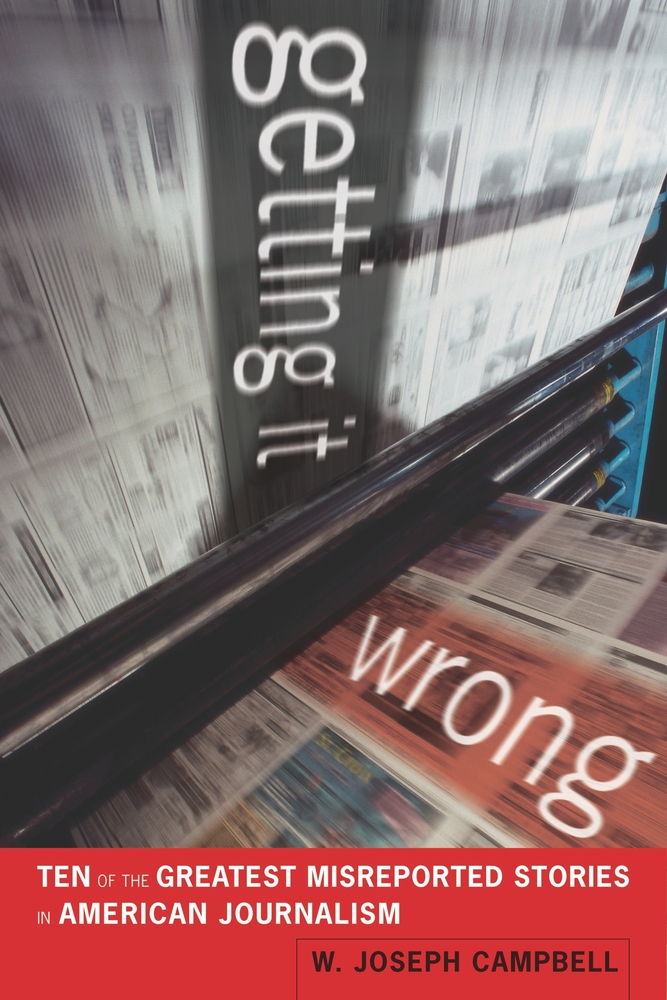
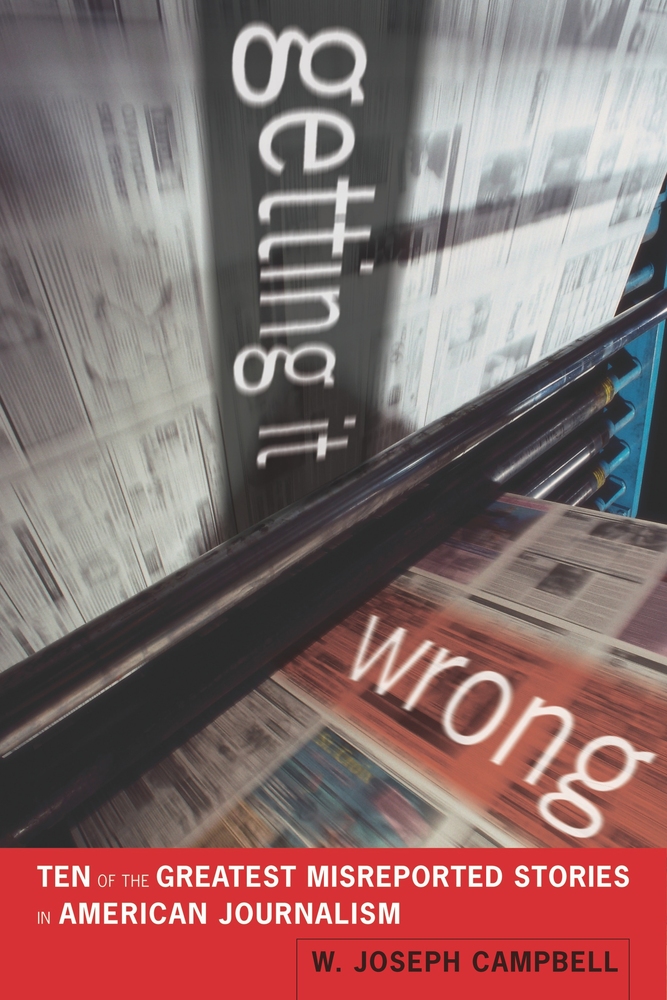
As I note in my latest book, Getting It Wrong, Loeb went on NPR’s Fresh Air program in December 2003 and declared, unequivocally:

“Our sources for that story were not Pentagon sources.”

Loeb then was the Post’s defense correspondent, and he and Schmidt reported the Lynch hero-warrior story from Washington, D.C. He also said in the NPR interview that Pentagon officials “wouldn’t say anything about Jessica Lynch.”

He also dismissed the interviewer’s suggestion that the Post’s “fighting to the death” report was the upshot of the Pentagon’s clever and cynical manipulation.

“I just didn’t see the Pentagon trying to create a hero where there was none,” Loeb said. “I mean …they never showed any interest in doing that, to me.”

On another occasion, Loeb was quoted by the New York Times as saying:

“Far from promoting stories about Lynch, the military didn’t like the story.”

Rarely do Loeb’s disclaimers find their way into articles, columns, blog posts, and other media discussions about the Lynch case. It’s far easier — and makes for a far better story — simply to embrace the false narrative about the Pentagon’s duplicity.

The false narrative, after all, conforms tidily and well to the curdled popular view that the Iraq War was a mistake, that it was a conflict waged on dubious grounds.

And yet no one who repeats or promotes the narrative about the Pentagon’s having concocted the story about Lynch ever explains how the Pentagon managed to dupe the Post so thoroughly that it published a bogus story.

I’d love to read a description about how that supposedly was accomplished.

WJC

Recent and related:

‘Getting It Wrong’ wins SPJ award for Research about Journalism

In Bay of Pigs, Bra-burning, Cronkite Moment, Debunking, Furnish the war, Hurricane Katrina, Jessica Lynch, Media myths, Media myths and radio, Murrow-McCarthy myth, New York Times, Spanish-American War, War of the Worlds, Washington Post, Watergate myth, Yellow Journalism on May 10, 2011 at 9:02 am

The Society of Professional Journalists announced today that my media-mythbusting book, Getting It Wrong, is the winner of the 2010 Sigma Delta Chi award for Research about Journalism.

The award will be presented in September at the Excellence in Journalism convention in New Orleans.

Getting It Wrong, which was published last year by the University of California Press, debunks 10 prominent media-driven myths, which are dubious tales about the news media that masquerade as factual.

Here’s a summary of the 10 myths dismantled in Getting It Wrong:

  1. Remington-Hearst: William Randolph Hearst’s famous vow “to furnish the war” with Spain is almost certainly apocryphal.
  2. War of Worlds: The notion that the War of Worlds radio dramatization in 1938 caused nationwide panic and mass hysteria is exaggerated.
  3. Murrow-McCarthy: Edward R. Murrow’s famous See It Now program in March 1954 did not end Senator Joseph McCarthy’s communists-in-government witch-hunt; Murrow in fact was very late to take on McCarthy.
  4. Bay of Pigs: The New York Times did not suppress its reporting in the run-up to the ill-fated Bay of Pigs invasion in April 1961.
  5. Cronkite-Johnson: Walter Cronkite’s special report on Vietnam in February 1968 did not prompt an immediate reassessment or revision of U.S. war policy.
  6. Bra-burning: Humor columnist Art Buchwald helped spread the notion that feminist demonstrators dramatically burned their bras at a Miss America protest in September 1968.
  7. Watergate: The Washington Post’s intrepid reporters, Carl Bernstein and Bob Woodward, did not bring down Richard Nixon’s corrupt presidency. That they did is a trope that knows few bounds.
  8. Crack babies: The much-feared “bio-underclass” of children born to women who smoked crack cocaine during their pregnancies never materialized.
  9. Jessica Lynch: The Washington Post’s erroneous reporting about Jessica Lynch early in the Iraq War gave rise to several myths about her capture and rescue.
  10. Hurricane Katrina: News coverage of Katrina’s aftermath in New Orleans in early September 2005 was marred by wild exaggerations about extreme, Mad Max-like violence.

The “Research about Journalism” award recognizes “an investigative study about some aspect of journalism,” SPJ says, and “must be based on original research; either published or unpublished, and must have been completed during the 2010 calendar year. … Judges will consider value to the profession, significance of the subject matter, thoroughness of the research, and soundness of the conclusion.”

WJC

Recent and related:

As if Hearst were ‘back with us,’ vowing to ‘furnish the war’

In 1897, Debunking, Furnish the war, Media myths, Spanish-American War, Yellow Journalism on May 10, 2011 at 2:26 am

Nieman Watchdog, a blog that “seeks to encourage more informed reporting,” indulged yesterday in the mythical tale of William Randolph Hearst‘s famous vow to “furnish the war” with Spain in the late 19th century.

Remington in Cuba for Hearst

It was a case of the blog’s turning to a fiction about Hearst and treating it as if it were fact.

The occasion for invoking “furnish the war” was to call attention to inaccuracies in news graphics accompanying reports last week about the slaying of terror mastermind Osama bin Laden.

“Journalism is a serious business where credibility is paramount,” the blog post asserted. “Editors need, first and foremost, to get the facts right, in graphics as well as text and video.”

The post further noted that “some publications presented as facts what was just fiction. Sometimes there was no factual support whatsoever. It’s as though William Randolph Hearst was back with us, saying once again, ‘You furnish the pictures and I’ll furnish the war.'”

As I discuss in my latest book, Getting It Wrong, the tale about Hearst’s vow to “furnish the war” is a hardy media-driven myth that lives on despite concerted attempts to discredit and dismantle it.

The vow supposedly was contained in a telegram sent to the famous artist, Frederic Remington, who was on assignment in Cuba for Hearst’s flamboyant New York Journal (see image, above). Remington and the correspondent Richard Harding Davis were assigned there to cover the insurrection against Spanish colonial rule — the conflict that gave rise in 1898 to the Spanish-American War.

They arrived in Havana in early January 1897; Remington stayed only six days.

Before leaving by passenger steamer for New York, Remington supposedly sent Hearst a cable, stating:

“Everything is quiet. There will be no war. I wish to return.”

Hearst replied with his famous vow:

Please remain. You furnish the pictures, and I’ll furnish the war.”

But Remington didn’t stay.

He promptly returned to New York, where his sketches were given prominent display in Hearst’s Journal. They appeared with such flattering headlines as: “Cuban War Sketches Gathered in the Field by Frederic Remington; The Gifted Artist, Visiting Cuba Especially for the Journal.”

That’s hardly the sort of tribute Hearst would have granted a wayward artist who ignored specific instructions to “remain” in Cuba.

I further note in Getting It Wrong that the anecdote about Hearst’s vow “lives on despite an irreconcilable internal inconsistency: It would have been absurd for Hearst to vow to ‘furnish the war’ because war — specifically, the Cuban rebellion against Spain’s colonial rule — was the very reason Hearst sent Remington to Cuba in the first place.”

Anyone reading U.S. newspapers in early 1897 “would have been well aware,” I write, “that Cuba was a theater of a nasty war,” which gave rise in April 1898 to the Spanish-American War.

Not only that, but the artifacts themselves — the telegrams reputedly sent by Remington and Hearst — have never surfaced. And Spanish censors monitored incoming and outgoing telegraphic traffic in Havana, and they surely would have intercepted Hearst’s incendiary message — had it been sent.

For those and other reasons, the tale about the Remington-Hearst exchange is surely apocryphal — fiction that too often masquerades as fact.

WJC

Recent and related:

Perceptive observations about Woodward, Bernstein, media power

In Cronkite Moment, Debunking, Media myths, Washington Post, Watergate myth on May 9, 2011 at 5:26 am

From time to time at Media Myth Alert, I’ve noted how American media myths have been embraced with gusto by news outlets overseas.

Watergate and the notion that the investigative reporting of Bob Woodward and Carl Bernstein brought down Richard Nixon’s corrupt presidency have particularly powerful myth appeal among news media abroad.

So it’s commendable when an international news organization treats consensus narratives about the U.S. media with decided skepticism, as the Independent newspaper in London did over the weekend.

In a commentary by Patrick Cockburn, the Independent noted that the news media have “always been more dependent on the powers-that-be” than they prefer to acknowledge.”

“American journalists outside Washington often express revulsion and contempt at the slavish ways of the Washington press corps,” Cockburn wrote. “But it is difficult to report any government on a day-to-day basis without a cooperation that can be peremptorily withdrawn to bring critics into line.”

About the Watergate scandal, he added, perceptively:

“Woodward and Bernstein learned about Watergate almost entirely from secondary sources such as judges, prosecutors and government investigative agencies which could force witnesses to come clean by threatening to put them in jail.”

That’s very true.

Woodward and Bernstein’s Watergate reporting often drew upon, and often prominently cited, government investigators such as the FBI.

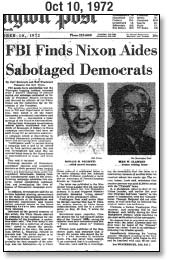
WaPo report, October 10, 1972

The Watergate report they’ve often described as decisive — an article published October 10, 1972, that characterized the scandal as “a massive campaign of political spying and sabotage conducted on behalf of President Nixon’s re-election” — referred prominently to the FBI and the Justice Department.

(That article cited “FBI reports” in asserting that “at least 50 undercover Nixon operatives traveled throughout the country trying to disrupt and spy on Democratic campaigns.” That claim was dismissed as “absolutely false” in internal FBI memoranda, and was scoffed at by Edward Jay Epstein in his brilliant 1976 essay puncturing the purported effects of Woodward and Bernstein’s  Watergate reporting.)

And as I write in my media-mythbusting book, Getting It Wrong, which came out last year, to characterize the reporting of Woodward and Bernstein as decisive in Watergate’s outcome “is to abridge and misunderstand the scandal and to indulge in a particularly beguiling media-driven myth.”

I also note that such a mediacentric interpretation of Watergate “minimizes the far more decisive forces that unraveled the scandal and forced Nixon from office.”

Those forces included special prosecutors, federal judges, both houses of Congress, the Supreme Court, as well as the Justice Department and the FBI, I note, adding:

“Even then, Nixon likely would have served out his term if not for the audiotape recordings he secretly made of most conversations in the Oval Office of the White House. Only when compelled by the Supreme Court did Nixon surrender those recordings, which captured him plotting the cover-up” of the crimes of Watergate.

I argue in Getting It Wrong that debunking media-driven myths “enhances a case for limited news media influence.”

Media power, I write, “tends to be modest, nuanced, diffused, and situational. But too often the ubiquitous presence of the news media is mistaken for power and influence.”

Cockburn’s commentary similarly suggested that media power can be overstated, exaggerated.

“In wars in Vietnam, Iraq and Afghanistan,” he noted, “effective media criticism has tended to follow rather than precede public opinion.”

Quite so.

Walter Cronkite‘s famous on-air assessment in late February 1968 that the U.S. military was “mired in stalemate” in the war in Vietnam is sometimes said to have shifted American public opinion about the conflict.

In reality, though, Americans had begun turning against the war months before Cronkite aired his analysis in a special report on CBS television.

WJC

Recent and related:

Bay of Pigs suppression myth too rich and delicious to die away

In Anniversaries, Bay of Pigs, Debunking, Media myths, New York Times on May 7, 2011 at 5:31 am

The tale of the New York Times censoring itself in the runup to the Bay of Pigs invasion 50 years ago supposedly offers timeless lessons about the perils of journalists surrendering to the agenda of government.

That anecdote, I write in my latest book, Getting It Wrong, is “often cited as an object lesson … about what can happen when independent news media give in to power-wielding authorities.”

Supposedly, in early April 1961, the Times spiked or emasculated a detailed report about the invasion preparations — and did so at the urging of President John F. Kennedy.

But as I discuss in detail in Getting It Wrong, neither Kennedy nor anyone in his administration asked or lobbied the Times to kill or tone down that report — which was written by a veteran correspondents named Tad Szulc, ran to more than 1,000 words, and was published April 7, 1961, above the fold on the newspaper’s front page.

Like many consensus narratives and media-driven myths, though, the Times-Bay of Pigs suppression tale is too neat and tidy, too rich and delicious, ever to die away.

A hint of that came yesterday at the online site of CounterPunch, which touts itself as “America’s best political newsletter.”

CounterPunch posted an essay that referred to the Times’ purported act of self-censorship, stating:

“Back in April 1961, the Times deleted from Tad Szulc’s story the time and place of landing of the CIA-backed Bay of Pigs invasion because President Kennedy told the Times’ publisher it would not serve U.S. National Security interests. (David Halberstam, The Powers That Be, p. 448).”

It’s neat the passage was cited. But the citation doesn’t render it accurate.

Halberstam‘s Powers That Be, after all, is no authoritative source on the tale of the Times‘ self-censorship. Far from it.

Halberstam’s account claimed that Kennedy called James (“Scotty”) Reston, the Times’ Washington bureau chief, “and tried to get him to kill” the Szulc story.

Szulc of the Times

According to Halberstam, Kennedy “argued strongly and passionately about what the Szulc story would do to his policy” and president warned that the Times would risk having blood on its hands were the article published and the invasion a failure.

Heady stuff, but it never happened.

As I note in Getting It Wrong, there is “no evidence that Kennedy spoke with anyone at the Times” on April 6, 1961, the day Szulc’s dispatch was written, edited, and prepared for publication.

“The Kennedy Library in Boston says that the White House telephone logs reveal no calls were placed to Reston” or other Times executives that day, I write, adding:

“Kennedy had almost no chance to speak with those executives during the interval from when Szulc’s story arrived at the Times building in midtown Manhattan and when it was set in type.”

That’s because the president spent the last half of the afternoon of April 6, 1961, playing host to Harold Macmillan, the British prime minister, on a lengthy cruise down the Potomac River to Mount Vernon.

The outing ended around 6:30 p.m., leaving Kennedy only a tiny window of opportunity to call Times executives before the first edition of the newspaper hit the streets.

Harrison Salisbury, a Pulitzer-winning Times correspondent and editor, offered in his book, Without Fear of Favor the most detailed account of the Times’ deliberations on the Szulc article. And Salisbury was unequivocal:

“The government in April 1961,” he wrote, “did not … know that The Times was going to publish the Szulc story, although it was aware that The Times and other newsmen were probing in Miami. Nor did President Kennedy telephone [Times President Orvil] Dryfoos, Scotty Reston or [Managing Editor] Turner Catledge about the story.”

The editing that Szulc’s story received served to improve its accuracy. The reference to the invasion’s imminence was removed, as it represented “a prediction and not a fact,” as Reston wrote years later.

(The story Szulc submitted included no reference to “place of landing.”)

The invasion at the Bay of  Pigs was launched April 17, 1961, or 10 days after Szulc’s story appeared.

In the interim, as I point out in Getting It Wrong, the Times “did not abandon the Cuba-invasion story ….  Subsequent reporting in the Times, by Szulc and others, kept expanding the realm of what was publicly known about a coming assault against Castro.”

So Szulc’s article of April 7, 1961, was no one-off effort. And it wasn’t sanitized at the request of the Kennedy administration, either.

WJC

Many thanks to Little Miss Attila
for linking to this post

Recent and related:

False narrative about Jessica Lynch and Pentagon surfaces anew

In Debunking, Jessica Lynch, Media myths, Washington Post on May 6, 2011 at 7:11 am

As the Obama Administration has made a hash of how terror leader Osama bin Laden was taken down, news outlets have blithely and misleadingly invoked false narrative about Jessica Lynch as a point of comparison.

Origin of the hero-warrior tale

The false narrative has it that the Pentagon concocted a tale about Lynch’s battlefield heroics in Iraq in 2003, fed it somehow to the Washington Post which spread the electrifying but bogus story around the world (see left).

In reality, the Pentagon treated the Lynch hero-warrior tale as if it were radioactive. The Post’s sensational story about Lynch, which was published April 3, 2003, indicated as much, referring to “Pentagon officials” as saying “they had heard ‘rumors’ of Lynch’s heroics but had had no confirmation.”

One of the Post reporters whose byline appeared on that story has stated unequivocally the Pentagon was not the newspaper’s source for the account of Lynch’s supposed derring-do.

“Our sources for that story were not Pentagon sources,” the reporter, Vernon Loeb, said in an interview on National Public Radio in late 2003.

Loeb, who then was the Post’s defense correspondent and now is the newspaper’s top editor for local news, also said in the NPR interview:

“I just didn’t see the Pentagon trying to create a hero where there was none. I mean …they never showed any interest in doing that, to me.”

Despite Loeb’s exculpatory statements, the false narrative that the Pentagon concocted the story about Lynch lives on — and has been repeated this week by the likes of filmmaker Michael Moore.

“The government, especially the Pentagon,” Moore has been quoted as saying, “has a poor track record of telling the truth, starting with Jessica Lynch.”

Moore has been on Twitter this week, making similarly unsubstantiated claims about the Pentagon.

The Guardian in  London also has offered unsupported claims about the Pentagon’s role in the Lynch hero-warrior tale.

The newspaper yesterday noted that “the White House has been busy messing up the aftermath [of bin Laden’s killing] with a display of PR ineptness that is remarkable.”

Notable among the administration’s flubs and mixed messages about bin Laden was the account, since repudiated, that the mastermind of the terrorist attacks of September 11, 2001, hid behind one of his wives before he was fatally shot by the U.S. commando team.

The Guardian article also declared:

“Whether it’s Islamists hoping Bin Laden is not dead or conservatives wondering if the facts are being manipulated in the way Pentagon officials did over Private Jessica Lynch during the Iraq war, this is precisely the opposite of what the Oval Office wanted.”

The Associated Press wire service has turned to the false narrative as well, asserting in a dispatch yesterday: “Initial military accounts of Jessica Lynch’s resistance to her captors were part of an effort to rally public support for the war, and were factually wrong.”

As I note in Getting It Wrong, making up the hero-warrior story to boost support for the conflict would have been nonsense: At the time, Americans in overwhelming numbers said they backed the war in Iraq.

It’s quite remarkable indeed how the singular role of the Post in reporting and spreading the bogus story about Lynch has receded so thoroughly in favor of the false narrative that blames the Pentagon for having made it all up.

Timothy Egan, writing at the New York Times’ “Opinionator” blog, revisited the Lynch case yesterday without once mentioning the Washington Post.

The Pentagon, after all, is a convenient foil and as I note in my latest book, Getting It Wrong, the bogus tale about Lynch corresponds well to the curdled popular view about the war in Iraq.

The Post, moreover, has never adequately explained how it got the Lynch story so thoroughly wrong.

Sgt. Walters

Nor has the Post ever had much to say about the American soldier who probably did perform the heroics that were misattributed to Lynch. His name was Donald Walters, a cook-sergeant in Lynch’s unit, which came under attack in Nasiriyah, in southern Iraq, on March 23, 2003.

Walters put down covering fire that allowed his comrades to attempt to flee.

Walters is believed to have fought until he was out of ammunition. He was overwhelmed, taken prisoner, and executed soon afterward.

A measure of the Post’s indifference about Walters can be found in searching a database of articles that the newspaper has published since 2003.  In that time, the Post has carried just two articles that even mention Donald Walters.

WJC

Recent and related:

False parallels: bin Laden slaying and bogus tale about Jessica Lynch

In Debunking, Jessica Lynch, Media myths, Washington Post on May 5, 2011 at 8:00 am

Lynch: No hero-warrior

The discrepancies and shifting details about the takedown of terror mastermind Osama bin Laden have reminded some commentators of the case of Jessica Lynch and the bogus tale of her battlefield heroics in the Iraq War.

Among those invoking such parallels was Ben Smith who, at a Politico blog the other day, examined the erroneous report that bin Laden used his wife as a human shield before being fatally shot during the U.S. commando raid on his lair in Pakistan.

“Every American war has been defined, in no small part, by mythmaking,” Smith wrote. “It was at its most egregious in the cases of Jessica Lynch and Pat Tillman, when the military establishment seemed, more or less, to have fed the press lies.”

The Guardian newspaper in London also brought up the Lynch case, in an article posted yesterday that carried the headline, “US military’s history of backtracking on initial reports.”

The Guardian said of Lynch: “Despite being badly wounded when her company came under attack near the town of Nasiriyah in March [2003], the soldier kept her finger on the trigger of her gun until her ammunition ran out. … The only problem with the official account is that it was untrue.”

But parallels between the Lynch and bin Laden cases are inexact and misleading. The heroics attributed to Jessica Lynch weren’t “lies” spread by the U.S. military; the account of her battlefield derring-do was no “official account,” either.

Far from it.

As I discuss in my media-mythbusting book, Getting It Wrong, the tale about Lynch was thrust into the public domain prominently and exclusively by the Washington Post.

The Post published an electrifying story on April 3, 2003, that declared that Lynch had been “‘fighting to the death'” when she was overpowered by Iraqi attackers  and taken prisoner.

The Post reported that Lynch, a supply clerk in the 507th Maintenance Unit, “continued firing at the Iraqis even after she sustained multiple gunshot wounds and watched several other soldiers in her unit die around her in fighting” at Nasiriyah.

The newspaper also said Lynch was “stabbed when Iraqi forces closed in on her position.”

But the Post’s dramatic hero-warrior tale was utterly wrong: Lynch never fired a shot in the fighting at Nasiriyah: Her rifle jammed.

She was neither shot nor stabbed; she suffered severe injuries in the crash of her Humvee as it sped away from the ambush.

As for sources, the Post vaguely cited “U.S. officials” who otherwise went unidentified. (And as I’ve said at Media Myth Alert, the Post has an obligation to the public to set the record straight by disclosing the identity of those sources.)

We do know that the Post’s sources were not Pentagon officials.

We know this from Vernon Loeb, one of the Post reporters who shared a byline on the “‘fighting to the death'” tale about Lynch.

As I discuss in Getting It Wrong, Loeb went on National Public Radio’s Fresh Air program in December 2003 and made clear that the Post’s sources weren’t Pentagon officials.

Loeb said: “They wouldn’t say anything about Jessica Lynch.”

He dismissed the interviewer’s suggestion that the Post’s “fighting to the death” report was the Pentagon’s result of clever and cynical manipulation.

“I just didn’t see the Pentagon trying to create a hero where there was none,” Loeb said. “I mean …they never showed any interest in doing that, to me.”

He also said: “Our sources for that story were not Pentagon sources.”

Moreover, the then Defense Department spokeswoman, Victoria Clarke, was quoted by the Associated Press news agency as saying in June 2003: “We were downplaying [the Lynch hero-warrior story]. We weren’t hyping it.”

The exaggerated tale about Lynch wasn’t a story that the Pentagon concocted, pushed, or embraced. It wasn’t an “official account” by any means.

It was solely the product of the Post’s over-eager journalism, an episode in flawed reporting for which the newspaper has never fully accounted.

Indeed, the Post has tried to dodge responsibility for its erroneous tale about Lynch.

In a follow-up story about Lynch published in June 2003, the Post had the temerity to fault the U.S. military and the administration of President George Bush for failing to correct the error for which the Post was responsible.

“Neither the Pentagon nor the White House publicly dispelled the more romanticized initial version of her capture,” the Post said, “helping to foster the myth surrounding Lynch and fuel accusations that the Bush administration stage-managed parts of Lynch’s story.”

It was, I write in Getting It Wrong, “an astounding assertion: The Post, alone, was responsible for propagating the ‘romanticized initial version’ that created the hero-warrior myth. To claim the Pentagon and the White House should have done more to dispel that report was, in short, exceedingly brazen.”

In his 2005 book, Misunderstimated, Bill Sammon, now a Fox News executive in Washington, D.C., said the Post’s attempt at blame-shifting represented “a new low, even for the shameless American press.”

He added:

“One of the most influential newspapers in the nation was now holding the Bush Administration responsible for correcting the paper’s own gross journalistic misdeeds. Instead of just coming clean and admitting its initial story was utterly bogus, the Post called it ‘romanticized,’ as if someone other than its own reporters had done the romanticizing.”

Appalling.

WJC

Recent and related:

A cautionary note on early coverage of dramatic events

In Debunking, Hurricane Katrina, Jessica Lynch, Media myths, Washington Post on May 3, 2011 at 8:17 am

Amid yesterday’s jubilation about the slaying of terror leader Osama bin Laden, the media critic at slate.com, Jack Shafer, posted a timely and telling reminder that initial news reports of major events seldom are reliable.

This is especially so, I would add, in covering disasters: The early accounts almost always are erroneous.

Got it wrong in New Orleans

The coverage of Hurricane Katrina’s aftermath, which I discuss in my latest book, Getting It Wrong, is instructive: News reports about the surreal violence that the storm supposedly unleashed on New Orleans in late summer 2005 were highly exaggerated and wildly inaccurate.

“Katrina’s aftermath was no high, heroic moment in American journalism,” I write, adding, “On crucial details, journalists erred badly, and got it wrong. ”

In his column about the coverage of the killing of bin Laden, Shafer noted that “the fog of breaking news almost always cloaks the truth, especially when the deadline news event is a super-top-secret military operation conducted by commandos halfway around the world and the sources of the sexiest information go unnamed.”

He pointed out the wide variance in the early reports about bin Laden’s violent end, noting such discrepancies as these:

  • ABC News: “He was shot in the head and then shot again to make sure he was dead.”
  • The Atlantic: “One of the dead was Osama bin Laden, done in by a double tap—boom, boom—to the left side of his face.”
  • The London Sun: “Elite troops opened fire when the 9/11 terror chief refused to surrender, hitting him in the head and chest. …”
  • MSNBC.com: “[H]e was shot in the left eye.”

Shafer added: “At some point, after reporters have time to independently report the events behind the raid, we’ll have a verified picture of who did what when instead of the official versions we’re reading and viewing today. Until then, it’s caveat emptor for news consumers.”

Journalists would do well to offer such reminders more frequently than they do.

Cautionary notes ought to be routine, as should specific reference to the challenges of reporting military operations from afar.

Such distance-reporting, after all, can give rise to errors that are both memorable and acutely embarrassingly. The Jessica Lynch case, which unfolded during the early days of the Iraq War in 2003 and which is discussed in Getting It Wrong, is memorable in that regard.

The Washington Post, drawing on sources it has never identified (but should), offered the world a sensational report about the battlefield heroics of Lynch, then a 19-year-old Army supply clerk who never expected to see combat.

Elements of her units fell under ambush in Nasiriyah, in southern Iraq on March 23, 2003.

According to the Post’s front-page article — which was mostly reported by journalists based in Washington — Lynch “continued firing at the Iraqis even after she sustained multiple gunshot wounds and watched several other soldiers in her unit die around her in fighting” at Nasiriyah.

The newspaper also said Lynch was “stabbed when Iraqi forces closed in on her position.”

The Post’s sensational report about Lynch was picked up by news outlets around the country and the world. But it was wrong, utterly wrong.

Lynch never fired a shot at Nasiriyah. Her rifle jammed during the ambush. She suffered shattering injuries when a rocket-propelled grenade struck her Humvee, causing the vehicle to crash.

But she was neither shot nor stabbed.

Lynch was taken prisoner and treated at an Iraqi hospital where she lingered near death before being rescued on April 1, 2003, by a U.S. special operations team.

The Post report offers another reminder about covering combat — the passage of time is no guarantee of accuracy in reporting. The sensational account about Lynch appeared on the Post’s front page of April 3, 2003, 11 days after the ambush at Nasiriyah.

WJC

Many thanks to Instapundit
Glenn Reynolds for linking to this post

Recent and related:

News media indispensable to democracy? Some evidence would be nice

In Debunking, Media myths, Newspapers, Washington Post, Yellow Journalism on May 1, 2011 at 9:49 am

The Washington Post ombudsman invokes in his column today the defining conceit of American journalism: That without truth-telling reporters and editors, democracy would be imperiled.

Or, as he puts it, rather simplistically:

“What we do is report, write and edit stories. We take and publish photographs (and now video, too). We publish the stories and images as news through compelling design and graphics. And, in columns and blogs, we analyze the news. Through this painstaking process, we reveal truths. The country cannot long survive as a democracy, or as a capitalist economy, without this kind of independent journalism.”

But how does the ombudsman, Patrick B. Pexton, know that? What evidence does he offer to buttress the notion that the news media are indispensable bulwarks of democracy and capitalism?

None. He presents the self-congratulatory claim about journalism’s value as self-evident.

It is true that robust journalism and media pluralism are hallmarks of democratic governance.

But democratic rule typically enables independent journalism rather than the other way round.

We see this phenomenon across the world: Whenever the heavy hand of authoritarian rule is lifted, non-official news media flourish, usually as partisan platforms. It’s a point I made in my first book, The Emergent Independent Press in Benin and Côte d’Ivoire, which examined the rise of media pluralism in two states in Francophone West Africa.

But emergent independent journalism, or well-established journalism, isn’t a variable essential to a thriving democracy. I’m reminded of a superb essay on this topic that the inestimable media critic Jack Shafer wrote in 2009 for slate.com.

As Shafer correctly pointed out:

“Democracy thrived in the United States in the 1800s, long before the invention of what we call quality journalism. Between 1856 and 1888, when most newspapers were crap and controlled by, or beholden to, a political party, voter turnout hovered around 80 percent for presidential elections. Compare that with the 55.3 percent and 56.8 percent turnouts in the 2004 and 2008 presidential elections.”

And party-oriented journalism lasted well beyond 1888. It stretched through the period of the yellow press at the end of the 19th century and early 20th century. The leading newspapers of those days were often overtly partisan.

The leading practitioner of yellow journalism, William Randolph Hearst, turned his newspapers into a platform for his mostly unfulfilled political objectives. He unsuccessfully sought the Democratic nomination for president and the governorship of New York, ambitions that were boosted by, but not contingent upon, his activist-oriented newspapers.

Shafer’s column also noted:

“Could it be that deep-dish reporting that uncovers governmental malfeasance and waste … doesn’t promote activism or participation? Could it be that such exposés end up souring the public on democracy and other institutions?”

It’s an interesting point. Aggressive, searching journalism that offers a stream of reporting about the flaws, shortcomings, and corruption in democratic institutions also may be a reason many adult Americans have tired of the news and have turned it off completely.

According to data compiled by the Pew Research Center and released last year, 17 percent of adult Americans go newsless on a typical day. That is, they eschew the news despite ready access to a variety of news-delivery options and platforms, both traditional and digital.

The going-newsless phenomenon in a news-drenched society is highest among 18-to-24-years-old; 31 percent of those young Americans go without the news on a typical day.

“Large numbers of Americans are beyond media influence,” I note in my latest book, Getting It Wrong, which addresses and debunks 10 prominent media-driven myths.

So how are news outlets so vital to American democracy when so many Americans ignore them completely? Pexton’s assertion about the indispensable character of the media ignores such complexity.

Pexton’s claim is the kind of thin platitude that serves to reassure journalists in a time of great upheaval in the field, a time when the direction of the profession is uncertain, when the longevity of once-superior newspapers like the Washington Post is in doubt.

WJC

Many thanks to Instapundit
Glenn Reynolds, and Little Miss Attila,
for linking to this post

Recent and related:

CounterPunch embraces bogus Lynch narrative

In Debunking, Jessica Lynch, Media myths, Washington Post on April 30, 2011 at 7:46 am

Private Lynch, before Iraq

The Pentagon concocted a tale about the battlefield heroics of Jessica Lynch, a waiflike Army private then 19-years-old, and fed it to the news media in order to boost popular support for the Iraq War.

Voilá,  the dominant popular narrative about Lynch, the conflict’s single most famous soldier.

CounterPunch, a muckraking newsletter, embraced that bogus narrative yesterday in a lengthy essay posted online about the supposed effects of careerism in the U.S. military.

In invoking the Lynch case, CounterPunch asserted:

“The conflicts in Iraq and Afghanistan … have severely tested and frequently compromised the U.S. officer corps’ traditional values of duty, honor and country. This is obvious in the selective careerist- and agenda-ridden assertions to portray a false picture of events to the American public about the Iraq and Afghanistan wars.”

Several examples followed, including this claim about Lynch: “Americans were told Army Spc. Jessica Lynch fired her M16 rifle until she ran out of bullets and was captured. It was a lie.”

In fact, that statement offers “a false picture of events”: The Pentagon did not put out the story about Lynch’s supposed derring-do in the ambush of her unit at Nasiriyah, in southern Iraq, in the first days of the conflict.

As I point out in my media-mythbusting book, Getting It Wrong, which came out last year, the Pentagon was not the source of the false narrative about Lynch.

It was the Washington Post that thrust the hero-warrior tale about Lynch into the public domain.

The Post did so April 3, 2003, in a sensational front-page article that appeared beneath the headline:

“‘She was fighting to the death.'”

The Post’s report said that Lynch, a supply clerk in the 507th Maintenance Unit, “continued firing at the Iraqis even after she sustained multiple gunshot wounds and watched several other soldiers in her unit die around her in fighting” at Nasiriyah.

The newspaper also said Lynch was “stabbed when Iraqi forces closed in on her position.”

The Post cited as sources “U.S. officials” whom it otherwise has never identified. As it should, to help dismantle the false narrative.

The Post’s sensational report about Lynch was picked up by news outlets around the country and the world.

For example, a columnist for the Hartford Courant newspaper in Connecticut suggested that Lynch was destined to join the likes of Audie Murphy and Alvin York in the gallery of improbable American war heroes. Lynch, the columnist noted, “does share qualities and background with her illustrious predecessors. Like them, she is from rural America, daughter of a truck driver, raised in a West Virginia tinroofed house surrounded by fields and woods.”

But the hero-warrior story about Lynch was thoroughly wrong.

Lynch never fired a shot at Nasiriyah. Her rifle jammed during the ambush. She suffered shattering injuries when a rocket-propelled grenade struck her Humvee, causing the vehicle to crash.

But she was neither shot nor stabbed.

Lynch was taken prisoner and treated at an Iraqi hospital where she lingered near death until rescued April 1, 2003, by a U.S. special operations team.

Meanwhile, the real hero of Nasiriyah, an Army cook-sergeant named Donald Walters, has received nothing that was remotely comparable to the attention given the false story about Lynch and her purported derring-do.

Walters is believed to have fought to his last bullet at Nasiriyah before being take prisoner by Iraqi irregulars. Soon afterward, he was executed.

It’s quite probable that Walters’ heroism was misattributed to Lynch.

And how do we know the Pentagon was not the source for the Washington Post’s bogus Lynch story?

We know from Vernon Loeb, who shared a byline with Susan Schmidt on the “‘Fighting to the Death'” article.

Loeb, now the Post’s top editor for local news, said in December 2003 on NPR’s  Fresh Air show program that he “could never get anybody from the Pentagon to talk about” the Lynch case.

“They wouldn’t say anything about Jessica Lynch,” he said.

“I just didn’t see the Pentagon trying to create a hero where there was none,” he added. “I mean …they never showed any interest in doing that, to me.”

Loeb also said:

“Our sources for that story were not Pentagon sources.”

He described them as “some really good intelligence sources” in Washington, D.C. , and added:

“We wrote a story that turned out to be wrong because intelligence information we were given was wrong. That happens quite often.”

Loeb on another occasion was quoted by the New York Times as saying:

“Far from promoting stories about Lynch, the military didn’t like the story.”

Despite Loeb’s insistent exculpatory remarks, the false narrative that the Pentagon made up the story about Lynch lives on, in large measure because it corresponds so well to the view that the war in Iraq was a thoroughly botched and dodgy affair.

WJC

Many thanks to Little Miss Attila
for linking to this post

Recent and related: