W. Joseph Campbell

Posts Tagged ‘Media-driven myths’

Suspicious Murrow quote reemerges

In Cinematic treatments, Debunking, Media myths, Murrow-McCarthy myth, Newspapers on October 25, 2010 at 10:06 am

A comment of uncertain authenticity but attributed to legendary broadcast journalist Edward R. Murrow resurfaced the other day, in an item posted at the online site of the Salem-News a news service in Oregon.
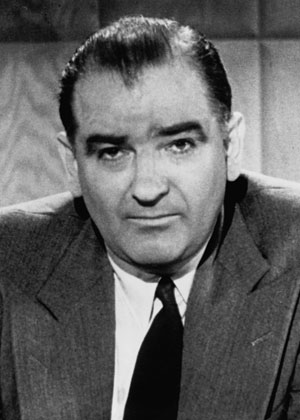
Witch-hunting senator

The item included this passage:

“As Edward R. Murrow noted, ‘We must not confuse dissent with disloyalty. When the loyal opposition dies, I think the soul of America dies with it.'”

The first portion of the quote–“We must not confuse dissent with disloyalty”–is genuine. Murrow uttered the line during the closing portion of his myth-enveloped television report in March 1954 about Senator Joseph R. McCarthy (above) and his witch-hunting ways.

The second part– “When the loyal opposition dies, I think the soul of America dies with it”–is highly suspect.

Murrow didn’t say it during his program about McCarthy, the mythical elements of which I address in my new book, Getting It Wrong.

Here’s what Murrow said on that occasion, immediately after his remark about not confusing “dissent with disloyalty”:

“We must remember always that accusation is not proof and that conviction depends upon evidence and due process of law.”

That’s not  even remotely suggestive of “When the loyal opposition dies, I think the soul of America dies with it.”

So it’s pretty certain that “We must not confuse dissent with disloyalty” was not followed by “When the loyal opposition dies, I think the soul of America dies with it.”

This dubious Murrow quotation has been the topic of a previous discussion at Media Myth Alert. I noted then that if the quotation were genuine–if Murrow really said it–then its derivation shouldn’t be too difficult to determine.

But its derivation remains unknown.

I’ve searched the “historical newspapers” database for the suspect quote. The database includes the New York Times, Washington Post, Chicago Tribune, and Los Angeles Times; no articles quoting “the loyal opposition” passage were returned.

As I’ve noted previously, a search of the LexisNexis database produced a few returns–and none dated before 2001. And none stated when and where Murrow supposedly made the comment.

Among the LexisNexis returns was a book review published in 2003 in the Washington Post. The review invoked “the loyal opposition” passage and said Murrow made the remark “half a century ago, at the height of the McCarthy era.” But exactly when and where was left unsaid.

I couldn’t find “the loyal opposition” passage in A.M. Sperber’s hefty biography of Murrow; nor could I locate it in Bob Edwards’ more recent and much thinner treatment.

The 2005 movie Good Night and Good Luck, which revisited the Murrow-McCarthy encounter, didn’t invoke the quote, either. The line is not to be found in the film’s script.

So why bother running this down? What’s the point?

Several reasons offer themselves.

As I point out in Getting It Wrong, there is intrinsic value in correcting the historical record, in insisting on “a demarcation between fact and fiction.” As is the case with many media-driven myths, the suspect quotation seems too neat, too tidy to be authentic.

Falsely attributing quotations is unsavory, off-putting, and distorts the historical record. The Murrow-McCarthy encounter is myth-choked as it is, in that it’s widely believed that the Murrow show in 1954 stopped the senator’s witch-hunt in its tracks.

What’s more, the dubious Murrow quote seems to possess particular relevance and resonance today. But to invoke without knowing its derivation is an abuse of history.

WJC

Recent and related:

Didn’t: A Watergate primer

In Debunking, Media myths, Newspapers, Washington Post, Watergate myth on October 23, 2010 at 5:10 pm

“Didn’t” can be a fairly effective way of understanding contributions of the Washington Post in the Watergate scandal, to which I devote a chapter in my new mythbusting book, Getting It Wrong.

Nixon resigns, 1974

The Post and its reporters Bob Woodward and Carl Bernstein didn’t bring down Richard Nixon’s corrupt presidency. Even principals of the Post have dismissed that notion, as note in Getting It Wrong.

They didn’t break open the cover-up that Nixon and his close aides plotted in June 1972, soon after the break-in of Democratic headquarters at the Watergate complex.

And they certainly didn’t expose the Watergate burglary, the scandal’s signal crime.

“Didn’t” as a way to consider Watergate occurred to me in reading an article posted online yesterday by the Worcester (Massachusetts) Telegram and Gazette; the article mistakenly asserted that Woodward “exposed the 1972 Watergate break-in with colleague Carl Bernstein.”

The Watergate break-in was thwarted by Washington, D.C., police and the story began circulating within hours.

In fact, the names of Woodward and Bernstein didn’t appear in the byline of the story the Post published June 18, 1972, about the foiled break-in. Woodward and Bernstein were listed among the eight reporters who contributed the report, which carried the byline of Alfred E. Lewis, a veteran police reporter for the Post.

“Didn’t” also characterizes another element of Watergate and the Post.

The secret, high-level source called “Deep Throat,” to whom Woodward periodically turned as the scandal unfolded, didn’t advise him to “follow the money”– or, in other words, to scrutinize the contributions to Nixon’s reelection campaign as a roadmap for understanding the scandal.

“Follow the money” is one of the most memorable phrases of Watergate-era American journalism, and it was uttered by the “Deep Throat” character in the cinema version of Woodward and Bernstein’s book, All the President’s Men.

But the “follow the money” didn’t appear in All the President’s Men, the book.

According to an item posted today at the online site of National Public Radio, the phrase was “kind of made up for the movie.”

The item discussed the variety of research conducted over the years by NPR’s research librarian, Kee Malesky. It noted that NPR reporters “have asked Malesky to look up some fairly obscure, though fascinating pieces of information.”

Malesky, who discusses her research in a new book titled All Facts Considered, recalled that Daniel Schorr once asked her “to find the phrase ‘follow the money’ in the book All The President’s Men.

She was quoted as saying that “because my policy was to go to any length to get Dan Schorr what he needed, I went through the book page by page, and that phrase does not appear there.

“And then in talking to Bob Woodward and the screenwriter, William Goldman, Dan discovered that [the phrase is] actually kind of made up for the movie.”

It’s a great anecdote, nicely retold.

Former Nixon speechwriter William Safire offered a somewhat more detailed version of the anecdote in 1997, writing in the New York Times Sunday Magazine that Woodward and Goldman blamed each other for having made up the line.

“The screenplay was written by William Goldman,” Safire wrote. “When Schorr called him, the famed screenwriter at first insisted that the line came from the book; when proved mistaken about that, he said: ‘I can’t believe I made it up. I was in constant contact with Woodward while writing the screenplay. I guess he made it up.”’

Safire wrote that Schorr “then called Woodward, who could not find the phrase in his exhaustive notes of Watergate interviews. The reporter told Schorr he could no longer rely on his memory as to whether Deep Throat had said the line and was inclined to believe that Goldman had invented it.”

This thin slice of Watergate arcana certainly is intriguing. And it testifies to how movies can propel media-driven myths.

The cinematic version of All the President’s Men is, I write in Getting It Wrong, an important reason why the heroic-journalist interpretation has become the dominant narrative of the Watergate scandal.

The movie version placed Woodward and Bernstein at the center of the unraveling of Watergate while downplaying or dismissing the efforts of investigative agencies such as the FBI.

“The effect,” I write in Getting It Wrong, “was to solidify and elevate the heroic-journalist myth, giving it dramatic power, and sustaining it in the collective memory.”

WJC

Recent and related:

If not for Edward R. Murrow

In Debunking, Media myths, Murrow-McCarthy myth, Newspapers on October 22, 2010 at 10:11 am

One of the especially savory myths in American journalism centers around Edward R. Murrow, the CBS newsman, and his takedown of Senator Joseph R. McCarthy.

As I discuss in Getting It Wrong, my new book that debunks 10 prominent media-driven myths, legend has it that Murrow “single-handedly confronted and took down the most feared and loathsome American political figure of the Cold War, Joseph R. McCarthy, the Red-baiting Republican senator from Wisconsin.

Murrow in 1954

“Murrow, it is often said, stood up to McCarthy when no one else would, or dared,” and did so March 9, 1954, on the half-hour CBS television program, See It Now.

The Murrow-McCarthy myth was repeated the other day in a commentary posted the other day at the online site of the News-Press of Falls Church, Virginia.

The commentary deceased that “the thuggery of Sen. Joe McCarthy in the early 1950s would not have ceased but for a determined effort by Murrow and CBS news to reveal the extent of the excess.”

Not only is the claim undocumented; it just isn’t true.

As I write in Getting It Wrong, “the evidence is overwhelming that Murrow’s famous program on McCarthy had no such decisive effect” as putting an abrupt end to McCarthy’s communists-in-government witch-hunt. Murrow, in fact, “was very late in confronting McCarthy,” I write, doing so “after other journalists had challenged the senator and his tactics for months, even years.”

What’s more, McCarthy’s favorability ratings had begun to slide months before the Murrow program.

I note in Getting It Wrong that “Gallup Poll data show that McCarthy’s appeal crested in December 1953, when 53 percent of Americans said they had a favorable view of him. McCarthy’s favorable rating had slipped to 40 percent by early January 1954, and to 39 percent in February 1954, when an almost identical number of Americans viewed him unfavorably.”

Interestingly, the Murrow-McCarthy media myth took hold despite the protestations of its central figures.

As I point out in Getting It Wrong:

“In the days and weeks after the See It Now program, Murrow said he recognized his accomplishments were modest, that at best he had reinforced what others had long said about McCarthy. Jay Nelson Tuck, the television critic for the New York Post, wrote that Murrow felt ‘almost a little shame faced at being saluted for his courage in the McCarthy matter. He said he had said nothing that … anyone might not have said without a raised eyebrow only a few years ago.'”

Fred Friendly, Murrow’s collaborator and co-producer, also rejected the notion that the See It Now program on McCarthy was pivotal in the senator’s decline. Friendly wrote in his memoir:

“To say that the Murrow broadcast of March 9, 1954, was the decisive blow against Senator McCarthy’s power is as inaccurate as it is to say that Joseph R. McCarthy … single-handedly gave birth to McCarthyism.”

McCarthy had no more persistent or implacable media foe than Drew Pearson, the muckraking, Washington-based syndicated columnist who wrote critically about the senator as early as February 1950–more than four years before Murrow’s program.

Pearson’s columns criticizing McCarthy began appearing soon after the senator launched his witch-hunt, in which he claimed that communists had infiltrated the U.S. State Department, the military, and the Democratic party.

So why was Murrow so late in confronting McCarthy? Why did Murrow wait until Pearson and other journalists had challenged McCarthy? Why did Murrow move only after McCarthy’s ratings had hit the skids?

Those are questions I pose in Getting It Wrong.

Among the explanations I offer is “the well-recognized tendency of television to follow the lead of print media.”

By the end of 1954, McCarthy had been censured by the Senate and his career had fallen into terminal decline.

WJC

Recent and related:

IBD invokes Hearst myth of ‘furnish the war’

In 1897, Debunking, Furnish the war, Media myths, Spanish-American War, Yellow Journalism on October 21, 2010 at 5:19 pm

Remington, Davis in Cuba

In Getting It Wrong, my new mythbusting book, I point out that the most resilient media-driven myths often are those that are distilled “to a catchy, pithy phrase.”

A telling case in point is the line often attributed to William Randolph Hearst: “You furnish the pictures, I’ll furnish the war.” He supposedly was referring to war with Spain in the late 19th century.

Testimony to the tenacity of Hearst’s reputed comment–which I address and debunk in Getting It Wrong–appeared the other day in a commentary in Investor’s Business Daily. The commentary asserted:

“The media have a history of offering more heat than light on many issues. Recall publisher William Randolph Hearst’s telegram to a photographer on assignment to document the supposed conflict in Cuba in 1897: ‘You furnish the pictures, and I’ll furnish the war.'”

Let’s unpack that error-fraught paragraph.

For starters, the story goes that Hearst purportedly sent the telegram to Frederic Remington, a prominent artist (not a photographer), who arrived in Cuba in January 1897 on assignment for Hearst’s New York Journal (see image, above).

Remington was sent there to illustrate the island-wide rebellion against Spanish colonial rule. The artist later recalled that at the time of his brief visit, the Cuban countryside “was a pall of smoke” from homes of Cubans that had been set afire.

Davis

Remington traveled to Cuba with Richard Harding Davis, a prominent writer and correspondent. Davis’ correspondence from that time stated flatly: “There is war here and no mistake.”

So a “supposed conflict” the rebellion was not. In fact, the Cuban rebellion gave rise in 1898 to the Spanish-American War.

As I also point out in Getting It Wrong, the “furnish the war” anecdote lives on despite a nearly complete absence of supporting documentation.

“It lives on,” I write, “even though telegrams supposedly exchanged by Remington and Hearst have never turned up.

“It lives on even though Hearst denied ever sending such a message.”

Moreover, I write, the myth “lives on despite an irreconcilable internal inconsistency: It would have been absurd for Hearst to vow to ‘furnish the war’ because war—specifically, the Cuban rebellion against Spain’s colonial rule—was the very reason Hearst sent Remington to Cuba in the first place.”

A further reason for doubting that Hearst sent such a message is that Spanish authorities closely controlled cable traffic into and out of Cuba. They surely would have intercepted–and would have called attention to–such an inflammatory message, had it been sent.

Despite those and other factors, the Remington-Hearst anecdote is a media myth that refuses to die. One reason for its tenacity, I point out in Getting It Wrong, is that the tale “has achieved unique status as an adaptable, hardy, all-purpose anecdote, useful in illustrating any number of media sins and shortcomings.

“It has been invoked to illustrate the media’s willingness to compromise impartiality, promote political agendas, and indulge in sensationalism. It has been used, more broadly, to suggest the media’s capacity to inject malign influence into international affairs.”

Like many media-driven myths, the “furnish the war” anecdote is succinct, savory, and easily remembered. It is indeed “a catchy, pithy phrase,” one almost too good not to be true.

WJC

Recent and related:

Check out new ‘War of Worlds’ mythbusting trailer

In Anniversaries, Media myths, Media myths and radio, War of the Worlds on October 21, 2010 at 9:17 am

No single program in American broadcasting has inspired more fear, controversy, and endless fascination than the radio dramatization of the War of The Worlds that aired on Halloween eve in 1938.

The program, which told of invading Martians wielding deadly heat rays, was the work of Orson Welles, a 23-year-old prodigy who directed and starred in the show.

As I write in my new mythbusting book, Getting It Wrong, Welles’ show supposedly was so alarming and made such effective use of simulated news bulletins that listeners by the tens of thousands—or even the hundreds of thousands—were convulsed in fear, panic, and mass hysteria, believing the Earth was under alien attack.

Fright beyond measure seized America that night more than 70 years ago.

Or so the media-driven myth has it.

Getting It Wrong offers compelling evidence that the fear, panic, and mass hysteria so readily associated with the War of The Worlds radio dramatization did not occur that night on anything approaching nationwide dimension.

I write that while some Americans may have been frightened by the program, the overwhelming number of listeners were not: They recognized it for what it was—an imaginative and entertaining radio show.

However, newspapers the day after Welles’ show suggested that mass panic had indeed swept the country.

Their reports were almost entirely anecdotal and based mostly on sketchy wire service roundups that emphasized breadth over depth. Newspapers, I write, “simply had no reliable way of ascertaining the validity of the sweeping claims” they made about the radio program.

“Inaccurate reporting,” I write, “gave rise to a misleading historical narrative and produced a savory and resilient media-driven myth.”

I further note in Getting It Wrong that the War of the Worlds show also offered American newspapers an “irresistible opportunity to rebuke radio—which in 1938 was an increasingly important rival source for news and advertising.”

Newspapers took delight in assailing radio as an unreliable, untrustworthy source of information. And this overwhelmingly negative commentary, I write, helped solidify the notion that the radio broadcast had sown mass panic and hysteria among Americans.

In short, the idea that the War of the Worlds program sent untold thousands of people into the streets in fear and panic, is a media-driven myth—one that offers a deceptive message about the influence of radio and about the media’s potential to cause panic and alarm.

I also note in Getting It Wrong that there can be “no disputing that the War of the Worlds dramatization was great entertainment”–worthy of distinction as perhaps the most famous radio show ever.

WJC

Recent and related:

Many thanks to Kathy Shaidle of fivefeetoffury for linking to this post.

WaPo’s belated and puzzling Lynch correction

In Debunking, Jessica Lynch, Media myths, Newspapers, Washington Post on October 20, 2010 at 7:54 am

Private Lynch

Nearly seven weeks after I brought up the matter in a post at Media Myth Alert, the Washington Post yesterday published this odd correction about its misleading characterization of the Jessica Lynch case:

“A Sept. 3 Style review of the documentary ‘The Tillman Story,’ which included a reference to the 2003 rescue in Iraq of Pfc. Jessica Lynch, should not have attributed to the Pentagon the early reports of Lynch’s supposed actions before her capture. Sources of those accounts, which appeared in The Washington Post, were never named.”

The correction is confusing, and awkwardly worded (“should not have attributed to the Pentagon the early reports of Lynch’s supposed actions before her capture” is absolutely headache-inducing).

The correction is puzzling, too, in that is so belated. (Supposedly, it’s policy at the Post to correct errors promptly. “But too often,” the newspaper’s ombudsman noted late last year, “reporters and editors move at a snail’s pace to correct errors.”)

The Lynch correction also is puzzling in what it’s supposed to tell the reader. Just what are readers to take away from reading such a flabby statement is not at all clear.

In publishing the correction, the Post was addressing this passage in its review of the Tillman film:

“In a surreal coincidence [Pat] Tillman’s first Army tour was in Iraq, where he helped provide perimeter support for the stage-managed rescue of Pfc. Jessica Lynch. Lynch later debunked the Pentagon’s account of her own actions before being captured by Iraqi forces, accusing the military of using her in their propaganda efforts.” (Emphasis added.)

What the correction should have made clear was that the review erred in calling Lynch’s rescue “stage-managed” and in blaming the Pentagon for a botched story that the Post–alone–thrust into the public domain.

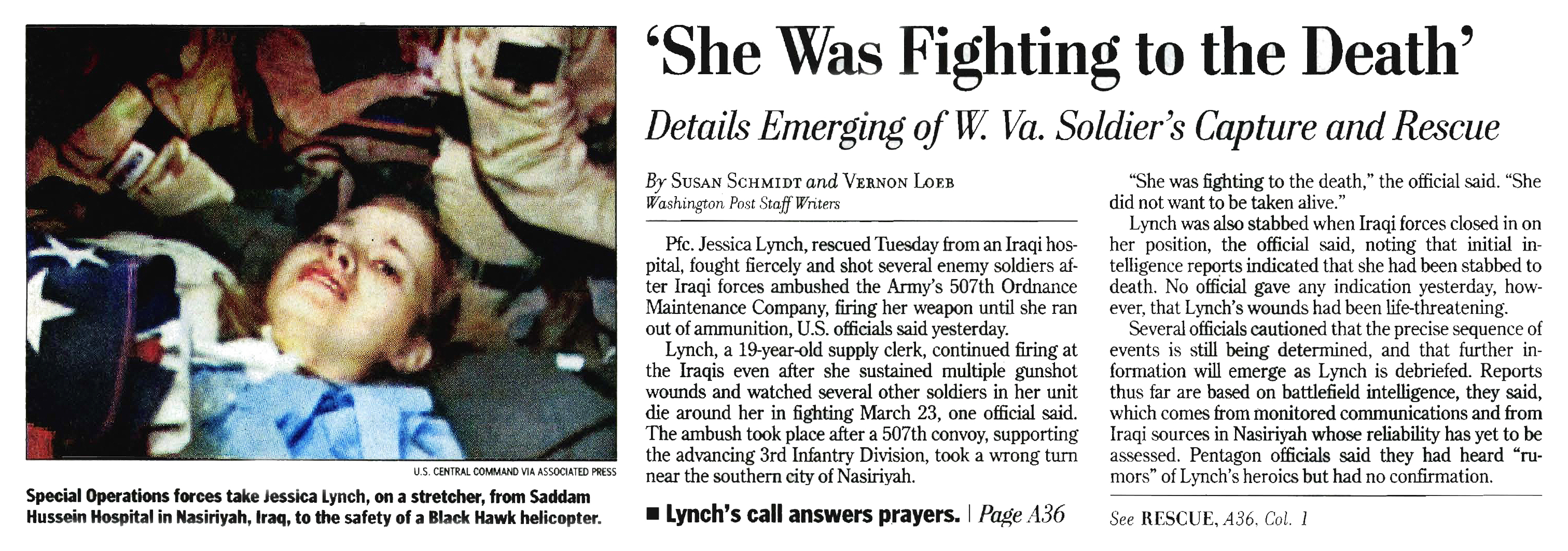
It did so on its front page of April 3, 2003, in an electrifying account that quoted “U.S. officials” as saying Lynch had been shot and stabbed but nonetheless “was fighting to the death” until she was subdued and taken prisoner during an ambush in Nasiriyah, in southern Iraq.

The hero-warrior tale was sensational and, as I note in my new book, Getting It Wrong, was picked up by news organizations around the world. The Times of London, for example, declared that “one thing is certain”–Lynch “has won a place in history as a gritty, all-American hero.”

Lynch, as it turned out, was no hero. She was a 19-year-old supply clerk with the 507th Maintenance Company, elements of which were ambushed on March 23, 2003, a few days after the war began.

As the Post only belatedly reported–in a rollback in June 2003 that one media critic called “the journalistic equivalent of Napoleon’s retreat from Moscow”–Lynch never fired a shot during the ambush. Her gun had jammed, she later said. She was neither shot nor stabbed; she suffered shattering injuries in the crash of a Humvee as it tried to flee the attack.

Lynch was knocked out in the crash, and lingered near death in an Iraqi hospital until she was rescued April 1, 2003, by a U.S. special forces team. The bogus “fighting to the death” report appeared in the Post two days later.

As I point out in Getting It Wrong, which debunks 10 prominent media-driven myths, one of the reporters who wrote the “fighting to the death” story “made clear in late 2003 that the Post‘s sources were not Pentagon officials.”

The reporter, Vernon Loeb, said on National Public Radio’s Fresh Air interview program:

“Our sources for that story were not Pentagon sources.

“And, in fact, I could never get anybody from the Pentagon to talk about those reports [about Lynch’s battlefield heroics] at all. I got indications that they had, in fact, received those intelligence reports, but the Pentagon was completely unwilling to comment on those reports at all. They wouldn’t say anything about Jessica Lynch.”

Loeb said in the interview that the Post had been “told by some really good intelligence sources here in Washington that, you know, there were indications that she had, you know, fired back and resisted her capture and actually been shot and possibly stabbed doing so.”

Loeb dismissed at the interviewer’s suggestion that the “fighting to the death” report was the upshot of clever manipulation by the Pentagon.

“I just didn’t see the Pentagon trying to create a hero where there was none,” Loeb said. “I mean …they never showed any interest in doing that, to me.”

More than seven years on, it’s time for the Post to resolve this lingering mess; it’s time to identify just who were its sources, who were the “U.S. officials” to whom it referred in reporting the botched hero-warrior tale about Jessica Lynch.

There’s no good reason to continue to guard the anonymity of sources who misled the newspaper, its readers, and media audiences around the world.

Anonymity ought not to be a cloak when error and deception persist. Identifying those sources, whoever they were, can help correct the erroneous dominant narrative that the Pentagon concocted the tale.

It’s time  for the Post to say who they were.

WJC

Recent and related:

Books and Banter club discusses ‘Getting It Wrong’
In Debunking, Furnish the war, Hurricane Katrina, Media myths, Washington Post, Watergate myth on October 19, 2010 at 6:46 pm

I was honored that the Books and Banter club in Washington, D.C., selected Getting It Wrong for discussion at its October meeting.

Getting It Wrong is my latest book; it debunks 10 prominent media-driven myths–dubious or improbable stories about the news media that masquerade as factual.

Sixteen members of the club met last night at a restaurant in the Rosslyn section of Arlington, Virginia–within a block or two of the underground parking garage where during the Watergate investigation Washington Post reporter Bob Woodward sometimes met his high-level federal source known as “Deep Throat.”

At the request of club member Paige Gold, who led the discussion, I dropped in for the closing half of the discussion about Getting It Wrong.

I told the club members that I didn’t consider Getting It Wrong as an exercise in media-bashing.

Rather, I said, I like to think of the book as aligned with a fundamental imperative in journalism–that of getting it right.

I had a great time fielding the club members’ very thoughtful, engaging, and intriguing questions.

Among those questions was whether media audiences bear any responsibility for the tenacity of media myths.

Not directly or significantly, I replied.

The myths addressed in Getting It Wrong are, in one way or another, all media-driven. Journalists and news organizations have been the primary culprits in pushing them. Their doing so is more than a little self-serving: After all, media myths serve to reinforce the notion that, for good or bad, the news media are central and decisive forces in American life.

So at one end of the scale, I said, “we have William Randolph Hearst, journalist-as-war-monger, who famously vowed to ‘furnish the war‘ with Spain” in the late 19th century.

At the other, I added, we have the heroic journalists of Watergate, Woodward and his colleague Carl Bernstein, whose investigative reporting brought down a corrupt presidency.

Myths such as those can be used to identify the media as malevolent forces or as indispensable guardians of truth and democratic values. And variety of that kind helps explain why media myths can be so tenacious.

I also was asked what should readers be sure to take away from the book.

In jest, I replied that I thought they should take away the recognition that Getting It Wrong is such a good book they should offer it as gifts to friends and family, especially at the year-end holidays.

Seriously, I added, the takeaway for readers may well be to treat media content with a healthy measure of skepticism, to realize that news reports often are tentative, incomplete, prone to error and revision.

This is especially the case in coverage of disasters, such as the aftermath of Hurricane Katrina a little more than five years ago.

Almost certainly, the early reports about a disaster will prove to be exaggerated in some fashion. The coverage of Katrina’s aftermath in New Orleans offers a telling reminder, I said.

As I write in Getting It Wrong, Katrina’s aftermath represented “no high, heroic moment in American journalism.

“The coverage was in important respects flawed and exaggerated. On crucial details, journalists erred badly, and got it wrong. In the days following Katrina’s landfall, news reports described apocalyptic horror that the hurricane supposedly had unleashed.”

The flawed coverage–the erroneous reports of snipers firing at medical personnel and relief helicopters, of bodies being stacked like cordwood in the New Orleans convention center, of roving gangs raping and killing, of children with their throats slashed, of sharks plying the city’s flood waters–was not without consequences.

As I write in Getting It Wrong, the over-the-top reporting “had the very real and serious effects of delaying the arrival of aid to New Orleans, of diverting and distorting the deployment of resources and capabilities, of heightening the anxiety of [storm] evacuees at the Superdome and Convention Center, and of broadly stigmatizing a city and its people.”

WJC

Recent and related:

Sniffing out media myths

In Cronkite Moment, Debunking, Furnish the war, Media myths, Washington Post, Watergate myth on October 17, 2010 at 8:19 am

I had a fine interview about Getting It Wrong the other day with Eric Deggans of the St. Petersburg Times, the fruits of which appear in his column today.

He writes that Getting It Wrong, my latest book, “picks apart some of journalism’s key moments, from the notion that Bob Woodward and Carl Bernstein’s Watergate reporting brought down Richard Nixon’s White House (action by the FBI, U.S. Congress and Supreme Court actually did that), to the myth of babies born to crack-addicted moms swamping the country and the idea that CBS anchorman Walter Cronkite turned public opinion on the Vietnam War with a single critical broadcast (public opinion had been souring on the war for months).”

Deggans cleverly structured the column as a series of “clues to spot myths in the making.”

Tip-offs mentioned in his column are:

  • Myths can seem too good to be true.
  • Myths tend to support the notion of media power.
  • Myths simplify complex issues and historical events.

Those factors certainly do characterize media-driven myths, which are prominent stories about and/or by the news media that are widely believed and often retold but which, under scrutiny, dissolve as apocryphal or wildly exaggerated. Media myths can be thought of as the junk food of journalism–tasty and alluring, perhaps, but not terribly nutritious or healthy.

The media myths addressed and debunked in Getting It Wrong include some of American journalism’s best-known stories. “Most of them are savory tales,” I write in the book. “And at least some of them seem almost too good to be false.”

Media myths, I point out in Getting It Wrong, do “tend to distort understanding about the role and function of journalism in American society, conferring on the news media far more power and influence than they necessarily wield.”

They are media-centric. Self-flattering.

As I further write in Getting It Wrong:

“Media myths often emerge from an eagerness to find influence and lasting significance in what journalists do and tend to extend credit where credit is not entirely due.”

What I call the heroic-journalist myth of Watergate is an example of such hero-seeking.

The myth has it that the investigative reporting of Woodward and Bernstein in the Washington Post brought down Nixon’s corrupt presidency.

“In reality,” I write in Getting It Wrong, “the Post and other news organizations were marginal factors in unraveling the Watergate scandal. Nixon’s fall was the consequence of his criminal conduct, which was exposed in the convergence of many forces, newspaper reporting being among the least decisive.”

And yet the Watergate myth lives on, as an example of the news media exerting power in an effective and beneficial manner.

Media myths also endure, I write, because they tend to be reductive. That is,  they simplify, they “offer unambiguous, easily remembered explanations about complex historic events.”

It is, after all, far easier to place Woodward and Bernstein at the center of unraveling Watergate than it is to grapple with and understand the sprawling complexity of the scandal.

Media myths also invite indulgence in the “golden age fallacy,” a flawed but enticing belief that there really was a time when journalism and its practitioners were respected and inspiring—the time, say, of Woodward and Bernstein.

Interestingly, Woodward has scoffed at the notion that he and Bernstein took down Nixon. Woodward said in an interview in 2005:

“To say that the press brought down Nixon, that’s horseshit.”

To the list of tip-offs that Deggans discusses, I would add: “Myths often fail the sniff test.” Tales that are quite neat and tidy do tend to emit a whiff of phoniness.

Pithy quotes such as William Randolph Hearst’s vow to “furnish the war” with Spain fail the sniff test. They invite suspicion because they seem almost too perfect, too neat and tidy.

Hearst’s famous vow is examined in Chapter One in Getting It Wrong.

In closing, I note another newspaper reference to Getting It Wrong.

Leo Morris, editorial page editor at the News-Sentinel in Fort Wayne, Indiana, wrote the other day that he the book “sounded so intriguing” that he was prompted to download its Kindle edition.

Morris’ brief piece carried the headline: “Journalism’s mythtakes.”

Clever. “Mythtakes.” I like it.

WJC

Recent and related:

Was ‘jailbreaking journalism’ a hoax? Evidence points the other way

In 1897, Anniversaries, Debunking, Media myths, Spanish-American War, Yellow Journalism on October 15, 2010 at 6:42 am

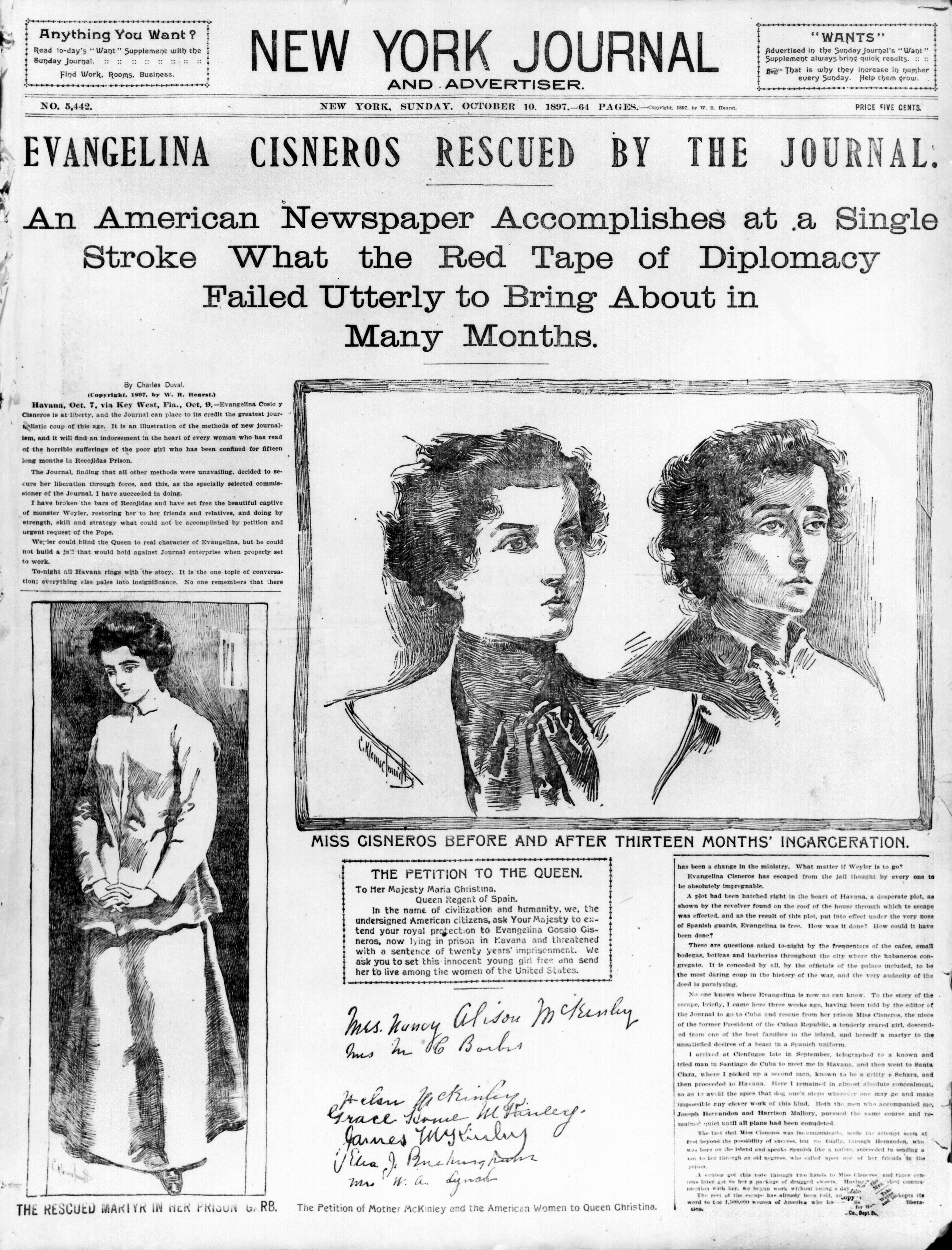
The sensational case of “jail-breaking journalism” reached a conclusion 113 years ago this week, when the passenger steamer Seneca reached in New York harbor, en route from Havana.

Among the passengers was 19-year-old Evangelina Cisneros, a petite Cuban woman who, a few days before, had been the world’s most famous political prisoner.

She had been broken out of jail in Havana in the early hours of October 7, 1897. Her rescuers included Karl Decker, a reporter for William Randolph Hearst‘s New York Journal who had been assigned to Havana to secure her freedom.

Once out of jail, Cisneros was hidden at the home of a bachelor Cuban banker for nearly three days. She was smuggled aboard the Seneca just before it left Havana.

The steamer reached New York on October 13, 1897, and the Journal lodged Cisneros in a palatial room at the Waldorf Hotel. Four days later, she and Decker were feted at Madison Square, at a thunderous outdoor reception organized by Hearst.

More than 75,000 people turned out at what was reported to have been the largest public gathering in New York since the Civil War.

I wrote about the case of “jail-breaking journalism” in my 2006 book, The Year That Defined American Journalism: 1897 and the Clash of Paradigms, noting:

“Cisneros was rapturously received [in New York] not because she was a daring and clever prison escapee, but because she was a frail and wily embodiment of the Cuban struggle for political independence from Spain.”

At the time, Cuba was in open rebellion against Spanish colonial rule, and Evangelina had been swept up in the tumult on the island. She was accused of plotting to kill a senior Spanish military officer; she said she was defending herself from the officer’s sexual advances.

To the Journal, her jailing stood as irrefutable evidence of Spain’s routine mistreatment of Cuban women. Cisneros, the Journal said, was guilty only of “having in her veins the best blood in Cuba.”

As that claim suggests, the Journal devoted impassioned and intensive coverage to Cisneros’ plight, turning her jailing into an international cause célèbre.

By the time of her escape, Cisneros had been in Spanish custody nearly 15 months without trial.

The jailbreak was breathtakingly illegal–and one of the most astonishing episodes in American journalism. The Journal declared it “epochal,” a stunning success of its activist brand of yellow journalism.

But the case long has been dogged by suspicions that the whole thing was a hoax, that Decker paid bribes to win Cisneros’ release and then concocted an elaborate tale about a jailbreak.

Such suspicions emerged almost as soon as Cisneros reached New York.  As I note in The Year That Defined American Journalism, Hearst’s leading rival newspaper, the New York World of Joseph Pulitzer, was particularly eager to denounce the Cisneros rescue as fraudulent.

“Gold did it,” the World declared. “The Spanish could not withstand its glitter. It oiled the palms of turnkeys and guards, of officers and civilians. Miss Cisneros’s friends had it a-plenty. And so she got out of her cell while her jailers looked the other way.”

But as I note in The Year That Defined American Journalism, such claims “have never been supported by any direct evidence. No one has identified to whom bribes were paid, how much, by what method, and how the purported payoffs secured the enduring silence of the authorities.”

Besides, a conspiracy of silence that included senior Spanish authorities in Cuba would have had to have been so improbably extensive—so many people would have known—that “concealment could not possibly have lasted for long, certainly not 100 years and more,” I wrote.

Allegations or suspicions of bribery, I noted, “rest more on assertion—and newspaper rivals’ contempt for the Journal—than on specific, persuasive documentation. They are supported more by argument than evidence.”

Decker–who denied that bribes had been paid–succeeded in the jailbreak because he tapped into a clandestine network in Havana, the operatives of which had become adept in smuggling arms, ammunition, and medicine into Cuba and, occasionally, people out.

Among those operatives was Carlos F. Carbonell, a bachelor banker in whose home Cisneros was hidden. They also included William B. MacDonald, an American national in Havana who was the agent for a steamship line. He was with Decker when the jailbreak took place.

It is simply implausible that Carbonell, MacDonald, and Decker’s other accomplices would have taken the risks they took had the Cisneros rescue been nothing more than hoax, farce, or sham.

WJC

Recent and related:

Ignoring WaPo role in pushing Lynch hero-warrior tale

In Debunking, Jessica Lynch, Media myths, Washington Post on October 13, 2010 at 8:12 am

It’s more than a mildly astonishing how the Washington Post‘s singular role in propelling the erroneous hero-warrior tale about Private Jessica Lynch is rarely noted when the case is recalled these days.

The dominant narrative about the Lynch case–one of 10  media-driven myths I examine in my new book, Getting It Wrong–has shifted decidedly away from the Post to focus on the Pentagon‘s purported role in concocting the story about Lynch’s battlefield heroics in Iraq.

London’s Daily Telegraph was the latest to buy into that misleading narrative, stating in an article posted online yesterday:

“The Pentagon was … accused of exaggerating the heroism of Private Jessica Lynch, who was rescued from an Iraqi prisoner of war hospital in 2003 after being captured and injured in an ambush.

“Government sources claimed she had tried to fight off her captors, but she later said her gun had jammed before she could fire a shot.”

It’s scarcely surprising that the Telegraph account makes no mention of the Post and its sensational, front-page report of April 3, 2003–the report that thrust Lynch into unwitting and undeserved international fame.

Lynch then was a 19-year-old Army private, a supply clerk with the 507th Maintenance Company. Elements of her unit were ambushed in Nasiriyah, in southern Iraq, on March 23, 2003, a few days into the war.

The Post‘s article of April 3 appeared beneath the headline: “‘She was fighting to the death.’” And it described how Lynch had fought fiercely in an ambush in southern Iraq in the early days of the Iraq War, that she had been shot and stabbed before taken prisoner.

But the story wasn’t true.

Lynch never fired her weapon in Iraq. Her gun jammed during the ambush, she later said. She was neither shot nor stabbed; she suffered serious injuries in the crash of a Humvee as it tried to flee. And she was sexually assaulted after the ambush.

Lynch lingered near death at a hospital in Nasiriyah before a U.S. special forces team rescued her, on April 1, 2003, two days before the Post‘s botched hero-warrior tale was published–and was promptly picked up by news organizations around the world.

The Post account vaguely cited “U.S. officials” as sources for the tale about Lynch’s derring-do.

But who those sources were has never been revealed.

As I mention in Getting It Wrong, Vernon Loeb, who shared a byline on the “fighting to the death” report about Lynch, made clear the Pentagon was not the source.

Speaking in what I called “a little-noted interview” on National Public Radio’s Fresh Air interview program in late 2003, Loeb said flatly :

“Our sources for that story were not Pentagon sources.

“And, in fact, I could never get anybody from the Pentagon to talk about those reports [about Lynch’s battlefield heroics] at all. I got indications that they had, in fact, received those intelligence reports, but the Pentagon was completely unwilling to comment on those reports at all. They wouldn’t say anything about Jessica Lynch.”

Loeb said in the interview that the Post had been “told by some really good intelligence sources here in Washington that, you know, there were indications that she had, you know, fired back and resisted her capture and actually been shot and possibly stabbed doing so.”

He added that the Post on April 3, 2003, “basically told our readers that day what the U.S. intelligence community was telling senior members of the U.S. government.”

Loeb, then the Post defense correspondent, dismissed the interviewer’s suggestion that the  “fighting to the death” report was the upshot of clever manipulation by the Pentagon.

“I just didn’t see the Pentagon trying to create a hero where there was none,” Loeb said. “I mean …they never showed any interest in doing that, to me.”

Why the Post escapes responsibility for the botched hero-warrior tale is intriguing, if not baffling.

It certainly makes for juicy story to claim the Pentagon for ginned up the tale about Lynch’s heroics. That story line fits well with the public’s curdled view of the war in Iraq: A bogus hero seems appropriate for a war fought on a supposedly dubious premise.

But that story line is deceptive: The bogus hero-warrior tale was a direct consequence of the bungled, credulous, and inadequately sourced reporting by the Washington Post.

WJC

Recent and related: