W. Joseph Campbell

Posts Tagged ‘Research’

‘News of World’ closure breaks link to 19th century yellow journalism

In 1897, Debunking, Year studies on July 10, 2011 at 12:04 am

The abrupt closure of Britain’s largest Sunday tabloid, Rupert Murdoch’s raunchy, scandal-ridden News of the World, breaks a link to the yellow journalism that flared in urban America at the end of the 19th century.
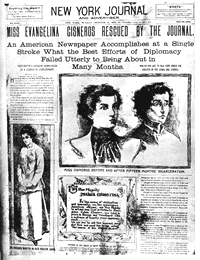
Jail-breaking journalism

I’m not referring to the News of the World’s tabloid flamboyance, which certainly evoked the typographic boldness of William Randolph Hearst’s New York Journal, a broadsheet that was the leading exemplar of American yellow journalism.

The link went deeper than appearances.

The News of the World was an heir to Hearst’s activist-oriented, participatory journalism — a self-engaging, self-promoting style of newspapering unheard of these days in the United States.

As I note in my book The Year That Defined American Journalism: 1897 and the Clash of Paradigms, Hearst’s Journal at the end of the 19th century sought to set a standard for the American press, insisting, I write, “that newspapers were obliged to inject themselves, conspicuously and vigorously, in righting the wrongs of public life, and in filling the void of government inaction and incompetence.”

The year 1897 brought memorable evidence of Hearst’s style of activist journalism.

In the summer that year, Hearst deployed a phalanx of Journal reporters to solve the grisly case of headless torso murder in New York.

Later that year, a reporter for the Journal broke from jail in Havana a 19-year-old political prisoner named Evangelina Cisneros. The Journal — and more than a few other U.S. newspapers — celebrated the breathtaking breach of international law.

For the Journal, the Cisneros jailbreak (see image, above) was “epochal” and represented the “supreme achievement” of its paradigm of activist journalism.

It acknowledged that freeing Cisneros had violated Spanish law and flouted international convention — and the Journal seemed delighted to have done so, saying:

“The Journal is quite aware of the rank illegality of its action. It knows very well that the whole proceeding is lawlessly out of tune with the prosaic and commercial nineteenth century. We shall not be surprised at international complications, nor at solemn and rebuking assurances that the age of knight errantry is dead. To that it can be answered that if innocent maidens are still imprisoned by tyrants, the knight errant is yet needed.”

That sort of willingness to wink at illegality was demonstrated by the News of the World well before it became swept up in a cellphone-voicemail hacking scandal that brought about its demise.
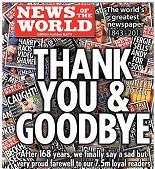
Final edition

The News of the World, which published its final issue today, had been for years one of the world’s most controversial titles, due in part to its activist-oriented undercover operations, ostensibly undertaken to bring drug dealers, fugitive financiers, and other criminals to justice.

As I noted in my 2001 book, Yellow Journalism: Puncturing the Myths, Defining the Legacies, the targets of the News of the World often were “small-time celebrities and wayward sports figures dabbling in modest quantities of illegal drugs. The undercover methods were criticized as entrapment and dismissed as ‘a kind of investigative reporting without much investigating.'”

I also described a notorious case in 1999, in which reporters for News of the World “posed as wealthy Arabs and enticed a British earl to buy cocaine and share the drug with them. A detailed report about the peer’s conduct — he was depicted as drunkenly snorting cocaine with a £5 note — soon after was splashed across News of the World. He was arrested and convicted of selling drugs.

“But the presiding judge declined to send the peer to jail, citing the subterfuge of the News of the World. If not for the journalists’ sting, the judge observed, the crimes likely would not have been committed.”

Such outlandishness hinted at the tabloid’s more recent and more egregious misconduct of breaking into the cellular phone voicemail of hundreds of people, including members of Britain’s royal family and perhaps victims of the terror attack on London’s subway system July 2005.

Phone-hacking, of course, wasn’t an element in the repertoire of the yellow press of Hearst or of his mean-spirited rival, Joseph Pulitzer. Nor did they did bring on the war with Spain in 1898, as is often alleged.

But on occasion they turned to deception, misrepresentation, and self-motivated activism in pursuit of their lusty brand of big-time journalism.

WJC

Recent and related:

The digital age ‘equivalent of the OJ Simpson trial’? Not quite

In Debunking, Media myths on July 7, 2011 at 9:02 am

Anthony mug shot

The stunning acquittal of Casey Anthony on the most serious charges in the slaying of her 2-year-old daughter has invited comparisons to the outcome of O.J. Simpson’s double-murder trial in 1995.

Those comparisons are mostly misleading.

The “Media File” blog of the Reuters news agency, for example, likened the Anthony verdict to the digital age “equivalent of the OJ Simpson trial.”

Simpson was found not guilty in October 1995 of the stabbing deaths of his former wife, Nicole, and her friend, Ron Goldman.

“Media File,” which was one of several outlets to detect parallels in the two cases, noted:

“Word of the verdict spread like wildfire … making a return to a normal life for newly-famous Anthony as unlikely as it was for already-famous Simpson 16 years ago.”

The blog also declared:

“Just as some greeted the Simpson verdict with tears and disbelief, there was much the same reaction about the Anthony verdict, including other mothers and daughters who railed against the verdict on the courthouse steps.

“Unlike OJ, who was accused of stabbing his [former] wife and one of her friends to death in a fit of jealous rage, there didn’t seem to be even the smallest cheering section for Anthony. Then again she was accused of murdering her two-year-old daughter, whose skeletal remains were found near the family home with duct tape dangling from her skull.

“Anthony’s defense was considerably less adamant than Simpson’s ‘100% not guilty’ plea, but, like Simpson, she did not take the stand in her own defense.”

While interesting, the parallels are mostly superficial and unrevealing.

The Anthony proceedings in Florida hardly were in the league of the O.J. trial in Los Angeles.

Casey Anthony, unlike Simpson, was no national celebrity before she was tried on charges of killing her daughter, Caylee.

As Marcia Clark, the prosecutor who lost the Simpson trial, said of Anthony:

“She never wowed the nation with her athletic prowess, shilled in countless car commercials, or entertained in film comedies.” Simpson had been a star football player, a pitchman for the Hertz car rental company, and a supporting actor in movies such as The Naked Gun.

Race — a central, defining factor in Simpson’s trial — was absent in the Anthony trial.

As such, the verdict in her case, surprising though it was, prompted nothing akin to the divisive, clashing reactions that greeted Simpson’s acquittal: Many whites reacted with shock and disbelief while many blacks cheered the outcome.

Significantly, the Anthony case produced nothing akin to the moment at the end of the Simpson trial, when the country held its collective breath and awaited the verdicts.

The Simpson jury deliberated less than four hours before deciding the case on October 2, 1995.  The hapless judge who presided over the 134-day trial, Lance Ito, announced that the verdicts would be read the following day, at 10 a.m. Pacific time, 1 p.m. Eastern.

As that hour approached on October 3, 1995, the country seemed almost to shut down. The New York Times reported that for 10 minutes, from 1 p.m. to 1:10 p.m. Eastern, “people didn’t work. They didn’t go to math class. They didn’t make phone calls. They didn’t use the bathroom. They didn’t walk the dog.

“They listened to the O.J. Simpson verdicts,” in what the newspaper accurately called “an eerie moment of national communion, in which the routines and rituals of the country were subsumed by an unquenchable curiosity.

“Millions of people in millions of places seemed to spend 10 spellbinding minutes doing exactly the same thing.”

Those minutes represented an exceptional occasion of collective anticipation, an almost incomparable moment.

For the collective anticipation they generated, the final moments in the Simpson case were rivaled perhaps only by the first manned lunar landing in July 1969.

WJC

Recent and related:

WaPo eludes responsibility in bogus hero-warrior tale about Lynch

In Debunking, Jessica Lynch, Media myths, Washington Post on July 6, 2011 at 9:17 am

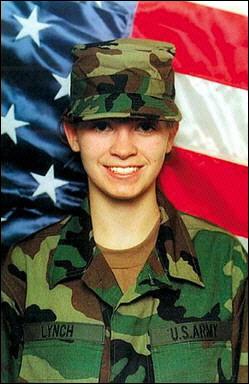
The Washington Post has the exclusive though obviously unwanted distinction of having brought the world the bogus story about Jessica Lynch and her battlefield heroics during the early days of the Iraq War.

Private Lynch, 2003

But in what has been a remarkable case of deflected attention, the Post’s singular role in the botched hero-warrior tale about Lynch has been obscured in favor of a darker, more sinister narrative that the Pentagon concocted the story and fed it to the American public.

That version — the military made it up — has become the dominant narrative of the Lynch case and is predictably invoked whenever Lynch attracts the news media’s attention, as she did on the Fourth of July.

She was in Idaho then to give a talk at a Presbyterian camp. Her appearance drew local news coverage, including a report published yesterday in the Spokesman-Review newspaper of Spokane.

The Spokesman-Review account blithely repeated the dominant narrative about Lynch’s supposedly heroic deeds, stating without attribution:

“The military initially portrayed Lynch as a hero, saying she fought back until she ran out of ammunition.”

Which just isn’t so.

As Vernon Loeb, one of the Post reporters on the botched Lynch story has made clear, the Pentagon wasn’t the source of the hero-warrior tale.

“Far from promoting stories about Lynch,” Loeb has said, “the military didn’t like the story.”

The dominant narrative is a false narrative.

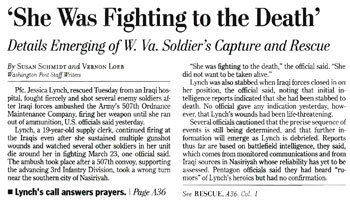
Loeb then was the Post’s defense correspondent. He shared a byline with Susan Schmidt on the sensational story about Lynch, which was published April 3, 2003, on the Post’s front page.

The Schmidt-Loeb report carried the headline:

“‘She was fighting to the death.'”

The story described how Lynch, then 19, supposedly had fought with Rambo-like ferocity in an ambush at Nasiriyah in southern Iraq, “even after she sustained multiple gunshot wounds and watched several other soldiers in her unit die around her.”

Lynch, a supply clerk in the Army’s 507th Maintenance Division, also was stabbed before being overwhelmed, according to the Post.

The newspaper cited otherwise unidentified “U.S. officials” for its sensational story, which was picked up and reported prominently by news organizations around the world.

The hero-warrior tale turned Lynch into the war’s best-known American soldier. But it wasn’t true.

Lynch hadn’t fired a shot in the ambush.

She was badly injured not from gunshots and stabbings, but in a Humvee that crashed fleeing the Iraqi attack.

In the years since, the Post  has not objected as the dominant narrative about the origins of the Lynch story has shifted to the Pentagon. The newspaper has said little, if anything, about the now-routine inclination to blame the military for the bogus tale.

Indeed, the newspaper has “never fully acknowledged or explained its extraordinary error about Jessica Lynch,” as I write in my latest book, Getting It Wrong.

It is certainly time for the Post to identify the “U.S. officials” who led it so badly astray on the Lynch story; doing so would clarify what role, if any, the Pentagon had in the derivation of the bogus tale.

Loeb has effectively absolved the Pentagon in the hero-warrior tale about Lynch, saying in an interview on NPR in December 2003:

“Our sources for that story were not Pentagon sources.

“And, in fact, I could never get anybody from the Pentagon to talk about those reports [about Lynch’s battlefield heroics] at all. I got indications that they had, in fact, received those intelligence reports, but the Pentagon was completely unwilling to comment on those reports at all.

“They wouldn’t say anything about Jessica Lynch.”

WJC

Recent and related:

The journos who saved us

In Cinematic treatments, Debunking, Media myths, Murrow-McCarthy myth, Washington Post, Watergate myth on July 5, 2011 at 12:49 pm

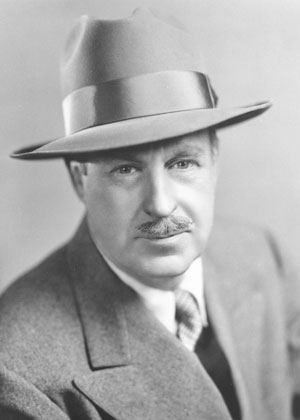
Murrow: Savior?

At their extreme, media-driven myths are hero-worshipping devices, invoked to venerate journalists as saviors.

Thankfully, such treatment is rare, and typically reserved for such journalists the legendary CBS newsman Edward R. Murrow and the Watergate reporting duo, Bob Woodward and Carl Bernstein.

Brian Unger, host of a history program on cable television, indulged in a bit of journalists-idolatry in compiling for an Entertainment Weekly blog a list of a dozen heroic figures from TV shows and the movies.

On the list was Ed Murrow, whom Unger praised for “saving us from someone who pretended to be a great American patriot, Sen. Joseph McCarthy.”

Also selected were Robert Redford and Dustin Hoffman, the movie stars who played Washington Post reporters Woodward and Bernstein in the film All the President’s Men. “Armed only with a pen,” Unger wrote, “they saved the country from itself.”

Journalists as saviors: Like most media-driven myths, the notion is simply too good to be true, too simplistic to be credible.

Murrow hardly took down Joe McCarthy in Murrow’s famous See It Now program on CBS in March 1954.

The show was aired four years after McCarthy began his communists-in-government witch-hunt, and four years after muckraking columnist Drew Pearson piercingly challenged and punctured many of McCarthy’s claims.

Pearson

The television critic for the New York Post, Jay Nelson Tuck, wrote that Murrow in the days after the show felt “almost a little shame faced at being saluted for his courage in the McCarthy matter. He said he had said nothing that … anyone might not have said without a raised eyebrow only a few years ago.”

Years later, Murrow’s CBS colleague, Eric Severaid, chafed at the misleading interpretation attached to the See It Now program on McCarthy which, he noted, “came very late in the day.”

Sevareid said: “The youngsters read back and they think only one person in broadcasting and the press stood up to McCarthy and this has made a lot of people feel very upset, including me, because that program came awfully late.”

As I write in my media myth-busting book, Getting It Wrong, Americans in early 1954 weren’t “hoping for someone to step up and expose McCarthy, or waiting for a white knight like Murrow to tell them about the toxic threat the senator posed.”

By then they knew, thanks to the work of journalists such as Pearson.

Murrow no more ended McCarthy’s witch-hunt than Woodward and Bernstein brought down Richard Nixon’s corrupt presidency in Watergate — and, as Unger wrote, “saved the country from itself.”

Whatever that means.

It is clear that Woodward and Bernstein’s contributions to unraveling the Watergate scandal of 1972-74 were modest, and pale in significance when compared to the work of such subpoena-wielding entities as special prosecutors, both houses of Congress, the Justice Department, the FBI.

“Even then,” I write in Getting It Wrong, Nixon “likely would have served out his term if not for the audiotape recordings he secretly made of most conversations in the Oval Office of the White House. Only when compelled by the Supreme Court did Nixon surrender those recordings, which captured him plotting” to obstruct justice in the Watergate scandal.

Interestingly, principals at the Washington Post over the years have scoffed at the mythical and mediacentric interpretation that the newspaper brought down Nixon.

In 2005, for example, Michael Getler, then the newspaper’s ombudsman, wrote in a column:

“Ultimately, it was not The Post, but the FBI, a Congress acting in bipartisan fashion and the courts that brought down the Nixon administration. They saw Watergate and the attempt to cover it up as a vast abuse of power and attempted corruption of U.S. institutions.”

Woodward, himself, declared in 2004, in an interview with American Journalism Review:

To say the press brought down Nixon, that’s horseshit.”

But undoubtedly it’s the film All the President’s Men that’s largely responsible for the heroic-journalist trope that Woodward and Bernstein took down Nixon and saved the country.

All the President’s Men easily is the most-viewed movie made about Watergate. And as I note in Getting It Wrong, it places “Woodward and Bernstein at the center of Watergate’s unraveling while denigrating the efforts of investigative agencies such as the FBI.

“The effect was to solidify and elevate the heroic-journalist myth, giving it dramatic power, and sustaining it in the collective memory.”

WJC

Recent and related:

False narrative accompanies Jessica Lynch to Idaho

In Debunking, Jessica Lynch, Media myths, Washington Post on July 4, 2011 at 7:12 am

Lynch in 2003

The false narrative that the Pentagon cynically concocted the tale of her battlefield derring-do in Iraq has accompanied Jessica Lynch to Idaho, where she is to deliver a speech today on the Fourth of July.

News reports in advance of Lynch’s appearance have said the Pentagon was the source of the erroneous report that she fought fiercely in an ambush in Nasiriyah in March 2003 — an engagement in which 11 American soldiers were killed.

But as I discuss in my media-mythbusting book, Getting It Wrong, the tale of Lynch’s purported heroics was thrust into the public domain not by the Pentagon but solely by the Washington Post.

The Post in a sensational, front-page story published April 3, 2003, said that Lynch, a 19-year-old supply clerk in the Army’s 507th Maintenance Company, had fought fiercely in the attack at Nasiriyah, suffering gunshot and stab wounds while firing round after round into the attacking Iraqis.

The Post’s article, which appeared beneath the bylines of Susan Schmidt and Vernon Loeb, was built almost entirely around anonymous sources identified only as “U.S. officials.”

One of the Schmidt-Loeb sources was quoted as saying of Lynch:

“‘She was fighting to the death. She did not want to be taken alive.'”

The article was thoroughly wrong. Bogus.

Schmidt and Loeb were misled by their sources, who to this day remain unidentified.

Lynch never fired a shot in the fighting in Nasiriyah.

She was neither shot nor stabbed.

According to her own account in a co-authored book, I Am a Soldier, Too, Lynch cowered in the back seat of a Humvee as it sped from the attack, praying, “Oh God help us. Oh God, get us out of here.”

The fleeing Humvee was struck by a rocket-propelled grenade, which sent the vehicle crashing into a disabled tractor-trailer just ahead. Lynch suffered shattering injuries; the four other soldiers in the Humvee were fatally injured.

Lynch was taken to an Iraqi hospital where she lingered near death before a U.S. special forces team rescued her on April 1, 2003.

The Post’s botched story by Schmidt and Loeb appeared two days later, beneath the headline:

“‘She was fighting to the death.'”

Over time, the singular role of the Post in the bogus hero-warrior story about Lynch has faded.

In its place has emerged the false narrative that the Pentagon made up the story to bolster popular support for the war.

But as I note in Getting It Wrong, the Pentagon wasn’t the Post’s source for the bogus hero-warrior tale.

We know that from an interview in December 2003 on NPR’s  Fresh Air show program. On that show, Loeb said he “could never get anybody from the Pentagon to talk about” Lynch’s purported heroics.

“They wouldn’t say anything about Jessica Lynch,” Loeb declared.

“I just didn’t see the Pentagon trying to create a hero where there was none,” he added. “I mean …they never showed any interest in doing that, to me.”

Loeb was unequivocal in saying:

“Our sources for that story were not Pentagon sources.”

Loeb said they were “some really good intelligence sources” in Washington, D.C., and added:

“We wrote a story that turned out to be wrong because intelligence information we were given was wrong. That happens quite often.”

Loeb on another occasion was quoted in the New York Times as saying:

“Far from promoting stories about Lynch, the military didn’t like the story.”

Despite Loeb’s exculpatory comments, the erroneous interpretation that the Pentagon concocted the story about Lynch’s heroics has taken hold and lives on — in part because it corresponds well to a view that the war in Iraq was a thoroughly botched affair.

The erroneous references to the Pentagon in advance stories about Lynch’s Fourth of July talk near Craigmont, Idaho, underscore anew why the Post ought to identify the sources who led it astray on Lynch’s supposed heroics.

By doing so, the Post will help to debunk a malicious false narrative and help set the record straight.

And after all, that’s what journalism is supposed to do.

WJC

Recent and related:

‘What’s a couple of centuries’ when it comes to China and Zhou Enlai?

In Bra-burning, Debunking, Media myths on July 3, 2011 at 5:58 am

When Zhou Enlai observed that it was “too early” to assess the significance of political upheaval in France, he was speaking about the turmoil of 1968, and not, as is often believed, about the French Revolution that began in 1789.

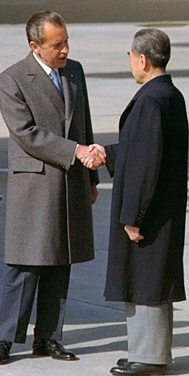
Zhou greets Nixon, 1972

The Independent newspaper in London referred to the Zhou misunderstanding in an editorial posted yesterday, and essentially shrugged it off, stating :

“Revisionists now claim that he was commenting not on the storming of the Bastille in 1789, but on the student riots of 1968. But what’s a couple of centuries to a China still engaged in its own long march to modernity?”

The editorial’s snark and breezy dismissiveness may be because the “revisionists” include the Financial Times, a rival London newspaper.

The Financial Times was first to call attention to the mistaken interpretation of Zhou’s remark.

Zhou, the Chinese premier, said during President Richard Nixon’s trip to China in February 1972 that it was “too early to say” what were the implications of political upheaval in France.

Charles (Chas) Freeman, an American diplomat who was Nixon’s interpreter on the China visit, told a panel discussion in Washington, D.C., last month that Zhou clearly was speaking about the turmoil and student protests in France in 1968 — not the French revolution of nearly 200 years before.

A reporter for the Financial Times moderated the panel discussion and in his article wrote that Freeman said:

“There was a mis­understanding [about Zhou’s remark] that was too delicious to invite correction.”

In a subsequent interview with me, Freeman said:

“I cannot explain the confusion about Zhou’s comment, except in terms of the extent to which it conveniently bolstered a stereotype” about Chinese leaders’ taking an exceptionally long and patient view of history.

Stereotyping helps explain why Zhou’s comment has been so widely quoted — and why debunking its erroneous and more extravagant interpretation really does matter.

Stereotyping, as I discuss in my latest book, Getting It Wrong, can be buoyed by media-driven myths, those dubious media-centric stories that masquerade as factual.

In Getting It Wrong, I note a number of examples of stereotypes that have been bolstered by media myths.

I write: “The misleading if euphonic epithet of ‘bra-burning‘ emerged from a demonstration on the Atlantic City boardwalk in 1968 to become shorthand for denigrating the emergent feminist movement and dismissing it as trivial and even a bit odd. The widely misreported pandemic of ‘crack babies‘ in the late 1980s and early 1990s seemed to confirm the worst pathologies associated with inner-city poor people.”

Rather than reflecting China’s supposedly long and patient view of history, Zhou’s “too early” observation was cautious analysis about events that were fairly recent and still under interpretation.

Zhou’s was a pragmatic observation, hardly sage or long-sighted.

WJC

Recent and related:

‘Sneakily patriotic’ movies that promote media myths

In Cinematic treatments, Debunking, Media myths, Murrow-McCarthy myth, Washington Post, Watergate myth on July 1, 2011 at 7:28 am

The film critic for Gannett News Service has identified in time for the Fourth of July weekend 10 movies he says are “sneakily patriotic.”

Meaning they promote patriotism indirectly, without a lot of flag-waving flamboyance.

The list, compiled by critic Bill Goodykoontz, includes Apollo 13, the dramatic 1995 movie about an ill-fated lunar mission that ended safely, and Miracle, the 2004 film about the gold medal-winning 1980 U.S. Olympics hockey team, a movie that does feature a fair amount of flag-waving.

Notably, two of the “sneakily patriotic” films have promoted and propelled media-driven myths — those dubious and improbable tales about news media that masquerade as factual.

Both myth-promoting movies push the extravagant notion that the news media are, or were, powerful and decisive forces in American political life. And both movies are discussed in my media myth-busting book, Getting It Wrong, which came out last year.

The myth-promoters are:

Goodykoontz, in describing the two movies, invokes their mythical aspects.

About All the President’s Men, Goodykoontz writes that Woodward and Bernstein’s “coverage of the Watergate break-in … led, ultimately, to the resignation of Richard Nixon.”

And Good Night, and Good Luck, he writes, “evokes an earlier era of media and how it could be used to stem the abuse of power.”

I point out in Getting It Wrong how movies can solidify media-driven myths in the public’s consciousness. “High-quality cinematic treatments,” I write, “are powerful agents of media myth-making, and can enhance a myth’s durability.”

The cinematic version of All the President’s Men solidified what I call the heroic-journalist myth of Watergate — the simplistic notion that Woodward and Bernstein’s investigative reporting brought down Richard Nixon’s corrupt presidency.

All the President’s Men, I write, allows no interpretation other than it was the work of Woodward and Bernstein that “set in motion far-reaching effects that brought about the first-ever resignation of a U.S. president.”

But to embrace that interpretation, I further write in Getting It Wrong, “is to abridge and misunderstand the scandal and to indulge in a particularly beguiling media-driven myth.”

The heroic-journalist interpretation serves to diminish and ignore the far more powerful forces that unraveled the scandal and forced Nixon from office.

Those forces, I write, “included special prosecutors, federal judges, both houses of Congress, the Supreme Court, as well as the Justice Department and the FBI.

“Even then, Nixon likely would have served out his term if not for the audiotape recordings he secretly made of most conversations in the Oval Office of the White House. Only when compelled by the Supreme Court did Nixon surrender those recordings, which captured him” plotting to obstruct justice in the Watergate scandal.

When considered against the tableau of subpoena-wielding authorities, the contributions of Woodward and Bernstein pale in significance and consequence.

A somewhat similar dynamic is at work in Good Night, and Good Luck.

The movie, which was released in black and white to lend a 1950s feel, permits no other conclusion than Murrow’s See It Now program about McCarthy single-handedly ended the senator’s communists-in-government witch-hunt.

Murrow’s show detailing McCarthy’s loathsome and bullying tactics was aired in March 1954 — long after other journalists had confronted the senator and, in some cases, paid a heavy price for doing so.

Among those journalists was the muckraking columnist Drew Pearson, who took aim at McCarthy in February 1950, not long after the senator began his red-baiting campaign.

By the end of that year, McCarthy had physically assaulted Pearson and denounced him from the Senate floor as the “diabolically” clever “voice of international communism,” a “prostitute of journalism,” and the “sugar-coated voice of Russia.”

In the Senate speech excoriating Pearson, McCarthy aimed a threat at Adam Hat Stores Inc., the principal sponsor of the columnist’s Sunday night radio program.

McCarthy said that “anyone who buys from a store that stocks an Adams hat is unknowingly contributing at least something to the cause of international communism by keeping this communist spokesman on the air.”

Within a week, Adam Hat announced the end of its sponsorship of Pearson’s program.

Pearson may not have had the finest reputation in 1950s American journalism. Jack Shafer, the media critic for Slate.com, wrote last year that Pearson was “one of the skuzziest journalists to ever write a story.”

But Pearson took on McCarthy years before Murrow — and long before it was safe. He certainly was “sneakily patriotic” in doing so.

WJC

Recent and related:

Newspapers vital to democracy? Where’s the proof?

In Debunking, Media myths, Newspapers on June 28, 2011 at 11:19 am

It’s a truism — a media myth, even — that independent-minded newspapers are “a vital bulwark” to democracy. It’s a claim easily made but supported by little persuasive evidence.

Hedges

Chris Hedges, a former New York Times foreign correspondent, is the latest commentator to invoke the “vital bulwark” conceit, offering it up in a lengthy essay posted yesterday at Truthdig.com.

Hedges’ is an angst-ridden ode to newspapering. He writes: “The day The New York Times and other great city newspapers die, if such a day comes, will be a black day for the nation.”

Why is that?

Hedges claims that a “democracy survives when its citizens have access to trustworthy and impartial sources of information, when it can discern lies from truth, when civic discourse is grounded in verifiable fact.”

But in saying so, Hedges offers more assertion than evidence.

Media pluralism is a marker of democratic governance, not its essential precondition.

The countries that New York-based Freedom House ranks highest in measures of press freedom are functioning democracies.

Democratic rule enables media pluralism, not the other way round.

What’s more, the American experience with even nominally impartial news media has been relatively brief. Democratic governance emerged, evolved, and became consolidated in America despite the absence of “trustworthy and impartial sources of information” that Hedges extols.

American media history has been defined mostly by a vigorously partisan press.

And of course, unabashedly partisan newspapers still characterize the media landscape of such well-established democracies as Britain.

The ethos of detached impartiality news coverage began to emerge in the United States in the late 19th century, as I discuss in my 2006 book, The Year That Defined American Journalism. But that approach to newsgathering took years to develop, years to become the normative standard in American journalism.

Detached impartiality is taught nowadays in journalism schools. It is the dominant professional paradigm. But that doesn’t mean it’s rigorously respected or routinely practiced.

Nor is much of the content of American newspapers necessarily vital to the functioning of a democracy. As Jack Shafer pointed out in a memorable commentary a couple of years ago:

“Even an excellent newspaper carries only a few articles each day that could honestly be said to nurture the democratic way. Car bomb in Pakistan? Drug war in Mexico? Flood in North Dakota? Murder in the suburbs? Great places to get Thai food after midnight? A review of the Britney Spears concert? New ideas on how to serve leftover turkey? The sports scores? The stock report? Few of these stories are likely to supercharge the democratic impulse.”

A little-studied phenomenon of American democratic life is that of going newsless, of choosing to avoid the news, impartial or not.

According to data compiled by the Pew Research Center and released last year, 17 percent of adult Americans  receive no news on a typical day. They eschew the news despite ready access to a variety of news-delivery platforms, both traditional and digital.

More than 25 percent of American of adults younger than 30 say they go newsless, according to Pew. In the 18-to-24 age cohort, 31 percent say they go without the news.

And yet American democracy functions, if not flourishes, in its messy, often-frustrating ways.

No doubt some slice of “newsless” population is turned off by perceived distortion in the content offered by the nominally impartial, even-handed news media.

Just 20 percent of respondents in the Pew study said they believed all or most of what they read in the New York Times; 25 percent said they believed all or most of what they read in the Wall Street Journal.

That figure for “your daily newspaper” was 21 percent, Pew reported.

So even if they nominally strive for even-handedness and impartiality, leading U.S. newspapers face steep believability problems.

Hedges, it’s interesting to recall, is no model of the impartial journalist.

He notes in his essay that he left the Times because of his “vocal and public opposition to the war in Iraq,” saying he “cared more about truth than news.”

WJC

Recent and related:

WaPo’s latest ‘missed’ opportunity evokes Jessica Lynch case

In Debunking, Jessica Lynch, Washington Post on June 26, 2011 at 9:11 am

Patrick Pexton has been hesitant and a bit baffling in three-plus months as the Washington Post’s ombudsman.

His choice of topics — he recently discussed the Post’s coverage of women’s sports — suggests he’s no Michael Getler, who set a rather hard-nosed standard in five years as ombudsman, and no Deborah Howell, who poked at the ideological lopsidedness of the Post’s newsroom.

But Pexton gets moderately tough in his column published today, criticizing the Post for fumbling the case of Jose Antonio Vargas, an undocumented immigrant who was a Post reporter for several years and kept his status mostly a secret.

A Post editor, Patrick Perl, knew that Vargas was an undocumented immigrant but kept quiet about it.

Vargas recently submitted to the Post a lengthy, first-person essay about his status and time as a reporter there. For reasons not entirely clear, the newspaper in mid-June abruptly spiked the piece.

So Vargas took his account to the New York Times, which published it in today’s magazine.

In his column about the Vargas case, Pexton asks:

“Why would The Post punt to a rival a riveting, already edited story that could provoke national discussion on immigration — an issue that sorely needs it — and that also included possibly illegal, and perhaps forgivable, conduct by a former Post reporter and current member of management?

“Beats the heck out of many in The Post’s newsroom,” Pexton adds, “and beats the heck out of me.”

He adds that in the Vargas matter, the Post “missed an opportunity to tell a great and compelling story, and to air and take responsibility for some internal dirty laundry. It’s that kind of act that earns you the lasting respect of your readers. It keeps their trust.”

It’s a ringing line with which to close a column.

It’s also an observation that evokes another messy case the Post has never thoroughly addressed: It never has come clean about its bogus hero-warrior story about Jessica Lynch, a story that became an international sensation in the early days of the Iraq War.

Lynch was a shy 19-year-old private, a supply clerk in the Army’s 507th Maintenance Company. Elements of her unit were caught in a deadly ambush in southern Iraq in March 2003.

The Post reported that Lynch fought fiercely in the attack, “even after she sustained multiple gunshot wounds and watched several other soldiers in her unit die around her” before being taken prisoner. She also was stabbed in the attack, the Post reported, but fought the Iraqis until she ran out of ammunition.

The Post quoted an otherwise anonymous “U.S. official” as saying: “She was fighting to the death. She did not want to be taken alive.”

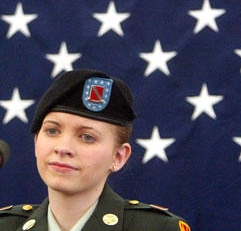
Private Lynch

But in fact Lynch never fired a shot in the ambush.

Lynch was neither shot nor stabbed.

She suffered shattering injuries was badly injured in the crash of a Humvee fleeing the attack.

Lynch was treated at an Iraqi hospital from where she was rescued by a U.S. commando team on April 1, 2003. The Post’s bogus hero-warrior story came out two days later.

In the years since, the newspaper has never fully explained how it got the hero-warrior story so utterly wrong; nor has it dealt adequately with fallout from the Lynch case.

As I note in my media myth-busting book, Getting It Wrong, the Post had the temerity, in a follow-up article published in June 2003, to blame the U.S. military and the administration of President George Bush for failing to correct an error for which the Post, alone, was responsible.

“Neither the Pentagon nor the White House publicly dispelled the more romanticized initial version of her capture,” the Post said in the follow-up article — as if the “romanticized initial version” wasn’t the Post’s, alone.

So why still fuss about the Post and its botched the story about Lynch?

For at least two compelling and somewhat related reasons.

One is the false narrative that has come to define the Lynch case — a narrative that says the Pentagon planted the bogus hero-warrior tale in order to bolster support for the war at home.

That narrative endures even though Vernon Loeb, one of the reporters on the original Lynch story, has said the Pentagon wasn’t the source for the hero-warrior tale.

“I could never get anybody from the Pentagon to talk about those reports [of Lynch’s battlefield derring-do] at all,” Loeb said on an NPR program in late 2003, adding:

“They wouldn’t say anything about Jessica Lynch.”

The other reason it still matters is that a former White House operative named Jim Wilkinson was fingered as the Post’s source in Where Men Win Glory: The Odyssey of Pat Tillman, a book by Jon Krakauer.

In the book, Krakauer referred to Wilkinson as a “master propagandist” and said he “deserves top billing for creating the myth of Jessica Lynch.”

But the book offered no specific source for its claims about Wilkinson, who at the time of Lynch’s capture and rescue was director of strategic communications for General Tommy Franks, then the commander of U.S. forces in Iraq.

I spoke with Wilkinson last year and he disputed Krakauer’s account as “factually incorrect” and insisted that “not one shred of evidence” links him to leaking the erroneous report to the Post.

Wilkinson also said:

“Tommy Franks would have killed me” had he been the Post’s source for the erroneous report about Lynch.

Wilkinson’s denial has a ring of validity, particularly his point about Franks.

The Post could swiftly resolve this lingering messiness by identifying the anonymous sources who led it astray on the Lynch story. The newspaper should feel no obligation to sources who caused it to err so badly.

Identifying those sources would reveal whether indeed the Pentagon planted the hero-warrior tale, and would clarify Wilkinson’s role, if any, in the Lynch case. And it would, as Pexton might say, represent “an opportunity to tell a great and compelling story” that would earn the respect of readers.

WJC

Recent and related:

Those delicious but phony quotes ‘that refuse to die’

In Cinematic treatments, Cronkite Moment, Debunking, Furnish the war, Media myths, Murrow-McCarthy myth, Spanish-American War, Washington Post, Watergate myth on June 25, 2011 at 10:31 am

Craig Silverman, author of Regret the Error, posted an intriguing column yesterday about appealing but dubious quotations that journalists seem especially prone to cite, noting that such famous lines “often turn out to be manufactured or inexact representations.”

It’s an important reminder, given the endless popularity of quotations that are neat, tidy, and irresistibly delicious. As I note in my latest book, Getting It Wrong, “Turns of phrase that sound too neat and tidy often are too perfect to be true.”

Plouffe: Not so 'queasy'?

Silverman’s column, titled “Misquotes that refuse to die,” was centered around a comment attributed in 2009 to David Plouffe, Barrack Obama’s campaign manager in 2008.

Plouffe supposedly said he felt a bit “queasy” about the prospect of Obama’s facing Jon Huntsman, the Republican former Utah governor, in the presidential election in 2012.

“Plouffe never said it,” Silverman wrote, describing how the queasy line took on life of its own.

Journalists can be particularly susceptible to such succinct “little gems,” as Silverman put it, because the gems are so effective in making a point or in distilling complexity.

Silverman’s column noted two famous, dubious quotes that I dismantle in Getting It Wrong.

One of them is the comment misattributed to President Lyndon Johnson who,  in reaction to Walter Cronkite’s on-air assessment that the war in Vietnam was “mired in stalemate,” supposedly said:

“If I’ve lost Cronkite, I’ve lost Middle America.”

Or something to that effect.

Versions as to what Johnson supposedly said vary quite a lot — which can be a marker of a media myth. I also point out in Getting It Wrong that Johnson did not see the Cronkite report when it aired on CBS on February 27, 1968.

The other dubious quote discussed in Getting It Wrong and mentioned by Silverman is William Randolph Hearst’s purported vow to “furnish the war” with Spain.

Reasons for doubting the Hearstian vow are many, I write, and include the fact that the telegram in which Hearst supposedly made the statement has never turned up. Plus, Hearst denied making such a vow.

A number of other famous and delicious quotes favored by journalists likewise have proven to be false, made-up, or of mythical dimension; among them:

  • Too early to say.” It’s often said that Chinese premier Zhou Enlai offered the observation in 1972, as sage, far-sighted analysis about the effects of the French Revolution of 1789. But according to a retired American diplomat, Charles W.  (Chas) Freeman Jr., Zhou’s comment, which came during President Richard Nixon’s visit to China in February 1972, was about political turmoil in France in 1968. “I cannot explain the confusion about Zhou’s comment, except in terms of the extent to which it conveniently bolstered a stereotype” about Chinese leaders taking an exceptionally long and patient view of history, Freeman said recently. Freeman was Nixon’s interpreter on the trip.

So what to do about these delicious but dubious and phony quotations?

Keep pounding away at them, calling them out for what they are, whenever they appear. That’s the only effective way of debunking.

But even then, thorough and utter debunking can be rare.

WJC

Recent and related: