It is a heroic narrative that found mention today’s New York Times, in an article discussing two movies about journalists that could be contenders this year for Academy Awards.
One of them is Truth, a perversely titled film that celebrates former CBS News anchor Dan Rather and producer Marla Mapes who in 2004 used bogus documents to claim President George W. Bush dodged wartime service in Vietnam. No way does that movie deserve Oscar consideration. The other contender-film is titled Spotlight.
But what most interests Media Myth Alert is the Times article’s blithe and mistaken reference to “the investigation by Bob Woodward and Carl Bernstein that led to Richard M. Nixon’s resignation.”
“All the President’s Men allows no other interpretation: It was the work Woodward and Bernstein that set in motion far-reaching effects that brought about the first-ever resignation of a U.S. president. And it is a message that has endured.”
Indeed, this year marks the 40th anniversary of the movie’s release and the notion that Woodward and Bernstein toppled Nixon remains the principal way Watergate is understood, a version that disregards and diminishes the far more accurate interpretation of what led to Nixon’s fall in August 1974.
To roll up a scandal of Watergate’s dimensions, I wrote in Getting It Wrong, “required the collective if not always the coordinated forces of special prosecutors, federal judges, both houses of Congress, the Supreme Court, as well as the Justice Department and the FBI.
“Even then, Nixon likely would have served out his term if not for the audiotape recordings he secretly made of most conversations in the Oval Office of the White House. Only when compelled by the Supreme Court did Nixon surrender those recordings, which captured him plotting the cover-up” of the burglary in June 1972 that was Watergate’s seminal crime.
Principals at the Post have, over the years, rejected the simplistic notion that the newspaper’s reporting led Nixon to resign.
Katharine Graham, the Post’s publisher during Watergate, said in 1997, for example:
“Sometimes people accuse us of bringing down a president, which of course we didn’t do. The processes that caused [Nixon’s] resignation were constitutional.”
In 2005, Michael Getler, then the Post’s ombudsman, or in-house critic, wrote:
“Ultimately, it was not The Post, but the FBI, a Congress acting in bipartisan fashion and the courts that brought down the Nixon administration. They saw Watergate and the attempt to cover it up as a vast abuse of power and attempted corruption of U.S. institutions.”
Not even Woodward has embraced the heroic-journalist myth. He once told an interviewer for American Journalism Review:
And in an interview with the PBS “Frontline” program, Woodward said “the mythologizing of our role in Watergate has gone to the point of absurdity, where journalists write … that I, single-handedly, brought down Richard Nixon. Totally absurd.”
Today’s article wasn’t the first time the Times has turned to the mythical claim about the Post’s Watergate reporting.
In a cover article in 2014, the Times Sunday magazine mentioned Woodward and Bernstein, saying they “actually managed to take down a mendacious American president, and in doing so they came to symbolize the hope and heroism of a new generation.”
And in 2008,in an article about Woodward’s finally introducing his high-level Watergate source to Bernstein, the Times referred to the “two young Washington Post reporters [who] cracked the Watergate scandal and brought down President Richard M. Nixon.”
Media Myth Alertcalled attention in 2015 to the appearance of prominent media-driven myths, including cases in which celebrities took up and repeated dubious tall tales about journalists and their work.
Here is a rundown of the blog’s five top posts of the year, followed by a roster of other notable mythbusting writeups of 2015.
The hoary old myth received a boost in April when, on the 152d anniversary of Hearst’s birth, the humorist and radio personality, Garrison Keillor, blithely invoked the unsubstantiated anecdote, which reinforces the superficial and misleading notion of Hearst as war-mongering newspaper publisher.
“In 1898,” Keillor told listeners of his “Writer’s Almanac” podcast that airs on NPR, “Hearst sent the artist Frederic Remington to Cuba to cover the war. And Remington wrote home, ‘There is no war. Request to be recalled.’
“And he was told, ‘You furnish the pictures, I’ll furnish the war.’ And the Hearst newspapers did their best to promulgate what came to be called the Spanish-American War.”
The tale is one of the best-known in American journalism, and it is almost certainly apocryphal, for reasons described in my 2010 media-mythbusting book, Getting It Wrong.
Keillor
Notably, the anecdote lives on despite the absence of supporting documentation: The telegraphed messages that Remington and Hearst supposedly exchanged have never turned up. And the Spanish authorities who controlled incoming and outbound telegraphic traffic in Cuba surely would have intercepted and called attention to Hearst’s incendiary message, had it been sent.
Moreover, the sole original source of the “furnish the war” anecdote, James Creelman, a portly, cigar-chomping journalist prone to hyperbole and exaggeration, never said how or where he learned about the purported Remingt0n-Hearst exchange.
And almost no one remembers that Hearst denied having sent such a message.
By the way, the transcript of Keillor’s remarks about Hearst and Remington remains posted at the “Writer’s Almanac” Web site. Uncorrected.
Peter Landesman, who is to produce and direct the film, was quoted last week as saying Felt will be akin to “a Shakespearean melodrama, a massively powerful story. It’s like a domestic spy thriller but there’s a very powerful, almost Shakespearean thing happening inside his home, but it will incorporate all those elements.”
But why is Mark Felt, who died in 2008, biopic worthy?
FBI agents who conducted the illegal break-ins went through “desks, closets, clothing and private papers for clues to the whereabouts of the Weathermen,” according to an account in the New York Times. “With a camera that could be concealed in an attaché case, the agents photographed diaries, love letters, address books and other documents” belonging to relatives of Weather radicals.
In 1980, Felt was convicted of felony charges related to those warrantless break-ins, which were known in the FBI as “black bag jobs.” He was fined $5,000 but not sentenced to prison for the crimes.
The following year, Felt received an unconditional pardon from President Ronald Reagan.
In its obituary about the former FBI official, the Los Angeles Times recalled that tears welled in Felt’s eyes as he acknowledged at trial having approved secret break-ins by FBI agents between May 1972 and May 1973 — “roughly the same time he was talking to Woodward about Watergate.”
Felt and co-defendant Edward S. Miller argued that the warrantless entries were justified for reasons of national security.
In doing so, Noonan tripped over the mythical “Cronkite Moment” of 1968.
Noonan
That “moment” was when CBS News anchorman Walter Cronkite declared on the air that the U.S. military effort in Vietnam was “mired in stalemate.” Cronkite’s assessment supposedly came as an epiphany to President Lyndon B. Johnson, who, in visceral reaction, said something to the effect of:
“If I’ve lost Cronkite, I’ve lost Middle America.”
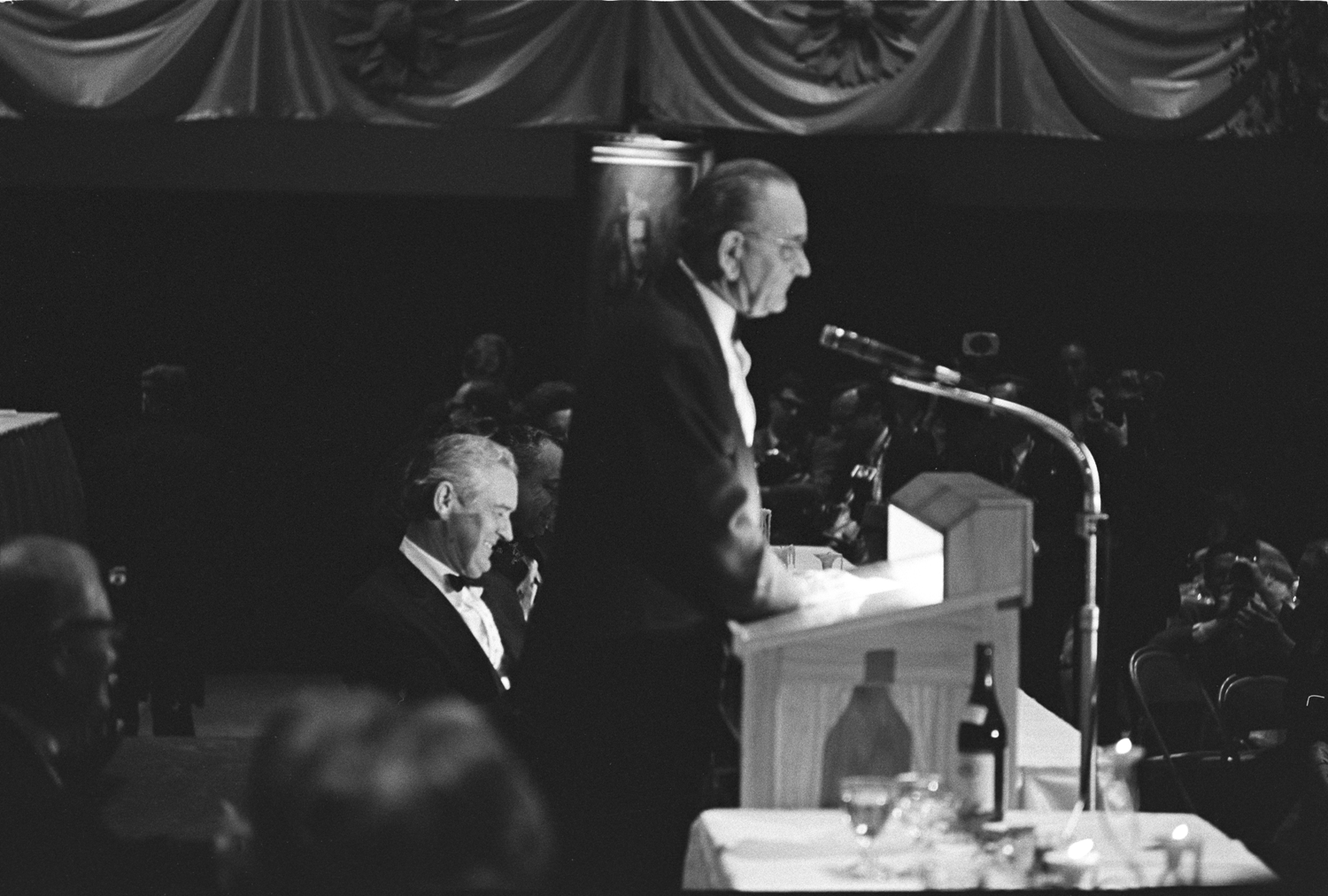
But as I discussed in Getting It Wrong, Johnson did not see Cronkite’s program when it aired on February 27, 1968; the president then was attending a black-tie birthday party in Texas for Governor John Connally.
I also noted in Getting It Wrong that by 1968, “stalemate” was hardly a novel or shocking way to characterize the Vietnam War: “Stalemate” had circulated in the news media months before Cronkite spoke the word on the air.
In her column, Noonan referred to shifting contours in American politics that have boosted Trump’s bid for the Republican presidential nomination. She also wrote:
“Old style: If I’ve lost Walter Cronkite, I’ve lost middle America. New style: How touching that an American president once thought if you lost a newsman you’d lost a country.”
Noonan’s reference to the “Cronkite Moment” may have been indirect and a bit confusing, given the topic of her column. But there was no doubt she was treating as authentic one of American journalism’s most tenacious myths.
Dowd did so in February, in a commentary that ruminated about the bizarre falsehoods told by Brian Williams, the disgraced former anchor of NBC Nightly News, about an assignment to Iraq in 2003: Williams claimed to have been aboard a U.S. Army helicopter when it was struck by a rocket-propelled grenade.
Dowd, after noting that network evening news shows are shells of their much-watched former selves, turned implicitly to the “Cronkite Moment,” writing that CBS anchorman had “risked his career to go on TV and tell the truth about the fact that we were losing the Vietnam War.”
Except Cronkite didn’t say “we were losing.” He said the war was stalemated and that negotiations might eventually prove to be the way out. But saying so posed no risk to Cronkite’s career. By then, it was commonplace, and safe, to say the war had reached a stalemate.
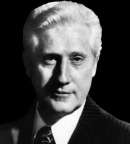
Of course, it had no such effect, as Bradlee himself had said, on the 25th anniversary of the seminal crime of Watergate–the burglary in June 1972 at the headquarters of the Democratic National Committee.
On Meet the Press in June 1997, Bradlee said “it must be remembered that Nixon got Nixon. The Post didn’t get Nixon.”
Bradlee, who died in 2014, was referring to the White House audio tapes which Nixon secretly made and which revealed the president’s guilty role in conspiring to obstruct the FBI’s investigation into the breakin at the DNC headquarters.
As I noted in Getting It Wrong the notion that the Post and its lead Watergate reporters, Bob Woodward and Carl Bernstein, “brought down” Nixon’s presidency represents a fundamental misreading of history that diminishes “the far more decisive forces that unraveled the scandal and forced Nixon from office.”
Those forces included special prosecutors and federal judges, FBI agents, bipartisan congressional panels, and the U.S. Supreme Court, which unanimously ruled that Nixon must turn over to prosecutors the tapes that captured his guilty participation in the attempted coverup.
Against this tableau, the contributions of the Post and Woodward and Bernstein to the outcome of Watergate were minimal. Modest at best. They were hardly decisive, Politico’s claim notwithstanding.
■Jorge Ramos, media-myth-teller (posted September 5): The international reach of media-driven myths was best defined in 2015 when Jorge Ramos, the self-important anchorman for Univision, went on an ABC News program and claimed that the Washington Post’s reporting of Watergate forced Nixon’s resignation.
He stated:
“I think that, as a reporter, many times, you have to take a stand. … And the best examples of journalism that I have—Edward R. Murrow against McCarthy; Cronkite during the Vietnam War, or the Washington Post reporters forcing the resignation of Richard Nixon—that’s when reporters challenge those who are in power.”
Ramos, who has been called the “Walter Cronkite of Latino America,” invoked a similar claim a few days later in a commentary posted at the online site of AM, a newspaper in Mexico.
What prompted these claims was Ramos’ conduct a news conference convened by Donald Trump. Ramos insisted on posing a question before being called on, a showboating moment that led to his being escorted from the room.
Not even the newspaper’s principal figures during the Watergate period embraced the notion that the Post forced Nixon to quit in August 1974.
Notable among them was the publisher during Watergate, Katharine Graham. She said 1997:
“Sometimes people accuse us of bringing down a president, which of course we didn’t do. The processes that caused [Nixon’s] resignation were constitutional.”
Sometimes it doesn’t take much to stir up a media myth.
Consider, for example, the recent move of the Washington Post to new quarters in the capital — a move the newspaper reported on to absurd excess.
Leaving this mythical place
The Guardian newspaper of London took up the development today in a report online, posted beneath the headline: “Washington Post bids farewell to office where it broke Watergate.”
The Guardian described the Post’sformer home on 15th Street NW as the place “where Woodward and Bernstein exposed the Watergate scandal and brought down president Richard Nixon.” It’s almost as if any excuse will do to trot out the bromide that the Bob Woodward and Carl Bernstein, through their dogged reporting for the Post, exposed the crimes of Watergate and forced Nixon’s resignation in 1974.
Untenable though it is, the heroic-journalist trope has become the dominant narrative of Watergate — an engaging but simplified account of the country’s gravest political crisis that not even principals at the Post have embraced.
Woodward, for example, once told an interviewer for American Journalism Review:
On another occasion, Woodward declared that “the mythologizing of our role in Watergate has gone to the point of absurdity, where journalists write … that I, single-handedly, brought down Richard Nixon. Totally absurd.”
And Katharine Graham, the Post’s publisher during Watergate, said in 1997: “Sometimes people accuse us of bringing down a president, which of course we didn’t do. The processes that caused [Nixon’s] resignation were constitutional.”
True enough. So why does the myth persist? What explains its tenacity in the face of denial, repudiation, and debunking?
An important explanation is that the epic scandal has become so distant that few Americans can accurately describe what took place.
The heroic-journalist interpretation makes Watergate accessible.
As I discussed in my media-mythbusting book,Getting It Wrong, that explanation strips away the scandal’s daunting complexity, does away with the intricate investigations that slowly exposed high-level misconduct, leaving the Post, Woodward, and Bernstein as celebrated stand-ins “for understanding Watergate and its denouement.”
It’s a trope that reassures journalists, too, reminding them in these unsettled times that the work of their predecessors supposedly had significant and memorable consequences. As the inimitable media critic Jack Shafer wrote the other day, journalists are “sentimental creatures who draw on the past to self-mythologize.”
To indulge in the heroic-journalist trope is to indulge in dubious history. As I noted in Getting It Wrong, “to explain Watergate through the lens of the heroic-journalist is to abridge and misunderstand the scandal and to indulge in a particularly beguiling media-driven myth. The heroic-journalist interpretation minimizes the far more decisive forces that unraveled the scandal and forced Nixon from office.”
Rolling up a scandal of the dimensions of Watergate, I wrote, “required the collective if not always the coordinated forces of special prosecutors, federal judges, both houses of Congress, the Supreme Court, as well as the Justice Department and the FBI.
“Even then, Nixon likely would have served out his term if not for the audiotape recordings he secretly made of most conversations in the Oval Office of the White House. Only when compelled by the Supreme Court did Nixon surrender those recordings, which captured him plotting the cover-up” of Watergate’s signal crime — the break-in at the headquarters of the Democratic National Committee in June 1972.
Guardian was not alone in recalling the heroic-journalist myth as the Post staff decamped a short distance to an address on K Street NW.
In a dispatch last week, the French new agency, Agence France-Presse, described the Post’s erstwhile home as “the scene of groundbreaking reporting on the Watergate scandal by young reporters Bob Woodward and Carl Bernstein, leading to the resignation of President Richard Nixon in 1974.”
The best-known anonymous source of the Watergate scandal, a former senior FBI official code-named “Deep Throat,” would receive hero’s treatment in a planned biopic, the shooting for which reportedly is to begin in March.
The movie is to be called Felt, the name of the “Deep Throat” source, W. Mark Felt, who cut a checkered career in government service.
Early this month, the Hollywood press was abuzz about the planned Felt biopic. The show business daily, Variety, said the film would be “a spy thriller” in which Felt wages an “isolated and dangerous struggle against the White House.” Shooting the film is to begin in March, Variety said, and Liam Neeson and Diane Lane may fill lead roles.
Felt: Biopic worthy?
All of which prompts inevitable questions: Why is Mark Felt, who died in 2008, biopic worthy? Even if the movie never makes it to production, why should Felt be considered a hero?
He was no noble figure. Felt was convicted in 1980 of felony charges related to the warrantless break-ins, known in the FBI as “black bag jobs,” and fined $5,000. He was not sentenced to prison for the crimes.
The year after his conviction, Felt was granted an unconditional pardon by President Ronald Reagan.
In its obituary about the former FBI official, the Los Angeles Times recalled that tears welled in Felt’s eyes as he acknowledged on the witness stand having approved secret break-ins by FBI agents between May 1972 and May 1973 — “roughly the same time he was talking to Woodward about Watergate.”
Felt and co-defendant Edward S. Miller justified the warrantless entries on grounds of national security.
The prosecutor in the case, John W. Nields Jr., said at the trial that FBI agents who conducted the breakins Felt approved had entered residences in New York City and New Jersey, “dressed in old clothes or disguised as telephone repairmen,” according to a New York Times report about the trial.
The agents picked locks or paid cash to landlords to obtain keys, Nields said, and they “searched every room in the home, methodically looking through desks, closets, clothing and private papers for clues to the whereabouts of the Weathermen. With a camera that could be concealed in an attaché case, the agents photographed diaries, love letters, address books and other documents.”
Nields said Reagan’s pardon of Felt and Miller came as a surprise. “Nobody spoke to me about it,” the New York Timesquoted him as saying. “I would warrant that whoever is responsible for the pardons did not read the record of the trial and did not know the facts of the case.”
Felt was hardly acting altruistically in passing Watergate-related information to Woodward; their periodic meetings included six in a parking garage in suburban Virginia. I argued in my media-mythbusting book, Getting It Wrong, that the contributions of Woodward and his Post colleague Carl Bernstein in uncovering the Watergate scandal were modest at best and that their reporting in no way can be thought of as having forced President Richard Nixon to resign.
In leaking to Woodward, Felt sought to undercut the acting director, L. Patrick Gray III, and thereby enhance Felt’s chances of being named to the bureau’s top position, as Max Holland persuasively argued in his book, Leak: Why Mark Felt Became Deep Throat. The book makes clear Felt was motivated by ambition in the internal struggle at the FBI to replace J. Edgar Hoover, the long-serving director who died in May 1972.
Felt lost out, and retired in 1973.
Perhaps Felt the movie will collapse in its preliminary stages, which is the fate of many Hollywood projects. A biopic about Mark Felt is a bad idea in any case.
The days around Halloween can be among the most myth-indulgent of the year, given the many media reminders about The War of the Worlds radio dramatization that aired 77 years ago tonight.
The hour-long show, which aired on CBS radio and starred 23-year-old Orson Welles, was so vivid in telling of the invasion of Earth by Martians wielding deadly heat rays that tens of thousands of Americans supposedly were convulsed in panic and mass hysteria.
Or as the Indianapolis Star put it the other day, “Pandemonium swept the nation that evening” in 1938.
Or as the Louisville Courier-Journal said about the program, “unsuspecting listeners reacted in horror while listening to descriptions of a devastating landing of ‘ferocious Martian invaders.'”
And so it goes: Late October brings predictable references to the “panic broadcast” of 1938 and to the upheaval it supposedly caused. It’s so predictable as to have become a cliché.
That the program set off widespread panic and mass hysteria also is a hoary media myth, a myth that offers deceptive messages about the influence radio wielded over listeners decades ago and about the media’s capacity to sow terror and alarm. There is scant evidence that The War of the Worlds had such effects: Whatever fright there was that night 77 years ago did not reach nationwide proportions.
As I discuss in my media-mythbusting book, Getting It Wrong, had panic spread across America during The War of the Worlds broadcast, the resulting trauma and turmoil surely would have resulted in deaths, including suicides, and in serious injuries.
But nothing of the sort — no deaths, no suicides, no serious injuries — were conclusively linked to the show.
Moreover, newspapers in 1938 would have devoted extensive coverage to the consequences of the extraordinary phenomenon of nationwide panic and mass hysteria — had it occurred. But after an initial burst of misleading and highly exaggerated reporting about the show’s supposed panic-inducing effects, large-city U.S. newspapers quickly dropped The War of the Worlds story.
What, then, accounts for the enduring fascination with a long ago radio show, the effects of which have been routinely hyped and overblown?
It is, for starters, famous, or infamous, for what it suggests about the presumptive dark power of mass media.
It is, moreover, a deliciously clever story, one well-suited for retelling at Halloween.
Indeed, the show is often rebroadcast, or re-enacted, this time of year — which serves to reintroduce and celebrate the performance, keeping it fresh in the popular consciousness.
The “panic broadcast” also lives on because it allows contemporary media consumers to indulge, if quietly and privately, in a bit of smugness — that we would never be so gullible as to believe such a media hoax; we are too media-savvy. But back then, in the 1930s when radio was still new, they weren’t so sophisticated: They were more naïve, more easily duped by exaggerated media messages.
This is known as the third-person effect, the belief that others are more credulous, or more susceptible to media influences, than we are.
Such smugness has helped keep alive the tired Halloween cliché of TheWar of the Worlds.
The Watergate scandal of the 1970s produced America’s gravest political crisis of the 20th century.
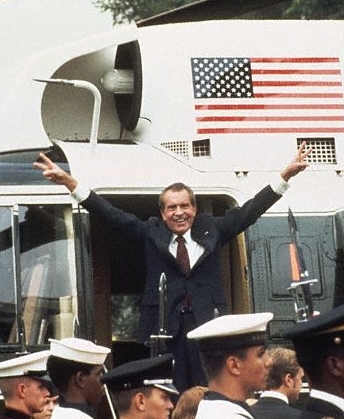
Nixon quits
And yet, because Watergate was such an intricate thicket of lies, deceit, and criminality — and because it unfolded more than 40 years ago — a sure understanding of the scandal can be defiantly elusive. Collective memory about the many lines of investigation that unwound Watergate and forced Richard Nixon to resign the presidency has inevitably grown faint.
Which takes us to a movie review posted today at the online site of WTOP, the all-news radio station in Washington, D.C.
The review discusses the perversely namedTruth, a new motion picture that celebrates former CBS News anchor Dan Rather and producer Marla Mapes who in 2004 used fraudulent documents to claim President George W. Bush dodged wartime service in Vietnam. (Because it stars Robert Redford in Rather’s role, Truth has invited comparisons — not all of them favorable — to All the President’s Men, the 1976 film in which Redford played Woodward of the Post.)
The WTOP reviewer has little truck with the Truth story line, saying it “would have been far better … to paint the characters as fallen figures who admit they screwed up, rather than misunderstood scapegoats who were taken down by The Man.”
Fair enough. But then, to demonstrate how assiduous journalists ought to proceed, the review reaches for the heroic-journalist trope of Watergate and declares:
“If Woodward and Bernstein ran the story too early — before they had actual proof from reliable sources — Nixon would have stayed in office, the Watergate would simply be a fancy hotel, and ‘All the President’s Men’ would not exist.”
The reference to “the story” is puzzling, given that the reporting of Watergate went far beyond a single article in the Washington Post. The scandal produced extensive news reporting over many months, from the burglary in June 1972 at the headquarters of the Democratic National Committee at the Watergate complex in Washington to the resignation of Nixon in August 1974, following disclosures that he had approved a plan to cover up the break-in.
And to assert that “Nixon would have stayed in office” if not for Woodward and Bernstein is to be decidedly in error — and to indulge in a powerful myth of American journalism.
It is a tempting trope, to be sure. As I wrote in my media-mythbusting book, Getting It Wrong, the heroic-journalist interpretation offers “ready short-hand for understanding Watergate and its denouement, a proxy for grasping the scandal’s essence while avoiding its forbidding complexity.”
Not even Woodward has embraced the heroic-journalist myth. He once told an interviewer for American Journalism Review:
And in an interview with the PBS “Frontline” program, Woodward said “the mythologizing of our role in Watergate has gone to the point of absurdity, where journalists write … that I, single-handedly, brought down Richard Nixon. Totally absurd.”
He’s right: Woodward and Bernstein did not topple Nixon’s corrupt presidency.
Their reporting did win a Pulitzer Prize in 1973. But Woodward and Bernstein did not break the most crucial stories of Watergate.
They did not, for example, disclose the extent to which the Nixon administration covered up of the crimes of Watergate. Nor did they reveal the existence of the secret White House audio tapes, the contents of which were decisive to Watergate’s outcome.
The so-called “Smoking Gun” tape captured Nixon’s approving a plan on June 23, 1972, to divert the FBI’s investigation of the Watergate break-in. The tape’s release sealed the president’s fate.
Without the tapes, Nixon likely would have served out his term.
Jorge Ramos, the Univision anchorman, demonstrated recently that he is a self-important showboat in disrupting a news conference convened by presidential candidate Donald Trump.
Ramos also has demonstrated a taste for media myth.
In a commentary posted yesterday at the online site of AM, a newspaper in Mexico, Ramos invoked the myth that the Washington Post brought down the corrupt presidency of Richard Nixon in its reporting of the Watergate scandal.
He wrote, according to the Google translation from Spanish, that among “the best examples of journalism” was the Washington Post’s “forcing Nixon to resign” in 1974.
Ramos made a similar claim on the ABC News “This Week” program Sunday, stating:
“I think that, as a reporter, many times, you have to take a stand. … And the best examples of journalism that I have — Edward R. Murrow against McCarthy; Cronkite during the Vietnam War, or the Washington Post reporters forcing the resignation of Richard Nixon — that’s when reporters challenge those who are in power.”
Not even principals at the Post during the Watergate period embraced that notion.
For example, the Post’s publisher during Watergate, Katharine Graham, said 1997:
“Sometimes people accuse us of bringing down a president, which of course we didn’t do. The processes that caused [Nixon’s] resignation were constitutional.”
Bob Woodward, one of the Post’s lead Watergate reporters, concurred, albeit in earthier terms. He told an interviewer in 2006:
And Ben Bradlee, the Post’s executive editor during Watergate, said on “Meet the Press” in 1997 that “it must be remembered that Nixon got Nixon. The Post didn’t get Nixon.”
Bradlee was referring to the White House audio tapes which Nixon secretly made and which revealed the president’s guilty role in seeking to thwart the FBI’s investigation into the break-in of Democratic National Committee headquarters in Washington in June 1972. The break-in touched off the scandal — and the country’s gravest political crisis of the 20th century.
“How the Post and its reporters uncovered Watergate is deeply ingrained in American journalism as one of the field’s most important and self-reverential stories.”
But it is a simplistic and decidedly misleading interpretation, one that minimizes the more powerful and decisive forces that unraveled the scandal and ended Nixon’s corrupt presidency.
“To roll up a scandal of” the dimensions of Watergate, I wrote in Getting It Wrong, “required the collective if not always the coordinated forces of special prosecutors, federal judges, both houses of Congress, the Supreme Court, as well as the Justice Department and the FBI.
“Even then, Nixon likely would have served out his term if not for the audiotape recordings he secretly made of most conversations in the Oval Office of the White House.”
Peggy Noonan, the prominent weekend columnist for the Wall Street Journal, attempts in her latest commentary to explain the political phenomenon that is Donald Trump — and in doing so trips over the mythical “Cronkite Moment” of 1968.
Noonan (Harvard University)
That was when CBS News anchorman Walter Cronkite declared on the air that the U.S. military effort in Vietnam was “mired in stalemate.” Cronkite’s assessment supposedly came as an epiphany to President Lyndon B. Johnson, who in visceral reaction said something to the effect of:
“If I’ve lost Cronkite, I’ve lost Middle America.”
But as I discussed in my media-mythbusting book, Getting It Wrong, Johnson did not see Cronkite’s program when it aired on February 27, 1968; he was at a black-tie birthday party in Texas for Governor John Connally. Nor is there evidence the president watched Cronkite’s report on videotape at some later date.
So it’s hard to imagine how the president could have been much moved by a TV program he did not see.
I further noted in Getting It Wrong that by 1968, “stalemate” was hardly a novel or shocking way to characterize the Vietnam War.
“Stalemate” had circulated in the news media months before Cronkite’s report. For example, the New York Times published a front-page analysis on August 7, 1967, that declared “the war is not going well. Victory is not close at hand.”
The Times report was published on its front page beneath the headline:
Which takes us to Noonan, formerly a speechwriter for President Ronald Reagan. She opens her column this weekend by writing: “So, more thoughts on Donald Trump’s candidacy, because I can’t stop being fascinated.”
The Trump phenomenon, she argues, signals that “[s]omething is going on, some tectonic plates are moving in interesting ways” in American political life.
She also invokes Trump’s recent news conference confrontation with Jorge Ramos, the showboating anchorman for Univision. At the news conference, he refused to wait his turn in posing a question and was escorted from the room. Ramos was allowed back in a short time later.
Noonan, whose columns invariably lean on personal anecdotes, mentions an acquaintance named “Cesar,” a Dominican immigrant who works at a New York City grocery and who, she says, is more impressed by Trump than Ramos.
Cesar’s views, Noonan suggests, may be representative of the shifting political contours.
“Old style: Jorge Ramos speaks for Hispanic America,” she writes. “New style: Jorge Ramos speaks for Jorge Ramos. Old style: If I’ve lost Walter Cronkite, I’ve lost middle America. New style: How touching that an American president once thought if you lost a newsman you’d lost a country.”
Noonan’s reference to the “Cronkite Moment” may seem odd, indirect, and even a bit confusing, given the context. But there’s no doubt she was treating as genuine one of American journalism’s most tenacious myths.
The “Cronkite Moment” indeed is one of journalism’s favored and most compelling stories, as it tells how a perceptive and courageous anchorman could effect powerful change.
Johnson in Texas, February 27, 1968
After all, Cronkite’s assessment is often said to have shifted U.S. public opinion about the Vietnam War.
Except that it didn’t.
That shift had taken place months earlier, and was detected when a plurality of respondents to a Gallup survey in October 1967 characterized as a mistake the Johnson administration’s decision to send U.S. troops to Vietnam.
A little more than two years earlier, in August 1965, just 24 percent of respondents said they thought it was a mistake to have deployed American forces to Vietnam.
Gallup asked the question again in a poll completed on the day Cronkite’s program aired: Forty-nine percent of the respondents said “yes,” U.S. military intervention in Vietnam had been a mistake; 42 percent said “no.”
In April 1968, Gallup found that 48 percent of respondents said U.S. military intervention in Vietnam had been a mistake; 42 percent said it had not been.
Moreover, print journalists had reported softening support for the war well before Cronkite’s “mired in stalemate” assessment.
In December 1967, for example, a national correspondent for Knight newspapers, Don Oberdorfer, noted that the previous summer and fall had “been a time of switching, when millions of American voters — along with many religious leaders, editorial writers and elected officials — appeared to be changing their views about the war.”
Cronkite’s “stalemate” assessment had little demonstrable effect on Americans’ views about Vietnam. Indeed, it can be said that Cronkite in early 1968 was following rather than leading public opinion on the war.
I call it the “myth of superlative reporting,” the notion that in the aftermath of Hurricane Katrina’s onslaught 10 years ago, journalists bravely held powerful officials accountable for their inept responses to a storm blamed for the deaths of 1,800 people.
Dan Rather, the former CBS News anchorman, gave voice to the “myth of superlative reporting,” describing Katrina coverage as “one of the quintessential great moments in television news,” ranking “right there with the Nixon/Kennedy debates, the Kennedy assassination, Watergate coverage, you name it.”
A quintessential great moment is was not.
The reporting of Katrina, as I wrote in my 2010 media-mythbusting book, Getting It Wrong, “was in important respects flawed and exaggerated. On crucial details, journalists erred badly, and got it wrong” in describing horrors the storm supposedly unleashed across New Orleans after making landfall east of the city on August 29, 2005.
Journalists reported snipers firing at medical personnel, I noted. They reported shots were fired at helicopters, halting evacuations from the Convention Center in New Orleans. They told of bodies being stacked like cordwood inside the Convention Center.
News reports also spoke of roving gangs that terrorized occupants of the Louisiana Superdome, where many people had taken shelter. The reports said children were victims of sexual assault, that one seven-year-old was raped and her throat was slit. They reported that sharks were plying the flooded streets of New Orleans.
None of those reports, as it turned out, was verified or substantiated.
“Many stories of rape, murder, and general lawlessness were at best unsubstantiated, at worst simply false.”
Erroneous and over-the-top reporting, I wrote in Getting It Wrong, “had the cumulative the effect of painting for America and the rest of the world a scene of surreal violence and terror, something straight out of Mad Max or Lord of the Flies.”
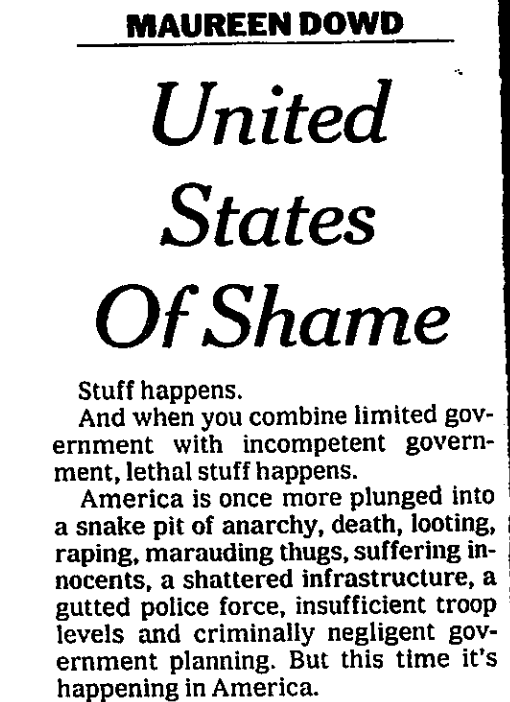
Which was rather how Maureen Dowd characterized Katrina’s aftermath in her New York Times column, published September 3, 2005, under the headline, “United States Of Shame”:
“America,” she wrote, “is once more plunged into a snake pit of anarchy, death, looting, raping, marauding thugs, suffering innocents, a shattered infrastructure, a gutted police force, insufficient troop levels and criminally negligent government planning. But this time it’s happening in America.”
Far more measured and perceptive was her Times colleague, Jim Dwyer, whom Brian Thevenot quoted this way, in a searching critique of the coverage of Katrina:
“I just thought that some of the reports were so garish, so untraceable and always seemed to stop short of having actual witnesses to the atrocities … like a galloping mythical nightmare had taken control.”
The erroneous and exaggerated reporting had the important effect delaying the delivery of aid to New Orleans — and of defaming the residents of a battered city, depicting them as having shed all restraint in the face of a disaster.
The 10th anniversary reports have instead offered conflicting assessments about how New Orleans has made a comeback, or really hasn’t, or how impressions of the city’s recovery can sharply differ.
Heavily advertised television specials shown on ABC and Fox News skirted the wrong-headed reporting of 10 years ago, if they alluded to it at all.
ABC’s retrospective was broadcast Sunday night and was so sappy and boosterish as to be almost unwatchable.
Fox, which aired its look-back on Friday, was notably rough on Ray Nagin, the incompetent, bloviating mayor of New Orleans 10 years ago. Nagin since has gone to federal prison on corruption convictions unrelated to Katrina.
It’s worth recalling how in the storm’s aftermath, Nagin went on Oprah Winfrey’s program to claim that “hundreds of armed gang members” were terrorizing Katrina evacuees inside the Louisiana Superdome.
Nagin said conditions at the Superdome had deteriorated to “an almost animalistic state” and evacuees had been “in that frickin’ Superdome for five days, watching dead bodies, watching hooligans killing people, raping people.”
Almost all of those claims were untrue: The mayor was winging it on national television, and smearing his city in the process. The Fox program alluded to some of Nagin’s exaggerations.
An exception to the media’s sidestepping was a segment Saturday on NPR’s On the Media show. The segment noted the flawed reporting, but didn’t much explore why or how it occurred.
In her introduction, co-host Brooke Gladstone said of journalists covering the storm’s aftermath:
“They didn’t always speak fact. While covering Katrina’s horrific aftermath, the media often perpetuated myths about what was going on in the streets and the gathering places for the displaced, like the Superdome in New Orleans.”
The broad effect, of the exaggerated reporting, she said, was to paint “an apocalyptic picture that never matched reality.”
Her observations were a sequeway to an extended conversation with James A. Cobb Jr., the lawyer who won acquittals in 2007 of Sal and Mabel Mangano, owners of a nursing home in suburban New Orleans where 35 old people drowned in floodwaters released by the collapsed levees.
The Manganos both were charged with 35 counts of negligent homicide and 24 counts of cruelty.
Before the storm hit, the Manganos had decided it was safer to hunker down and not evacuate their frail and bedridden charges — and they were pilloried by the media when word of the deaths of their elderly charges began to circulate.
The vow attributed to William Randolph Hearst that he would “furnish the war” with Spain in the late 19th century is a zombie-like bogus quote: Despite thorough and repeated debunking, it never dies.
The vow supposedly was made in a telegram to the artist, Frederic Remington, whom Hearst had sent to Cuba to draw sketches of the rebellion against Spanish colonial rule. Remington stayed just six days in January 1897 before returning to New York, where his sketches were displayed prominently in Hearst’s New York Journal.
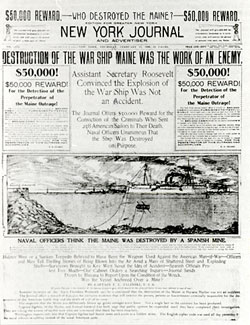
‘Journal’ reports ‘Maine’ destruction
The mythical tale about the Hearstian vow and the war with Spain was offered up anew yesterday, in an essay posted at Forbes.com. It declared:
“Artist Frederick [sic] Remington was working for Hearst and the Journal was filled with his sketches of alleged Spanish atrocities committed against the Cuban populace, especially women and children. When events in Cuba seemed to have run their course and the Spanish had regained control Remington wrote to Hearst and asked if it was time to come home, Hearst replied, ‘Remain there. You provide the pictures, and I will provide the war.’ And when the battleship Maine blew up in Havana Harbor, he did just that with a stream of fictional stories of sabotage and anti-Americanism. That the explosion was actually caused by the accidental ignition of coal dust was, as far as Hearst was concerned, irrelevant. He had his war.”
There’s a lot of myth and misunderstanding to unpack there.
For starters, the “alleged Spanish atrocities committed against the Cuban populace” were quite real. The abuses stemmed from Spain’s policy of “reconcentration,” in which Cuban non-combattants were herded into garrison towns, to deprive the rebels of their support. Reconcentration led to acute hardships, privation, and the deaths of untold thousands of Cubans.
A leading historian of the Spanish-American War period, Ivan Musicant, has written that reconcentration “did more to bring on the Spanish-American War than anything else the Spanish could have done.”
The misguided policy, Musicant also noted, “turned public opinion enormously in the United States.”
Despite the Forbes claim, Spain never “regained control” of Cuba; at best, the rebellion had settled into an uneasy stalemate by the end of 1897.
The battleship USSMaine blew up in Havana harbor on February 15, 1898, 13 months after Remington’s brief visit to Cuba. Cause of the explosion that killed 266 U.S. sailors and officers remains disputed. But in March 1898, a U.S. Naval Court of Inquiry reported that the Maine most likely had been destroyed by an underwater mine. The Inquiry could not determine who set the device, however.
About a month after the Court of Inquiry issued its report, the United States and Spain went to war over Cuba.
In the run-up to war, the Journal didn’t distinguish itself with its overheated reporting about the crisis. But the newspaper’s content cannot be said to have brought on the conflict.
As I’ve noted previously at Media Myth Alert, claims that Hearst fomented the war invariably are offered without persuasive explanation as to how the often-exaggerated content of his newspapers was transformed into U.S. policy, how newspaper reports were decisive in the decision-making the led the United States to declare war in April 1898.
The inescapable answer: Newspaper content was not decisive.
If Hearst and his newspapers had pushed the country into war, then researchers surely should be able to locate evidence of such influence in the personal papers and reminiscences of policymakers of the time.
But nothing of the like can be found in the private letters, diary entries, and diplomatic correspondence of top members of the administration of President William McKinley.
Those papers contain almost no evidence that the content of Hearst’s newspapers “penetrated the thinking of key White House officials, let alone influenced the Cuban policy of the McKinley administration,” I noted in my 2001 book, Yellow Journalism: Puncturing the Myths, Defining the Legacies.
Which brings us back to the zombie-like vow, which, by the way, the Forbes essay mangles.
Hearst purportedly told Remington, “Please remain. You furnish the pictures, and I’ll furnish the war” — not “Remain there. You provide the pictures, and I will provide the war.”
Creelman the pompous
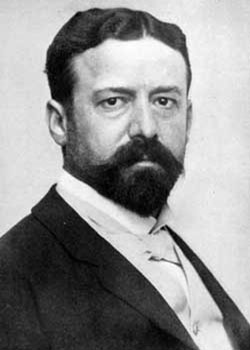
The original source for the “furnish the war” quotation was On the Great Highway, a slim volume of reminiscences published in 1901. The author, James Creelman, was a vain, cigar-chomping journalist inclined to self-promotion, hyperbole, and pomposity.
Creelman did not explain in On the Great Highway how or where he learned about the supposed Remingt0n-Hearst exchange.
What’s more, Creelman – who was in Spain at the time Remington was in Cuba in 1897 – recounted the anecdote not as a rebuke but as a compliment to Hearst and the activist “yellow journalism” he had pioneered in New York City.
Over the decades, though, the quote has morphed into censure of Hearst and his supposedly war-mongering newspapers.
The quote lives on despite the absence of any supporting documentation: The telegrams that Remington and Hearst supposedly exchanged have never turned up, and Hearst denied having sent such a message.
Not only that, but the Spanish authorities who controlled Cuba’s incoming and outbound telegraphic traffic surely would have intercepted and called attention to such an incendiary message — had it been sent.
In addition, the timing of Remington’s assignment further undercuts the “furnish the war” tale: The timing poses an irreconcilable internal inconsistency, in that it would have been absurd for Hearst to pledge to “furnish the war” because war — specifically, the Cuban rebellion — was the very reason he sent Remington to Cuba in the first place.

 The hoary old myth received a boost in April when, on the 152d anniversary of Hearst’s birth, the humorist and radio personality, Garrison Keillor,

 Of course, it had no such effect, as Bradlee himself had said, on the 25th anniversary of the seminal crime of Watergate–the burglary in June 1972 at the headquarters of the Democratic National Committee.




 Media Myth Alert