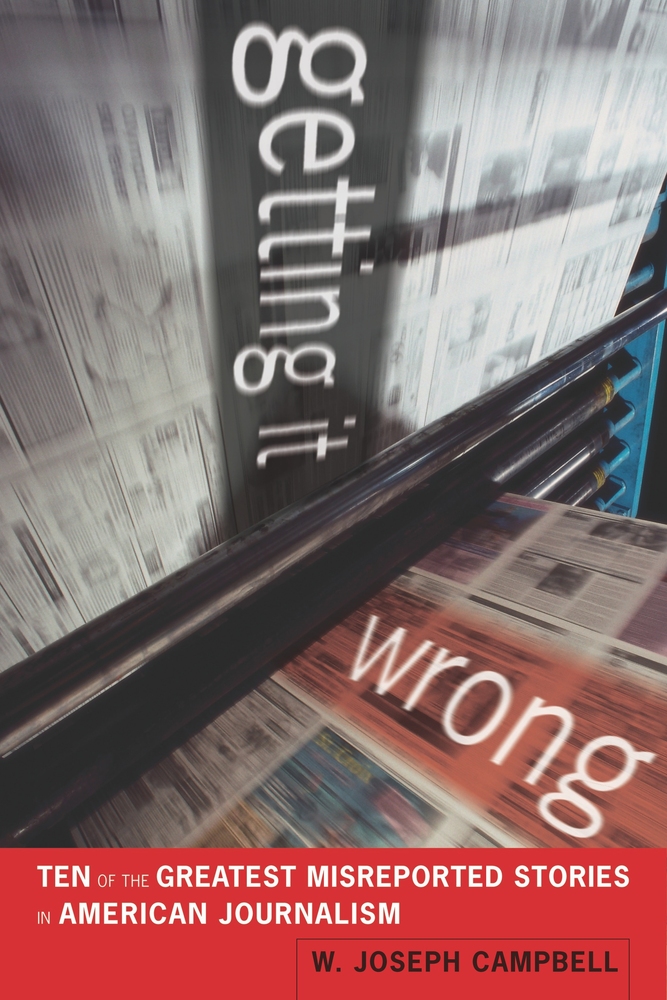
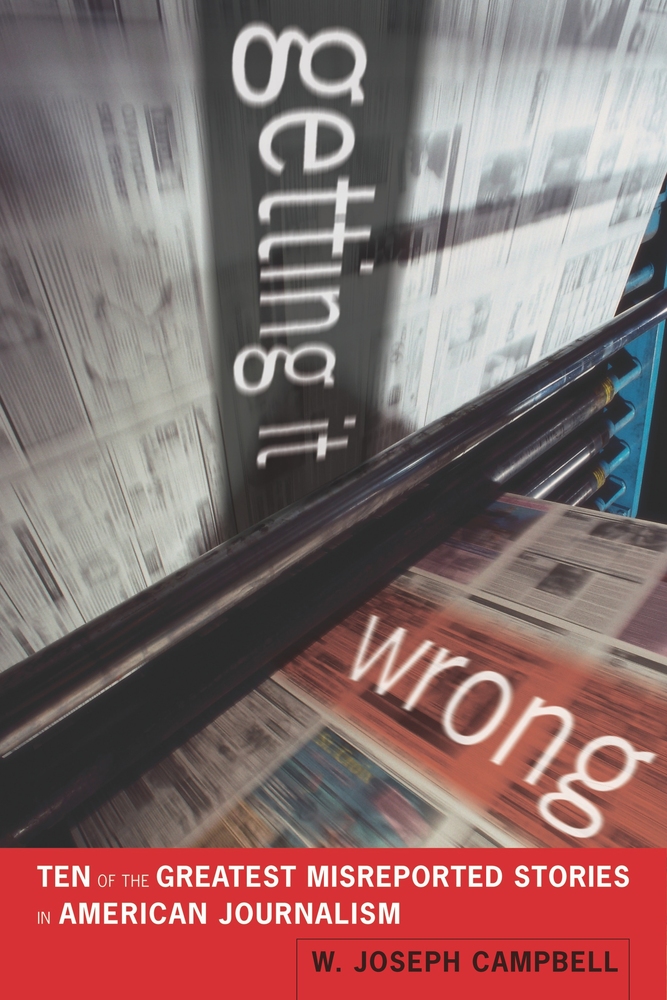
The “critic at large” essay in the latest number of the New Yorker includes references to my myth-busting latest book, Getting It Wrong.
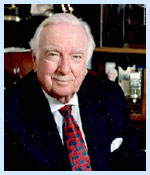
Cronkite: His ‘moment’ wasn’t so special
The essay by Louis Menand is largely a searching review of Cronkite, the recent, so-so biography about legendary CBS News anchorman, Walter Cronkite.
Menand calls the book “long and hastily written.”
He discusses in detail the so-called “Cronkite Moment” of February 27, 1968, when Cronkite’s on-air assessment that the Vietnam War was stalemated supposedly was so powerful that it influenced American war policy and moved American public opinion. The Cronkite biography says as much.
But Menand scoffs at the notion the “Cronkite Moment” was very important at all, writing:
“The trouble with this inspiring little story is that most of it is either invented or disputed.”
He specifically refers to Getting It Wrong in dismissing the supposed effects of Cronkite’s pronouncement about the war — notably, that Cronkite’s assessment prompted President Lyndon B. Johnson to declare something to the effect of, “If I’ve lost Cronkite, I’ve lost Middle America.”
Menand notes that Johnson did not see the Cronkite report about Vietnam when it aired, pointing out that the president was in Austin, Texas, “attending a birthday celebration for Governor John Connally. … There is no solid evidence that Johnson ever saw the show on tape, either, though the White House did tape it.”
Further drawing on Getting It Wrong, which includes a chapter debunking the mythical “Cronkite Moment,” Menand writes that even after Cronkite “stalemate” assessment, “Johnson’s speeches on Vietnam … were as hawkish as ever.
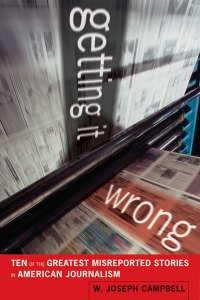 “Not only is there little evidence that the broadcast had an effect on Johnson; there is little evidence that it had an effect on public opinion.” And that’s certainly true.
Menand also notes that the author of the Cronkite biography, Douglas Brinkley, “implies that it was Cronkite’s commentary that emboldened the [Wall Street] Journal to criticize the war, but the Journal editorial appeared four days before the broadcast.”
The Journal’s editorial of February 23, 1968, said “everyone had better be prepared for the bitter taste of a defeat [in Vietnam] beyond America’s power to prevent.”
The editorial was strong stuff. And it undeniably preceded Cronkite’s on-air assessment which, given the times, was tepid and unoriginal. Leading U.S. news organizations such as the New York Times, had taken to calling the war a “stalemate” months before Cronkite’s program.
As Menand observes: “In 1968, you did not need an anchorman to know which way the wind blew” on Vietnam.
Menand’s essay also challenges the notion that Cronkite was “the most trusted man in America,” dissecting a 1972 survey that rated the anchorman more trustworthy than the leading national politicians of the time. Not much of a comparison, that. As media critic Jack Shafer wrote in 2009, shortly after Cronkite’s death, the anchorman’s score in the survey “seemed impressive until you considered the skunks polled alongside him.”
Menand touches on Edward R. Murrow’s famous program in 1954 that addressed the smears and bullying tactics of the red-baiting U.S. senator, Joseph R. McCarthy. Menand notes that Getting It Wrong describes how Murrow’s televised assessment of McCarthy came “very late in the day.” By 1954, Menand writes, “McCarthy had been hunting witches for four years….”
He also offers a thoughtful and telling assessment about why media myths take hold.
“Journalism and history,” Menand writes, “are about getting things right. But the past has many uses, and one of them is to inspire the present. … More honorably, if not necessarily more accurately, we imagine our predecessors as nobler and braver than our small selves — as men and women who stuck up for principle and, by their righteousness, moved the world.”
That’s well said, and offers revealing insight about the tenacity of such myths as the “Cronkite Moment.”
Recent or related:
- Cronkite the ‘most trusted’? Where’s the evidence?
- A glowing, hagiographic treatment of the ‘Cronkite Moment’
- On media myths and the ‘golden age’ fallacy
- What ‘lesson’ from Cronkite?
- ‘Mired in stalemate’? How unoriginal of Cronkite
- Wasn’t so special: Revisiting the ‘Cronkite Moment,’ 44 years on
- Murrow: No white knight — and not above the political fray
- 57 years on: Was it really TV’s ‘finest half hour’?
- Suspect Murrow quote pulled at Murrow school
- Slaying the McCarthy dragon: It wasn’t Murrow
- Just what we need: Barbra Streisand, media critic
- ‘A debunker’s work is never done’
- ‘Getting It Wrong’ wins SPJ award for Research about Journalism



 Media Myth Alert