W. Joseph Campbell

Archive for the ‘Washington Post’ Category

Why they get it wrong

In Bay of Pigs, Cronkite Moment, Debunking, Furnish the war, Jessica Lynch, Media myths, New York Times, Newspapers, Washington Post, Watergate myth on June 3, 2011 at 6:49 am

It’s striking how several well-known journalists and news outlets have indulged over last six months in media-driven myths, those dubious tales about the news media that masquerade as factual.

The lineup of myth-indulgers is impressive and, among others, includes:

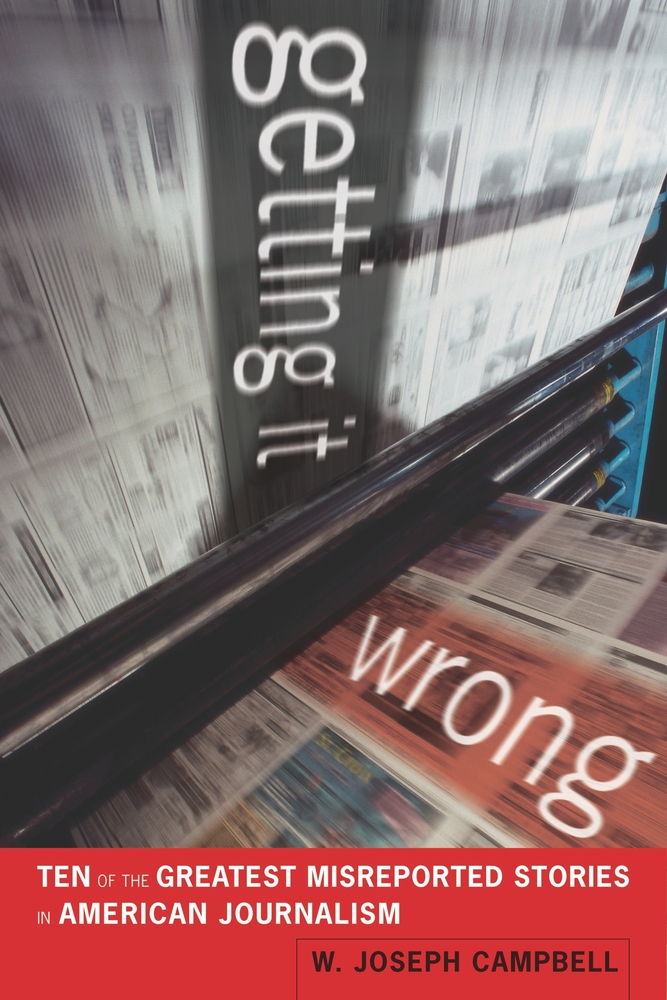
  • Bill Keller, executive editor of the New York Times, who rubbed shoulders with the Bay of Pigs suppression myth in a column in the Times in January. The suppression myth holds that at the behest of President John F. Kennedy, the Times killed or emasculated its report about the pending Bay of Pigs invasion in 1961. That tale is unfounded, as I discuss in my latest book, Getting It Wrong.
  • Mother Jones magazine which, in its May/June cover story by Rick Perlstein, offered up a rare two-fer — two media myths discussed in a single article. One of the myths was the hoary and surely apocryphal tale about William Randolph Hearst and his reputed vow to “furnish the war” with Spain. The other was about the so-called the “Cronkite Moment” of 1968, in which Walter Cronkite’s on-air assessment that the U.S. military was “mired in stalemate” in Vietnam was so powerful as to alter U.S. policy.
  • Keith Olbermann, the acerbic cable television commentator who, as he quit his prime-time Countdown show in January, referred to the  “exaggerated rescue” of Army private Jessica Lynch in the early days of the Iraq War. Such claims, raised as long ago as 2003, were unsubstantiated by an inquiry of the Defense Department’s inspector general who found the rescue operation was found to have been “a valid mission” to recover Lynch, a prisoner of war, “under combat conditions.”

What accounts for such lapses by prominent journalists and their outlets? Why do these and other media-driven myths often find their way into news reports and commentaries?

Some media myths are just too good not to be true; they almost are too good to take time to check out. The tale about Hearst’s vowing to “furnish the war” certainly falls into this category. It shouldn’t be at all difficult to locate references to the dubious character of the anecdote, which has been the subject of repeated debunking over the years.

Likewise, it can be far easier to invoke a media myths that to commit to the tedium of research and legwork. Media myths are convenient, readily at hand. Poking into their details takes time, and a willingness to challenge what are accepted as consensus narratives.

As I noted in discussing Keller’s column that invoked the Bay of Pigs suppression myth:

“Had Keller consulted the newspaper’s database of reporting about the run-up to the Bay of Pigs invasion in April 1961, he would have found that the Times reported in detail, if not always accurately, about the preparations to infiltrate a U.S.-trained brigade of Cuban exiles in an attempt to topple Fidel Castro.”

Similarly, some media myths (such as the illusory “Cronkite Moment“) may be too ingrained, too dearly held by journalists, ever to be uprooted or thoroughly repudiated.

Unlearning such tales is no small challenge, after all. The conundrum of unlearning was addressed a few months ago in a Wall Street Journal column, which noted:

“For adults, one of the most important lessons to learn in life is the necessity of unlearning. We all think that we know certain things to be true beyond doubt, but these things often turn out to be false and, until we unlearn them, they get in the way of new understanding.”

Media myths also can be convenient means of scoring political points. The two-fer in Mother Jones magazine, for example, were presented as part of a sneering attack about “fact-free” Republicans.

Moreover, media myths — the most prominent of them, anyway — resonate in contemporary contexts.

History, it has been said, is “what we decide to remember,” and journalism history is not an exception. Recalling and celebrating the memory of Cronkite’s supposedly telling truth to power about Vietnam — or of Bob Woodward and Carl Bernstein’s bringing down a corrupt presidency — is to offer reassurance to contemporary journalists at a time of confusion and upheaval in their field.

Deciding to remember such mythical tales is understandable if not justifiable, given that those tales bring solace and reassurance amid sweeping uncertainty.

WJC

Recent and related:

Six years on: Identity of Watergate’s ‘Deep Throat’ revealed

In Anniversaries, Cinematic treatments, Debunking, Media myths, Washington Post, Watergate myth on May 29, 2011 at 6:22 am

It’s been six years since W. Mark Felt,  once a senior FBI official, was revealed to have been “Deep Throat” of the Watergate era, the most famous source in modern American journalism.

Alias 'Deep Throat'

Felt’s “Deep Throat” identity had remained a secret — and was a topic of often-intense speculation — for more than 30 years.

On May 31, 2005, Vanity Fair disclosed that Felt had been the Washington Post’s elusive and enigmatic source as the Watergate scandal unfolded in 1972-73.

The disclosure was made with the consent of Felt — who then was 91 and in declining physical and mental health — and his daughter, Joan.

The Vanity Fair report meant that the Post effectively had been scooped on its own story.

“The identity of Deep Throat is modern journalism’s greatest unsolved mystery,” Vanity Fair crowed in its article lifting Felt’s secret. “It has been said that he may be the most famous anonymous person in U.S. history.”

As I note in Getting It Wrong, my media-mythbusting book that came out last year, the prolonged guessing game about the identity of “Deep Throat” help solidify the notion that the Post and its lead Watergate reporters, Bob Woodward and Carl Bernstein, were central to uncovering the scandal and forcing President Richard Nixon’s resignation.

I point out that speculation “about the identity of the ‘Deep Throat’ source provided periodic and powerful reminders about the Post and its Watergate coverage, serving to keep Woodward and Bernstein in the public eye far longer than they otherwise would have been.”

I further note:

“They and the mysterious ‘Deep Throat’ source became central figures” in what the Philadelphia Inquirer once called “the parlor game that would not die. … With each passing year, as ‘Deep Throat’s’ cloak of anonymity remained securely in place, his perceived role in Watergate gained gravitas.”

“And so,” I write, “… did the roles of Woodward and Bernstein.”

Although Alexander Haig, John Dean, and Henry Kissinger were among the suspects mentioned in the “Deep Throat” guessing game, Felt’s name always placed high on the roster of likely candidates.

As I discuss in Getting It Wrong, speculation about the identity of “Deep Throat” began in earnest in June 1974, with a front-page article in the Wall Street Journal, and continued periodically over the next 31 years.

The Journal article appeared soon after publication of All the President’s Men, Woodward and Bernstein’s best-selling book about Watergate in which they introduced the furtive source they called “Deep Throat.”

The Journal article described Felt as the top suspect.

Felt, though, repeatedly and adamantly denied having been “Deep Throat.” He was quoted as saying in the Journal article in 1974:

“I’m just not that kind of person.”

He told the Hartford Courant newspaper in 1999 that he “would have been more effective” had he indeed been Woodward’s secretive source, adding:

“Deep Throat didn’t exactly bring the White House crashing down, did he?”

That’s a revealing point that goes to the heart of what I call the heroic-journalist myth of Watergate: Disclosures by “Deep Throat” didn’t bring down Nixon’s corrupt presidency; nor did the reporting of Woodward and Bernstein.

(Bernstein, by the way, never spoke with Felt during the Watergate scandal; Felt was Woodward’s exclusive source. Bernstein finally met Felt in November 2008, shortly before the former G-man’s death.)

On the day six years ago when Felt was confirmed to have been “Deep Throat,” his family issued a statement calling him “a great American hero who went well above and beyond the call of duty at much risk to himself to save his country from a horrible injustice. We all sincerely hope the country will see him this way as well.”

Felt, though, hardly was such a noble character.

In his senior position at the FBI, he had authorized illegal burglaries as part of FBI investigations into leftists associated with the radical Weather Underground in the early 1970s.

Felt was convicted in 1980 on felony charges related to the break-ins, but pardoned by President Ronald Reagan.

Interestingly, his “Deep Throat” alter ego may best be known for a line Felt never spoke: “Follow the money.”

As I’ve discussed at Media Myth Alert, Felt never offered such guidance to Woodward. He never advised the reporter to “follow the money.”

The line doesn’t appear in the book All the President’s Men. But it was written into the script of the cinematic adaptation of Woodward and Bernstein’s book.

Follow the money” was spoken by Hal Holbrook, who delivered a bravado performance as “Deep Throat” in the movie.

Holbrook delivered his “follow the money” lines with such quiet insistence and knowing authority that it sounded for all the world as if it really had been guidance crucial to rolling up Watergate.

WJC

Recent and related:

Every good historian a mythbuster

In Anniversaries, Cinematic treatments, Debunking, Media myths, Newspapers, Washington Post, Watergate myth on May 27, 2011 at 6:10 am

While researching studies of memorable or decisive years recently, I happened across a Washington Post review of The Year That Changed the World, a book about 1989.

I was impressed by this passage in the review:

The good historian is a mythbuster.”

Indeed.

Couldn’t agree more.

The reviewer, Gerard DeGroot, also wrote:

“The past is what happened, history what we decide to remember. We mine the past for myths to buttress our present.”

That’s well said, too. It’s a characterization that offers insight about the rise and diffusion of media-driven myths, 10 of which I debunk in my latest book, Getting It Wrong.

History often is what we decide to remember. And we tend to remember what’s most accessible, what’s most easy to remember.

Take, for example, the mediacentric interpretation of Watergate, the greatest political scandal in American history, a scandal that destroyed a presidency and sent nearly twenty men to jail.

The shorthand, easy-to-grasp version of Watergate is that Bob Woodward and Carl Bernstein of the Washington Post, aided immeasurably by a stealthy, high-level source code-named “Deep Throat,” brought down Richard Nixon’s corrupt presidency.

That’s also the mediacentric version of Watergate, the version journalists love to recall. It serves to remind them of the potential power of the news media.

But as I note in Getting It Wrong, the mediacentric interpretation is misleading and historically inaccurate; it “minimizes the far more decisive forces that unraveled the scandal and forced Nixon from office,” I write.

To roll up a scandal of Watergate’s dimensions, I add, “required the collective if not always the coordinated forces of special prosecutors, federal judges, both houses of Congress, the Supreme Court, as well as the Justice Department and the FBI.

“Even then,” I argue, “Nixon likely would have served out his term if not for the audiotape recordings he secretly made of most conversations in the Oval Office of the White House. Only when compelled by the Supreme Court did Nixon surrender those recordings, which captured him plotting the cover-up and authorizing payments of thousands of dollars in hush money.”

So why do we choose to remember the Woodward-Bernstein-mediacentric interpretation of Watergate? Why has it become the dominant narrative of the scandal? That it is shorn of complexity and easy to grasp is one reason.

A more powerful reason is to be found in the cinematic adaptation of All the President’s Men, Woodward and Bernstein’s book about their Watergate reporting.

The book came out in June 1974 as Watergate was approaching its climax, and was a best-seller.

All the President’s Men was an even greater success in its screen adaptation. It was released 35 years ago this spring and surely ranks as the most-viewed movie about Watergate.

To an extent “far greater than the book,” I write in Getting It Wrong, “the cinematic version of All the President’s Men placed Woodward and Bernstein at the center of Watergate’s unraveling while denigrating the efforts of investigative agencies such as the FBI.

“The effect,” I add, “was to solidify and elevate” the heroic-journalist myth of Woodward and Bernstein, “giving it dramatic power, and sustaining it in the collective memory.”

For contemporary journalists who confront sustained and sweeping upheaval in their field, the mediacentric myth of Watergate is comforting,  reassuring.

Recalling the myth and treating it as authentic serves to buttress the present against the riptide of change.

WJC

Recent and related:

WaPo commentary off target on ‘sexual misbehavior of prominent men’

In Debunking, Media myths, Washington Post, Watergate myth on May 23, 2011 at 7:20 am

Packwood: Scuzzy guy

“Until recently,” declared a commentary in yesterday’s Washington Post, “we didn’t have to worry so much about how to talk about the sexual misbehavior of prominent men.”

The Post commentary asserted that “until recently, we didn’t talk much about it at all. But that certainly changed in the late 1990s, when Kenneth Starr broke the sexual sound barrier” with his allegations of sexual indiscretions by President Bill Clinton.

That’s nonsense, a misreading of recent history.

By the time Starr, a special federal prosecutor investigating Clinton’s suspected misdeeds, presented his case against the then-president, the “sexual sound barrier” had long been broken.

If anything, the sexual harassment scandal that ended the political career of Republican Senator Bob Packwood in 1995 was more likely a moment when “sexual misbehavior of prominent men” became a topic of considerable discussion.

Packwood was a scuzzy guy who resigned his Senate seat in 1995 in the face of probable expulsion, following release of the Senate Ethics Committee’s 10,000 page document that described a long history of his sexual misconduct.

The allegations against Packwood, a 26-year member of the Senate,  included no fewer than 18 “unwanted and unwelcome sexual advances,” many of which he described in his electronic diary.

One of Packwood’s victims was 17-years-old when, she said, the senator kissed her against her will.

The bipartisan ethics committee accused Packwood of having “engaged in a pattern of abuse of his position of power and authority as a United States Senator by repeatedly committing sexual misconduct, making at least 18 separate unwanted and unwelcome sexual advances between 1969 and 1990.”

He entered the Senate in 1969.

Most of Packwood’s victims were members of his staff, “or individuals whose livelihoods were dependent upon or connected to the power and authority” wielded by the senator, the ethics committee report said.

The ethics committee, moreover, charged Packwood with having “endeavored to obstruct and impede” the ethics committee investigation by “withholding, altering and destroying relevant evidence, including his diary transcripts and audio taped diary material.”

Packwood’s misconduct, the ethics committee said, brought “discredit and dishonor” upon the Senate.

About two months after Packwood resigned his Senate seat, Clinton began his furtive liaison with Monica Lewinsky, who was 27 years his junior.

In a way, Packwood’s execrable conduct probably helped Clinton sidestep political disaster in the Lewinsky affair.

The Lewinsky affair, while unseemly, was neither abusive nor unbidden, as were many of Packwood’s sordid overtures. Simply put, Clinton’s liaison with Lewinsky, and the lies he told about the affair, did not reach the seedy precedent that Packwood had set.

Lewinsky was a White House intern in late 1995 who, Starr later reported, seemed eager to initiate the liaison.

She performed oral sex with Clinton on November 15, 1995, while he spoke by telephone with a congressman. Clinton and Lewinsky had a second similar encounter two days later, and another on New Year’s Eve 1995.

Their liaison continued periodically until 1997.

When asked during a deposition about his sexual relations with Lewinsky, Clinton lied. The deposition was taken in January 1998, as part of Paula Corbin Jones’ civil lawsuit against the president.

Clinton’s lies under oath led to his impeachment in late 1998 by the House of Representatives and his trial and acquittal in 1999 by the Senate .

Clinton, though, was found in contempt of court by federal judge Susan Webber Wright for  “false, misleading and evasive answers” during the deposition in the Jones suit, answers the judge said “were designed to obstruct the judicial process.”

Clinton was ordered to pay nearly $90,000 to Jones’ lawyers and later agreed to a five-year suspension of his license to practice law.

While undeniably egregious, Clinton’s misconduct did not rise to the level of Packwood’s serial misconduct and repeated sexual harassment. Clinton’s misconduct also fell short of Richard Nixon’s criminality in the Watergate scandal — felonious wrongdoing that set a standard for turning a sitting president from office.

WJC

Recent and related:

Recalling how a ‘debunker’s work is never done’

In Bay of Pigs, Bra-burning, Cronkite Moment, Debunking, Furnish the war, Jessica Lynch, Media myths, Murrow-McCarthy myth, New York Times, Reviews, War of the Worlds, Washington Post, Watergate myth, Yellow Journalism on May 20, 2011 at 5:45 am

It’s been a year since Jack Shafer, media critic for slate.com, posted his review of my media-mythbusting book, Getting It Wrong. The review offered the telling observation that a “debunker’s work is never done.”

So true.

In the 52 weeks since the review went online, I’ve posted more than 275 essays at Media Myth Alert, nearly all of them calling attention to media-driven myths that have found their way into traditional or online media.

So, no, a debunker’s work is never done.

The top posts over the past 52 weeks, as measured by page views, were these:

Shafer’s review sent traffic to Media Myth Alert, too, as it linked to my post that critically discussed Evan Thomas’ book, The War Lovers.

The review, which appeared beneath the headline “The Master of Debunk,” noted that “the only way to debunk an enshrined falsehood is with maximum reportorial firepower.”

And repetitive firepower. Debunking media myths will happen no other way.

Even then, some myths are so deeply ingrained — so delicious, beloved, and readily at hand — that they’ll probably never be thoroughly uprooted and forgotten.

The tale about William Randolph Hearst’s vow to “furnish the war” with Spain at the end of the 19th century is an excellent example. It’s been around more than 100 years.

And it surely is apocryphal, for a long list of reasons I discuss in Getting It Wrong.

Even so, “furnish the war” lives on — hardy, robust, and apparently only slightly dented for all the debunking broadsides hurled its way. Evan Thomas turned to it in War Lovers. So, more recently, did the Nieman Watchdog blog.

Another especially hardy media myth is the presumptive “Cronkite Moment” of 1968, when Walter Cronkite’s on-air assessment that the U.S. military was “mired in stalemate” in Vietnam supposedly prompted President Lyndon Johnson to declare:

“If I’ve lost Cronkite, I’ve lost Middle America.”

Or something along those lines. Versions vary markedly.

That they do vary is among the many indicators the “Cronkite Moment” is media myth. Another, more direct indicator is that Johnson did not see the program when it aired.

The “Cronkite Moment” surely will live on, too, as it represents so well the news media conceit of the effects of telling truth to power, of serving as the indispensable watchdog of government.

Shafer noted the durability of media myths in one of his periodic dismantlings of the “pharm party” phenomenon, which in some form has circulated for 40-some years. (The mythical “pharm party” has it that teens swipe pharmaceuticals from medicine cabinets at home, dump the purloined pills into a bowl at a party, and take turns swallowing handfuls to see what sort of high they’ll reach.)

Shafer wrote early last year:

“I regret to inform you that this column has failed to eradicate the ‘pharm party’ meme. Since June 2006, I’ve written five columns … debunking pharm parties, and yet the press keeps on churning out stories that pretend the events are both real and ubiquitous.”

He added:

“Any myth hearty enough to survive and thrive for 40-plus years in the media is probably unkillable.”

The Hearstian vow is easily within the 40-plus-years category. So, too, are the “Cronkite Moment,” the Bay of Pigs suppression myth, and the War of the Worlds panic meme.

Irrepressible myths, all.

WJC

Recent and related:

The enduring appeal for journalists of the would-be apocalyptic

In Debunking, Hurricane Katrina, Media myths, Washington Post on May 16, 2011 at 6:54 am

The Wall Street Journal  over the weekend carried an intriguing commentary about the appeal of the apocalyptic, a commentary pegged to predictions of a Christian radio network that Saturday next will mark the end of days.

Terrible, but not apocalyptic

“Why are such apocalyptic prophecies so common in human history? What are their emotional and cognitive underpinnings?” the Journal commentary asked.

“In most doomsday scenarios,” it noted, “destruction is followed by redemption, giving us a sense of both fear and hope. The ostensible ‘end’ is usually seen as a transition to a new beginning and a better life to come.”

When posed in a slightly different manner, the question has relevance for journalists: What accounts for the perverse appeal of the would-be apocalyptic that often emerges in the reporting of upheaval and disasters?

As I discuss in my media-mythbusting book, Getting It Wrong, which came out last year, the perverse appeal of the would-be apocalyptic helps define and animate such coverage. And it helps explain why news reporting of Hurricane Katrina‘s aftermath in 2005 and of the “crack baby” scare of the 1980s was so distorted and exaggerated.

By “perverse appeal of the would-be apocalyptic,” I mean a tendency or eagerness among journalists “to identify and report on trends and developments that seem so exceptional or frightening as to be without precedent.”

This is not to characterize journalists “as morbid or macabre in their newsgathering,” I write in Getting It Wrong. “But they respond with undeniable excitement and energy when trends of exceptional and hazardous proportion seem to being taking hold.”

I write in Getting It Wrong that Hurricane Katrina – which struck New Orleans and the Gulf Coast at the end of August 2005 – seemed in news reports to have unleashed “a disaster of almost biblical proportion: Storms and floods, death and mayhem; criminal gangs run amok in a city collapsing in chaos. New Orleans seemed to promise a descent into the truly apocalyptic. And for a time the reporting matched that premise: It was as if the some of most dreadful events imaginable were taking place in New Orleans.”

But little of the news media’s apocalyptic-like reporting of mayhem, violence, and anarchy in post-Katrina New Orleans proved true.

The “crack baby” scare, I write in Getting It Wrong, “was a media-driven myth based more on anecdote than solid, sustained research, a myth that had the effect of stigmatizing underprivileged children presumed to have been born damaged and despised as ‘crack babies.’”

The scare was based on the widely reported belief that prenatal exposure to crack cocaine would give rise to a generation of misfits, of children so mentally and physically damaged that they would forever be wards of the state.

Commentators turned to phrases such as “bio-underclass” to characterize the disaster they said lie ahead. Syndicated columnist Charles Krauthammer invoked “bio-underclass” in 1989, declaring in a column in the Washington Post:

“Theirs will be a life of certain suffering, of probable deviance, of permanent inferiority.”

To be sure, smoking crack during pregnancy is hardly risk-free: “neither prudent nor sensible,” I write.

However, I note, “the effects of prenatal cocaine exposure have proved more subtle than sweeping.” And biomedical research has found nothing akin to the “bio-underclass” that Krauthammer and others warned about more than 20 years ago.

Revisiting the media-driven myth of the crack baby is important, I argue in Getting It Wrong, because doing so permits “insights into a tendency among journalists to neglect or disregard the tentativeness that characterizes serious scientific and biomedical research.” They seize upon the would-be apocalyptic instead.

WJC

Recent and related:

A ‘follow the money’ hat trick

In Anniversaries, Cinematic treatments, Debunking, Media myths, Washington Post, Watergate myth on May 14, 2011 at 9:32 am

Follow the money,” the line so readily associated with the Washington Post and its Watergate reporting, is freighted with no fewer than three related media myths.

One is that the Post’s stealthy, high-level source known as “Deep Throat” uttered “follow the money” as guidance vital to unraveling the Watergate scandal.

What page is it on?

Two is that “Deep Throat” conferred privately with both Bob Woodward and Carl Bernstein, the Post’s  lead reporters on Watergate.

Three is that “follow the money” appears in Woodward and Bernstein’s book about Watergate, All the President’s Men.

All three are untrue.

And all three were incorporated into a blog report posted yesterday at the online site of the Providence Journal, in what was a rare “follow the money” hat trick.

The Providence Journal item described “follow the money” as “the famous admonition from the source ‘Deep Throat’ to Washington Post reporters Bob Woodward and Carl Bernstein during the Watergate scandal that brought down President Richard M. Nixon. It was immortalized in the reporters’ book, and the subsequent movie, ‘All the President’s Men.'”

No, no, and most definitely no.

The Post’s “Deep Throat” source — who was revealed in 2005 to have been W. Mark Felt, formerly a senior FBI official — never recommended that the Post “follow the money” as a way to get a handle on Watergate.

“Deep Throat,” moreover, conferred only with Woodward, sometimes late at night in a parking garage in the Rosslyn section of Arlington, Va., across the Potomac River from Washington. Felt/”Deep Throat” never met Bernstein until weeks before Felt’s death in 2008.

And, no, “follow the money” certainly does not appear in Woodward and Bernstein’s book, which came out in June 1974, just as the Watergate scandal was nearing its denouement with Nixon’s resignation.

The famous line was written into the cinematic version of All the President’s Men, which came out 35 years ago last month.

Follow the money” was spoken not by Felt but by the actor who played “Deep Throat” in the movie — Hal Holbrook.

As I’ve noted at Media Myth Alert, Holbrook turned in a marvelous performance as a twitchy, tormented, conflicted “Deep Throat.”

And he delivered his “follow the money” lines with such quiet conviction that for all the world they seemed to suggest a way through the labyrinth that was the Watergate scandal.

But even if guidance such as “follow the money” had been offered to Woodward (and/or Bernstein), it would have taken them only so far in investigating Watergate. The scandal was, after all, much broader than the misuse of campaign monies.

In the end, Nixon was toppled by his felonious conduct in attempting to cover up the signal crime of Watergate, the break-in at the headquarters of the Democratic National Committee in June 1972.

The simplified, mediacentric, follow-the-money  interpretation of Watergate tends to minimize the more decisive forces that unraveled the scandal and forced Nixon from office.

As I note in my latest book, Getting It Wrong, rolling up a scandal of Watergate’s dimensions required “the collective if not always the coordinated forces of special prosecutors, federal judges, both houses of Congress, the Supreme Court, as well as the Justice Department and the FBI.

“Even then,” I write, “Nixon likely would have served out his term if not for the audiotape recordings he secretly made of most conversations in the Oval Office of the White House. Only when compelled by the Supreme Court did Nixon surrender those recordings, which captured him plotting the cover-up and authorizing payments of thousands of dollars in hush money.”

Against the tableau of subpoena-wielding investigative authorities, the contributions of Woodward and Bernstein in the Watergate scandal fade into comparative insignificance.

WJC

Recent and related:

Lynch heroics not ‘the Pentagon’s story’; it was WaPo’s

In Debunking, Jessica Lynch, Media myths, Washington Post on May 12, 2011 at 9:50 am

Private Lynch: No hero-warrior

The mythical tale that the Pentagon concocted the story about Jessica Lynch’s battlefield heroics early in the Iraq War probably is just too delicious ever to be thoroughly debunked and forgotten.

The tale about the Pentagon’s purported fabrication turned up today in a syndicated column published by the Modesto Bee.

The column deplored the exaggerated early accounts of the slaying of terror mastermind Osama bin Laden. Initial reports offered by the Obama administration inaccurately described bin Laden as having used one of his wives as a shield during the Navy SEALS’ dramatic raid on his lair in Pakistan.

“To their credit,” wrote the columnist, Bob Franken, “Obama administration leaders quickly owned up, which is far better than some of the cover-ups attempted during the Bush years.”

Franken then invoked the Lynch case, writing: “In April 2003, she was captured after being seriously injured in southern Iraq. News media at the time bought the Pentagon’s story that PFC Lynch had been badly wounded and taken prisoner after she had blazed away during a firefight.”

Franken,  formerly a correspondent for CNN, also wrote: “The truth, as she acknowledged after her release, is that her injuries were the result of a Humvee crash that occurred as she and the others in her unit tried to flee.”

For starters, let’s check the date: Lynch was captured March 23, 2003, after Iraqis ambushed elements of Lynch’s unit, the 507th Maintenance Company, in Nasiriyah. She was rescued by a U.S. special forces team April 1, 2003.

More important, though, the Pentagon wasn’t the source for the hero-warrior tale about Jessica Lynch. It wasn’t “the Pentagon’s story.”

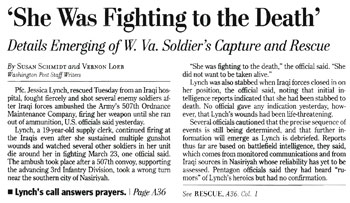
The story was thrust into the public domain exclusively by the Washington Post, which reported on April 3, 2003, that Lynch had fought fiercely in the ambush at Nasariyah, ” firing at the Iraqis even after she sustained multiple gunshot wounds and watched several other soldiers in her unit die around her….”

Above this dramatic story, the Post ran the headline: “‘She was fighting to the death.'”

The story was utterly false.

Lynch never fired a shot during the ambush; her weapon jammed.

She was neither shot nor stabbed, although the Post reported she had been so wounded. Lynch suffered shattering injuries in the crash of the Humvee, as Franken’s column mentions.

We know from Vernon Loeb, who shared a byline with Susan Schmidt on the original, inaccurate Lynch story, that the Pentagon wasn’t the source for that report.

As I note in my latest book, Getting It Wrong, Loeb went on NPR’s Fresh Air program in December 2003 and declared, unequivocally:

“Our sources for that story were not Pentagon sources.”

Loeb then was the Post’s defense correspondent, and he and Schmidt reported the Lynch hero-warrior story from Washington, D.C. He also said in the NPR interview that Pentagon officials “wouldn’t say anything about Jessica Lynch.”

He also dismissed the interviewer’s suggestion that the Post’s “fighting to the death” report was the upshot of the Pentagon’s clever and cynical manipulation.

“I just didn’t see the Pentagon trying to create a hero where there was none,” Loeb said. “I mean …they never showed any interest in doing that, to me.”

On another occasion, Loeb was quoted by the New York Times as saying:

“Far from promoting stories about Lynch, the military didn’t like the story.”

Rarely do Loeb’s disclaimers find their way into articles, columns, blog posts, and other media discussions about the Lynch case. It’s far easier — and makes for a far better story — simply to embrace the false narrative about the Pentagon’s duplicity.

The false narrative, after all, conforms tidily and well to the curdled popular view that the Iraq War was a mistake, that it was a conflict waged on dubious grounds.

And yet no one who repeats or promotes the narrative about the Pentagon’s having concocted the story about Lynch ever explains how the Pentagon managed to dupe the Post so thoroughly that it published a bogus story.

I’d love to read a description about how that supposedly was accomplished.

WJC

Recent and related:

‘Getting It Wrong’ wins SPJ award for Research about Journalism
In Bay of Pigs, Bra-burning, Cronkite Moment, Debunking, Furnish the war, Hurricane Katrina, Jessica Lynch, Media myths, Media myths and radio, Murrow-McCarthy myth, New York Times, Spanish-American War, War of the Worlds, Washington Post, Watergate myth, Yellow Journalism on May 10, 2011 at 9:02 am

The Society of Professional Journalists announced today that my media-mythbusting book, Getting It Wrong, is the winner of the 2010 Sigma Delta Chi award for Research about Journalism.

The award will be presented in September at the Excellence in Journalism convention in New Orleans.

Getting It Wrong, which was published last year by the University of California Press, debunks 10 prominent media-driven myths, which are dubious tales about the news media that masquerade as factual.

Here’s a summary of the 10 myths dismantled in Getting It Wrong:

  1. Remington-Hearst: William Randolph Hearst’s famous vow “to furnish the war” with Spain is almost certainly apocryphal.
  2. War of Worlds: The notion that the War of Worlds radio dramatization in 1938 caused nationwide panic and mass hysteria is exaggerated.
  3. Murrow-McCarthy: Edward R. Murrow’s famous See It Now program in March 1954 did not end Senator Joseph McCarthy’s communists-in-government witch-hunt; Murrow in fact was very late to take on McCarthy.
  4. Bay of Pigs: The New York Times did not suppress its reporting in the run-up to the ill-fated Bay of Pigs invasion in April 1961.
  5. Cronkite-Johnson: Walter Cronkite’s special report on Vietnam in February 1968 did not prompt an immediate reassessment or revision of U.S. war policy.
  6. Bra-burning: Humor columnist Art Buchwald helped spread the notion that feminist demonstrators dramatically burned their bras at a Miss America protest in September 1968.
  7. Watergate: The Washington Post’s intrepid reporters, Carl Bernstein and Bob Woodward, did not bring down Richard Nixon’s corrupt presidency. That they did is a trope that knows few bounds.
  8. Crack babies: The much-feared “bio-underclass” of children born to women who smoked crack cocaine during their pregnancies never materialized.
  9. Jessica Lynch: The Washington Post’s erroneous reporting about Jessica Lynch early in the Iraq War gave rise to several myths about her capture and rescue.
  10. Hurricane Katrina: News coverage of Katrina’s aftermath in New Orleans in early September 2005 was marred by wild exaggerations about extreme, Mad Max-like violence.

The “Research about Journalism” award recognizes “an investigative study about some aspect of journalism,” SPJ says, and “must be based on original research; either published or unpublished, and must have been completed during the 2010 calendar year. … Judges will consider value to the profession, significance of the subject matter, thoroughness of the research, and soundness of the conclusion.”

WJC

Recent and related:

Perceptive observations about Woodward, Bernstein, media power

In Cronkite Moment, Debunking, Media myths, Washington Post, Watergate myth on May 9, 2011 at 5:26 am

From time to time at Media Myth Alert, I’ve noted how American media myths have been embraced with gusto by news outlets overseas.

Watergate and the notion that the investigative reporting of Bob Woodward and Carl Bernstein brought down Richard Nixon’s corrupt presidency have particularly powerful myth appeal among news media abroad.

So it’s commendable when an international news organization treats consensus narratives about the U.S. media with decided skepticism, as the Independent newspaper in London did over the weekend.

In a commentary by Patrick Cockburn, the Independent noted that the news media have “always been more dependent on the powers-that-be” than they prefer to acknowledge.”

“American journalists outside Washington often express revulsion and contempt at the slavish ways of the Washington press corps,” Cockburn wrote. “But it is difficult to report any government on a day-to-day basis without a cooperation that can be peremptorily withdrawn to bring critics into line.”

About the Watergate scandal, he added, perceptively:

“Woodward and Bernstein learned about Watergate almost entirely from secondary sources such as judges, prosecutors and government investigative agencies which could force witnesses to come clean by threatening to put them in jail.”

That’s very true.

Woodward and Bernstein’s Watergate reporting often drew upon, and often prominently cited, government investigators such as the FBI.

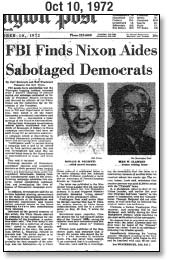
WaPo report, October 10, 1972

The Watergate report they’ve often described as decisive — an article published October 10, 1972, that characterized the scandal as “a massive campaign of political spying and sabotage conducted on behalf of President Nixon’s re-election” — referred prominently to the FBI and the Justice Department.

(That article cited “FBI reports” in asserting that “at least 50 undercover Nixon operatives traveled throughout the country trying to disrupt and spy on Democratic campaigns.” That claim was dismissed as “absolutely false” in internal FBI memoranda, and was scoffed at by Edward Jay Epstein in his brilliant 1976 essay puncturing the purported effects of Woodward and Bernstein’s  Watergate reporting.)

And as I write in my media-mythbusting book, Getting It Wrong, which came out last year, to characterize the reporting of Woodward and Bernstein as decisive in Watergate’s outcome “is to abridge and misunderstand the scandal and to indulge in a particularly beguiling media-driven myth.”

I also note that such a mediacentric interpretation of Watergate “minimizes the far more decisive forces that unraveled the scandal and forced Nixon from office.”

Those forces included special prosecutors, federal judges, both houses of Congress, the Supreme Court, as well as the Justice Department and the FBI, I note, adding:

“Even then, Nixon likely would have served out his term if not for the audiotape recordings he secretly made of most conversations in the Oval Office of the White House. Only when compelled by the Supreme Court did Nixon surrender those recordings, which captured him plotting the cover-up” of the crimes of Watergate.

I argue in Getting It Wrong that debunking media-driven myths “enhances a case for limited news media influence.”

Media power, I write, “tends to be modest, nuanced, diffused, and situational. But too often the ubiquitous presence of the news media is mistaken for power and influence.”

Cockburn’s commentary similarly suggested that media power can be overstated, exaggerated.

“In wars in Vietnam, Iraq and Afghanistan,” he noted, “effective media criticism has tended to follow rather than precede public opinion.”

Quite so.

Walter Cronkite‘s famous on-air assessment in late February 1968 that the U.S. military was “mired in stalemate” in the war in Vietnam is sometimes said to have shifted American public opinion about the conflict.

In reality, though, Americans had begun turning against the war months before Cronkite aired his analysis in a special report on CBS television.

WJC

Recent and related: