W. Joseph Campbell

Archive for the ‘Washington Post’ Category

Who, or what, brought down Nixon?

In Debunking, Media myths, Washington Post, Watergate myth on January 24, 2011 at 10:26 am

Who brought him down?

The easy, but wrong, answer to the question of who or what brought down Richard Nixon’s corrupt presidency in the Watergate scandal is: Bob Woodward and Carl Bernstein of the Washington Post.

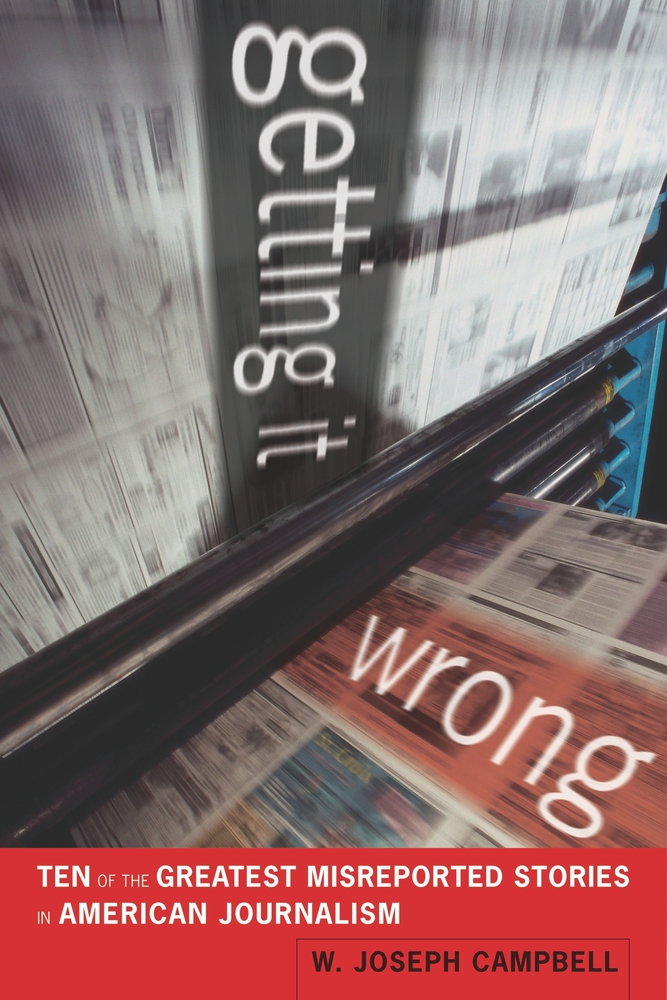
As I point out in my latest book, Getting It Wrong, that interpretation has become “ready short-hand for understanding Watergate and its denouement, a proxy for grasping the scandal’s essence while avoiding its forbidding complexity.

“How the Post and its reporters uncovered Watergate is deeply ingrained in American journalism as one of the field’s most important and self-reverential stories.”

It’s also a prominent media-driven myth–a well-known but dubious or improbable tale about the news media that masquerades as factual.

What I call the heroic-journalist interpretation of Watergate offers a convenient, accessible, easy-to-grasp version of what was a sprawling and intricate scandal.

“But to explain Watergate through the lens of the heroic-journalist,” I write in Getting It Wrong, “is to abridge and misunderstand the scandal and to indulge in a particularly beguiling media-driven myth. The heroic-journalist interpretation minimizes the far more decisive forces that unraveled the scandal and forced Nixon from office.”

Britain’s Spectator magazine takes up the Watergate question in an article about fallout from the phone-hacking scandal that has swept up Rupert Murdoch’s London tabloid, the Sunday News of the World.

To its credit, Spectator sidestepped the heroic-journalist myth in declaring:

“Everyone who remembers the Watergate scandal remembers Bob Woodward and Carl Bernstein’s reporting. Brilliant though it was, the Nixon administration was destroyed not by the Washington Post, but by Sam Ervin’s Senate committee, which had the powers parliamentary select committees ought to have to issue subpoenas and compel witnesses to talk or go to jail for contempt.”

While commendable in eschewing the mythical heroic-journalist interpretation, the Spectator commentary overstated the importance of the Senate select committee on Watergate, which was chaired by Sam Ervin of North Carolina and took testimony during the spring and summer of 1973.

Rather than destroying Nixon’s presidency, the select committee had the effect of training public attention on the crimes of Watergate and, in the testimony it elicited, offered a way to determine whether Nixon had a guilty role in the scandal.

The select committee’s signal contribution to unraveling Watergate came in producing the revelation that Nixon had secretly tape-recorded conversations with top aides in the Oval Office of the White House.

The tapes, I note in Getting It Wrong, “proved crucial to the scandal’s outcome.”

They constituted Nixon’s “deepest secret,” Stanley Kutler, Watergate’s leading historian, has written.

The revelation about their existence set off a year-long effort to force Nixon to turn over the tapes, as they promised to clear or implicate him in the scandal.

Nixon resisted surrendering the tapes until compelled by the U.S. Supreme Court, in a unanimous decision in July 1974.

The tapes revealed his guilty role in seeking to block the FBI investigation of the Watergate’s seminal crime, the breakin in June 1972 at the offices of the Democratic national committee in Washington.

Nixon resigned in August 1974.

In the final analysis, then, who or what brought down Richard Nixon?

Certainly not Woodward and Bernstein. Not the Senate select committee, either.

The best answer is that rolling up a scandal of the dimension and complexity of Watergate “required the collective if not always the coordinated forces of special prosecutors, federal judges, both houses of Congress, the Supreme Court, as well as the Justice Department and the FBI,” as I write in Getting It Wrong.

“Even then,” I add, “Nixon likely would have served out his term if not for the audiotape recordings he secretly made of most conversations in the Oval Office of the White House. Only when compelled by the Supreme Court did Nixon surrender those recordings,” making inevitable the early end of his presidency.

WJC

Recent and related:

Indulging in myth on the way out

In Debunking, Jessica Lynch, Media myths, Washington Post on January 22, 2011 at 9:04 am

The insufferable Keith Olbermann bid sudden farewell last night, indulging in media myth as he left his primetime “Countdown” show on MSNBC.

Olbermann, who quit or was pushed out midway through a four-year contract,  said in an on-air valedictory that his program had “established its position as anti-establishment with the stagecraft of Mission Accomplished to the exaggerated rescue of Jessica Lynch in Iraq to the death of Pat Tillman to Hurricane Katrina to the nexus of politics and terror to the first special comment.”

The reference to the “exaggerated rescue of Jessica Lynch”  caught the attention of Media Myth Alert, given that Olbermann clearly suggested the mission was needlessly hyped.

That claim is an element of the multidimensional media myth that has come to define the Lynch case, which I examine in my mythbusting book, Getting It Wrong.

Lynch was a 19-year-old Army private captured after an ambush in Nasiriyah in the first days of the Iraq War in 2003. She was badly injured and lingered near death at an Iraqi hospital, from where she rescued April 1, 2003, in a swift and well-coordinated raid by a U.S. special operations team.

The rescue of Jessica Lynch

Lynch was the first captured American soldier rescued from behind enemy lines since World War II.

In mid-May 2003, the British Broadcasting Corporation aired a report claiming the Lynch rescue was “one of the most stunning pieces of news management ever conceived,” a shameless bit of stagecraft done for propaganda purposes.

The BBC report interviewed an Iraqi doctor who said the rescue raid “was like a Hollywood film. They cried, ‘go, go, go,’ with guns and blanks without bullets and the sound of explosion.”

The Pentagon dismissed the BBC’s “news management” claims as “void of all facts and absolutely ridiculous.” Experts scoffed at the claim that Special Operations units would conduct a mission with blanks in their weapons, as the BBC had reported.

At the request of three Democratic members of Congress, including then-Congressman Rahm Emanuel, the Defense Department inspector general investigated the BBC’s allegations.

As I note in Getting It Wrong, Thomas F. Gimble, the acting inspector general, reported to Congress in April 2007 that the BBC’s allegations had not been substantiated, that no evidence had been uncovered to support the notion the rescue “was a staged media event.”

Rather, Gimble said, the rescue operation was found to have been “a valid mission” to recover a prisoner of war “under combat conditions.”

Gimble said in written testimony that more than 30 witnesses were interviewed in the inspector general’s inquiry, including members of the Special Operations rescue team. Few if any of those witnesses had been interviewed the BBC or other news organizations, he said.

The inspector general’s report was, I note in Getting It Wrong, “an unequivocal rebuke to the BBC’s account.

“Even so, by the time Gimble testified, four years had passed and the BBC’s version had become an unshakeable, widely accepted element of the Lynch saga,” as suggested in Olbermann’s farewell remarks last night.

The BBC claim that the rescue mission was counterfeit corresponded to a broader view that the Pentagon was up to no good in the Lynch case, that it had planted an erroneous report about her supposed battlefield heroics in order to boost popular support for the war.

The erroneous report appeared in the Washington Post on April 3, 2003, two days after the rescue.

In a front-page account published beneath the headline, “‘She was fighting to the death,'” the Post anonymously cited “U.S. officials” in saying Lynch had “fought fiercely” in the ambush of her unit in Nasiriyah, that she had “shot several enemy soldiers,” and that she had continued firing her weapon “until she ran out of ammunition.”

As it turned out, the hero-warrior tale — written by Susan Schmidt and Vernon Loeb — untrue. Lynch did not fire her weapon in the ambush. Nor was she shot and stabbed, as the Post had reported.

But as months passed and American public opinion turned against the war, the role of the Post in propelling Lynch into unwarranted international fame receded in favor of the false narrative that the Pentagon had made it all up. The Post itself has been complicit at times in suggesting machinations by the Pentagon.

However, as I point out in Getting It Wrong, the Pentagon was not the source for the hero-warrior tale. Loeb, one of the reporters who wrote the botched story, said on an NPR program in mid-December 2003 that he “could never get anybody from the Pentagon to talk about” the Lynch case.

“They wouldn’t say anything about Jessica Lynch,” Loeb said on the Fresh Air show.

“I just didn’t see the Pentagon trying to create a hero where there was none,” he added. “I mean …they never showed any interest in doing that, to me.”

Loeb declared:

“Our sources for that story were not Pentagon sources.”

Loeb described them as “some really good intelligence sources” in Washington, D.C. , and added:

“We wrote a story that turned out to be wrong because intelligence information we were given was wrong. That happens quite often.”

Despite Loeb’s exculpatory remarks, the erroneous view the Pentagon made up the story about Lynch’s derring-do lives on, in large measure because it fits well with the notion the Iraq War was a botched affair. And like many media myths, the false narrative offers a simplistic, easy-to-understand account of an event that was both complex and faraway.

WJC

Recent and related:

On ‘transformational moments’ that journalists see

In Debunking, Media myths, Murrow-McCarthy myth, New York Times, Newspapers, Spanish-American War, Washington Post on January 20, 2011 at 9:04 am

The “turning points” that journalists seem eager to find in dramatic events usually turn out to be mythical–chimeras built on a convenient if faulty and clichéd storyline.

'Turning points' sculpture in Ohio (Marty Gooden)

That’s a central point blogger and political scientist Brendan Nyhan offered the other day in a perceptive commentary dismissing the notion that the shootings this month in Tucson may be seen, sooner or later, as a turning point in American political life.

Nyhan argued that “single events almost never reshape social and political life” and added:

“The turning points of the past seem more clear in large part because the messiness of those events has faded in our memory and we remember the narratives that have been constructed after the fact.”

Well said.

Nyhan’s particular target was the New York Times and two rather superficial commentaries written by Matt Bai in the aftermath of the Tucson shootings. The longer and more recent piece was published Sunday in the Times “Week in Review” section. In it, Bai ruminated:

“If the shooting didn’t feel like the turning point in the civic life of the nation that some of us had imagined it might become, then it may be because such turning points aren’t always immediately evident.”

Welch (Library of Congress)

He went on to consider a few supposedly “transformational moments” of the past, such as the televised Senate hearing in 1954, when lawyer Joseph N. Welch upbraided Senator Joseph McCarthy, declaring:

“Have you no sense of decency, sir? At long last, have you left no sense of decency?”

It was a moment, Bai wrote, that “resonated throughout a country that was just then discovering the nascent power of television. Years of ruinous disagreement over the threat of internal Communism seemed to dissipate almost overnight.”

The sweeping claim caught my eye, given that my latest book, Getting It Wrong, addresses and debunks the media myth that broadcast journalist Edward R. Murrow put an end to McCarthy’s communists-in-government witch-hunt in a 30-minute television program in March 1954.

I don’t discuss the Welch-McCarthy encounter in Getting It Wrong, but barnacles of media myth seem to cling to that tale, too.

Take, for example, the claim that Welch’s famous line — uttered on the 30th day of what were called the Army-McCarthy hearings — “resonated throughout” the country.

The hearings centered around the Army’s accusations that McCarthy and his top aide, Roy Cohn, had sought special treatment for a McCarthy staffer who had been drafted into military service. The hearings were televised live, gavel to gavel, by the fledgling ABC and by the declining DuMont networks.

As Thomas Doherty pointed out in Cold War, Cool Medium, a fine study of television during the McCarthy period,the hearings “were not a saturation television event in the modern sense. The refusal of NBC and CBS [for commercial reasons] to telecast the hearings blacked out whole regions of the country from live coverage.”

He also wrote:

“With cable costs keeping ABC from relaying the hearings to Denver and points west, the coverage on the Pacific Coast was particularly sparse.”

Given such gaps in television’s coverage, it’s hard to see how the sudden and dramatic put down by Welch, a Boston lawyer who was the Army’s lead counsel at the hearings, could have “resonated” across the entire country.

Welch’s comment certainly attracted attention. But briefly.

The New York Times said the rebuke of McCarthy was greeted by a burst of applause in the Senate gallery and that Welch the next day reported having received 1,400 telegrams, most of them supportive.

Even so, a database review of the reporting in the Times and four other leading U.S. newspapers indicates the Welch-McCarthy encounter was at the time essentially a one-day story.

The database search for articles, editorials, transcriptions, and letters to the editor that contained “McCarthy,” “Welch,” and “sense of decency” returned 14 items in the period from June 9, 1954, to June 30, 1955.

Ten of the 14 items were published June 10, 1954, a day after Welch rebuked McCarthy.  The remarks were reported that day on the front pages of all five newspapers–the Times, Baltimore Sun, Chicago Tribune, Los Angeles Times, and Washington Post.

But none of the 14 items was published after June 25, 1954. In other words, none of the items was published during the time late in 1954 when the Senate voted to censure (“condemn” was the term) McCarthy’s conduct.

What’s more, lengthy excerpts of the hearing record published in the New York Times show that Welch’s “sense of decency” rebuke didn’t stun McCarthy into silence. The senator blundered on, insinuating that Welch had sought to include on his hearing staff a young lawyer with a dubious background.

The Welch-McCarthy encounter assumed “turning point” status in the years after 1954. But in the moment, in June 1954, it was recognized as dramatic but not “transformational.”

Bai’s “Week in Review” piece offered up this dubious point as well:

“A century ago, news traveled slowly enough for Americans to absorb and evaluate it; today’s events are almost instantaneously digested and debated, in a way that makes even the most cataclysmic event feel temporal.”

A century ago, news traveled rapidly by telegraph. It was scarcely  unusual then for large-circulation urban newspapers to publish multiple extra editions to report fresh elements of a major breaking story.

During the Spanish-American War in 1898, for example, William Randolph Hearst’s New York Evening Journal published as many as 40 extra editions a day. On such occasions, news surely wasn’t traveling slowly.

Indeed, at the end of the 19th century, it was not uncommon for Americans to claim they were living at “a time of rush and hurry.”

WJC

Recent and related:

Talking ethics and the ‘golden days’ of Watergate

In Debunking, Media myths, Washington Post, Watergate myth on January 19, 2011 at 8:12 am

An Editor & Publisher commentary yesterday referred to the Watergate reporting of Bob Woodward and Carl Bernstein as “golden days” of journalism that “made heroes of reporters.”

Journalism schools, the commentary declared, “filled up with idealistic young men and women hoping to become famous and perhaps bring down a president, or two.

“Didn’t Woodward and Bernstein–or Woodstein as they were famously known –practically force President Nixon to resign?”

Er, no.

Not even remotely.

The investigative reporting of Woodward and Bernstein didn’t force Nixon’s resignation. Nor did journalism school enrollments surge because of the presumed glamor effect of their work, as the column suggested.

Both topics–what I call the heroic-journalist myth and the subsidiary or spinoff myth of Watergate–are addressed and debunked in my latest book, Getting It Wrong.

As I write in Getting It Wrong:

To “explain Watergate through the lens of the heroic-journalist is to abridge and misunderstand the scandal and to indulge in a particularly beguiling media-driven myth. The heroic-journalist interpretation minimizes the far more decisive forces that unraveled the scandal and forced Nixon from office.”

Rolling up the Watergate scandal, I note, “required the collective if not always the coordinated forces of special prosecutors, federal judges, both houses of Congress, the Supreme Court, as well as the Justice Department and the FBI.”

And even then, Nixon probably would have served out his term had it not been for the audiotape recordings he secretly made of most conversations in the Oval Office of the White House. Only when compelled by the Supreme Court in the summer of 1974 did Nixon surrender those recordings, which captured him plotting the cover-up and authorizing payments of thousands of dollars in hush money.

Those disclosures, required by the Supreme Court’s decision, forced Nixon to resign in August 1974.

So against the tableau of special prosecutors, federal judges, congressional panels, the Justice Department, and the Supreme Court, the contributions of Woodward and Bernstein recede in significance–even though their work became the stuff of legend, at least as depicted in the cinematic version of their book, All the President’s Men.

“Ultimately,” as Michael Getler, the then-ombudsman of the Post, accurately noted in 2005, “it was not The Post, but the FBI, a Congress acting in bipartisan fashion and the courts that brought down the Nixon administration.”

The spinoff or subsidiary myth of Watergate has it that the exploits of Woodward and Bernstein “were a profound stimulus to enrollments in collegiate journalism programs,” I write in Getting It Wrong. “Journalism supposedly was made sexy by All the President’s Men, and enrollments in journalism schools surged.”

However, there’s at best only anecdotal support for such claims.

Scholarly research has shown that Woodward, Bernstein, and the cinematic treatment of All the President’s Men did not prompt enrollments to climb at journalism and mass communication programs at U.S. college and universities.

One such study, financed by the Freedom Forum media foundation, was conducted by researchers Lee B. Becker and Joseph D. Graf. They reported in 1995 that “growth in journalism education result[ed] not from specific events as Watergate … but rather to a larger extent from the appeal of the field to women, who ha[d] been attending universities in record numbers. The growth also in part reflect[ed] the applied nature of the field and its link to specific job skills.”

They added:

“There is no evidence … that Watergate had any effect on enrollments.”

The E&P commentary, titled “Talking Ethics: Money and Politics,” lamented ethical lapses of contemporary journalists, such as Keith Olbermann of MSNBC, who donate money to political causes and candidates for public office.

The commentary noted that giving money to politicians allows them “one more chance to publicly complain that journalists are all bought and paid for or in somebody’s pocket.”

That’s a fair point.

But in characterizing the Watergate reporting of Woodward and Bernstein as “golden days,” the commentary overlooked the ethical lapses those reporters committed in their work.

They acknowledged in their book to failed attempts in encouraging federal grand jurors to violate their oaths of secrecy and talk about Watergate testimony. Woodward and Bernstein conceded their efforts were “a seedy venture”–which nonetheless had the approval of top editors at the Post, including the then-executive editor, Ben Bradlee.

Bernstein also acknowledged in the book that he sought and obtained information from otherwise private telephone records.

Woodward and Bernstein also inaccurately attributed to FBI investigators an account published in the Post in October 1972 that said “at least 50 Nixon operatives” had been set loose “to disrupt and spy on Democratic campaigns.” An internal FBI memorandum disputed Woodward and Bernstein’s claim as “absolutely false.”

So those were “golden days”? I’d say that’s erroneous.

WJC

Recent and related:

Have a look: New trailer for ‘Getting It Wrong’

In Anniversaries, Debunking, Hurricane Katrina, Media myths, Media myths and radio, Newspapers, War of the Worlds, Washington Post, Watergate myth on January 18, 2011 at 7:08 am

Check out the new trailer for my latest book, Getting It Wrong, which addresses and debunks 10 prominent media-driven myths–those dubious stories about the news media that masquerade as factual.

As I say in narrating the trailer, media-driven myths can be thought of as the “junk food of journalism“–delicious and appealing, perhaps, but not very nutritious.

The trailer, recently completed by research assistant Jeremiah N. Patterson, reviews the media myths related to the Watergate scandal, the purported Cronkite Moment, and the aftermath of Hurricane Katrina.

A trailer prepared last year by Mariah Howell shortly before publication of Getting It Wrong remains accessible at YouTube.

Another YouTube video–prepared by Patterson in the fall to mark the anniversary of the famous War of the Worlds radio broadcast that supposedly was so realistic that it panicked America–also is accessible online. The video discusses Halloween’s greatest media myth.

WJC

Recent and related:

Fact-checking WaPo columnist on the ‘McKinley moment’

In Debunking, Media myths, Spanish-American War, Washington Post, Yellow Journalism on January 12, 2011 at 7:42 am

Washington Post columnist Dana Milbank offered up a glib and flabby column yesterday, arguing that the false charges of incitement raised long ago in the McKinley assassination should serve as a cautionary reminder to the likes of Sarah Palin and Fox News commentator Glenn Beck.

They should experience what Milbank vaguely termed a “McKinley moment.”

McKinley

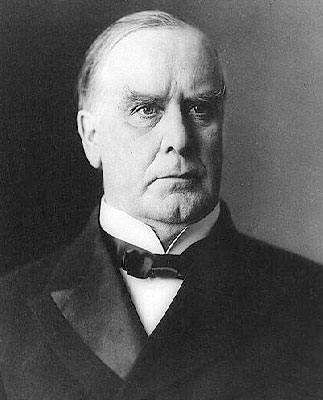
He recalled–and not entirely accurately–the efforts in 1901 to link the contents of William Randolph Hearst’s newspapers to the fatal shooting of President William McKinley.

I discussed that topic in a post Monday at Media Myth Alert, noting how extreme and wrong-headed attempts to exploit and politicize the weekend’s shooting rampage in Tucson was reminiscent of the smear campaign against Hearst following McKinley’s slaying.

The rampage in Arizona left six people dead, including a federal judge. Congresswoman Gabrielle Giffords was severely wounded.

Milbank’s column seizes on the shootings in Tuscon as a pretext to condemn the views and rhetoric of Palin and Beck, neither of whom I much care for.

Milbank began his column by declaring:

“If any good can come of the horror in Tucson, it will be that this becomes a McKinley moment for Sarah Palin and her chief spokesman, Glenn Beck.”

A “McKinley moment”? Meaning what? An occasion for self-censorship because of the insinuations and false allegations raised against them in the aftermath of the shootings in Tucson–much as false allegations were raised against Hearst following McKinley’s slaying?

Not only is “McKinley moment” an imprecise construct: It suggests that using smears to batter foes into silence is somehow worthy or admirable.

Milbank in his column briefly reviewed the false and improbable charges of incitement leveled against Hearst after McKinley was fatally shot in September 1901 and wrote:

“The outcry against Hearst’s incitement–there were boycotts and a burning in effigy–dashed his presidential ambitions.

“A similar, and long overdue, outcry has followed the Tucson killings.”

“Maybe,” Milbank added, “Beck and Palin will be good enough to show us what a real moment of silence is–by having themselves a nice long one.”

A more fitting and appropriate response from the violence in Tucson would be not to seek to mute the rhetoric of foes, but to condemn the smear, to call attention to the hazards of battering opponents with indirect and groundless allegations of incitement.

Hearst was so battered in 1901.

He, not unlike Palin and Beck, was a brash and controversial figure, easy to dislike.

Hearst’s aggressive, activist-oriented approach to newspapering–his yellow journalism–shook up New York City’s media scene in late 1890s and served as a platform for his political ambitions during the first decade of the 20th century.

But Hearst was no villain, no violence-monger. As I write in my latest book, Getting It Wrong, Hearst almost surely never vowed to bring on the Spanish-American War of 1898, although that hardy myth is often invoked and readily believed.

His newspapers were known to publish intemperate commentary, as were rival newspapers at the turn of the 20th century. And ill-advised surely defines the column written in 1900 by Ambrose Bierce, who ruminated about a bullet “speeding here to stretch McKinley on his bier.”

Milbank’s column suggested that Bierce’s commentary was published in the Hearst papers some six months before McKinley was shot.

In fact, it appeared 20 months before the assassination, in a quatrain about the fatal shooting of William Goebel, the governor of Kentucky. Bierce said he meant to call attention to risks of not finding and prosecuting Goebel’s killer.

Milbank’s column, moreover, erred in claiming the uproar that followed McKinley’s assassination “dashed” Hearst’s presidential ambitions.

Not so.

Hearst mounted a serious bid for Democratic nomination for president in 1904. He was by then a congressman, and his presidential bandwagon  gathered some momentum during the first months of that year.

In the end, though, his candidacy was doomed–not by the smears and fabrications raised after the McKinley assassination but by the reluctance of William Jennings Bryan to embrace Hearst’s bid.

Bryan, who lost presidential elections to McKinley in 1896 and 1900, had been expected to endorse Hearst for Democratic nomination in 1904. After all, Hearst had supported Bryan’s ill-fated campaigns for the presidency and had even financially supported Bryan’s travels in Europe following the 1900 election.

When Bryan did not deliver the hoped-for endorsement (thinking, perhaps, he might again emerge as the party’s standard-bearer), Hearst’s candidacy was faded, according to David Nasaw, Hearst’s leading biographer.

“Without Bryan’s endorsement,” Nasaw wrote in his 2000 work, The Chief, “Hearst had no hope of securing the votes [of convention delegates] he needed for the nomination.”

Still, Hearst pursued his bid for the nomination to the Democratic convention in St. Louis in 1904. He lost by a wide margin to Judge Alton B. Parker.

Parker in turn lost the 1904 election in a landslide to Teddy Roosevelt, who as vice president had succeeded McKinley to the presidency.

The “McKinley moment,” as Milbank used the term, seems a misnomer.

More appropriate and accurate would be to call it the “Hearst moment,” given that Hearst was the target, the victim, of distortion and falsehood.

The “Hearst moment” offers a useful and pertinent reminder about the use and effect of the smear.

WJC

Recent and related:

Many thanks to Glenn Reynolds
at Instapundit for linking to this post.

Turning to that fake Watergate line, ‘follow the money’

In Cinematic treatments, Cronkite Moment, Debunking, Media myths, Murrow-McCarthy myth, Washington Post, Watergate myth on January 11, 2011 at 8:56 am

The irresistible but entirely made-up line from the Watergate scandal–the supposed advice to the Washington Post by the anonymous source “Deep Throat” to “follow the money”–made an appearance the other day in Spokane Spokesman-Review.

The newspaper invoked the passage in a commentary about priorities of Washington’s state legislature which yesterday opened its 2011 session.

During the session, the commentary said,  “important state policy will seem to adhere to Deep Throat’s admonition on Watergate: It will follow the money.”

Follow the money.

It’s a wonderfully evocative and appealing line. But it never figured in the Watergate coverage of the Washington Post–a topic of a chapter in my latest book, Getting It Wrong.

As I’ve noted at Media Myth Alert, electronic archives containing issues of the Post show that the phrase “follow the money” never made it into print during the period of the Watergate scandal–June 1, 1972, to October 1, 1974.

Indeed, no Post article or editorial invoked “follow the money” in a Watergate-related context until June 1981–long after Richard Nixon had resigned the presidency, long after the successor who pardoned him, Gerald Ford, had lost reelection. (And the article in June 1981 merely noted the line’s use in a fifth grade play.)

“Follow the money” was, however, spoken in the movie All the President’s Men, by the character who played the anonymous and mysterious source called “Deep Throat.” The film, which dramatized the Watergate reporting of Post reporters Bob Woodward and Carl Bernstein, was based on their non-fiction book by the same title.

The actor Hal Hollbrook played “Deep Throat,” and invoked the phrase rather insistently in All the President’s Men.

In a scene showing a late-night meeting in a parking garage, Holbrook tells the Woodward character, played by Robert Redford:

“I have to do this my way. You tell me what you know, and I’ll confirm. I’ll keep you in the right direction, if I can, but that’s all. Just follow the money.”

The line’s probable author was William Goldman, the screenwriter of All the President’s Men. He told a New York Times columnist in 2005 that he had invented “follow the money” for the movie.

So why bother with all this? What difference does it make if “follow the money” is a made-up line?

For starters, misattributing “follow the money” bolsters a misleading and simplistic interpretation of the sprawling scandal that was Watergate–a scandal that sent nearly 20 of Nixon’s men to jail.

And that interpretation is what I call the heroic-journalist myth of Watergate–that it was the dogged investigative reporting of Woodward and Bernstein that brought down Nixon’s corrupt presidency.

I write in Getting It Wrong that to consider Watergate “through the lens of the heroic-journalist is to abridge and misunderstand the scandal and to indulge in a particularly beguiling media-driven myth.

“The heroic-journalist interpretation,” I add, “minimizes the far more decisive forces that unraveled the scandal and forced Nixon from office.”

And those forces included subpoena-wielding agencies and entities such as the FBI, federal grand juries, special Watergate prosecutors, bipartisan congressional panels, and ultimately the U.S. Supreme Court.

Their contributions to unraveling the Watergate scandal are minimized, and even denigrated, in the cinematic treatment of  All the President’s Men, which came out in 1976 and effectively promoted, and solidified, the heroic-journalist myth.

I point out in Getting It Wrong how media myths like the heroic-journalist meme “tend to minimize or negate complexity in historical events and offer simplistic and misleading interpretations instead. Edward Murrow no more took down Joseph McCarthy than Walter Cronkite swayed a president’s views about the war in Vietnam. Yet those and other media myths endure, because in part they are reductive: They offer unambiguous, easily remembered explanations about complex historic events.”

Speaking of reductive: I’ve meant to share this fine observation from the Financial Times commentary over the weekend that called Woodward and Bernstein’s Watergate coverage the “defining moment” in investigative reporting. The commentary was topic of a couple of recent posts at Media Myth Alert.

The essay, which was titled “The new power of the press,” noted:

“Any journalist not too full of himself to admit it reali[z]es, sooner or later, that the trade demands a facility for simplification that squeezes the most complex events, trends and characters into a limited form with limited, stereotypical narratives.”

So it is with “follow the money”: To invoke the passage is to reach for simplification, to seek an ostensibly telling phrase that can be applied widely, even to the often-dry business of a state legislature.

WJC

Recent and related:

H/T to Kenton Bird for correcting the publication city
of the Spokesman-Review (January 14, 2011).

The elusive ‘defining moment’ in investigative journalism

In Cinematic treatments, Debunking, Media myths, New York Times, Newspapers, Washington Post, Watergate myth on January 9, 2011 at 8:59 am

The Financial Times of London has asserted that the Watergate reporting of the Washington Post stands as the “defining moment” in investigative reporting–a claim I challenged yesterday.

Not the Post's doing

The notion that the Post and its reporters Bob Woodward and Carl Bernstein brought down Richard Nixon’s corrupt presidency in the Watergate scandal is a hardy meme–and is one of 10 prominent media-driven myths I debunk in my latest book, Getting It Wrong.

The heroic-journalist trope has been driven principally the cinematic version of Woodward and Bernstein’s book about their Watergate reporting, All the President’s Men. The movie’s inescapable message was that the work of reporters brought about Nixon’s resignation in 1974.

But even principals at the Post over the years have dismissed the heroic-journalist interpretation of Watergate.

So if not Watergate, what then was the “defining moment” in investigative reporting?

And how’s “defining moment” to be defined, anyway? The essay in the Financial Times didn’t say.

I argue that the “defining moment” in investigative reporting would have to be that collection of reports recognized years afterward as a landmark in journalism, for having exposed corruption or misconduct. The reports would have been so significant as to have changed government policy and/or altered practices among journalists.

Not many media investigations have had such profound and lasting effect. As Jack Shafer of slate.com has correctly noted:

“Too many journalists who wave the investigative banner merely act as the conduit for other people’s probing.” That is, they often feed off government-led investigations. Woodward and Bernstein did so, to an extent.

A review of the Pulitzer Prizes awarded for investigative reporting over the past 25 years turns up impressive and intriguing candidates. But most winners of the Pulitzer for investigative journalism are local and decidedly narrow in focus and impact; none of them meets my definition of “defining moment.”

The Post won the 2008 Pulitzer for public service for its outstanding reports about abuses at the Walter Reed Army hospital. The first installment of the Post series described the venerable institution as “a holding ground for physically and psychologically damaged outpatients.”

It was a shameful scandal that led to much soul-searching, some reforms, and a few broken careers in Army medicine. The series projected a faint whiff of controversy, too, because conditions at Walter Reed had been the subject of somewhat similar reporting two years earlier by salon.com.

The Boston Globe in 2003 won the public service Pulitzer for its reports about sexual abuse among Roman Catholic priests–a series that seems to have stood up well over time and perhaps qualifies as landmark in investigative reporting.

But is it widely recognized and remembered as such? I don’t think so.

A few media historians have identified the so-called “Arizona Project” in the 1970s as landmark investigative journalism.

The Arizona Project brought together reporters and editors from 23 newspapers, in response to a call by the Investigative Reporters and Editors organization to conduct a collaborative inquiry into the bombing death of Don Bolles, an investigative reporter for the Arizona Republic.

The project produced 40 articles about organized crime in Arizona.

David Sloan and Lisa Mullikin Parcell wrote in their book, American Journalism: History, Principles, Practices that the Arizona Project “was a defining moment in the history of investigative reporting–a rare instance when normally competitive journalists set aside their egos, stepped outside their news organizations, and cooperated on a dramatic and startling story.”

But in all, the Arizona Project produced mixed results.

It didn’t lead to a succession of similar joint ventures by journalists. Prominent news organizations such as the Post and the New York Times declined to participate. And critics said the undertaking smacked of a kind of arrogant vigilantism by journalists.

The Financial Times in its essay published Friday mentioned in addition to the Watergate reporting by the Post a few other works of outstanding investigative journalism.

It said the journalistic “exposures such as The Sunday Times on the effects of Thalidomide in the 1970s, The Guardian on bribery scandals in British Aerospace in 2003 and The New Yorker’s revelations about abuses in Iraq’s Abu Ghraib prison in 2004″ have prominent places on “a long roll of honor” in investigative journalism.

Intriguing cases, all. But are they recognized as landmarks? Maybe.

Tarbell (Library of Congress)

How about the muckraking period early in the 20th century–notably Ida Tarbell’s two-year exposé of Standard Oil, published in McClure’s magazine from 1904 to 1906? That work certainly is recognized as memorable, as a landmark, even.

But its effects tend to have been overstated. Tarbell’s work, detailed and searching though it was, did not bring about the breakup of Standard Oil, as is often claimed.

The breakup came years after Tarbell’s series, when the U.S. Supreme Court ruled in 1911 that Standard Oil had violated antitrust laws.

In the end, we have a few candidates but no overwhelming favorite for the “defining moment” in investigative journalism. And perhaps that’s not so surprising.

Like most works of journalism, investigative reporting tends to be time-specific and of transient importance–and short-lived in its effects.

WJC

Recent and related:

WaPo journo on Jessica Lynch story rejoins paper

In Debunking, Jessica Lynch, Media myths, Newspapers, Washington Post on January 6, 2011 at 8:50 am

Vernon Loeb, one of the Washington Post reporters who in 2003 wrote the botched story about Jessica Lynch’s purported battlefield heroics in Iraq, is returning to the newspaper as its local editor.

Washington Post, April 3, 2003

The electrifying but erroneous story about Lynch, then a 19-year-old Army private, turned her into the single most recognizable soldier of the Iraq War.

In a front-page report published April 3, 2003, the Post anonymously cited “U.S. officials” in saying that Lynch “fought fiercely” in the ambush of her unit in southern Iraq, that she had “shot several enemy soldiers,” and that she had fired her weapon “until she ran out of ammunition.”

But the hero-warrior narrative–published beneath the bylines of Loeb and Susan Schmidt–was untrue.

Lynch did not fire her weapon in the ambush. Nor was she shot and stabbed, as the Post reported.

I examine the Lynch case in my latest book, Getting It Wrong, noting how the Post account of her supposed derring-do “became a classic illustration of intermedia agenda-setting: News organizations around the world followed the Post’s lead by prominently reporting the supposed heroics of young Jessica Lynch and contemplating their significance.”

Not surprisingly, the Post in announcing yesterday that Loeb was returning neither mentioned nor hinted at his role in reporting the Lynch story. The Post memo did describe Loeb as “a tremendously talented, high-energy journalist, whose enthusiasm for what we do is infectious.

“In his new job, he will drive our coverage of the region, ensuring we are serving our readers, both print and digital, the smartest, freshest and most authoritative news and features on the issues that matter most to them. It’s a good match: this is a highly competitive market, and Vernon is an intensely competitive editor.”

The memo also said Loeb has run marathons and is an ardent fan of the Philadelphia Phillies baseball team. (The DCist blog noted that Loeb’s Twitter account has been silent for several months.)

Loeb returns to the Post on February 1, following a stint as deputy managing editor for news at the Philadelphia Inquirer. He had left the Post in 2004 to become an investigations editor at the Los Angeles Times.

I once tried to speak with Loeb about the Lynch case. I called him at the Inquirer in 2008, while I was researching Getting It Wrong; he abruptly hung up on me.

I wanted to ask Loeb about the sources behind the Lynch story. I also wanted to ask him about the interview he gave to the NPR Fresh Air show in late 2003, during which he said the Pentagon was not the source for the Post story.

In the years since, the dominant narrative has become that the Pentagon concocted the story about Lynch’s heroics and fed it to the Post in order to boost American support for the war.

But in the interview on Fresh Air, Loeb said he “could never get anybody from the Pentagon to talk about” the Lynch case.

“They wouldn’t say anything about Jessica Lynch,” Loeb said on the show.

“I just didn’t see the Pentagon trying to create a hero where there was none,” he added. “I mean …they never showed any interest in doing that, to me.”

Moreover, he declared:

“Our sources for that story were not Pentagon sources.”

Loeb described them as “some really good intelligence sources” in Washington, D.C.

And he added:

“We wrote a story that turned out to be wrong because intelligence information we were given was wrong. That happens quite often.”

And yet, the false narrative about the Pentagon’s having made up the story about Lynch’s heroics endures, and has become dominant. It fits well with a curdled popular view about the war in Iraq.

I’ve called before at Media Myth Alert for the Post to knock down the false narrative about the Lynch case and disclose the identify of its sources on that story.

If they weren’t “Pentagon sources,” then who were the “U.S. officials” who supplied the erroneous account about Lynch? Why should they be continue to be protected with anonymity, given that they clearly provided inaccurate information?

Loeb should say, especially since his new job at the Post will include “ensuring [that] we are serving our readers” in an “authoritative” way.

WJC

Recent and related:

LOC honor stirs references to Watergate myth

In Cinematic treatments, Debunking, Media myths, Newspapers, Washington Post, Watergate myth on December 29, 2010 at 11:31 am

All the President’s Men, the movie that helped solidify the heroic-journalist myth of Watergate, was among 25 American motion pictures chosen for the 2010 National Film Registry, the Library of Congress announced yesterday.

I have no serious quarrel with the LOC’s selection. All the President’s Men is an entertaining and imaginative film, adapted from Bob Woodward and Carl Bernstein’s book by the same title about their Watergate reporting for the Washington Post.

The cinematic version of All the President’s Men came out in 1976, just as the wounds of Watergate were beginning to heal, and has aged quite well.

But as I discuss in my latest book, Getting It Wrong, All the President’s Men “offers an unmistakable assertion of the power and centrality of the press” in the fall of Richard Nixon’s corrupt presidency. The movie promotes the misleading yet beguiling heroic-journalist interpretation of Watergate.

I note in Getting It Wrong that All the President’s Men “allows no other interpretation: It was the work Woodward and Bernstein that set in motion far-reaching effects that brought about the first-ever resignation of a U.S. president.”

And that message that “has endured,” I write. “More than thirty-five years later, what remains most vivid, memorable, and accessible about Watergate is the cinematic version of All the President’s Men.”

Nonetheless, as I discuss in Getting It Wrong, the Watergate reporting of Woodward and Bernstein was at best marginal to the outcome of the scandal, in which 19 men associated with Nixon’s presidency or his 1972 reelection campaign went to jail.

Nixon resigned in 1974, to avoid certain impeachment and conviction for his role in Watergate.

Rolling up a scandal of such dimension, I write in Getting It Wrong, “required the collective if not always the coordinated forces of special prosecutors, federal judges, both houses of Congress, the Supreme Court, as well as the Justice Department and the FBI.”

But the cinematic version of All the President’s Men portrays none of that collective effort. In fact, the movie downplays, even denigrates, the contributions of investigative agencies such as the FBI.

The LOC’s announcement inevitably stirred references in mainstream media and the blogosphere to the heroic-journalist interpretation of Watergate.

The New York Post, for example, said in referring to the movie’s recognition that the work of Woodward and Bernstein “led to the resignation of President Nixon.”

And in a lengthy and glowing post at Houston’s CultureMap blog, a film critic described Woodward and Bernstein as “fearless and relentless seekers of truth who helped to bring down the most corrupt President in U.S. history.”

He also wrote that All the President’s Men stood as “first among equals” among the movies selected for the National Film Registry and added that Woodward and Bernstein “set new standards for American journalism, and inspired thousands of idealists — along with more than a few amoral glory-hounds — to follow in their paths.”

Just what were those “new standards” was left unsaid.

And the work of Woodward and Bernstein may have “inspired thousands of idealists” to enter American journalism, but there’s only anecdotal support for such claims.

And scholarly research has shown that Woodward, Bernstein, and All the President’s Men did not cause enrollments to climb at journalism and mass communication programs at U.S. college and universities.

One such study was financed by the Freedom Forum media foundation and conducted by researchers Lee B. Becker and Joseph D. Graf. They reported in 1995 that “growth in journalism education result[ed] not from specific events as Watergate … but rather to a larger extent from the appeal of the field to women, who ha[d] been attending universities in record numbers. The growth also in part reflect[ed] the applied nature of the field and its link to specific job skills.”

Becker and Graf added:

“There is no evidence … that Watergate had any effect on enrollments.”

A final note about All the President’s Men and the National Film Registry: As the MovieNation blog at the Boston Globe pointed out, “It has to be the only film on the list that includes a scene set in the Library of Congress.”

That scene depicts Woodward and Bernstein at a table in the Library’s spectacular Main Reading Room, sorting through records of materials checked out by the Nixon White House. As they thumb through stacks of cards, the camera pulls away, slowly and upward, toward the Reading Room’s gold-inlaid dome. The effect is to suggest the lonely earnestness of the reporters’ work.

WJC

Recent and related: