W. Joseph Campbell

Posts Tagged ‘Cinema’

Taking stock: Top mythbusting posts of 2017

In 'Napalm girl', Cinematic treatments, Cronkite Moment, Debunking, Error, Furnish the war, Media myths, Newspapers, Scandal, Washington Post, Watergate myth on December 26, 2017 at 8:01 am

Media Myth Alert directed attention in 2017 to the appearance of a number of well-known media-driven myths, which are prominent tales about and/or by the news media that are widely believed and often retold but which, under scrutiny, dissolve as apocryphal or wildly exaggerated.

Here is a rundown of the five top posts of the year at Media Myth Alert, which was established at the end of October 2009, a few months before publication of the first edition of Getting It Wrong. An expanded second edition of the mythbusting book came out in late 2016.

Vox offers up myth of the ‘Napalm Girl’ in essay about ‘fake news’ (posted July 6): “Fake news” was much in the media in 2017, and in addressing the phenomenon, the online site Vox invoked one of the media myths associated with the famous “Napalm Girl” photograph of June 1972.

‘Napalm girl,’ 1972 (Nick Ut/AP)

Vox  asserted that the image showed “a naked 9-year-old Vietnamese girl running from the United States’ napalm bombing of her village during the Vietnam War.”

It was not a U.S. bombing. As I discuss in Getting It Wrong, the napalm attack was carried out by the South Vietnamese Air Force — as news reports made quite clear at the time.

For example, a veteran British journalist, Christopher Wain, wrote in a dispatch for the United Press International wire service:

“These were South Vietnamese planes dropping napalm on South Vietnamese peasants and troops.”

The notion that U.S. warplanes dropped the napalm that burned the girl and others is false, but enduring.

And Vox has not corrected its error.

The photographer who took the “Napalm Girl” image, Nick Ut of the Associated Press, retired from the news agency at the end of March 2017.

After the ‘Cronkite Moment,’ LBJ doubled down on Viet policy (posted February 23): We are certain to hear fairly often about the mythical “Cronkite Moment” in 2018, especially around the 50th anniversary in February of the on-air editorializing by CBS News anchor Walter Cronkite, who famously declared the U.S. military was “mired in stalemate” in Vietnam.

Cronkite’s assessment is said to have been so powerful and shocking that it came as an epiphany for President Lyndon B. Johnson, who suddenly realized his war policy was in tatters.

It’s a compelling story of media influence. But it’s hardly what happened.

Not only did Johnson not see Cronkite’s special report when it aired on February 27, 1968; the president doubled down on his Vietnam policy in the days and weeks afterward, mounting an aggressive and outspoken defense of his policy while making clear he had not taken the Cronkite’s message to heart — if he was aware of it at all.

Just three days after Cronkite’s program aired, Johnson vowed in remarks at a testimonial dinner that the United States would “not cut and run” from Vietnam.

“We’re not going to be Quislings,” the president said, invoking the surname of a Norwegian politician who had helped the Nazis take over his country. “And we’re not going to be appeasers.”

In mid-March 1968, Johnson told a meeting of business leaders in Washington: “We must meet our commitments in the world and in Vietnam. We shall and we are going to win. … I don’t want a man in here to go back home thinking otherwise — we are going to win.”

A few days later, on March 18, 1968, the president traveled to Minneapolis to speak at the National Farmers Union convention. He took the occasion to urge “a total national effort to win the war” in Vietnam. Johnson punctuated his remarks by slapping the lectern and declaring:

“We love nothing more than peace, but we hate nothing worse than surrender and cowardice.”

So at a time when Cronkite’s view about Vietnam should have been most potent and influential, Johnson remained openly and tenaciously hawkish on the war. On several occasions, the president effectively brushed aside Cronkite’s assessment and encouraged popular support for the war effort.

Johnson’s assertiveness at that time is little remembered, while the “Cronkite Moment” remains one of American journalism’s most enduring and appealing media myths.

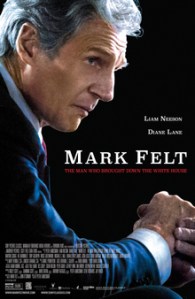
‘Mark Felt’ biopic worse than its negative reviews (posted October 14): Long before its release in late September 2017, Peter Landesman’s biopic of Watergate’s mythical and most famous secret source, W. Mark Felt, was ballyhooed in the Hollywood press as a “spy thriller.”
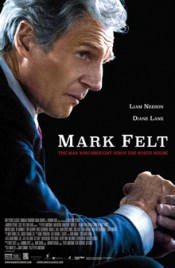
The movie was grandiose in its title, “Mark Felt: The Man Who Brought Down the White House.” But its script was a tedious mess that offered no coherent insight into Watergate or what really toppled Richard Nixon’s presidency in 1974.

Felt, who was played by Liam Neeson, was a top official at the FBI who in 1972 and 1973 conferred periodically with Bob Woodward, one of the Washington Post’s lead reporters on the Watergate scandal. In All the President’s Men, a book about their Watergate reporting for the Post, Woodward and Carl Bernstein referred to Felt as “Deep Throat.”

Felt’s clandestine meetings with Woodward took place in a parking garage in suburban Virginia and became the stuff of legend — not to mention media myth.

About the time he was conferring with Woodward, Felt was authorizing illegal break-ins — known at the FBI as “black bag jobs” — at homes of relatives and associates of fugitives of the domestic terrorist group Weather Underground.

Felt was indicted in 1978 for approving illegal entries and searches. He was tried with an FBI colleague; both were convicted and ordered to pay fines. They were pardoned in 1981 by President Ronald Reagan.

A far better biopic about Felt could have been developed around his criminal misconduct in investigating the Weather Underground. Such a movie could have been a study of the corrupting tendencies of almost-unchecked power, which Felt wielded for a time at the FBI. Instead, Landesman produced a plodding cinematic treatment that was rewarded with no better than modest receipts at the box office.

WaPo’s media writer embraces Watergate myths (posted October 7): The identity of “Deep Throat” remained a secret for more than 30 years — until Felt and his family revealed in 2005 that he had been the secret source. The Washington Post’s ombudsman, Michael Getler, took the occasion to offer an important reminder about Watergate and the forces that had ended Nixon’s presidency.

Getler wrote in a column in June 2005 that “it was not The Post, but the FBI, a Congress acting in bipartisan fashion and the courts that brought down the Nixon administration.”

In October 2017, one of Getler’s distant successors at the Post, media columnist Margaret Sullivan, revisited the lessons of Watergate in an essay in Columbia Journalism Review — and embraced the trope that the Post and Woodward and Bernstein were central to bringing down Nixon’s presidency.

I call it the heroic-journalist myth of Watergate.

In her essay, Sullivan declared, without documentation, that Woodward and Bernstein had “uncovered the Nixon administration’s crimes and the cover-up that followed. In time, their stories helped to bring down a president who had insisted, ‘I am not a crook.’”

Woodward and Bernstein most certainly did not uncover Nixon’s obstruction. That was revealed in 1974, not long before Nixon resigned, in the release of a previously secret White House tape on which the president can be heard approving a scheme to divert the FBI’s investigation into the burglary at Democratic National Committee headquarters — the signal crime of Watergate.

Nor did Woodward and Bernstein reveal the Nixon’s administration’s cover-up of the Watergate burglary.

That was made quite clear long ago, in a mostly hagiographic account that the Columbia Journalism Review published in summer 1973, about a year before Nixon quit.

Deep in that article was a passage noting that Woodward and Bernstein had “missed perhaps the most insidious acts of all — the story of the coverup and the payment of money to the Watergate defendants [charged and tried in the burglary] to buy their silence.”

The article quoted Woodward as saying about the cover-up: “It was too high. It was held too close. Too few people knew.

We couldn’t get that high.”

Woodward and Bernstein’s reporting was hardly decisive to the outcome of Watergate.

And Sullivan’s myth-embracing claims in Columbia Journalism Review remain uncorrected.

Imagining Richard Nixon’s ‘secret plan’ for Vietnam (posted November 14): About two weeks before Minnesota Public Radio dismissed him for inappropriate workplace behavior, storyteller Garrison Keillor wrote an essay in which he imagined paying a return visit to New York City of 1961.

The thought was “unbearable,” he wrote, because “I’d have to relive the 1963 assassination [of President John F. Kennedy] and stay in grad school to dodge the draft and hear Richard Nixon say that he had a secret plan to end the war in Vietnam.”

Were he somehow to make a return to the ’60s, Keillor would never hear Nixon touting a “secret plan” for Vietnam. Certainly not as a campaign pledge for the presidency in 1968 when, as a hoary media myth has it, Nixon cynically proclaimed having a “secret plan” to end the war.

But in fact, Nixon pointedly disavowed such a claim.

In an article published March 28, 1968, in the Los Angeles Times, Nixon was quoted as saying he had “no gimmicks or secret plans” for Vietnam.

“If I had any way to end the war,” he also was quoted as saying, “I would pass it on to President [Lyndon] Johnson.” (Nixon’s remarks were made just a few days before Johnson announced he would not seek reelection.)

Nixon may or may not have had a “secret plan” in mind in 1968. But it was neither a topic nor a plank of his campaign that year, and that is clear in reviewing search results of a full-text database of leading U.S. newspapers in 1968. The titles include the Los Angeles Times, New York Times, Baltimore Sun, Wall Street Journal, Washington Post, and Chicago Tribune.

The search period was January 1, 1967, to January 1, 1969, and search terms were “Nixon” and “secret plan.” No articles were returned in which Nixon was quoted as saying he had a “secret plan” for Vietnam. Had Nixon touted a “secret plan” during his campaign, leading U.S. newspapers surely would have mentioned it.

Keillor’s odd musings about returning to the ’60s were not the first time he’s indulged in media myth.

In a “Writer’s Almanac” podcast aired on NPR in April 2015, Keillor asserted that “in 1898,” newspaper publisher William Randolph Hearst “sent the artist Frederic Remington to Cuba to cover the war. And Remington wrote home, ‘There is no war. Request to be recalled.’

“And he was told, ‘You furnish the pictures, I’ll furnish the war.’ And the Hearst newspapers did their best to promulgate what came to be called the Spanish-American War.”

The Remington-Hearst anecdote, featuring Hearst’s purported vow to “furnish the war,” is one of the best-known in American journalism. But it is apocryphal, for reasons addressed in detail in the opening chapter of Getting It Wrong.

WJC

Other memorable posts of 2017:


‘Mark Felt’ biopic worse than its negative reviews

In Cinematic treatments, Newspapers, Reviews, Scandal, Washington Post, Watergate myth on October 14, 2017 at 1:31 pm

Mark Felt is a movie worse than its many negative reviews.
It’s a tedious biopic about Watergate’s most famous anonymous source that fails to offer anything close to a coherent interpretation of America’s gravest political scandal of the 20th century.

The subtitle asserts that Felt — celebrated as Bob Woodward‘s highly placed “Deep Throat” source during Watergate — was the “man who brought down the White House.” But that exceedingly dubious claim is not  much addressed — let alone supported — in this headache-inducing mess of a movie.

No one who sits through Mark Felt will come away with a cogent understanding about Watergate and what really brought down Richard Nixon’s presidency.

And that perhaps is its most acute failing.

The movie offers a badly mashed-up timeline of Watergate; suggests that the Nixon White House coverup of the scandal nearly succeeded when it was amateurish and wobbly, and provides no sense at all about the array of forces that closed in on Nixon. The movie is about a career G-man (played grimly by Liam Neeson) who leaked to the press, ostensibly to protect his beloved FBI from Nixon and his skulking, disreputable top aides.

Woodward’s character, played by Julian Morris, is amusingly callow and in a couple of brief appearances comes across as more stenographer than searching journalist. Mark Felt grants considerably more face time to Sandy Smith of Time magazine’s Washington bureau, a veteran journalist to whom Felt also leaked.

But as the credits roll, it’s not hard to think that director Peter Landesman missed an opportunity to shoot a far better movie about Felt.

Landesman’s portrayal notwithstanding, Felt was no heroic whistleblower. He was no noble character; the far better movie would have depicted Felt more accurately as a cunning G-man not above breaking the law.

The far better movie would have been a study of the corrupting tendencies of almost-unchecked power, which Felt for a short time wielded at the FBI.

The far better movie would have been developed around Felt’s criminal misconduct as the agency’s acting associate director, authorizing illegal breakins — known as “black bag jobs” — at homes of relatives and associates of Weather Underground fugitives.

Felt was indicted in 1978 for illegal entries and searches in New York City and Union City, N.J. Indicted with him for conspiring to violate civil rights of American citizens were former FBI acting director L. Patrick Gray and Edward S. Miller, former head of the agency’s counterintelligence unit.

Felt and Miller were convicted, ordered to pay fines, but pardoned in 1981 by President Ronald Reagan. Charges against Gray were dropped.

Felt died in 2008, a few years after outing himself as Woodward’s “Deep Throat” source during Watergate.

The “black bag jobs” were conducted in late 1972 and early 1973, roughly the time Felt was speaking with Woodward of the Washington Post about Watergate. Felt and Miller later said the warrantless entries were justified for reasons of national security.

Landesman’s Felt doesn’t ignore the FBI’s illegal activities, but seems to excuse them because the Weather Underground’s bombings were increasingly worrisome. The radical group detonated timebombs in washrooms at the Capitol in March 1971, the Pentagon in May 1972, and State Department in January 1975.

A parallel track of the far better movie would have explored but censured the Weather Underground, a violent, far-left terrorist group led by the likes of Bernadine Dohrn and her husband, Bill Ayers. They escaped  federal prosecution for their most serious crimes because crucial evidence against them had been gathered through illegal telephone surveillance.

Dohrn and Ayers became professors, he at the University of Illinois at Chicago, she at Northwestern University Law School. They were early supporters of Barack Obama as he began his climb from Chicago to the presidency. During his 2008 presidential campaign, Obama sought to distance himself from Ayers, calling him “somebody who engaged in detestable acts 40 years ago, when I was 8.”

The far better movie also would have zeroed in on Felt’s efforts to undermine Gray during the so-called FBI war of succession following J. Edgar Hoover’s death in May 1972.

By leaking to Woodward and Sandy Smith, Felt sought to discredit Gray and thus enhance Felt’s chances of being named to the bureau’s top position, an interpretation Max Holland persuasively presented in his book, Leak: Why Mark Felt Became Deep Throat.

Felt lost out and retired in 1973, the year before Nixon resigned.

A far better movie could have been made. The material was there. Instead, Landesman produced a plodding and confusing cinematic treatment that’s been aptly rewarded with modest box office receipts.

WJC

More from Media Myth Alert:

Why is he biopic worthy? Movie planned about Watergate’s ‘Deep Throat’ source

In Cinematic treatments, Debunking, Media myths, Scandal, Washington Post, Watergate myth on November 27, 2015 at 7:22 am

The best-known anonymous source of the Watergate scandal, a former senior FBI official code-named “Deep Throat,” would receive hero’s treatment in a planned biopic, the shooting for which reportedly is to begin in March.

The movie is to be called Felt, the name of the “Deep Throat” source, W. Mark Felt, who cut a checkered career in government service.

Besides being a secret, high-level source for Bob Woodward of the Washington Post, Felt in the early 1970s was the agency’s acting associate director. In that role, he authorized several burglaries as part of the FBI’s investigations into the radical Weather Underground.

Early this month, the Hollywood press was abuzz about the planned Felt biopic. The show business daily, Variety, said the film would be “a spy thriller” in which Felt wages an “isolated and dangerous struggle against the White House.” Shooting the film is to begin in March, Variety said, and Liam Neeson and Diane Lane may fill lead roles.

Felt: Biopic worthy?

Felt: Biopic worthy?

All of which prompts inevitable questions: Why is Mark Felt, who died in 2008, biopic worthy? Even if the movie never makes it to production, why should Felt be considered a hero?

He was no noble figure. Felt was convicted in 1980 of felony charges related to the warrantless break-ins, known in the FBI as “black bag jobs,” and fined $5,000. He was not sentenced to prison for the crimes.

The year after his conviction, Felt was granted an unconditional pardon by President Ronald Reagan.

In its obituary about the former FBI official, the Los Angeles Times recalled that tears welled in Felt’s eyes as he acknowledged on the witness stand having approved secret break-ins by FBI agents between May 1972 and May 1973 — “roughly the same time he was talking to Woodward about Watergate.”

Felt and co-defendant Edward S. Miller justified the warrantless entries on grounds of national security.

The prosecutor in the case, John W. Nields Jr., said at the trial that FBI agents who conducted the breakins Felt approved had entered residences in New York City  and New Jersey, “dressed in old clothes or disguised as telephone repairmen,” according to a New York Times report about the trial.

The agents picked locks or paid cash to landlords to obtain keys, Nields said, and they “searched every room in the home, methodically looking through desks, closets, clothing and private papers for clues to the whereabouts of the Weathermen. With a camera that could be concealed in an attaché case, the agents photographed diaries, love letters, address books and other documents.”

Nields said Reagan’s pardon of Felt and Miller came as a surprise. “Nobody spoke to me about it,” the New York Times quoted him as saying. “I would warrant that whoever is responsible for the pardons did not read the record of the trial and did not know the facts of the case.”

Felt was hardly acting altruistically in passing Watergate-related information to Woodward; their periodic meetings included six in a parking garage in suburban Virginia. I argued in my media-mythbusting book, Getting It Wrong, that the contributions of Woodward and his Post colleague Carl Bernstein in uncovering the Watergate scandal were modest at best and that their reporting in no way can be thought of as having forced President Richard Nixon to resign.

In leaking to Woodward, Felt sought to undercut the acting director, L. Patrick Gray III, and thereby enhance Felt’s chances of being named to the bureau’s top position, as Max Holland persuasively argued in his book, Leak: Why Mark Felt Became Deep Throat. The book makes clear Felt was motivated by ambition in the internal struggle at the FBI to replace J. Edgar Hoover, the long-serving director who died in May 1972.

Felt lost out, and retired in 1973.

Perhaps Felt the movie will collapse in its preliminary stages, which is the fate of many Hollywood projects. A biopic about Mark Felt is a bad idea in any case.

WJC


The hero-journalist trope: Watergate’s go-to mythical narrative

In Cinematic treatments, Debunking, Error, Media myths, Media myths and radio, Reviews, Washington Post, Watergate myth on October 23, 2015 at 6:10 pm

The Watergate scandal of the 1970s produced America’s gravest political crisis of the 20th century.

Nixon got Nixon

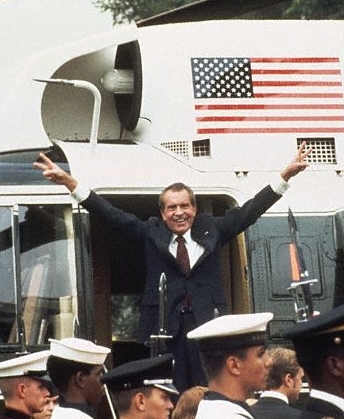
Nixon quits

And yet, because Watergate was such an intricate thicket of lies, deceit, and criminality — and because it unfolded more than 40 years ago — a sure understanding of the scandal can be defiantly elusive. Collective memory about the many lines of investigation that unwound Watergate and forced Richard Nixon to resign the presidency has inevitably grown faint.

What endures is the heroic-journalist trope, Watergate’s dominant popular narrative, which rests on the notion that dogged reporting by Bob Woodward and Carl Bernstein of the Washington Post exposed Nixon’s criminal misconduct and forced his resignation. It has become the go-to explanation about how Watergate was exposed, and it is an endlessly appealing interpretation.

It also is a prominent media-driven myth.

Which takes us to a movie review posted today at the online site of WTOP, the all-news radio station in Washington, D.C.

The review discusses the perversely named Truth, a new motion picture that celebrates former CBS News anchor Dan Rather and producer Marla Mapes who in 2004 used fraudulent documents to claim President George W. Bush dodged wartime service in Vietnam. (Because it stars Robert Redford in Rather’s role, Truth has invited comparisons — not all of them favorable — to All the President’s Men, the 1976 film in which Redford played Woodward of the Post.) 

The WTOP reviewer has little truck with the Truth story line, saying it “would have been far better … to paint the characters as fallen figures who admit they screwed up, rather than misunderstood scapegoats who were taken down by The Man.”

Fair enough. But then, to demonstrate how assiduous journalists ought to proceed, the review reaches for the heroic-journalist trope of Watergate and declares:

“If Woodward and Bernstein ran the story too early — before they had actual proof from reliable sources — Nixon would have stayed in office, the Watergate would simply be a fancy hotel, and ‘All the President’s Men’ would not exist.”

The reference to “the story” is puzzling, given that the reporting of Watergate went far beyond a single article in the Washington Post. The scandal produced extensive news reporting over many months, from the burglary in June 1972 at the headquarters of the Democratic National Committee at the Watergate complex in Washington to the resignation of Nixon in August 1974, following disclosures that he had approved a plan to cover up the break-in.

And to assert that “Nixon would have stayed in office” if not for Woodward and Bernstein is to be decidedly in error — and to indulge in a powerful myth of American journalism.

It is a tempting trope, to be sure. As I wrote in my media-mythbusting book, Getting It Wrong, the heroic-journalist interpretation offers “ready short-hand for understanding Watergate and its denouement, a proxy for grasping the scandal’s essence while avoiding its forbidding complexity.”

Not even Woodward has embraced the heroic-journalist myth. He once told an interviewer for American Journalism Review:

To say the press brought down Nixon, that’s horse shit.”

And in an interview with the PBS “Frontline” program, Woodward said “the mythologizing of our role in Watergate has gone to the point of absurdity, where journalists write … that I, single-handedly, brought down Richard Nixon. Totally absurd.”

He’s right: Woodward and Bernstein did not topple Nixon’s corrupt presidency.

Their reporting did win a Pulitzer Prize in 1973. But Woodward and Bernstein did not break the most crucial stories of Watergate.

They did not, for example, disclose the extent to which the Nixon administration covered up of the crimes of Watergate. Nor did they reveal the existence of the secret White House audio tapes, the contents of which were decisive to Watergate’s outcome.

The so-called “Smoking Gun” tape captured Nixon’s approving a plan on June 23, 1972, to divert the FBI’s investigation of the Watergate break-in. The tape’s release sealed the president’s fate.

Without the tapes, Nixon likely would have served out his term.

WJC

More from Media Myth Alert:

WaPo now embracing the dominant myth of Watergate?

In Debunking, Error, Media myths, Scandal, Washington Post, Watergate myth on July 22, 2014 at 8:05 pm

To its credit, the Washington Post over the years has mostly declined to embrace the dominant media myth about the Watergate scandal, which culminated 40 years ago with the resignation of President Richard Nixon.

Nixon resigns_1974

Not the Post’s doing: Nixon resigns, 1974

The dominant narrative is that Post reporters Bob Woodward and Carl Bernstein uncovered evidence that brought down Nixon and his corrupt presidency. It’s one of 10 media-driven myths debunked in my 2010 book, Getting It Wrong.

Principals at the Post, among them Katharine Graham, the newspaper’s publisher during Watergate, typically have steered well clear of what I call the hero-journalist myth. Graham, who died in 2001, said in 1997:

“Sometimes people accuse us of bringing down a president, which of course we didn’t do.”

Graham added, quite accurately: “The processes that caused [Nixon’s] resignation were constitutional.”

Michael Getler, who was an outstanding ombudsman for the Post, wrote in 2005:

“Ultimately, it was not The Post, but the FBI, a Congress acting in bipartisan fashion and the courts that brought down the Nixon administration. They saw Watergate and the attempt to cover it up as a vast abuse of power and attempted corruption of U.S. institutions.”

In earthier terms, Woodward, too, has scoffed at the dominant narrative, declaring in an interview in 2004:

To say the press brought down Nixon, that’s horse shit.”

But of late, such myth-avoidance has slipped.

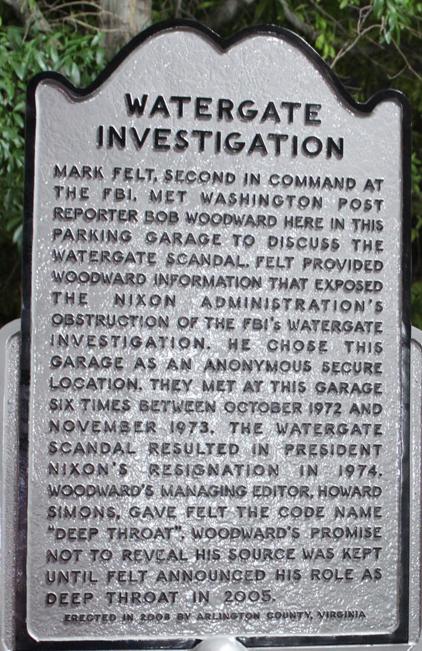
In an article last month about the planned demolition of the parking garage where Woodward periodically conferred with a stealthy, high-level source codenamed “Deep Throat,” the Post said the source “provided Woodward with information that exposed the Nixon administration’s obstruction of the FBI’s Watergate investigation.”

The source — who revealed himself years later to have been W. Mark Felt, formerly the FBI’s second-ranking official — did no such thing.

As I noted soon after the Post article appeared, if Felt had shared obstruction-of-justice evidence with Woodward — and if the Post had published such information — the uproar would have been so intense that Nixon certainly would have had to resign the presidency long before he did in August 1974.

But it was not until late summer 1974 — several months after Felt’s retirement from the FBI — when unequivocal evidence emerged about Nixon’s attempt to block FBI’s investigation into the foiled burglary in 1972 at Democratic National Committee headquarters at the Watergate building in Washington.

Watergate marker_cropped

The marker with the error

(I also pointed out that the Post’s erroneous description of the information Felt shared with Woodward was almost word-for-word identical to a passage on the historical marker that was placed outside the garage in 2011. The marker says: “Felt provided Woodward information that exposed the Nixon administration’s obstruction of the FBI’s Watergate investigation.” The Post article said Felt “provided Woodward with information that exposed the Nixon administration’s obstruction of the FBI’s Watergate investigation.”)

In any case, the Post hasn’t corrected its mischaracterization about the information Felt passed on to Woodward.

And in today’s issue, John Kelly, a popular Post columnist, referred to Bernstein as “the former Washington Post reporter famous for his role in bringing down a president.”

Kelly’s column neither explained nor elaborated on Bernstein’s putative “role in bringing down” Nixon. As I wrote in Getting It Wrong, the reporting of Woodward and Bernstein was not decisive in Watergate’s outcome. Their contributions — while glamorized in the cinematic version of their book, All the President’s Men — were marginal in forcing Nixon’s resignation.

Rolling up a scandal of Watergate’s dimension and complexity required the collective efforts of special prosecutors, federal judges, both houses of Congress, the Supreme Court, as well as the Justice Department and the FBI.

And even then, as I noted in Getting It Wrong, Nixon likely would have survived the scandal and served out his term if not for the audiotape recordings that he secretly made of conversations in the Oval Office of the White House.

Only when compelled by the Supreme Court did Nixon surrender the recordings, which captured him approving a plan to divert the FBI’s investigation into  the break-in at Democratic National Committee headquarters, seminal crime of Watergate.

It is not clear whether the recent examples of myth-embrace reflect laziness, inattentive editing, or a gradual inclination to embrace an interpretation of Watergate that is beguiling but misleading. It is an easy-to-remember, simplified version of the history of America’s greatest political scandal.

And it’s wrong.

WJC

More from Media Myth Alert:


Vomit humor and scandal: Inane ‘Drunk History’ TV show promotes Watergate media myth

In Cinematic treatments, Debunking, Media myths, Scandal, Washington Post, Watergate myth on July 8, 2013 at 8:10 am

Drunk History, a new cable TV show based on the inane premise that history is entertaining when told by inebriated narrators, isn’t meant to be taken seriously.

Obviously.

Drunk History, which  debuts tomorrow night on DrunkHistory_logoComedy Central (the pilot is available online), features what the show’s  Web site says is an “often incoherent narration of our nation’s history.”

If the first episode is an indication, incoherent history makes for faint humor. Even worse, the inaugural show promotes a notably tenacious media myth in offering a chaotic look at the Watergate scandal of 1972-74.

In doing so, Drunk History draws heavily, if erratically, on the 1976 film, All the President’s Men. The movie focused on Bob Woodward and Carl Bernstein’s Watergate reporting for the Washington Post — and was central to the rise of the myth that Woodward and Bernstein brought down the corrupt presidency of Richard Nixon.

The movie as inspiration

The media myth of Watergate has helped make accessible to contemporary audiences a complex scandal that unfolded 40 years ago. But it’s an inaccurate interpretation; not even the Washington Post embraces it, as I point out in my mythbusting book, Getting It Wrong.

As Woodward said in an interview several years ago with American Journalism Review:

To say the press brought down Nixon, that’s horseshit.”

But back to the blurry first episode of Drunk History: Woodward is shown meeting “Deep Throat,” his secret Watergate source, in an underground garage in suburban Virginia. And he throws up on the source’s shoes.

Vomit humor: Now that’s inspired.

Woodward then asks “Deep Throat” — who was a senior FBI official named W. Mark Felt — for help in understanding the scandal.

“Put the pieces together, you dumbass,” Felt snaps. “It’s all in front of you. Do the work. Just be careful. Watergate is the tip of the iceberg.”

In the compressed Drunk History version of Watergate, Nixon soon realizes he has no choice but to resign.

“And in the end,” the narrator says, “you can toss aside Richard Nixon for all his cynicism, you can toss aside Mark Felt for all his cynicism, but you can’t toss aside Robert Woodward, and to a lesser extent, Carl Bernstein, for the truth that they exposed for America.”

That’s really not a bad touch, tweaking the pompous Bernstein for having had a “lesser” role in Watergate. Which is not entirely inaccurate, given that Felt was Woodward’s source. Bernstein first met Felt in 2008, shortly before Felt’s death.

“Well,” the narrator says, “we told the story of Watergate. There’s no way I could possibly misconstrue it as not the greatest journalistic endeavor ever told. Robert Woodward would be proud.”

Watergate was scarcely that.

Unraveling the scandal, as I write in Getting It Wrong, “required the collective if not always the coordinated forces of special prosecutors, federal judges, both houses of Congress, the Supreme Court, as well as the Justice Department and the FBI.

“Even then, Nixon likely would have served out his term if not for the audiotape recordings he secretly made of most conversations in the Oval Office of the White House. Only when compelled by the Supreme Court did Nixon surrender those recordings,” which captured him plotting to cover up the seminal crime of Watergate, the breakin in June 1972 at the headquarters in Washington of the Democratic National Committee.

So against the complex tableau of special prosecutors, federal investigations, and bipartisan congressional panels, Woodward and Bernstein’s contributions in unraveling the scandal were modest at best, and certainly not decisive to Watergate’s outcome.

In its tipsy way, Drunk History pokes at the conventions of documentary history, as the New Yorker has noted. Otherwise, there’s little to cheer about the show, which was a Web-based series before moving to cable. Whatever humor Drunk History projects isn’t likely to be sustaining.

A far more humorous send-up of Watergate — and of Woodward and Bernstein — is the underappreciated 1999 film, Dick. Although Woodward and Bernstein are not the central characters, the movie depicts them as antagonistic incompetents who bungle their way to a Pulitzer Prize.

WJC

Many thanks to Instapundit
Glenn Reynolds for linking to this post

More from Media Myth Alert:

‘All the President’s Men Revisited’: A mediacentric rehash, with some insight

In Anniversaries, Cinematic treatments, Debunking, Media myths, Scandal, Washington Post, Watergate myth on April 22, 2013 at 2:49 pm

The much-ballyhooed documentary, All the President’s Men Revisited, was mostly a mediacentric rehash of the Watergate scandal 40 years ago. Even so, the show, which aired last night on the Discovery channel, managed to present insight into the forces that really uncovered the criminality of what was America’s gravest political scandal.

The two-hour program took a look back at Watergate often through the context of All the President’s Men, the 1976 cinematic adaptation of Bob Woodward and Carl Bernstein’s eponymous book about their Watergate reporting for the Washington Post.

The movie, which starred Robert Redford and Dustin Hoffman, idealized Woodward and Bernstein, identifying their reporting as central to uncovering the scandal that toppled Richard Nixon’s corrupt presidency. The first hour of the Discovery program similarly emphasized that misleading interpretation, mostly through frequent snippets of interviews with the aging Woodward and Bernstein.

The inescapable impression was that their reporting was essential to spurring the federal and congressional investigations that ultimately produced tape-recorded evidence that showed Nixon conspired to cover up the signal crime of Watergate — the break-in in June 1972 at the headquarters of the Democratic National Committee.

That interpretation — that Woodward and Bernstein’s reporting set the table for the crucial official inquiries — is favored by the Post (its Web site explains Watergate that way).

But  it is utterly misleading.

As serious historians of Watergate have demonstrated, federal investigators were far ahead of Woodward and Bernstein in their piecemeal reporting about the unfolding scandal in the summer and fall of 1972.

For example, Max Holland, author of Leak, a book about Watergate published last year, has aptly noted:

“Federal prosecutors and agents never truly learned anything germane from The Washington Posts [Watergate] stories — although they were certainly mortified to see the fruits of their investigation appear in print. … The government was always ahead of the press in its investigation of Watergate; it just wasn’t publishing its findings.”

What’s more, the Post’s investigation into Watergate “ran out of gas” by late October 1972, Barry Sussman, then the newspaper’s city editor, acknowledged in an interview in 1974.

The most interesting segments of All the President’s Men Revisited were during the program’s second hour, when the federal and congressional investigations of Watergate figured prominently. At the same time, Woodward and Bernstein receded noticeably from the limelight, replaced by the likes of Alexander Butterfield, the former White House aide who disclosed that Nixon recorded his conversations in the Oval Office.

Butterfield’s revelation about the tapes came during a U.S. Senate select committee’s investigation into Watergate — and represented a decisive pivot in the unfolding the scandal. Nixon ultimately was compelled to surrender audiotapes that demonstrated his role in attempting to coverup the Watergate breakin. He resigned soon afterward.

http://www.youtube.com/watch?v=MeQXopJ5U-Q

Interestingly, All the President’s Men Revisited  made clear that Woodward and Bernstein did not break the story about the existence of the tapes — and pinned the blame on the Post’s executive editor, Ben Bradlee.

Woodward recounted in the program (as he did in the book All the President’s Men) that he had heard about the tapes and asked Bradlee about pursuing a story along those lines. Bradlee, according to Woodward’s recollections, rated a prospective story about the tapes a B-plus: Not good enough for Woodward to pursue immediately.

(In the book, Bradlee is quoted as saying: “See what more you can find out, but I wouldn’t bust one on it.” And the reporters didn’t, thus failing to report a pivotal story about the scandal.)

The program’s second-half focus on the federal and congressional inquiries in a way addresses a major flaw of All the President’s Men, the movie, which was criticized for ignoring the contributions of federal investigators, special prosecutors, and congressional panels in ripping away the coverup of the Watergate break-in.

The movie’s narrow focus, I wrote in my media-mythbusting book Getting It Wrong, served “to solidify and elevate the heroic-journalist myth” of Watergate — the notion that the dogged work of Woodward and Bernstein brought down Nixon.

While the program did not challenge the deeply entrenched heroic-journalist myth, All the President’s Men Revisited did offer an historically accurate interpretation about how the scandal unspooled: As such, it rather succeeded where the movie had clearly failed.

WJC

More from Media Myth Alert:

William Randolph Hearst mostly elusive in new ‘Citizen Hearst’ documentary

In 1897, Anniversaries, Cinematic treatments, Error, Furnish the war, Reviews on March 15, 2013 at 10:26 am

Citizen Hearst was a mostly unsatisfactory biography published in 1961 about media baron William Randolph Hearst. It was more caricature than revealing portrait.

Citizen HearstThe title, Citizen Hearst, has been reprised for documentary that opened in several theaters this week. The documentary — commissioned by the media company that Hearst founded 126 years ago — is no revealing portrait, either.

Hearst was an innovative yet often-contradictory figure, and this complexity is largely elusive in Citizen Hearst, an 84-minute film that had its Washington, D.C., debut screening last night at the Newseum. The director, Leslie Iwerks, introduced the film by saying it told “the wonderful Hearst story.”

The opening third of Citizen Hearst delivers a fast-paced if mostly shallow look at Hearst’s long career in journalism. After that, the film turns mostly gushy about the diversified media company that is Hearst Corp.

To its credit, Citizen Hearst steers largely clear of the myths that distort understanding of Hearst and his early, most innovative years in journalism.

His affable grandson, Will Hearst, is shown in the film scoffing at what may be the best-known anecdote in American journalism — that William Randolph Hearst vowed in a telegram to the artist Frederic Remington to “furnish the war” with Spain.

The anecdote is undocumented and utterly dubious, but it was presented at face value in the biography Citizen Hearst. It is an irresistible tale often invoked in support of a broader and nastier media myth, that Hearst and his newspapers fomented the Spanish-American War in 1898.

Citizen Hearst the documentary doesn’t embrace the warmongering myth (although former CBS News anchor Dan Rather is shown saying he was taught in school that Hearst practically brought on the Spanish-American War).

The documentary, however, fails to consider the innovative character of Hearst’s newspapers of the late 19th century.

It notably avoids discussing Hearst’s eye-opening brand of participatory journalism — the “journalism of action” — which maintained that newspapers were obliged take a prominent and participatory roles in civic life, to swing into action when no other agency or entity was willing or able.

This ethos was a motivating force for one of the most exceptional and dramatic episodes in American journalism — the jailbreak and escape of Evangelina Cisneros, a 19-year-old political prisoner held without charge in Spanish-ruled Cuba.

Cisneros

Evangelina Cisneros

A reporter for Hearst’s New York Journal, supported by clandestine operatives in Havana and U.S. diplomatic personnel in Cuba, broke Cisneros from jail in early October 1897.

She was hidden for nearly three days at the home of an American-educated Cuban banker (whom she married several months later). Then, dressed as a boy, Cisneros was smuggled aboard a passenger steamer bound for New York City, where Hearst organized a thunderous welcome for her.

The Cisneros jailbreak was stunning manifestation of Hearst’s “journalism of action” and it offers rich material for a documentary. It was, as I wrote in my 2006 book, The Year That Defined American Journalism: 1897 and the Clash of Paradigms, the “greatest escape narrative” in U.S. media history.

It receives not a mention in Citizen Hearst.

The documentary presents only superficial consideration of Hearst’s mostly unfulfilled political ambitions — and avoids mentioning how he turned his newspapers into platforms to support those ambitions.

Hearst wanted to be president, and was a serious contender for the Democratic party’s nomination in 1904. He lost out to Alton Parker, a New York judge, who in turn was badly defeated by Republican Theodore Roosevelt.

Citizen Hearst presents the observations of no serious Hearst biographer: No David Nasaw, author of The Chief, an admirably even-handed biography published in 2000; no Kenneth Whyte, author of The Uncrowned King, an outstanding work published in 2009 about Hearst’s s early career.

Instead, Dan Rather is shown speaking vaguely about Hearst’s journalism (“he played big”). Movie critic Leonard Maltin makes several appearances, discussing such topics as headline size in Hearst’s fin de siècle newspapers.

The documentary treats Helen Gurley Brown, she of Cosmopolitan fame, much like a rock star. And Hearst company officials are quoted often and sometimes at length.

HuffingtonPost was quite right in noting in a review posted Wednesday that the film turns into “something you’d expect to see playing on a loop on the lobby TV screen at Hearst’s headquarters”  in New York.

It leaves you wondering how many people would pay to see it. Or why.

WJC

More from Media Myth Alert:

Woodward ‘destroyed the Nixon presidency’: More dubious history from Rush Limbaugh

In Cinematic treatments, Debunking, Error, Media myths, Scandal, Washington Post, Watergate myth on March 1, 2013 at 7:21 am

Talk-radio host Rush Limbaugh was at it again yesterday, offering up the dubious interpretation that Bob Woodward’s Watergate reporting “destroyed the Nixon presidency.”

That’s a seriously exaggerated version of the Watergate scandal, which led to Nixon’s resignation in 1974. Not even Woodward embraces that interpretation, once telling an interviewer: “To say the press brought down Nixon, that’s horse shit.”

(Woodward(Jim Wallace/Smithsonian)

Woodward
(Jim Wallace/Smithsonian)

Limbaugh’s remark about Woodward’s having “destroyed the Nixon presidency” came during a lengthy commentary about Woodward’s recent criticism about the administration of President Barack Obama.

Woodward has asserted that Obama proposed the controversial sequester plan — the automatic federal spending cuts that are to begin taking effect today.

What most intrigues Media Myth Alert is Limbaugh’s repeated claim that Woodward’s reporting was decisive in ending Nixon’s presidency. The talk-show host’s remark yesterday about Woodward and Nixon marked the second time this week he has made such an assertion.

On his show Monday, Limbaugh said flatly that “Woodward brought down Nixon” in the Watergate scandal.

The record, though,  is far more nuanced and complex than that: Woodward and his Washington Post reporting colleague Carl Bernstein played rather modest roles in unraveling the scandal.

Their reporting in the summer and fall 1972 progressively linked White House officials to a secret fund used to finance the foiled burglary at the headquarters of the Democratic National Committee — the signal crime of Watergate.

But by late October 1972, the Post’s investigation into Watergate “ran out of gas,” as Barry Sussman, then the newspaper’s city editor, later acknowledged.

Significantly, Woodward and Bernstein did not break such crucial stories as the existence of Nixon’s audiotaping system at the White House. The tapes ultimately provided evidence that the president had obstructed justice by approving a scheme to deflect the FBI’s inquiry into the burglary.

The disclosure about the taping system came in July 1973, during a Senate select committee’s investigation into the unfolding Watergate scandal.

Nor did Woodward and Bernstein disclose the payment of hush money to operatives arrested in the burglary — a key development in tying the White House to the Watergate scandal.

I discuss the media myth of Watergate in my latest book, Getting It Wrong, and write that the scandal demanded “the collective if not always the coordinated forces of special prosecutors, federal judges, both houses of Congress, the Supreme Court, as well as the Justice Department and the FBI.”

What I call the hero-journalist myth of Watergate — the notion that Woodward and Bernstein’s dogged reporting brought down Nixon — stems in large measure from the 1976 motion picture, All the President’s Men.

The movie, an adaptation of Woodward and Bernstein’s book by the same title, concentrated on the  reporters and ignored the far more decisive contributions of subpoena-wielding investigators and special prosecutors.Getting It Wrong_cover

The movie was critically acclaimed and widely seen. Its effect, I write in Getting It Wrong, was “to solidify and elevate the heroic-journalist myth, giving it dramatic power, and sustaining it in the collective memory.”

All the President’s Men, the movie, promoted a simplistic yet readily accessible interpretation of the Watergate scandal that is often invoked — as Limbaugh’s recent comments suggest. But it is an interpretation that nonetheless is utterly wrong.

WJC

More from Media Myth Alert:

Runup to the Oscars: ‘Politically inspired movies’ and the myth of Watergate

In Cinematic treatments, Debunking, Error, Media myths, Scandal, Washington Post, Watergate myth on February 22, 2013 at 2:51 pm

The runup to the Academy Awards ceremony brings inevitable bursts of nostalgia — as well as the almost-predictable appearance of hoary media myths.

CNN logoCNN.com today offered a gauzy look back at “politically inspired movies that have been nominated [for] or won” an Oscar. In doing so, CNN bought into the media myth of the Watergate scandal.

The retrospective discussed the 1976 film All The President’s Men, noting that it “won four Oscars and was nominated for four more.”

The movie was an adaptation of a book by the Washington Post’s lead Watergate reporters, Bob Woodward and Carl Bernstein, who, according to CNN, were “responsible for uncovering the Watergate scandal and forcing the resignation of President Richard Nixon.”

All the President’s Men, CNN added, “provided context and drama about how the reporters brought down the most powerful man on Earth.”

That’s an expansive claim. It’s also glib, and totally mythical.

As I discuss in my media mythbusting book, Getting It Wrong, Woodward and Bernstein’s reporting did not bring down Nixon. They didn’t uncover the scandal, either.

All President's Men

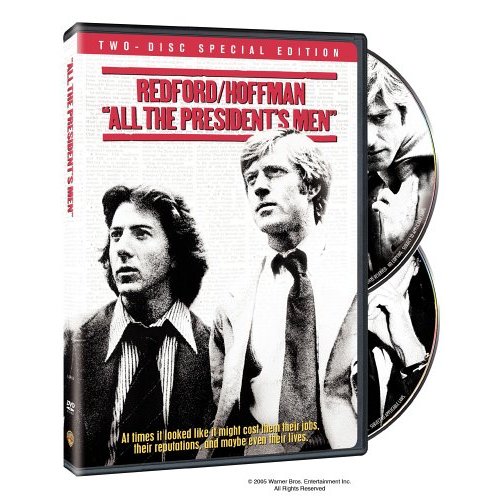
The movie

Far from it.

Woodward and Bernstein and the Post were at best modest contributors in unraveling an intricate scandal that sent to jail nearly 20 men associated with Nixon’s presidency or his 1972 reelection campaign.

Indeed, when considered against the far more decisive forces and factors that uncovered Watergate, Woodward and Bernstein’s contributions recede into near insignificance.

The decisive forces included special prosecutors, federal judges, the FBI, panels of both houses of Congress, and the Supreme Court.

Even in the face of such an array of forces, I write in Getting It Wrong, “Nixon likely would have served out his term if not for the audiotape recordings he secretly made of most conversations in the Oval Office of the White House. Only when compelled by the Supreme Court did Nixon surrender those recordings, which captured him plotting the cover-up” of the signal crime of Watergate — the breakin in June 1972 at the headquarters of the Democratic National Committee.

Notably, Woodward and Bernstein didn’t reveal existence of Nixon’s secret tapes, the contents of which proved vital in Watergate’s outcome. Nor did Woodward and Bernstein disclose the extent of the attempted coverup of the crimes of Watergate.

What’s more, principals at the Washington Post have from time to time over the years dismissed the notion that the newspaper was central in forcing Nixon’s resignation.

For example, the Post’s publisher during and after the Watergate scandal, Katharine Graham, said in 1997 at a program marking the scandal’s 25th anniversary:

“Sometimes people accuse us of bringing down a president, which of course we didn’t do. The processes that caused [Nixon’s] resignation were constitutional.”

Even Woodward has scoffed at the notion, telling American Journalism Review in 2004:

To say the press brought down Nixon, that’s horse shit.”

The cinematic version of All the President’s Men contains few references to the subpoena-wielding authorities who really did break open the scandal. Instead, the movie leads audiences to just one, misleading conclusion — that the tireless reporting of Woodward and Bernstein was vital to Watergate’s ultimate outcome.

WJC

More from Media Myth Alert: