W. Joseph Campbell

Posts Tagged ‘Getting It Wrong’

Good call: WaPo building no landmark

In Debunking, Media myths, Scandal, Washington Post, Watergate myth on September 19, 2013 at 10:59 am
A landmark?

Not a landmark

A leading preservation group in Washington, DC, has quietly decided against seeking landmark status for the Washington Post building, saying the structure isn’t distinctive enough, architecturally.

And that’s a good call.

I had suspected that landmark status would be proposed for the building because of the newspaper’s reporting of the Watergate scandal, which over the years has become a subject of a towering media myth.

The myth has it that the Post’s dogged reporting on Watergate forced Richard M. Nixon to resign the presidency.

That, of course, is a simplistic and superficial interpretation of Watergate — an interpretation not even embraced by the sometimes-arrogant Post. One of the newspaper’s lead reporters on Watergate, Bob Woodward, has declared, for example:

To say that the press brought down Nixon, that’s horseshit.”

Had the Post building been designated a landmark, a likely upshot would have to deepen the heroic-journalist myth of Watergate. Landmark status could have further entrenched the erroneous notion that the Post was the place where Woodward and his colleague Carl Bernstein wrote the stories that exposed and ended a corrupt presidency.

As I discuss in my mythbusting book, Getting It Wrong, the Post’s contributions to unraveling Watergate were very modest and not at all decisive.

To roll up a scandal of the complexity of Watergate, I write in Getting It Wrong, “required the collective if not always the coordinated forces of special prosecutors, federal judges, both houses of Congress, the Supreme Court, as well as the Justice Department and the FBI.”

And even then, Nixon likely would have served out his term if not for the forced disclosures about the audiotape recordings he secretly made of his conversations in the Oval Office of the White House.

Only when compelled by a Supreme Court ruling did Nixon surrender those recordings, which captured him plotting to cover up the signal crime of Watergate, the break-in in June 1972 at headquarters of the Democratic National Committee.

The Post reported this week that the non-profit DC Preservation League has decided that the building’s design “did not rise to a level worth preserving, despite the fact it served as the workplace for journalists who pursued stories such as the Watergate scandal that brought down President Richard Nixon.”

The Post building is pretty bland.  Without landmark status, it may be easier to sell to a developer. The Post said early this year that it was exploring the building’s sale.

Over the summer, the Post was sold to Jeff Bezos, founder of Amazon.com, who agreed to pay $250 million for the newspaper, a deal that’s expected to close in a few weeks. Bezos did not acquire the building.

Meantime, the garage in suburban Virginia where Woodward occasionally met a secret Watergate source, codenamed “Deep Throat,” may be torn down in the next few years and an office building put up in its place.

If that happens, then the historical marker next to the garage ought to be removed, too.

The marker, which was put up a little more than two years ago, errs in describing the information Woodward received from his “Deep Throat” source, who in 2005 revealed himself as W. Mark Felt, formerly the FBI’s second in command.

The marker says: “Felt provided Woodward information that exposed the Nixon administration’s obstruction of the FBI’s Watergate investigation.”

Not so.

As I’ve pointed out, such evidence “would have been so damaging and explosive that it surely would have forced Nixon to resign the presidency well before he did, in August 1974.”

Felt didn’t have that sort of information — or (less likely) he didn’t share it with Woodward.

Given the historical inaccuracy the marker ought to go.

WJC

More from Media Myth Alert:

Upcoming PBS show on ‘War of Worlds’ may reinforce media myth — in cheesy fashion

In Anniversaries, Debunking, Error, Media myths, Media myths and radio, War of the Worlds on August 29, 2013 at 11:05 am

An upcoming PBS documentary about the famous War of the Worlds radio dramatization seems certain to embrace the media myth that the show provoked panic across the United States when it aired nearly 75 years ago.

Welles and 'War of Worlds'

Orson Welles and ‘War of Worlds’

The PBS program is to be shown October 29, on the eve of the anniversary of the radio play that starred Orson Welles and cleverly told of the invasion of America by Martians wielding deadly heat rays.

A description PBS has posted online signals that its documentary, as suspected, will buy into the panic myth. The description says, in part, that “perhaps a million or more” listeners that night in 1938 were “plunged into panic, convinced that America was under a deadly Martian attack.”

PBS also says The War of the Worlds program created “one of the biggest mass hysteria events in U.S. history.” As if there have been many such events.

The ever-appealing tale of radio-inducted hysteria is one of the 10 prominent media-driven myths that I addressed and debunked in my latest book, Getting It Wrong. Simply put, the notion that The War of the Worlds convulsed America in panic and mass hysteria is Halloween’s greatest media myth.

I note in Getting It Wrong that pockets of Americans may have been frightened by the program. But there is scant evidence that many listeners acted on their fears. And being frightened is hardly synonymous with being pitched into panic and hysteria.

In overwhelming numbers, listeners to the program recognized it for what it was: An imaginative and entertaining show that aired on CBS Radio in its usual Sunday evening time slot.

I also note that had panic and mass hysteria  swept the country that night, the resulting trauma and turmoil surely would have led to many deaths and serious injuries.

But newspaper reports of the time were notably silent about extensive casualties. No deaths were attributed to The War of the Worlds broadcast.

And as Michael J. Socolow wrote in a fine essay about the program, no suicides could “be traced to the broadcast,” either.

Nonetheless, the panic myth probably is too well-known, and too entrenched in American culture, ever to be thoroughly cast aside. And the PBS program in late October may well serve to reinforce an already-tenacious media myth.

It could be a cheesy show, too. The PBS description suggests as much, saying the program will make use of “letters written to CBS, the Federal Communications Commission and Mr. Welles himself” to dramatize “the public’s reaction … with on-camera interviews, bringing to life the people who listened that night to the broadcast and thought it was rip-roaring entertainment… or the end of the world.”

(The actor outtakes posted online undeniably are cheesy.)

The PBS program, should it promote the media myth, would run counter to a substantial body of research that has dismissed or cast serious doubt on the notion Welles’ radio program caused panic and mass hysteria. In addition to my research and Socolow’s work, Robert E. Bartholomew, an authority on the phenomenon of panics, has written that many people wrongly “believe a panic took place” during and immediately after the airing of The War of the Worlds radio show.

Moreover, this month has brought publication of The United States of Paranoia, a sophisticated study of conspiracy theories in the United States. The book, written by Jesse Walker, an editor at  Reason magazine, addresses The War of the Worlds radio show and notes:

“There were indeed listeners who, apparently missing the initial announcement that the story was fiction, took the show at face value and believed a real invasion was under way. It is not clear, though, that they were any more common than the people today who mistake satires in The Onion for real newspaper reports.”

That’s very good. The producers of the PBS documentary would do well to give thought to such a telling observation.

WJC

Many thanks to Instapundit
Glenn Reynolds for linking to this post

More from Media Myth Alert:

The Nixon tapes: A pivotal Watergate story that WaPo missed

In Anniversaries, Error, Media myths, Newspapers, Scandal, Washington Post, Watergate myth on July 14, 2013 at 8:45 am

Forty years ago this week, Alexander Butterfield told a U.S. Senate select committee investigating the Watergate scandal that President Richard Nixon had installed a secret audiotaping system in his offices.

Butterfield’s disclosure was one of the most decisive moments in the Watergate. It focused the scandal’s multiple investigations into a months-long pursuit of the tapes — one of which clearly revealed Nixon’s role in attempting to cover up the crimes of Watergate. That revelation forced his resignation in August 1974.

The disclosure of Nixon’s audiotaping system was a major story which the Washington Post — often and inaccurately credited with having “uncovered” or “broken” the Watergate scandal — missed badly.

How the Post fumbled that story makes for an intriguing sidebar at the anniversary of Butterfield’s stunning disclosure. The newspaper’s lead Watergate reporters, Bob Woodward and Carl Bernstein, described in a book about their reporting how leads about the taping system were not pursued.

The book, All the President’s Men, says that Woodward had found out about private testimony that Butterfield had given to staff members of the select committee and he called Ben Bradlee, the Post’s executive editor, for guidance.

The call to Bradlee was on a Saturday night. After outlining what he knew, Woodward, according to the book, said:

“We’ll go to work on it, if you want.”
In reply, Bradlee is quoted as saying with some slight irritation, “Well, I don’t know.”

How would you rate the prospective story? Woodward asked him.

“B-plus,” Bradlee replied.

Woodward figured a B-plus wasn’t much, according to the book.

“See what more you can find out, but I wouldn’t bust one on it,” Bradlee is quoted as instructing Woodward.

And Woodward didn’t “bust one.”

Two days later, on July 16, 1973, Butterfield made his reluctant disclosure at a public session of the Senate select committee.

The following day, according to All the President’s Men, Bradlee conceded that the lead about the taping system was “more than a B-plus.”

The anecdote from All the President’s Men is suggestive of the overall minor role that the Post played in uncovering Watergate. As I point out in my media-mythbusting book, Getting It Wrong, unraveling a scandal of the dimension of Watergate “required the collective if not always the coordinated forces of special prosecutors, federal judges, both houses of Congress, the Supreme Court, as well as the Justice Department and the FBI.

“Even then, Nixon likely would have served out his term if not for the audiotape recordings he secretly made of most conversations in the Oval Office of the White House. Only when compelled by the Supreme Court did Nixon surrender those recordings, which captured him plotting the cover-up” of Watergate’s signal crime, the breakin in June 1972 at the headquarters of the Democratic National Committee.

All the President’s Men was revealing in other ways about the work and conduct of Woodward and Bernstein. Media critic Jack Shafer, in a column in 2004, revisited a number of reporting flaws and ethical lapses that Woodward and Bernstein acknowledged in their book.

It’s a roster of transgressions that is too-little remembered.

WJC

More from Media Myth Alert:

Vomit humor and scandal: Inane ‘Drunk History’ TV show promotes Watergate media myth

In Cinematic treatments, Debunking, Media myths, Scandal, Washington Post, Watergate myth on July 8, 2013 at 8:10 am

Drunk History, a new cable TV show based on the inane premise that history is entertaining when told by inebriated narrators, isn’t meant to be taken seriously.

Obviously.

Drunk History, which  debuts tomorrow night on DrunkHistory_logoComedy Central (the pilot is available online), features what the show’s  Web site says is an “often incoherent narration of our nation’s history.”

If the first episode is an indication, incoherent history makes for faint humor. Even worse, the inaugural show promotes a notably tenacious media myth in offering a chaotic look at the Watergate scandal of 1972-74.

In doing so, Drunk History draws heavily, if erratically, on the 1976 film, All the President’s Men. The movie focused on Bob Woodward and Carl Bernstein’s Watergate reporting for the Washington Post — and was central to the rise of the myth that Woodward and Bernstein brought down the corrupt presidency of Richard Nixon.

The movie as inspiration

The media myth of Watergate has helped make accessible to contemporary audiences a complex scandal that unfolded 40 years ago. But it’s an inaccurate interpretation; not even the Washington Post embraces it, as I point out in my mythbusting book, Getting It Wrong.

As Woodward said in an interview several years ago with American Journalism Review:

To say the press brought down Nixon, that’s horseshit.”

But back to the blurry first episode of Drunk History: Woodward is shown meeting “Deep Throat,” his secret Watergate source, in an underground garage in suburban Virginia. And he throws up on the source’s shoes.

Vomit humor: Now that’s inspired.

Woodward then asks “Deep Throat” — who was a senior FBI official named W. Mark Felt — for help in understanding the scandal.

“Put the pieces together, you dumbass,” Felt snaps. “It’s all in front of you. Do the work. Just be careful. Watergate is the tip of the iceberg.”

In the compressed Drunk History version of Watergate, Nixon soon realizes he has no choice but to resign.

“And in the end,” the narrator says, “you can toss aside Richard Nixon for all his cynicism, you can toss aside Mark Felt for all his cynicism, but you can’t toss aside Robert Woodward, and to a lesser extent, Carl Bernstein, for the truth that they exposed for America.”

That’s really not a bad touch, tweaking the pompous Bernstein for having had a “lesser” role in Watergate. Which is not entirely inaccurate, given that Felt was Woodward’s source. Bernstein first met Felt in 2008, shortly before Felt’s death.

“Well,” the narrator says, “we told the story of Watergate. There’s no way I could possibly misconstrue it as not the greatest journalistic endeavor ever told. Robert Woodward would be proud.”

Watergate was scarcely that.

Unraveling the scandal, as I write in Getting It Wrong, “required the collective if not always the coordinated forces of special prosecutors, federal judges, both houses of Congress, the Supreme Court, as well as the Justice Department and the FBI.

“Even then, Nixon likely would have served out his term if not for the audiotape recordings he secretly made of most conversations in the Oval Office of the White House. Only when compelled by the Supreme Court did Nixon surrender those recordings,” which captured him plotting to cover up the seminal crime of Watergate, the breakin in June 1972 at the headquarters in Washington of the Democratic National Committee.

So against the complex tableau of special prosecutors, federal investigations, and bipartisan congressional panels, Woodward and Bernstein’s contributions in unraveling the scandal were modest at best, and certainly not decisive to Watergate’s outcome.

In its tipsy way, Drunk History pokes at the conventions of documentary history, as the New Yorker has noted. Otherwise, there’s little to cheer about the show, which was a Web-based series before moving to cable. Whatever humor Drunk History projects isn’t likely to be sustaining.

A far more humorous send-up of Watergate — and of Woodward and Bernstein — is the underappreciated 1999 film, Dick. Although Woodward and Bernstein are not the central characters, the movie depicts them as antagonistic incompetents who bungle their way to a Pulitzer Prize.

WJC

Many thanks to Instapundit
Glenn Reynolds for linking to this post

More from Media Myth Alert:

Mistaking conspiracy for sloppy history in Hearst’s ‘vow’ to ‘furnish the war’

In 1897, Debunking, Furnish the war, Media myths, Newspapers, Spanish-American War, Yellow Journalism on June 29, 2013 at 3:31 pm

The media myth of William Randolph Hearst’s vow to “furnish the war” with Spain has proved irresistible in a number of ways.

Hearst in the late 1890s

Hearst, activist publisher

The vow has been invoked as evidence of the sketchy character of Hearst, an activist newspaper publisher whose “yellow journalism” brought him prominence in the closing years of the 19th century.

The vow has been cited to illustrate the potential malignant power of the news media — that at their worst, they can bring on a war.

And in a column in the weekend issue of the Wall Street Journal, the vow is offered as evidence of how conspiracy theories can double back on their makers.

Or something like that.

The fuzzy conspiracy argument is advanced by Amanda Foreman, an historian who writes the Journal’s “historically speaking” column. The latest column is of interest to Media Myth Alert in that it offers an unusual twist to Hearst’s mythical vow.

Not that Foreman is all that persuasive in advancing her conspiracy argument. What she sees as conspiracy looks a lot like sloppy history.

Like all media myths, the “furnish the war” anecdote has some factual scaffolding. But Foreman misstates a key factual element in the tale, which stems from a reputed exchange of telegrams between Hearst and the artist Frederic Remington, who went to Cuba in early 1897 for Hearst’s New York Journal.

Remington’s assignment was to draw sketches of the island-wide Cuban rebellion against Spanish rule. Soon, supposedly, the artist sought permission to return to New York, saying in a telegram that “everything is quiet.”

Hearst, in reply, is said to have told Remington:

“Please remain. You furnish the pictures, and I’ll furnish the war.”

Remington left Cuba anyway, and his sketches of the Cuban rebellion began appearing in the Journal in late January 1897.

Foreman in her column writes that Hearst was both “peddler and victim of the same conspiracy theory.”

span-am war_journal

Wasn’t the Journal’s war

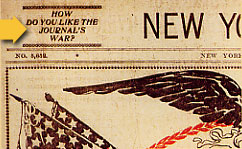
She says he promoted the notion that he fomented the conflict with Spain by proclaiming in the New York Journal in May 1898: “How do you like the Journal’s war?” But in that epigram, the Journal was taunting its rivals, not claiming responsibility for the war — an important distinction that will be discussed in some detail below.

Foreman writes that “when critics started labeling Hearst a warmonger, he became the victim of his own success” of having advanced the notion he had fomented the war.

She then introduces the “furnish the war” vow, calling it “a fictitious communiqué” that “remains the single-most quoted proof that Hearst engineered the Spanish-American War.”

Foreman says the “chief problem” with the Remington-Hearst anecdote “is that Remington was nowhere near Cuba at the time.”

But Remington was in Cuba before the war — for six days in January 1897. That he was there, on assignment for Hearst, is a component of the factual scaffolding of the “furnish the war” tale, which entered the public domain in 1901, in a book by James Creelman.

He was a journalist known for hyperbole and bluster. And he recounted the anecdote without documentation, writing:

“Some time before the destruction of the battleship Maine in the harbor of Havana [in February 1898], the New York Journal sent Frederic Remington, the distinguished artist, to Cuba. He was instructed to remain there until the war began; for ‘yellow journalism’ was alert and had an eye for the future.”

Creelman then described the purported Remington-Hearst exchange of telegrams, invoking it to praise the aggressive, anticipatory character of Hearst’s “yellow journalism.” Only years later did Creelman’s unsourced anecdote become popular as evidence of Hearst’s perfidy.

While Hearst for a time in 1898 may have thought that he had brought about the war with Spain, supporting evidence is not to be found in the pithy epigram that Foreman cites.

As I discuss in my 2001 book, Yellow Journalism: Puncturing the Myths, Defining the Legacies, context and timing matter in evaluating the epigram, which appeared in the upper-left corner, or left ear, of the New York Journal on May 8, 9, and 10, 1898.

The epigram

The Journal’s taunt

In asking “How do you like the Journal’s war?” Hearst’s newspaper, I wrote, was not boasting but “mocking the claims” of its rivals — notably the anti-war New York Evening Post, which in an editorial published April 30, 1898, accused the Journal of fomenting the war.

The following day, U.S. naval vessels destroyed a Spanish squadron in Manila Bay in the war’s first major engagement.

First reports of the naval battle appeared in U.S. newspapers on May 2, 1898. That day on its editorial page, the Journal published the portion of the Evening Post editorial accusing the Journal of fomenting the war. That assertion was derided in a headline spread across the Journal’s editorial page, which stated:

“Some People Say the Journal Brought on This War. How Do You Like It as Far as It’s Gone[?] ”

The headline and the epigram that appeared at the Journal’s left ear a few days later (“How do you like the Journal’s war?”) clearly were snarky retorts aimed at the Evening Post in the aftermath of a stunning U.S. naval victory.

When it did specifically address the notion of fomenting the war, Hearst’s Journal was far more oblique and ambiguous. For example, the newspaper stated in early May 1898:

“This war has been called a war brought on by the New York Journal and the press which it leads. This is merely another way of saying that the war is the war of the American people, for it is only as a newspaper gives voice to the American spirit that it can be influential with the American masses. The Journal is powerful with the masses because it believes in them — because it believes that on issues of national policy, their judgment is always likely to be sounder than that of the objecting few.”

The statement hardly qualifies as a ringing assertion of responsibility for bringing on the war.

WJC

More from Media Myth Alert:

Cronkite report on Vietnam was ‘most influential TV show ever’?

In Cronkite Moment, Debunking, Error, Hurricane Katrina, Media myths, Television on June 18, 2013 at 10:41 am

The most influential TV show ever?

Cronkite in Vietnam, 1968

Cronkite in Vietnam, 1968

It’s rather a thumbsucker, but it’s the topic of the “Big Question” feature in the June number of the Atlantic. And the responses, culled from TV executives, producers, and show creators, range from All in the Family, to the Simpson’s, to Saturday Night Light, to Walter Cronkite’s special report about Vietnam.

I always thought All in the Family was grating and repetitive; the Simpson’s predictable, and Saturday Night Light ever-erratic. But the Cronkite report about Vietnam, which aired February 27, 1968?

The most influential?

That’s just wrong. Factually wrong.

The Cronkite program was proposed as “most influential” by John Langley, co-creator of the series Cops, who wrote in explaining his choice:

“Public opinion followed Cronkite’s assessment, leading President Johnson to observe, ‘If I’ve lost Cronkite, I’ve lost Middle America.'”

That assessment includes a couple of important errors, to be addressed in moment.

Some background, first: Walter Cronkite, the anchor of the CBS Evening News, went to Vietnam in February 1968, shortly after the communist North Vietnamese and their Viet Cong allies launched a surprisingly extensive but ultimately failed offensive across South Vietnam.

Upon returning to New York, Cronkite prepared a report about Vietnam, describing the U.S. war effort there as “mired in stalemate” and suggesting that negotiations could offer a way out.

In the supposed reactions to Cronkite’s report lurks one the most popular and enduring myths of American journalism.

As Langley writes, American public opinion supposedly followed Cronkite: Americans were swayed, supposedly, by the assessment of someone as trusted as Cronkite, and they likewise turned against the war. President Lyndon B. Johnson, after watching Cronkite’s special report, knew his war policy was in tatters and purportedly uttered something to the effect of:

“If I’ve lost Cronkite, I’ve lost Middle America.”

In fact, public opinion had begun turning against the Vietnam War months before the Cronkite program: Cronkite followed rather than precipitated deepening doubts about the wisdom of fighting in Vietnam.

As I discuss in my media-mythbusting book, Getting It Wrong, a plurality of Americans (47 percent) told pollsters for Gallup in October 1967 that sending U.S. troops to Vietnam had been a mistake. That plurality edged upward to 49 percent in a Gallup Poll completed the day of Cronkite’s program about Vietnam.

Journalists, moreover, had detected a softening of popular support for the war.

In December 1967, for example, Don Oberdorfer, a national correspondent for Knight newspapers, reported that the “summer and fall of 1967 [had] been a time of switching, when millions of American voters — along with many religious leaders, editorial writers and elected officials — appeared to be changing their views about the war.”

LBJ: Wasn't watching Cronkite

LBJ: Wasn’t watching Cronkite

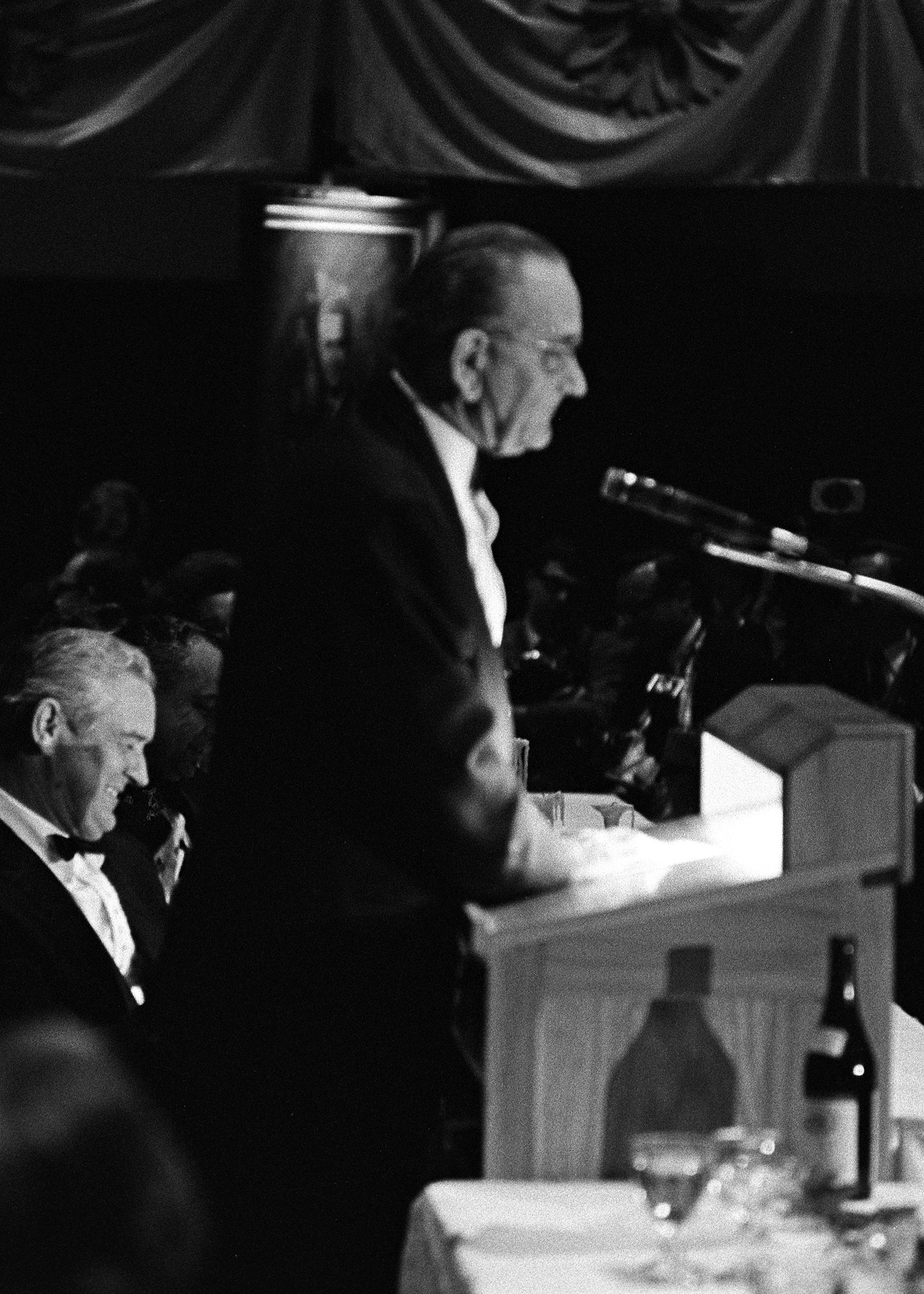
As for Johnson, he didn’t see the Cronkite report on Vietnam when it aired. He wasn’t in front a television set that night; he was in Austin, Texas, at a black-tie party marking the 51st birthday party of Governor John Connally.

And about the time Cronkite was intoning his pessimistic, “mired in stalemate” editorial comment about the war, Johnson was offering light-hearted remarks about Connally’s age.

“Today, you are 51, John,” the president said. “That is the magic number that every man of politics prays for — a simple majority.”

Cronkite’s “mired in stalemate” was an appraisal that was neither stunning nor novel in late February 1968. U.S. news organizations had been invoking “stalemate” to describe the war effort for months before the Cronkite program.

For example, the New York Times asserted in an analysis published August 7, 1967,  that “the war is not going well. Victory is not close at hand.”

The Times analysis, filed from Saigon, further declared:

“‘Stalemate’ is a fighting word in Washington. President Johnson rejects it as a description of the situation in Vietnam. But it is the word used by almost all Americans here, except the top officials, to characterize what is happening.”

The Times’ assessment appeared on its front page, beneath the headline:

Vietnam: The Signs of Stalemate.

While the Atlantic’s “Big Question” had the intended effect of stirring debate and discussion, it wasn’t nearly as intriguing as the rankings issued last year of the “most impactful moments” on U.S. television of the past 50 years. Notably, none of the top 20 was an entertainment program.

The rankings were prepared from a survey conducted by Nielsen and Sony Electronics, and topping that list was coverage of the terrorist attacks of September 11, 2001, followed by the reporting of the Hurricane Katrina disaster in 2005 and of the O.J. Simpson not-guilty verdicts in 1995.

While dramatic, the Katrina coverage, was no high, heroic moment in American journalism.

As I discuss in Getting It Wrong, the reporting on TV and in print “was in important respects flawed and exaggerated. On crucial details, journalists erred badly, and got it wrong. In the days following Katrina’s landfall, news reports described apocalyptic horror that the hurricane supposedly had unleashed.”

But few if any of the nightmarish accounts of violence, anarchy, and mayhem proved true.

WJC

More from Media Myth Alert:

‘Furnish the war’ media myth infiltrates NPR tribute to Evelyn Waugh’s ‘Scoop’

In 1897, Debunking, Error, Furnish the war, Media myths, Quotes, Spanish-American War, Yellow Journalism on June 16, 2013 at 11:07 am

Media myths often are pressed into the service of emphasis, to underscore telling points and broader themes about media performance.

Hearst in caricature, 1896

Hearst in caricature, 1896

So it is with the mythical tale about William Randolph Hearst’s vow to “furnish the war” with Spain at the end of the 19th century. The anecdote speaks to the arrogance and dangers of media power — that at their worst, the news media can even bring on war.

Which is nonsense.

Even so, “furnish the war” is a tale too tempting sometimes not to be pressed into the service of emphasis.

Which takes us to an essay posted today at the NPR’s online “You Must Read This” column, where writers discuss their favorite books. In the essay, Alexander Nazaryan of the “Page Views” blog of the New York Daily News pays tribute to Evelyn Waugh’s Scoop, a delicious send-up of war reporting that was published in 1938.

ScNPR books_logooop centers around William Boot, a hapless nature writer for the fictional London newspaper Daily Beast who inadvertently is assigned to cover the turmoil in Ishmaelia, a fictional state in East Africa.

While slow to get going, Scoop offers hilarious turns. Its portraits of arrogant, suspicious, hype-prone war reporters are entertaining and resonate even today, 75 years on.

Why the NPR essay about Scoop much matters to Media Myth Alert is that it invokes the tale about “furnish the war.”

The essay notes how the bumbling Boot inevitably incurs the wrath of editors back in London, and adds:

“After filing the kind of stories that wouldn’t get a single retweet these days, he receives an unambiguous telegram from the Daily Beast:  ‘LORD COPPER PERSONALLY REQUIRES VICTORIES.’ If that seems like rather heavy-handed satire, remember that the not-at-all-fictional Randolph William Hearst once allegedly told a correspondent in Cuba, ‘You furnish the pictures. I’ll furnish the war.'”

Actually, it’s  not “Randolph William Hearst.”

And William Randolph Hearst almost certainly never sent a message vowing to “furnish the war.”

That anecdote revolves around a purported exchange of telegrams between Hearst and Frederic Remington, the famous American artist who in January 1897 went to Cuba for Hearst’s New York Journal.

Remington’s assignment was to draw sketches about Cuba’s rebellion against Spanish colonial rule. He was in Cuba six days, then returned to New York.

Before leaving, Remington supposedly wired Hearst, saying:

“Everything is quiet. There is no trouble here. There will be no war. I wish to return.”

In reply, Hearst supposedly said:

“Please remain. You furnish the pictures, and I’ll furnish the war.”

As I discuss in my 2010 book, Getting It Wrong, reasons for doubting the Remington-Hearst exchange are many, and include the absence of documentary evidence: The telegrams supposedly exchanged by Remington and Hearst have never turned up.

Moreover, Hearst denied ever having sent such a message, and Remington apparently never discussed it.

And the tale lives on despite an irreconcilable internal inconsistency:  It would have been absurd for Hearst to have sent a message vowing to “furnish the war” because war— the Cuban rebellion against Spain’s colonial rule — was the reason Hearst dispatched Remington to Cuba in the first place.

“Anyone reading U.S. newspapers in early 1897 would have been well aware that Cuba was a theater of a nasty war,” I write in Getting It Wrong. “By then, the Cuban rebellion had reached island-wide proportion and not a single province had been pacified by Spain’s armed forces.”

The “furnish the war” anecdote first appeared in 1901, a brief passage in a slim memoir titled On the Great Highway: The Wanderings and Adventures of a Special Correspondent. The author was James Creelman, a portly, bearded, cigar-chomping journalist prone to hype and pomposity.

Creelman did not explain how or from whom he learned about the purported Remington-Hearst exchange. Creelman in January 1897 was Hearst’s correspondent in Europe, which means he wasn’t with Remington in Cuba, nor with Hearst in New York.

Creelman invoked the anecdote not to condemn Hearst, but to compliment him. For Creelman, the “furnish the war” vow was suggestive of the aggressive, anticipatory “yellow journalism” that he saw and liked in Hearst’s newspapers.

But in the mid- and late-1930s, the anecdote’s meaning shifted dramatically, to become emblematic of the supposedly wretched character of Hearst and his journalism.

The transformation made “furnish the war” a far more engaging tale, and ensured that it would live on and on. And ready to be pressed into the service of emphasis.

WJC

More from Media Myth Alert:

Ignoring nuance in the bra-burning myth

In Bra-burning, Debunking, Error, Media myths on May 30, 2013 at 9:01 am

“Myths die hard.”

So says the latest issue of the Economist magazine, in an article that addresses the nuanced myth of bra-burning.

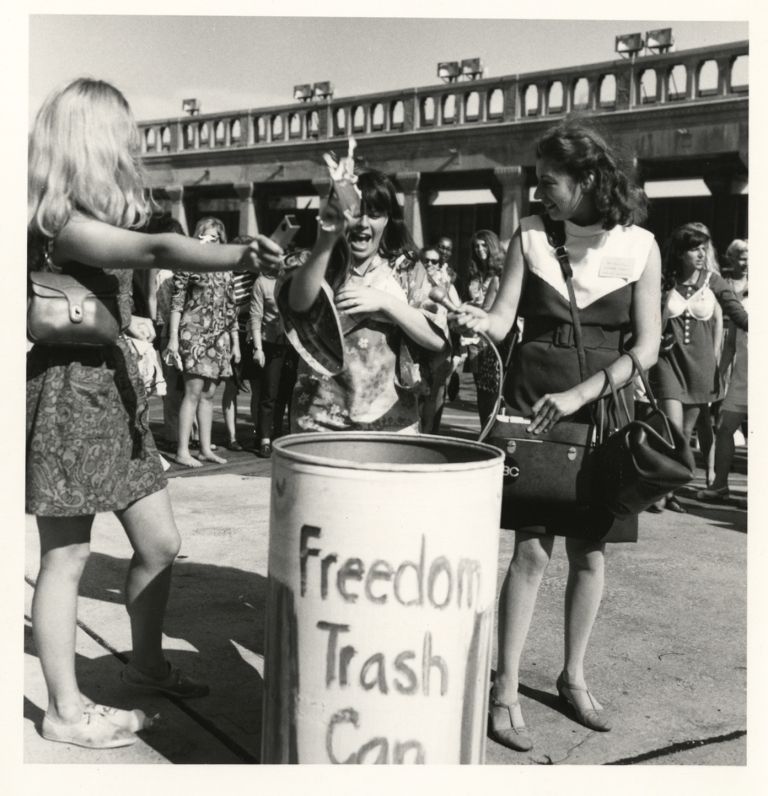
bra-burning_freedomtrashcan

At the ‘Freedom Trash Can,’ 1968

Only there’s not much nuance in the Economist’s description.

“When a handful of feminists protested at the 1968 Miss America pageant in Atlantic City,” the Economist says, “they burned no brassières. They did, however, dump a few (and make-up and high-heeled shoes) into a ‘freedom trash can,’ while also crowning a sheep.”

The syntax of that paragraph is certainly awkward. But what most interests Media Myth Alert is the assertion “they burned no brassières.”

And that’s not quite right.

As I discuss in my myth-busting book, Getting It Wrong, there is compelling evidence that bras were indeed set afire, briefly, during a women’s liberation protest on the boardwalk at Atlantic City.

That protest took place September 7, 1968, and denounced the Miss America pageant as a degrading spectacle. Demonstrators carried placards that expressed such unsubtle sentiments as: “Up Against the Wall, Miss America,” “Miss America Sells It,” “Miss America Is a Big Falsie,” and “Miss America Goes Down.”

A centerpiece of the demonstration was what the organizers called the “Freedom Trash Can.” The Economist is correct in noting that high-heel shoes and other items were tossed into that converted burn barrel.

Bras went into the Freedom Trash Can, too. And according to a first-hand account published the following day in the Atlantic City newspaper, the Press, “bras, girdles, falsies, curlers, and copies of popular women’s magazines [were] burned in the ‘Freedom Trash Can.'”

The Press account appeared beneath this headline:

“Bra-burners blitz boardwalk.”

That account was endorsed by Jon Katz, who in 1968 was a young reporter for the Press and who wrote a sidebar article about the women’s liberation demonstration.

“I quite clearly remember the ‘Freedom Trash Can,’ and also remember some protestors putting their bras into it along with other articles of clothing, and some Pageant brochures, and setting the can on fire,” Katz told me in my research for Getting It Wrong.

“I am,” he added, “quite certain of this.”

Katz also said:

“I recall and remember noting at the time that the fire was small, and quickly was extinguished, and didn’t pose a credible threat to the Boardwalk. I noted this as a reporter in case a fire did erupt.”

When the fire flickered out, Katz said, the police dragged the trash bin to the sand.

The reference to bra-burning in the Press article the day afterward as well as Katz’s recollections “offer fresh dimension to the bra-burning legend,” I write in Getting It Wrong, noting:

“They represent two witness accounts that bras and other items were burned, or at least smoldered, in the Freedom Trash Can. There is now evidence that bras and other items were set afire, if briefly, at the 1968 Miss America protest in Atlantic City.

“This evidence cannot be taken lightly, dismissed or ignored.”

However, these accounts do not support the much more vivid and popular notion that bras went up in flames that day, in a flamboyant protest on the boardwalk.

The witness accounts, I write, do not corroborate the “widely held image of angry feminists demonstratively setting fire to their bras and tossing the flaming undergarments into a spectacular bonfire.”

And yet, as the evidence presented in Getting It Wrong makes clear, “bra-burning” is an epithet not entirely misapplied to the women’s liberation demonstration at Atlantic City.

WJC

More from Media Myth Alert:

Still hardy after 40 years: The myth that Woodward, Bernstein ‘brought down’ Nixon

In Anniversaries, Debunking, Error, Media myths, Scandal, Washington Post, Watergate myth on May 17, 2013 at 10:30 am

Forty years ago today, a Senate select committee convened public hearings into the then-emergent Watergate scandal. The hearings stretched into the summer of 1973 and helped make “Watergate” a household term.

More important, the panel’s inquiry produced the disclosure that President Richard Nixon had secretly taped many of his private conversations at the White House — a revelation that was to prove decisive to the scandal’s outcome.

The most incriminating tape, released under Supreme Court directive in July 1974, captured Nixon plotting a coverup of the FBI’s investigation into the break-in at the headquarters of the Democratic National Committee in Washington in June 1972.

If not for the tapes, Nixon likely would have remained in office — a wounded and hobbled president, but one who would have completed his term.

So the Senate select committee was vital in the array of subpoena-wielding forces that produced evidence that eventually compelled Nixon’s resignation.

And yet, on this anniversary, the simplistic, media myth circulates anew — that two dogged reporters for the Washington Post, Bob Woodward and Carl Bernstein, exposed the crimes of Watergate and brought down Nixon’s corrupt presidency.

The latest to invoke what I call the heroic-journalist myth of Watergate was the executive director of the ACLU of Massachusetts, Carol Rose, who declared in a commentary for Boston’s NPR station, WBUR:

“Nixon himself was brought down by two enterprising young reporters at the Washington Post and a whistleblower by the name of ‘Deep Throat.'”

Rose’s commentary, posted yesterday at the “Cognoscenti” page of WBUR’s Web site, focused on and rightly took issue with the Justice Department’s snooping into phone records of Associated Press reporters and editors in Washington, New York, and Hartford, Connecticut.

“Lest there be any confusion: This is a big deal,” Rose says of the Justice Department’s activity. (She also writes, “Dismantle the free press, and you pretty much dismantle democracy,” which probably is to put it backwards: A free press is a marker and byproduct of democratic government, not an essential precondition.)

But what most concerns Media Myth Alert is the blithely offered claim about the work of Woodward and Bernstein — those “enterprising young reporters” to whom Rose refers.

Simply put, Woodward and Bernstein did not bring down Nixon’s corrupt presidency.

Their Watergate reporting for the Post as the scandal slowly unfolded in the summer and fall of 1972 did win a Pulitzer Prize in 1973. But Woodward and Bernstein were not central to the major disclosures of Watergate.

Notably, they did not reveal the existence of the Nixon’s tapes.

Nor did they describe the extent of the Nixon administration’s coverup of the crimes of Watergate.

Interestingly, authorities at the Post over the years have scoffed at claims that Woodward and Bernstein’s reporting took down Nixon.

Katharine Graham, the Post’s publisher during Watergate, said in 1997:

“Sometimes people accuse us of bringing down a president, which of course we didn’t do. The processes that caused [Nixon’s] resignation were constitutional.”

Woodward, himself, has pooh-poohed the notion, too. He once told an interviewer:

To say the press brought down Nixon, that’s horse shit.”

More delicately, Woodward said in an interview with the PBS “Frontline” program that “the mythologizing of our role in Watergate has gone to the point of absurdity, where journalists write … that I, single-handedly, brought down Richard Nixon. Totally absurd.”

As for the “whistleblower” Rose mentions, the shadowy “Deep Throat” source?

He turned out to be W. Mark Felt, a senior FBI official motivated not so much by whistleblowing as by high-stakes, inter-office politics.

Felt wanted the FBI top job after the death in May 1972 of the agency’s director, J. Edgar Hoover. Leaking to Woodward (Felt never met Bernstein during Watergate) was a way to pursue those ambitions — and to undercut the official who was appointed acting FBI director, L. Patrick Gray.

Felt was no noble figure. As I note in my media-mythbusting book, Getting It Wrong, he authorized burglaries as part of the FBI’s investigations into leftists associated with the radical Weather Underground.

Felt was convicted in 1980 on felony charges related to the break-ins, but was pardoned the following year by President Ronald Reagan.

WJC

More from Media Myth Alert:

Obama’s ‘Cronkite Moment’? ‘Salon’ dials up a media myth

In Cronkite Moment, Debunking, Error, Media myths, Quotes, Scandal, Television on May 14, 2013 at 6:48 pm

The online news and commentary site Salon today invokes the mythical “Cronkite Moment” of 1968 in mulling TV comedian Jon Stewart’s obscenity-laced criticism last night about the scandals battering the administration of President Barack Obama.

Salon logoStewart’s remarks on his Daily Show are evocative, Salon declares, of “one of the most famed moments in broadcasting, when CBS News legend Walter Cronkite delivered an editorial opinion after the Tet Offensive in February 1968,” in which he suggested that negotiations could offer a way out of Vietnam.

Salon adds the media myth, stating:

“Apparently watching at the White House, President Johnson, who had lost the left long ago, reportedly turned to an aide and said, ‘If I’ve lost Cronkite, I’ve lost Middle America.’ Just a few weeks later, Johnson announced he would not seek reelection.”

Salon then injects a muddled caveat, stated parenthetically: “Critics say the event has been widely misreported and overblown, but it still looms large in the American consciousness of the era, even if apocryphally.”

How’s that? It “looms large … even if apocryphally”?

Simply put, the “Cronkite Moment” is apocryphal.

And here are a few of the reasons why:

  • Johnson did not see the Cronkite program when it aired on February 27, 1968. He wasn’t at the White House, either. He was in Austin, Texas, at a black-tie party marking the 51st birthday of a longtime political ally, Governor John Connally. About the time Cronkite was intoning his commentary about Vietnam, Johnson was making light of Connally’s age, saying: “Today, you are 51, John. That is the magic number that every man of politics prays for — a simple majority.”
  • Cronkite’s on-air remarks had little to do with Johnson’s decision, announced at the end of March 1968, not to seek reelection. Far more decisive was Johnson’s eroding political support: By mid-March 1968, the president was confronting intra-party challenges from Democratic senators Eugene McCarthy and Robert F. Kennedy. And Johnson may have decided well before then against another term. He wrote in his 1971 memoir, The Vantage Point, that well before March 1968, he “had told a number of people” of his “intention not to run again.”
  • Cronkite for years rejected the notion that his on-air comments about Vietnam had had much effect on Johnson. The anchorman characterized his observations as akin to “another straw on the back of a crippled camel.” Evidence is scant, moreover, that Cronkite’s commentary had much influence on popular opinion, either. Polls had detected shifts in public sentiment against Vietnam months before Cronkite’s on-air remarks. Which means the anchorman can be said to have followed rather than have precipitated deepening disenchantment about the war.

What’s more, as I discuss in my media-mythbusting book, Getting It Wrong, Cronkite’s commentary — he also said the U.S. war effort was “mired in stalemate” — was far less emphatic than the on-air remarks not long afterward by a rival network newsman, Frank McGee of NBC News.

On March 10, 1968, McGee declared: “The war is being lost by the administration’s definition.”

Lost: No hedging there about a stalemate.

Not only does Salon indulge in media myth, its commentary probably overstates the impact of Stewart’s segment about the scandals.

The comedian was hardly direct or unrelenting in criticizing Obama. His frustration was aimed primarily at IRS and the agency’s stunning recent acknowledgement that it had singled out conservative organizations for detailed scrutiny.

As such, Stewart’s remarks are unlikely to be remembered as much of a turning point in popular views about the Obama administration.

WJC

More from Media Myth Alert: