W. Joseph Campbell

Posts Tagged ‘History’

NYTimes practices ‘yellow journalism’? How so?

In 1897, Debunking, Media myths, New York Times, Year studies, Yellow Journalism on January 14, 2011 at 8:03 am

The “Best of the Web” roundup yesterday accused the New York Times of practicing “yellow journalism” for suggesting that conservative activists and politicians bore collective responsibility for last weekend’s murderous rampage in Arizona.

Best of the Web,” an online compilation prepared by the Wall Street Journal, assailed the Times for having “seized upon a horrific crime to demonize its political opponents,” for having “instigated” an uproar “with its yellow journalism.”

The Times certainly deserves criticism for hasty and politically charged commentary about the violence in Arizona that killed six people and left Congresswoman Gabrielle Giffords severely wounded.

But to accuse the Times of “yellow journalism“?

Well, that’s absurd.

For starters, the “Best of the Web” item didn’t explain what it meant by “yellow journalism.”

The term is convenient but imprecise; it’s often invoked (though not entirely accurately) as a shorthand for the sensational treatment of the news.

More broadly, as I noted in my 2001 book Yellow Journalism: Puncturing the Myths, Defining the Legacies, “yellow journalism” is an amorphous epithet that has been applied to all sorts of journalistic misconduct. It’s a term favored by letter-writers to newspapers who denounce bias, distortion, and other presumed misdeeds in journalism.

“Yellow journalism” also finds expression in international contexts, often emerging, for example, as a complaint about press performance in India.
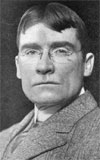
Wardman: Coined 'yellow journalism'

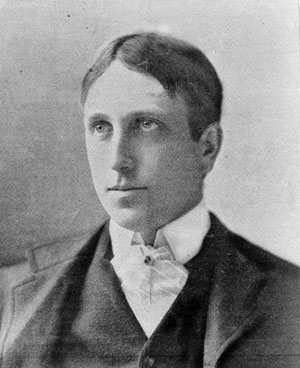
This impressively dexterous term emerged in early 1897. That was when a New York newspaper editor named Ervin Wardman coined “yellow journalism” to disparage the flamboyant newspapers of William Randolph Hearst and Joseph Pulitzer.

Hearst claimed to practice “new journalism” but came to embrace Wardman’s term. In so doing, Hearst’s flagship New York Journal was typically immodest, likening itself to the sun–“the sun which is to this earth what the Journal is American journalism.”

Yellow journalism” became a recognizable, even bold genre in the late 19th and early 20th centuries.

As I wrote in Yellow Journalism, the genre in its most developed and intense form was characterized by these features:

  • the frequent use of multicolumn headlines that sometimes stretched across the front page.
  • a variety of topics reported on the front page, including news of politics, war, international diplomacy, sports, and society.
  • the generous and imaginative use of illustrations, including photographs and other graphic representations such as locator maps.
  • bold and experimental layouts, including those in which one report and illustration would dominate the front page. Such layouts sometimes were enhanced by the use of color.
  • a tendency to rely on anonymous sources, particularly in dispatches of leading reporters.
  • a penchant for self-promotion, to call attention eagerly to the paper’s accomplishments. This tendency was notably evident in crusades against monopolies and municipal corruption.

And as I noted in Yellow Journalism, the genre as practiced more than a century ago “certainly could not be called predictable, boring, or uninspired”—complaints of the sort that often are raised about contemporary American newspapers.

Interestingly, the New York Times established itself as the antithesis of yellow journalism of the late 1890s. It often condemned the excesses of the genre, especially those of Hearst’s Journal.

Under the ownership of Adolph Ochs, who acquired the newspaper in 1896, the Times nominally sought to position itself as a staid, impartial, fact-based model of journalism that eschewed extravagance and flamboyance in presenting the news.

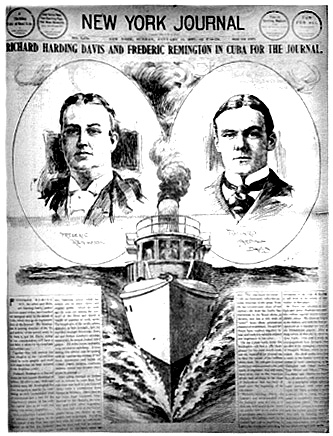
And as I wrote in my 2006 book–a year-study titled The Year That Defined American Journalism: 1897 and the Clash of Paradigms–the Times under Ochs lacked the resources of Hearst’s Journal and seldom competed in expensive and far-flung newsgathering ventures. (Hearst spent lavishly to gather the news; in 1897, he paid Richard Harding Davis the contemporary equivalent of $50,000 to report from Cuba for a month on the uprising against Spanish colonial rule.)

The Times instead sought to position itself as the sober, moral counterweight to the Journal, and periodically challenged the wisdom and ethics of that newspaper’s forays into activist journalismsuch as the case of jailbreaking journalism in 1897. That was when a reporter for the Journal organized the escape of a 19-year-old Cuban political prisoner named Evangelina Cisneros.

“Yellow journalism” has a long, varied, but not distinguished pedigree. It is to be sure a handy and supple pejorative.

But when invoked in criticism, definitional vagueness doesn’t cut it. “Yellow journalism” ought to be used with precision.

WJC

Recent and related:

Many thanks to Jim Romenesko for linking to the post.

n its most developed and intense form, yellow journalism was characterized by:

· the frequent use of multicolumn headlines that sometimes stretched across the front page.

· a variety of topics reported on the front page, including news of politics, war, international diplomacy, sports, and society.

· the generous and imaginative use of illustrations, including photographs and other graphic representations such as locator maps.

· bold and experimental layouts, including those in which one report and illustration would dominate the front page.[i] Such layouts sometimes were enhanced by the use of color.

· a tendency to rely on anonymous sources, particularly in dispatches of leading reporters (such as James Creelman, who wrote for the Journal and the World).

· a penchant for self-promotion, to call attention eagerly to the paper’s accomplishments. This tendency was notably evident in crusades against monopolies and municipal corruption.

As defined above and as practiced a century ago, yellow journalism certainly could not be called predictable, boring, or uninspired—complaints of the sort that were not infrequently raised about U.S. newspapers at the turn of the twenty-first century


[i]. See, among many other examples, “Remington and Davis Tell of Spanish Cruelty,” New York Journal (2 February 1897): 1. The front page was almost entirely devoted to a sketch by Frederic Remington to illustrate a dispatch by Richard Harding Davis about a Cuban rebel’s execution by Spanish firing squad.
The ‘anniversary’ of a media myth: ‘I’ll furnish the war’

In 1897, Anniversaries, Debunking, Furnish the war, Media myths, Newspapers, Spanish-American War, Yellow Journalism on January 13, 2011 at 7:31 am

Remington, Davis in Cuba for Hearst

Had it occurred, the legendary but improbable exchange of telegrams between William Randolph Hearst and the artist Frederic Remington–in which Hearst supposedly vowed to “furnish the war” with Spain–would have taken place in mid-January 1897.

The uncertainty as to exactly when the purported exchange occurred is one of many signals the tale is apocryphal, a media-driven myth.

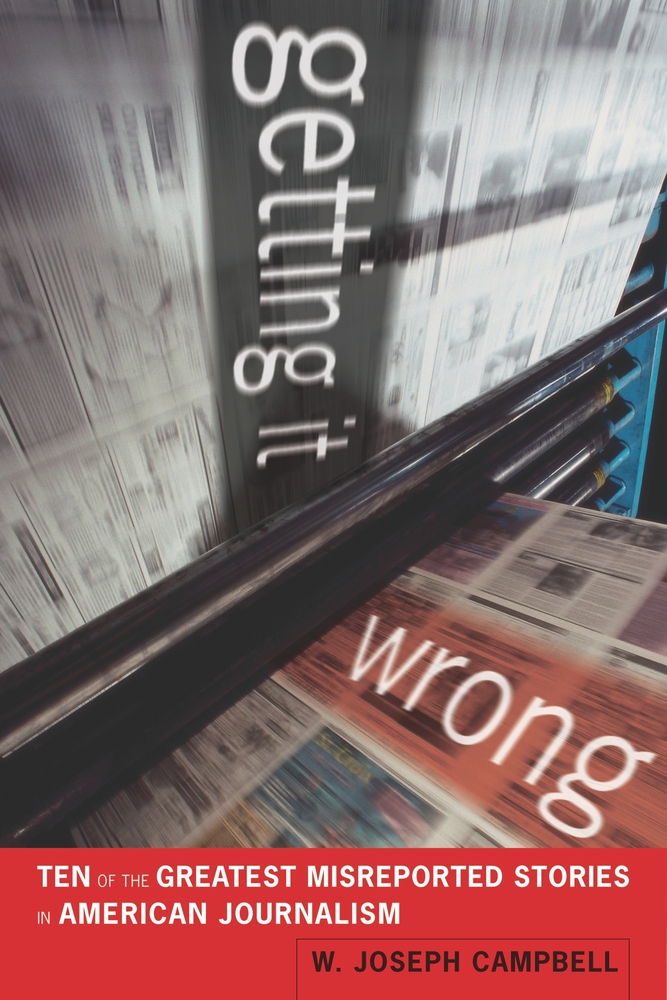
As I discuss in my media-mythbusting book, Getting It Wrong, the Remington-Hearst anecdote is “perhaps the hardiest myth in American journalism.”

It lives on in part because it is a pithy and delicious tale. It corresponds well to the image of Hearst the war-monger, the unscrupulous newspaper published who fomented the Spanish-American War in 1898.

As I point out in the first chapter of Getting It Wrong, the Remington-Hearst tale is often retold “despite a nearly complete absence of supporting documentation. It lives on even though telegrams supposedly exchanged by Remington and Hearst have never turned up. It lives on even though Hearst denied ever sending such a message.”

Moreover, I write:

The anecdote “lives on despite an irreconcilable internal inconsistency: It would have been absurd for Hearst to vow to ‘furnish the war’ because war—specifically, the Cuban rebellion against Spain’s colonial rule—was the very reason Hearst sent Remington to Cuba in the first place.”

The sole original source for the “furnish the war” quotation was On the Great Highway, a slim volume of reminiscences that came out in 1901. The author was James Creelman, a portly, cigar-chomping journalist prone to pomposity and exaggeration.

Creelman did not explain in On the Great Highway how or where he learned about the purported Remingt0n-Hearst exchange. Creelman–who was in Madrid at the time Remington was in Cuba–recounted the anecdote a not as a rebuke but as a compliment to Hearst and the activist “yellow journalism” he had pioneered in New York City.

Nor did Creelman say exactly when the presumed exchange took place, writing only that it was “some time before the destruction of the battleship Maine in the harbor of Havana” in mid-February 1898. The only time Remington was in Cuba before the explosion that destroyed the Maine was in January 1897.

Creelman: Sole source

Remington, an accomplished artist of the American West, went to Cuba in 1897 to draw sketches of scenes of the uprising against Spanish rule. He traveled with Richard Harding Davis, who then was burnishing a reputation as one of American journalism’s leading correspondents.

Hearst recruited Remington and Davis for a month, and the plan was for them to reach a force of Cuban rebels under the command of Máximo Gómez.

But Remington and Davis never reached the rebels. What’s more, they proved to be an oddly matched team. In Matanzas on January 15, 1897, they parted ways. Remington returned to Havana and the next day boarded a steamship bound for New York.

Legend has it that before leaving Havana, Remington sent Hearst a telegram that supposedly said:

“Everything is quiet. There will be no war. I wish to return.”

Hearst purportedly cabled Remington in reply:

“Please remain. You furnish the pictures, and I’ll furnish the war.”

Had it occurred, the exchange would have taken place late on January 15, 1897, or early on January 16, 1897.

Remington disregarded Hearst’s purported instructions to “remain” in Cuba. The artist was one of seven passengers aboard the Seneca when it sailed from Havana on January 16, 1897. The steamer reached New York four days later and soon afterward, Hearst’s New York Journal began publishing Remington’s sketches drawn in Cuba.

“The work was given prominent display,” I note in Getting It Wrong. Headlines in the Journal hailed Remington as a “gifted artist”–hardly the sort of accolade Hearst would have extended to someone in his employ who had brazenly disregarded instructions to remain on the scene.

That’s further reason for doubting that Hearst ever sent a telegram vowing to “furnish the war.”

And yet another reason is that Spanish censors, who controlled all incoming and outgoing cable traffic in Havana, surely would have intercepted Hearst’s inflammatory message, had it been sent. It’s highly improbable that cables such as those attributed to Hearst and Remington would have flowed readily between New York and Havana.

Additionally, the correspondence of Davis gives lie to the anecdote.

Davis wrote frequently to his family, especially to his mother, Rebecca Harding Davis. His letters make clear that  Remington did not leave because they found “everything is quiet” in Cuba.

In fact, Davis wrote on the day he and Remington parted ways:

“There is war here and no mistake.”

His correspondence offered detailed descriptions of what he called the grim process “of extermination and ruin” in Cuba.

More important, Davis’ letters make clear that Remington left for home not on the pretext that “everything is quiet,” but because Davis wanted him to go.

“I am as relieved at getting old Remington to go as though I had won $5000,” Davis wrote to his mother on January 15, 1897. “He was a splendid fellow but a perfect kid and had to be humored and petted all the time.”

Davis added that he “was very glad” Remington left “for he kept me back all the time and I can do twice as much in half the time.”

I note in Getting It Wrong that the Remington-Hearst tale was “Creelman’s singular contribution to American journalism.” The anecdote has proven to have timeless appeal, in part because it promotes what I call “the improbable notion the media are powerful and dangerous forces, so powerful they can even bring on a war.”

WJC

Recent and related:

Fact-checking WaPo columnist on the ‘McKinley moment’

In Debunking, Media myths, Spanish-American War, Washington Post, Yellow Journalism on January 12, 2011 at 7:42 am

Washington Post columnist Dana Milbank offered up a glib and flabby column yesterday, arguing that the false charges of incitement raised long ago in the McKinley assassination should serve as a cautionary reminder to the likes of Sarah Palin and Fox News commentator Glenn Beck.

They should experience what Milbank vaguely termed a “McKinley moment.”

McKinley

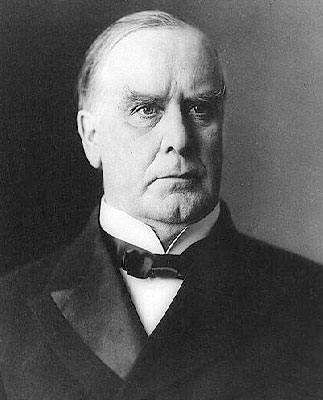
He recalled–and not entirely accurately–the efforts in 1901 to link the contents of William Randolph Hearst’s newspapers to the fatal shooting of President William McKinley.

I discussed that topic in a post Monday at Media Myth Alert, noting how extreme and wrong-headed attempts to exploit and politicize the weekend’s shooting rampage in Tucson was reminiscent of the smear campaign against Hearst following McKinley’s slaying.

The rampage in Arizona left six people dead, including a federal judge. Congresswoman Gabrielle Giffords was severely wounded.

Milbank’s column seizes on the shootings in Tuscon as a pretext to condemn the views and rhetoric of Palin and Beck, neither of whom I much care for.

Milbank began his column by declaring:

“If any good can come of the horror in Tucson, it will be that this becomes a McKinley moment for Sarah Palin and her chief spokesman, Glenn Beck.”

A “McKinley moment”? Meaning what? An occasion for self-censorship because of the insinuations and false allegations raised against them in the aftermath of the shootings in Tucson–much as false allegations were raised against Hearst following McKinley’s slaying?

Not only is “McKinley moment” an imprecise construct: It suggests that using smears to batter foes into silence is somehow worthy or admirable.

Milbank in his column briefly reviewed the false and improbable charges of incitement leveled against Hearst after McKinley was fatally shot in September 1901 and wrote:

“The outcry against Hearst’s incitement–there were boycotts and a burning in effigy–dashed his presidential ambitions.

“A similar, and long overdue, outcry has followed the Tucson killings.”

“Maybe,” Milbank added, “Beck and Palin will be good enough to show us what a real moment of silence is–by having themselves a nice long one.”

A more fitting and appropriate response from the violence in Tucson would be not to seek to mute the rhetoric of foes, but to condemn the smear, to call attention to the hazards of battering opponents with indirect and groundless allegations of incitement.

Hearst was so battered in 1901.

He, not unlike Palin and Beck, was a brash and controversial figure, easy to dislike.

Hearst’s aggressive, activist-oriented approach to newspapering–his yellow journalism–shook up New York City’s media scene in late 1890s and served as a platform for his political ambitions during the first decade of the 20th century.

But Hearst was no villain, no violence-monger. As I write in my latest book, Getting It Wrong, Hearst almost surely never vowed to bring on the Spanish-American War of 1898, although that hardy myth is often invoked and readily believed.

His newspapers were known to publish intemperate commentary, as were rival newspapers at the turn of the 20th century. And ill-advised surely defines the column written in 1900 by Ambrose Bierce, who ruminated about a bullet “speeding here to stretch McKinley on his bier.”

Milbank’s column suggested that Bierce’s commentary was published in the Hearst papers some six months before McKinley was shot.

In fact, it appeared 20 months before the assassination, in a quatrain about the fatal shooting of William Goebel, the governor of Kentucky. Bierce said he meant to call attention to risks of not finding and prosecuting Goebel’s killer.

Milbank’s column, moreover, erred in claiming the uproar that followed McKinley’s assassination “dashed” Hearst’s presidential ambitions.

Not so.

Hearst mounted a serious bid for Democratic nomination for president in 1904. He was by then a congressman, and his presidential bandwagon  gathered some momentum during the first months of that year.

In the end, though, his candidacy was doomed–not by the smears and fabrications raised after the McKinley assassination but by the reluctance of William Jennings Bryan to embrace Hearst’s bid.

Bryan, who lost presidential elections to McKinley in 1896 and 1900, had been expected to endorse Hearst for Democratic nomination in 1904. After all, Hearst had supported Bryan’s ill-fated campaigns for the presidency and had even financially supported Bryan’s travels in Europe following the 1900 election.

When Bryan did not deliver the hoped-for endorsement (thinking, perhaps, he might again emerge as the party’s standard-bearer), Hearst’s candidacy was faded, according to David Nasaw, Hearst’s leading biographer.

“Without Bryan’s endorsement,” Nasaw wrote in his 2000 work, The Chief, “Hearst had no hope of securing the votes [of convention delegates] he needed for the nomination.”

Still, Hearst pursued his bid for the nomination to the Democratic convention in St. Louis in 1904. He lost by a wide margin to Judge Alton B. Parker.

Parker in turn lost the 1904 election in a landslide to Teddy Roosevelt, who as vice president had succeeded McKinley to the presidency.

The “McKinley moment,” as Milbank used the term, seems a misnomer.

More appropriate and accurate would be to call it the “Hearst moment,” given that Hearst was the target, the victim, of distortion and falsehood.

The “Hearst moment” offers a useful and pertinent reminder about the use and effect of the smear.

WJC

Recent and related:

Many thanks to Glenn Reynolds
at Instapundit for linking to this post.

Turning to that fake Watergate line, ‘follow the money’

In Cinematic treatments, Cronkite Moment, Debunking, Media myths, Murrow-McCarthy myth, Washington Post, Watergate myth on January 11, 2011 at 8:56 am

The irresistible but entirely made-up line from the Watergate scandal–the supposed advice to the Washington Post by the anonymous source “Deep Throat” to “follow the money”–made an appearance the other day in Spokane Spokesman-Review.

The newspaper invoked the passage in a commentary about priorities of Washington’s state legislature which yesterday opened its 2011 session.

During the session, the commentary said,  “important state policy will seem to adhere to Deep Throat’s admonition on Watergate: It will follow the money.”

Follow the money.

It’s a wonderfully evocative and appealing line. But it never figured in the Watergate coverage of the Washington Post–a topic of a chapter in my latest book, Getting It Wrong.

As I’ve noted at Media Myth Alert, electronic archives containing issues of the Post show that the phrase “follow the money” never made it into print during the period of the Watergate scandal–June 1, 1972, to October 1, 1974.

Indeed, no Post article or editorial invoked “follow the money” in a Watergate-related context until June 1981–long after Richard Nixon had resigned the presidency, long after the successor who pardoned him, Gerald Ford, had lost reelection. (And the article in June 1981 merely noted the line’s use in a fifth grade play.)

“Follow the money” was, however, spoken in the movie All the President’s Men, by the character who played the anonymous and mysterious source called “Deep Throat.” The film, which dramatized the Watergate reporting of Post reporters Bob Woodward and Carl Bernstein, was based on their non-fiction book by the same title.

The actor Hal Hollbrook played “Deep Throat,” and invoked the phrase rather insistently in All the President’s Men.

In a scene showing a late-night meeting in a parking garage, Holbrook tells the Woodward character, played by Robert Redford:

“I have to do this my way. You tell me what you know, and I’ll confirm. I’ll keep you in the right direction, if I can, but that’s all. Just follow the money.”

The line’s probable author was William Goldman, the screenwriter of All the President’s Men. He told a New York Times columnist in 2005 that he had invented “follow the money” for the movie.

So why bother with all this? What difference does it make if “follow the money” is a made-up line?

For starters, misattributing “follow the money” bolsters a misleading and simplistic interpretation of the sprawling scandal that was Watergate–a scandal that sent nearly 20 of Nixon’s men to jail.

And that interpretation is what I call the heroic-journalist myth of Watergate–that it was the dogged investigative reporting of Woodward and Bernstein that brought down Nixon’s corrupt presidency.

I write in Getting It Wrong that to consider Watergate “through the lens of the heroic-journalist is to abridge and misunderstand the scandal and to indulge in a particularly beguiling media-driven myth.

“The heroic-journalist interpretation,” I add, “minimizes the far more decisive forces that unraveled the scandal and forced Nixon from office.”

And those forces included subpoena-wielding agencies and entities such as the FBI, federal grand juries, special Watergate prosecutors, bipartisan congressional panels, and ultimately the U.S. Supreme Court.

Their contributions to unraveling the Watergate scandal are minimized, and even denigrated, in the cinematic treatment of  All the President’s Men, which came out in 1976 and effectively promoted, and solidified, the heroic-journalist myth.

I point out in Getting It Wrong how media myths like the heroic-journalist meme “tend to minimize or negate complexity in historical events and offer simplistic and misleading interpretations instead. Edward Murrow no more took down Joseph McCarthy than Walter Cronkite swayed a president’s views about the war in Vietnam. Yet those and other media myths endure, because in part they are reductive: They offer unambiguous, easily remembered explanations about complex historic events.”

Speaking of reductive: I’ve meant to share this fine observation from the Financial Times commentary over the weekend that called Woodward and Bernstein’s Watergate coverage the “defining moment” in investigative reporting. The commentary was topic of a couple of recent posts at Media Myth Alert.

The essay, which was titled “The new power of the press,” noted:

“Any journalist not too full of himself to admit it reali[z]es, sooner or later, that the trade demands a facility for simplification that squeezes the most complex events, trends and characters into a limited form with limited, stereotypical narratives.”

So it is with “follow the money”: To invoke the passage is to reach for simplification, to seek an ostensibly telling phrase that can be applied widely, even to the often-dry business of a state legislature.

WJC

Recent and related:

H/T to Kenton Bird for correcting the publication city
of the Spokesman-Review (January 14, 2011).

Blaming assassination on overheated commentary: No new tactic

In 1897, Debunking, Media myths, New York Sun, Spanish-American War, Yellow Journalism on January 10, 2011 at 7:56 am

The extreme attempts to politicize the weekend shootings in Arizona were dismaying and wrong-headed, but not without parallel.

Efforts to link the attack on Democratic Congresswoman Gabrielle Giffords to overheated political rhetoric and, more explicitly, to Republican Sarah Palin and the conservative Tea Party movement were evocative of a campaign more than a century ago to blame the assassination of President William McKinley on the yellow press of William Randolph Hearst.

Czolgosz, assassin

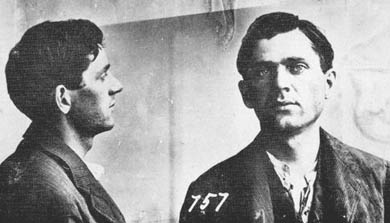
McKinley was fatally shot in September 1901 by an anarchist named Leon Czolgosz, who, according to Hearst’s finest biographer, was unable to read English.

Even so, Hearst’s foes–notably, the New York Sun–sought to tie the assassination to ill-advised comments about McKinley that had appeared in Hearst’s newspapers months earlier.

One especially ill-considered comment helped fuel the allegations: That was a quatrain written by columnist Ambrose Bierce 20 months before McKinley was shot on September 6, 1901, while greeting well-wishers in Buffalo.

Bierce’s column of February 4, 1900, closed with a reference to the assassination a few days earlier of the Kentucky governor, William Goebel. Bierce, a prickly and acerbic commentator, wrote:

The bullet that pierced Goebel’s breast
Can not be found in all the West.
Good reason: it is speeding here [to Washington]
To stretch McKinley on his bier.

As I pointed out in my 2005 work, The Spanish-American War: American Wars and the Media in Primary Documents, “The quatrain attracted little notice or comment until Czolgosz shot the president in 1901.”

Bierce later wrote, ‘The verses, variously garbled but mostly made into an editorial, or a news dispatch with a Washington date-line but usually no date, were published all over the country as evidence of Mr. Hearst’s [supposed] complicity in the crime.”

The Sun led the assault on Hearst and his flagship newspaper, the New York Journal.

Beneath the headline, “A Menace to Our Civilization,” the Sun on September 12, 1901, accused the Journal of having provoked “an atrocious Anarchistic assault on the President” and declared that yellow journalism had “graduated into a serious and studied propaganda of social revolution.”

Never, the Sun declared, “was an instrument of disorder and sedition used so effectually and none ever had so great opportunities for its malign propaganda.”

Advertisers in the Journal, said the Sun, were “feeding a monster which is using the strength they are giving nutrition to in an effort to strike down the civilization upon which they depend.”

It was of course absurd to claim that Czolgosz’s mind had been poisoned by the contents of the Hearst press. Few other New York City newspapers were inclined to pick up the cudgel, even though not many admired Hearst’s activist-oriented journalism.

And as media scholar Brian Thornton noted in a fine journal article in 2000, “most of the attack against Hearst” in the aftermath of the McKinley shooting was sustained by letters to the editor of the Sun, not by the newspaper’s editorials.

The Sun, it should be noted, had long campaigned against Hearst, having urged in early 1897 a readership boycott of the yellow press, an effort that drew attention but ultimately collapsed.

Hearst

Still, the uproar in 1901 stunned Hearst. David Nasaw, Hearst’s leading biographer, wrote that perhaps for “the first time in his life, Hearst was forced onto the defensive.”

In response, Hearst renamed the Journal the Journal and American, to assert the newspaper’s patriotism. Eventually, he dropped the “Journal” from the nameplate altogether.

Hearst could take a measure of comfort in the insightful and level-headed commentary of journals such as The Bookman, which dismissed the criticism as preposterous.

“As a matter of fact,” The Bookman said in its December 1901 number, “it cannot be shown that any President ever lost his life because his assassins were influenced by the reading of newspaper denunciation.”

The Bookman also noted:

“Indeed, the most severe attacks on President McKinley’s policy were not attacks for which the so-called ‘yellow journals’ were responsible, but they were attacks uttered by such sincere and high-minded men as Senator [George] Hoar and ex-Secretary [Carl] Schurz–both of them Republicans–and by newspapers of great ability, such as the Evening Post” of New York.

The Bookman added:

“It is unthinkable that a press censorship should ever be established in our country; for in its practical operation it would mean that the opposition would have to abstain from all newspaper criticism of the party in power.”

There are in The Bookman commentary echoes of well-reasoned and insightful commentary written in the aftermath of the rampage in Arizona that left six people (a federal judge among them) dead and Giffords clinging to life.

Notably, media critic Jack Shafer pointed out in a column posted yesterday at slate.com that only “the tiniest handful of people—most of whom are already behind bars, in psychiatric institutions, or on psycho-meds—can be driven to kill by political whispers or shouts.

“Asking us to forever hold our tongues lest we awake their deeper demons,” Shafer wrote, “infantilizes and neuters us and makes politicians no safer.”

He’s absolutely right.

And to seize on political shootings to score political points is as appalling as it is unworthy.

WJC

Recent and related:

The elusive ‘defining moment’ in investigative journalism

In Cinematic treatments, Debunking, Media myths, New York Times, Newspapers, Washington Post, Watergate myth on January 9, 2011 at 8:59 am

The Financial Times of London has asserted that the Watergate reporting of the Washington Post stands as the “defining moment” in investigative reporting–a claim I challenged yesterday.

Not the Post's doing

The notion that the Post and its reporters Bob Woodward and Carl Bernstein brought down Richard Nixon’s corrupt presidency in the Watergate scandal is a hardy meme–and is one of 10 prominent media-driven myths I debunk in my latest book, Getting It Wrong.

The heroic-journalist trope has been driven principally the cinematic version of Woodward and Bernstein’s book about their Watergate reporting, All the President’s Men. The movie’s inescapable message was that the work of reporters brought about Nixon’s resignation in 1974.

But even principals at the Post over the years have dismissed the heroic-journalist interpretation of Watergate.

So if not Watergate, what then was the “defining moment” in investigative reporting?

And how’s “defining moment” to be defined, anyway? The essay in the Financial Times didn’t say.

I argue that the “defining moment” in investigative reporting would have to be that collection of reports recognized years afterward as a landmark in journalism, for having exposed corruption or misconduct. The reports would have been so significant as to have changed government policy and/or altered practices among journalists.

Not many media investigations have had such profound and lasting effect. As Jack Shafer of slate.com has correctly noted:

“Too many journalists who wave the investigative banner merely act as the conduit for other people’s probing.” That is, they often feed off government-led investigations. Woodward and Bernstein did so, to an extent.

A review of the Pulitzer Prizes awarded for investigative reporting over the past 25 years turns up impressive and intriguing candidates. But most winners of the Pulitzer for investigative journalism are local and decidedly narrow in focus and impact; none of them meets my definition of “defining moment.”

The Post won the 2008 Pulitzer for public service for its outstanding reports about abuses at the Walter Reed Army hospital. The first installment of the Post series described the venerable institution as “a holding ground for physically and psychologically damaged outpatients.”

It was a shameful scandal that led to much soul-searching, some reforms, and a few broken careers in Army medicine. The series projected a faint whiff of controversy, too, because conditions at Walter Reed had been the subject of somewhat similar reporting two years earlier by salon.com.

The Boston Globe in 2003 won the public service Pulitzer for its reports about sexual abuse among Roman Catholic priests–a series that seems to have stood up well over time and perhaps qualifies as landmark in investigative reporting.

But is it widely recognized and remembered as such? I don’t think so.

A few media historians have identified the so-called “Arizona Project” in the 1970s as landmark investigative journalism.

The Arizona Project brought together reporters and editors from 23 newspapers, in response to a call by the Investigative Reporters and Editors organization to conduct a collaborative inquiry into the bombing death of Don Bolles, an investigative reporter for the Arizona Republic.

The project produced 40 articles about organized crime in Arizona.

David Sloan and Lisa Mullikin Parcell wrote in their book, American Journalism: History, Principles, Practices that the Arizona Project “was a defining moment in the history of investigative reporting–a rare instance when normally competitive journalists set aside their egos, stepped outside their news organizations, and cooperated on a dramatic and startling story.”

But in all, the Arizona Project produced mixed results.

It didn’t lead to a succession of similar joint ventures by journalists. Prominent news organizations such as the Post and the New York Times declined to participate. And critics said the undertaking smacked of a kind of arrogant vigilantism by journalists.

The Financial Times in its essay published Friday mentioned in addition to the Watergate reporting by the Post a few other works of outstanding investigative journalism.

It said the journalistic “exposures such as The Sunday Times on the effects of Thalidomide in the 1970s, The Guardian on bribery scandals in British Aerospace in 2003 and The New Yorker’s revelations about abuses in Iraq’s Abu Ghraib prison in 2004″ have prominent places on “a long roll of honor” in investigative journalism.

Intriguing cases, all. But are they recognized as landmarks? Maybe.

Tarbell (Library of Congress)

How about the muckraking period early in the 20th century–notably Ida Tarbell’s two-year exposé of Standard Oil, published in McClure’s magazine from 1904 to 1906? That work certainly is recognized as memorable, as a landmark, even.

But its effects tend to have been overstated. Tarbell’s work, detailed and searching though it was, did not bring about the breakup of Standard Oil, as is often claimed.

The breakup came years after Tarbell’s series, when the U.S. Supreme Court ruled in 1911 that Standard Oil had violated antitrust laws.

In the end, we have a few candidates but no overwhelming favorite for the “defining moment” in investigative journalism. And perhaps that’s not so surprising.

Like most works of journalism, investigative reporting tends to be time-specific and of transient importance–and short-lived in its effects.

WJC

Recent and related:

The ‘defining moment’ in investigative journalism? Wasn’t Watergate

In Cinematic treatments, Debunking, Media myths, Newspapers, Watergate myth, Yellow Journalism on January 8, 2011 at 9:03 am

The “defining moment” in investigative journalism? Well, that had to be the Watergate reporting of the Washington Post in the early 1970s.

So says Britain’s serious-minded Financial Times in a commentary published yesterday.

The newspaper, however, offered no persuasive evidence for the Post-Watergate claim beyond asserting:

“Investigative reporting has been one of the strongest developments of postwar journalism, illuminating government deceit, corporate fraud and criminal activity. The reporting of Bob Woodward and Carl Bernstein for The Washington Post in the early 1970s on the illegal efforts of Nixon’s White House to destabilise the Democratic party remains its defining moment.”

Was it, really, the “defining moment”? The Post certainly practiced some solid journalism in reporting the unfolding Watergate scandal; its coverage after all won the Pulitzer Prize for public service in 1973.

But the defining moment of investigative reporting?

I argue “no, not at all,” in my latest book, Getting It Wrong, which addresses and debunks 10 prominent media-driven myths–among them the heroic-journalist interpretation of Watergate.

The heroic-journalist meme has it that Woodward and Bernstein’s dogged reporting about the Watergate scandal brought down Richard Nixon’s corrupt presidency. (Nixon resigned in 1974, in the face of certain impeachment and conviction for his role in seeking to coverup the Watergate scandal.)

“The heroic-journalist has become the most familiar storyline of Watergate,” I write in Getting It Wrong. That interpretation, I add, is “ready short-hand for understanding” Watergate, “a proxy for grasping the scandal’s essence while avoiding its forbidding complexity. How the Post and its reporters uncovered Watergate is deeply ingrained in American journalism as one of the field’s most important and self-reverential stories.”

But that doesn’t make it the “defining moment” in investigative reporting.

The reporting by the Post certainly did not bring down Nixon’s presidency. To embrace that interpretation is, I write, “to indulge in a particularly beguiling media-driven myth.

“The heroic-journalist interpretation minimizes the far more decisive forces that unraveled the scandal and forced Nixon from office”–including the collective efforts of such subpoena-wielding agencies and entities as the FBI, federal grand juries, special prosecutors, bipartisan congressional panels, and ultimately the U.S. Supreme Court.

Not even the Post embraces the heroic-journalist interpretation of Watergate.

For example, the newspaper’s publisher during the Watergate period, Katharine Graham, insisted the Post did topple Nixon. In 1997, at a Newseum program marking the 25th anniversary of the break-in at Democratic headquarters–the Watergate’s seminal crime–Graham declared:

“Sometimes people accuse us of bringing down a president, which of course we didn’t do,” she said. “The processes that caused [Nixon’s] resignation were constitutional.”

And in 2005, Michael Getler, then the newspaper’s ombudsman, declared in his column:

“Ultimately, it was not The Post, but the FBI, a Congress acting in bipartisan fashion and the courts that brought down the Nixon administration.”

I note in Getting It Wrong that Woodward and Bernstein “did not uncover defining and decisive elements of the Watergate scandal—the cover-up and the payment of hush money to the Watergate burglars.”

Those aspects of the scandal, Woodward was quoted as saying in 1973, were “held too close. Too few people knew. We couldn’t get that high.”

Nor did they disclose the secret audiotaping system that Nixon had installed at the White House; the recordings of his private conversations about Watergate proved decisive in the scandal’s outcome.

If not Watergate, then what was the “defining moment” in investigative reporting–the genre’s most decisive and lasting contribution?

I’ll take up that question tomorrow at Media Myth Alert.

WJC

Recent and related:

WaPo journo on Jessica Lynch story rejoins paper

In Debunking, Jessica Lynch, Media myths, Newspapers, Washington Post on January 6, 2011 at 8:50 am

Vernon Loeb, one of the Washington Post reporters who in 2003 wrote the botched story about Jessica Lynch’s purported battlefield heroics in Iraq, is returning to the newspaper as its local editor.

Washington Post, April 3, 2003

The electrifying but erroneous story about Lynch, then a 19-year-old Army private, turned her into the single most recognizable soldier of the Iraq War.

In a front-page report published April 3, 2003, the Post anonymously cited “U.S. officials” in saying that Lynch “fought fiercely” in the ambush of her unit in southern Iraq, that she had “shot several enemy soldiers,” and that she had fired her weapon “until she ran out of ammunition.”

But the hero-warrior narrative–published beneath the bylines of Loeb and Susan Schmidt–was untrue.

Lynch did not fire her weapon in the ambush. Nor was she shot and stabbed, as the Post reported.

I examine the Lynch case in my latest book, Getting It Wrong, noting how the Post account of her supposed derring-do “became a classic illustration of intermedia agenda-setting: News organizations around the world followed the Post’s lead by prominently reporting the supposed heroics of young Jessica Lynch and contemplating their significance.”

Not surprisingly, the Post in announcing yesterday that Loeb was returning neither mentioned nor hinted at his role in reporting the Lynch story. The Post memo did describe Loeb as “a tremendously talented, high-energy journalist, whose enthusiasm for what we do is infectious.

“In his new job, he will drive our coverage of the region, ensuring we are serving our readers, both print and digital, the smartest, freshest and most authoritative news and features on the issues that matter most to them. It’s a good match: this is a highly competitive market, and Vernon is an intensely competitive editor.”

The memo also said Loeb has run marathons and is an ardent fan of the Philadelphia Phillies baseball team. (The DCist blog noted that Loeb’s Twitter account has been silent for several months.)

Loeb returns to the Post on February 1, following a stint as deputy managing editor for news at the Philadelphia Inquirer. He had left the Post in 2004 to become an investigations editor at the Los Angeles Times.

I once tried to speak with Loeb about the Lynch case. I called him at the Inquirer in 2008, while I was researching Getting It Wrong; he abruptly hung up on me.

I wanted to ask Loeb about the sources behind the Lynch story. I also wanted to ask him about the interview he gave to the NPR Fresh Air show in late 2003, during which he said the Pentagon was not the source for the Post story.

In the years since, the dominant narrative has become that the Pentagon concocted the story about Lynch’s heroics and fed it to the Post in order to boost American support for the war.

But in the interview on Fresh Air, Loeb said he “could never get anybody from the Pentagon to talk about” the Lynch case.

“They wouldn’t say anything about Jessica Lynch,” Loeb said on the show.

“I just didn’t see the Pentagon trying to create a hero where there was none,” he added. “I mean …they never showed any interest in doing that, to me.”

Moreover, he declared:

“Our sources for that story were not Pentagon sources.”

Loeb described them as “some really good intelligence sources” in Washington, D.C.

And he added:

“We wrote a story that turned out to be wrong because intelligence information we were given was wrong. That happens quite often.”

And yet, the false narrative about the Pentagon’s having made up the story about Lynch’s heroics endures, and has become dominant. It fits well with a curdled popular view about the war in Iraq.

I’ve called before at Media Myth Alert for the Post to knock down the false narrative about the Lynch case and disclose the identify of its sources on that story.

If they weren’t “Pentagon sources,” then who were the “U.S. officials” who supplied the erroneous account about Lynch? Why should they be continue to be protected with anonymity, given that they clearly provided inaccurate information?

Loeb should say, especially since his new job at the Post will include “ensuring [that] we are serving our readers” in an “authoritative” way.

WJC

Recent and related:

Murrow, Cronkite myths cited in Poland’s top paper

In Cronkite Moment, Debunking, Media myths, Murrow-McCarthy myth, New York Times, Newspapers, Watergate myth on January 4, 2011 at 10:25 am

I’ve discussed from time to time at Media Myth Alert how media-driven myths about the U.S. news media have a way of traveling well and finding expression in news outlets overseas.

Watergate-related myths are notable examples of this tendency.

A couple of prominent media myths popped up yesterday in an article posted at the online site of Gazeta Wyborca, the leading daily in Poland and a newspaper with a remarkable past.

Gazeta Wyborca traces its lineage to what was the leading underground newspaper in Poland of the 1980s, Tygodnik Mazowsze. The clandestine title appeared under the noses of Poland’s communist authorities, week after week, from 1982 to 1989–some 290 issues in all.

Tygodnik Mazowsze was run almost entirely by women affiliated with Poland’s then-banned Solidarity opposition. When the country’s communist rulers permitted Solidarity candidates to stand in elections in 1989, one of the conditions was that the movement be permitted to publish an above-ground newspaper.

So the staff of Tygodnik Mazowsze moved up from the underground to launch Gazeta Wyborca, which means “electoral newspaper.” In the years since, Gazeta has become the dominant news outlet in Poland, which now is a thriving democracy.

Gazeta yesterday referred to the debate that bubbled last week in U.S. news media over a New York Times article that likened TV comedian Jon Stewart to legendary CBS newsman Edward R. Murrow.

Gazeta noted that U.S. news media “triumphantly” mentioned “cases in which journalists have changed the course of history” and referred to Murrow’s “instrumental” role in ending Senator Joseph McCarthy’s communists-in-government witch-hunt.

It also noted CBS anchorman Walter Cronkite’s criticism of the Vietnam War in 1968, which supposedly forced President Lyndon Johnson to realize his war policy was a shambles.

It’s too bad Gazeta didn’t point out that both cases are media-driven myths.

As I discuss in my latest book, Getting It Wrong, Murrow was quite late in confronting McCarthy, doing so most prominently in a half-hour television program that aired March 9, 1954.

That show came months, even years after other American journalists–notably, syndicated columnist Drew Pearson–had reported critically, closely, and often about McCarthy and his exaggerated charges.

“To be sure,” I write in Getting It Wrong, “it wasn’t as if Americans in early 1954 were hoping for someone to step up and expose McCarthy, or waiting for a white knight like Murrow to tell them about the toxic threat the senator posed.”

By then, they knew all too well.

Nor was Cronkite at the cutting edge of criticism of the U.S. war effort in Vietnam.

Far from it.

The CBS anchorman declared in a televised special report on February 27, 1968, that the U.S. military was “mired in stalemate” in Vietnam.

LBJ in Texas, February 27, 1968

But that scarcely was a remarkable assertion.

As I note in Getting It Wrong, stalemate” had been appearing as early as the summer of 1967 in New York Times editorials and analyses about the war.

What supposedly made the Cronkite characterization stand out is that President Johnson saw the program and, as it ended, said to an aide or aides, “If I’ve lost Cronkite, I’ve lost Middle America.”

Or something to that effect.

But in fact, Johnson wasn’t in front of a television set that night. He didn’t see the Cronkite program when it aired.

At the time Cronkite was intoning his “mired in stalemate” assessment, Johnson was offering light-hearted banter in Austin, Texas, at the 51st birthday party of one of his longtime political allies, Governor John Connally.

So it’s difficult to fathom how Johnson could have been much moved by a program that he hadn’t seen.

WJC

Recent and related:

Excess praise for Edward R. Murrow

In Debunking, Media myths, Murrow-McCarthy myth, New York Times on January 2, 2011 at 10:59 am

Edward R. Murrow, the legendary CBS newsman who died in 1965, has been back in the news of late, owing to the facile suggestion by the New York Times that TV comedian Jon Stewart is Murrow’s “modern-day equivalent.”

Murrow the legendary

Absurd though it was, the comparison in the Times served to train attention anew on Murrow and on his famous 30-minute television program of March 9, 1954, which supposedly helped end the communists-in-government witch-hunt of Senator Joseph R. McCarthy.

The latest iteration of that theme find expression today in a commentary in South Bend Tribune in Indiana, which revisits the Times-Stewart-Murrow tempest and asserts that “in broadcast journalism history, Murrow was a giant of his time, honored for turning the spotlight in 1954 on the witch-hunt excesses of Sen. Joseph McCarthy, ‘McCarthyism,’ and helping to bring the demagogue’s downfall.”

Murrow certainly was a preeminent figure in American broadcast journalism, having won fame for his radio reports from London during World War II and for his weekly, documentary-style television program, See It Now, which was launched in 1951.

But to argue that Murrow turned the spotlight on the excesses of McCarthyism, and to claim Murrow helped bring about McCarthy’s downfall–well, that’s excess praise.

As I point out in Getting It Wrong, my mythbusting book published last year, the See It Now program on McCarthy in 1954 was neither pivotal nor decisive, in part because Murrow was following the spotlight when he turned attention to McCarthy and his excesses.

That is, Murrow was quite late in taking on McCarthy, doing so long after other journalists–among them muckraking columnist Drew Pearson–had become persistent and searching critics of the senator, his record, and his tactics.

As I write in Getting It Wrong,  Murrow’s friend and CBS colleague Eric Sevareid chafed at the misleading interpretation attached to the See It Now program on McCarthy which, he noted, “came very late in the day.”

Sevareid said in 1978:

“The youngsters read back and they think only one person in broadcasting and the press stood up to McCarthy and this has made a lot of people feel very upset, including me, because that program came awfully late.”

And in the days and weeks following the See It Now program on McCarthy, Murrow acknowledged the show’s contributions were modest, that it had at best reinforced what others had long said about McCarthy.

Jay Nelson Tuck, the television critic for the New York Post, wrote in April 1954 that Murrow felt “almost a little shame faced at being saluted for his courage in the McCarthy matter. He said he had said nothing that … anyone might not have said without a raised eyebrow only a few years ago.”

And Murrow’s collaborator and co-producer, Fred W. Friendly, rejected claims the See It Now program was decisive. Friendly wrote in his memoir, Due to Circumstances Beyond Our Control:

“To say that the Murrow broadcast of March 9, 1954, was the decisive blow against Senator McCarthy’s power is as inaccurate as it is to say that Joseph R. McCarthy … single-handedly gave birth to McCarthyism.”

These were not assertions of false modesty. McCarthy’s tactics, after all, had become quite well-known by March 1954. As I write in Getting It Wrong, it wasn’t as if Americans then “were waiting for a white knight like Murrow to tell them about the toxic threat the senator posed.”

From the work of Pearson and other journalists, they already knew.

'Best of Person to Person'

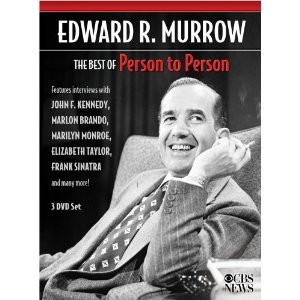
While Murrow may have been a giant in American broadcasting, he did a fair share of puff-ball journalism, too. Besides the See It Now program, Murrow conducted mushy interviews with the likes of Marilyn Monroe, Elizabeth Taylor, Marlon Brando, and other celebrities of the 1950s on his highly rated Person to Person show on CBS.

As Jack Shafer of slate.com has argued: “If we’re going to praise Murrow for producing fearless TV news, we should also be ready to damn him for paving the way for Barbara Walters, Oprah Winfrey, and all the celebrity bootlickers on red carpets.”

It should be noted that Murrow was no white knight, either. He privately tutored Adlai Stevenson, the Democratic presidential candidate in 1956, on speaking to the TV camera. In addition, Murrow claimed a master’s degree that he never earned, and inflated his speech major at Washington State University to a degree in international relations and political science.

I mention this not to dismiss Murrow’s contributions, but to argue for context about an important though flawed figure in American journalism–and to challenge as one-dimensional and misleading the mythic image of Murrow as “a giant of his time.”

WJC

Recent and related: