W. Joseph Campbell

Posts Tagged ‘Washington Post’

Why history is badly taught, poorly learned

In Cinematic treatments, Debunking, Media myths on June 19, 2011 at 12:41 pm

I’m not much a fan of the work of David McCullough, the award-winning popular historian whose latest book is the well-received The Greater Journey: Americans in Paris.

I couldn’t get through McCullough’s acclaimed 1776, a military history of a decisive year in American life that oddly had little to say about the Declaration of Independence.

But McCullough, in an interview published in yesterday’s Wall Street Journal, offered several provocative and telling points about why American history is so badly taught and so poorly grasped.

The splintered state of historical studies is one of the factors, McCullough said, adding:

“History is often taught in categories — women’s history, African American history, environmental history — so that many of the students have no sense of chronology. They have no idea what followed what.”

That’s a fair point. History by interest group can be an invitation to incoherence.

McCullough also pointed out that textbooks on history tend to “so politically correct as to be comic. Very minor characters that are currently fashionable are given considerable space, whereas people of major consequence … are given very little space or none at all.”

What’s more, as McCullough noted, textbooks often are tedious, boring, and poorly written. Historians by and large “haven’t learned to write very well,” McCullough wrote.

Although McCullough didn’t mention this in the interview, learning history can be frustrating because history is prone to error, distortion, and myth.

History quite simply can be myth-encrusted — and unlearning the myths of history can be challenging, time-consuming, and often unrewarding.

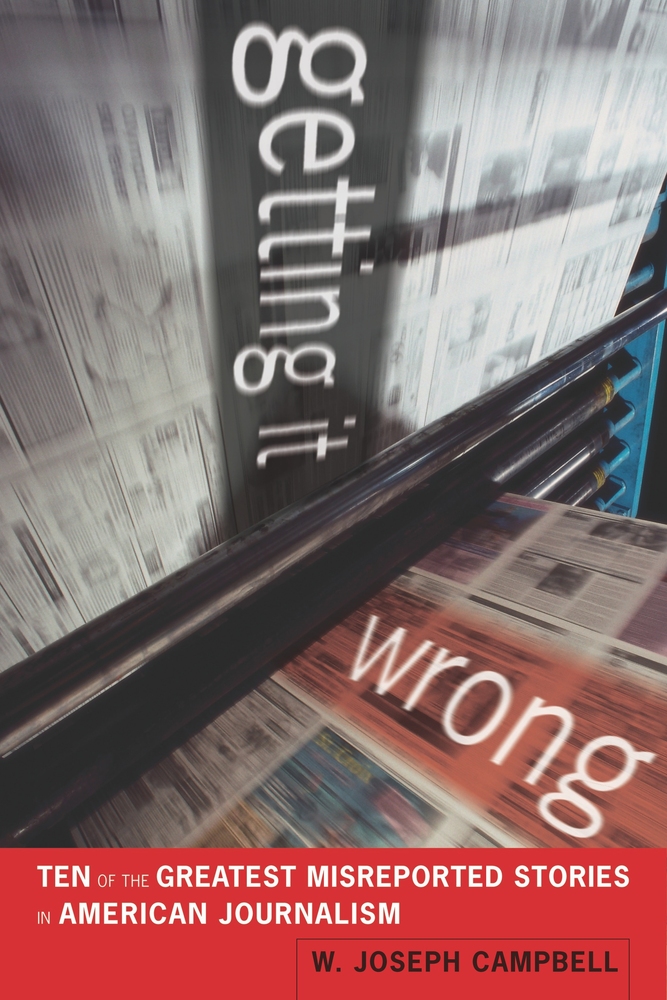
As I discuss in Getting It Wrong, my media-mythbusting book that came out last year, myths in history spring from many sources, including the timeless appeal of the tale that’s simple and delicious.

A telling example is the undying tale about William Randolph Hearst’s purported vow in an exchange of telegrams with Frederic Remington to “furnish the war” with Spain at the end of the 19th century.

As I discuss in Getting It Wrong, among the many reasons for doubting that anecdote are Hearst’s denial and the absence of any supporting documentation. The Remington-Hearst telegrams have never surfaced.

But the tale lives on, as an appealing yet exceedingly simplified explanation about the causes of the Spanish-American War and as presumptive evidence of Hearst’s madcap and ethically compromised ways.

The urge to simplify history also explains the tenacity of the so-called “Cronkite Moment” of 1968, when the CBS News anchorman’s assessment of the Vietnam War as a “stalemate” supposedly prompted President Lyndon Johnson to realize the folly of his war policy and not to seek reelection.

However, as I discuss in Getting It Wrong, Johnson did not see the program when it aired, and Cronkite until late in his life claimed his “stalemate” assessment had at best modest influence, that it was “another straw on the back of a crippled camel.”

And even that effect was probably exaggerated.

But the notion that the “Cronkite Moment” was powerful and decisive has been promoted by many historians, notably David Halberstam in his error-riddled The Powers That Be.

The cinema, too, often injects error and misunderstanding into historical topics.

Hollywood’s treatment of Bob Woodward and Carl Bernstein’s investigative reporting for the Washington Post is an important reason why many people erroneously believe that Woodward and Bernstein brought down Richard Nixon’s corrupt presidency.

Good history and successful cinema are quite often at odds, as Richard Bernstein noted in a memorable essay published several years ago in the New York Times.

“Artists who present as fact things that never happened, who refuse to allow the truth to interfere with a good story, are betraying their art and history,” Bernstein wrote.

So there are plenty of reasons beyond McCullough’s useful observations as to why American history is so poorly understood.

It may always be that way. After all, as the Scottish historian Gerard De Groot has noted, history is “what we decide to remember.

“We mine the past,” he has written, “for myths to buttress our present.”

WJC

Recent and related:

Commodity markets and Watergate’s most famous made-up line

In Cinematic treatments, Debunking, Media myths, Washington Post, Watergate myth on June 15, 2011 at 7:56 am

Follow the money,” that famous and dramatic line about the Watergate scandal, was made up for the cinema.

Not in this book

But because it’s so pithy and compelling, the passage is routinely treated as if it had been advice vital to unseating President Richard Nixon and unraveling the greatest scandal in American politics.

The Reuters wire service yesterday offered “follow the money” as if it were genuine, stating in a dispatch posted at the Commodities Now online site:

“‘Follow the money,’ FBI Deputy Director Mark Felt (‘Deep Throat’) told Washington Post reporters Bob Woodward and Carl Bernstein during their investigation into the Watergate break ins. It remains good advice for participants in commodity markets.”

Follow the money” may well be sound guidance for commodities brokers. But in the Watergate scandal, the line had relevance and as dramatic effect only in the movies.

Felt — whose family disclosed in 2005 that he had been the fabled “Deep Throat” source of the Washington Postdidn’t offer such guidance to Woodward during their periodic meetings in 1972 and 1973 as the scandal unfolded. Felt, moreover, never spoke with Bernstein during Watergate.

Nor does the advice to “follow the money” appear in All the President’s Men, Woodward and Bernstein’s book about their Watergate reporting. And the line can’t be found in any Watergate-related article or editorial in the Washington Post before 1981.

The derivation of the line lies in the screenplay of All the President’s Men, the cinematic version of Woodward and Bernstein’s book. The movie came out 35 years ago and has been seen by millions of people, easily qualifying it as the most-viewed film about Watergate.

All the President’s Men included a boffo performance by Hal Holbrook who played the stealthy, conflicted “Deep Throat” character.

Holbrook advised the Woodward character, played by Robert Redford, to “follow the money” — and did so with such quiet assurance and insistence that it sure seemed as if the guidance were vital to rolling up Watergate.

But had the advice indeed been given to Woodward, “follow the money” would’ve have taken the reporter only so far. Watergate, after all, was a scandal far more complex than the misuse of campaign monies.

As I write in Getting It Wrong, my media-mythbusting book that came out last year, some 20 men associated with Richard Nixon’s presidency or his 1972 reelection campaign went to jail for crimes linked to Watergate.

To unravel a scandal of such dimension, I write in Getting It Wrong, “required the collective if not always the coordinated forces of special prosecutors, federal judges, both houses of Congress, the Supreme Court, as well as the Justice Department and the FBI.

“Even then,” I add, “Nixon likely would have served out his [second] term if not for the audiotape recordings he secretly made of most conversations in the Oval Office of the White House. Only when compelled by the Supreme Court did Nixon surrender those recordings, which captured him plotting the cover-up and authorizing payments of thousands of dollars in hush money.”

As I’ve noted previously at Media Myth Alert, what cost Nixon the presidency wasn’t of the improper use of campaign funds but his obstruction of justice in attempting to thwart the FBI’s investigation of the scandal.

The misunderstanding about “follow the money” is an element in the broader mythology of Watergate, which centers around the historically inaccurate notion that Woodward and Bernstein, through their dogged investigative reporting, brought down Nixon’s presidency.

To embrace that interpretation of Watergate is, I write in Getting It Wrong, “to abridge and misunderstand the scandal and to indulge in a particularly beguiling media-driven myth.”

WJC

Recent and related:

On Gingrich, JFK, and the appearance factor in presidential debates

In Debunking, Media myths on June 13, 2011 at 11:19 am

First presidential debate, 1960

The first televised presidential debate set a standard for American politics.

A myth-encrusted standard.

John F. Kennedy supposedly won that debate in September 1960 because he looked so much more rested and telegenic than his rival, Richard M. Nixon. There is, however, scant evidence to support that notion, which was revived yesterday in a commentary at the Daily Caller blog.

The commentary suggested that Newt Gingrich’s beleaguered presidential campaign might find a spark during tonight’s debate in New Hampshire among seven Republicans seeking the presidency.

In 1960, the Daily Caller commentary stated, “then-Sen. John F. Kennedy reportedly spent the day of his big debate against Vice President Richard Nixon getting a sun tan and resting. Nixon, on the other hand, spent the day rigorously campaigning (he also didn’t wear makeup). It worked for Kennedy who, thanks to the advent of TV, ‘won’ the debate. A rested Gingrich might likewise perform well in Monday’s debate in New Hampshire.”

Gingrich’s hopes to win the presidency probably were destroyed with last week’s mass departure of top campaign staffers and advisers. But his long-shot candidacy is of scant interest to Media Myth Alert. Far more compelling is the Daily Caller’s claim about the presidential debate in September 1960.

It’s important to note that most commentary in the debate’s immediate aftermath called the Kennedy-Nixon encounter a draw.

For example, James Reston, then the Washington bureau chief for the New York Times, wrote in a post-debate column: “Who took the first round is a matter of individual opinion. My own view is that Kennedy gained more than Nixon, but it was a fielder’s choice, settling nothing.”

The Washington Post, on the other hand, said in a post-debate editorial:

“Of the two performances, Mr. Nixon’s was probably the smoother. He is an accomplished debater with a professional polish, and he managed to convey a slightly patronizing air of a master instructing a pupil.”

The St. Louis Post-Dispatch hedged in its assessment, declaring: “We should not say that anybody won. … They both looked pretty young to us.”

Immediately after the Kennedy-Nixon encounter, the Associated Press conducted an unscientific survey in 10 major U.S. cities and reported that most respondents said they hadn’t been influenced by the exchanges. “Only a few persons,” according to AP, “said they had actually switched from one candidate to the other because of the debate.”

In the months afterward, Nixon’s sweaty brow and haggard appearance during the debate emerged as factors supposedly decisive to the outcome of the encounter — and to the 1960 election. Such claims, however, rest on more on conjecture than compelling evidence.

David L. Vancil and Sue D. Pendell wrote in a revealing journal article published in 1987 that “the inference that appearance problems caused Nixon’s loss, or Kennedy’s victory [in the debate], is classic post hoc fallacy.

“Appearance problems, such as Nixon’s perspiring brow, could have had a negative impact on viewer perceptions, but it is also possible for viewers to be sympathetic to such problems, or to interpret them as evidence of attractive or desirable qualities.”

That is, Nixon’s sweating under hot television lights could have stirred viewers empathy, making them feel more kindly toward the Republican candidate. It’s a plausible supposition.

Vancil and Pendell also wrote:

“Even if viewers disliked Nixon’s physical appearance, the relative importance of this factor in viewers’ selection of a debate winner is a matter of conjecture.”

A Gallup poll conducted during the week following the debate and released October 11, 1960, reported that 43 percent of voters thought Kennedy “did the better job” in the debate, which was the first of four during the 1960 fall campaign. Twenty-three percent thought Nixon was better; 29 percent said both candidates were about the same. Five percent offered no opinion.

But the poll did not specifically address the appearance of either candidate; nor did the poll detect a sharp swing of support to Kennedy. The survey reported Kennedy to be narrowly ahead, by 49 percent to 46 percent, with 5 percent undecided.

That result represented a slight change from a Gallup survey taken just before the debate, which reported Nixon leading by 47 percent to 46 percent.

But Gallup termed the post-debate shift too slight to be meaningful.

“The prudent reader can see,” George Gallup, head of the polling organization, stated in reporting the results, “that polling accuracy has not reached the degree of accuracy required to say with certainty which candidate is ahead in a close race such as the present one.”

By the way, Kennedy didn’t take off the day of the debate to rest and work on his tan, as the Daily Caller commentary said. The Chicago Tribune reported that Kennedy received “a boisterous welcome” in an appearance that afternoon at a carpenters union convention in Chicago, the debate’s host city.

WJC

Recent and related:

Bra-burning, a media myth ‘that will never die’?

In Bra-burning, Debunking, Media myths, Washington Post on June 8, 2011 at 1:23 pm

Bra-burning a myth? (Corbis)

A commentary in the Washington Post the other day referred to the famous protest at Atlantic City in 1968 at which women’s liberation demonstrators “tossed their bras and high heels into a trash can … kicking off the bra-burning myth that will never die.”

Well, it was more nuanced than that. Bra-burning, at least in a modest, smoldering kind of way, wasn’t such a myth at all.

I offer evidence in my latest book, Getting It Wrong, which debunks 10 prominent media-driven myths, that bras were  set afire, briefly, during the protest on the Atlantic City boardwalk on September 7, 1968. The 100 or so demonstrators there that day were protesting the Miss America pageant as a sexist and degrading spectacle.

I also note in Getting It Wrong that “the notion of flamboyant bra-burnings is fanciful and highly exaggerated.” The demonstrators at Atlantic City, I write, did not set fire to bras and twirl them above their heads in a way that coincides with the far more vivid and popular imagery of bra-burning.

But evidence that bra-burning — or bra-smoldering — did take place at Atlantic City comes from separate witness accounts, including a report published in the Press of Atlantic City on September 8, 1968.

That account appeared beneath the byline of a veteran reporter, John L. Boucher, and carried the headline:

“Bra-burners blitz boardwalk.”

The article referred to a burn barrel that the demonstrators dubbed the “Freedom Trash Can” and stated:

“As the bras, girdles, falsies, curlers, and copies of popular women’s magazines burned in the ‘Freedom Trash Can,’ the demonstration reached the pinnacle of ridicule when the participants paraded a small lamb wearing a gold banner worded ‘Miss America.’”

Boucher’s account was buttressed by recollections of the writer Jon Katz, who in 1968 was a young reporter for the Atlantic City Press. Katz was at protest that September day, gathering material for a sidebar article about reactions to the demonstration.

Katz’s sidebar focused on the befuddled reactions of passersby who saw the women’s liberation protest but did not mention fire in the “Freedom Trash Can.”

However, in correspondence with me, Katz stated:

“I quite clearly remember the ‘Freedom Trash Can,’ and also remember some protestors putting their bras into it along with other articles of clothing, and some Pageant brochures, and setting the can on fire.

“I am quite certain of this.”

Katz added:

“I recall and remember noting at the time that the fire was small, and quickly was extinguished, and didn’t pose a credible threat to the Boardwalk. I noted this as a reporter in case a fire did erupt …. It is my recollection that this burning was planned, and that a number of demonstrators brought bras and other articles of clothing to burn, including, I believe some underwear.”

Nearly 11 years after the protest at Atlantic City, a feminist group in Canada called Women Against Violence Against Women burned a bra during a protest near Toronto’s City Hall.

One of the demonstrators in Toronto recalled that the group was media-savvy and “knew that if they burned a bra, someone would take their picture.” (See photo, above.)

So bra-burning is no myth. It’s the mischaracterization that feminists never burned bras that more likely “will never die.”

WJC

Many thanks to Little Miss Attila for linking to this post.

Recent and related:

Why they get it wrong

In Bay of Pigs, Cronkite Moment, Debunking, Furnish the war, Jessica Lynch, Media myths, New York Times, Newspapers, Washington Post, Watergate myth on June 3, 2011 at 6:49 am

It’s striking how several well-known journalists and news outlets have indulged over last six months in media-driven myths, those dubious tales about the news media that masquerade as factual.

The lineup of myth-indulgers is impressive and, among others, includes:

  • Bill Keller, executive editor of the New York Times, who rubbed shoulders with the Bay of Pigs suppression myth in a column in the Times in January. The suppression myth holds that at the behest of President John F. Kennedy, the Times killed or emasculated its report about the pending Bay of Pigs invasion in 1961. That tale is unfounded, as I discuss in my latest book, Getting It Wrong.
  • Mother Jones magazine which, in its May/June cover story by Rick Perlstein, offered up a rare two-fer — two media myths discussed in a single article. One of the myths was the hoary and surely apocryphal tale about William Randolph Hearst and his reputed vow to “furnish the war” with Spain. The other was about the so-called the “Cronkite Moment” of 1968, in which Walter Cronkite’s on-air assessment that the U.S. military was “mired in stalemate” in Vietnam was so powerful as to alter U.S. policy.
  • Keith Olbermann, the acerbic cable television commentator who, as he quit his prime-time Countdown show in January, referred to the  “exaggerated rescue” of Army private Jessica Lynch in the early days of the Iraq War. Such claims, raised as long ago as 2003, were unsubstantiated by an inquiry of the Defense Department’s inspector general who found the rescue operation was found to have been “a valid mission” to recover Lynch, a prisoner of war, “under combat conditions.”

What accounts for such lapses by prominent journalists and their outlets? Why do these and other media-driven myths often find their way into news reports and commentaries?

Some media myths are just too good not to be true; they almost are too good to take time to check out. The tale about Hearst’s vowing to “furnish the war” certainly falls into this category. It shouldn’t be at all difficult to locate references to the dubious character of the anecdote, which has been the subject of repeated debunking over the years.

Likewise, it can be far easier to invoke a media myths that to commit to the tedium of research and legwork. Media myths are convenient, readily at hand. Poking into their details takes time, and a willingness to challenge what are accepted as consensus narratives.

As I noted in discussing Keller’s column that invoked the Bay of Pigs suppression myth:

“Had Keller consulted the newspaper’s database of reporting about the run-up to the Bay of Pigs invasion in April 1961, he would have found that the Times reported in detail, if not always accurately, about the preparations to infiltrate a U.S.-trained brigade of Cuban exiles in an attempt to topple Fidel Castro.”

Similarly, some media myths (such as the illusory “Cronkite Moment“) may be too ingrained, too dearly held by journalists, ever to be uprooted or thoroughly repudiated.

Unlearning such tales is no small challenge, after all. The conundrum of unlearning was addressed a few months ago in a Wall Street Journal column, which noted:

“For adults, one of the most important lessons to learn in life is the necessity of unlearning. We all think that we know certain things to be true beyond doubt, but these things often turn out to be false and, until we unlearn them, they get in the way of new understanding.”

Media myths also can be convenient means of scoring political points. The two-fer in Mother Jones magazine, for example, were presented as part of a sneering attack about “fact-free” Republicans.

Moreover, media myths — the most prominent of them, anyway — resonate in contemporary contexts.

History, it has been said, is “what we decide to remember,” and journalism history is not an exception. Recalling and celebrating the memory of Cronkite’s supposedly telling truth to power about Vietnam — or of Bob Woodward and Carl Bernstein’s bringing down a corrupt presidency — is to offer reassurance to contemporary journalists at a time of confusion and upheaval in their field.

Deciding to remember such mythical tales is understandable if not justifiable, given that those tales bring solace and reassurance amid sweeping uncertainty.

WJC

Recent and related:

Six years on: Identity of Watergate’s ‘Deep Throat’ revealed

In Anniversaries, Cinematic treatments, Debunking, Media myths, Washington Post, Watergate myth on May 29, 2011 at 6:22 am

It’s been six years since W. Mark Felt,  once a senior FBI official, was revealed to have been “Deep Throat” of the Watergate era, the most famous source in modern American journalism.

Alias 'Deep Throat'

Felt’s “Deep Throat” identity had remained a secret — and was a topic of often-intense speculation — for more than 30 years.

On May 31, 2005, Vanity Fair disclosed that Felt had been the Washington Post’s elusive and enigmatic source as the Watergate scandal unfolded in 1972-73.

The disclosure was made with the consent of Felt — who then was 91 and in declining physical and mental health — and his daughter, Joan.

The Vanity Fair report meant that the Post effectively had been scooped on its own story.

“The identity of Deep Throat is modern journalism’s greatest unsolved mystery,” Vanity Fair crowed in its article lifting Felt’s secret. “It has been said that he may be the most famous anonymous person in U.S. history.”

As I note in Getting It Wrong, my media-mythbusting book that came out last year, the prolonged guessing game about the identity of “Deep Throat” help solidify the notion that the Post and its lead Watergate reporters, Bob Woodward and Carl Bernstein, were central to uncovering the scandal and forcing President Richard Nixon’s resignation.

I point out that speculation “about the identity of the ‘Deep Throat’ source provided periodic and powerful reminders about the Post and its Watergate coverage, serving to keep Woodward and Bernstein in the public eye far longer than they otherwise would have been.”

I further note:

“They and the mysterious ‘Deep Throat’ source became central figures” in what the Philadelphia Inquirer once called “the parlor game that would not die. … With each passing year, as ‘Deep Throat’s’ cloak of anonymity remained securely in place, his perceived role in Watergate gained gravitas.”

“And so,” I write, “… did the roles of Woodward and Bernstein.”

Although Alexander Haig, John Dean, and Henry Kissinger were among the suspects mentioned in the “Deep Throat” guessing game, Felt’s name always placed high on the roster of likely candidates.

As I discuss in Getting It Wrong, speculation about the identity of “Deep Throat” began in earnest in June 1974, with a front-page article in the Wall Street Journal, and continued periodically over the next 31 years.

The Journal article appeared soon after publication of All the President’s Men, Woodward and Bernstein’s best-selling book about Watergate in which they introduced the furtive source they called “Deep Throat.”

The Journal article described Felt as the top suspect.

Felt, though, repeatedly and adamantly denied having been “Deep Throat.” He was quoted as saying in the Journal article in 1974:

“I’m just not that kind of person.”

He told the Hartford Courant newspaper in 1999 that he “would have been more effective” had he indeed been Woodward’s secretive source, adding:

“Deep Throat didn’t exactly bring the White House crashing down, did he?”

That’s a revealing point that goes to the heart of what I call the heroic-journalist myth of Watergate: Disclosures by “Deep Throat” didn’t bring down Nixon’s corrupt presidency; nor did the reporting of Woodward and Bernstein.

(Bernstein, by the way, never spoke with Felt during the Watergate scandal; Felt was Woodward’s exclusive source. Bernstein finally met Felt in November 2008, shortly before the former G-man’s death.)

On the day six years ago when Felt was confirmed to have been “Deep Throat,” his family issued a statement calling him “a great American hero who went well above and beyond the call of duty at much risk to himself to save his country from a horrible injustice. We all sincerely hope the country will see him this way as well.”

Felt, though, hardly was such a noble character.

In his senior position at the FBI, he had authorized illegal burglaries as part of FBI investigations into leftists associated with the radical Weather Underground in the early 1970s.

Felt was convicted in 1980 on felony charges related to the break-ins, but pardoned by President Ronald Reagan.

Interestingly, his “Deep Throat” alter ego may best be known for a line Felt never spoke: “Follow the money.”

As I’ve discussed at Media Myth Alert, Felt never offered such guidance to Woodward. He never advised the reporter to “follow the money.”

The line doesn’t appear in the book All the President’s Men. But it was written into the script of the cinematic adaptation of Woodward and Bernstein’s book.

Follow the money” was spoken by Hal Holbrook, who delivered a bravado performance as “Deep Throat” in the movie.

Holbrook delivered his “follow the money” lines with such quiet insistence and knowing authority that it sounded for all the world as if it really had been guidance crucial to rolling up Watergate.

WJC

Recent and related:

WaPo commentary off target on ‘sexual misbehavior of prominent men’

In Debunking, Media myths, Washington Post, Watergate myth on May 23, 2011 at 7:20 am

Packwood: Scuzzy guy

“Until recently,” declared a commentary in yesterday’s Washington Post, “we didn’t have to worry so much about how to talk about the sexual misbehavior of prominent men.”

The Post commentary asserted that “until recently, we didn’t talk much about it at all. But that certainly changed in the late 1990s, when Kenneth Starr broke the sexual sound barrier” with his allegations of sexual indiscretions by President Bill Clinton.

That’s nonsense, a misreading of recent history.

By the time Starr, a special federal prosecutor investigating Clinton’s suspected misdeeds, presented his case against the then-president, the “sexual sound barrier” had long been broken.

If anything, the sexual harassment scandal that ended the political career of Republican Senator Bob Packwood in 1995 was more likely a moment when “sexual misbehavior of prominent men” became a topic of considerable discussion.

Packwood was a scuzzy guy who resigned his Senate seat in 1995 in the face of probable expulsion, following release of the Senate Ethics Committee’s 10,000 page document that described a long history of his sexual misconduct.

The allegations against Packwood, a 26-year member of the Senate,  included no fewer than 18 “unwanted and unwelcome sexual advances,” many of which he described in his electronic diary.

One of Packwood’s victims was 17-years-old when, she said, the senator kissed her against her will.

The bipartisan ethics committee accused Packwood of having “engaged in a pattern of abuse of his position of power and authority as a United States Senator by repeatedly committing sexual misconduct, making at least 18 separate unwanted and unwelcome sexual advances between 1969 and 1990.”

He entered the Senate in 1969.

Most of Packwood’s victims were members of his staff, “or individuals whose livelihoods were dependent upon or connected to the power and authority” wielded by the senator, the ethics committee report said.

The ethics committee, moreover, charged Packwood with having “endeavored to obstruct and impede” the ethics committee investigation by “withholding, altering and destroying relevant evidence, including his diary transcripts and audio taped diary material.”

Packwood’s misconduct, the ethics committee said, brought “discredit and dishonor” upon the Senate.

About two months after Packwood resigned his Senate seat, Clinton began his furtive liaison with Monica Lewinsky, who was 27 years his junior.

In a way, Packwood’s execrable conduct probably helped Clinton sidestep political disaster in the Lewinsky affair.

The Lewinsky affair, while unseemly, was neither abusive nor unbidden, as were many of Packwood’s sordid overtures. Simply put, Clinton’s liaison with Lewinsky, and the lies he told about the affair, did not reach the seedy precedent that Packwood had set.

Lewinsky was a White House intern in late 1995 who, Starr later reported, seemed eager to initiate the liaison.

She performed oral sex with Clinton on November 15, 1995, while he spoke by telephone with a congressman. Clinton and Lewinsky had a second similar encounter two days later, and another on New Year’s Eve 1995.

Their liaison continued periodically until 1997.

When asked during a deposition about his sexual relations with Lewinsky, Clinton lied. The deposition was taken in January 1998, as part of Paula Corbin Jones’ civil lawsuit against the president.

Clinton’s lies under oath led to his impeachment in late 1998 by the House of Representatives and his trial and acquittal in 1999 by the Senate .

Clinton, though, was found in contempt of court by federal judge Susan Webber Wright for  “false, misleading and evasive answers” during the deposition in the Jones suit, answers the judge said “were designed to obstruct the judicial process.”

Clinton was ordered to pay nearly $90,000 to Jones’ lawyers and later agreed to a five-year suspension of his license to practice law.

While undeniably egregious, Clinton’s misconduct did not rise to the level of Packwood’s serial misconduct and repeated sexual harassment. Clinton’s misconduct also fell short of Richard Nixon’s criminality in the Watergate scandal — felonious wrongdoing that set a standard for turning a sitting president from office.

WJC

Recent and related:

Recalling how a ‘debunker’s work is never done’

In Bay of Pigs, Bra-burning, Cronkite Moment, Debunking, Furnish the war, Jessica Lynch, Media myths, Murrow-McCarthy myth, New York Times, Reviews, War of the Worlds, Washington Post, Watergate myth, Yellow Journalism on May 20, 2011 at 5:45 am

It’s been a year since Jack Shafer, media critic for slate.com, posted his review of my media-mythbusting book, Getting It Wrong. The review offered the telling observation that a “debunker’s work is never done.”

So true.

In the 52 weeks since the review went online, I’ve posted more than 275 essays at Media Myth Alert, nearly all of them calling attention to media-driven myths that have found their way into traditional or online media.

So, no, a debunker’s work is never done.

The top posts over the past 52 weeks, as measured by page views, were these:

Shafer’s review sent traffic to Media Myth Alert, too, as it linked to my post that critically discussed Evan Thomas’ book, The War Lovers.

The review, which appeared beneath the headline “The Master of Debunk,” noted that “the only way to debunk an enshrined falsehood is with maximum reportorial firepower.”

And repetitive firepower. Debunking media myths will happen no other way.

Even then, some myths are so deeply ingrained — so delicious, beloved, and readily at hand — that they’ll probably never be thoroughly uprooted and forgotten.

The tale about William Randolph Hearst’s vow to “furnish the war” with Spain at the end of the 19th century is an excellent example. It’s been around more than 100 years.

And it surely is apocryphal, for a long list of reasons I discuss in Getting It Wrong.

Even so, “furnish the war” lives on — hardy, robust, and apparently only slightly dented for all the debunking broadsides hurled its way. Evan Thomas turned to it in War Lovers. So, more recently, did the Nieman Watchdog blog.

Another especially hardy media myth is the presumptive “Cronkite Moment” of 1968, when Walter Cronkite’s on-air assessment that the U.S. military was “mired in stalemate” in Vietnam supposedly prompted President Lyndon Johnson to declare:

“If I’ve lost Cronkite, I’ve lost Middle America.”

Or something along those lines. Versions vary markedly.

That they do vary is among the many indicators the “Cronkite Moment” is media myth. Another, more direct indicator is that Johnson did not see the program when it aired.

The “Cronkite Moment” surely will live on, too, as it represents so well the news media conceit of the effects of telling truth to power, of serving as the indispensable watchdog of government.

Shafer noted the durability of media myths in one of his periodic dismantlings of the “pharm party” phenomenon, which in some form has circulated for 40-some years. (The mythical “pharm party” has it that teens swipe pharmaceuticals from medicine cabinets at home, dump the purloined pills into a bowl at a party, and take turns swallowing handfuls to see what sort of high they’ll reach.)

Shafer wrote early last year:

“I regret to inform you that this column has failed to eradicate the ‘pharm party’ meme. Since June 2006, I’ve written five columns … debunking pharm parties, and yet the press keeps on churning out stories that pretend the events are both real and ubiquitous.”

He added:

“Any myth hearty enough to survive and thrive for 40-plus years in the media is probably unkillable.”

The Hearstian vow is easily within the 40-plus-years category. So, too, are the “Cronkite Moment,” the Bay of Pigs suppression myth, and the War of the Worlds panic meme.

Irrepressible myths, all.

WJC

Recent and related:

The enduring appeal for journalists of the would-be apocalyptic

In Debunking, Hurricane Katrina, Media myths, Washington Post on May 16, 2011 at 6:54 am

The Wall Street Journal  over the weekend carried an intriguing commentary about the appeal of the apocalyptic, a commentary pegged to predictions of a Christian radio network that Saturday next will mark the end of days.

Terrible, but not apocalyptic

“Why are such apocalyptic prophecies so common in human history? What are their emotional and cognitive underpinnings?” the Journal commentary asked.

“In most doomsday scenarios,” it noted, “destruction is followed by redemption, giving us a sense of both fear and hope. The ostensible ‘end’ is usually seen as a transition to a new beginning and a better life to come.”

When posed in a slightly different manner, the question has relevance for journalists: What accounts for the perverse appeal of the would-be apocalyptic that often emerges in the reporting of upheaval and disasters?

As I discuss in my media-mythbusting book, Getting It Wrong, which came out last year, the perverse appeal of the would-be apocalyptic helps define and animate such coverage. And it helps explain why news reporting of Hurricane Katrina‘s aftermath in 2005 and of the “crack baby” scare of the 1980s was so distorted and exaggerated.

By “perverse appeal of the would-be apocalyptic,” I mean a tendency or eagerness among journalists “to identify and report on trends and developments that seem so exceptional or frightening as to be without precedent.”

This is not to characterize journalists “as morbid or macabre in their newsgathering,” I write in Getting It Wrong. “But they respond with undeniable excitement and energy when trends of exceptional and hazardous proportion seem to being taking hold.”

I write in Getting It Wrong that Hurricane Katrina – which struck New Orleans and the Gulf Coast at the end of August 2005 – seemed in news reports to have unleashed “a disaster of almost biblical proportion: Storms and floods, death and mayhem; criminal gangs run amok in a city collapsing in chaos. New Orleans seemed to promise a descent into the truly apocalyptic. And for a time the reporting matched that premise: It was as if the some of most dreadful events imaginable were taking place in New Orleans.”

But little of the news media’s apocalyptic-like reporting of mayhem, violence, and anarchy in post-Katrina New Orleans proved true.

The “crack baby” scare, I write in Getting It Wrong, “was a media-driven myth based more on anecdote than solid, sustained research, a myth that had the effect of stigmatizing underprivileged children presumed to have been born damaged and despised as ‘crack babies.’”

The scare was based on the widely reported belief that prenatal exposure to crack cocaine would give rise to a generation of misfits, of children so mentally and physically damaged that they would forever be wards of the state.

Commentators turned to phrases such as “bio-underclass” to characterize the disaster they said lie ahead. Syndicated columnist Charles Krauthammer invoked “bio-underclass” in 1989, declaring in a column in the Washington Post:

“Theirs will be a life of certain suffering, of probable deviance, of permanent inferiority.”

To be sure, smoking crack during pregnancy is hardly risk-free: “neither prudent nor sensible,” I write.

However, I note, “the effects of prenatal cocaine exposure have proved more subtle than sweeping.” And biomedical research has found nothing akin to the “bio-underclass” that Krauthammer and others warned about more than 20 years ago.

Revisiting the media-driven myth of the crack baby is important, I argue in Getting It Wrong, because doing so permits “insights into a tendency among journalists to neglect or disregard the tentativeness that characterizes serious scientific and biomedical research.” They seize upon the would-be apocalyptic instead.

WJC

Recent and related:

A ‘follow the money’ hat trick

In Anniversaries, Cinematic treatments, Debunking, Media myths, Washington Post, Watergate myth on May 14, 2011 at 9:32 am

Follow the money,” the line so readily associated with the Washington Post and its Watergate reporting, is freighted with no fewer than three related media myths.

One is that the Post’s stealthy, high-level source known as “Deep Throat” uttered “follow the money” as guidance vital to unraveling the Watergate scandal.

What page is it on?

Two is that “Deep Throat” conferred privately with both Bob Woodward and Carl Bernstein, the Post’s  lead reporters on Watergate.

Three is that “follow the money” appears in Woodward and Bernstein’s book about Watergate, All the President’s Men.

All three are untrue.

And all three were incorporated into a blog report posted yesterday at the online site of the Providence Journal, in what was a rare “follow the money” hat trick.

The Providence Journal item described “follow the money” as “the famous admonition from the source ‘Deep Throat’ to Washington Post reporters Bob Woodward and Carl Bernstein during the Watergate scandal that brought down President Richard M. Nixon. It was immortalized in the reporters’ book, and the subsequent movie, ‘All the President’s Men.'”

No, no, and most definitely no.

The Post’s “Deep Throat” source — who was revealed in 2005 to have been W. Mark Felt, formerly a senior FBI official — never recommended that the Post “follow the money” as a way to get a handle on Watergate.

“Deep Throat,” moreover, conferred only with Woodward, sometimes late at night in a parking garage in the Rosslyn section of Arlington, Va., across the Potomac River from Washington. Felt/”Deep Throat” never met Bernstein until weeks before Felt’s death in 2008.

And, no, “follow the money” certainly does not appear in Woodward and Bernstein’s book, which came out in June 1974, just as the Watergate scandal was nearing its denouement with Nixon’s resignation.

The famous line was written into the cinematic version of All the President’s Men, which came out 35 years ago last month.

Follow the money” was spoken not by Felt but by the actor who played “Deep Throat” in the movie — Hal Holbrook.

As I’ve noted at Media Myth Alert, Holbrook turned in a marvelous performance as a twitchy, tormented, conflicted “Deep Throat.”

And he delivered his “follow the money” lines with such quiet conviction that for all the world they seemed to suggest a way through the labyrinth that was the Watergate scandal.

But even if guidance such as “follow the money” had been offered to Woodward (and/or Bernstein), it would have taken them only so far in investigating Watergate. The scandal was, after all, much broader than the misuse of campaign monies.

In the end, Nixon was toppled by his felonious conduct in attempting to cover up the signal crime of Watergate, the break-in at the headquarters of the Democratic National Committee in June 1972.

The simplified, mediacentric, follow-the-money  interpretation of Watergate tends to minimize the more decisive forces that unraveled the scandal and forced Nixon from office.

As I note in my latest book, Getting It Wrong, rolling up a scandal of Watergate’s dimensions required “the collective if not always the coordinated forces of special prosecutors, federal judges, both houses of Congress, the Supreme Court, as well as the Justice Department and the FBI.

“Even then,” I write, “Nixon likely would have served out his term if not for the audiotape recordings he secretly made of most conversations in the Oval Office of the White House. Only when compelled by the Supreme Court did Nixon surrender those recordings, which captured him plotting the cover-up and authorizing payments of thousands of dollars in hush money.”

Against the tableau of subpoena-wielding investigative authorities, the contributions of Woodward and Bernstein in the Watergate scandal fade into comparative insignificance.

WJC

Recent and related: