W. Joseph Campbell

Archive for the ‘Anniversaries’ Category

Fact-checking Keller on NYT-Bay of Pigs suppression myth

In Anniversaries, Bay of Pigs, Debunking, Media myths, New York Times on January 28, 2011 at 11:57 am

'Publish it did'

In an article to be published Sunday, Bill Keller, executive editor of the New York Times, rubs shoulders with a tenacious media myth linked to the newspaper’s reporting in the run-up to the Bay of Pigs invasion nearly 50 years ago.

I devote a chapter to the New York Times-Bay of Pigs suppression myth in my latest, mythbusting book, Getting It Wrong.

The suppression myth has it that the Times, at the request of President John F. Kennedy, suppressed or emasculated its reporting about the pending Bay of Pigs invasion of Cuba.

But as I discuss in Getting It Wrong, in the 10 days before the ill-fated assault, the Times published several detailed reports on its front page discussing an invasion and exiles’ calls to topple Fidel Castro. And, I note, there is no evidence that Kennedy either asked or persuaded the Times to suppress, hold back, or dilute any of its pre-invasion reporting.

“The anecdote about the Times’ self-censorship is potent, compelling, instructive, and timeless,” I write in Getting It Wrong . “It also is apocryphal, a media-driven myth.”

Keller, though, repeats the myth in a lengthy article to run in the Times Sunday magazine about his newspaper’s dealings with Julian Assange, head of Wikileaks, which not long ago disclosed the contents of thousands of classified U.S. diplomatic cables.

Keller invokes the Bay of Pigs as an example of the newspaper’s having erred “on the side of keeping secrets.”

He writes:

“I’m the first to admit that news organizations, including this one, sometimes get things wrong. We can be overly credulous (as in some of the prewar reporting about Iraq’s supposed weapons of mass destruction) or overly cynical about official claims and motives. We may err on the side of keeping secrets (President Kennedy reportedly wished, after the fact, that The Times had published what it knew about the planned Bay of Pigs invasion, which possibly would have helped avert a bloody debacle) or on the side of exposing them. We make the best judgments we can.”

Had Keller consulted the newspaper’s database of reporting about the run-up to the Bay of Pigs invasion in April 1961, he would have found that the Times reported in detail, if not always accurately, about the preparations to infiltrate a U.S.-trained brigade of Cuban exiles in an attempt to topple Fidel Castro.

The invasion failed, and the anti-Castro exiles were mostly killed or captured. The foreign policy debacle came less than three months into Kennedy’s presidency.

As I write in Getting It Wrong, “the notion that Kennedy asked or persuaded the Times to suppress, hold back, or dilute any of its reports about the pending Bay of Pigs invasion is utter fancy. There is no evidence that Kennedy or his administration knew in advance about the Times report of April 7, 1961, a front-page article that lies at the heart of this media myth” (see image, above).

The report was filed from Miami by veteran Timesman Tad Szulc who, I write, “pieced together the outline of CIA-backed plans to attempt to topple Castro with an invasion force of Cuban exiles who had been trained in Guatemala.”

The invasion plans, Szulc found, were an open secret in Miami. “It was,” he was later to say, “the most open operation which you can imagine.”

On April 6, 1961, Szulc filed a dispatch to New York, reporting that 5,000 to 6,000 Cuban exiles had been trained in a plan to overthrow Castro, that invasion plans were in their final stages, and that the operation had been organized and directed by the CIA.

Szulc’s dispatch report ran more than 1,000 words and, I write in Getting It Wrong, “set off a flurry of intense consultations among senior editors.” Their deliberations revolved around three elements: Szulc’s characterization that the invasion was imminent, the reference to the operation being CIA-directed, and the prominence the report should receive on the Times front page.

In the end, the references to the invasion’s imminence were dropped; it was more prediction than fact, as James Reston, the Times Washington bureau chief at time, pointed out. (The invasion was launched April 17, 1961, 11 days after Szulc filed his dispatch.)

The reference to CIA also was dropped, in favor of the more nebulous terms phrases, “U.S. officials” and “U.S. experts. The then-managing editor, Turner Catledge, later wrote that the decision was based on the reality the government had more than a few intelligence agencies, “and I was hesitant to specify the CIA when we might not be able to document the charge.”

As for the report’s prominence, the decision was to publish Szulc’s story on the front page, beneath a single-column headline, instead of a four-column headline. Given that the invasion wasn’t deemed imminent, a four-column headline was difficult to justify.

I write in Getting It Wrong that although “the headline size was modified, Szulc’s report hardly can be said to have been played down. It certainly had not been spiked, diluted, or emasculated. Szulc’s report, as Catledge wrote, made ‘perfectly clear to any intelligent reader that the U.S. government was training an army of Cuban exiles who intended to invade Cuba.'”

As Timesman Harrison Salisbury wrote in Without Fear or Favor, his insider’s account of the Times:

“The government in April 1961 did not … know that The Times was going to publish the Szulc story, although it was aware that The Times and other newsmen were probing in Miami. … The action which The Times took [in editing Szulc’s report] was on its own responsibility,” the result of internal discussions and deliberations recognizable to anyone familiar with the give-and-take of newsroom decision-making.

But most important, as Salisbury pointed out, “The Times had not killed Szulc’s story. … The Times believed it was more important to publish than to withhold.

“Publish it did.”

As for Kennedy’s remark, that he wished the Times “had run everything on Cuba”: The comment was vague and self-serving, an attempt to deflect blame from his administration’s first-rate foreign policy disaster.

Besides, what was it that the Times supposedly held back? The president didn’t specify.

Nor does Keller.

WJC

Many thanks to Instapundit Glenn Reynolds for linking to this post

Recent and related:

.[i] Szulc’s report, as Catledge wrote, made “perfectly clear to any intelligent reader that the U.S. government was training an army of Cuban exiles who intended to invade Cuba.” 


[i] Arthur Schlesinger, the historian and Kennedy adviser, claimed that Szulc’s story had been “emasculated” by Times editors. See “Rebuttal Is Made by Schlesinger,” New York Times (14 June 1966): 15.
Have a look: New trailer for ‘Getting It Wrong’

In Anniversaries, Debunking, Hurricane Katrina, Media myths, Media myths and radio, Newspapers, War of the Worlds, Washington Post, Watergate myth on January 18, 2011 at 7:08 am

Check out the new trailer for my latest book, Getting It Wrong, which addresses and debunks 10 prominent media-driven myths–those dubious stories about the news media that masquerade as factual.

As I say in narrating the trailer, media-driven myths can be thought of as the “junk food of journalism“–delicious and appealing, perhaps, but not very nutritious.

The trailer, recently completed by research assistant Jeremiah N. Patterson, reviews the media myths related to the Watergate scandal, the purported Cronkite Moment, and the aftermath of Hurricane Katrina.

A trailer prepared last year by Mariah Howell shortly before publication of Getting It Wrong remains accessible at YouTube.

Another YouTube video–prepared by Patterson in the fall to mark the anniversary of the famous War of the Worlds radio broadcast that supposedly was so realistic that it panicked America–also is accessible online. The video discusses Halloween’s greatest media myth.

WJC

Recent and related:

The ‘anniversary’ of a media myth: ‘I’ll furnish the war’

In 1897, Anniversaries, Debunking, Furnish the war, Media myths, Newspapers, Spanish-American War, Yellow Journalism on January 13, 2011 at 7:31 am

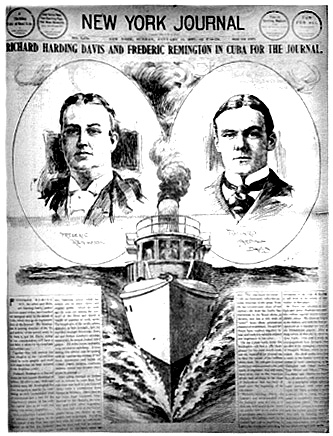
Remington, Davis in Cuba for Hearst

Had it occurred, the legendary but improbable exchange of telegrams between William Randolph Hearst and the artist Frederic Remington–in which Hearst supposedly vowed to “furnish the war” with Spain–would have taken place in mid-January 1897.

The uncertainty as to exactly when the purported exchange occurred is one of many signals the tale is apocryphal, a media-driven myth.

As I discuss in my media-mythbusting book, Getting It Wrong, the Remington-Hearst anecdote is “perhaps the hardiest myth in American journalism.”

It lives on in part because it is a pithy and delicious tale. It corresponds well to the image of Hearst the war-monger, the unscrupulous newspaper published who fomented the Spanish-American War in 1898.

As I point out in the first chapter of Getting It Wrong, the Remington-Hearst tale is often retold “despite a nearly complete absence of supporting documentation. It lives on even though telegrams supposedly exchanged by Remington and Hearst have never turned up. It lives on even though Hearst denied ever sending such a message.”

Moreover, I write:

The anecdote “lives on despite an irreconcilable internal inconsistency: It would have been absurd for Hearst to vow to ‘furnish the war’ because war—specifically, the Cuban rebellion against Spain’s colonial rule—was the very reason Hearst sent Remington to Cuba in the first place.”

The sole original source for the “furnish the war” quotation was On the Great Highway, a slim volume of reminiscences that came out in 1901. The author was James Creelman, a portly, cigar-chomping journalist prone to pomposity and exaggeration.

Creelman did not explain in On the Great Highway how or where he learned about the purported Remingt0n-Hearst exchange. Creelman–who was in Madrid at the time Remington was in Cuba–recounted the anecdote a not as a rebuke but as a compliment to Hearst and the activist “yellow journalism” he had pioneered in New York City.

Nor did Creelman say exactly when the presumed exchange took place, writing only that it was “some time before the destruction of the battleship Maine in the harbor of Havana” in mid-February 1898. The only time Remington was in Cuba before the explosion that destroyed the Maine was in January 1897.

Creelman: Sole source

Remington, an accomplished artist of the American West, went to Cuba in 1897 to draw sketches of scenes of the uprising against Spanish rule. He traveled with Richard Harding Davis, who then was burnishing a reputation as one of American journalism’s leading correspondents.

Hearst recruited Remington and Davis for a month, and the plan was for them to reach a force of Cuban rebels under the command of Máximo Gómez.

But Remington and Davis never reached the rebels. What’s more, they proved to be an oddly matched team. In Matanzas on January 15, 1897, they parted ways. Remington returned to Havana and the next day boarded a steamship bound for New York.

Legend has it that before leaving Havana, Remington sent Hearst a telegram that supposedly said:

“Everything is quiet. There will be no war. I wish to return.”

Hearst purportedly cabled Remington in reply:

“Please remain. You furnish the pictures, and I’ll furnish the war.”

Had it occurred, the exchange would have taken place late on January 15, 1897, or early on January 16, 1897.

Remington disregarded Hearst’s purported instructions to “remain” in Cuba. The artist was one of seven passengers aboard the Seneca when it sailed from Havana on January 16, 1897. The steamer reached New York four days later and soon afterward, Hearst’s New York Journal began publishing Remington’s sketches drawn in Cuba.

“The work was given prominent display,” I note in Getting It Wrong. Headlines in the Journal hailed Remington as a “gifted artist”–hardly the sort of accolade Hearst would have extended to someone in his employ who had brazenly disregarded instructions to remain on the scene.

That’s further reason for doubting that Hearst ever sent a telegram vowing to “furnish the war.”

And yet another reason is that Spanish censors, who controlled all incoming and outgoing cable traffic in Havana, surely would have intercepted Hearst’s inflammatory message, had it been sent. It’s highly improbable that cables such as those attributed to Hearst and Remington would have flowed readily between New York and Havana.

Additionally, the correspondence of Davis gives lie to the anecdote.

Davis wrote frequently to his family, especially to his mother, Rebecca Harding Davis. His letters make clear that  Remington did not leave because they found “everything is quiet” in Cuba.

In fact, Davis wrote on the day he and Remington parted ways:

“There is war here and no mistake.”

His correspondence offered detailed descriptions of what he called the grim process “of extermination and ruin” in Cuba.

More important, Davis’ letters make clear that Remington left for home not on the pretext that “everything is quiet,” but because Davis wanted him to go.

“I am as relieved at getting old Remington to go as though I had won $5000,” Davis wrote to his mother on January 15, 1897. “He was a splendid fellow but a perfect kid and had to be humored and petted all the time.”

Davis added that he “was very glad” Remington left “for he kept me back all the time and I can do twice as much in half the time.”

I note in Getting It Wrong that the Remington-Hearst tale was “Creelman’s singular contribution to American journalism.” The anecdote has proven to have timeless appeal, in part because it promotes what I call “the improbable notion the media are powerful and dangerous forces, so powerful they can even bring on a war.”

WJC

Recent and related:

Anniversary journalism and media-driven myths in 2011

In Anniversaries, Bay of Pigs, Debunking, Media myths, New York Times, Newspapers on January 1, 2011 at 7:21 am

NY Times front page, April 7, 1961

“Anniversary journalism” has the appeal of being irresistible and easily done.

Typically, a reporter targets an upcoming anniversary (preferably, the occasion is divisible by 5 or 10), sells the idea to an editor, and cobbles together a story recalling the event. Easily done, but as the Independent newspaper in London has observed, not always very compelling.

We’ll surely see a lot of “anniversary journalism” in 2011.

The year, after all, brings the 10th anniversary of terrorist attacks of September 11, the 100th anniversary of the death of Joseph Pulitzer, and the 150th anniversary of the start of the American Civil War.

Media Myth Alert will be especially interested in 2011 in the 50th anniversary of the botched Bay of Pigs invasion of Cuba, which gave rise to the durable New York Times-Bay of Pigs suppression myth.

In the run-up to the anniversary in April of the Bay of Pigs invasion, we’ll no doubt see frequent references to this media-driven myth.

As I discuss in Getting It Wrong, my mythbusting book that came out in 2010, the suppression myth has it that the New York Times bowed to pressure from the White House of President John F. Kennedy and “spiked,” or self-censored, its detailed report about the pending Bay of Pigs invasion of Cuba.

The purported self-censorship took place about 10 days before the invasion– which failed utterly in its objective of toppling the Cuban revolutionary leader, Fidel Castro.

But as I point out in Getting It Wrong, the Times did not suppress its reports about the pending invasion of Cuba.

It did not censor itself.

The Times’ reports about preparations for the invasion were in fact fairly detailed–and prominently displayed on the front page in the days before the invasion.

The run-up to the Bay of Pigs was no one-day story. A succession of articles before the invasion “kept expanding the realm of what was publicly known about a coming assault against Castro,” I write.

To be sure, not all pre-invasion news reports were accurate or on-target. Much of the reporting was piecemeal.

But overall, the reports in the Times and other U.S. newspapers let readers know that something was afoot in the Caribbean, that an assault on Castro was in the works.

“Indeed,” I write in Getting It Wrong, “the coverage helped strip away the fiction circulated by the Kennedy administration that the invasion was strictly a Cuban affair.”

The suppression myth largely centers around a dispatch that a veteran Times correspondent, Tad Szulc, filed on April 6, 1961.

Supposedly, the Kennedy administration learned of the contents of Szulc’s dispatch about the pending invasion and urged that it be suppressed.

In his book The Powers That Be, David Halberstam offered a graphic, though exaggerated, account of Kennedy’s calling James Reston of the Times, saying the newspaper risked having blood on its hands were the article published.

Such a conversation never happened, according to Reston and others quoted in Harrison Salisbury’s Without Fear or Favor, an insider’s account of the Times and its history.

Moreover, as I note in Getting It Wrong:

“The Kennedy Library in Boston says that the White House telephone logs reveal no calls were placed to Reston” or other Times executives on April 6, 1961.

Szulc’s story was published on the front page on April 7, 1961 (see image, above).

I argue in Getting It Wrong that that the suppression myth likely stems from confusion over an episode in October 1962, when Kennedy did ask the Times to delay publication of a sensitive report.

That came during the Cuban Missile Crisis, when Reston was prepared to report that nuclear-tipped Soviet weapons had been deployed in Cuba. With the prospect of a nuclear exchange seemingly in the balance, the Times complied with the president’s request.

Kennedy took office in 1961–a year with more than a few significant anniversaries. In 1961, Berlin Wall went up, the Soviets put the first man into space, Hemingway killed himself, and Adolf Eichmann‘s war-crimes trial was convened in Israel.

And the Times suppression myth took hold.

WJC

Recent and related:

‘Yes, Virginia,’ on CBS: No classic

In 1897, Anniversaries, Debunking, Media myths, New York Sun, Newspapers, Year studies on December 18, 2010 at 7:44 am

I wrote a year ago about the charmless CBS animated Christmas special, Yes, Virginia, a show based on Virginia O’Hanlon’s famous letter to the New York Sun in 1897 that prompted American journalism’s best-known editorial.

The show aired again last night; watching it was headache-inducing.

It utterly lacks the serendipity, anticipation, disappointment, and surprise that characterized the real back story to Virginia’s 1897 letter.

Her appeal to the Sun — “Please tell me the truth; is there a Santa Claus?”–gave rise to an editorial published beneath the headline, “Is There A Santa Claus?”

The editorial’s most memorable and most-quoted passage declared:

“Yes, Virginia, there is a Santa Claus. He exists as certainly as love and generosity and devotion exist, and you know that they abound and give to your life its highest beauty and joy. Alas! how dreary would be the world if there were no Santa Claus. It would be as dreary as if there were no Virginias.”

As I noted last year at Media Myth Alert, CBS took great liberties with the back story in offering up a tedious half-hour show that was neither accurate nor entertaining. It’s a distortion of a charming story.

Francis P. Church

The animated Virginia is waddling, round-headed, and unaccountably obsessed with the existence of Santa Claus. Francis P. Church, the retiring journalist who wrote the famous editorial, is depicted–no, misrepresented–as scowling, dismissive, and hard-hearted.

Neither character is convincing. Neither is realistic.

The animated Church is identified as the editor of the Sun, which is shown as a tabloid newspaper. Church was not the editor; he was an editorial writer. And the Sun was no tabloid.

The CBS show also had Virginia writing her letter, and the Sun publishing its reply, in December, as Christmas approached.

In fact, the letter was written in the summer of 1897, and the Sun published the editorial on September 21, 1897 — obscurely, in the third of three columns on editorials on an inside page (and not in big, sensation-stirring headlines across the front page, as the CBS show had it).

As I discuss in my 2006 book–a year-study titled The Year That Defined American Journalism: 1897 and the Clash of Paradigms–Virginia O’Hanlon said that she addressed her letter to the Sun’s question-and-answer column, and waited impatiently for the newspaper to publish a response.

She recalled that the Sun did not promptly take up her inquiry. Far from being obsessed, little Virginia stopped thinking about it after a while.

“After writing to the Sun,” she told an audience in Connecticut many years later, “I looked every day for the simple answer I expected. When it didn’t appear, I got disappointed and forgot about it.”

At the Sun, Virginia’s letter probably was overlooked, or misplaced, for an extended period.

That there was such a gap seems certain, given O’Hanlon’s recollections about waiting and waiting for a reply, and the accounts that say Church wrote the editorial in “a short time” or “hastily, in the course of the day’s work.”

Virginia O'Hanlon

What reconciles the two accounts—O’Hanlon’s prolonged wait and Church’s quickly written response—is that the Sun for a time had misplaced the letter that inspired a classic editorial, one that would recall the newspaper long after it folded in 1950.

The real back story to Virginia’s letter is far richer than the cheerless, vapid fare that CBS offered up.

Unlike the 1897 editorial, the wretched animated show is destined to be no classic.

WJC

Recent and related:

Remembering when Joe McCarthy beat up a columnist

In Anniversaries, Debunking, Media myths, Murrow-McCarthy myth on December 9, 2010 at 12:09 am

It may seem unimaginable these days, but a U.S. Senator once assaulted a prominent newspaper columnist at an exclusive club in Washington, D.C.

Assaulted a columnist

The brief but violent confrontation between Joe McCarthy and columnist Drew Pearson took place December 12, 1950, at the end of a dinner at the Sulgrave Club, which occupies a Gilded Age Beaux Arts mansion on DuPont Circle.

I recount this episode in my book, Getting It Wrong — in a chapter puncturing the myth about CBS newsman Edward R. Murrow and his half-hour television report on McCarthy in March 1954. The myth has it that Murrow confronted and single-handedly took down McCarthy, the Red-baiting Republican senator from Wisconsin.

I note in Getting It Wrong that “the evidence is overwhelming” that Murrow’s television report on McCarthy “had no such decisive effect, that Murrow in fact was very late in confronting McCarthy, that he did so only after other journalists had challenged the senator and his tactics for months, even years.”

Notable among those journalists was Pearson, a veteran, Washington-based syndicated columnist and radio commentator who, long before Murrow’s show, raised pointed and repeated challenges to McCarthy’s claims that communists had infiltrated high positions in the State Department, the Army, and other American institutions.

McCarthy, I write in Getting It Wrong, “had no more relentless, implacable, or scathing foe in the news media than Drew Pearson.”

The columnist readily made enemies, “and almost seemed to relish doing so,” I note. (Jack Shafer, the inestimable media critic, once referred to Pearson not long ago as “one of the skuzziest journalists to ever write a story.”)

Pearson became a target of McCarthy and his threats after writing repeatedly and critically about the senator’s bullying tactics, his tax troubles, and his thinly documented allegations about subversives in government.

In May 1950, McCarthy approached the columnist at a Gridiron Club dinner in Washington, placed a hand on his arm and muttered, “Someday I’m going to get a hold of you and really break your arm….”

The threat was in effect a prelude to the encounter at the Sulgrave Club, then a hush-hush meeting place for Washington socialites and powerbrokers.

In December 1950, a 27-year-old socialite named Louise Tinsley (“Tinnie”) Steinman invited Pearson and McCarthy to join her guests at dinner at the Sulgrave. She seated the men at the same table and they traded barbs and insults throughout the evening.

Pearson and McCarthy “are the two biggest billygoats in the onion patch, and when they began butting, all present knew history was being made,” Time magazine said about their encounter, which took place on the eve of Pearson’s 53rd birthday. The columnist was born December 13, 1897.

At the Sulgrave, McCarthy repeatedly warned Pearson that he planned to attack the columnist in a speech in the Senate. Pearson in turn chided McCarthy on his tax troubles in Wisconsin.

As the evening ended, McCarthy confronted Pearson in the Sulgrave’s coat check room. Accounts differ about what happened.

Pearson said McCarthy pinned his arms to one side and kneed him twice in the groin. McCarthy said he slapped Pearson, hard, with his open hand. A third account, offered by a radio broadcaster friendly to McCarthy, said the senator slugged Pearson, a blow so powerful that it lifted Pearson three feet into the air.

Richard Nixon, who had recently been sworn in as a U.S. Senator and who was guest at Tinnie Steinman’s party, intervened and broke up the encounter.

Nixon, in his memoir RN, said Pearson “grabbed his coat and ran from the room. McCarthy said, ‘You shouldn’t have stopped me, Dick.'”

Pearson

Pearson said he was embarrassed by McCarthy’s assault but insisted the senator had caused no harm.

In his 1999 book, Joseph McCarthy: Reexamining the Life and Legacy of America’s Most Hated Senator, a revisionist treatment of McCarthy, Arthur Herman wrote of the encounter:

“If some were horrified and disgusted with what McCarthy had done, many were not,” given the many enemies that Pearson had made.

The encounter certainly didn’t stir the outrage that such an attack would cause today.

Soon after, McCarthy followed through on his threat to attack Pearson verbally.

From the libel-proof confines of the Senate floor, McCarthy  delivered a vicious speech denouncing his nemesis as the “diabolically” clever “voice of international communism,” a “prostitute of journalism,” and a “Moscow-directed character assassin.”

McCarthy’s speech about Pearson was given December 15, 1950–more than three years before Murrow’s television report about the senator.

WJC

Recent and related:

SRO for ‘Getting It Wrong’ talk at UMd

In Anniversaries, Cronkite Moment, Debunking, Furnish the war, Jessica Lynch, Media myths, Media myths and radio, War of the Worlds, Washington Post, Watergate myth on November 5, 2010 at 11:50 am

A terrific audience of journalism students and faculty turned out last night for my talk at the University of Maryland’s Merrill College of Journalism.

It was standing-room-only at the Knight Hall conference room, where I discussed several chapters in my latest book, Getting It Wrong, which debunks 10 prominent media-driven myths.

I walked through the heroic-journalist myth of the Watergate scandal that toppled Richard Nixon’s presidency; the mythical  “Cronkite Moment” of 1968 that reputedly shifted U.S. public opinion about the war in Vietnam, and The War of the Worlds radio dramatization of 1938 that supposedly panicked listeners across the United States.

During the Q-and-A period that followed, I touched on the famous vow to “furnish the war” attributed to William Randolph Hearst and on the erroneously reported battlefield heroics of Private Jessica Lynch early in the Iraq War.

An intriguing question from the audience was what message should students take away from a book that identifies as media-driven myths some of the best-known stories in American journalism. The implication was that mythbusting may undercut the regard would-be journalists have for the profession.

I replied by saying that I  don’t consider Getting It Wrong a media-bashing book: Such books are many on the market as it is.

Rather, I said, the mythbusting in Getting It Wrong is aligned with the fundamental objective of American journalism. And that is to get it right, to offer an account that is as accurate as possible.

And it does journalism little good to indulge in tales such as the heroic-journalist myth of Watergate or the mythical “Cronkite Moment” that offer misleading interpretations about the news media and their power.

Debunking media myths, as I write in Getting It Wrong, “can help to place media influence in more coherent context.”

Nor should we worry about students being disappointed that well-known and even cherished stories about American journalism have been exposed as mythical. It shouldn’t be disheartening to learn the news media aren’t necessarily the powerful forces they are often believed to be.

Students can handle it.

Not only that, but mythbusting can offer them useful lessons in the importance of applying skepticism and a critical eye to dominant narratives and received wisdom of American journalism.

Indeed, Professor John Kirch, host and organizer of my talk at Maryland, does just that in presenting these and other tales in his journalism classes. Doing so can become a revealing exercise in critical thinking.

I also was asked about candidate-myths for a prospective sequel to Getting It Wrong.

A strong candidate for such a book, I said, is the myth of viewer-listener disagreement in the first Kennedy-Nixon debate in 1960.

The myth has it that people who watched the debate on television thought that Senator John F. Kennedy won; those who listened on radio thought Vice President Richard Nixon had the better of the exchanges.

The notion of listener-viewer-disagreement was long ago debunked by David L. Vancil and Sue D. Pendell, in an article in Central States Speech Journal. They noted that reports of viewer-listener disagreement typically were anecdotal and the few surveys that hinted at a viewer-listener disconnect were too small and unrepresentative from which to make confident judgments.

But the myth is a hardy one, I noted, and it resurfaced in late September, at the 50th anniversary of the Kennedy-Nixon encounter.

Among the 80 or so people in attendance last night was Jamie McIntyre, former Pentagon correspondent for CNN. Afterward, we compared notes about the misreported Lynch case, which the Washington Post propelled into the public domain with a botched, front-page story in early April 2003.

Recent and related:

Why ‘War of the Worlds’ show didn’t panic America

In Anniversaries, Debunking, Media myths, Media myths and radio, Newspapers, War of the Worlds on October 30, 2010 at 12:54 am

Today’s the 72nd anniversary of the famous War of the Worlds radio dramatization, a show that was so realistic and made such effective use of simulated news reports that it pitched America into panic and mass hysteria.

That The War of the Worlds program created fear beyond measure on that long ago October night is a delicious tale, one inevitably recalled and retold with gusto as Halloween approaches.

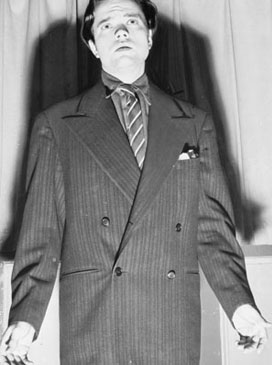
The radio dramatization–the work of 23-year-old Orson Welles–was aired over the CBS radio network on Sunday evening, October 30, 1938.

As I write in my latest book, Getting It Wrong: “So alarming was the show, so realistic were its accounts of invading Martians wielding deadly heat rays, that listeners by the tens of thousands—or maybe the hundreds of thousands—were convulsed in panic.

“They fled their homes, jammed highways, overwhelmed telephone circuits, flocked to houses of worship, set about preparing defenses, and even contemplated suicide in the belief that the end of the world was at hand.

“Fright beyond measure seized America that night more than seventy years ago. … Or so the media myth has it.”

Getting It Wrong presents a compelling case that the panic and hysteria so commonly associated with The War of The Worlds program did not occur on anything approaching nationwide dimension. That it did can be called Halloween’s greatest media myth.

Some Americans may have been frightened by what they heard on Welles’ show, but most listeners, in overwhelming numbers, were not.

“They recognized it for what it was—an imaginative and entertaining show on the night before Halloween,” I write, citing data from surveys taken shortly after the program.

But newspaper reports appearing the day after the program advanced the thesis of mass panic had indeed swept the country. From coast to coast, front-page newspaper headlines  told of the fright, terror, and panic that the program supposedly caused.

Welles, the day after

“U.S. Terrorized By Radio’s ‘Men From Mars,’” said the San Francisco Chronicle.

“Radio Listeners in Panic, Taking War Drama as Fact,” declared the New York Times.

“Attack From Mars In Radio Play Puts Thousands in Fear,” said the New York Herald Tribune.

“Radio Fake Scares Nation,” cried the Chicago Herald and Examiner.

These reports, however, were highly anecdotal and the reactions they reported simply did not rise to the level of nationwide panic and mass hysteria.

Newspapers, I point out, “had no reliable way of ascertaining the validity of the sweeping claims they offered in their columns the day after the program.”

Here’s why.

The broadcast aired late on Sunday evening in the Eastern time zone, a time when newsrooms of most daily newspapers were thinly staffed.

As such, collecting the reactions to The War of The Worlds broadcast represented no small challenge, especially for morning newspapers having late-night deadlines, I note in Getting It Wrong, adding:

“Given the constraints of time and staffing, relying on wire services such as the Associated Press became essential.

“This dependency, in turn, had the effect of promoting and deepening the notion that panic was widespread that night: On a late-breaking story of uncertain dimension and severity, many newspapers took their lead from wire service dispatches. They had little choice.”

The wire service reports were roundups that emphasized breadth rather than depth. Reliance on the roundups helps explain the consensus among U.S. newspapers that The War of the Worlds program had caused mass panic.

It also helps explains the striking similarity that characterized newspaper coverage of the broadcast. Many anecdotes transmitted by the wire services found their way into  newspapers across the country.

One widely recounted anecdote told of a woman in Pittsburgh whose husband prevented her from poisoning herself. “I’d rather die like this,” she exclaimed, than fall victim to a Martian heat ray.

Also widely reported was the story of a woman who told the Boston Globe she could “see the fire” caused by the alien attack and that she and her neighbors were preparing to flee.

Newspapers in their coverage also tended to place considerable importance on the unusually large volume of calls placed that October night to their switchboards and to those of police and fire departments and local radio stations.

“The surge in call volume was routinely but mistakenly characterized by newspapers as evidence of widespread fright and hysteria,” I write, noting that call volume was a misleading marker of fear and alarm.

The increased call volume is in fact best understood as signaling an altogether rational response by people who neither panicked nor became hysterical. Instead, they sought confirmation or clarification from external sources–newspapers, ironically, as well as police and fire departments–known to be usually reliable.

“Moreover, the call volume surely included people who telephoned friends and relatives to talk about the unusual and clever program they had just heard,” I point out in Getting It Wrong.

WJC

Recent and related:

Discussing ‘Getting It Wrong’ at a special place

In Anniversaries, Debunking, Media myths, Media myths and radio, Newspapers, War of the Worlds on October 28, 2010 at 5:30 pm

There was a fine turnout today for my book talk at the Library of Congress, the splendid institution where I have done a great deal of research over the past 12 years or so.

The Library is a special place, and more than 120 people were there as I reviewed three of the 10 media-driven myths that are addressed and debunked in my latest book, Getting It Wrong.

Two of the myths discussed possess a strong Washington, D.C., connections; the third was timely in a seasonal, late-October sort of way. Specifically, I discussed:

  • The heroic-journalist myth of Watergate: That is, the notion that the investigative reporting of Washington Post reporters Bob Woodward and Carl Bernstein brought down the corrupt presidency of Richard Nixon.
  • The so-called “Cronkite Moment” of February 1968: The belief President Lyndon Johnson realized the Vietnam Was was unwinnable following a dire, on-air assessment by CBS anchorman Walter Cronkite, who declared the U.S. military was “mired in stalemate” in Southeast Asia.
  • The War of the Worlds radio dramatization: The widely held view that Orson Welles’ clever adaptation of The War of the Worlds, a science fiction thriller about a deadly Martian invasion of Earth, touched widespread panic and mass hysteria on Halloween Even 1938.

Welles and 'War of Worlds'

The anniversary of Welles’ War of Worlds broadcast is Saturday.

In my talk at the Library of Congress, I pointed out how improbable it was that a radio show–even one as inspired as Welles’ adaptation–could have had the effect of sending tens of thousands, if not hundreds of thousands, of listeners into the streets in panic and hysteria.

There were many internal clues for listeners signaling that the show was just that–a radio show.

It aired Sundays, from 8-9 p.m., Eastern time, on CBS–in the usual time slot for Welles’ program, which he called the Mercury Theatre on the Air. Welles was the show’s star and director, and his distinctive voice would have been familiar to many listeners that long ago October night.

What’s more, events described in the show moved far too rapidly to be plausible or believable. In less than 30 minutes, for example, the Martians blasted off from their planet, traveled millions of miles to Earth, landed in rural New Jersey, set up lethal heat rays, wiped out units of American soldiers, and began a destructive march on New York City.

As I point out in Getting It Wrong, “Claims that the broadcast fomented mass panic and hysteria were dramatically overstated” by daily newspapers the following day.

Close reading of the contemporaneous newspaper accounts made it clear that they based their characterizations of widespread turmoil on relatively small numbers of anecdotal cases of people who were frightened or upset. These anecdotes, I write, “typically were not of broad scale but were small-bore. They described agitation and odd behavior among individuals, their families, or neighbors.”

But by no means did these accounts suggest fright that night reached the level of nationwide panic and mass hysteria.

For newspapers, however, the notion that The War of the Worlds show had caused great panic and alarm represented an irresistible opportunity to bash radio as an unreliable, untrustworthy upstart medium. And newspapers did so in overwhelmingly negative editorial commentary.

“Radio is new but it has adult responsibilities,” the New York Times declared about the show. “It has not mastered itself or the material it uses. It does many things which the newspapers learned long ago not to do, such as mixing its news and advertising.”

Such criticism was more than mildly self-serving. After all, radio by 1938 had become an increasingly important rival source for news, information, and advertising.

And that negative commentary helped to lock into place the mistaken notion that the radio show about Martian invaders had sown panic and hysteria across the country.

My talk was sponsored by the Library’s Center for the Book, which is directed by John Y. Cole. Library stalwarts in attendance today included Terri Sierra, Mark  Sweeney, Georgia Higley, and G. Travis Westly.

WJC

Recent and related:

Halloween’s greatest media myth

In Anniversaries, Debunking, Media myths, Media myths and radio, War of the Worlds on October 26, 2010 at 4:03 pm

My Q-and-A with Big Think blog was posted today. In it I discuss Halloween’s greatest media myth–Orson Welles’ famous War of the Worlds dramatization, which aired on CBS radio 72 years ago this week.

The War of the Worlds program was so clever, and made such effective use of simulated news bulletins reporting a Martian invasion of Earth, that tens of thousands–or even hundreds of thousands–of Americans were pitched into mass panic and hysteria.

Or so the media myth has it.

As I discuss in my new mythbusting book Getting It Wrong, “the panic and mass hysteria so readily associated with The War of The Worlds program did not occur on anything approaching nationwide dimension” on that long ago night in 1938.

While some Americans may have been briefly frightened or upset by Welles’ program, “most listeners, overwhelmingly, were not: They recognized it for what it was—an imaginative and entertaining show on the night before Halloween,” I point out in Getting It Wrong.

I discuss in the Q-and-A with Big Think just how improbable and unlikely it was that tens of thousands of people were panic-stricken by the radio show.

Think about it, I say: “Tens of thousands? Even hundreds of thousands? That sounded to me quite unlikely and highly improbable. Especially given that mass panic is such a rare phenomenon.”

I added that anecdotal news reports about reactions to the broadcast “simply did not rise to the level of nationwide panic and mass hysteria.”

I also pointed out that had there indeed been widespread panic and hysteria that night, “newspapers for days and even weeks afterward would have been expected to have published details about the upheaval and its repercussions. But as it was, newspapers dropped the story after only a day or two.”

No deaths, serious injuries, or even suicides were associated with the program. “Had there been widespread panic and hysteria,” I noted, “surely many people would have been badly injured and even killed in the resulting tumult.”

I discussed in some detail at Big Think what I call “the would-be Paul Revere effect,” which emerged as the The War of the Worlds show unfolded.

This effect occurred when well-intentioned people who had an incomplete understanding of The War of the Worlds broadcast set out to warn others of the sudden and terrible threat.

“These would-be Paul Reveres,” I noted, “burst into churches, theaters, taverns, and other public places, shouting that the country was being invaded or bombed, or that the end of the world was near. …

“The unsuspecting recipients of what were typically jumbled, second- and third-hand accounts had no immediate way of verifying the troubling news they had just received so unexpectedly. Unlike listeners of the radio show, they could not spin a dial to find out whether other networks were reporting an invasion. This second- and third-hand fright didn’t last long. It was evanescent.

“But it is interesting that the show caused some level of apprehension among many people who had not heard one word of the program.”

The “would-be Paul Revere effect” is a little-recognized subsidiary phenomenon of The War of the Worlds broadcast, a show that always is remembered at Halloween time.

WJC

Recent and related: