W. Joseph Campbell

Archive for the ‘Error’ Category

Runup to the Oscars: ‘Politically inspired movies’ and the myth of Watergate

In Cinematic treatments, Debunking, Error, Media myths, Scandal, Washington Post, Watergate myth on February 22, 2013 at 2:51 pm

The runup to the Academy Awards ceremony brings inevitable bursts of nostalgia — as well as the almost-predictable appearance of hoary media myths.

CNN logoCNN.com today offered a gauzy look back at “politically inspired movies that have been nominated [for] or won” an Oscar. In doing so, CNN bought into the media myth of the Watergate scandal.

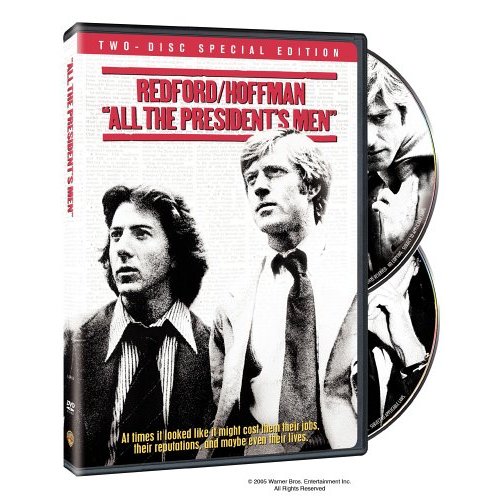
The retrospective discussed the 1976 film All The President’s Men, noting that it “won four Oscars and was nominated for four more.”

The movie was an adaptation of a book by the Washington Post’s lead Watergate reporters, Bob Woodward and Carl Bernstein, who, according to CNN, were “responsible for uncovering the Watergate scandal and forcing the resignation of President Richard Nixon.”

All the President’s Men, CNN added, “provided context and drama about how the reporters brought down the most powerful man on Earth.”

That’s an expansive claim. It’s also glib, and totally mythical.

As I discuss in my media mythbusting book, Getting It Wrong, Woodward and Bernstein’s reporting did not bring down Nixon. They didn’t uncover the scandal, either.

All President's Men

The movie

Far from it.

Woodward and Bernstein and the Post were at best modest contributors in unraveling an intricate scandal that sent to jail nearly 20 men associated with Nixon’s presidency or his 1972 reelection campaign.

Indeed, when considered against the far more decisive forces and factors that uncovered Watergate, Woodward and Bernstein’s contributions recede into near insignificance.

The decisive forces included special prosecutors, federal judges, the FBI, panels of both houses of Congress, and the Supreme Court.

Even in the face of such an array of forces, I write in Getting It Wrong, “Nixon likely would have served out his term if not for the audiotape recordings he secretly made of most conversations in the Oval Office of the White House. Only when compelled by the Supreme Court did Nixon surrender those recordings, which captured him plotting the cover-up” of the signal crime of Watergate — the breakin in June 1972 at the headquarters of the Democratic National Committee.

Notably, Woodward and Bernstein didn’t reveal existence of Nixon’s secret tapes, the contents of which proved vital in Watergate’s outcome. Nor did Woodward and Bernstein disclose the extent of the attempted coverup of the crimes of Watergate.

What’s more, principals at the Washington Post have from time to time over the years dismissed the notion that the newspaper was central in forcing Nixon’s resignation.

For example, the Post’s publisher during and after the Watergate scandal, Katharine Graham, said in 1997 at a program marking the scandal’s 25th anniversary:

“Sometimes people accuse us of bringing down a president, which of course we didn’t do. The processes that caused [Nixon’s] resignation were constitutional.”

Even Woodward has scoffed at the notion, telling American Journalism Review in 2004:

To say the press brought down Nixon, that’s horse shit.”

The cinematic version of All the President’s Men contains few references to the subpoena-wielding authorities who really did break open the scandal. Instead, the movie leads audiences to just one, misleading conclusion — that the tireless reporting of Woodward and Bernstein was vital to Watergate’s ultimate outcome.

WJC

More from Media Myth Alert:

The ‘newsroom where two reporters took down a president’? Sure it was

In Debunking, Error, Media myths, Scandal, Washington Post, Watergate myth on February 2, 2013 at 7:58 am

News that the Washington Post is exploring the sale of its headquarters building inevitably stirred reminders of the Watergate scandal, supposedly the newspaper’s most memorable exposé.

The Wall Street Journal makes that link in an article today while credulously invoking the heroic-journalist myth of Watergate, the scandal that forced Richard Nixon to resign the presidency in 1974.

wapo-logo“The Washington, D.C., newsroom where two reporters took down a president may soon be on the block,” the Journal states, referring to Bob Woodward and Carl Bernstein, the Post’s lead reporters on America’s greatest political scandal.

While it may make for a catchy “lede” (journalese for a story’s opening paragraph), the reference to the reporters who “took down a president” is wrong-headed: It’s a media myth that simplifies and distorts the forces and factors that led Nixon to quit in disgrace.

Even principals at the PostWoodward among them — have asserted over the years that the newspaper did not bring down Nixon’s corrupt presidency. And they weren’t indulging in false modesty in saying so. (Ben Bradlee, the Post’s executive editor during Watergate, once said, for example: “[I]t must be remembered that Nixon got Nixon. The Post didn’t get Nixon.”)

And as I write in my media-mythbusting book, Getting It Wrong, “to explain Watergate through the lens of the heroic-journalist is to abridge and misunderstand the scandal and to indulge in a particularly beguiling media-driven myth. The heroic-journalist interpretation minimizes the far more decisive forces that unraveled the scandal and forced Nixon from office.”

Those forces included special federal prosecutors, federal judges, both houses of Congress, the Supreme Court, as well as the Justice Department and the FBI.

“Even then,” I note in Getting It Wrong, “Nixon likely would have served out his term if not for the audiotape recordings he secretly made of most conversations in the Oval Office of the White House.

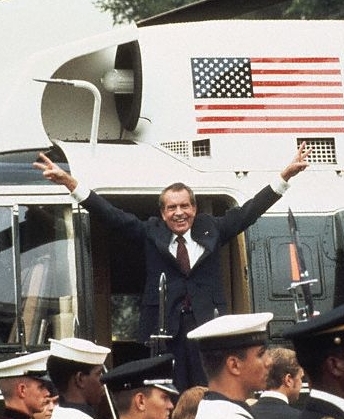
Nixon quits

‘Nixon got Nixon’

“Only when compelled by the Supreme Court did Nixon surrender those recordings, which captured him plotting the cover-up and authorizing payments of thousands of dollars in hush money.”

So why does the mediacentric heroic-journalist interpretation of Watergate live on? Why is it so tempting to invoke, as the Journal does today?

Explanations go well beyond a reporter’s need for a catchy lede.

An especially compelling reason for the myth’s tenacity is that it makes accessible and understandable the intricate scandal that was Watergate.

That complexity —the webs of lies, the deceit, and the criminality that characterized the Nixon White House; the multiple lines of investigation that slowly unwound the scandal, and the drama of a constitutional crisis — are not readily recalled these days.

The scandal that unfolded from 1972 to 1974 has become so distant that few Americans can accurately describe what took place.

What does stand out, though, is the heroic-journalist meme — the appealing if misleading notion that the tireless reporting of Woodward and Bernstein exposed the crimes of Watergate and brought Nixon down.

It’s history lite, history made simple.

The myth is endlessly reassuring for journalists, too, suggesting as it does that journalism can make a difference, can bring about dramatic change. As I point out in Getting It Wrong, “How the Post and its reporters uncovered Watergate is deeply ingrained in American journalism as one of the field’s most important and self-reverential stories.”

It’s also one of journalism’s self-sustaining tales, as the Wall Street Journal demonstrates quite well today.

WJC

Many thanks to Instapundit
Glenn Reynolds for linking to this post

More from Media Myth Alert:

London’s ‘Independent’ latest to invoke media myth about Pentagon and Jessica Lynch

In Debunking, Error, Jessica Lynch, Media myths, Newspapers, Washington Post on January 28, 2013 at 7:40 am

In the debate about women being permitted to join U.S. military combat units, it was inevitable the media myth would resurface about Jessica Lynch and her purported battlefield heroics in Iraq nearly 10 years ago.

The myth has it that the Pentagon concocted the tale about Lynch’s having fought fiercely in an ambush in Nasiriyah and fed the propaganda to a credulous U.S. news media.

Sure enough, Britain’s Independent newspaper stepped in that myth over the weekend, in an online report about women in the U.S. military.

The newspaper referred to Lynch as a name fresh “in America’s collective memory” and asserted that “initial reports from the Pentagon exaggerated her story as it waged a propaganda war, stating that she had fought back heroically against the enemy when in fact she had never fired her weapon.”

Lynch was an element of a Pentagon “propaganda war”?

Not so.Independent masthead

Not according to Vernon Loeb, the Washington Post reporter who helped thrust the hero-warrior tale about Lynch into the public domain in an electrifying but utterly inaccurate front-page story published April 3, 2003. Loeb has said the Pentagon wasn’t the source of the Post’s story about Lynch, which it pegged to otherwise anonymous “U.S. officials.”

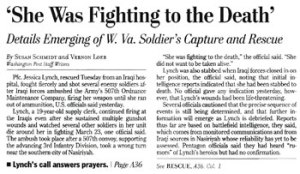
Under the byline of Loeb and Susan Schmidt, the Post reported that Lynch, then  a 19-year-old Army private in a support unit, kept firing at attacking Iraqis “even after she sustained multiple gunshot wounds and watched several other soldiers in her unit die around her in fighting” at Nasiriyah on March 23, 2003.

The Post quoted one anonymous official as saying that Lynch “‘was fighting to the death. She did not want to be taken alive.'”

The story turned out to be wrong in every significant detail: Lynch never fired a shot in the attack at Nasiriyah; her weapon jammed during the deadly ambush in which 11 American soldiers were killed.

Lynch was neither shot nor stabbed, as Loeb and Schmidt reported, but suffered shattering injuries to her back, legs, and arms in the crash of a Humvee in which she was attempting to flee.

She was taken prisoner and treated at an Iraqi hospital, from where she was rescued April 1, 2003, by a U.S. special forces team.

As Lynch herself insists, she was no hero (although she has said she could have embraced the Post’s hero-warrior tale and no one would’ve been the wiser).

The Post, though, has never identified the “U.S. officials” who led it so badly astray.

But we do know that the Pentagon wasn’t the source of the Post’s exaggerated hero-warrior tale: Loeb said so in an interview on Fresh Air, an NPR radio program, in mid-December 2003.

In the interview, Loeb declared flatly:

“Our sources for that story were not Pentagon sources.”

Loeb also said that he “could never get anybody from the Pentagon to talk about” the Lynch case.

“They wouldn’t say anything about Jessica Lynch,” Loeb declared, adding:

“I just didn’t see the Pentagon trying to create a hero where there was none. I mean … they never showed any interest in doing that, to me.”

Although Loeb’s remarks have long been in the public domain, the Independent is the latest of many news organizations to have ignored or overlooked them, blithely offering instead the juicy but unsubstantiated claim that “the Pentagon exaggerated her story.”

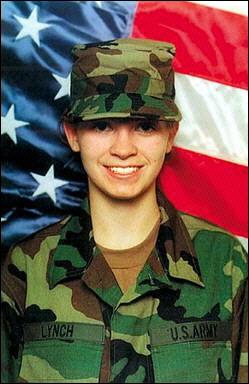
Lynch_large photo

Private Lynch

The claim is a weak one, even without Loeb’s disclaimer. After all, in the early days of the Iraq War, the Pentagon had little reason to exploit the Lynch case as a way to boost popular support  for the conflict.

As I point out in my myth-busting book, Getting It Wrong:

“It may be little-recalled now, but the U.S.-led invasion of Iraq was widely supported by the American public. Polling data from March and April 2003, the opening days and weeks of the war, show an overwhelming percentage of Americans supported the conflict and believed the war effort, overall, was going well.”

Among those public opinion polls was a Washington Post-ABC News survey conducted in late March and early April 2003 — when Lynch was much in the news. The poll found that eight of 10 Americans felt the war effort was going well, and 71 percent approved of the Bush administration’s handling of the Iraq situation.

WJC

Many thanks to Instapundit
Glenn Reynolds for linking to this post

More from Media Myth Alert:

Women at the front: Recalling Jessica Lynch in Iraq

In Error, Jessica Lynch, Media myths, Washington Post on January 26, 2013 at 1:06 pm
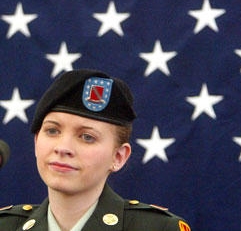
Lynch: Accidental celebrity

Jessica Lynch in 2003

Jessica Lynch, who unwittingly became the best-known Army private of the Iraq War, has added her support to the Obama administration’s plan to end restrictions on women in Army combat units.

Lynch, whose purported battlefield heroics in Iraq proved to be a wild exaggeration by the Washington Post, told a Virginia television station the other day:

“For years women have been fighting for our freedom. They’ve been put in those roles anyway. Whether they are designed for a front line mission, they’re being put in those kind of roles and paths anyway.”

Given what she went through in Iraq, you’d be excused for thinking Lynch would have other views about women at the front.

Her authorized biography, written by Rick Bragg and published in November 2003, presents a disturbing account of her lone exposure to combat.

That came by mistake in southern Iraq on March 23, 2003, when elements of her support unit, the 507th Maintenance Company, made a wrong turn and plunged into Nasiriyah, a city under Iraqi control.

The heavy vehicles and Humvees of the 507th came under withering fire. Lynch was in the backseat of a Humvee, driven by her friend Lori Piestewa; they were trying to escape the Iraqi assault.

The biography, I Am a Solider, Too: The Jessica Lynch Story, says this about the attack on her unit, and about what happened to her afterward:

“‘I just wanted it to be over,’ Jessi said. It had been about an hour since the battle began in the city of Nasiriyah, maybe a little longer.

“In fear and resignation, she could not look at it anymore.

“‘I lowered my head to my knees, and I closed my eyes.’

“Just ahead of them, Iraqi soldiers had used a truck to block the road. An American tractor-trailer rumbling just in front of Jessi and Lori’s Humvee came under heavy fire, and, swerving to miss the Iraqi truck, ran off the road just in front of them.

“In the mass of Iraqi fighters, one of them raised a rocket-propelled grenade launcher to his shoulder and sighted the speeding Humvee. He squeezed the trigger.

“Jessi, crouched in the back seat, her arms around her own shoulders, her forehead on her knees, did not feel the round that finally punctured Lori’s control and sent the Humvee bouncing off the road, straight at the five-ton tractor-trailer.

“The last thing she remembered was praying.

“‘Oh God help us.

“‘Oh God, get us out of here.

“‘Oh God, please.'”

The biography says Lynch blacked out in the crash:

“Jessi lost three hours.

“She lost them in the snapping bones, in the crash of the Humvee, in the torment her enemies inflicted on her after she was pulled from it. It all left marks on her, and it is those marks that fill in the blanks of what Jessi lived through on the morning of March 23, 2003.”

The biography (which Lynch has referred to as “my book”) says the Humvee crashed about 7 a.m. that day, “but Jessi and Lori were not taken to the hospital, a military hospital, until about 10 a.m. The hospital was only steps away — minutes away. Still, three hours passed.”

Lori Piestewa died of her wounds. Three other soldiers in the Humvee were killed in the crash or died shortly afterward.

Lynch, who was 19, suffered shattering injuries to her spine, right arm, right foot, and left leg below the knee.

“The records also show,” the biography says, “that she was the victim of anal sexual assault. The records do not tell whether her captors assaulted her almost lifeless, broken body after she was lifted from the wreckage, or if they assaulted her and then broke her bones into splinters until she was almost dead.”

(The allegation of sexual assault was disputed by an Iraqi doctor who treated Lynch at a hospital in Nasiriyah.)

Lynch was a supply clerk in the 507th and had entered the Army not expecting to see combat. The biography quotes Lynch as telling a friend, “‘Don’t worry. We won’t be anywhere near danger.'”

Lynch lingered near death at the Iraqi hospital before being rescued by U.S. special forces on April 1, 2003.

Two days later, the Washington Post published an electrifying but thoroughly botched front-page account that said Lynch had fought heroically at Nasiriyah and that despite being shot and stabbed, she fired at attacking Iraqis until she ran out of ammunition and was captured.

In fact, Lynch suffered neither gunshot nor stab wounds.

She never fired a shot at Nasiriyah: Her weapon had jammed.

As I discuss in my media-mythbusting book, Getting It Wrong, the Post  never fully explained how it erred so utterly in presenting the hero-warrior tale about Lynch. The newspaper cited otherwise anonymous “U.S. officials” in its account, which appeared beneath the headline, “‘She was fighting to the death.'”Lynch_headline_Post

The story was picked up by news organizations around the world and made Lynch — who never embraced the story — a household name in America.

The hero-warrior tale almost surely was a case of mistaken identify: The exploits the Post erroneously attributed to Lynch most likely were the deeds of Donald R. Walters, an unsung cook-sergeant in Lynch’s unit.

Walters was one of 11 U.S. soldiers killed in the battle of Nasiriyah.

WJC

More from Media Myth Alert:

Oprah as ‘this generation’s Walter Cronkite’?

In Cronkite Moment, Debunking, Error, Media myths, Television on January 13, 2013 at 3:26 pm

Here’s a good one: Oprah Winfrey is a latter-day Walter Cronkite, a television personality “capable of massively shifting public sentiment.”

LBJ in Austin

Lyndon Johnson in Austin, February 27, 1968

So writes a sports columnist for the Detroit Free Press.

It’s a ridiculous claim, but not for reasons that may immediately come to mind.

Walter Cronkite was the avuncular anchorman on the CBS Evening News from 1962-81. Oprah Winfrey is an iconic talk-show host, whose appeal may or may not be ebbing.

Her clout is formidable. Cronkite’s was overstated.

But to return to the columnist’s claim:

Drew Sharp, writing in the Free Press about Oprah’s upcoming interview with disgraced international cycling star Lance Armstrong, notes that it’ll be an occasion for “staged news.”

Armstrong, he observes, “made the smart move, agreeing to a 90-minute taped interview with Oprah, which will air on her OWN cable network Thursday. It no doubt will be well watched.”

Sharp also declares, in a passage of particular interest to Media Myth Alert, that Oprah “has become this generation’s Walter Cronkite, capable of massively shifting public sentiment.

“It was,” Sharp adds, “the late CBS anchorman’s pointed commentary 45 years [ago,] following the North Vietnamese’s Tet Offensive in which he argued in a rare editorial that the U.S. couldn’t win the Vietnam War. President Lyndon B. Johnson famously said afterward that if he lost Cronkite, he lost Middle America.

“Not long afterward, LBJ opted not to run for reelection in the 1968 presidential campaign.”

In his claims about the effects of Cronkite’s report about Vietnam, the columnist indulges in one of American journalism’s most prominent and tenacious media myths.

As I discuss in my mythbusting book, Getting It Wrong, there is no evidence that Johnson saw the Cronkite program when it aired on the night of February 27, 1968, or that he viewed it afterward on videotape.

So it’s hard to argue that Johnson could have been much moved by a television report he didn’t see.

The president wasn’t in front of a television set that night. He was in Austin, Texas, at a black-tie party (see photo, above) to mark the 51st birthday of Governor John Connally, a longtime political ally.

About the time Cronkite was offering his pessimistic, on-air assessment about the war in Vietnam — that the U.S. military was “mired in stalemate” — Johnson wasn’t bemoaning a loss of Cronkite’s support; he was saying:

“Today you are 51, John. That is the magic number that every man of politics prays for — a simple majority.”

Johnson did announce, a month later, that he was not running for reelection to the presidency. But his reasons had little, if anything, to do with Cronkite and the anchorman’s comments about Vietnam.

More significant to Johnson’s decision was his eroding political strength. By late March 1968, he was facing insurgent challenges within his own party from senators Eugene McCarthy and Robert F. Kennedy.

Not only that, but Johnson may have decided long before March 1968 not to seek reelection.

“Long before I settled on the proper forum to make my announcement,” Johnson wrote in his memoir, The Vantage Point, “I had told a number of people of my intention not to run again.”

The memoir, by the way, has nothing to say about the Cronkite program of February 1968.

What’s more, there’s no evidence that Cronkite’s “mired in stalemate” comment influenced public opinion “massively” or otherwise.

Indeed, as I point out in Getting It Wrong, polls signaled shifts in public opinion against Vietnam months before Cronkite’s program. The anchorman followed rather than led deepening popular doubts about the wisdom of the war.

And until late in his life, Cronkite pooh-poohed the notion that his assessment of the war had much effect, saying it was akin to “another straw on the back of a crippled camel.”

To liken Oprah to Cronkite is, of course, more than a little incongruous. But it has been done before.

In a commentary published at Huffington Post in 2007 and titled “Oprah is to Iraq what Cronkite was to Vietnam,” Marty Kaplan asserted that “Oprah may actually be the twenty-first century’s de facto national anchor.”

A more frequent if similarly imprecise comparison is to identify Jon Stewart as a latter-day Cronkite.

But both comparisons are strained and feeble: They seek to reapportion to contemporary contexts influence the legendary Cronkite never really possessed. As such, they succeed only in promoting a media-driven myth.

WJC

More from Media Myth Alert:

‘Digital wildfires’ and the ‘War of the Worlds’ media myth

In Debunking, Error, Media myths, Media myths and radio, New York Times, War of the Worlds on January 9, 2013 at 12:00 pm

The New York Times considers in a commentary posted yesterday the prospect of “digital wildfires” — how rumor and error spread by social media could give rise to panic and widespread turmoil.

It’s a catchy phrase, “digital wildfires.” But the commentary is largely speculative and, worse, it conjures the panic myth of the famous War of the Worlds radio dramatization of October 30, 1938.

“In 1938,” the commentary declares, “thousands of Americans famously mistook a radio adaptation of the H.G. Wells novel ‘War of the Worlds’ for a genuine news broadcast. Police stations were flooded with calls from citizens who believed the United States had been invaded by Martians. …

“Is it conceivable that a misleading post on social media could spark a comparable panic?”

What “panic”?

The notion that The War of the Worlds radio program of October 30, 1938, set off a wildfire of panic is a hoary media myth — a myth so tenaciously held that not even a sustained social media campaign could undo it.

Like many media myths, the tale of the panic broadcast of 1938 is just too engrained, and too delicious, ever to be uprooted and delivered to the ash heap of history. As the Times commentary suggests, it’s an irresistible story, full of  illustrative potential.

But as I discuss in my latest book, Getting It Wrong, “the notion that The War of the Worlds program sent untold thousands of people into the streets in panic, is a media-driven myth that offers a deceptive message about the influence radio wielded over listeners in its early days and, more broadly, about the media’s potential to sow fright, panic, and alarm.”

Some people who listened to the show in 1938 were frightened or disturbed by what they heard. But most listeners — in overwhelming numbers — recognized the dramatization for what it was, an imaginative and entertaining show that aired on CBS radio in its usual Sunday evening time slot.

This conclusion is based on research by Hadley Cantril, a Princeton University psychologist, who studied the program’s aftermath. His research, while crude by contemporary standards, drew on interviews and a public opinion survey to estimate that at least 6 million people listened to The War of the Worlds program.

Of that number, Cantril estimated as many as 1.2 million were “frightened,” “disturbed,” or “excited” by what they heard.

But Cantril did not specify what he meant by “frightened,” “disturbed,” and “excited” — terms not synonymous with “panic-stricken.”

As  Robert E. Bartholomew, an authority on mass hysteria and social delusions, has noted, there is scant evidence that many frightened listeners acted on their fears.

In short, what radio-induced fright there was that night did not rise to the level of broad panic or hysteria.

Had it — had panic swept the country — trauma and turmoil surely would have resulted in deaths, including suicides. But none were linked to the program, as Michael J. Socolow noted in his fine essay in 2008.

The Times commentary notes that authorities “were flooded with calls” that night. Indeed, telephone volume surged during and immediately after the program, especially in metropolitan New York and New Jersey — ground zero for the fictive Martian invasion in The War of the Worlds show.

Police station, fire departments, and many newspaper offices reported receiving an unusually large number of telephone calls.

But call volume is a crude, and even misleading, marker of fear and alarm.

As I discuss in Getting It Wrong, increased call volume that night is better understood as “signaling an altogether rational response of people who neither panicked nor became hysterical, but who sought confirmation or clarification from external sources known to be usually reliable.”

Interestingly, the notion that a radio show did create panic gave newspapers an irresistible opportunity to assail their upstart rival medium.

By the late 1930s, radio was an increasingly important source for news and advertising, and American newspapers thus had, as I write, “competitive incentives to denounce radio, and characterize it as irresponsible and unreliable.

“Many newspapers seized the chance to do with enthusiasm. It was as an opportunity they could not fail to let pass.”

The New York Times, for example, declared in an editorial titled “Terror by Radio”:

“Radio is new but it has adult responsibilities. It has not mastered itself or the material it uses.”

The Times and other American newspapers in 1938 seemed to delight in chastising radio. And their overwhelmingly negative commentary helped seal the erroneous view that The War of the Worlds dramatization had set off panic and mass hysteria.

WJC

More from Media Myth Alert:

Taking stock: Top mythbusting posts of 2012

In Anniversaries, Cronkite Moment, Debunking, Error, Jessica Lynch, Media myths, New York Times, New Yorker, Photographs, Television, Washington Post on December 30, 2012 at 6:25 am

Media Myth Alert reported in 2012 on the appearance of many prominent media-driven myths and errors. Here are the year’s five top writeups, followed by a roster of other mythbusting posts of note.

Calling out the New York Times on ‘napalm girl’ photo error (posted June 3): The 40th anniversary of the famous “napalm girl” photograph — one of the most memorable images of the Vietnam War — fell in early June.

NapalmGirl photo_AP

Nick Ut/Associated Press

In an obituary a few weeks before, the New York Times had referred to the photograph of terror-stricken Vietnamese children and claimed, erroneously, that it showed “the aftermath of one of the thousands of bombings in the countryside by American planes.”

That passage suggested U.S. forces were responsible for the aerial napalm attack that gave rise to the photograph, taken by Nick Ut of the Associated Press. I pointed this out in an email to the Times, noting that the bombing was a misdirected attack by the South Vietnamese Air Force, as news reports at the time had made clear.

The newspaper’s assistant obituary editor, Peter Keepnews, replied, and offered some baffling logic in doing so:

“You are correct that the bombing in question was conducted by the South Vietnamese Air Force. However, the obituary referred only to ‘American planes,’ and there does not seem to be any doubt that this plane was American –- a Douglas A-1 Skyraider, to be precise.”

As if the aircraft’s manufacturer was at all relevant in the attack.

Independent of my efforts, two former Associated Press journalists also called on the Times to correct its error about “American planes.”

The Times resisted doing so until late August, when it issued a sort-of correction that embraced Keepnews’ tortured reasoning and stated:

“While the planes that carried out that attack were ‘American planes’ in the sense that they were made in the United States, they were flown by the South Vietnamese Air Force, not by American forces.”

It was, I noted, a begrudging and less-than-forthright acknowledgement of error. It hardly was in keeping with the declaration by the newspaper’s then-executive editor, Bill Keller. He asserted in a column in 2011 that “when we get it wrong, we correct ourselves as quickly and forthrightly as possible.”

hagiographic treatment of the “Cronkite Moment” (posted May 31): Few media-driven myths are as tenacious and desperately held as the so-called “Cronkite Moment” of 1968, when CBS News anchorman Walter Cronkite declared on air that the U.S. military was “mired in stalemate” in Vietnam.

Cronkite in Vietnam, 1968

Cronkite in Vietnam, 1968

For years, journalists have sought to attach great significance to Cronkite’s assessment, even though it was thoroughly unoriginal and was, as I discuss in my latest book, Getting It Wrong, of little demonstrable impact. Even Cronkite, until late in his life, pooh-poohed its importance.

But all that scarcely deterred Douglas Brinkley from presenting in a hefty biography about Cronkite a decidedly hagiographic — and misleading — interpretation of the “Cronkite Moment.”

Brinkley offered little persuasive evidence in asserting that the “aftershock” of Cronkite’s report about Vietnam, which aired February 27, 1968, “was seismic” and “signaled a major shift in the public’s view of the war.”

In discussing the supposed “seismic” effects of Cronkite’s assessment, Brinkley wrote:

“Even the conservative Wall Street Journal editorial page said, ‘The whole Vietnam effort may be doomed.’”

But the Journal editorial that  said so was published four days before Cronkite’s broadcast. To cite the editorial as evidence of a “seismic” effect of the “Cronkite Moment” was certainly misleading.

What’s more, Cronkite’s characterization of stalemate in Vietnam hardly “signaled a major shift in the public’s view of the war.”  Public opinion polls indicated that the shift had begun several months earlier.

If anything, Cronkite followed rather than led public opinion on Vietnam.

Uneven availability of WaPo’s online content about Jessica Lynch (posted April 27): On April 4, 2003, the Washington Post published a front-page report about an Iraqi lawyer who helped set in motion the rescue from captivity of Jessica Lynch, a wounded, 19-year-old Army private.

That report ran to 1,500 words and is freely available at the Post’s online site.

The day before that article appeared, the Post published an electrifying but far more problematic story about Jessica Lynch — an account that claimed she had fought fiercely against Iraqi attackers and had suffered gunshot and stab wounds before running out of ammunition and being taken prisoner.

Lynch_headline_Post

That article was published on the Post’s front page beneath the headline:

“‘She was fighting to the death.'”

It was a stunning report that proved wrong in all important details: Lynch was neither shot nor stabbed; she did not fire a shot in the attack in Iraq. She was badly injured in the crash of her Humvee in attempting to flee.

But try finding the “fighting to the death” story at the Post’s online site.

Unlike the far less embarrassing report of April 4, 2003, the “fighting to the death” story is not freely available online. Clicking on the story’s URL opens what essentially is an empty link.

Also unavailable online are the scathing reviews of the hero-warrior tale published by the newspaper’s then-ombudsman in April and June 2003.

Such inconsistencies suggest a digital scrubbing of embarrassing content. I asked the newspaper’s incumbent ombudsman, Patrick Pexton, about this matter.

He took several weeks to reply, finally stating in an email in August that he had found “nothing nefarious about this.” He added that the Post since 2003 “has gone through several changes of content management systems,” by which articles are posted online.

He further noted that the “fighting to the death” story about Lynch and related content are available in the Post’s fee-based archive.

So why not make the “fighting to the death” story freely available? Why not remove the fee to access a singularly memorable article about the Iraq War, a mistaken report that made Jessica Lynch something of a celebrity and gave rise to misguided suspicions that the U.S. military concocted the hero-warrior tale and somehow fed it to the Post?

“Restoring the digital version of the article of April 3, 2003, would represent a contribution to the record about the case of Jessica Lynch, which the Post is solely responsible for having placed in the public domain,” I wrote in an email to Pexton in mid-August.

He has not replied.

Kennedy-Nixon debate myth lives on (posted September 30): The run-up to the televised presidential campaign debates in October prompted numerous references to the purported lesson of the first such encounter, between John F. Kennedy and Richard M. Nixon in late September 1960.

That lesson is about the presumptive power of the televised image: Supposedly, television viewers thought Kennedy won the first debate in 1960 while radio listeners felt Nixon got the better of it.

This notion of viewer-listener disagreement has become an enduring media myth, even though it was thoroughly dismantled 25 years ago by scholars David L. Vancil and Sue D. Pendell.

Dismantling, though, hasn’t destroyed the myth. The notion of viewer-listener disagreement remains hardy and irresistible.

For example, in the runup to the debates in October between President Barack Obama and his Republican challenger, Mitt Romney, the founder of USA Today, Al Neuharth, wrote a column that recalled the first Kennedy-Nixon debate.

“Listeners,” Neuharth said, “generally gave Nixon the nod. But TV viewers strongly favored Kennedy.”

And the Chicago Tribune declared that “not everyone thought Kennedy had won the debate. Pollsters found that those who heard the radio broadcast thought Nixon won. … Television viewers experienced a different debate from radio listeners.”

Only one polling organization, Sindlinger & Company, had conducted a survey of any size that included a sub-sample of radio listeners. The Sindlinger survey, taken the day after the first Kennedy-Nixon debate, indicated that radio listeners felt Nixon prevailed, by a margin of 2-to-1.

But Vancil and Pendell, in their article in Central States Speech Journal in 1987, noted that the Sindlinger survey included more than 2,100 respondents, of whom just 282 had listened to the debate on radio.

They noted that “a subordinate group of 282 interviews is below the threshold normally required for a national sample.” Not only that, but only 178 of the 282 respondents “expressed an opinion on the debate winner,” Vancil and Pendell wrote.

Given the shortcomings of the unrepresentative Sindlinger sample, Nixon’s supposedly decisive margin among radio listeners dissolves as meaningless — and renders viewer-listener disagreement a media myth.

George Romney’s “brainwashing” — and Gene McCarthy’s retort (posted September 4): Mitt Romney’s ill-fated run for the presidency prompted reminders of his father’s failed presidential campaign in 1968 — a campaign done in by a memorably clumsy gaffe.

The gaffe, in turn, is said to have inspired one of the most devastating putdowns in American political history. But as my research has found, the context of the supposed putdown is unclear at best.

The gaffe was committed in late August 1967 by George Romney, then governor of Michigan and a presumptive leading candidate for the Republican presidential nomination in 1968.

In an interview with a Detroit television reporter, Romney referred to his visit to South Vietnam in 1965 and said:

“You know, when I came back from Vietnam, I’d just had the greatest brainwashing that anybody could get. … Well, not only by the generals but by the diplomatic corps over there. They do a very thorough job.”

Romney’s claim that he had been duped into supporting America’s war effort in Vietnam suggested muddled thinking, gullibility, and an uncertain command of foreign policy. His abbreviated presidential campaign never recovered from the self-inflicted wound; he ended his  run for the presidency at the end of February 1968.

Sealing the gaffe’s unforgettable quality was the supposed witty putdown by Democratic Senator Eugene McCarthy. Rather than a “brainwashing,” McCarthy supposedly said, a “light rinse” would have sufficed for Romney.

So telling was McCarthy’s “light rinse” quip that it “essentially finished Romney.”

But when, or even whether, McCarthy made the “light rinse” comment is unclear.

A database search of leading U.S. newspapers — including the New York Times, the Washington PostChicago Tribune, Los Angeles Times, and Baltimore Sun — turned up no published reference to the “light rinse” quip in 1967 or 1968. Or for years afterward.

The first reference was in 1983, a column in the Baltimore Sun that did not say when, where, or to whom McCarthy uttered the remark.

It seems improbable that journalists in 1967 or 1968 would have failed to report a retort as delicious as McCarthy’s.

But that’s what An American Melodrama: The Presidential Campaign of 1968, a hefty book published in 1969 would have us believe.

American Melodrama described McCarthy’s remark as off-handed and said the senator’s aides persuaded reporters to hush it up.

While intriguing, American Melodrama doesn’t say when McCarthy made the comment, where, or specifically to whom.

WJC

Many thanks to Instapundit
Glenn Reynolds for linking to this post

Other memorable posts of 2012:

Little sustained media reflection two weeks after botched massacre coverage

In Error, New York Times on December 28, 2012 at 11:29 am

The news media are notorious for seldom looking back in any sustained way to understand and explain their missteps when coverage of a prominent story has been botched.

This tendency was quite apparent in the aftermath of the exaggerated reporting of the mayhem Hurricane Katrina supposedly unleashed in New Orleans in 2005.

No media_cropped

Newtown, Connecticut

It also has been apparent in the two weeks since the schoolhouse massacre in Newtown, Connecticut.

There can be little dispute that the news media stumbled badly in reporting Adam Lanza’s lethal attack at Sandy Hook Elementary School in Newtown, an assault in which 26 people were killed, including 20 first-grade pupils.

As Andrew Beaujon of Poynter Online noted in an impressively succinct summary of the news media’s most glaring reporting errors:

“Adam Lanza was not buzzed in to Sandy Hook Elementary School …. His mother, Nancy, did not work at the school. He didn’t have an altercation with school officials the day before. He used a Bushmaster rifle, not the Glock and SIG Sauer pistols he was carrying, to carry out his massacre. The children he killed were first-graders, not mostly kindergarteners.

“Adam Lanza’s name was not Ryan.”

Ryan Lanza is the shooter’s brother.

Mistaking the assailant’s name may well endure as the single most memorable of the media’s errors in reporting the Newtown shootings. Just as Brian Ross’ egregious lapse last summer in tying the Colorado-movie theater shooter to the Tea Party movement stands as the most-remembered error in the coverage of that massacre.

Two weeks after the shootings in Connecticut, just how and why the news media failed so often has not been adequately dissected or explained. Not in any sustained or granular way.

When journalists and media critics have paused to consider the flawed reporting, they’ve tended to cite competitive pressures or have shifted blame to anonymous sources, especially those vaguely identified as “law enforcement” officials who provided bum information.

Blaming sources isn’t exculpatory, however. It doesn’t let journalists off the hook, despite an inclination to do so.

In a blog post the day after the shootings, Erik Wemple of the Washington Post wrote:

“The media can do many things; one thing they cannot do is on-the-spot fact-checking of the cops.”

But of course they can. Reporters have an obligation to press the cops for details about how they developed the information they’re passing along.

Journalists aren’t stenographers for the authorities;  they need not be timid or credulous.

Reporters covering unfolding disasters would be well-served to remember Eddie Compass, formerly the police commissioner in New Orleans, who offered graphic accounts of lawlessness in his city following Katrina’s landfall.

Little of Compass’ extravagance proved true.

As I note in my media-mythbusting book, Getting It Wrong, “Compass was asked months afterward why he had depicted New Orleans as swept by mayhem in Katrina’s aftermath. He offered a baffling reply. ‘I didn’t want people to think we were trying to cover anything up,’ he said. ‘So I repeated things without being substantiated, and it caused a lot of problems.'”

It sure did.

In the misreporting at Newtown, it’s not entirely clear that cops were the sources for the media’s most stunning error.

In the hours after the shootings on December 14, CNN correspondent Susan Candiotti went on the air and to say the shooter’s name was “Ryan” Lanza.

According to a transcript of CNN’s coverage available at the LexisNexis database, Candiotti said:

“The shooter has been identified to me by a source as Ryan Lanza, Ryan Lanza, in his 20s, apparently, we are told from the source, from this area.”

The identification, she said, was “by a source,” a most lazy and opaque sort of attribution. A “source” could be almost anyone, and not necessarily a “law enforcement” official.

In any case, the error about the shooter’s name soon was compounded.

The misidentification was reported by other news organizations in a revealing example of what Av Westin, formerly of ABC News, has called the “out there” syndrome. That is, if other news organizations are “out there” reporting what seems to be an important element of a disaster-related story, pressures mount on rival news outlets to match that information.

The New York Times repeated the misidentification in a report posted online — a report that said:

“Various news outlets identified the shooter as Ryan Lanza.”

The Times’ public editor (or in-house critic), Margaret Sullivan, noted that error in a blog post three days after the shootings.

But Sullivan did not consider the implications of the Times’ having joined in the “out there” syndrome. She offered neither criticism nor rebuke.

She wrote that “some mistakes may be inevitable on a major, fast-moving story, working against brutally demanding deadlines. That’s not an excuse, just a reality.”

Sullivan in a subsequent column seemed to modify that interpretation, writing that the Times “has to stand apart from those news sources that are getting information out in a fast, piecemeal and frequently inaccurate way.”

Fair enough.

Given that early disaster coverage does tend to be accompanied by missteps and error, journalists are well-advised to proceed cautiously. The challenges of filing on “brutally demanding deadlines” should give reporters, and their editors, pause: It should leave them more wary about what they are told and more cautious about what they report.

Greater restraint at such times — coupled with a broader inclination to study and learn from the missteps of disaster coverage — would leave journalists less likely to traffic in claims that prove exaggerated or unfounded.

WJC

Recent or related:

‘They even started wars’: Nonsense in the Economist’s holiday double issue

In Debunking, Error, Media myths, Spanish-American War, Yellow Journalism on December 22, 2012 at 6:19 am

One of the year-end delights in print media is the Economist’s holiday season double issue, a lode of offbeat features and whimsical takes on the news.

Economist double issue_2012This year’s edition is no exception. The “Christmas Specials” in the  Economist’s double issue consider such topics as Japan’s Citizen Kane and offer long ruminations about hell.

The “Christmas Specials” also include an account about the Internet-borne resurgence of cartooning — an account that serves up the hoary media myth of yellow journalism, declaring:

“In the United States, the modern comic strip emerged as a by-product of the New York newspaper wars between Joseph Pulitzer and William Randolph Hearst in the late 19th century. In 1895 Pulitzer’s Sunday World published a cartoon of a bald child with jug ears and buck teeth dressed in a simple yellow shirt: the Yellow Kid. The cartoon gave the name to the new mass media that followed: ‘yellow journalism.’

“Newspapers filled with sensationalist reporting sold millions. They even started wars.”

They even started wars?

Uh-uh.

The yellow press of Hearst and Pulitzer certainly reported closely about the Spanish-American War of 1898. But no serious historian believes their newspapers were important factors in bringing about the conflict.

But simply put, the yellow press did not create, nor was responsible for, the irreconcilable differences led to war between the United States and Spain.

As I wrote in my 2001 book, Yellow Journalism: Puncturing the Myths, Defining the Legacies:

“The yellow press is not to blame for the Spanish-American-War. It did not force — it could not have forced — the United States into hostilities with Spain over Cuba in 1898. The conflict was, rather, the result of a convergence of forces far beyond the control or direct influence of even the most aggressive of the yellow newspapers, William Randolph Hearst’s New York Journal.”

The convergence of forces that gave rise to the war — which lasted 114 days and ended with Spain’s utter defeat in the Caribbean and the Philippines — can be traced to the rebellion on Cuba that began in 1895.

The Cuban uprising challenged Spanish rule of the island and by early 1898 had settled into a vicious stalemate. The Spanish military occupied most Cuba’s urban centers; the Cuban rebels controlled the countryside.

In an ill-considered attempt to deprive the rebels of food and logistical support, Spanish had ordered Cuban non-combattants — women, children, old men — into garrison towns where, by the tens of thousands, they fell victim to disease and malnutrition.

The Spanish policy, known as reconcentración, or reconcentration, was, I wrote in Yellow Journalism, “emblematic of the severity of Spain’s efforts to quell the rebellion.”

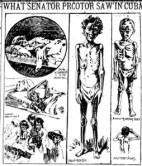
Not only was the rebellion stalemated by early 1898; a human rights disaster had taken shape in Cuba. The horrors of reconcentración drew wide attention, and condemnation, in the United States.

Reconcentration images

Horrors of reconcentración

The reconcentración policy, along with Spain’s inability to quell the rebellion by negotiation or military force, were the proximate causes of the war that began in April 1898.

As I point out in Yellow Journalism:

“To indict the yellow press for instigating the Spanish-American War is fundamentally to misread the evidence and thus do disservice to the broader understanding of a much-misunderstood conflict. ”

Alas, the holiday season number is not the first time the Economist has fallen for the media myth of yellow journalism.

In July 2011, the magazine declared, without attribution, that “William Randolph Hearst is widely suspected of stirring up the Spanish-American war to give his papers something to report.”

WJC

Recent or related:

‘Yes, Virginia’ special on CBS a sad distortion of a timeless newspaper reply

In 1897, Debunking, Error, Media myths, New York Sun, Quotes, Television on December 13, 2012 at 7:29 am

CBS will demonstrate anew tomorrow night that repeat performance is no measure of quality. Or accuracy.

The network will air for the fourth successive Christmas season its charmless, half-hour animated special, “Yes Virginia.”

The show is an unrelieved distortion of  the story behind the New York Sun’s classic editorial reply to 8-year-old Virginia O’Hanlon who implored in a letter to the newspaper in 1897:

“Please tell me the truth; is there a Santa Claus?”

Church

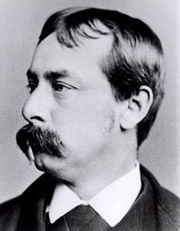
The Sun’s reply, by a veteran editorial writer named Francis P. Church, declared in part:

“Yes, Virginia, there is a Santa Claus. He exists as certainly as love and generosity and devotion exist, and you know that they abound and give to your life its highest beauty and joy. Alas! how dreary would be the world if there were no Santa Claus. It would be as dreary as if there were no Virginias.”

The tiresome CBS show offers none of the charm of Church’s timeless paean to childhood and the Christmas spirit.

Indeed, the program distorts all major elements of the back story of the “Yes, Virginia,” editorial.

Holiday Programming

CBS’ Church: Scowling, loud, irritable

It depicts Virginia is a waddling, round-headed girl annoyingly obsessed about the existence of Santa Claus. It portrays Church as scowling, loud, and irritable.

Neither portrayal is convincing, nor very accurate.

Church is cast as the editor of the Sun, which is shown as a tabloid newspaper. Church wasn’t the editor; he was an editorial writer who relished the anonymity the position allowed.

And the Sun of 1897 was no tabloid.

Not only that, but the CBS show has Virginia writing her letter, and the Sun publishing its reply, in December, as Christmas approached.

That’s far from accurate.

As I discussed in my 2006 book, The Year That Defined American Journalism: 1897 and the Clash of Paradigms, Virginia wrote the letter not long after her birthday in July 1897.

The Sun published its editorial-reply on page 6 of its issue of September 21, 1897.

In first appearance, the editorial that has become the most famous in American journalism was inconspicuous and obscure. It was placed in the third of three columns of editorials. It certainly was not introduced with large headlines on the front page, as the CBS show has it.

The headline accompanying the Sun’s editorial posed the timeless question:

“Is There A Santa Claus?”

The editorial was no instant sensation, no immediate hit. And the Sun did not reprint the editorial at Christmastime every year after 1897, as is commonly believed.

It took years for the newspaper to warm to and embrace “Is There A Santa Claus?”

As I noted in The Year That Defined American Journalism, it wasn’t until the mid-1920s when the Sun began routinely publishing the essay at Christmastime.

What helped kept the editorial alive were the newspaper’s readers. They found it appealing and memorable. They found solace and inspiration in its passages.

In untold numbers over the years, readers asked the Sun to reprint the essay.

A letter-writer told the newspaper in 1926 that “Is There A Santa Claus” offered “fine relief from the commercialism and unsentimental greed” of the Christmas season.

In 1940, a writer to the Sun likened the essay to “a ray of hope on the path to human understanding in our troubled times.”

The CBS program hints at none of that. It offers no indication that the editorial’s fame rests at least in part on generations of readers who collectively proved to be far more perceptive than editors in identifying and affirming the essay’s significance and enduring appeal.

If anything, the vapid CBS show demonstrates that history’s back story can be richer, and far more charming, than repeat holiday fare on television.

WJC

Many thanks to Instapundit
Glenn Reynolds for linking to this post

Recent and related: