W. Joseph Campbell

Archive for the ‘Newspapers’ Category

PBS set to embrace ‘mass hysteria’ myth in anniversary show on ‘War of Worlds’?

In Anniversaries, Debunking, Error, Media myths, Media myths and radio, Newspapers, Television, War of the Worlds on May 13, 2013 at 12:20 pm
Welles and 'War of the Worlds'

Orson Welles and ‘War of the Worlds’: No panic

PBS plans to air an “American Experience” program in October about the famous War of the Worlds radio adaptation, which starred Orson Welles and cleverly told of Earth’s invasion by Martians wielding deadly heat rays.

The PBS description sounds as if the program will embrace a hoary media-driven myth — that The War of the Worlds show of October 30, 1938, set off widespread panic and mass hysteria.

As I discuss in my media-mythbusting book, Getting It Wrong, “the panic and mass hysteria so readily associated with The War of The Worlds program did not occur on anything approaching nationwide dimension.”

In overwhelming numbers, I write in referring to contemporaneous polling data, most listeners “recognized it for what it was — an imaginative and entertaining show on the night before Halloween.”

But here’s the PBS summary of an hour-long “American Experience” program, to be aired October 29, on the eve of the radio show’s 75th anniversary:

“AMERICAN EXPERIENCE ‘War of the Worlds’ Orson Welles’ infamous radio dramatization of H.G. Wells’ War of the Worlds set off one of the biggest mass hysteria events in U.S. history 75 years ago. The film examines the elements that made America ripe for the hoax. Tuesday, October 29, 9:00-10:00 p.m. ET.”

The reference to “one of the biggest mass hysteria events in U.S. history” raises eyebrows — and commanded the attention of Media Myth Alert.

(Asked for details about the content of the “American Experience” show, Cara White, a spokeswoman, said by email: “We don’t have additional information at this time since the program isn’t premiering until October. But we should have more information closer to the broadcast.”)

The 1938 radio adaptation of The War of the Worlds may have produced fleeting, localized fright and confusion. But there’s no persuasive evidence that it stirred anything approaching panic of nationwide dimension.

This is more than an academic argument: Listener reaction to The War of the Worlds program in 1938 speaks to whether the media have the capacity to create powerful, immediate, and unnerving effects.

I point out in Getting It Wrong that “the notion that The War of the Worlds program sent untold thousands of people into the streets in panic, is a media-driven myth that offers a deceptive message about the influence radio wielded over listeners in its early days and, more broadly, about the media’s potential to sow fright, panic, and alarm.”

I’m not alone in my conclusions about The War of the Worlds program, an hour-long adaptation that aired on CBS radio.

Robert E. Bartholomew, an authority on mass hysteria and social delusions, has noted there is scant evidence that many frightened listeners acted on their fears that night in 1938.

Michael J. Socolow wrote in a fine essay in 2008 that “panic was neither as widespread nor as serious as many have believed at the time or since.”

Socolow also noted:

“The streets were never flooded with a terrified citizenry” during or after the radio program.

Moreover, had Welles’ show “set off one of the biggest mass hysteria events in U.S. history,” the resulting turmoil and trauma certainly would have resulted in serious injuries and deaths, including suicides.

But none were linked to the program.

The erroneous notion that The War of the Worlds dramatization had convulsed the country in panic and mass hysteria certainly was afoot in 1938 — and for U.S. newspapers of the time, that misleading interpretation offered a delicious opportunity to assail an upstart rival medium, radio.

By the late 1930s, radio had become an important source for news and advertising, and American newspapers had, as I write in Getting It Wrong, “competitive incentives to denounce radio, and characterize it as irresponsible and unreliable.

“Many newspapers seized the chance to do with enthusiasm,” I note. “It was as an opportunity they could not fail to let pass.”

The New York Times, for example, declared in an editorial titled “Terror by Radio”:

“Radio is new but it has adult responsibilities. It has not mastered itself or the material it uses.”

The Times and other American newspapers in 1938 seemed eager to chastise radio. And their overwhelmingly negative commentary helped seal the lingering and erroneous view that The War of the Worlds dramatization set off panic and hysteria across the country.

Judging from its news release, PBS seems ready to embrace that media myth.

WJC

More from Media Myth Alert:

Cuban dissident blogger Yoani Sanchez in DC, plans digital newspaper back home

In Newspapers on March 20, 2013 at 6:13 am
Sanchez_Cato

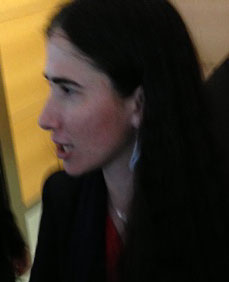
Yoani Sanchez in DC

Yoani Sanchez, Cuba’s most prominent and outspoken dissident blogger, took her international tour to Washington yesterday, vowing to promote “responsible, objective journalism” on an island that has known anything but since Fidel Castro seized power in 1959.

Sanchez, in remarks at the libertarian Cato Institute, said she plans to establish an independent digital newspaper upon her return to Cuba, one of the world’s most inhospitable places for searching journalism.

Sanchez, 37, has won international fame as a blogger who has stood up to the regime’s hostility while posting pithy ruminations and slice-of-life essays at her Generación Y (“Generation Y”) site, which has attracted a wide following outside of Cuba.

She is on an 80-day world tour, accepting honors and honors that she has won over the years but has not been allowed to collect. Sanchez told the audience at the Cato Institute that Cuban authorities denied her applications to travel abroad no fewer than 20 times over the past five years.

She was granted a passport in January, after the communist regime of Raul Castro, Fidel’s brother and successor as president, eased travel restrictions.

She speculated that in permitting her to travel abroad, the regime may have hoped that she would not return to Cuba.

But, she declared, “I’m not going to stay in another country,  and I’m not going to be afraid” of what the regime may have in store upon her return.

She said she likely will be the target of surveillance and harassment back in Cuba, but added that her prominence and outspokenness serve as “a protective shield,” making it less likely that Cuban authorities will treat her harshly.

Sanchez is dark-eyed, petite, and strikingly poised. She seems to wear the mantle of international fame comfortably, without evident haughtiness. Swaggering she is not.

She spoke through an interpreter, Ted Henken, a professor at Baruch College in New York. Henken helped organize her visit to the United States, which included a stop in New York City to collect the Maria Moors Cabot Prize, given by Columbia University to recognize journalism that promotes inter-American understanding. She won the award in 2009.

Sanchez said yesterday that she never expected to gain international prominence through her blogging, and characterized her fame as “a joke of fate” and “a cross” that she bears.

Her travels outside Cuba — she visited Brazil and the Czech Republic before arriving last week in the United States — certainly have heightened her international profile. And her intention to start an non-governmental newspaper in Cuba could place her on a collision course with the Castro regime.

Sanchez said the newspaper she envisions will be digital-only, at least at first. That’s because the regime would outlaw an independent print newspaper as anti-government propaganda, she said.

Cuba’s media landscape is among the most repressive in the world. The non-governmental organization Freedom House ranks Cuba 190th among 197 countries and territories it assesses in its annual press-freedom report. North Korea is last in the Freedom House rankings; Finland, Norway, and Sweden are first.

Sanchez said social media platforms such as blogs and Twitter “have helped us create small cracks in the wall of censorship” in Cuba. But she said she’s under no illusion that social media will seriously threaten the regime. (Sanchez’s Twitter account has more than 450,000 followers.)

“By themselves,” she said, “these aren’t the instruments that will bring democracy to Cuba.”

Even so, she said, “you can’t imagine the speed with which information is circulating in Cuba.” It often moves hand-to-hand, in that someone uses a thumb drive to download information from the Internet — access to which is severely restricted — and passes the thumb drive from person to person, in what Sanchez called a “black market of information.”

Sanchez, who spoke without notes, also traced the recent trajectory of dissidence in Cuba. It was 10 years ago, she noted, when the Castro regime imposed a sweeping crackdown, rounding up dissidents and journalists and sentencing them to lengthy prison terms.

What is often called Cuba’s “Black Spring” crackdown took place when the world’s attention was trained on the U.S.-led war in Iraq.

WJC

Many thanks to Ed Driscoll, subbing at Instapundit,
for linking to this post.

More from Media Myth Alert:

Media myth outbreak abroad; ‘Cronkite Moment’ goes viral

In Cronkite Moment, Debunking, Media myths, Newspapers, Quotes, Television on February 9, 2013 at 8:38 am

It’s well-known that media myths — those tall tales about the purported feats of American journalists — can go viral, internationally.

Seldom, though, has there been an outbreak as such yesterday’s, when leading newspapers in Canada, Britain, and Belgium separately indulged in the  “Cronkite Moment” media myth.

Johnson: Not in front of a TV

Johnson on February 27, 1968: Not watching Cronkite

The “Cronkite Moment” was in 1968, when on-air editorializing by CBS News anchorman Walter Cronkite supposedly produced a moment of stunning clarity and insight for President Lyndon B. Johnson and altered the course of the war in Vietnam.

Such effects are wildly overstated, but they make for an irresistible tale of powerful media influence, and that’s like so much catnip to contemporary journalists and columnists.

It helps explains yesterday’s outbreak, which was abundantly seasoned with hagiographic praise for Cronkite, who died in 2009:

  • Rick Salutin, in a column for the Toronto Star about a Canadian news anchor, wrote that Cronkite set the “gold standard for anchors” and “was solid as the bronze statue of the American revolutionary minuteman” at Concord, Massachusetts. Salutin further wrote: “When president Lyndon Johnson heard Cronkite turn against the Vietnam War, he said, ‘If I’ve lost Cronkite, I’ve lost the country.'”
  • Michael McCarthy, the environment editor for London’s Independent newspaper, wrote in a column about filmmaker David Attenborough that Cronkite “was a world figure as America’s most celebrated broadcaster.”Independent masthead McCarthy declared: “Such was his aura and influence that when, on his return from a Vietnam trip in 1968, he pronounced that the US could not win the war, President Lyndon Johnson is said to have exclaimed: ‘If I’ve lost Cronkite, I’ve lost Middle America!’ and shortly afterwards announced he would not seek re-election.”
  • Jean-Paul Marthoz, in a blog commentary for the French-language Le Soir of Brussels, wrote that Cronkite was America’s “most trusted man” and added: “In 1968, on his return from a reporting assignment to Vietnam, a conflict that he covered with rigorous impartiality, he declared that the war couldn’t be won, which led President Lyndon Johnson to declare:  ‘If I’ve lost Walter Cronkite, I’ve lost America.'”

It’s true that Cronkite, on February 27, 1968, pronounced the U.S. war effort in Vietnam was “mired in stalemate.” And he suggested that negotiations might prove to be the way out.

But the effects of Cronkite’s commentary were dramatically more modest than the characterizations of Salutin, McCarthy, and Marthoz.

As I discuss in my media-mythbusting book, Getting It Wrong, Lyndon Johnson did not see the Cronkite program when it aired, and there’s no certain evidence he ever saw it later, on videotape.

Johnson was not at the White House on February 27, 1968. He was not in front of a television set when Cronkite’s special report aired.

The president then was in Austin, Texas, at a black-tie event marking the 51st birthday party of Governor John Connally, one of Johnson’s long-time political allies.

About the time Cronkite was intoning his “mired in stalemate” assessment, Johnson was engaging in light-hearted banter about Connally’s age. Johnson hardly was bemoaning the loss of an anchorman’s support.

“Today,” the president said, “you are 51, John. That is the magic number that every man of politics prays for — a simple majority.”

What’s more, Cronkite’s “mired in stalemate” assessment was neither profound nor exceptional in early 1968.

For months before Cronkite’s program, U.S. news organizations had been invoking “stalemate” to characterize the war effort.

The New York Times, in an analysis published August 7, 1967,  declared “the war is not going well. Victory is not close at hand.”

The analysis, filed from Saigon, further stated:

“‘Stalemate’ is a fighting word in Washington. President Johnson rejects it as a description of the situation in Vietnam. But it is the word used by almost all Americans here, except the top officials, to characterize what is happening.”

The Times’ assessment appeared on its front page, beneath the headline:

Vietnam: The Signs of Stalemate.

Not only was Cronkite’s “mired in stalemate” assessment belated; it was mild compared to other commentary at the time.

The Wall Street Journal in an editorial published four days before Cronkite’s report, said the U.S. war effort in Vietnam “may be doomed” and that “everyone had better be prepared for the bitter taste of defeat beyond America’s power to prevent.”

Strong stuff.

Interestingly, Cronkite in his memoir dismissed the supposedly powerful effects of his report on Vietnam. He wrote in memoir, titled A Reporters’ Life and published in 1997, that the “mired in stalemate” assessment represented for Johnson “just one more straw in the increasing burden of Vietnam.”

Cronkite repeated the analogy in promoting the book, telling CNBC that he doubted whether the program “had a huge significance. I think it was a very small straw on a very heavy load [Johnson] was already carrying.”

WJC

More from Media Myth Alert:

London’s ‘Independent’ latest to invoke media myth about Pentagon and Jessica Lynch

In Debunking, Error, Jessica Lynch, Media myths, Newspapers, Washington Post on January 28, 2013 at 7:40 am

In the debate about women being permitted to join U.S. military combat units, it was inevitable the media myth would resurface about Jessica Lynch and her purported battlefield heroics in Iraq nearly 10 years ago.

The myth has it that the Pentagon concocted the tale about Lynch’s having fought fiercely in an ambush in Nasiriyah and fed the propaganda to a credulous U.S. news media.

Sure enough, Britain’s Independent newspaper stepped in that myth over the weekend, in an online report about women in the U.S. military.

The newspaper referred to Lynch as a name fresh “in America’s collective memory” and asserted that “initial reports from the Pentagon exaggerated her story as it waged a propaganda war, stating that she had fought back heroically against the enemy when in fact she had never fired her weapon.”

Lynch was an element of a Pentagon “propaganda war”?

Not so.Independent masthead

Not according to Vernon Loeb, the Washington Post reporter who helped thrust the hero-warrior tale about Lynch into the public domain in an electrifying but utterly inaccurate front-page story published April 3, 2003. Loeb has said the Pentagon wasn’t the source of the Post’s story about Lynch, which it pegged to otherwise anonymous “U.S. officials.”

Under the byline of Loeb and Susan Schmidt, the Post reported that Lynch, then  a 19-year-old Army private in a support unit, kept firing at attacking Iraqis “even after she sustained multiple gunshot wounds and watched several other soldiers in her unit die around her in fighting” at Nasiriyah on March 23, 2003.

The Post quoted one anonymous official as saying that Lynch “‘was fighting to the death. She did not want to be taken alive.'”

The story turned out to be wrong in every significant detail: Lynch never fired a shot in the attack at Nasiriyah; her weapon jammed during the deadly ambush in which 11 American soldiers were killed.

Lynch was neither shot nor stabbed, as Loeb and Schmidt reported, but suffered shattering injuries to her back, legs, and arms in the crash of a Humvee in which she was attempting to flee.

She was taken prisoner and treated at an Iraqi hospital, from where she was rescued April 1, 2003, by a U.S. special forces team.

As Lynch herself insists, she was no hero (although she has said she could have embraced the Post’s hero-warrior tale and no one would’ve been the wiser).

The Post, though, has never identified the “U.S. officials” who led it so badly astray.

But we do know that the Pentagon wasn’t the source of the Post’s exaggerated hero-warrior tale: Loeb said so in an interview on Fresh Air, an NPR radio program, in mid-December 2003.

In the interview, Loeb declared flatly:

“Our sources for that story were not Pentagon sources.”

Loeb also said that he “could never get anybody from the Pentagon to talk about” the Lynch case.

“They wouldn’t say anything about Jessica Lynch,” Loeb declared, adding:

“I just didn’t see the Pentagon trying to create a hero where there was none. I mean … they never showed any interest in doing that, to me.”

Although Loeb’s remarks have long been in the public domain, the Independent is the latest of many news organizations to have ignored or overlooked them, blithely offering instead the juicy but unsubstantiated claim that “the Pentagon exaggerated her story.”

Lynch_large photo

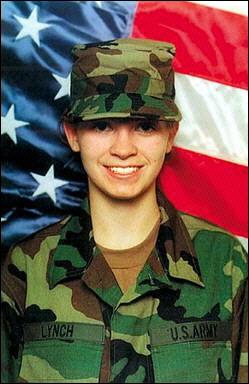
Private Lynch

The claim is a weak one, even without Loeb’s disclaimer. After all, in the early days of the Iraq War, the Pentagon had little reason to exploit the Lynch case as a way to boost popular support  for the conflict.

As I point out in my myth-busting book, Getting It Wrong:

“It may be little-recalled now, but the U.S.-led invasion of Iraq was widely supported by the American public. Polling data from March and April 2003, the opening days and weeks of the war, show an overwhelming percentage of Americans supported the conflict and believed the war effort, overall, was going well.”

Among those public opinion polls was a Washington Post-ABC News survey conducted in late March and early April 2003 — when Lynch was much in the news. The poll found that eight of 10 Americans felt the war effort was going well, and 71 percent approved of the Bush administration’s handling of the Iraq situation.

WJC

Many thanks to Instapundit
Glenn Reynolds for linking to this post

More from Media Myth Alert:

Media myth distorts Chicago Tribune timeline of newspaper history

In Debunking, Error, Media myths, Newspapers, Washington Post, Watergate myth on November 20, 2012 at 9:24 am

The Chicago Tribune the other day published a timeline of American newspaper history over the past 50 years — a chronology tainted by the inclusion of a prominent media myth.

The Tribune declared “the daily paper remains vital to an informed citizenry” in presenting the timeline, which it said demonstrated “how newspapers expose — and occasionally commit — wrongdoing.”

The myth appears in the timeline entry for 1974, which says: “A corrupt U.S. president, Richard Nixon, is brought down by a newspaper, The Washington Post.”

Brought down by a newspaper.

Now, that may be the popular dominant narrative of the Watergate scandal — that the dogged reporting of Washington Post reporters Bob Woodward and Carl Bernstein exposed the corruption that forced Nixon’s resignation.

But it’s a mythical, media-centric interpretation, a trope that not even the Post embraces.

In fact, Woodward once dismissed such characterizations as “horseshit.” And for good reason.

As I discuss in a chapter in my 2010 book, Getting It Wrong, unraveling a scandal of the dimension and complexity of Watergate demanded the collective if not always coordinated efforts of special prosecutors, federal judges, both houses of Congress, the Supreme Court, as well as the Justice Department and the FBI.

Even then, as I note in Getting It Wrong, Nixon likely would have survived the scandal and served out his term had it not been for the audiotape recordings he secretly made of conversations in the Oval Office of the White House.

Only when compelled by the Supreme Court did Nixon surrender the telltale recordings, which captured him approving a plan to divert the FBI’s investigation into Watergate’s seminal crime, the break-in June 17, 1972, at the headquarters of the Democratic National Committee.

It is interesting to note that the Post in its Watergate reporting did not disclose the existence of the Watergate tapes, nor did the newspaper identify or unravel the coverup of Watergate-related crimes.

To assert that the Post brought down Nixon is, as I write in Getting It Wrong, “to abridge and misunderstand the scandal and to indulge in a particularly beguiling media-driven myth.”

What, then, accounts for the tenacity of this hoary media myth? Why does it persist, despite the evidence that can be arrayed against it?

A number of reasons offer themselves.

The Watergate myth, after all, offers a simplistic, easy-to-grasp interpretation of a scandal that was intimidating in its complexity: The web of misconduct that took down Nixon also landed nearly 20 of his top aides, associates, and cabinet officers in jail.

Media myths often spring from simplicity, from the desire for tidy and uncomplicated versions of history. Not only that, but the notion that the Post brought down Nixon fits neatly into a timeline.

A feel-good component buoys the Watergate myth, too: The myth affirms the notion that newspapers, beleaguered though they are, really can make a difference in American politics and in American democracy.

Which, itself, is something of a media myth.

WJC

Recent or related:

Newspaper endorsements don’t much matter — except maybe at the margins

In 1897, Newspapers on November 5, 2012 at 6:54 am

Romney endorsed by New York Daily News

It’s long been apparent that newspaper endorsements for high political office are rarely decisive.

Back in 1897, when print made up the mass media, newspapers were shocked when their endorsements had little impact on the outcome of the New York City mayoral election.

The Tammany Hall candidate, an obscure judge named Robert A. Van Wyck, won the election decisively — without giving a speech and without receiving the editorial support of the city’s leading newspapers.

Nowadays, in a world of myriad digital options, many U.S. daily newspapers are but shells of their former selves. Few of them really presume to set an agenda for their communities and their endorsements for high political office are all but irrelevant. More than a handful of newspapers no longer endorse candidates for president.

Still, it is conceivable that newspaper endorsements could make a difference in close elections in a few places in tomorrow’s presidential election. Enough readers could take cues from newspaper endorsements to tip the outcome in very tight races — as perhaps in Iowa and Florida.

It’s speculative, but not implausible.

In Iowa and Florida, prominent newspapers that endorsed Barack Obama in 2008 are backing Republican Mitt Romney this year. And the Obama-Romney race is close in both states. Polling data compiled and aggregated at RealClearPolitics indicate that Obama leads by three percentage points in Iowa and that Romney is narrowly ahead in Florida.

The largest-circulation newspaper in Iowa, the Des Moines Register, has endorsed Romney, citing his “strong record of achievement in both the private and public sectors.”

In Florida, the Orlando Sentinel and the Fort Lauderdale Sun-Sentinel have come out for Romney.

The Sentinel asserted in its editorial endorsement: “We have little confidence that Obama would be more successful managing the economy and the budget in the next four years. For that reason, though we endorsed him in 2008, we are recommending Romney in this race.”

And the Sun-Sentinel said: “When President Obama came into office in 2009, the economy was in freefall and though untested, he inspired us with his promise of hope and change. Now, four years later, we have little reason to believe he can turn things around.

“So while we endorsed Obama in 2008, we recommend voters choose Republican Mitt Romney on Nov. 6.”

That those newspapers have turned away from Obama probably matters much only to a few readers. But editorial endorsements that sway even a few readers could make a difference if the statewide race is very close.

This point was made the other day by a leading political analyst and numbers-cruncher, Michael Barone. Writing in the Washington Examiner, Barone said the Des Moines Register’s endorsement “could make a significant difference” in the outcome in Iowa.

Some indirect evidence suggests that newspaper endorsements can signal the outcomes of close races.

Greg Mitchell, formerly editor of the trade journal Editor & Publisher, noted in a recent commentary at the Nation that just before the presidential election in 2008,  he “went out on a limb and predicted which candidates would win in the thirteen key ‘toss-up’ states based purely on newspaper endorsements in those states — not polls or common sense or anything else.”

Mitchell said he “got them right, except for one.”

Based on newspaper endorsements in swing states this year, Mitchell has predicted that Obama will narrowly defeat Romney. Mitchell’s breakdown has five swing states for Obama, five for Romney, and one (Virginia) undecided, which seems more like a toss-up.

In any case, data compiled by the American Presidency Project at the University of California, Santa Barbara, show that 12 newspapers that endorsed Obama in 2008 are supporting Romney this year. They include the New York Daily News, the country’s fifth-largest newspaper, and Newsday of Long Island, the 13th largest daily.

Those endorsements aren’t likely to matter much, though, given that Obama is a sure bet to carry New York State.

WJC

Recalling George Romney’s ‘brainwashing’ — and Gene McCarthy’s ‘light rinse’ retort

In Anniversaries, Cronkite Moment, Debunking, Media myths, Newspapers, Quotes on September 4, 2012 at 3:38 pm

It’s been 45 years since George Romney committed one of the greatest gaffes in American political history — a misstep that supposedly inspired one of the most devastating putdowns in American political history.

Interestingly, though, crucial details about the devastating putdown remain rather murky.

Romney’s gaffe, which effectively destroyed his run for the presidency before it officially began, came in an interview taped on August 31, 1967, and aired September 4, 1967, on a Detroit television station.

In the interview, Romney, then governor of Michigan and a presumptive Republican candidate for president, referred to his visit to South Vietnam in 1965 and declared:

“You know, when I came back from Vietnam, I’d just had the greatest brainwashing that anybody could get. … Well, not only by the generals but by the diplomatic corps over there. They do a very thorough job.”

The assertion that he had been duped into supporting America’s war effort in Vietnam revealed Romney’s muddled thinking and an uncertain command of foreign policy. (“Could the country afford a President who was so easily deceived?” the New York Times wondered.)

Forty-five years on, Romney’s comment remains striking both for clumsiness and self-destructiveness. And it’s been recalled not infrequently in recent months as Romney’s son, Mitt, has campaigned for the presidency.

When it is recalled, the “brainwashing” gaffe often is coupled with the stiletto-like rejoinder attributed to Eugene McCarthy, then a second-term U.S. senator from Minnesota.

McCarthy supposedly said that rather than brainwashing, “a light rinse” would have sufficed in Romney’s case.

There is no question about Romney’s having made the “brainwashing” claim; this YouTube video cuts to the money quote:

The anecdote’s memorable quality lies not only in Romney’s befuddled claim but also in McCarthy’s “light rinse” quip. Indeed, McCarthy’s retort is said to have been so powerful that it “essentially finished Romney.”

But the precise context of McCarthy’s “light rinse” zinger is at best unclear. My research has turned up no unambiguous documentation about when McCarthy made the comment, where, and specifically to whom.

(And why does this matter? Getting it right matters a lot, especially about an insult so piercing and effective that it lives on like few others in American political lore.)

A database search of leading U.S. newspapers — including the New York Times, the Washington PostChicago Tribune, Los Angeles Times, and Baltimore Sun — turned up no published reference to McCarthy’s “light rinse” remark in 1967 or 1968, or for many years afterward.

The nearest contemporaneous hint to a “light rinse” came in a commentary published in mid-September 1967 in the Los Angeles Times, in which conservative columnist James J. Kilpatrick said of Romney:

“Brainwashed, was he? It couldn’t have been much of a laundry bill.”

Kilpatrick’s column did not mention McCarthy, who wasn’t prominently in the news in September 1967. McCarthy did not announce his candidacy for president until November that year.

The first reference found in the database search to the “light rinse” comment  was in a commentary written by Fred Barnes and published in Baltimore Sun in April 1983. Barnes’ commentary, however, did not say when, where, or to whom McCarthy uttered the “light rinse” line.

The “light rinse” anecdote notably has been afflicted with version variability — my term for the shifting of important details as a story is retold over the years. As I point out in my 2010 book,  Getting It Wrong, version variability can be a marker of a media-driven myth.

Here are a few examples of the shifting versions of the “light rinse” remark:

  • Maureen Dowd of the New York Times, writing in her column in January 2012, quoted McCarthy as having said: “All that was needed in the case of George Romney was a light rinse.”
  • Syndicated columnist Jules Witcover wrote in 2007 that McCarthy “quipped that he ‘would have thought a light rinse would have done it.'”
  • Mark Shields, writing in the Washington Post in 1988, quoted McCarthy’s one-liner this way: “I don’t know why Romney was brainwashed; in his case, a light rinse would have been sufficient.”

And as further evidence of version variability, the “light rinse” quip has even been attributed to Daniel Patrick Moynihan.

Such imprecision invites suspicion about the “light rinse” quip. (It also sounds almost too perfect to be true — not unlike, say, William Randolph Hearst’s purported vow to “furnish the war” with Spain or Lyndon B. Johnson’s supposed epiphany on the Vietnam War: “If I’ve lost Cronkite, I’ve lost Middle America.”)

Among the first accounts  — if not the first account — of McCarthy’s quip appeared in An American Melodrama: The Presidential Campaign of 1968, a hefty book published in 1969.

American Melodrama, which was written by Lewis Chester, Godfrey Hodgson, and Bruce Page, described McCarthy’s remark as off-handed and said his aides persuaded journalists to hush it up.

According to American Melodrama, McCarthy was asked “by reporters whether he thought Romney’s ‘brainwashed’ gaffe had dealt the death blow to his chances.”

McCarthy was quoted as saying in reply:

“Well . . . er no, not really. Anyway, I think in that case a light rinse would have been sufficient.”

The book further stated:

“McCarthy’s press aides, appalled at the possible effects of this remark on Republicans, who, bereft of a dove candidate in their own party, might write-in McCarthy’s name, pleaded with reporters not to use it. They dutifully complied; though few would have done the same for Romney.”

While intriguing, American Melodrama doesn’t say when McCarthy made the comment, where, or specifically to whom.

Although self-censorship could account for the absence of contemporaneous references to McCarthy’s quip in leading U.S. newspapers, it seems implausible that an insult so delicious and devastating would have remained hushed up, even by compliant reporters, for very long.

Another version was offered by British journalist David Frost in an interview the aired on C-SPAN in 2007. Frost recalled having heard McCarthy’s comment, and said it was made in New Hampshire not long after Romney’s “brainwashing” statement.

But Frost’s recollection is faulty in a crucial respect: He said in the interview that “within a week or so” after making the “brainwashing” comment, Romney “was out of the race.”

Not so. Romney’s ended his campaign for the presidency on February 28, 1968 — six months after uttering the “brainwashing” remark and 3½ months after officially entering the race.

During the week Romney dropped out, Frost said in the C-SPAN interview, “I was interviewing Eugene McCarthy in New Hampshire, and, as we came out, there were three or four people who … wanted a sound bite. And one of them said, ‘What do you think about George Romney being brainwashed?’

“And McCarthy said, ‘I would have thought a light rinse would have been sufficient.’ Killer line. Fantastic line, I thought.”

But left unclear in Frost’s version is why journalists would have been asking McCarthy in late February or early March 1968 about a claim that Romney had made months before. Why would it have been newsworthy then?

Puzzling.

Not only that, but Frost did not say whether, or when, he reported McCarthy’s “killer line.” Or whether McCarthy’s “press aides” pleaded with him not to use it.

WJC

Recent or related:

‘Not Likely Sent’ article about Hearst’s ‘vow’ a top 50 selection in AEJMC flagship journal

In 1897, Debunking, Furnish the war, Media myths, Newspapers, Quotes, Spanish-American War, Yellow Journalism on August 10, 2012 at 12:45 pm

AEJMC, the journalism educators organization, announced yesterday the 50 top articles to have appeared in its flagship journal — and among the selections was “Not Likely Sent,” my 2000 myth-busting study about William Randolph Hearst and his purported vow to “furnish the war” with Spain.

Hearst

“Not Likely Sent” was published in the summer 2000 issue of the peer-reviewed Journalism & Mass Communication Quarterly.

The article challenged as implausible the often-retold anecdote about Hearst’s supposed exchange of telegrams with the artist Frederic Remington, in which Hearst is said to have declared:

You furnish the pictures, and I’ll furnish the war.”

Remington at the time of purported exchange was in Cuba, on assignment for Hearst’s New York Journal. Remington spent six days on the island in January 1897, preparing sketches to illustrate aspects of the Cuban insurrection against Spain’s colonial rule.

Among the reasons for dismissing the famous anecdote — which has been invoked over the decades by scores of journalists and historians — is Hearst’s denial, and the implausibility of the supposed exchange.

That is, Spanish censors who controlled all incoming and outgoing telegraphic traffic surely would have intercepted and called attention to Hearst’s message to Remington, had it been sent.

I also pointed out in “Not Likely Sent” that Hearst’s supposed vow ran counter “to the Journals editorial positions in January 1897. The newspaper in editorials at the time expected the collapse of the Spanish war effort and resulting independence for Cuban insurgents. The Journal was neither anticipating nor campaigning for U.S. military intervention to end the conflict.”

The Cuban rebellion, however, ground on and became a stalemate. In April 1898, the United States entered the conflict, principally to end a human rights disaster that was festering in Cuba.

The editor of Journalism and Mass Communication Quarterly, Daniel Riffe, said in a statement that selecting the journal’s top 50 articles was “a piece of research in itself.” The process included tapping the advice of his predecessors as editor, as well as consulting citation guides and Google Scholar.

“I finally assembled a list of 50 articles that I hope our members agree have been influential in our field,” Riffe said.

The top 50 articles were selected and announced as part of the centennial celebration of AEJMC — the Association for Education in Journalism and Mass Communication.

Predecessor titles of Journalism and Mass Communication Quarterly were Journalism Quarterly and The Journalism Bulletin.

An elaboration of “Not Likely Sent” appeared as a chapter in my 2001 book, Yellow Journalism: Puncturing the Myths, Defining the Legacies. Separately, a chapter in my latest book, Getting It Wrong, described how Hearst’s purported vow came to be embedded in the lore of American journalism.

Despite the repeated debunkings, however, the anecdote about “furnish the war” lives on — a timeless, pithy, and easily recalled example of the news media at their supposed worst.

As I wrote in the article:

“The Remington-Hearst anecdote is indeed ‘a beautiful story,’ a succinct and delicious tale, one rich in hubris and in swaggering recklessness. It is, however, a story altogether dubious and misleading.

“It suggests a power that the press, including Hearst’s Journal, did not possess, that of propelling the country into a war that it did not want.”

WJC

Recent or related:

The Internet’s uneven capacity to expose media fakes

In Debunking, Media myths, Media myths and radio, Newspapers, War of the Worlds on July 30, 2012 at 10:35 am

Glenn Greenwald, a columnist for the online magazine Salon, hailed yesterday the corrective capacity of the Internet, noting how quickly a purported column by Bill Keller, one-time executive editor of the New York Times, was exposed over the weekend as an imaginative fake.

In pressing the argument, though, Greenwald offered up a hoary media myth that has survived quite well in the age of the Internet.

Greenwald wrote: “For anyone who still believes that traditional journalism is inherently more reliable than the Internet, just … compare the duration and seriousness of the frauds and fakes enabled by the model of traditional journalism.

“Long before the Internet — in 1938 — a dramatized radio broadcast by Orson Wells [sic] (“The War of the Worlds”) of Martians landing on Earth spawned mass panic.”

The notion that The War of the Worlds radio dramatization set off “mass panic” is a delicious tale.

But as I discuss in my latest book, Getting It Wrong, it’s also a tenacious media-driven myth “that offers a deceptive message about the influence radio wielded over listeners in its early days and, more broadly, about the media’s potential to sow fright, panic, and alarm.”

I point out that “the panic and mass hysteria so readily associated with The War of The Worlds program did not occur on anything approaching nationwide dimension.”

Some people who listened to the show in 1938 were frightened or disturbed by what they heard. But there is no evidence their fright rose to anything approaching “mass panic” or nationwide hysteria.

Indeed, most listeners recognized Welles’ program for what it was— an imaginative and entertaining show on the night before Halloween.

But newspaper reports the following day advanced the notion that “mass panic” had swept the country.

“These reports,” I point out, “were almost entirely anecdotal and largely based on sketchy wire service roundups that emphasized breadth over in-depth detail.”

But newspapers in 1938 “simply had no reliable way of testing or ascertaining the validity of the sweeping claims they made about the radio show,” I write.

Nonetheless, the purported “panic-broadcast” offered U.S. newspapers “an exceptional and irresistible opportunity to rebuke radio — then an increasingly important rival source for news and advertising — as unreliable and untrustworthy,” I write.

The overwhelmingly negative commentary in the American press, helped frame and solidify the erroneous impression that The War of the Worlds dramatization had sown mass panic and hysteria.

The debunking of the myth is told not only in Getting It WrongI’ve blogged about the dubious “panic broadcast,” too, as posts here, here, here, and here indicate. I’ve also written about The War of the Worlds myth for the BBC online. Others have discussed the myth in blog posts as well, notably Michael Socolow in a fine dissection in 2008.

So why does the myth live on in the digital age? Why is it resistant to the Internet’s capacity, which Greenwald extols, to detect errors and swiftly banish them?

Obviously, the notion of the “panic broadcast” became entrenched in media lore long before the digital age. Indeed, it began taking dimension the day after Welles’ clever show.

Once a myth becomes thoroughly entrenched, it may be beyond the Internet’s power ever  to dismantle. (See also, William Randolph Hearst’s purported vow to “furnish the war” with Spain; the supposed “Cronkite Moment” of 1968, and the misleading dominant narrative of Watergate.)

What’s more, the notion that tens of thousands of Americans were abruptly pitched into “mass panic” one night long ago remains a perversely appealing and irresistible tale. Its retelling affirms in a way the reassuring view that Americans these days are hardly the gullible rubes their ancestors were, back when broadcast media was emergent.

The mythical “panic broadcast” also offers a timeless anecdote with which to bash the media. The tale, after all, does suggest that when circumstances are just so, the media can spread fear and disruption, profoundly and unexpectedly.

WJC

Many thanks to Instapundit
Glenn Reynolds for linking to this post

Recent or related:

The media myths of Watergate: Part Four

In Anniversaries, Cinematic treatments, Debunking, Media myths, Newspapers, Quotes, Reviews, Washington Post, Watergate myth on June 20, 2012 at 7:40 am

This is the fourth of five posts addressing prominent media-driven myths about the Watergate scandal, which began unfolding 40 years ago this week, with
the foiled burglary at the headquarters
in Washington of the Democratic National Committee.
This installment addresses the notion that the Watergate reporting of Bob Woodward and Carl Bernstein
placed the reporters in grave danger.

No film or documentary about Watergate has been seen more often by more people than All the President’s Men, the 1976 adaptation of the eponymous book by the Washington Post’s lead reporters on the scandal, Bob Woodward and Carl Bernstein.

The movie won rave reviews. The New York Times called it “a spellbinding detective story” and “an unequivocal smash-hit — the thinking man’s Jaws.”

The Post once immodestly described All the President’s Men as “journalism’s finest 2 hours and 16 minutes” and “the best film ever made about the craft of journalism.”

For all its glowing notices, All the President’s Men was often sluggish in pacing. More than a few scenes showed reporters at their desk, talking into telephones and banging away at typewriters.

Hardly gripping cinema.

But a measure of drama and menace was injected near the close of the movie (see video clip below).

http://www.youtube.com/watch?feature=player_embedded&v=NVNU5jkOwzU

That came when Woodward’s stealthy, high-level “Deep Throat” source, at a meeting in a darkened parking garage, grimly warns the wide-eyed reporter, played by Robert Redford:

“Your lives are in danger.”

But was it even true? Had Woodward and Bernstein, in their reporting about the misdeeds of men close to President Richard Nixon, unknowingly put their lives on the line? Were they targeted by Nixon’s henchmen? Or was this just dramatic license by Hollywood?

The movie leaves such questions hanging. The Woodward/Redford character informs the Bernstein character (played by Dustin Hoffman) about what “Deep Throat” said, and together they confer with the Post’s executive editor character (Jason Robards) — in the middle of the night, in the middle of the editor’s lawn.

But the movie closes before resolving the question of the hazards the reporters faced.

So were their lives really in danger?

Nope.

Not according to the book, All the President’s Men.

The book discusses a late-night meeting between Woodward and “Deep Throat” in mid-May 1973 when the source — W. Mark Felt, a senior official at the FBI, as it turned out — advised the reporter to “be cautious.”

Woodward returned to his apartment and invited Bernstein to stop by. When he did, Woodward typed out a message and handed it to his colleague:

Everyone’s life is in danger.”

Bernstein gave a curious look and Woodward typed another note:

Deep Throat says electronic surveillance is going on and we had better watch it.”

Who was doing the surveillance? Bernstein asked in long hand.

“C-I-A,” Woodward silently mouthed.

For a time afterward, the reporters and senior editors at the Post took precautions to avoid the suspected surveillance of their activities.

Woodward and Bernstein wrote in All the President’s Men that they “conferred on street corners, passed notes in the office, avoided telephone conversations.”

But soon, they said, “it all seemed rather foolish and melodramatic” and they went back to their routines.

No evidence, they wrote, was ever found “that their telephones had been tapped or that anyone’s life had been in danger.”

At a program last week at the Newseum, Woodward said he took Felt’s warning “too literally. I think he was speaking metaphorically” about the hazards.

“I think it was an overreaction,” Woodward said.

On another occasion — an online chat five years ago — Woodward said the “most sinister pressure” he and Bernstein felt during Watergate “was the repeated denial” by Nixon’s White House “of the information we were publishing” as the scandal deepened.

Also in that chat, Woodward said of the cinematic version of All the President’s Men:

“The movie is an incredibly accurate portrait of what happened.”

Oh, sure, it is.

Even that Post review, which called the movie journalism’s finest 2 hours and 16 minutes, noted that All the President’s Men “over-glamorizes reporting, oversimplifies editing and makes power appear the only proper subject for a newsman’s pen.”

WJC

Recent or related: