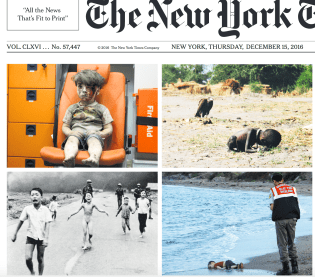
Prominently displayed on the front page of today’s New York Times were powerful images of war — the memorable and myth-burdened “Napalm Girl” photograph of 1972 among them.
The wartime images accompanied an essay about the misery of Syria’s battered city, Aleppo, once a rebel stronghold in the country’s prolonged civil war.
“They keep coming,” the essay began, “both the bombs and the images from Aleppo, so many of them ….”
“Pictures of war and suffering have pricked the public conscience and provoked action before. … There was Nick Ut’s 1972 photograph from South Vietnam of the naked 9-year-old Phan Thi Kim Phuc, screaming, burned by napalm. These pictures drove news cycles for weeks, months, years, helping tip the scales of policy.”
The photograph, which showed a cluster of terror-stricken children fleeing an errant napalm attack on their village northwest of what was then called Saigon, provoked no prolonged conversation in the American press in the days following its publication. It prompted few newspaper editorials.
There’s no evidence, moreover, that “Napalm Girl” helped “tip the scales of policy.” (The essay in the Times cited none.)
“Over the years,” I write in Getting It Wrong, “the superlatives associated with the image have edged into hyperbole and exaggeration. Napalm Girl has become invested with mythic qualities and a power that no photograph, however distinctive and exceptional, can project.”
Among the myths is that “Napalm Girl” was so arresting and extraordinary that it appeared on the front pages of newspapers across the United States. I present data challenging that notion, reporting in Getting It Wrong that of 40 major U.S. dailies examined, 21 placed the photograph on the front page in the days soon after it was taken on June 8, 1972.
Fourteen of the 21 newspapers displayed “Napalm Girl” above the front-page fold, a newspaper’s most coveted placement.
But 19 newspapers examined either did not publish “Napalm Girl” or placed the photograph on an inside page.
Reservations about front nudity no doubt led some newspapers to decline to publish “Napalm Girl” or give it prominence, I note, although the depth of such reluctance is difficult to measure.
In any event, it is clear that “Napalm Girl” did not drive “news cycles for weeks, months, years,” as the Times’ essay asserted.
Nor did the image drive policy.
It had no discernible effect on the U.S. policy of Vietnamization, which was put in place during the presidency of Richard Nixon and sought to shift the bulk of fighting to America’s South Vietnamese allies.
By June 1972, most American combat troops had been removed from South Vietnam, a drawdown neither slowed nor accelerated by publication of “Napalm Girl.”
This is not to say Nixon was unaware of the photograph, however. He briefly discussed “Napalm Girl” with his top White House aide, H.R. Haldeman, a conversation captured on Nixon’s secret taping system.
The tapes show that Haldeman on June 12, 1972, brought up what he called the “napalm thing.” Nixon replied by saying:
“I wonder if that was a fix” meaning: Was the image staged?
“Could have been,” Haldeman said, adding, “Napalm bothers people. You get a picture of a little girl with her clothes burnt off.”
“I wondered about that,” Nixon replied.
The photograph had no known effect on Nixon’s thinking about the war, I write in Getting It Wrong, pointing out that his attention was soon diverted. On June 17, 1972, burglars linked to Nixon’s reelection campaign were arrested inside the headquarters of the Democratic National Committee in Washington, the signal crime of what ballooned into the Watergate scandal.
Nixon’s attempts to cover up the burglary’s links to his campaign — a scheme he discussed with Haldeman in tape-recorded conversation June 23, 1972 — eventually cost Nixon the presidency.
The mainstream media’s recent panic about a surge of “fake news” has tended to ignore a critical element: The media themselves often have been purveyors of bogus stories.
“Fake news” has plenty of antecedents in mainstream media — several cases of which are examined in my mythbusting book, Getting It Wrong, a new, expanded edition of which was published recently by University of California Press.
The book addresses and debunks media-driven myths, which are well-known stories about and/or by the news media that are widely believed and often retold but which, under scrutiny, dissolve as false or wildly exaggerated.
Media myths can be thought of as prominent cases of “fake news” or shoddy interpretation that have masqueraded as fact for years. Or decades.
Take, for example, the often-told tale that television viewers and radio listeners had sharply different impressions about who won the first-ever televised debate in September 1960 between major party candidates. The media myth is that John F. Kennedy looked so cool and collected that TV audiences gave him the nod, but that Richard Nixon was the winner among radio listeners.
The tale of viewer-listener disagreement has circulated for years and is dismantled in one of three new chapters in the second edition of Getting It Wrong. “Despite a feeble base of supporting documentation,” I write, “it is a robust trope that emerged within months of the first of four Kennedy-Nixon debates [in 1960] and is often invoked decades later as conclusive evidence of the power of television images and the triumph of image over substance.”
Viewer-listener disagreement is a dubious bit of political lore that’s frequently cited by mainstream media, especially in the runup to national elections. As with many media myths, I point out in the book, “the notion of viewer-listener disagreement rests more on assertion than persuasive evidence.”
What little polling data exist about the debate’s radio listeners are simply too sparse, too unstable, and too imprecise to support any broad conclusions about their views of the debate winner.
Moreover, the extensive debate coverage in major U.S. newspapers lends no support to the claim of viewer-listener disagreement, either.
Had dramatic and widespread differences characterized the reactions of TV and radio audiences, journalists in 1960 were well-positioned to detect and report about such clashing perceptions — especially in the days immediately after the Kennedy-Nixon encounter when curiosity about the debate, its novelty, and its impact ran high.
But none of the scores of newspaper articles, editorials, and commentaries I examined in researching the chapter about the debate made specific reference to the presumptive phenomenon of listener-viewer disagreement: Leading American newspapers contained nothing in the debate’s immediate aftermath that suggested pervasive differences in how televisions viewers and radio listeners reacted to the landmark debate, I note.
The myth of viewer-listener disagreement appears to have originated in a passage in The Making of the President, 1960, an award-winning book about the campaign written by journalist Theodore White.
The purported vow of William Randolph Hearst to “furnish the war” with Spain, supposedly contained in a telegraphic exchange with Frederic Remington, an artist on assignment in Cuba in 1897 for Hearst’s New York Journal. The war-mongering vow is well-known in American journalism, but is supported by no compelling evidence or documentation. The telegrams have never turned up and Hearst denied sending such a message. But because it supposedly captures Hearst’s duplicitous ways so well, the “furnish the war” anecdote lives on, despite having been thoroughly debunked.
The radio adaptation in October 1938 of The War of The Worlds was supposedly so dramatic and sounded so convincing that tens of thousands of Americans took to the streets in panic and mass hysteria, believing that Earth was under an invasion from Mars. But evidence is scant at best that the radio program caused such powerful effects. If panic had spread across America during The War of the Worlds broadcast, the resulting turmoil surely would have resulted in deaths, including suicides, and in serious injuries. But nothing of the sort was linked to the show.
This tale, too, lives on, resistant to debunking.
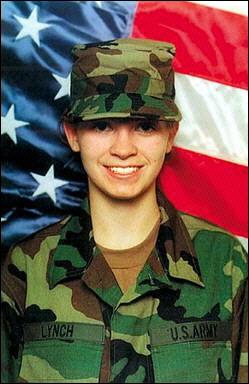
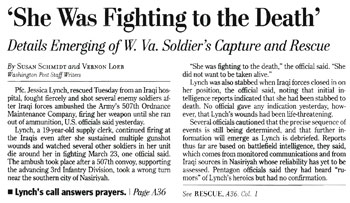
The supposed battlefield heroics of PFC Jessica Lynch, a 19-year-old Army supply clerk who, the Washington Post said, fought fiercely in the ambush of her unit during the early days of the Iraq War in 2003. Lynch, the Post claimed, was shot and stabbed, but kept firing her weapon until she ran out of ammunition and was taken prisoner. The Post’s electrifying, front-page story about Lynch’s derring-do carried the headline “‘She was fighting to the death'” and was picked up and amplified by news organizations around the world.
But the story soon was found to be wrong in all important respects: Lynch never fired a shot during the ambush (her weapon had jammed) and she was neither shot nor stabbed. The heroics attributed to her were an apparent case of mistaken identity that likely stemmed from a translation error. The Post, however, never has adequately explained how it got it so badly wrong about Jessica Lynch. Or who its sources were.
The Post figures in an even more prominent media myth — namely that the reporting of two of its reporters, Bob Woodward and Carl Bernstein, uncovered the Watergate scandal and exposed the wrongdoing that brought down Nixon’s presidency in 1974. This simplistic, easy-to-remember yet misleading version of Watergate has become the scandal’s dominant narrative.
But clearly, that’s not how Watergate was uncovered. Unspooling the scandal was the work of subpoena-wielding agencies and actors, including federal special prosecutors, congressional committees, the FBI, and ultimately the Supreme Court.
Even then, Nixon probably would have survived the scandal if not for the secret audio tapes he had made of conversations at the White House. The tapes clearly revealed his guilty role in approving a cover-up of Watergate’s seminal crime — the burglary in June 1972 of the headquarters of the Democratic National Committee in Washington.
The tale endures even though officials at the Post have periodically over the years pointedly rejected the notion. Katharine Graham, the newspaper’s publisher during the Watergate period, once said:
“Sometimes, people accuse us of bringing down a president, which of course we didn’t do. The processes that caused [Nixon’s] resignation were constitutional.”
Graham was right. But the constitutional-processes interpretation of Watergate is far less dramatic, and far more intricate, than the narrative about two ambitious journalists and their earnest reporting.
The anniversary of the mythical panic broadcast — Orson Welles’ clever radio adaptation of The War of the Worlds that supposedly touched off nationwide panic and mass hysteria in 1938 — falls this evening.
And late October this year brought the publication of an expanded second edition of Getting It Wrong, my award-winning mythbusting book, published by University of California Press.
The second edition includes a new preface, and three new chapters that discuss:
The myth of the first televised presidential debate in 1960 between John F. Kennedy and Richard M. Nixon — notably that television viewers and radio listeners reached dramatically different conclusions about who won the encounter. In Getting It Wrong, I characterize the notion of viewer-listener disagreement as “a robust trope” that’s often cited as “conclusive evidence of the power of television images and the triumph of image over substance.” I also present reasons why the debate of September 26, 1960, was at best a small factor in the outcome of the election, which Kennedy narrowly won.
The myths of the “Napalm Girl” photograph, taken in Vietnam in June 1972, which shows a cluster of children burned or terrorized by an errant napalm attack. I note the photograph has given rise to a variety of media myths — notably that American warplanes dropped the napalm. The attack was carried out by the South Vietnamese Air Force. Related myths are that the photograph was so powerful that it turned U.S. public opinion against the war, that it hastened an end to the war, and that it was published on newspaper front pages across the country. (Many leading U.S. daily newspapers did publish the photograph; many abstained.)
The spread of bogus quotations via social media and the Internet. Among the examples discussed in the new edition is this phony quotation, attributed to Thomas Jefferson: “Some of my finest hours have been spent on my back veranda, smoking hemp and observing as far as my eye can see.” The utterance, I point out, is found in none of Jefferson’s writings. And there is no evidence the third U.S. president smoked hemp or other substances, including tobacco. Even so, the obviously preposterous quote — like many others attributed to important men and women of the past — “is too alluring and oddly amusing to drift away as so much historical rubbish,” I write.
The second edition of Getting It Wrong also explores the tenacity of prominent media myths, calling attention to the roles of celebrities and luminaries — authors, entertainers, and social critics, as well as politicians and talk show hosts — in amplifying dubious or apocryphal tales about the news media and their power.
The upshot of the celebrity effect, I write, is scarcely trivial: The prominence of luminaries helps ensure that the myths will reach wide audiences, making the myths all the more difficult to uproot. The importance of the celebrity effect in the diffusion of media myths has become better recognized, and better documented, in the years since publication in 2010 of the first edition of Getting It Wrong, I point out.
Myth-telling luminaries include Vice President Joe Biden, radio talk show host Rush Limbaugh, former President Jimmy Carter, humorist Garrison Keillor, and author and TV commentator Juan Williams.
I further note that for journalists, media myths “are very seductive: They place the news media at the epicenter of vital and decisive moments of the past, they tell of journalistic bravado and triumph, and they offer memorable if simplistic narratives that are central to journalism’s amour propre.
“They also encourage an assumption that, the disruption and retrenchment in their field notwithstanding, journalists can be moved to such heights again.”
Forbes weighed in yesterday on the dust-up over Facebook’s removal of the famous “Napalm Girl” photograph of the Vietnam War. In doing so, the magazine stepped squarely in a nasty and tenacious media myth.
Facebook deleted the image from a Norwegian writer’s site, claiming the photograph violated content prohibitions on showing nudity. The move sparked an uproar in Norway and beyond, and the social media giant soon reversed itself.
Of particular interest to Media Myth Alert was this passage in a commentary at the Forbes online site: “the image depicts a group of children, one of whom is nude, running in fear after an American napalm attack.”
The napalm bombing took place June 8, 1972, near the village of Trang Bang, in what then was South Vietnam.
But it was no “American napalm attack.”
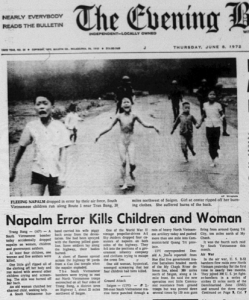
The napalm was dropped in error by a South Vietnamese warplane, as news reports at the time made quite clear (see front page image, nearby, of the now-defunct Evening Bulletin of Philadelphia).
“These were South Vietnamese planes dropping napalm on South Vietnamese peasants and troops,” Christopher Wain of Britain’s ITN television network, who saw the attack, wrote in a dispatch for the United Press International news service.
Similarly, Fox Butterfield of the New York Times reported from Trang Bang that “a South Vietnamese plane mistakenly dropped flaming napalm on his troops and a cluster of civilians.”
Nonetheless, the myth of U.S. culpability in the napalm attack soon took hold, and has proven extremely durable. A few weeks ago, for example, the Los Angeles Times declared the naked girl at the center of the photograph had been “scorched by American napalm.” (The newspaper subsequently deleted the erroneous reference, without acknowledging error or posting a correction.)
Even more egregious, and even farther from the truth, was this assertion, offered last month in the online newsletter of an Australian think tank: “The image of an innocent girl caught in the crosshairs of unthinking and unfeeling American pilots who bombed the Vietnamese from 30,000 feet personalised the narrative of high-tech American forces arrayed against the low-tech Vietnamese.”
The making of the myth can be traced to the hapless campaign in 1972 of George McGovern, the Democratic nominee for president.
In a televised speech on October 10, 1972, McGovern invoked the photograph of “the little South Vietnamese girl, Kim [Phuc], fleeing in terror” and “running naked into the lens of that camera.
“That picture ought to break the heart of every American,” McGovern said. “How can we rest with the grim knowledge that the burning napalm that splashed over little Kim and countless thousands of other children was dropped in the name of America?”
How he determined that Kim Phuc was representative of “countless thousands of other children” sprayed by napalm, McGovern did not say. In any case, his reference to “dropped in the name of America” suggested U.S. involvement in the attack.
So, too, did Susan Sontag, the filmmaker and author, who asserted that the “naked Vietnamese child” shown in the picture had been “sprayed by American napalm.” That passage, which appeared in her book, On Photography, was an unmistakable insinuation of U.S. responsibility for the napalm bombing.
One of the most memorable photographs of the Vietnam War was “The Terror of War,” better known as “Napalm Girl.”
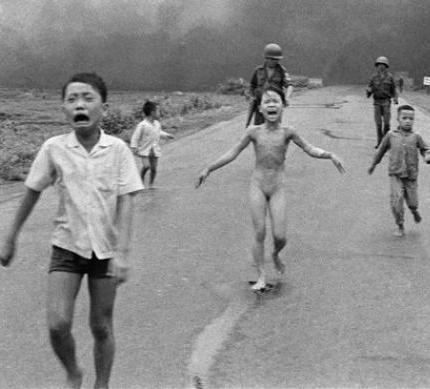
The image showed a cluster of terrified Vietnamese children fleeing an errant bombing raid near their village, Trang Bang. At the center of the photograph was a naked, 9-year-old girl named Kim Phuc who was badly burned in the napalm attack.
‘Napalm Girl,’ 1972 (Nick Ut/AP)
The photograph was taken June 8, 1972, by an Associated Press photographer, Nick Ut. The photograph won a Pulitzer Prize in 1973 and much acclaim in the years since then.
That myth of the “Napalm Girl” was invoked yesterday in a 900-word profile of Ut in the Los AngelesTimes. The article referred in its opening paragraph to Kim Phuc, saying she had been “scorched by American napalm.”
In fact, the aerial napalm attack was carried out by the South Vietnamese Air Force, as news reports at the time made clear.
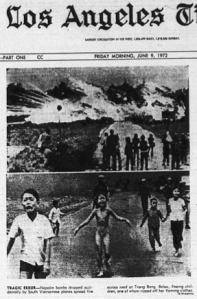
The Los Angeles Times prominently displayed the photograph on its front page of June 9, 1972 (see right), and stated in its caption that the napalm had been “dropped accidentally by South Vietnamese planes.”
The New York Times reported on June 9, 1972, that “a South Vietnamese plane mistakenly dropped flaming napalm right on his troops and a cluster of civilians.” The Chicago Tribune told of “napalm dropped by a Vietnamese air force Skyraider [warplane] diving onto the wrong target.”
Christopher Wain of Britain ITN television network wrote in a dispatch from Trang Bang for the United Press International news service:
“These were South Vietnamese planes dropping napalm on South Vietnamese peasants and troops.”
The myth of American culpability in the attack at Trang Bang has been invoked often over the years. Early this month, for example, a columnist for USAToday referred to Ut’s photograph and said it showed “a naked nine-year-old Vietnamese girl fleeing her village after U.S. forces bombed it with napalm….”
The making of the myth can be traced to the hapless campaign in 1972 of George McGovern, the Democratic nominee for president.
In a televised speech in October 1972, McGovern invoked the image of “the little South Vietnamese girl, Kim, fleeing in terror” and “running naked into the lens of that camera.
“That picture ought to break the heart of every American,” McGovern said. “How can we rest with the grim knowledge that the burning napalm that splashed over little Kim and countless thousands of other children was dropped in the name of America?”
How he determined that Kim Phuc was representative of “countless thousands of other children” sprayed by napalm, McGovern did not say.
But his claim that the napalm had been “dropped in the name of America” insinuated U.S. responsibility for the errant attack — which misstated what had happened at Trang Bang. The aerial attack was carried out by South Vietnamese forces to roust communist troops from bunkers at the outskirts of the village.
The fighting there was an all-Vietnamese encounter.
Indeed, according to the Los Angeles Times, Cronkite’s report of February 27, 1968, “shifted public opinion on the war.”
But it didn’t. Not demonstrably, not measurably.
The “shifted public opinion” claim is embedded in the Times’profile of Scott Pelley, a successor to Cronkite as anchor of the CBS Evening News.
The profile, posted online yesterday, mentions photographs on Pelley’s office walls, images that include “Walter Cronkite in Vietnam for his documentary that shifted public opinion on the war.”
What CBS aired 47 years ago tonight was a special, hour-long news report about the Tet offensive launched at the end of January 1968. The communist North Vietnamese and their Viet Cong allies struck then across South Vietnam and the extent of their attacks surprised the American public, which had been told the U.S. military was making significant progress in the war.
The offensive prompted Cronkite to travel to Vietnam to gather material for his special report, which he closed by declaring the U.S. war effort in Vietnam was “mired in stalemate” — a tepid characterization that hardly was very original.
Cronkite also suggested in his wrap-up assessment that negotiations might eventually prove to be a way out of the war. Nor was that a particularly bold suggestion.
In time, though, Cronkite’s report came to be thought of as legendary, as exceptional, as the “Cronkite Moment.” It has become barnacled with media myth.
It is often said the President Lyndon Johnson was at the White House that night (he was in Texas), that he watched Cronkite’s report (he did not), and that Cronkite’s assessment prompted him to say something to the effect of “If I’ve lost Cronkite, I’ve lost Middle America” (there’s no evidence he said anything of the sort, and it’s hard to believe the president was much moved by a report he did not see).
As for the notion that Cronkite’s analysis altered American public opinion about the war, supporting evidence is extremely thin.
As I discuss in my media-mythbusting book, Getting It Wrong, popular support for the war had begun declining months before the Cronkite report. That shift was evident by Fall 1967.
A Gallup poll conducted in October 1967 found for the first time that a plurality of Americans — 47 percent — believed that sending troops to fight in Vietnam had been a mistake.
A little more than two years earlier, just 24 percent of respondents said they thought it was a mistake to have deployed American forces to Vietnam.
Gallup asked the question again in a poll completed on the day Cronkite’s program aired: Forty-nine percent of the respondents said “yes,” U.S. military intervention in Vietnam had been a mistake; 42 percent said “no.”
In April 1968, Gallup found that 48 percent of respondents said U.S. military intervention in Vietnam had been a mistake; 42 percent said it had not been.
Moreover, print journalists had detected a softening in support for the war well before Cronkite’s “mired in stalemate” assessment.
In December 1967, for example, a national correspondent for the Knight newspapers, Don Oberdorfer, noted that the previous summer and fall had “been a time of switching, when millions of American voters — along with many religious leaders, editorial writers and elected officials — appeared to be changing their views about the war.”
So Cronkite’s report had little demonstrable effect on Americans’ views about Vietnam. Indeed, it can be said that Cronkite followed rather than led public opinion on the war.
The Los Angeles Times, for example, declared that the Post’s Watergate reporting “ultimately brought down a president.”
The online version of the New York Times obituary said Bradlee, who was 93, had “presided over The Washington Post’s Watergate reporting that led to the fall of President Richard M. Nixon.”
The Guardian newspaper in London asserted that Bradlee “oversaw the reporting that brought down a president.”
Britain’s Economist magazine said the Post under Bradlee “toppled President Richard Nixon.”
And so it went.
But as I pointed out in discussing those erroneous characterizations, Bradlee, himself, had rejected the notion that the Post’sWatergate reporting brought down Nixon’s corrupt presidency. He said in 1997 that “it must be remembered that Nixon got Nixon. The Post didn’t get Nixon.” (Bradlee was referring to the White House tapes which Nixon secretly made and which revealed the president’s guilty role in covering up the crimes of Watergate, forcing him to quit in August 1974.)
His comment “that Nixon got Nixon” was in keeping with the tendency of senior figures at the Post to reject the simplistic notion that the newspaper’s reporting — especially that of Bob Woodward and Carl Bernstein — uncovered the crimes that led to Nixon’s downfall.
Indeed, it is revealing to consider what critical disclosures the Post missed in its Watergate reporting.
It failed to disclose the White House cover up of the Watergate crimes.
It likewise failed to reveal the existence of the White House tapes, which clearly revealed Nixon’s active role in seeking to block the FBI’s investigation of the seminal crime of Watergate — the break-in at the headquarters of the Democratic National Committee.
Moreover, the story that Woodward and Bernsteinstill say they are most proud of was in error on crucial details.
That story was published October 10, 1972, beneath the headline, “FBI Finds Nixon Aides Sabotaged Democrats.” It claimed — wrongly — that the FBI had determined some 50 political saboteurs had traveled the country, disrupting Democratic candidates who were seeking to run against Nixon. Internal FBI memoranda dismissed key elements of the Post’s story as conjecture or “absolutely false.”
As I noted in my media-mythbusting book Getting It Wrong, the contributions of Woodward and Bernstein to Watergate’s outcome at best “were modest, and certainly not decisive.”
Far more important in bringing about Nixon’s resignation were the collective efforts of special prosecutors, federal judges, both houses of Congress, the Supreme Court, as well as the Justice Department and the FBI.
The Post report cited otherwise unidentified “U.S. officials” and said that Lynch, a 19-year-old Army private, had fought fiercely in the ambush of the 507th Maintenance Company in Nasiriyah in southern Iraq on March 23, 2003.
Lynch in fact had not fired a shot. Nor was she shot and stabbed, as the Post had reported. She suffered severe injuries in the crash of a Humvee as it fled the attack. She was taken prisoner and hospitalized by the Iraqis but rescued by U.S. special forces on April 1, 2003.
Vernon Loeb, one of the Post reporters who wrote the hero-warrior story about Lynch — which was wrong in its most crucial details — made clear that the Pentagon had not been the newspaper’s source.
As I noted in Getting It Wrong, Loeb went on NPR’s Fresh Air program in December 2003 and flatly declared:
“Our sources for that story were not Pentagon sources.”
Loeb, who then covered the Pentagon for the Post and who now is managing editor at the Houston Chronicle, also told NPR that he “could never get anybody from the Pentagon to talk about” the Lynch case.
He also said: “I just didn’t see the Pentagon trying to create a hero where there was none.”
But none of that vital context was mentioned by Maddow in her commentary on June 3.
“If the heroics that the Pentagon made up about her didn’t really happen, and they didn’t, maybe the U.S. special forces who rescued her, maybe they shouldn’t have bothered,” Maddow said about Lynch. (Maddow’s commentary came amid the controversy stirred by the release of Bowe Bergdahl, an Army sergeant who apparently had walked away from his post in Afghanistan and was held captive by the Taliban for five years. The administration of President Barack Obama released five senior Taliban figures to gain Bergdahl’s freedom.)
When Maddow was called out for her erroneous claim about the Pentagon, she dodged a correction by cherry-picking — by referring to an obscure report in the Military Times on April 3, 2003, in which a U.S. military spokesman, Frank Thorp, was quoted as saying that Lynch “waged quite a battle prior to her capture.
“We do have very strong indications that Jessica Lynch was not captured very easily,” Thorp was quoted as saying.
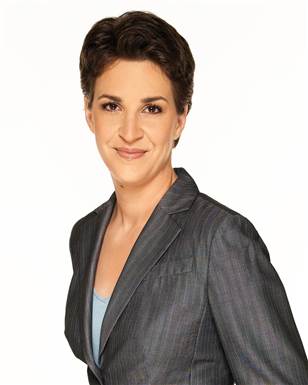
Maddow (NBC News)
Crowed Maddow: “That information straight from a military public affairs official was not true. It was made up. But it landed in press reports anyway.”
What Maddow neglected to mention was that Thorp was recapping for the Military Times what the Washington Post had already placed in the public domain.
Thorp, then a Navy captain, was assigned to U.S. Central Command headquarters in Doha, Qatar. He was following, not fabricating: He was, unwisely, restating elements of the Post’s sensational story about Lynch’s purported heroics, which Loeb and co-author Susan Schmidt had prepared in Washington.
I noted in discussing Maddow’s cherry-picking that it is impossible to address the hero-warrior tale about Lynch without considering the Post’s central role in publicizing the bogus narrative, which was picked up by news organizations around the world.
But Maddow ignored the agenda-setting character of the Post’s reporting about Lynch: It didn’t fit her narrative.
The photograph showed Vietnamese children terror-stricken by a misdirected napalm attack on their village by the South Vietnamese Air Force. At the center of image was a 9-year-old girl named Kim Phuc, shown screaming and naked as she fled.
The photograph, taken by Nick Ut of the Associated Press and formally titled “The Terror of War,” won a Pulitzer Prize in 1973.
In the years since, it also has become an artifact of exaggeration, as is evident in a tendency to ascribe powerful effects to the photograph, effects that it never had.
‘Napalm girl,’ 1972 (Nick Ut/AP)
In May, for example, the Guardian newspaper in London exaggerated the effects of the “napalm girl” image, asserting in an exhibit review that it had “galvani[z]ed” American “public opinion and expedited the end of the Vietnam war.”
In fact, “napalm girl” did neither.
U.S. public opinion had turned against the war in Vietnam well before June 1972. For example, nearly 60 percent of respondents to a Gallup poll conducted early in 1971 had said that the United States had made a mistake by sending troops to fight in Vietnam. (Gallup periodically has asked the question since 1965, when just 24 percent of respondents said it was a mistake to have sent troops to Vietnam. By August 1968, a majority of respondents said it had been a mistake.)
So Ut’s photo hardly can be said to have galvanized opinion against the war: Nor can it be said that the photo “expedited” the war’s end.
By June 1972, the war was essentially over for American forces in Vietnam. President Richard Nixon had announced in November 1971 that U.S. ground operations had ended in South Vietnam and by June 1972, nearly all U.S. combat units had been removed from the country.
No single photograph turned public opinion against the war in Vietnam; no single image “expedited” its end. The war’s confusing aims and uncertain policy objectives, its duration, and its toll in dead and wounded all were far more decisive to its outcome.
Had that been the case, had Nixon run for president saying he had “secret plan,” the country’s leading newspapers surely would have called attention to such a claim.
But they didn’t, as a search of a full-text database of leading U.S. newspapers makes clear. (The newspapers included the New York Times, Washington Post, Los Angeles Times, Baltimore Sun, Wall Street Journal, and Chicago Tribune.) Searching for “Nixon” and “secret plan” returned no articles from January 1967 to January 1969 that quoted Nixon as touting or promising or describing a “secret plan” for Vietnam.
Still, the old chestnut still circulates, usually invoked as supposed evidence of Nixon’s guile, shiftiness, and venality.
Secret plan? Who me?
In September, for example, a columnist for the Washington Examiner summoned the myth in seeking historical context to discuss President Barack Obama’s air war against Islamic militants in Iraq and Syria.
“Obama wasn’t the first president to promise peace and deliver war,” the columnist, Timothy P. Carney, wrote. “Woodrow Wilson ran for reelection on keeping America out of the Great War. Nixon promised a secret plan to exit Vietnam quickly.”
As I noted at the time, “Missing from Carney’s discussion were details about when Nixon made such a promise, and what the ‘secret plan’ entailed. Those elements are missing because Nixon never promised a ‘secret plan’ on Vietnam.”
The derivation of the hoary myth can be traced to the presidential primary election campaign of 1968 and a speech in New Hampshire. There, in early March 1968, Nixon pledged that “new leadership” in Washington — a Nixon administration, in other words — would “end the war” in Vietnam.
In reporting on the speech, the wire service United Press International said Nixon “did not spell out how” he would “end the war.” Nixon may have been vague in those remarks about Vietnam. But he made no claim about a “secret plan.”
And he was asked about having a secret plan, according to an article published March 28, 1968, in the Los Angeles Times. Nixon replied that he had “no gimmicks or secret plans” for Vietnam.
He also said then: “If I had any way to end the war, I would pass it on to President [Lyndon] Johnson.” Nixon’s comments were made just a few days before Johnson announced he would not seek reelection.
The claim is absurd, embraced by few if any serious historians of the era — and by no recent biographer of Hearst.
Nonetheless, the myth was offered up as fact in a commentary in Politico Magazine in June.
The commentary pointedly criticized the scholar Robert Kagan for having “sounded his favorite, and the neocons’, favorite theme” in a 2006 book, Dangerous Nation.
“He depicted America as uniquely virtuous, pursuing idealistic aims, while presenting all other great powers as fighting for venal and self-interested motives. So assiduous was Kagan in his fanciful interpretation of American actions,” the Politico commentary said, “that even the Spanish-American War, seen by most historians as the product of William Randolph Hearst’s yellow press and the U.S. desire to expand its influence on behalf of economic imperialism, becomes something else entirely — a bright and shining crusade for freedom….”
But in characterizing the war as “the product” of Hearst’s yellow press, Politico erred.
As I wrote in my 2001 book, Yellow Journalism: Puncturing the Myths, Defining the Legacies, the newspapers of Hearst and his rival, Joseph Pulitzer, “did not force — it could not have forced— the United States into hostilities with Spain over Cuba in 1898. The conflict was, rather, the result of a convergence of forces far beyond the control or direct influence of even the most aggressive of the yellow newspapers, William Randolph Hearst’s New York Journal.”
Claims that the yellow press brought on the war, I noted, “are exceedingly media-centric, often rest on the selective use of evidence, and tend to ignore more relevant and immediate factors that give rise to armed conflict.”
In 1898, those factors centered around a diplomatic impasse between the United States and Spain over Spanish rule of Cuba, which since early 1895 had been the scene of an islandwide rebellion.
In a failed attempt to put down the uprising, Spanish authorities sent as many as 200,000 troops to the island and imposed a policy called “reconcentration,” which forcibly removed thousands of Cubans — mostly old men, women, and children — into garrison towns where they could neither support nor offer supplies to the Cuban rebels.
Spain’s “reconcentration” policy gave rise to malnutrition and disease: Unknown tens of thousands of Cuban non-combatants died from illness and starvation.
The humanitarian nightmare in Cuba “inevitably stirred outrage and condemnation in the United States,” I wrote in Yellow Journalism. The desperate conditions were in 1897 and early 1898 a frequent topic of reporting in the American press, including but by no means limited to the newspapers of Hearst and Pulitzer.
The yellow press reported on — but certainly did not create — the terrible effects of Spain’s “reconcentration” policy.
In the end, the humanitarian crisis on Cuba, and Spain’s inability to resolve the crisis, weighed decisively in the U.S. decision to go to war in 1898. It was not the content of the yellow press — and not “economic imperialism,” as Politico put it — that pushed America into conflict with Spain.
Media Myth Alert revisits its top-ever posts today in observing its fifth anniversary.
The blog went live October 31, 2009, and its objective was, and remains, twofold: Calling out the appearance and publication of media myths and helping to promote Getting It Wrong, my media mythbusting book that came out in 2010.
This is the second of a two-part review of the 10 top posts published at Media Myth Alert, home over the years to more than 640 essays and commentaries. The top posts shared these elements: All were about prominent topics, all received a fair amount of attention in the blogosphere and beyond, and all represented disclosures exclusive to Media Myth Alert.
Credible, first-hand accounts are cited in Getting It Wrong that bras and other items were set afire, briefly, at a women’s liberation protest at Atlantic City during the 1968 Miss American pageant. And in Toronto in March 1979, a demonstration was capped by a bra-burning, intended as a way to attract media attention. A photograph of the Toronto bra-burning is at right.
I had not seen the photograph before it appeared in February 2011 with an article at the online site of London’s Guardian newspaper. I had doubts about its authenticity, given the periodic claims about no bras ever having been burned at a feminist protest.
The Toronto image, I thought at first, might have been faked — or unethically altered somehow.
Turns out that was not the case.
I tracked down one of the participants at the Toronto protest and she confirmed the bra-burning, saying by phone from Vancouver:
“The photo is authentic. Absolutely. It happened.”
The participant was Vicki Trerise, who appears at the far right in the photograph above.
The photograph shows a moment of demonstrative bra-burning, although Trerise said that “wasn’t a focal point” of the protest, which took place not far from Toronto’s City Hall.
The bra-burning came near the end of the demonstration, which was called to protest what the organizers said was an illogical report about rape, prepared by the Ontario Provincial Police. (The report said that of 337 rapes investigated, 140 were “unprovoked.” The report also said “promiscuity” was a factor in many rapes.)
Trerise said the demonstrators in Toronto were media-aware and “knew that if they burned a bra, someone would take their picture.”
Toronto newspapers the next day reported on the protest — but did not mention the bra-burning.
The Post report cited otherwise unidentified “U.S. officials” and declared that Lynch, a 19-year-old Army private, had fought fiercely in the ambush of her unit, the 507th Maintenance Company, in Nasiriyah in southern Iraq on March 23, 2003. Lynch suffered severe injuries in the crash of a Humvee in Nasiriyah. She was taken prisoner by the Iraqis but rescued by U.S. special forces on April 1, 2003.
Vernon Loeb, one of the Post reporters on the hero-warrior story — which was wrong in its important details — later made clear that the Pentagon had not been the newspaper’s source.
As I noted in Getting It Wrong, Loeb went on NPR’s Fresh Air program in December 2003 and declared, unequivocally:
“Our sources for that story were not Pentagon sources.”
None of that vital context was acknowledged by Maddow as she discussed the Lynch case on June 3, 2014.
“If the heroics that the Pentagon made up about her didn’t really happen, and they didn’t, maybe the U.S. special forces who rescued her, maybe they shouldn’t have bothered,” Maddow said about Lynch. (Maddow’s commentary was inspired by controversy surrounding the release a few days before of Bowe Bergdahl, an Army sergeant who apparently had walked away from his post in Afghanistan and was held captive by the Taliban for five years. The administration of President Barack Obama released five senior Taliban figures to gain Bergdahl’s freedom.)
When Maddow was called out on her erroneous claim about the Pentagon, she dodged a correction by cherry-picking — by referring to an obscure report in the Military Times on April 3, 2003, in which a military spokesman, Frank Thorp, was quoted as saying that Lynch “waged quite a battle prior to her capture.
“We do have very strong indications that Jessica Lynch was not captured very easily,” Thorp was additionally quoted as saying.
Crowed Maddow: “That information straight from a military public affairs official was not true. It was made up. But it landed in press reports anyway.”
What Maddow neglected to mention was that Thorp was recapping for the Military Times what the Washington Post had already published.
Thorp, then a Navy captain assigned to U.S. Central Command headquarters in Doha, Qatar, was not inventing — he was following. He was, unwisely, restating elements of the Post’s story already in circulation and quickly gaining international attention.
I wrote in discussing Maddow’s cherry-picking that “it is impossible to address the hero-warrior tale about Lynch without considering the Washington Post’s central and decisive role in the story.” But Maddow ignored the Post’s exclusive role in pushing the botched Lynch story into the public domain.
The Post did so by relying on sources it has never disclosed.
But try finding online the Post’s famously wrong reporting about Jessica Lynch’s derring-do in Iraq, notably the electrifying front-page report that appeared April 3, 2003, beneath the headline:
“‘She was fighting to the death.'”
That story — which said Lynch had fought fiercely against Iraqi attackers and had suffered gunshot and stab wounds before running out of ammunition and being taken prisoner — was in error in all important details. You won’t find it online at any Washington Post site. (The Post’s story is available in full at the online site of the Pittsburgh Post-Gazette.)
Nor will you find freely available online the scathing reviews of the Lynch story published by the Post’s then-ombudsman, Michael Getler, in April and June 2003.
All of which suggests digital scrubbing of embarrassing content — conduct of the sort the Post criticized in 2012, in noting that Vogue magazine expunged the online version of a fawning profile of Syrian dictator Bashar al-Assad. The Post at that time said Vogue had taken “an almost-unheard-of step for a mainstream media organization” and had committed “a generally acknowledged violation of digital etiquette.”
But had the Post not committed a similar “violation” in excising the digital reminders of the embarrassing Lynch case, a dramatic story that it had thoroughly and exclusively botched?
Rather looks like it.
I asked the newspaper’s then-ombudsman, Patrick Pexton, about the apparent digital scrubbing of the Lynch content.
Pexton took weeks to reply, finally stating in an email that he had found “nothing nefarious about this.” He said the Post since 2003 “has gone through several changes of content management systems,” by which articles are posted online.
He noted that the “fighting to the death” story about Lynch and related content are available in the Post’s fee-based archive.
“Restoring the digital version of the article of April 3, 2003, would represent a contribution to the record about the case of Jessica Lynch, which the Post is solely responsible for having placed in the public domain,” I wrote in an email to Pexton.
He never replied before leaving the position in 2013, when his two-year term as ombudsman expired. He was not replaced.
The gaffe, in turn, is said to have inspired one of the most scathing putdowns in American political history.
But my research found that the context of the supposed putdown is unclear at best.
The gaffe was committed in late August 1967 by George Romney, then governor of Michigan and a presumptive leading candidate for the Republican presidential nomination in 1968.
In an interview with a Detroit television reporter, Romney referred to a visit he had made to South Vietnam in 1965 and said:
“You know, when I came back from Vietnam, I’d just had the greatest brainwashing that anybody could get. … Well, not only by the generals but by the diplomatic corps over there. They do a very thorough job.”
Romney’s claim that he had been duped into supporting America’s war effort in Vietnam suggested gullibility, muddled thinking, and an uncertain command of foreign policy. His run for the presidency never righted itself; he quit the race at the end of February 1968.
A witty putdown attributed to Democratic Senator Eugene McCarthy ensured that Romney’s gaffe would remain unforgettable. Rather than a “brainwashing,” McCarthy supposedly said, all Romney needed was a “light rinse.”
So incisive was McCarthy’s quip that it is said to have “essentially finished Romney” as a candidate for president.
But unclear is where, when, and even whether McCarthy made the “light rinse” comment.
A search of a full-text database of leading U.S. newspapers — including the New York Times, the Washington Post, Chicago Tribune, Los Angeles Times, and Baltimore Sun — turned up no published reference to the “light rinse” quip in 1967 or 1968. Or for years afterward. (The first reference was in 1983, a column in the Baltimore Sun that did not say when, where, or to whom McCarthy uttered the remark.)
It seems improbable that American journalists in 1967 or 1968 would have failed to report a retort as deft and delicious as McCarthy’s.
American Melodrama, a hefty book published in 1969, described McCarthy’s remark as off-hand and said the senator’s aides persuaded reporters to hush it up.
While intriguing, American Melodrama doesn’t say where McCarthy made the comment, when, or specifically to whom.
Such vagueness invites suspicion about the “light rinse” quip. It also sounds a bit too perfect — not unlike, say, William Randolph Hearst’s purported vow to “furnish the war” with Spain or Lyndon B. Johnson’s supposed epiphany on the Vietnam War: “If I’ve lost Cronkite, I’ve lost Middle America.”
This was apparent in late summer 2013, when the newspaper refused to acknowledge and correct an inarguably erroneous reference to Richard Nixon’s supposed “secret plan” to end the war in Vietnam.
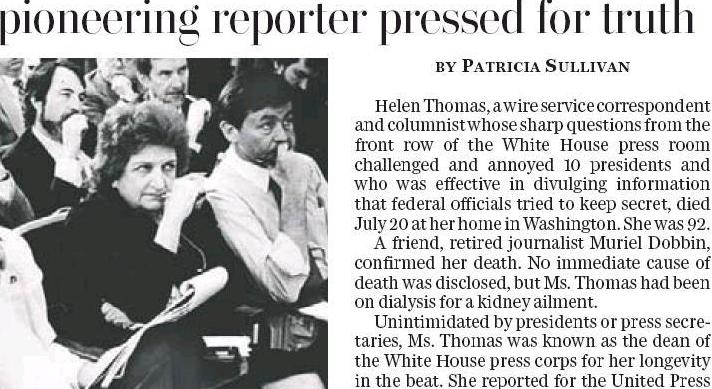
The wrong-headed reference to Nixon’s “secret plan” was embedded in the Post’s front-page obituary about Helen Thomas, a querulous and overrated Washington journalist who covered the White House for years for United Press International.
The Post’s obit of Thomas
The Post’s obituary was glowing and, as if to suggest Thomas’s impressive assertiveness, claimed that she once “asked President Richard M. Nixon point-blank what his secret plan to end the Vietnam War was.”
Trouble is, there is no evidence that Thomas ever posed such a question, point-blank or otherwise.
The nearest approximation came at a news conference in late January 1969, when Thomas asked Nixon about his “peace plan” for Vietnam. That’s probably what the obituary writer had in mind.
But Thomas had asked about Nixon’s peace plan, not a “secret plan.”
The Post’s error in the obituary had broader dimension, in that it suggested an embrace of the persistent notion that Nixon ran for president in 1968 touting a “secret plan” to end the war in Vietnam.
Which is untrue. Nixon did not campaign for the White House on a “secret plan.” The belief that he did circulates still, as supposedly powerful evidence of Nixon’s devious and conniving ways.
The obituary’s writer, Patricia Sullivan, said as much, telling me in response to an email query: “I recall the Nixon years and his promise during his candidacy that he had a plan to end the Vietnam War, which he would not explain in detail.”
In fact, Nixon was asked during the 1968 campaign about having a “secret plan” to end the war. And according to a report in the Los Angeles Times on March 28, 1968, he replied that he had “no gimmicks or secret plans.”
He also said: “If I had any way to end the war, I would pass it on to President [Lyndon] Johnson.”
I brought all this to the attention of Douglas Feaver, who had been designated the Post’sreader representative, a sort of ombudsman-lite position set up months after Pexton’s departure.
I noted to Feaver that if the Post could identify an occasion when Thomas asked Nixon about a “secret plan” on Vietnam — if the newspaper could back up the claim in its obituary, in other words — then that would represent an intriguing if modest contribution to the understanding about Nixon’s campaign in 1968. It would indicate that journalists at the time suspected Nixon was less than forthcoming about his intended war policy.
If, on the other hand, the Post could not identify such an occasion, then, I wrote, a correction was in order.
Feaver took more than two weeks to reply to my query, and when he did, he absolved the Post of error. “I see nothing here that deserves a correction,” he wrote.
How obtuse.
Coincidentally, not long after the Post published its flawed obituary about Thomas, the newspaper was sold for $250 million to Jeff Bezos, founder of Amazon.com. In an open letter to the newspaper’s employees soon after the sale was announced, Bezos stated:
“We will continue to follow the truth wherever it leads, and we’ll work hard not to make mistakes. When we do, we will own up to them quickly and completely.”
Sure: Quickly and completely. Just as it did in its mistaken reference to Nixon’s “secret plan.”
Media Myth Alert today marks its fifth anniversary — an occasion fitting to revisit the top posts since the blog went live on October 31, 2009, with the objectives of calling out the appearance and publication of media myths and helping to promote my 2010 mythbusting book, Getting It Wrong.
Here are the top five of the more than 640 posts at Media Myth Alert. (A separate post today will revisit five other top items posted at Media Myth Alert.)
The top posts all were about prominent topics, all received a fair amount of attention in the blogosphere and beyond, and all were represented disclosures found only at Media Myth Alert.
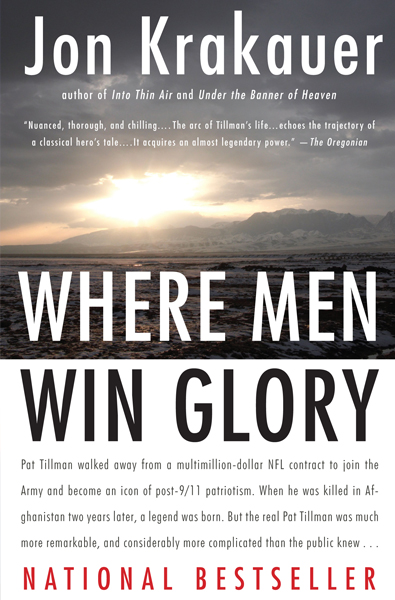
Those claims were unattributed in the book — and vigorously denied by Wilkinson, who sought a correction.
When it came, the correction was inserted unobtrusively in a new printing of the paperback edition of Krakauer’s book, Where Men Win Glory.
It read:
“Earlier editions of this book stated that it was Jim Wilkinson ‘who arranged to give the Washington Post exclusive access’ to this leaked intelligence [about Jessica Lynch]. This is incorrect. Wilkinson had nothing to do with the leak.”
The false narrative also has deflected attention from the soldier whose heroics apparently were misattributed to Lynch. He was Sgt. Donald Walters, a cook in Lynch’s unit, which was ambushed in Nasiriyah in southern Iraq in the first days of the Iraq War.
Walters was taken prisoner by Iraqi irregulars, and shot and killed.
The photograph was taken by Nick Ut of the Associated Press on June 8, 1972, and showed terror-stricken Vietnamese children running from an errant aerial napalm attack. The central figure of the image was a naked, 9-year-old girl screaming from her burns.
So powerful was the photograph that it is sometimes said — erroneously — that it hastened an end to the war. Another myth is that the napalm was dropped by U.S. aircraft, a version repeated by the New York Times in May 2012, in an obituary of an Associated Press photo editor, Horst Faas.
The Times’ obituary claimed that the “napalm girl” photograph showed “the aftermath of one of the thousands of bombings in the countryside by American planes.”
That passage suggested U.S. forces were responsible for the napalm attack, and I pointed this out in an email to the Times. I noted that the bombing was a misdirected attack by the South Vietnamese Air Force, as news reports at the time made clear.
An editor for the Times, Peter Keepnews, replied, in what clearly was a contorted attempt to avoid publishing a correction:
“You are correct that the bombing in question was conducted by the South Vietnamese Air Force. However, the obituary referred only to ‘American planes,’ and there does not seem to be any doubt that this plane was American –- a Douglas A-1 Skyraider, to be precise.”
Of course the aircraft’s manufacturer was not at all relevant as to who carried out the attack.
The Times resisted for weeks before publishing an obscure sort-of correction that embraced Keepnews’ tortured reasoning and stated:
“While the planes that carried out that attack were ‘American planes’ in the sense that they were made in the United States, they were flown by the South Vietnamese Air Force, not by American forces.”
It was, I noted, a muddled and begrudging acknowledgement of error — hardly was in keeping with the declaration by the newspaper’s then-executive editor, Bill Keller, who had asserted in 2011 that “when we get it wrong, we correct ourselves as quickly and forthrightly as possible.”
In 2013, at the 75th anniversary of Welles’ program, PBS revisited The War of the Worlds in a much-anticipated “American Experience” documentary that turned out to be quite a disappointment. PBS managed not only to make The War of the Worlds seem snoozy and tedious; it missed the opportunity to revisit the well-known but much-misunderstood radio program in fresh and revealing ways.
“PBS could have confronted head-on the question of whether the radio show … really did provoke hysteria and mass panic in the United States,” I wrote.
Instead, I added, “The documentary’s makers settled for a turgid program that was far less educational, informative, and inspiring than it could have been.”
The PBS program failed to address the supposed effects of Welles’ radio dramatization in any meaningful way.
And it failed to consider the growing body of scholarship which has impugned the conventional wisdom and has found that The War of the Worlds program sowed neither chaos nor widespread alarm. Instead, listeners in overwhelming numbers recognized the program for what it was: A clever radio show that aired in its scheduled Sunday time slot and featured the not-unfamiliar voice of Welles, the program’s 23-year-old star.
My critique was endorsed by the PBS ombudsman, Michael Getler, who wrote in a column after the documentary was broadcast:
“I find myself in agreement with the judgment of W. Joseph Campbell, the well-known critic and author of ‘Getting It Wrong: Ten of the Greatest Misreported Stories in American Journalism’ who headlined his comment: ‘PBS squanders opportunity to offer “content that educates” in “War of the Worlds” doc.’”
It’s an easy-to-remember tale that cuts through the considerable complexity of Watergate and, as such, has become the dominant narrative of the scandal.
But it’s a history-lite version of Watergate, a media-centric version that the Post itself has mostly eschewed and dismissed over the years. (Woodward once put it this way: “To say that the press brought down Nixon, that’s horseshit.”)
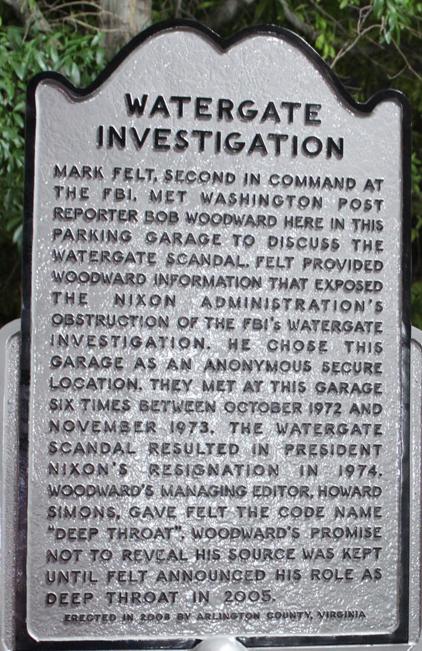
Marker with the error
A measure of how engrained Watergate’s dominant narrative has become can be seen in the historical marker that went up in August 2011 outside the parking garage in Arlington, Virginia, where Woodward conferred occasionally in 1972 and 1973 with his “Deep Throat” source.
The marker, as I pointed out, errs in describing the information Woodward received from the “Deep Throat” source, who in 2005 revealed himself as W. Mark Felt, formerly the FBI’s second in command.
The marker says:
“Felt provided Woodward information that exposed the Nixon administration’s obstruction of the FBI’s Watergate investigation.”
That’s not so.
Such obstruction-of-justice evidence, had “Deep Throat” offered it to Woodward, would have been so damaging and so explosive that it surely would have forced Richard Nixon to resign the presidency well before he did.
But Felt didn’t have that sort of information — or (less likely) did not share it with Woodward.
The “Deep Throat” garage is to be razed to permit the construction of two commercial and residential towers, the Post reported in June 2014. Interestingly, the Post’s article about the planned demolition repeated nearly verbatim the key portion of the marker’s description, stating:
“Felt … provided Woodward with information that exposed the Nixon administration’s obstruction of the FBI’s Watergate investigation.”
Which is still wrong, even if printed in the newspaper.
■ Suspect Murrow quote pulled at Murrow school (posted February 17, 2011): The online welcome page of the dean of the Edward R. Murrow College of Communication at Washington State University used to feature a quotation attributed to Murrow — a quotation that was only half-true.
Soon after I asked the dean about the provenance of the suspicious quotation, it was taken down.
The quotation read:
“We must not confuse dissent with disloyalty. When the loyal opposition dies, I think the soul of America dies with it.”
The second sentence of the quote — “When the loyal opposition dies, I think the soul of America dies with it” — is apocryphal.
In mid-February 2011, I noted that the full quotation — accompanied by a facsimile of Murrow’s signature — was posted at the welcome page of Dean Lawrence Pintak of Murrow College at Washington State, Murrow’s alma mater.
I asked the dean what knew about the quote’s first appearance, noting that I had consulted, among other sources, a database of historical newspapers which contained no articles quoting the “loyal opposition” passage.
Pintak, who said he believed the Web page containing the suspect quote had been developed before his arrival at Washington State in 2009, referred my inquiry to an instructor on his faculty who, a few hours later, sent an email to the dean and me, stating:
“While [the ‘loyal opposition’ quotation] seems to reflect the Murrow spirit, the lack of evidence that he phrased it that way is indeed suspicious.”
He added: “I feel the evidence says no, Murrow did not say this.”
By day’s end, the suspect quote had been pulled from the welcome page. Just the authentic portion — “We must not confuse dissent with disloyalty” — remained posted there.
The bogus Murrow quote about “the loyal opposition” has popped up before.
For example, in a speech in 2006 about Iraq, Harry Reid, now the U.S. Senate majority leader, invoked the passage — and claimed Murrow was its author.
The conservative talk radio host, Rush Limbaugh, ruminated on his show yesterday about the power of images — and seemed to err in describing an iconic photograph of the Vietnam War.
In response to a caller’s observation that “the Vietnam War changed when somebody got shot live on the air” — an evident reference to Eddie Adams’ “Saigon Execution” photograph — Limbaugh declared:
Nick Ut’s ‘Napalm Girl’ (AP)
“The Vietnam War, I’ll tell you what began the end of the Vietnam War. It was not Walter Cronkite saying that some operation failed. It was a picture of young children burned by Agent Orange fleeing an explosion in Time magazine. That’s what did it. … Naked girl running away from disaster with her skin burned by Agent Orange.”
“Napalm Girl” showed a cluster of Vietnamese children, the terror-stricken victims of a misdirected napalm attack by the South Vietnamese Air Force. At the center of photograph was a 9-year-old girl named Kim Phuc, naked and screaming from the burns she suffered.
Except for the reference to chemical defoliant Agent Orange, “Napalm Girl” — formally titled “The Terror of War” — is the photograph that most closely corresponds to Limbaugh’s description: “Naked girl running away from disaster with her skin burned by Agent Orange.”
More problematic than mistaking the details of one of the Vietnam’s most searing images was Limbaugh’s blithe claim of the photo’s power, that the image — any image — possessed such impact as to mark the beginning of the end of the war.
That’s hardly the case.
By June 1972 when Ut’s photo was taken, the war was essentially over already for U.S. military forces in Vietnam. Nearly all U.S. combat units had been removed from the country. By mid-year 1972, about 49,000 American troops were in Vietnam, well off the peak of 549,000 in early 1969. U.S. casualties were lower, too — from 4,221 killed in 1970 to 1,380 killed in 1971. President Richard Nixon’s policy of “Vietnamization” — of turning over the war effort to South Vietnamese forces — was in full flower.
None of that is attributable to the effects of “Napalm Girl.” Indeed, the beginning of the end for the U.S. military in Vietnam came well before the photograph was taken.
Even so, it’s not uncommon to exaggerate the photograph’s influence; it’s as if the image was so powerful that its effects likewise must be profound.
For example, the Associated Press declared in a retrospective article in 2012, 40 years after the photo was taken, that “Napalm Girl” helped “to end one of the most divisive wars in American history.”
And more recently, Ut was quoted as saying: “When I pressed the button, I knew. This picture will stop the war.”
It didn’t, of course. The war ended in April 1975, when North Vietnamese forces overwhelmed South Vietnamese troops and seized the South Vietnamese capital, Saigon.
 The wartime images accompanied an essay about the misery of Syria’s battered city, Aleppo, once a rebel stronghold in the country’s prolonged civil war.
 “Fake news” has plenty of antecedents in mainstream media — several cases of which are examined in my mythbusting book,
  fiercely in the ambush of her unit during the early days of the Iraq War in 2003. Lynch, the
 Of particular interest to Media Myth Alert was this passage in a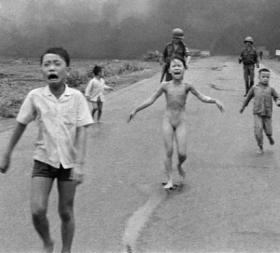






 Media Myth Alert