W. Joseph Campbell

Archive for the ‘Spanish-American War’ Category

Scandalously wrong: AP roundup on media scandals errs on yellow press

In Debunking, Media myths, Spanish-American War, Yellow Journalism on July 14, 2011 at 7:37 am

The Associated Press wire service cobbled together a superficial roundup about scandals in American journalism — and in doing so exaggerated the role of the yellow press in bringing on war with Spain in 1898.

The roundup, posted yesterday, was pegged to Rupert Murdoch’s troubles in Britain and the recent demise of the media mogul’s scandal-ridden Sunday tabloid, News of the World.

“Before the technology existed for Rupert Murdoch’s journalists to hack into phone records,” the roundup began, “past generations of dubious reporters have given readers 4-foot-tall furry creatures living on the moon, a bogus 8-year-old heroin addict and a nonexistent interview with a sick president that won a Pulitzer Prize.”

All sounds interesting.

But the roundup soon turned listy, bouncing from case to case with scant detail or analysis — a failing common to hurriedly prepared wire service compilations.

And the roundup was scandalously wrong in stating unsubstantiated claims about the yellow press and the Spanish-American War.

“During the ‘yellow journalism’ era of the 1890s,” AP’s roundup declared, “powerful publishers Joseph Pulitzer of the New York World and William Randolph Hearst of the New York Journal whipped up a frenzy with false or exaggerated stories about Spanish rulers in Cuba, leading to the Spanish-American War.”

Let’s unpack that paragraph.

First, there’s little to no evidence that the content of the Hearst and Pulitzer’s newspapers “whipped up” any kind of frenzy related to Spain’s rule of Cuba. Second, the yellow press wasn’t much exaggerating in reporting about the effects of Spain’s harsh policies on the Cuban people.

Hearst and Pulitzer’s newspapers certainly were advocates of Cuban self-rule. But even at their most egregious — in the days following the destruction in February 1898 of the U.S. battleship Maine in Havana harbor — the content of those newspapers stirred little frenzy among Americans.

As I wrote in my 2001 work, Yellow Journalism: Puncturing the Myths, Defining the Legacies, Hearst’s Journal and Pulitzer’s World “were undeniably extreme in their reporting, especially in the aftermath of the Maine’s destruction.

“But their excesses,” I noted, “were not widely shared in the U.S. press; the excesses in fact were roundly deplored and even ridiculed. That they influenced many people, or whipped Americans ‘to a white heat’ is doubtful: Several contemporaneous sources describe the sober calm with which the American public and many newspapers awaited the official U.S. report about the cause of the Maine’s destruction.”

The Nation, for example, observed in March 1898: “Nothing could be more curious than the contrast between the wild aspect of the first pages of our [yellow journals] and the calm of the persons who are seen reading them.”

Nor was the yellow press exaggerating the deplorable conditions in Spanish-ruled Cuba, where a rebellion begun in 1895 had soon reached islandwide proportions.
Humanitarian disaster

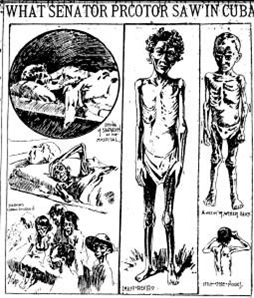
Spain not only sent 200,000 troops in an attempt to put down the rising; senior Spanish leaders in Cuba imposed what they called a policy of reconcentración, or reconcentration, in which old men, women, and children — non-combattants — were herded into garrison towns.

The policy was intended to deprive Cuban rebels of food, supplies, and logistical support.

But the consequences were disastrous.

The Cuban non-combattants suffered enormously under reconcentración; tens of thousands of them died from hunger, disease, and malnutrition.

The effects of reconcentración drew the frequent attention of U.S. newspapers of all kinds — yellow and otherwise.

It was the humanitarian crisis on Cuba — and Spain’s inability to resolve the crisis — that weighed significantly in the U.S. decision to go to war in April 1898. The often-flamboyant yellow press was a non-factor.

WJC

Recent and related:

Yellow journalism ‘brought about Spanish-American War’? But how?

In Debunking, Media myths, Spanish-American War, Yellow Journalism on July 13, 2011 at 8:03 am

Not to blame: Hearst’s ‘Evening Journal’

The hoary claim that the yellow journalism of William Randolph Hearst and Joseph Pulitzer brought on the Spanish-American War is often asserted but never persuasively substantiated.

It’s a notion that suggests the worst tendencies of the news media — that in extreme cases, they media can plunge the country into war, as Hearst and Pulitzer supposedly did with the sometimes-inflammatory content of their New York City newspapers.

Although the claim was long ago demolished as a media-driven myth, it remains too good not to be true, too delicious to resist.

It was asserted without substantiation the other day in a commentary posted online by the Scripps Howard news service.

“In fact,” wrote the commentary’s author, Dan K. Thomasson, “yellow journalism was founded in New York by Joseph Pulitzer and William Randolph Hearst and even brought about the Spanish-American War. But as the competition began to thin and more truth-smitten journalists took over, respectability began making inroads and ultimately won the day — with an exception or two.”

Left unaddressed was just how the yellow journalism of Hearst and Pulitzer managed to accomplish that trick: By what mechanism was the content of their newspapers transformed into policy and military action?

In fact, there was no such mechanism.

As I noted in my 2001 book, Yellow Journalism: Puncturing the Myths, Defining the Legacies, top officials in the administration of President William McKinley largely disregarded the content of the yellow press. They certainly didn’t turn to it for guidance in policymaking.

“There is,” I wrote, “almost no evidence that the content of the yellow press, especially during the decisive weeks following the Maine’s destruction [in Havana harbor in February 1898], shaped the thinking, influenced the policy formulation, or informed the conduct of key White House officials.

“If the yellow press did foment the war,” I added, “researchers should be able to find some hint of, some reference to, that influence in the personal papers and the reminiscences of policymakers of the time.

“But neither the diary entries of Cabinet officers nor the contemporaneous private exchanges among American diplomats indicate that the yellow newspapers exerted any influence at all. When it was discussed within the McKinley administration, the yellow press was dismissed as a nuisance or scoffed at as a complicating factor.”

The content of the yellow press, I wrote, was “regarded neither as a source of insight into popular thinking in the United States nor as a useful guide in pursuing the delicate and ultimately futile negotiations with Spain” that preceded the declaration of war in April 1898.

So why is the myth so enduring that the yellow press fomented the war?

In part because it’s simplistic tale that’s often taught in high schools and colleges.

It’s also a ready way to excoriate 19th century yellow journalism, to summarize its flamboyant excesses and to point to its supposedly malign potential.

But to indict the yellow press for bringing on the Spanish-American War is, I wrote in Yellow Journalism, “to misread the evidence and thus do disservice to the broader understanding of a much-misunderstood conflict.

“It does disservice as well to keener appreciation of the much-maligned genre of yellow journalism.”

WJC

Recent and related:


Those delicious but phony quotes ‘that refuse to die’

In Cinematic treatments, Cronkite Moment, Debunking, Furnish the war, Media myths, Murrow-McCarthy myth, Spanish-American War, Washington Post, Watergate myth on June 25, 2011 at 10:31 am

Craig Silverman, author of Regret the Error, posted an intriguing column yesterday about appealing but dubious quotations that journalists seem especially prone to cite, noting that such famous lines “often turn out to be manufactured or inexact representations.”

It’s an important reminder, given the endless popularity of quotations that are neat, tidy, and irresistibly delicious. As I note in my latest book, Getting It Wrong, “Turns of phrase that sound too neat and tidy often are too perfect to be true.”

Plouffe: Not so 'queasy'?

Silverman’s column, titled “Misquotes that refuse to die,” was centered around a comment attributed in 2009 to David Plouffe, Barrack Obama’s campaign manager in 2008.

Plouffe supposedly said he felt a bit “queasy” about the prospect of Obama’s facing Jon Huntsman, the Republican former Utah governor, in the presidential election in 2012.

“Plouffe never said it,” Silverman wrote, describing how the queasy line took on life of its own.

Journalists can be particularly susceptible to such succinct “little gems,” as Silverman put it, because the gems are so effective in making a point or in distilling complexity.

Silverman’s column noted two famous, dubious quotes that I dismantle in Getting It Wrong.

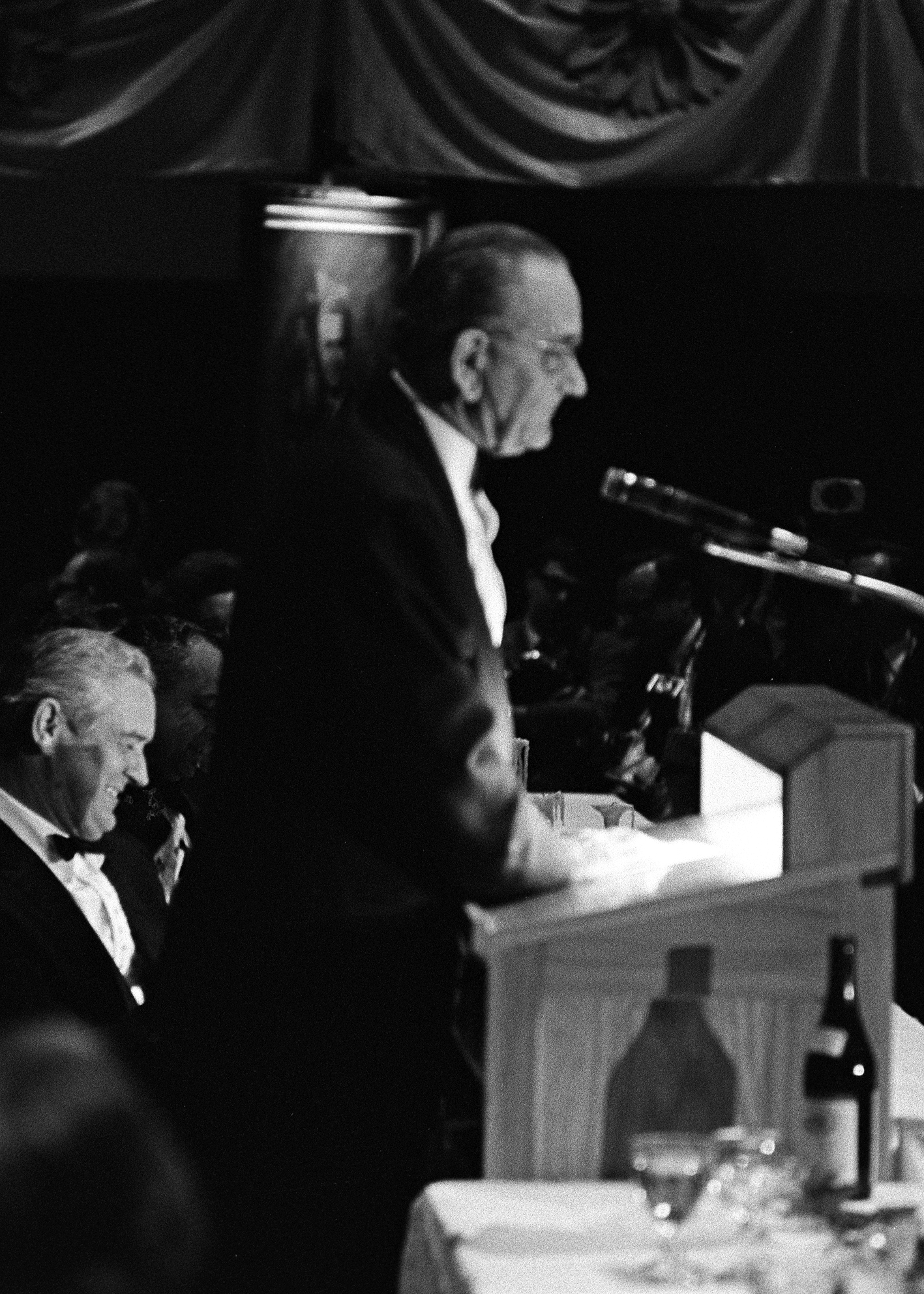
One of them is the comment misattributed to President Lyndon Johnson who,  in reaction to Walter Cronkite’s on-air assessment that the war in Vietnam was “mired in stalemate,” supposedly said:

“If I’ve lost Cronkite, I’ve lost Middle America.”

Or something to that effect.

Versions as to what Johnson supposedly said vary quite a lot — which can be a marker of a media myth. I also point out in Getting It Wrong that Johnson did not see the Cronkite report when it aired on CBS on February 27, 1968.

The other dubious quote discussed in Getting It Wrong and mentioned by Silverman is William Randolph Hearst’s purported vow to “furnish the war” with Spain.

Reasons for doubting the Hearstian vow are many, I write, and include the fact that the telegram in which Hearst supposedly made the statement has never turned up. Plus, Hearst denied making such a vow.

A number of other famous and delicious quotes favored by journalists likewise have proven to be false, made-up, or of mythical dimension; among them:

  • Too early to say.” It’s often said that Chinese premier Zhou Enlai offered the observation in 1972, as sage, far-sighted analysis about the effects of the French Revolution of 1789. But according to a retired American diplomat, Charles W.  (Chas) Freeman Jr., Zhou’s comment, which came during President Richard Nixon’s visit to China in February 1972, was about political turmoil in France in 1968. “I cannot explain the confusion about Zhou’s comment, except in terms of the extent to which it conveniently bolstered a stereotype” about Chinese leaders taking an exceptionally long and patient view of history, Freeman said recently. Freeman was Nixon’s interpreter on the trip.

So what to do about these delicious but dubious and phony quotations?

Keep pounding away at them, calling them out for what they are, whenever they appear. That’s the only effective way of debunking.

But even then, thorough and utter debunking can be rare.

WJC

Recent and related:

Wrong-headed history: Yellow press stampeded U.S. to war

In Debunking, Media myths, Spanish-American War, Yellow Journalism on June 21, 2011 at 9:13 am

Glib but thinly substantiated.

Hearst: War-monger?

That characterizes the not-infrequent claims about William Randolph Hearst, Joseph Pulitzer, and the war-mongering ways of their yellow newspapers. The claims are readily offered but rarely documented.

Take, for example, an essay published yesterday at Huffington Post which addressed the farcical campaign of the satiric newspaper, the Onion, to seek a Pulitzer Prize.

The HuffPo essay was headlined, “Why not give The Onion a Pulitzer?” and offered this dollop of wrong-headed history:

“Pulitzer and William Randolph Hearst used their newspapers to stampede the country into the Spanish-American War. A century later, the publications most often honored by Pulitzer Prizes went along for the ride of our Iraqi adventure in the same fashion — which makes the point that today’s regular Pulitzer honorees haven’t come very far from the journalism practiced in Pulitzer’s day.”

The latter claim — “today’s regular Pulitzer honorees haven’t come very far” — is risible. The preceding claim about the yellow press and a “stampede” to war with Spain is utterly false.

As I discussed in my 2001 book, Yellow Journalism: Puncturing the Myths, Defining the Legacies:

“The yellow press is not to blame for the Spanish-American-War. It did not force — it could not have forced — the United States into hostilities with Spain over Cuba in 1898. The conflict was, rather, the result of a convergence of forces far beyond the control or direct influence of even the most aggressive of the yellow newspapers, William Randolph Hearst’s New York Journal. ”

In 1898, Pulitzer and Hearst published six newspapers between them. Pulitzer’s were the World and the Evening World in New York, and the Post-Dispatch in St. Louis. Hearst’s were the Journal, the New York Evening Journal, and the San Francisco Examiner.

Those half-dozen titles wielded no more than modest agenda-setting influence on the rest of the American press, which then numbered more than 2,200 daily newspapers.

As I pointed out in Yellow Journalism:

“There is little evidence that the press beyond New York City, especially in small-town and rural America, was influenced by the content of the yellow journals, including their demands for war after the destruction of the Maine,” the American battleship that blew up in Havana harbor in February 1898, killing 266 officers and sailors.

The destruction of the Maine was a triggering event of the war with Spain for the future of Cuba. But it was not the sole factor, or even necessarily the decisive factor.

Effects of 'reconcentration'

What more than anything led America to war in 1898 were Spain’s brutal efforts to suppress the rebellion on Cuba, a vicious conflict that began in February 1895.

Spain sought to crush the rebellion by forcing Cuban non-combattants – old men, women, and children– into were called “reconcentration centers,” to prevent the non-combattants from giving aid, succor, and supplies to the Cuban rebels.

Spain’s “reconcentration” policy was a disaster. Tens of thousands of Cubans fell victim to disease and starvation. U.S. newspapers — including but certainly not limited to the dailies of Pulitzer and Hearst — were aware of, and reported extensively about, the humanitarian crisis that had taken hold on Cuba by early 1898.

That crisis — and not the often-flamboyant contents of the yellow press — was what precipitated the conflict with Spain.

As the historian David Trask has written, Americans in 1898 “went to war convinced that they had embarked upon an entirely selfless mission for humanity,” to end Spain’s brutal rule of Cuba.

It’s important to note that the fierce Pulitzer-Hearst competition for readers in New York undercut whatever power their respective newspapers may have wielded in shaping U.S. public opinion and U.S. policy toward Spain.

As I noted in Yellow Journalism, the newspapers of Pulitzer and Hearst “were not in lockstep but sought instead to denigrate, undercut, or minimize the other’s coverage during the months before and after the United States declared war on Spain.”

The broader effect of the Pulitzer-Hearst rivalry, I noted, “likely was to diminish the integrity and, in turn, the credibility and  presumed influence” of their newspapers, further weakening their agenda-setting capacity.

WJC

Recent and related:

That was quick: Crummy Cleveland mob pic now out on DVD

In Cinematic treatments, Cronkite Moment, Debunking, Furnish the war, Media myths, Spanish-American War on June 16, 2011 at 1:08 pm

It was just three months ago when a low-budget yet widely reviewed movie about Cleveland’s 1970s mob scene came out in limited release.

The film, Kill the Irishman, never much caught on and was released this week in DVD.

I’m hardly surprised that its time in theaters was so brief.

Update: I’ve now seen Kill the Irishman and it’s not as dreadful as anticipated. Still, the movie meanders without making much of a point, other than to glamorize the Cleveland mob scene of the 1970s and romanticize a violence-prone hood named Danny Greene.

I’ve not seen the movie but have enjoyed reading the reviews, such as the one in the New York Times that called Kill the Irishman “an extravagantly corny ode to the collapse of the Cleveland mafia in the 1970s” that “never misses an opportunity to mythologize the meatheads who populate [the] script.”

The Los Angeles Times review likened Kill the Irishman to “clichéd shards of mob movies that add up to the usual ‘Goodfellas’ knockoff.”

Plain Dealer, October 7, 1977

Kill the Irishman is based on the violent life of a Cleveland mob figure, Daniel J. (Danny) Greene, best known for having survived several attempts on his life before falling victim to a deadly car bombing in 1977.

I was in Cleveland then, a young reporter for the city’s morning newspaper, the Plain Dealer. I remember the city’s mob scene as murky, chaotic, and not at all glamorous; its figures — including Greene — were scarcely heroic.

Greene rather struck me as an arrogant, somewhat off-kilter punk.

He was hardly a legendary character possessing the stuff that would attract serious attention beyond Cleveland.

What most rankled me about Kill the Irishman was its exaggerated premise, that there were 36 bombing in the heart of Cleveland in the summer of 1976 as Greene waged a turf war with the local Italian mafia.

Sure, Hollywood exaggerates. A lot. But a documentary-esque film ought not to cock a snook at the truth. And there was no such bombing rampage in downtown Cleveland that summer.

The claim is preposterous.

As I’ve noted previously at Media Myth Alert, the figure of 36 bombings appears to have been mistakenly taken from an article published in May 1977 in the Plain Dealer, as a sidebar to the account of the bombing death of John A. Nardi, a mob figure allied with Greene.

The sidebar article said that in all of 1976, there had been 21 bombings in Cleveland and 37 in Cuyahoga County, which includes Cleveland and most of its many suburbs. That’s a lot, but nothing as stunning or sustained as 36 bombings in the heart of the city in a single summer. Such a spree would correspond to 12 bombings a month.

That never happened.

Also off-putting is the movie’s clear objective of glamorizing the unglamorous Danny Greene. One reviewer of the Blu-Ray version called Kill the Irishman “a clichéd offering of criminal worship ….” Well said.

So maybe I’ll rent the DVD. Some day.

WJC

Recent and related:

‘Getting It Wrong’ wins SPJ award for Research about Journalism

In Bay of Pigs, Bra-burning, Cronkite Moment, Debunking, Furnish the war, Hurricane Katrina, Jessica Lynch, Media myths, Media myths and radio, Murrow-McCarthy myth, New York Times, Spanish-American War, War of the Worlds, Washington Post, Watergate myth, Yellow Journalism on May 10, 2011 at 9:02 am

The Society of Professional Journalists announced today that my media-mythbusting book, Getting It Wrong, is the winner of the 2010 Sigma Delta Chi award for Research about Journalism.

The award will be presented in September at the Excellence in Journalism convention in New Orleans.

Getting It Wrong, which was published last year by the University of California Press, debunks 10 prominent media-driven myths, which are dubious tales about the news media that masquerade as factual.

Here’s a summary of the 10 myths dismantled in Getting It Wrong:

  1. Remington-Hearst: William Randolph Hearst’s famous vow “to furnish the war” with Spain is almost certainly apocryphal.
  2. War of Worlds: The notion that the War of Worlds radio dramatization in 1938 caused nationwide panic and mass hysteria is exaggerated.
  3. Murrow-McCarthy: Edward R. Murrow’s famous See It Now program in March 1954 did not end Senator Joseph McCarthy’s communists-in-government witch-hunt; Murrow in fact was very late to take on McCarthy.
  4. Bay of Pigs: The New York Times did not suppress its reporting in the run-up to the ill-fated Bay of Pigs invasion in April 1961.
  5. Cronkite-Johnson: Walter Cronkite’s special report on Vietnam in February 1968 did not prompt an immediate reassessment or revision of U.S. war policy.
  6. Bra-burning: Humor columnist Art Buchwald helped spread the notion that feminist demonstrators dramatically burned their bras at a Miss America protest in September 1968.
  7. Watergate: The Washington Post’s intrepid reporters, Carl Bernstein and Bob Woodward, did not bring down Richard Nixon’s corrupt presidency. That they did is a trope that knows few bounds.
  8. Crack babies: The much-feared “bio-underclass” of children born to women who smoked crack cocaine during their pregnancies never materialized.
  9. Jessica Lynch: The Washington Post’s erroneous reporting about Jessica Lynch early in the Iraq War gave rise to several myths about her capture and rescue.
  10. Hurricane Katrina: News coverage of Katrina’s aftermath in New Orleans in early September 2005 was marred by wild exaggerations about extreme, Mad Max-like violence.

The “Research about Journalism” award recognizes “an investigative study about some aspect of journalism,” SPJ says, and “must be based on original research; either published or unpublished, and must have been completed during the 2010 calendar year. … Judges will consider value to the profession, significance of the subject matter, thoroughness of the research, and soundness of the conclusion.”

WJC

Recent and related:

As if Hearst were ‘back with us,’ vowing to ‘furnish the war’

In 1897, Debunking, Furnish the war, Media myths, Spanish-American War, Yellow Journalism on May 10, 2011 at 2:26 am

Nieman Watchdog, a blog that “seeks to encourage more informed reporting,” indulged yesterday in the mythical tale of William Randolph Hearst‘s famous vow to “furnish the war” with Spain in the late 19th century.

Remington in Cuba for Hearst

It was a case of the blog’s turning to a fiction about Hearst and treating it as if it were fact.

The occasion for invoking “furnish the war” was to call attention to inaccuracies in news graphics accompanying reports last week about the slaying of terror mastermind Osama bin Laden.

“Journalism is a serious business where credibility is paramount,” the blog post asserted. “Editors need, first and foremost, to get the facts right, in graphics as well as text and video.”

The post further noted that “some publications presented as facts what was just fiction. Sometimes there was no factual support whatsoever. It’s as though William Randolph Hearst was back with us, saying once again, ‘You furnish the pictures and I’ll furnish the war.'”

As I discuss in my latest book, Getting It Wrong, the tale about Hearst’s vow to “furnish the war” is a hardy media-driven myth that lives on despite concerted attempts to discredit and dismantle it.

The vow supposedly was contained in a telegram sent to the famous artist, Frederic Remington, who was on assignment in Cuba for Hearst’s flamboyant New York Journal (see image, above). Remington and the correspondent Richard Harding Davis were assigned there to cover the insurrection against Spanish colonial rule — the conflict that gave rise in 1898 to the Spanish-American War.

They arrived in Havana in early January 1897; Remington stayed only six days.

Before leaving by passenger steamer for New York, Remington supposedly sent Hearst a cable, stating:

“Everything is quiet. There will be no war. I wish to return.”

Hearst replied with his famous vow:

Please remain. You furnish the pictures, and I’ll furnish the war.”

But Remington didn’t stay.

He promptly returned to New York, where his sketches were given prominent display in Hearst’s Journal. They appeared with such flattering headlines as: “Cuban War Sketches Gathered in the Field by Frederic Remington; The Gifted Artist, Visiting Cuba Especially for the Journal.”

That’s hardly the sort of tribute Hearst would have granted a wayward artist who ignored specific instructions to “remain” in Cuba.

I further note in Getting It Wrong that the anecdote about Hearst’s vow “lives on despite an irreconcilable internal inconsistency: It would have been absurd for Hearst to vow to ‘furnish the war’ because war — specifically, the Cuban rebellion against Spain’s colonial rule — was the very reason Hearst sent Remington to Cuba in the first place.”

Anyone reading U.S. newspapers in early 1897 “would have been well aware,” I write, “that Cuba was a theater of a nasty war,” which gave rise in April 1898 to the Spanish-American War.

Not only that, but the artifacts themselves — the telegrams reputedly sent by Remington and Hearst — have never surfaced. And Spanish censors monitored incoming and outgoing telegraphic traffic in Havana, and they surely would have intercepted Hearst’s incendiary message — had it been sent.

For those and other reasons, the tale about the Remington-Hearst exchange is surely apocryphal — fiction that too often masquerades as fact.

WJC

Recent and related:

Fact-checking ‘Mother Jones’: A rare two-fer

In Cronkite Moment, Debunking, Furnish the war, Media myths, New York Times, Spanish-American War on April 26, 2011 at 7:07 am

The most prominent media-driven myths — those dubious or apocryphal stories about the news media that masquerade as factual — include William Randolph Hearst’s vow to “furnish the war” and the so-called “Cronkite Moment” of 1968.

Mother Jones magazine, in the cover story of its May/June number, cites both tales as if they were genuine, in a rare, myth-indulging two-fer.

In an article written by Rick Perlstein and titled “Inside the GOP’s fact-free nation,” Mother Jones says of Hearst (who was no Republican):

“In a fearsome rivalry with Joseph Pulitzer, he chose as his vehicle the sort of manly imperialism to which the Washington elites of the day were certainly sympathetic — although far too cautiously for Hearst’s taste. ‘You furnish the pictures,’ he supposedly telegraphed a reporter, ‘and I’ll furnish the war.’ The tail wagged the dog.”

You furnish the pictures, and I’ll furnish the war.” Couching it with “supposedly” allows no free pass for myth-telling.

It’s quotation most often attributed to Hearst. And as I discuss in my latest book, Getting It Wrong, it’s a durable media-driven myth that has survived “concerted attempts to discredit and dismantle it.”

It is, I add, “succinct, savory, and easily remembered. It is almost too good not to be true.”

The purported recipient of Hearst’s telegram was not “a reporter,” as Perlstein writes, but Frederic Remington, the famous artist of the American West.

Remington, Davis in Cuba

Hearst had assigned Remington and the correspondent Richard Harding Davis to Cuba to cover the insurrection against Spanish colonial rule. They arrived in Havana in early January 1897, and Remington six days later.

He parted ways with Davis in Matanzas, Cuba, and, before leaving Havana for New York, supposedly cabled Hearst, saying:

“Everything is quiet. There will be no war. I wish to return.”

Hearst, in reply, cabled his famous vow, telling Remington:

“Please remain. You furnish the pictures, and I’ll furnish the war.”

Remington didn’t stay. He promptly returned to New York, where his sketches were given prominent display in Hearst’s New York Journal, appearing beneath such headlines as:

“Cuban War Sketches Gathered in the Field by Frederic Remington; The Gifted Artist, Visiting Cuba Especially for the Journal.”

That’s hardly an accolade Hearst would have extended to someone who had so brazenly disregarded instructions to remain on the scene.

As I write in Getting It Wrong, “the anecdote lives on despite a nearly complete absence of supporting documentation. It lives on even though telegrams supposedly exchanged by Remington and Hearst have never turned up.”

What’s more, I note in Getting It Wrong, the Remington-Hearst anecdote “lives on despite an irreconcilable internal inconsistency: It would have been absurd for Hearst to vow to ‘furnish the war’ because war — specifically, the Cuban rebellion against Spain’s colonial rule — was the very reason Hearst sent Remington to Cuba in the first place.”

Anyone who read U.S. newspapers in early 1897 “would have been well aware,” I write, “that Cuba was a theater of a nasty war,” which gave rise in April 1898 to the Spanish-American War.

The tale about the Remington-Hearst exchange is surely apocryphal.

So, too, is the presumed effect of the “Cronkite Moment” which, like the story about Hearst’s famous vow, is “succinct, savory, and easily remembered.”  It reputedly demonstrates the potency of broadcast journalism.

The “Cronkite Moment” was, I point out in Getting It Wrong, purportedly “an occasion when the power of television news was unequivocally confirmed,” a rare, pivotal moment when a truth-telling broadcast demonstrated the folly of a faraway war.

Perlstein writes in Mother Jones:

“Walter Cronkite traveled to Saigon after the Tet Offensive in 1968, saw things with his own eyes, and told the truth: The Vietnam War was stuck in a disastrous stalemate, no matter what the government said. That was a watershed.”

Well, no, it wasn’t.

Cronkite did indeed travel to Vietnam in February 1968 and upon his return to the United States aired an hour-long special report about the war, in which he concluded that the American military was “mired in stalemate” and suggested that negotiations offered the best way out.

But “mired in stalemate,” I write in Getting It Wrong, “was neither notable nor extraordinary” by February 27, 1968, when Cronkite’s report aired. As Mark Kurlansky wrote in his study of the year 1968, Cronkite’s assessment was “hardly a radical position” for the time.

Indeed, months before the program, the New York Times had been using “stalemate” to describe the war in Vietnam.

On July 4, 1967, for example, the Times said this about the war effort:

“Many officers believe that despite the commitment of 466,000 United States troops now in South Vietnam … the military situation there has developed into a virtual stalemate.”

And in a front-page analysis published August 7, 1967, the Times declared “the war is not going well.” Victory “is not close at hand.”

The Times published the analysis beneath the headline:

Vietnam: The Signs of Stalemate.

And in an editorial published October 29, 1967, the Times offered this assessment:

“Instead of denying a stalemate in Vietnam, Washington should be boasting that it has imposed a stalemate, for that is the prerequisite – on both sides – to a negotiated settlement. That settlement, if it is to be achieved, will have to be pursued with the same ingenuity and determination that have been applied to fighting the war.”

Cronkite’s “mired in stalemate” represented no watershed, no assessment of exceptional and stunning clarity. Cronkite said as much in his memoir, which was published in 1997. He wrote that his special report represented for President Lyndon B. Johnson “just one more straw in the increasing burden of Vietnam.”

In fact, public opinion had begun shifting away from supporting the war months before the “Cronkite Moment.”

It’s often said that Johnson watched Cronkite’s program and, upon hearing the “mired in stalemate” interpretation, snapped off the television set and said something to the effect of:

“If I’ve lost Cronkite, I’ve lost Middle America.”

LBJ: Not watching TV

But as I discuss in Getting It Wrong, Johnson did not see the Cronkite report went it aired. The president at that time wasn’t in front of a television set. And he certainly wasn’t lamenting the loss of Cronkite’s support. Indeed, it is hard to fathom how he could have been much moved by a show he did not see.

At about the time Cronkite was intoning “mired in stalemate,” Johnson was in Austin, Texas, offering light-hearted banter at the 51st birthday party of Governor John Connally.

“Today,” the president said, “you are 51, John. That is the magic number that every man of politics prays for — a simple majority.”

WJC

Many thanks to Little Miss Attila
for linking to this post

Recent and related:

Hearst and war: A newspaper misreads history

In Debunking, Media myths, Newspapers, Spanish-American War, Yellow Journalism on March 28, 2011 at 8:30 am

American journalists, to put it charitably, can be quite unfamiliar with the history of their profession.

The field, as I note in my latest book, Getting It Wrong, “seldom is seriously introspective, or very mindful of its history.”

As such, journalists are known to flub it — or indulge in media myths — when they do take up the past. Consider, for example, the Bangor Daily News in Maine, which both flubs it and offers up a hardy media myth in an editorial posted online last night.

The media myth centers around the hoary notion, rejected by serious historians, that William Randolph Hearst’s yellow journalism fomented or brought about the Spanish-American War in 1898.

In invoking the myth of Hearst and the long-ago war, the Bangor newspaper sought to describe the context for the multiple military missions the United States is pursuing these days.

The newspaper declared:

“U.S. forces have been in Afghanistan since 2001. They’ve been in Iraq since 2003. And they soon could be in Libya. This is not to mention standing U.S. military bases in Japan, South Korea, Germany, Italy, Greece, Spain, Bulgaria, Kosovo, Israel, Turkey, Saudi Arabia, Kuwait, Bahrain, Brazil, Greenland, the Philippines, Cuba, Guam and on and on. How and when did this happen?

“The year the United States began its ascendancy as a world power was 1898, beginning with the Spanish-American War, a conflict of dubious progeny fanned into flames by the partisan journalism practiced by William Randolph Hearst.”

How simplistic. And how illogical.

Just think it through: wars can begin because of overheated newspaper content?

Quite simply, that’s a misreading of history, a lazy interpretation that ascribes too much power to Hearst and his yellow press while ignoring the human rights disaster on Cuba that helped precipitate the war in April 1898.

As I wrote in my 2001 book, Yellow Journalism: Puncturing the Myths, Defining the Legacies:

“The yellow press is not to blame for the Spanish-American-War. It did not force — it could not have forced — the United States into hostilities with Spain over Cuba in 1898. The conflict was, rather, the result of a convergence of forces far beyond the control or direct influence of even the most aggressive of the yellow newspapers, William Randolph Hearst’s New York Journal.”

In 1898, Hearst published the Journal, the New York Evening Journal, and the San Francisco Examiner. The three titles wielded at best modest agenda-setting influence on the rest of the American press, which then numbered more than 2,200 daily newspapers.

Indeed, as I pointed out in Yellow Journalism:

“There is little evidence that the press beyond New York City, especially in small-town and rural America, was influenced by the content of the yellow journals, including their demands for war after the destruction of the Maine,” an American battleship that blew up in Havana harbor in February 1898, killing 266 officers and sailors.

The destruction of the Maine was a triggering event of the war. But it was not the sole factor, or even necessarily the decisive factor.

What galvanized American public opinion were Spain’s brutal efforts to suppress an islandwide rebellion on Cuba, a nasty conflict that began in February 1895 and ultimately gave rise to the Spanish-American War.

A centerpiece of Spain’s attempt to crush the rebellion was to force Cuban non-combattants – old men, women, and children– into what the Spanish called “reconcentration centers,” to prevent the non-combattants from giving aid, succor, and supplies to the Cuban rebels.

The “reconcentration” policy was a disaster. Tens of thousands of Cubans fell victim to disease and starvation. U.S. newspapers — including but certainly not limited to Hearst’s dailies — were aware of, and reported extensively about, the humanitarian crisis that had taken hold on Cuba by early 1898.

That crisis, not the content of the yellow press, was what “fanned” the flames for war with Spain.

As the historian David Trask has written, Americans in 1898 “went to war convinced that they had embarked upon an entirely selfless mission for humanity,” to end Spain’s brutal rule of Cuba.

The war hardly was “a conflict of dubious progeny,” as the Bangor Daily News dismissively put it. And it surely wasn’t a war driven by Hearst and his yellow press.

WJC

Recent and related:

Talking media myths at the alma mater

In 1897, Cronkite Moment, Debunking, Furnish the war, Media myths, Spanish-American War, Washington Post, Watergate myth on March 19, 2011 at 9:06 am

I gave a talk about media-driven myths yesterday on the campus of Ohio Wesleyan University, where years ago I earned my undergraduate degree in journalism and history.

The talk focused on three of the media myths debunked in my latest book, Getting It Wrong, which is dedicated to Verne E. Edwards Jr., my journalism professor at Ohio Wesleyan.

I was delighted that Edwards and his wife attended yesterday’s talk, during which I discussed the myths of Watergate, of the “Cronkite Moment,” of William Randolph Hearst’s purported vow to “furnish the war” with Spain.

These, I said, all are well-known tales about the power of the news media that often are taught in schools, colleges, and universities. All of them are delicious stories that purport to offer lessons about the news media’s power to bring about change, for good or ill.

I described media-driven myths as I often do — as “the junk food of journalism, meaning that they’re tasty and alluring, but in the end, not terribly healthy or nutritious.”

Because it debunks prominent media myths, Getting It Wrong, I said, should not be considered “yet another media-bashing book.”

Rather, I said, Getting It Wrong is aligned with a fundamental objective of American journalism — that of getting it right.

I noted that the book is provocative and edgy — inevitably so, given that it dismantles several of the most-cherished stories in American journalism.

Among them is the notion that the Watergate reporting of the Washington Post exposed the crimes of the administration of President Richard Nixon and forced his resignation in 1974.

I noted that the Post and its reporting “was really peripheral to the outcome” of Watergate, pointing out that even senior officials at the newspaper have insisted as much over the years.

Among them was Katharine Graham, publisher of the Post during Watergate, who said on the scandal’s 25th anniversary in 1997:

“Sometimes people accuse us of bringing down a president, which of course we didn’t do. The processes that caused [Nixon’s] resignation were constitutional.”

I also pointed out that Bob Woodward, one the lead reporters for the Post on Watergate, has expressed much the same sentiment, only in earthier terms. In an interview in 2004 with American Journalism Review, Woodward declared:

To say the press brought down Nixon, that’s horseshit.”

I also reviewed the “Cronkite Moment” of February 27, 1968 — that legendary occasion when the on-air assessment of CBS News anchorman Walter Cronkite supposedly altered American policy on the Vietnam War. At the end of a special report about Vietnam, Cronkite asserted that the U.S. war effort was “mired in stalemate.”

President Lyndon Johnson supposedly watched Cronkite’s program and, upon hearing the anchorman’s “mired in stalemate” analysis, snapped off the television set and declared:

“If I’ve lost Cronkite, I’ve lost Middle America.”

Or something to that effect.

I pointed out that Johnson did not see the Cronkite program when it aired, that the president then was in Austin, Texas, at the 51st birthday party of Governor John Connally.

“About the time Cronkite was intoning his ‘mired in stalemate’ commentary,” I told the audience at Ohio Wesleyan, “Johnson was at the podium at Connally’s birthday party, saying: ‘Today, you are 51, John. That is the magic number that every man of politics prays for — a simple majority.’

“Now that may not have been the greatest presidential joke ever told,” I said, “but it is clear that Johnson at that time wasn’t lamenting his fate, wasn’t lamenting the supposed loss of Cronkite’s support” for the war in Vietnam.

Clearly, I added, the so-called “‘Cronkite Moment’ was of little importance or significance for Johnson. Especially since he didn’t even see the show when it aired.”

I described how Hearst’s purported vow to “furnish the war” lives on despite Hearst’s denial and despite an array of reasons that point to the anecdote’s falsity.

Hearst supposedly made the vow in an exchange of telegrams with the artist Frederic Remington, whom Hearst had sent to Cuba in early 1897 to draw sketches of the Cuban rebellion against Spanish colonial rule — the nasty conflict that gave rise in 1898 to the Spanish-American War.

The tale “lives on despite an irreconcilable internal inconsistency,” I said. “It would have been absurd for  Hearst to have vowed to ‘furnish the war’ because war — the Cuban rebellion against Spanish rule — was the very reasons he sent Remington to Cuba in the first place.”

Still, that anecdote and other media myths live on because they are “deliciously good stories — too good, almost, to be disbelieved,” I said. Too good, almost, to check out.

The university president, Rock Jones, introduced my talk, which was organized by Lesley Olson, general manager of the OWU bookstore, and by Cole E. Hatcher, the university’s director of media and community relations.

Two college buddies of mine, Hugh D. Pace and Tom Jenkins, also attended the talk.

WJC

Recent and related: