W. Joseph Campbell

Posts Tagged ‘History’

William Randolph Hearst mostly elusive in new ‘Citizen Hearst’ documentary

In 1897, Anniversaries, Cinematic treatments, Error, Furnish the war, Reviews on March 15, 2013 at 10:26 am

Citizen Hearst was a mostly unsatisfactory biography published in 1961 about media baron William Randolph Hearst. It was more caricature than revealing portrait.
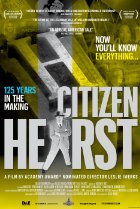
Citizen HearstThe title, Citizen Hearst, has been reprised for documentary that opened in several theaters this week. The documentary — commissioned by the media company that Hearst founded 126 years ago — is no revealing portrait, either.

Hearst was an innovative yet often-contradictory figure, and this complexity is largely elusive in Citizen Hearst, an 84-minute film that had its Washington, D.C., debut screening last night at the Newseum. The director, Leslie Iwerks, introduced the film by saying it told “the wonderful Hearst story.”

The opening third of Citizen Hearst delivers a fast-paced if mostly shallow look at Hearst’s long career in journalism. After that, the film turns mostly gushy about the diversified media company that is Hearst Corp.

To its credit, Citizen Hearst steers largely clear of the myths that distort understanding of Hearst and his early, most innovative years in journalism.

His affable grandson, Will Hearst, is shown in the film scoffing at what may be the best-known anecdote in American journalism — that William Randolph Hearst vowed in a telegram to the artist Frederic Remington to “furnish the war” with Spain.

The anecdote is undocumented and utterly dubious, but it was presented at face value in the biography Citizen Hearst. It is an irresistible tale often invoked in support of a broader and nastier media myth, that Hearst and his newspapers fomented the Spanish-American War in 1898.

Citizen Hearst the documentary doesn’t embrace the warmongering myth (although former CBS News anchor Dan Rather is shown saying he was taught in school that Hearst practically brought on the Spanish-American War).

The documentary, however, fails to consider the innovative character of Hearst’s newspapers of the late 19th century.

It notably avoids discussing Hearst’s eye-opening brand of participatory journalism — the “journalism of action” — which maintained that newspapers were obliged take a prominent and participatory roles in civic life, to swing into action when no other agency or entity was willing or able.

This ethos was a motivating force for one of the most exceptional and dramatic episodes in American journalism — the jailbreak and escape of Evangelina Cisneros, a 19-year-old political prisoner held without charge in Spanish-ruled Cuba.

Cisneros

Evangelina Cisneros

A reporter for Hearst’s New York Journal, supported by clandestine operatives in Havana and U.S. diplomatic personnel in Cuba, broke Cisneros from jail in early October 1897.

She was hidden for nearly three days at the home of an American-educated Cuban banker (whom she married several months later). Then, dressed as a boy, Cisneros was smuggled aboard a passenger steamer bound for New York City, where Hearst organized a thunderous welcome for her.

The Cisneros jailbreak was stunning manifestation of Hearst’s “journalism of action” and it offers rich material for a documentary. It was, as I wrote in my 2006 book, The Year That Defined American Journalism: 1897 and the Clash of Paradigms, the “greatest escape narrative” in U.S. media history.

It receives not a mention in Citizen Hearst.

The documentary presents only superficial consideration of Hearst’s mostly unfulfilled political ambitions — and avoids mentioning how he turned his newspapers into platforms to support those ambitions.

Hearst wanted to be president, and was a serious contender for the Democratic party’s nomination in 1904. He lost out to Alton Parker, a New York judge, who in turn was badly defeated by Republican Theodore Roosevelt.

Citizen Hearst presents the observations of no serious Hearst biographer: No David Nasaw, author of The Chief, an admirably even-handed biography published in 2000; no Kenneth Whyte, author of The Uncrowned King, an outstanding work published in 2009 about Hearst’s s early career.

Instead, Dan Rather is shown speaking vaguely about Hearst’s journalism (“he played big”). Movie critic Leonard Maltin makes several appearances, discussing such topics as headline size in Hearst’s fin de siècle newspapers.

The documentary treats Helen Gurley Brown, she of Cosmopolitan fame, much like a rock star. And Hearst company officials are quoted often and sometimes at length.

HuffingtonPost was quite right in noting in a review posted Wednesday that the film turns into “something you’d expect to see playing on a loop on the lobby TV screen at Hearst’s headquarters”  in New York.

It leaves you wondering how many people would pay to see it. Or why.

WJC

More from Media Myth Alert:

Woodward ‘destroyed the Nixon presidency’: More dubious history from Rush Limbaugh

In Cinematic treatments, Debunking, Error, Media myths, Scandal, Washington Post, Watergate myth on March 1, 2013 at 7:21 am

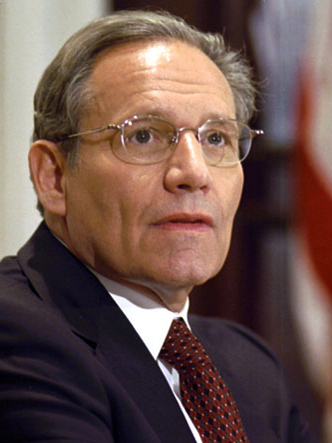
Talk-radio host Rush Limbaugh was at it again yesterday, offering up the dubious interpretation that Bob Woodward’s Watergate reporting “destroyed the Nixon presidency.”

That’s a seriously exaggerated version of the Watergate scandal, which led to Nixon’s resignation in 1974. Not even Woodward embraces that interpretation, once telling an interviewer: “To say the press brought down Nixon, that’s horse shit.”

(Woodward(Jim Wallace/Smithsonian)

Woodward
(Jim Wallace/Smithsonian)

Limbaugh’s remark about Woodward’s having “destroyed the Nixon presidency” came during a lengthy commentary about Woodward’s recent criticism about the administration of President Barack Obama.

Woodward has asserted that Obama proposed the controversial sequester plan — the automatic federal spending cuts that are to begin taking effect today.

What most intrigues Media Myth Alert is Limbaugh’s repeated claim that Woodward’s reporting was decisive in ending Nixon’s presidency. The talk-show host’s remark yesterday about Woodward and Nixon marked the second time this week he has made such an assertion.

On his show Monday, Limbaugh said flatly that “Woodward brought down Nixon” in the Watergate scandal.

The record, though,  is far more nuanced and complex than that: Woodward and his Washington Post reporting colleague Carl Bernstein played rather modest roles in unraveling the scandal.

Their reporting in the summer and fall 1972 progressively linked White House officials to a secret fund used to finance the foiled burglary at the headquarters of the Democratic National Committee — the signal crime of Watergate.

But by late October 1972, the Post’s investigation into Watergate “ran out of gas,” as Barry Sussman, then the newspaper’s city editor, later acknowledged.

Significantly, Woodward and Bernstein did not break such crucial stories as the existence of Nixon’s audiotaping system at the White House. The tapes ultimately provided evidence that the president had obstructed justice by approving a scheme to deflect the FBI’s inquiry into the burglary.

The disclosure about the taping system came in July 1973, during a Senate select committee’s investigation into the unfolding Watergate scandal.

Nor did Woodward and Bernstein disclose the payment of hush money to operatives arrested in the burglary — a key development in tying the White House to the Watergate scandal.

I discuss the media myth of Watergate in my latest book, Getting It Wrong, and write that the scandal demanded “the collective if not always the coordinated forces of special prosecutors, federal judges, both houses of Congress, the Supreme Court, as well as the Justice Department and the FBI.”

What I call the hero-journalist myth of Watergate — the notion that Woodward and Bernstein’s dogged reporting brought down Nixon — stems in large measure from the 1976 motion picture, All the President’s Men.

The movie, an adaptation of Woodward and Bernstein’s book by the same title, concentrated on the  reporters and ignored the far more decisive contributions of subpoena-wielding investigators and special prosecutors.Getting It Wrong_cover

The movie was critically acclaimed and widely seen. Its effect, I write in Getting It Wrong, was “to solidify and elevate the heroic-journalist myth, giving it dramatic power, and sustaining it in the collective memory.”

All the President’s Men, the movie, promoted a simplistic yet readily accessible interpretation of the Watergate scandal that is often invoked — as Limbaugh’s recent comments suggest. But it is an interpretation that nonetheless is utterly wrong.

WJC

More from Media Myth Alert:

If Obama loses AP: Rush Limbaugh embraces media myths two days running

In Anniversaries, Cronkite Moment, Debunking, Error, Media myths, Media myths and radio, Washington Post, Watergate myth on February 26, 2013 at 6:53 pm

Rush Limbaugh attracts the largest talk-show audiences on radio. Which is why it’s troubling when he indulges in media myths, as he’s done the past two days.

THUMB_RushLimbaugh

Limbaugh

Program transcripts show that Limbaugh made clear if passing references to the “Cronkite Moment,” the 45th anniversary of which falls tomorrow, and to the hero-journalist myth that the Washington Post’s reporting of the Watergate scandal brought down Richard Nixon’s presidency.

Limbaugh on today’s program called attention to an Associated Press report that skeptically considered President Barack Obama’s claims of great disruption should federal government spending cuts, collectively known as the sequester, take effect beginning Friday.

Limbaugh, according to the program transcript, declared that “if Obama is losing AP on this, it’d be like Lyndon Johnson losing Cronkite on the war in Vietnam.”

The reference was to President Lyndon Johnson’s purported reaction to Walter Cronkite’s on-air assessment, delivered February 27, 1968, that the U.S. military was “mired in stalemate” in Vietnam.

Cronkite

Cronkite

Upon hearing Cronkite’s comment, Johnson supposedly understood that his war policy was in tatters and declared: “If I’ve lost Cronkite, I’ve lost Middle America.”

Or something to that effect. Versions of what the president supposedly said vary markedly.

But as I discuss in my media-mythbusting book, Getting It Wrong, Johnson didn’t see Cronkite’s program when it aired.

Johnson at the time was in Austin, Texas, attending the 51st birthday party of a long-time political ally, Governor John Connally. And at the time Cronkite intoned his “mired in stalemate” assessment, the president was making light-hearted remarks about Connally’s age.

“Today you are 51, John,” he said. “That is the magic number that every man of politics prays for—a simple majority.”

So it’s hard to believe that the president could have been much moved by a program he did not see.

The importance of the debunking the “Cronkite Moment” goes beyond whether Johnson saw the program; far more significant is the anecdote’s deceptive message that a prominent journalist can profoundly alter policy.

Altering war policy certainly wasn’t the effect of Cronkite’s program 45 years ago. Even Cronkite likened the program’s influence to that of a straw placed on the back of a crippled camel.

Johnson did announce at the end of March 1968 that he was not seeking reelection to the presidency. But that decision had far more to do with his health and the prospect that Democrats would not renominate him than with Cronkite’s fairly tame and unoriginal commentary about Vietnam.

Limbaugh invoked Watergate’s hero-journalist trope in discussing the sequester during his program yesterday, stating flatly:

“Woodward brought down Nixon.”

He was referring to the supposed effects of the Watergate reporting of Bob Woodward of the Washington Post.

But that’s a myth not even Woodward embraces.

Woodward: 'Horseshit'

Woodward

In 2004, for example, Woodward told American Journalism Review, “To say the press brought down Nixon, that’s horse shit.”

And on another occasion, in an interview with the PBS “Frontline” program, Woodward said “the mythologizing of our role in Watergate has gone to the point of absurdity, where journalists write … that I, single-handedly, brought down Richard Nixon. Totally absurd.”

Other principals at the Post have over the years similarly dismissed such outsize claims.

If not Woodward and his reporting sidekick Carl Bernstein, then who, or what, brought down Richard Nixon?

The best answer is that unraveling a scandal of the reach and complexity of Watergate “required the collective if not always the coordinated forces of special prosecutors, federal judges, both houses of Congress, the Supreme Court, as well as the Justice Department and the FBI,” as I write in Getting It Wrong.

“Even then,” I add, “Nixon likely would have served out his term if not for the audiotape recordings he secretly made of most conversations in the Oval Office of the White House. Only when compelled by the Supreme Court did Nixon surrender those recordings” in 1974, making inevitable an early end to his presidency.

In the end, the reporting of Woodward and Bernstein was of faint consequence to Watergate’s dramatic outcome.

It merits mentioning that there’s no small irony in Limbaugh’s giving voice to these media myths.

He is, after all, a prominent conservative commentator and the “Cronkite Moment” and the Watergate myth center around journalists and news organizations commonly associated with liberal views.

WJC

More from Media Myth Alert:

The ‘newsroom where two reporters took down a president’? Sure it was

In Debunking, Error, Media myths, Scandal, Washington Post, Watergate myth on February 2, 2013 at 7:58 am

News that the Washington Post is exploring the sale of its headquarters building inevitably stirred reminders of the Watergate scandal, supposedly the newspaper’s most memorable exposé.

The Wall Street Journal makes that link in an article today while credulously invoking the heroic-journalist myth of Watergate, the scandal that forced Richard Nixon to resign the presidency in 1974.

wapo-logo“The Washington, D.C., newsroom where two reporters took down a president may soon be on the block,” the Journal states, referring to Bob Woodward and Carl Bernstein, the Post’s lead reporters on America’s greatest political scandal.

While it may make for a catchy “lede” (journalese for a story’s opening paragraph), the reference to the reporters who “took down a president” is wrong-headed: It’s a media myth that simplifies and distorts the forces and factors that led Nixon to quit in disgrace.

Even principals at the PostWoodward among them — have asserted over the years that the newspaper did not bring down Nixon’s corrupt presidency. And they weren’t indulging in false modesty in saying so. (Ben Bradlee, the Post’s executive editor during Watergate, once said, for example: “[I]t must be remembered that Nixon got Nixon. The Post didn’t get Nixon.”)

And as I write in my media-mythbusting book, Getting It Wrong, “to explain Watergate through the lens of the heroic-journalist is to abridge and misunderstand the scandal and to indulge in a particularly beguiling media-driven myth. The heroic-journalist interpretation minimizes the far more decisive forces that unraveled the scandal and forced Nixon from office.”

Those forces included special federal prosecutors, federal judges, both houses of Congress, the Supreme Court, as well as the Justice Department and the FBI.

“Even then,” I note in Getting It Wrong, “Nixon likely would have served out his term if not for the audiotape recordings he secretly made of most conversations in the Oval Office of the White House.

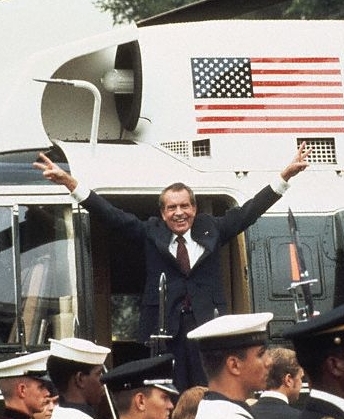
Nixon quits

‘Nixon got Nixon’

“Only when compelled by the Supreme Court did Nixon surrender those recordings, which captured him plotting the cover-up and authorizing payments of thousands of dollars in hush money.”

So why does the mediacentric heroic-journalist interpretation of Watergate live on? Why is it so tempting to invoke, as the Journal does today?

Explanations go well beyond a reporter’s need for a catchy lede.

An especially compelling reason for the myth’s tenacity is that it makes accessible and understandable the intricate scandal that was Watergate.

That complexity —the webs of lies, the deceit, and the criminality that characterized the Nixon White House; the multiple lines of investigation that slowly unwound the scandal, and the drama of a constitutional crisis — are not readily recalled these days.

The scandal that unfolded from 1972 to 1974 has become so distant that few Americans can accurately describe what took place.

What does stand out, though, is the heroic-journalist meme — the appealing if misleading notion that the tireless reporting of Woodward and Bernstein exposed the crimes of Watergate and brought Nixon down.

It’s history lite, history made simple.

The myth is endlessly reassuring for journalists, too, suggesting as it does that journalism can make a difference, can bring about dramatic change. As I point out in Getting It Wrong, “How the Post and its reporters uncovered Watergate is deeply ingrained in American journalism as one of the field’s most important and self-reverential stories.”

It’s also one of journalism’s self-sustaining tales, as the Wall Street Journal demonstrates quite well today.

WJC

Many thanks to Instapundit
Glenn Reynolds for linking to this post

More from Media Myth Alert:

‘Digital wildfires’ and the ‘War of the Worlds’ media myth

In Debunking, Error, Media myths, Media myths and radio, New York Times, War of the Worlds on January 9, 2013 at 12:00 pm

The New York Times considers in a commentary posted yesterday the prospect of “digital wildfires” — how rumor and error spread by social media could give rise to panic and widespread turmoil.

It’s a catchy phrase, “digital wildfires.” But the commentary is largely speculative and, worse, it conjures the panic myth of the famous War of the Worlds radio dramatization of October 30, 1938.

“In 1938,” the commentary declares, “thousands of Americans famously mistook a radio adaptation of the H.G. Wells novel ‘War of the Worlds’ for a genuine news broadcast. Police stations were flooded with calls from citizens who believed the United States had been invaded by Martians. …

“Is it conceivable that a misleading post on social media could spark a comparable panic?”

What “panic”?

The notion that The War of the Worlds radio program of October 30, 1938, set off a wildfire of panic is a hoary media myth — a myth so tenaciously held that not even a sustained social media campaign could undo it.

Like many media myths, the tale of the panic broadcast of 1938 is just too engrained, and too delicious, ever to be uprooted and delivered to the ash heap of history. As the Times commentary suggests, it’s an irresistible story, full of  illustrative potential.

But as I discuss in my latest book, Getting It Wrong, “the notion that The War of the Worlds program sent untold thousands of people into the streets in panic, is a media-driven myth that offers a deceptive message about the influence radio wielded over listeners in its early days and, more broadly, about the media’s potential to sow fright, panic, and alarm.”

Some people who listened to the show in 1938 were frightened or disturbed by what they heard. But most listeners — in overwhelming numbers — recognized the dramatization for what it was, an imaginative and entertaining show that aired on CBS radio in its usual Sunday evening time slot.

This conclusion is based on research by Hadley Cantril, a Princeton University psychologist, who studied the program’s aftermath. His research, while crude by contemporary standards, drew on interviews and a public opinion survey to estimate that at least 6 million people listened to The War of the Worlds program.

Of that number, Cantril estimated as many as 1.2 million were “frightened,” “disturbed,” or “excited” by what they heard.

But Cantril did not specify what he meant by “frightened,” “disturbed,” and “excited” — terms not synonymous with “panic-stricken.”

As  Robert E. Bartholomew, an authority on mass hysteria and social delusions, has noted, there is scant evidence that many frightened listeners acted on their fears.

In short, what radio-induced fright there was that night did not rise to the level of broad panic or hysteria.

Had it — had panic swept the country — trauma and turmoil surely would have resulted in deaths, including suicides. But none were linked to the program, as Michael J. Socolow noted in his fine essay in 2008.

The Times commentary notes that authorities “were flooded with calls” that night. Indeed, telephone volume surged during and immediately after the program, especially in metropolitan New York and New Jersey — ground zero for the fictive Martian invasion in The War of the Worlds show.

Police station, fire departments, and many newspaper offices reported receiving an unusually large number of telephone calls.

But call volume is a crude, and even misleading, marker of fear and alarm.

As I discuss in Getting It Wrong, increased call volume that night is better understood as “signaling an altogether rational response of people who neither panicked nor became hysterical, but who sought confirmation or clarification from external sources known to be usually reliable.”

Interestingly, the notion that a radio show did create panic gave newspapers an irresistible opportunity to assail their upstart rival medium.

By the late 1930s, radio was an increasingly important source for news and advertising, and American newspapers thus had, as I write, “competitive incentives to denounce radio, and characterize it as irresponsible and unreliable.

“Many newspapers seized the chance to do with enthusiasm. It was as an opportunity they could not fail to let pass.”

The New York Times, for example, declared in an editorial titled “Terror by Radio”:

“Radio is new but it has adult responsibilities. It has not mastered itself or the material it uses.”

The Times and other American newspapers in 1938 seemed to delight in chastising radio. And their overwhelmingly negative commentary helped seal the erroneous view that The War of the Worlds dramatization had set off panic and mass hysteria.

WJC

More from Media Myth Alert:

Proxies for reality: Fact-based films and their mythmaking potential

In Cinematic treatments, Debunking, Murrow-McCarthy myth, Washington Post, Watergate myth on January 7, 2013 at 12:03 pm

The Sunday “Outlook” section of the Washington Post usually is such a ZeroDarkThirty_posterjumble of thumbsucker essays and middling book reviews that it deserves just passing attention.

What made yesterday’s “Outlook” an exception was an engaging critique of Zero Dark Thirty, the controversial new movie about the CIA’s years-long hunt for terror leader Osama bin-Laden.

The critique, written by former CIA official Jose A. Rodriguez Jr., suggests anew the mythmaking capacity of fact-based films. “Inevitably,” Rodriguez writes of Zero Dark Thirty, “films like this come to be seen by the public as a sort of proxy for reality.”

And that’s especially troubling because, as Rodriguez also points out:

“One of the advantages of inhabiting the world of Hollywood is that you can have things both ways.” Publicity for Zero Dark Thirty emphasizes that it rests upon careful research, Rodriguez notes; at the same time, the film’s screenwriter, Mark Boal, has insisted it’s “not a documentary.”

Carefully researched, yet with enough fictional or imaginative elements so that it’s no documentary: Such have been the ingredients of mythmaking by the cinema.

All the President’s Men offers a compelling example.

The hero-journalist myth of Watergate — the notion that the dogged investigative journalism of Washington Post reporters Bob Woodward and Carl Bernstein brought down Richard Nixon’s corrupt presidency — was propelled and solidified by the cinematic treatment of Woodward and Bernstein‘s 1974 book, All the President’s Men.

The movie version was fact-based, but certainly no documentary treatment of Watergate (even though the Post once referred to the film as journalism’s “finest 2 hours and 16 minutes“).

As I note in my media-mythbusting book, Getting It Wrong, All the President’s Men the movie offers “a neat, tidy, and vastly simplified account of the Watergate scandal, one that allowed viewers to sidestep the scandal’s complexity while engaging in an entertaining storyline.”

The movie dramatized the reporting of Woodward and Bernstein while ignoring the far more decisive contributions of federal investigators, special prosecutors, and Congressional investigative panels.

The omissions made for a cleaner storyline — and promoted a media-centric myth that not even Woodward embraces.

“To say that the press brought down Nixon,” Woodward once told American Journalism Review, “that’s horseshit.”

WordPress_FreshlyPressed logoAll the President’s Men was made in 1976 and remains the most-viewed cinematic treatment of Watergate —  a “proxy for reality” about how America’s greatest political scandal was rolled up. It’s Watergate simplified.

Rodriguez says in his commentary that the makers of Zero Dark Thirty get a lot right: Notably, they “portray the hunt for bin Laden as a 10-year marathon, rather than a sprint ordered by a new president.”

His principal concern is the movie’s depiction of the interrogation of captured al-Qaeda operatives. The interrogation scenes early in the movie “torture the truth,” he writes, adding:

“The film shows CIA officers brutalizing detainees — beating them mercilessly, suspending them from the ceiling with chains, leading them around in dog collars and, on the spur of the moment, throwing them on the floor, grabbing a large bucket and administering a vicious ad hoc waterboarding. The movie implies that such treatment went on for years.

“The truth is that no one was bloodied or beaten in the enhanced interrogation program which I supervised from 2002 to 2007. Most detainees received no enhanced interrogation techniques, and the relative few who did faced harsh measures for only a few days or weeks at the start of their detention.”

I’ve not seen Zero Dark Thirty. But Rodriguez’s critique seems well-reasoned. He advises theatergoers to recognize “that Zero Dark Thirty is more than a movie and less than the literal truth.”

I’d shift the obligation somewhat, away from moviegoers: It behooves the makers of fact-based movies to stipulate that “fact-based” doesn’t mean factual, that even high-quality cinematic treatments simplify and distort.

Fact-based movies ought not be served up in effect as history lessons for the public.

These are hardly new concerns, of course. “Is it possible,” Richard Bernstein wrote in 1989 in an essay in the New York Times, “to have successful cinema and good history at the same time?”

Perhaps, Bernstein added, “the rule of thumb is this: When artists, intentionally or not, distort the known facts to get an effect, either political or commercial, they are on the wrong side of the line between poetic truth and historical falsification. Artists who present as fact things that never happened, who refuse to allow the truth to interfere with a good story, are betraying their art and history as well.”

Ideally, fact-based movies would be so compelling as to stimulate interest and curiosity, to encourage passive theatergoers to find out more about the subject, to conduct some research on their own.

Doing so isn’t always easy; but it can be an antidote to cinematic mythmaking.

WJC

More from Media Myth Alert:

‘Yes, Virginia’ special on CBS a sad distortion of a timeless newspaper reply

In 1897, Debunking, Error, Media myths, New York Sun, Quotes, Television on December 13, 2012 at 7:29 am

CBS will demonstrate anew tomorrow night that repeat performance is no measure of quality. Or accuracy.

The network will air for the fourth successive Christmas season its charmless, half-hour animated special, “Yes Virginia.”

The show is an unrelieved distortion of  the story behind the New York Sun’s classic editorial reply to 8-year-old Virginia O’Hanlon who implored in a letter to the newspaper in 1897:

“Please tell me the truth; is there a Santa Claus?”

Church

The Sun’s reply, by a veteran editorial writer named Francis P. Church, declared in part:

“Yes, Virginia, there is a Santa Claus. He exists as certainly as love and generosity and devotion exist, and you know that they abound and give to your life its highest beauty and joy. Alas! how dreary would be the world if there were no Santa Claus. It would be as dreary as if there were no Virginias.”

The tiresome CBS show offers none of the charm of Church’s timeless paean to childhood and the Christmas spirit.

Indeed, the program distorts all major elements of the back story of the “Yes, Virginia,” editorial.

Holiday Programming

CBS’ Church: Scowling, loud, irritable

It depicts Virginia is a waddling, round-headed girl annoyingly obsessed about the existence of Santa Claus. It portrays Church as scowling, loud, and irritable.

Neither portrayal is convincing, nor very accurate.

Church is cast as the editor of the Sun, which is shown as a tabloid newspaper. Church wasn’t the editor; he was an editorial writer who relished the anonymity the position allowed.

And the Sun of 1897 was no tabloid.

Not only that, but the CBS show has Virginia writing her letter, and the Sun publishing its reply, in December, as Christmas approached.

That’s far from accurate.

As I discussed in my 2006 book, The Year That Defined American Journalism: 1897 and the Clash of Paradigms, Virginia wrote the letter not long after her birthday in July 1897.

The Sun published its editorial-reply on page 6 of its issue of September 21, 1897.

In first appearance, the editorial that has become the most famous in American journalism was inconspicuous and obscure. It was placed in the third of three columns of editorials. It certainly was not introduced with large headlines on the front page, as the CBS show has it.

The headline accompanying the Sun’s editorial posed the timeless question:

“Is There A Santa Claus?”

The editorial was no instant sensation, no immediate hit. And the Sun did not reprint the editorial at Christmastime every year after 1897, as is commonly believed.

It took years for the newspaper to warm to and embrace “Is There A Santa Claus?”

As I noted in The Year That Defined American Journalism, it wasn’t until the mid-1920s when the Sun began routinely publishing the essay at Christmastime.

What helped kept the editorial alive were the newspaper’s readers. They found it appealing and memorable. They found solace and inspiration in its passages.

In untold numbers over the years, readers asked the Sun to reprint the essay.

A letter-writer told the newspaper in 1926 that “Is There A Santa Claus” offered “fine relief from the commercialism and unsentimental greed” of the Christmas season.

In 1940, a writer to the Sun likened the essay to “a ray of hope on the path to human understanding in our troubled times.”

The CBS program hints at none of that. It offers no indication that the editorial’s fame rests at least in part on generations of readers who collectively proved to be far more perceptive than editors in identifying and affirming the essay’s significance and enduring appeal.

If anything, the vapid CBS show demonstrates that history’s back story can be richer, and far more charming, than repeat holiday fare on television.

WJC

Many thanks to Instapundit
Glenn Reynolds for linking to this post

Recent and related:

Lessons unlearned: Indulging in the ‘Cronkite Moment’ myth

In Cronkite Moment, Debunking, Media myths, Quotes, Television on December 6, 2012 at 4:50 am
Johnson: Not in front of a TV

Johnson: Not at the White House

The wide applicability of the mythical “Cronkite Moment” — that occasion in 1968 when Walter Cronkite’s observations about the Vietnam War supposedly altered opinions of the president and the American public — is nothing less than astonishing.

The myth’s resistance to debunking is similarly impressive.

Just yesterday, for example, two media outlets in the American heartland invoked elements of the “Cronkite Moment” as if they were genuine, as if they were instructive.

The sports director of WHO TV in Des Moines, Iowa, asserted in a blog post that “Walter Cronkite didn’t oppose the Vietnam War initially, but when he started questioning what we were doing over there, public opinion turned – correctly – against the war.”

And an item posted yesterday at the online site of the Oklahoma Gazette  arts and entertainment weekly declared: “Lyndon Johnson once remarked that he knew he’d lost Middle America’s support for the Vietnam War when he lost the support of CBS news anchor Walter Cronkite.”

Both are inaccurate elements of the larger, mythical interpretation of what Cronkite, the CBS News anchor, said about Vietnam and what President Lyndon Johnson said in reaction.

The “Cronkite Moment”  is the short-hand phrase for Cronkite’s editorial comment, offered February 27, 1968, at the end of a special report about the Vietnam War.

Cronkite said that the U.S. military had become “mired in stalemate” in Vietnam and suggested that negotiations eventually might offer to be a way out.

At the White House, Johnson supposedly watched the Cronkite report and, upon hearing the “mired in stalemate” assessment, suddenly realized his war policy had received a devastating blow. “If I’ve lost Cronkite,” the president is said to have told an aide, or aides, “I’ve lost Middle America.”

Or something to that effect.

Versions vary markedly.

In reality, Johnson did not see the Cronkite program when it aired. Nor is there any persuasive evidence that he watched the show on videotape at some later date.

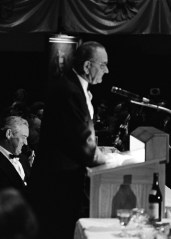
As I discuss in my latest book, Getting It Wrong, Johnson was not at the White House but in Austin, Texas, at a black-tie affair marking the 51st birthday of his longtime political ally, Governor John Connally (see photo, above).

At the time Cronkite was intoning “mired in stalemate,” Johnson wasn’t lamenting the loss of the anchorman’s support. He wasn’t wringing his hands or bemoaning that he had “lost Middle America.”

The president was making lighthearted comments about Connally’s age, saying:

“Today you are 51, John. That is the magic number that every man of politics prays for— a simple majority.”

As for Cronkite’s assessment being so powerful as to shift public opinion — that, too, is mistaken: Popular views about the war had begun shifting months before the “Cronkite Moment.”

By October 1967, 47 percent of Americans, a plurality, maintained that U.S. military presence in Vietnam was a mistake, according to Gallup surveys. The plurality climbed to 49 percent, according to a Gallup Poll completed the day of Cronkite’s program about Vietnam.

So not only that, but Cronkite’s “mired in stalemate” observation was scarcely  remarkable.

Or novel. Journalists had been using the term “stalemate” for months in commentaries, analyses, and news reports about the war.

For example, syndicated columnist James J. Kilpatrick wrote in August 1967:

“So long as the present ground rules obtain in Vietnam, this war will drag along its indecisive way. … [T]he condition is stalemate.”

Also in August 1967, the New York Times said in a news analysis that the war in Vietnam “is not going well.”

U.S. victory, the Times said, “is not close at hand. It may be beyond reach.”

The analysis was published on the front page, beneath the headline: “Vietnam: The Signs of Stalemate.”

Not only did Cronkite’s views of the war lag public opinion, they trailed those offered by rival news organizations.

What, then, accounts for the tenacity of the mythical “Cronkite Moment”?

It’s an accessible tale, easily told and readily understood. It has broad applicability, as the myth’s appearance at WHO TV and in the Oklahoma Gazette suggest.

And it’s unreservedly media-centric: In a period of declining audience share and declining perceived influence, it’s reassuring to media practitioners that there were better, more powerful times when the likes of Cronkite supposedly told truth to power — and supposedly altered policy as a result.

WJC

Recent and related:

Media myth distorts Chicago Tribune timeline of newspaper history

In Debunking, Error, Media myths, Newspapers, Washington Post, Watergate myth on November 20, 2012 at 9:24 am

The Chicago Tribune the other day published a timeline of American newspaper history over the past 50 years — a chronology tainted by the inclusion of a prominent media myth.

The Tribune declared “the daily paper remains vital to an informed citizenry” in presenting the timeline, which it said demonstrated “how newspapers expose — and occasionally commit — wrongdoing.”

The myth appears in the timeline entry for 1974, which says: “A corrupt U.S. president, Richard Nixon, is brought down by a newspaper, The Washington Post.”

Brought down by a newspaper.

Now, that may be the popular dominant narrative of the Watergate scandal — that the dogged reporting of Washington Post reporters Bob Woodward and Carl Bernstein exposed the corruption that forced Nixon’s resignation.

But it’s a mythical, media-centric interpretation, a trope that not even the Post embraces.

In fact, Woodward once dismissed such characterizations as “horseshit.” And for good reason.

As I discuss in a chapter in my 2010 book, Getting It Wrong, unraveling a scandal of the dimension and complexity of Watergate demanded the collective if not always coordinated efforts of special prosecutors, federal judges, both houses of Congress, the Supreme Court, as well as the Justice Department and the FBI.

Even then, as I note in Getting It Wrong, Nixon likely would have survived the scandal and served out his term had it not been for the audiotape recordings he secretly made of conversations in the Oval Office of the White House.

Only when compelled by the Supreme Court did Nixon surrender the telltale recordings, which captured him approving a plan to divert the FBI’s investigation into Watergate’s seminal crime, the break-in June 17, 1972, at the headquarters of the Democratic National Committee.

It is interesting to note that the Post in its Watergate reporting did not disclose the existence of the Watergate tapes, nor did the newspaper identify or unravel the coverup of Watergate-related crimes.

To assert that the Post brought down Nixon is, as I write in Getting It Wrong, “to abridge and misunderstand the scandal and to indulge in a particularly beguiling media-driven myth.”

What, then, accounts for the tenacity of this hoary media myth? Why does it persist, despite the evidence that can be arrayed against it?

A number of reasons offer themselves.

The Watergate myth, after all, offers a simplistic, easy-to-grasp interpretation of a scandal that was intimidating in its complexity: The web of misconduct that took down Nixon also landed nearly 20 of his top aides, associates, and cabinet officers in jail.

Media myths often spring from simplicity, from the desire for tidy and uncomplicated versions of history. Not only that, but the notion that the Post brought down Nixon fits neatly into a timeline.

A feel-good component buoys the Watergate myth, too: The myth affirms the notion that newspapers, beleaguered though they are, really can make a difference in American politics and in American democracy.

Which, itself, is something of a media myth.

WJC

Recent or related:

The subtlety of media myths: A ‘New Yorker’ brief and the napalm-attack myth

In Debunking, Error, Media myths, New Yorker, Photographs on November 19, 2012 at 6:53 pm

Media myths can emerge in blithe and subtle ways, as a brief item in the November 19 issue of the New Yorker testifies.

‘Napalm girl,’ 1972 (Nick Ut/AP)

The myth the New Yorker insinuates is especially pernicious: It suggests U.S. forces dropped the napalm that wounded and terrified a group of Vietnamese children — a moment captured by Associated Press photographer Nick Ut in one of the most memorable images of the Vietnam War.

In a brief retrospective review of Alfred Hitchcock’s 1963 film, The Birds, the New Yorker said a scene in that movie of “screaming schoolkids fleeing down a lonely road disturbingly presage[d] the iconic news image of Vietnamese children escaping from American napalm attacks.”

The reference to “iconic news image of Vietnamese children” running from “napalm attacks” points unmistakably to Ut’s Pulitzer Prize-winning photograph, which was taken June 8, 1972, not far from the village of Trang Bang, in what was then South Vietnam.

The centerpiece of Ut’s photograph shows a naked, 9-year-old girl screaming in pain and terror as she fled the attack.

The media myth associated with the image is that U.S. forces carried out the aerial napalm attack that terrorized and injured the children near Trang Bang.

But that interpretation — or, perhaps, the reflexive inclination to blame the American military — is in error: The napalm was dropped in a misdirected attack by the South Vietnamese Air Force, as news reports of the time made clear.

In the 40 years since, however, the erroneous interpretation has emerged not infrequently.

A notable example came six months ago, in an obituary published in the New York Times that referred to Ut’s photograph and said it depicted “the aftermath of one of the thousands of bombings in the countryside by American planes: a group of terror-stricken children fleeing the scene, a girl in the middle of the group screaming and naked, her clothes incinerated by burning napalm.”

For weeks, the Times resisted correcting its error about “American planes” having carried out the attack, torturing logic as it defended its phrasing.

In reply to my email pointing out the error, the correction expert on the Times obituary staff, Peter Keepnews, wrote:

“You are correct that the bombing in question was conducted by the South Vietnamese Air Force. However, the obituary referred only to ‘American planes,’ and there does not seem to be any doubt that this plane was American –- a Douglas A-1 Skyraider, to be precise.”

As if the plane’s manufacturer were of crucial importance to the napalm attack. Which it wasn’t. The Times clearly had meant that American forces were responsible. Which they weren’t.

Finally, in late August, the Times published what I called “a sort-of correction,” invoking Keepnews’ baffling logic in stating:

“While the planes that carried out that attack were ‘American planes’ in the sense that they were made in the United States, they were flown by the South Vietnamese Air Force, not by American forces.”

It was a begrudging, less-than-sincere acknowledgement of error.

Independently of my efforts, two senior former journalists for the Associated Press also had pressed the Times to correct the error about the napalm attack. They were Richard Pyle, a veteran AP correspondent who was the news agency’s Saigon bureau chief from 1970-73, and Hal Buell, a retired AP vice president who for years directed the agency’s photo service. (Pyle directed my attention to the New Yorker brief that alludes to the napalm-attack myth.)

In July, Pyle and Buell sent a joint letter by email to the Times, noting that the error, if left uncorrected, could solidify into wide popular acceptance.

Their fears were hardly unfounded — as the New Yorker’s movie brief suggests, in its blithe, almost casual invoking of the napalm-attack myth.

WJC

Many thanks to Instapundit
Glenn Reynolds for linking to this post.

Recent or related: