The best-known anonymous source of the Watergate scandal, a former senior FBI official code-named “Deep Throat,” would receive hero’s treatment in a planned biopic, the shooting for which reportedly is to begin in March.
The movie is to be called Felt, the name of the “Deep Throat” source, W. Mark Felt, who cut a checkered career in government service.
Early this month, the Hollywood press was abuzz about the planned Felt biopic. The show business daily, Variety, said the film would be “a spy thriller” in which Felt wages an “isolated and dangerous struggle against the White House.” Shooting the film is to begin in March, Variety said, and Liam Neeson and Diane Lane may fill lead roles.
Felt: Biopic worthy?
All of which prompts inevitable questions: Why is Mark Felt, who died in 2008, biopic worthy? Even if the movie never makes it to production, why should Felt be considered a hero?
He was no noble figure. Felt was convicted in 1980 of felony charges related to the warrantless break-ins, known in the FBI as “black bag jobs,” and fined $5,000. He was not sentenced to prison for the crimes.
The year after his conviction, Felt was granted an unconditional pardon by President Ronald Reagan.
In its obituary about the former FBI official, the Los Angeles Times recalled that tears welled in Felt’s eyes as he acknowledged on the witness stand having approved secret break-ins by FBI agents between May 1972 and May 1973 — “roughly the same time he was talking to Woodward about Watergate.”
Felt and co-defendant Edward S. Miller justified the warrantless entries on grounds of national security.
The prosecutor in the case, John W. Nields Jr., said at the trial that FBI agents who conducted the breakins Felt approved had entered residences in New York City and New Jersey, “dressed in old clothes or disguised as telephone repairmen,” according to a New York Times report about the trial.
The agents picked locks or paid cash to landlords to obtain keys, Nields said, and they “searched every room in the home, methodically looking through desks, closets, clothing and private papers for clues to the whereabouts of the Weathermen. With a camera that could be concealed in an attaché case, the agents photographed diaries, love letters, address books and other documents.”
Nields said Reagan’s pardon of Felt and Miller came as a surprise. “Nobody spoke to me about it,” the New York Timesquoted him as saying. “I would warrant that whoever is responsible for the pardons did not read the record of the trial and did not know the facts of the case.”
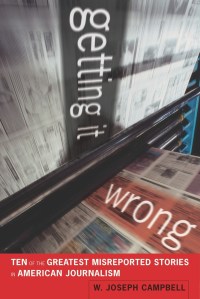
Felt was hardly acting altruistically in passing Watergate-related information to Woodward; their periodic meetings included six in a parking garage in suburban Virginia. I argued in my media-mythbusting book, Getting It Wrong, that the contributions of Woodward and his Post colleague Carl Bernstein in uncovering the Watergate scandal were modest at best and that their reporting in no way can be thought of as having forced President Richard Nixon to resign.
In leaking to Woodward, Felt sought to undercut the acting director, L. Patrick Gray III, and thereby enhance Felt’s chances of being named to the bureau’s top position, as Max Holland persuasively argued in his book, Leak: Why Mark Felt Became Deep Throat. The book makes clear Felt was motivated by ambition in the internal struggle at the FBI to replace J. Edgar Hoover, the long-serving director who died in May 1972.
Felt lost out, and retired in 1973.
Perhaps Felt the movie will collapse in its preliminary stages, which is the fate of many Hollywood projects. A biopic about Mark Felt is a bad idea in any case.
Jorge Ramos, the Univision anchorman, demonstrated recently that he is a self-important showboat in disrupting a news conference convened by presidential candidate Donald Trump.
Ramos also has demonstrated a taste for media myth.
In a commentary posted yesterday at the online site of AM, a newspaper in Mexico, Ramos invoked the myth that the Washington Post brought down the corrupt presidency of Richard Nixon in its reporting of the Watergate scandal.
He wrote, according to the Google translation from Spanish, that among “the best examples of journalism” was the Washington Post’s “forcing Nixon to resign” in 1974.
Ramos made a similar claim on the ABC News “This Week” program Sunday, stating:
“I think that, as a reporter, many times, you have to take a stand. … And the best examples of journalism that I have — Edward R. Murrow against McCarthy; Cronkite during the Vietnam War, or the Washington Post reporters forcing the resignation of Richard Nixon — that’s when reporters challenge those who are in power.”
Not even principals at the Post during the Watergate period embraced that notion.
For example, the Post’s publisher during Watergate, Katharine Graham, said 1997:
“Sometimes people accuse us of bringing down a president, which of course we didn’t do. The processes that caused [Nixon’s] resignation were constitutional.”
Bob Woodward, one of the Post’s lead Watergate reporters, concurred, albeit in earthier terms. He told an interviewer in 2006:
And Ben Bradlee, the Post’s executive editor during Watergate, said on “Meet the Press” in 1997 that “it must be remembered that Nixon got Nixon. The Post didn’t get Nixon.”
Bradlee was referring to the White House audio tapes which Nixon secretly made and which revealed the president’s guilty role in seeking to thwart the FBI’s investigation into the break-in of Democratic National Committee headquarters in Washington in June 1972. The break-in touched off the scandal — and the country’s gravest political crisis of the 20th century.
“How the Post and its reporters uncovered Watergate is deeply ingrained in American journalism as one of the field’s most important and self-reverential stories.”
But it is a simplistic and decidedly misleading interpretation, one that minimizes the more powerful and decisive forces that unraveled the scandal and ended Nixon’s corrupt presidency.
“To roll up a scandal of” the dimensions of Watergate, I wrote in Getting It Wrong, “required the collective if not always the coordinated forces of special prosecutors, federal judges, both houses of Congress, the Supreme Court, as well as the Justice Department and the FBI.
“Even then, Nixon likely would have served out his term if not for the audiotape recordings he secretly made of most conversations in the Oval Office of the White House.”
Media myths sometimes make appearances in odd and baffling ways. As non-sequiturs, even.
Take, for example, this pithy mischaracterization of Watergate, offered a number of years ago by the New York media critic, Michael Wolff:
Nixon’s tapes got Nixon
“The Washington Post didn’t like [Richard] Nixon — and because of that bad blood we got Watergate.”
As I pointed out soon after Wolff’s observation was posted at Newser.com, such an interpretation is absurd. Nixon and the Post may not have much liked each other, but bad blood had nothing to do with how the Watergate scandal unfolded from 1972-74.
Nixon’s resignation in August 1974 was the culmination not of the Post’s reporting but of the collective investigative efforts by a variety of agencies and entities, including bipartisan panels of both houses of Congress, special prosecutors, federal judges, the FBI, and, ultimately, the U.S. Supreme Court, which compelled Nixon’s release of the telltale evidence of Watergate — the secret tape recordings he had made of private conversations in the Oval Office.
The so-called “smoking gun tape” captured Nixon obstructing justice by approving a plan to divert the FBI investigation into the signal crime of Watergate — the break-in in June 1972 of the Democratic National Committee’s headquarters.
If not for evidence of criminality captured on the tapes, Nixon probably would have survived the scandal.
Which brings us to the Christian Science Monitor’sreview of Being Nixon: A Man Divided, a new biography by Evan Thomas. The review was posted online the other day and contained this erroneous and baffling statement:
“Even the Woodward and Bernstein stories in The Washington Post that toppled Nixon, bolstered by the subsequent best-selling book and Robert Redford movie (‘All the President’s Men’), are, for many current readers, as remote as D-Day or Pearl Harbor.”
The “toppled” passage is erroneous because the reporting by Bob Woodward and Carl Bernstein for the Postassuredly did not bring down Nixon. Woodward, in fact, has insisted on that point from time to time: For example, he told an interviewer in 2004:
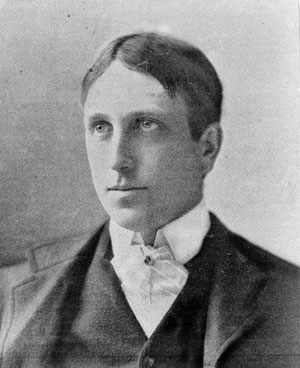
The “toppled” passage is baffling because Thomas makes no such claim in his book. Indeed, he seems careful not to indulge in media-driven myths. (As I noted at the time at Media MythAlert, Thomas’ 2010 book, The War Lovers, repeated one of American journalism’s best-known myths, the purported vow of William Randolph Hearst to “furnish the war” with Spain.)
According to the book’s index, “Woodward” is mentioned on six pages in Being Nixon; “Bernstein” appears on four pages. None of those pages contains the mythical claim that their reporting forced Nixon’s resignation. (“Topple” or “toppled” appear not at all in the book.)
So it is rather baffling that the Monitor’s review would state that claim so matter-of-factly. It’s not as if the book’s content led the reviewer astray.
Moreover, it is revealing and instructive to consider what were the most important Watergate articles by Woodward and Bernstein.
I noted in my media-mythbusting book, Getting It Wrong, that as “the scandal slowly unfolded in the summer and fall of 1972, Woodward and Bernstein progressively linked White House officials to a secret fund used to finance the burglary [at the Democratic headquarters]. The Post was the first news organization to establish a connection between the burglars and the White House, the first to demonstrate that campaign funds … were used to fund the break-in, the first to implicate the former attorney general John Mitchell in the scandal, and the first to link [senior Nixon aide H.R.] Haldeman to Watergate.”
But those articles, separately or collectively, were hardly enough to threaten Nixon’s presidency. They weren’t “stories … that toppled Nixon.”
In any case, Woodward and Bernstein’s reporting notably failed to disclose what were decisive elements of the scandal — the Nixon administration’s efforts to cover up the crimes of Watergate and the existence of the secret White House tapes.
It’s striking how prominent politicians, entertainers, and celebrities contribute to the recycling and, thus, the solidifying of media-driven myths, those hoary and exaggerated tales that often tell of magnificent deeds by journalists.
During his vice presidency, gaffe-prone Joe Biden went to Moscow and repeated the heroic-journalist trope of Watergate, about how, in his words, “it was a newspaper, not the FBI, or the Justice Department, it was a newspaper, the Washington Post that brought down a President for illegal actions.”
Cavett: Pushing the Cronkite myth
He was referring to the resignation of President Richard M. Nixon in August 1974.
The claim is absurd, but it has resonance across the political spectrum. Last year, for example, Rush Limbaugh, the voluble conservative talk-radio host, indulged in the heroic-journalist myth, declaring on his show last year that Bob Woodward’s Watergate reporting for the Washington Post “destroyed the Nixon presidency.”
Now comes Dick Cavett, the former television talk show host, who in a shrill and shallow commentary posted recently at the New York Times online site, recycles the media myth of the “Cronkite Moment” of 1968, when an analysis of the CBS News anchorman about the Vietnam War supposedly brought an epiphany to President Lyndon B. Johnson.
Cavett writes in what is a sneering and superficial assessment of the Vietnam conflict:
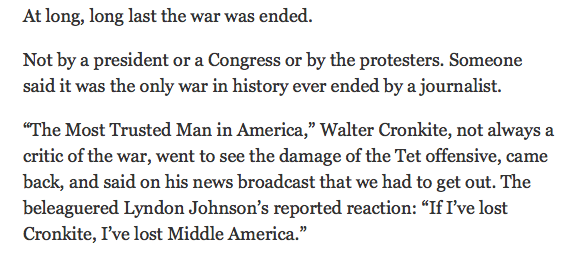
“At long, long last the war was ended.
“Not by a president or a Congress or by the protesters. Someone said it was the only war in history ever ended by a journalist.
“‘The Most Trusted Man in America,’ Walter Cronkite, not always a critic of the war, went to see the damage of the Tet offensive, came back, and said on his news broadcast that we had to get out. The beleaguered Lyndon Johnson’s reported reaction: ‘If I’ve lost Cronkite, I’ve lost Middle America.'”
From Cavett’s commentary
So let’s unpack that bundle of myth and exaggeration.
The reference to “only war in history ever ended by a journalist” sounds much like David Halberstam’s hyperbolic and unsourced claim in his book, The Powers That Be, that Cronkite’s analysis about Vietnam “was the first time in history a war had been declared over by an anchorman.”
Moreover, the notion that Cronkite reigned as America’s “most trusted man” rests more on advertising by CBS News, his employer, than on persuasive empirical evidence such as representative survey samples.
As for Cavett’s claim that Cronkite “said on his news broadcast that we had to get out” — well, that’s not what Cronkite said.
The claim refers to Cronkite’s special report about Vietnam, which CBS aired on February 27, 1968. At the close of the program, Cronkite said the U.S. war effort in Vietnam was “mired in stalemate” and that negotiations might prove to be a way out.
It was hardly a call for withdrawal.
Johnson with Connolly: Not watching Cronkite
It was in fact a tepid reiteration of the thinking prevalent in the news media at the time: The war was stalemated. The New York Times had been saying as much periodically for months.
Finally, there’s no compelling evidence that President Lyndon Johnson reacted to Cronkite’s assessment by declaring in a flash of insight:
“If I’ve lost Cronkite, I’ve lost Middle America.”
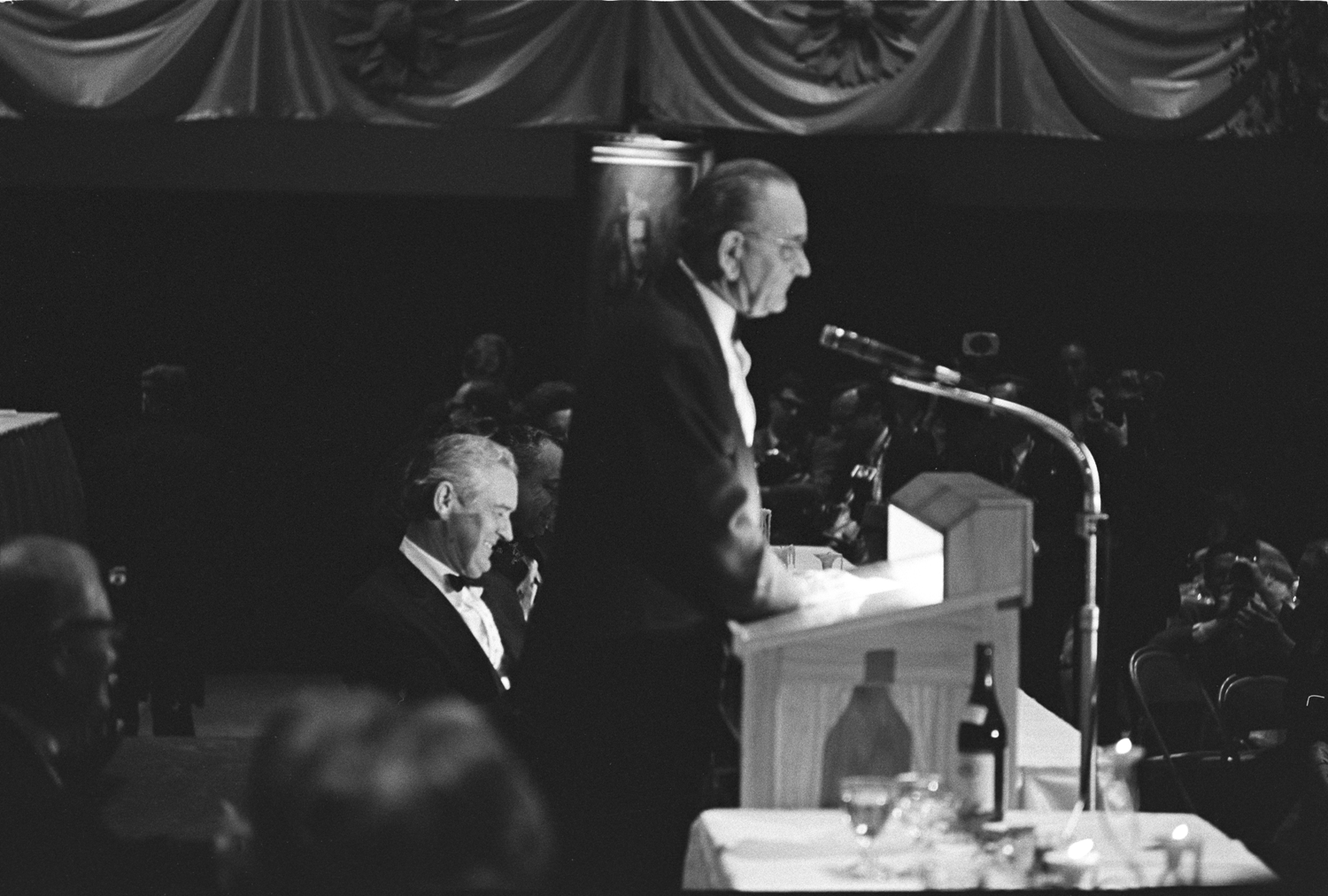
Johnson that night was on the campus of the University of Texas at Austin, attending a black-tie birthday party for his longtime political ally, Texas Governor John Connolly.
About the time Cronkite’s was intoning his tired “mired in stalemate” observation, the president was making light of Connolly’s age.
“Today, you are 51, John,” he said. “That is the magic number that every man of politics prays for—a simple majority.”
The Los Angeles Times, for example, declared that the Post’s Watergate reporting “ultimately brought down a president.”
The online version of the New York Times obituary said Bradlee, who was 93, had “presided over The Washington Post’s Watergate reporting that led to the fall of President Richard M. Nixon.”
The Guardian newspaper in London asserted that Bradlee “oversaw the reporting that brought down a president.”
Britain’s Economist magazine said the Post under Bradlee “toppled President Richard Nixon.”
And so it went.
But as I pointed out in discussing those erroneous characterizations, Bradlee, himself, had rejected the notion that the Post’sWatergate reporting brought down Nixon’s corrupt presidency. He said in 1997 that “it must be remembered that Nixon got Nixon. The Post didn’t get Nixon.” (Bradlee was referring to the White House tapes which Nixon secretly made and which revealed the president’s guilty role in covering up the crimes of Watergate, forcing him to quit in August 1974.)
His comment “that Nixon got Nixon” was in keeping with the tendency of senior figures at the Post to reject the simplistic notion that the newspaper’s reporting — especially that of Bob Woodward and Carl Bernstein — uncovered the crimes that led to Nixon’s downfall.
Indeed, it is revealing to consider what critical disclosures the Post missed in its Watergate reporting.
It failed to disclose the White House cover up of the Watergate crimes.
It likewise failed to reveal the existence of the White House tapes, which clearly revealed Nixon’s active role in seeking to block the FBI’s investigation of the seminal crime of Watergate — the break-in at the headquarters of the Democratic National Committee.
Moreover, the story that Woodward and Bernsteinstill say they are most proud of was in error on crucial details.
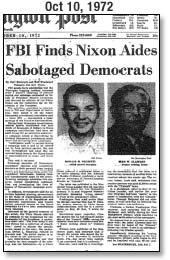
That story was published October 10, 1972, beneath the headline, “FBI Finds Nixon Aides Sabotaged Democrats.” It claimed — wrongly — that the FBI had determined some 50 political saboteurs had traveled the country, disrupting Democratic candidates who were seeking to run against Nixon. Internal FBI memoranda dismissed key elements of the Post’s story as conjecture or “absolutely false.”
As I noted in my media-mythbusting book Getting It Wrong, the contributions of Woodward and Bernstein to Watergate’s outcome at best “were modest, and certainly not decisive.”
Far more important in bringing about Nixon’s resignation were the collective efforts of special prosecutors, federal judges, both houses of Congress, the Supreme Court, as well as the Justice Department and the FBI.
The Post report cited otherwise unidentified “U.S. officials” and said that Lynch, a 19-year-old Army private, had fought fiercely in the ambush of the 507th Maintenance Company in Nasiriyah in southern Iraq on March 23, 2003.
Lynch in fact had not fired a shot. Nor was she shot and stabbed, as the Post had reported. She suffered severe injuries in the crash of a Humvee as it fled the attack. She was taken prisoner and hospitalized by the Iraqis but rescued by U.S. special forces on April 1, 2003.
Vernon Loeb, one of the Post reporters who wrote the hero-warrior story about Lynch — which was wrong in its most crucial details — made clear that the Pentagon had not been the newspaper’s source.
As I noted in Getting It Wrong, Loeb went on NPR’s Fresh Air program in December 2003 and flatly declared:
“Our sources for that story were not Pentagon sources.”
Loeb, who then covered the Pentagon for the Post and who now is managing editor at the Houston Chronicle, also told NPR that he “could never get anybody from the Pentagon to talk about” the Lynch case.
He also said: “I just didn’t see the Pentagon trying to create a hero where there was none.”
But none of that vital context was mentioned by Maddow in her commentary on June 3.
“If the heroics that the Pentagon made up about her didn’t really happen, and they didn’t, maybe the U.S. special forces who rescued her, maybe they shouldn’t have bothered,” Maddow said about Lynch. (Maddow’s commentary came amid the controversy stirred by the release of Bowe Bergdahl, an Army sergeant who apparently had walked away from his post in Afghanistan and was held captive by the Taliban for five years. The administration of President Barack Obama released five senior Taliban figures to gain Bergdahl’s freedom.)
When Maddow was called out for her erroneous claim about the Pentagon, she dodged a correction by cherry-picking — by referring to an obscure report in the Military Times on April 3, 2003, in which a U.S. military spokesman, Frank Thorp, was quoted as saying that Lynch “waged quite a battle prior to her capture.
“We do have very strong indications that Jessica Lynch was not captured very easily,” Thorp was quoted as saying.
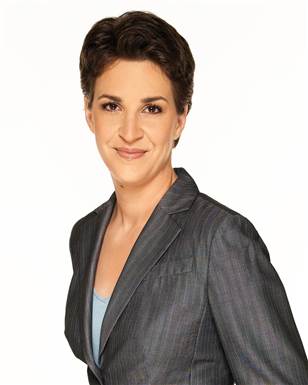
Maddow (NBC News)
Crowed Maddow: “That information straight from a military public affairs official was not true. It was made up. But it landed in press reports anyway.”
What Maddow neglected to mention was that Thorp was recapping for the Military Times what the Washington Post had already placed in the public domain.
Thorp, then a Navy captain, was assigned to U.S. Central Command headquarters in Doha, Qatar. He was following, not fabricating: He was, unwisely, restating elements of the Post’s sensational story about Lynch’s purported heroics, which Loeb and co-author Susan Schmidt had prepared in Washington.
I noted in discussing Maddow’s cherry-picking that it is impossible to address the hero-warrior tale about Lynch without considering the Post’s central role in publicizing the bogus narrative, which was picked up by news organizations around the world.
But Maddow ignored the agenda-setting character of the Post’s reporting about Lynch: It didn’t fit her narrative.
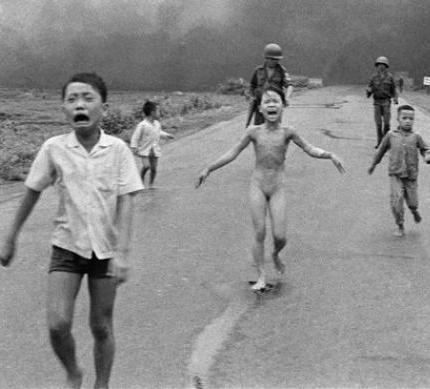
The photograph showed Vietnamese children terror-stricken by a misdirected napalm attack on their village by the South Vietnamese Air Force. At the center of image was a 9-year-old girl named Kim Phuc, shown screaming and naked as she fled.
The photograph, taken by Nick Ut of the Associated Press and formally titled “The Terror of War,” won a Pulitzer Prize in 1973.
In the years since, it also has become an artifact of exaggeration, as is evident in a tendency to ascribe powerful effects to the photograph, effects that it never had.
‘Napalm girl,’ 1972 (Nick Ut/AP)
In May, for example, the Guardian newspaper in London exaggerated the effects of the “napalm girl” image, asserting in an exhibit review that it had “galvani[z]ed” American “public opinion and expedited the end of the Vietnam war.”
In fact, “napalm girl” did neither.
U.S. public opinion had turned against the war in Vietnam well before June 1972. For example, nearly 60 percent of respondents to a Gallup poll conducted early in 1971 had said that the United States had made a mistake by sending troops to fight in Vietnam. (Gallup periodically has asked the question since 1965, when just 24 percent of respondents said it was a mistake to have sent troops to Vietnam. By August 1968, a majority of respondents said it had been a mistake.)
So Ut’s photo hardly can be said to have galvanized opinion against the war: Nor can it be said that the photo “expedited” the war’s end.
By June 1972, the war was essentially over for American forces in Vietnam. President Richard Nixon had announced in November 1971 that U.S. ground operations had ended in South Vietnam and by June 1972, nearly all U.S. combat units had been removed from the country.
No single photograph turned public opinion against the war in Vietnam; no single image “expedited” its end. The war’s confusing aims and uncertain policy objectives, its duration, and its toll in dead and wounded all were far more decisive to its outcome.
Had that been the case, had Nixon run for president saying he had “secret plan,” the country’s leading newspapers surely would have called attention to such a claim.
But they didn’t, as a search of a full-text database of leading U.S. newspapers makes clear. (The newspapers included the New York Times, Washington Post, Los Angeles Times, Baltimore Sun, Wall Street Journal, and Chicago Tribune.) Searching for “Nixon” and “secret plan” returned no articles from January 1967 to January 1969 that quoted Nixon as touting or promising or describing a “secret plan” for Vietnam.
Still, the old chestnut still circulates, usually invoked as supposed evidence of Nixon’s guile, shiftiness, and venality.
Secret plan? Who me?
In September, for example, a columnist for the Washington Examiner summoned the myth in seeking historical context to discuss President Barack Obama’s air war against Islamic militants in Iraq and Syria.
“Obama wasn’t the first president to promise peace and deliver war,” the columnist, Timothy P. Carney, wrote. “Woodrow Wilson ran for reelection on keeping America out of the Great War. Nixon promised a secret plan to exit Vietnam quickly.”
As I noted at the time, “Missing from Carney’s discussion were details about when Nixon made such a promise, and what the ‘secret plan’ entailed. Those elements are missing because Nixon never promised a ‘secret plan’ on Vietnam.”
The derivation of the hoary myth can be traced to the presidential primary election campaign of 1968 and a speech in New Hampshire. There, in early March 1968, Nixon pledged that “new leadership” in Washington — a Nixon administration, in other words — would “end the war” in Vietnam.
In reporting on the speech, the wire service United Press International said Nixon “did not spell out how” he would “end the war.” Nixon may have been vague in those remarks about Vietnam. But he made no claim about a “secret plan.”
And he was asked about having a secret plan, according to an article published March 28, 1968, in the Los Angeles Times. Nixon replied that he had “no gimmicks or secret plans” for Vietnam.
He also said then: “If I had any way to end the war, I would pass it on to President [Lyndon] Johnson.” Nixon’s comments were made just a few days before Johnson announced he would not seek reelection.
The claim is absurd, embraced by few if any serious historians of the era — and by no recent biographer of Hearst.
Nonetheless, the myth was offered up as fact in a commentary in Politico Magazine in June.
The commentary pointedly criticized the scholar Robert Kagan for having “sounded his favorite, and the neocons’, favorite theme” in a 2006 book, Dangerous Nation.
“He depicted America as uniquely virtuous, pursuing idealistic aims, while presenting all other great powers as fighting for venal and self-interested motives. So assiduous was Kagan in his fanciful interpretation of American actions,” the Politico commentary said, “that even the Spanish-American War, seen by most historians as the product of William Randolph Hearst’s yellow press and the U.S. desire to expand its influence on behalf of economic imperialism, becomes something else entirely — a bright and shining crusade for freedom….”
But in characterizing the war as “the product” of Hearst’s yellow press, Politico erred.
As I wrote in my 2001 book, Yellow Journalism: Puncturing the Myths, Defining the Legacies, the newspapers of Hearst and his rival, Joseph Pulitzer, “did not force — it could not have forced— the United States into hostilities with Spain over Cuba in 1898. The conflict was, rather, the result of a convergence of forces far beyond the control or direct influence of even the most aggressive of the yellow newspapers, William Randolph Hearst’s New York Journal.”
Claims that the yellow press brought on the war, I noted, “are exceedingly media-centric, often rest on the selective use of evidence, and tend to ignore more relevant and immediate factors that give rise to armed conflict.”
In 1898, those factors centered around a diplomatic impasse between the United States and Spain over Spanish rule of Cuba, which since early 1895 had been the scene of an islandwide rebellion.
In a failed attempt to put down the uprising, Spanish authorities sent as many as 200,000 troops to the island and imposed a policy called “reconcentration,” which forcibly removed thousands of Cubans — mostly old men, women, and children — into garrison towns where they could neither support nor offer supplies to the Cuban rebels.
Spain’s “reconcentration” policy gave rise to malnutrition and disease: Unknown tens of thousands of Cuban non-combatants died from illness and starvation.
The humanitarian nightmare in Cuba “inevitably stirred outrage and condemnation in the United States,” I wrote in Yellow Journalism. The desperate conditions were in 1897 and early 1898 a frequent topic of reporting in the American press, including but by no means limited to the newspapers of Hearst and Pulitzer.
The yellow press reported on — but certainly did not create — the terrible effects of Spain’s “reconcentration” policy.
In the end, the humanitarian crisis on Cuba, and Spain’s inability to resolve the crisis, weighed decisively in the U.S. decision to go to war in 1898. It was not the content of the yellow press — and not “economic imperialism,” as Politico put it — that pushed America into conflict with Spain.
Media Myth Alert today marks its fifth anniversary — an occasion fitting to revisit the top posts since the blog went live on October 31, 2009, with the objectives of calling out the appearance and publication of media myths and helping to promote my 2010 mythbusting book, Getting It Wrong.
Here are the top five of the more than 640 posts at Media Myth Alert. (A separate post today will revisit five other top items posted at Media Myth Alert.)
The top posts all were about prominent topics, all received a fair amount of attention in the blogosphere and beyond, and all were represented disclosures found only at Media Myth Alert.
Those claims were unattributed in the book — and vigorously denied by Wilkinson, who sought a correction.
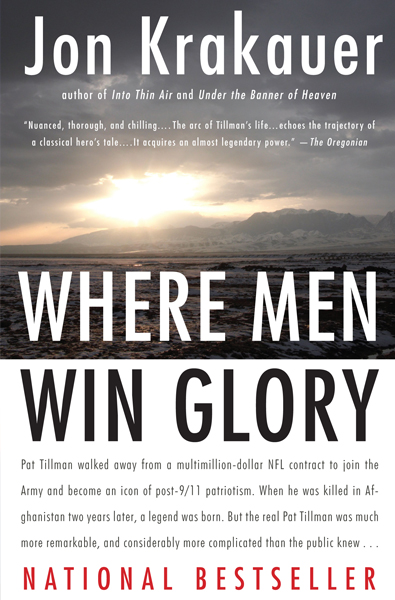
When it came, the correction was inserted unobtrusively in a new printing of the paperback edition of Krakauer’s book, Where Men Win Glory.
It read:
“Earlier editions of this book stated that it was Jim Wilkinson ‘who arranged to give the Washington Post exclusive access’ to this leaked intelligence [about Jessica Lynch]. This is incorrect. Wilkinson had nothing to do with the leak.”
The false narrative also has deflected attention from the soldier whose heroics apparently were misattributed to Lynch. He was Sgt. Donald Walters, a cook in Lynch’s unit, which was ambushed in Nasiriyah in southern Iraq in the first days of the Iraq War.
Walters was taken prisoner by Iraqi irregulars, and shot and killed.
The photograph was taken by Nick Ut of the Associated Press on June 8, 1972, and showed terror-stricken Vietnamese children running from an errant aerial napalm attack. The central figure of the image was a naked, 9-year-old girl screaming from her burns.
So powerful was the photograph that it is sometimes said — erroneously — that it hastened an end to the war. Another myth is that the napalm was dropped by U.S. aircraft, a version repeated by the New York Times in May 2012, in an obituary of an Associated Press photo editor, Horst Faas.
The Times’ obituary claimed that the “napalm girl” photograph showed “the aftermath of one of the thousands of bombings in the countryside by American planes.”
That passage suggested U.S. forces were responsible for the napalm attack, and I pointed this out in an email to the Times. I noted that the bombing was a misdirected attack by the South Vietnamese Air Force, as news reports at the time made clear.
An editor for the Times, Peter Keepnews, replied, in what clearly was a contorted attempt to avoid publishing a correction:
“You are correct that the bombing in question was conducted by the South Vietnamese Air Force. However, the obituary referred only to ‘American planes,’ and there does not seem to be any doubt that this plane was American –- a Douglas A-1 Skyraider, to be precise.”
Of course the aircraft’s manufacturer was not at all relevant as to who carried out the attack.
The Times resisted for weeks before publishing an obscure sort-of correction that embraced Keepnews’ tortured reasoning and stated:
“While the planes that carried out that attack were ‘American planes’ in the sense that they were made in the United States, they were flown by the South Vietnamese Air Force, not by American forces.”
It was, I noted, a muddled and begrudging acknowledgement of error — hardly was in keeping with the declaration by the newspaper’s then-executive editor, Bill Keller, who had asserted in 2011 that “when we get it wrong, we correct ourselves as quickly and forthrightly as possible.”
In 2013, at the 75th anniversary of Welles’ program, PBS revisited The War of the Worlds in a much-anticipated “American Experience” documentary that turned out to be quite a disappointment. PBS managed not only to make The War of the Worlds seem snoozy and tedious; it missed the opportunity to revisit the well-known but much-misunderstood radio program in fresh and revealing ways.
“PBS could have confronted head-on the question of whether the radio show … really did provoke hysteria and mass panic in the United States,” I wrote.
Instead, I added, “The documentary’s makers settled for a turgid program that was far less educational, informative, and inspiring than it could have been.”
The PBS program failed to address the supposed effects of Welles’ radio dramatization in any meaningful way.
And it failed to consider the growing body of scholarship which has impugned the conventional wisdom and has found that The War of the Worlds program sowed neither chaos nor widespread alarm. Instead, listeners in overwhelming numbers recognized the program for what it was: A clever radio show that aired in its scheduled Sunday time slot and featured the not-unfamiliar voice of Welles, the program’s 23-year-old star.
My critique was endorsed by the PBS ombudsman, Michael Getler, who wrote in a column after the documentary was broadcast:
“I find myself in agreement with the judgment of W. Joseph Campbell, the well-known critic and author of ‘Getting It Wrong: Ten of the Greatest Misreported Stories in American Journalism’ who headlined his comment: ‘PBS squanders opportunity to offer “content that educates” in “War of the Worlds” doc.’”
It’s an easy-to-remember tale that cuts through the considerable complexity of Watergate and, as such, has become the dominant narrative of the scandal.
But it’s a history-lite version of Watergate, a media-centric version that the Post itself has mostly eschewed and dismissed over the years. (Woodward once put it this way: “To say that the press brought down Nixon, that’s horseshit.”)
Marker with the error
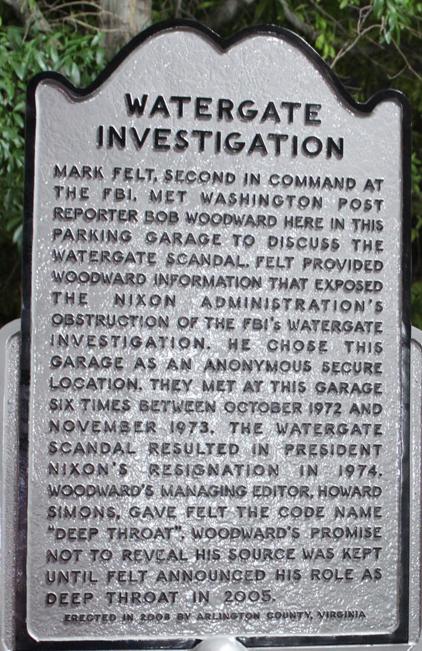
A measure of how engrained Watergate’s dominant narrative has become can be seen in the historical marker that went up in August 2011 outside the parking garage in Arlington, Virginia, where Woodward conferred occasionally in 1972 and 1973 with his “Deep Throat” source.
The marker, as I pointed out, errs in describing the information Woodward received from the “Deep Throat” source, who in 2005 revealed himself as W. Mark Felt, formerly the FBI’s second in command.
The marker says:
“Felt provided Woodward information that exposed the Nixon administration’s obstruction of the FBI’s Watergate investigation.”
That’s not so.
Such obstruction-of-justice evidence, had “Deep Throat” offered it to Woodward, would have been so damaging and so explosive that it surely would have forced Richard Nixon to resign the presidency well before he did.
But Felt didn’t have that sort of information — or (less likely) did not share it with Woodward.
The “Deep Throat” garage is to be razed to permit the construction of two commercial and residential towers, the Post reported in June 2014. Interestingly, the Post’s article about the planned demolition repeated nearly verbatim the key portion of the marker’s description, stating:
“Felt … provided Woodward with information that exposed the Nixon administration’s obstruction of the FBI’s Watergate investigation.”
Which is still wrong, even if printed in the newspaper.
■ Suspect Murrow quote pulled at Murrow school (posted February 17, 2011): The online welcome page of the dean of the Edward R. Murrow College of Communication at Washington State University used to feature a quotation attributed to Murrow — a quotation that was only half-true.
Soon after I asked the dean about the provenance of the suspicious quotation, it was taken down.
The quotation read:
“We must not confuse dissent with disloyalty. When the loyal opposition dies, I think the soul of America dies with it.”
The second sentence of the quote — “When the loyal opposition dies, I think the soul of America dies with it” — is apocryphal.
In mid-February 2011, I noted that the full quotation — accompanied by a facsimile of Murrow’s signature — was posted at the welcome page of Dean Lawrence Pintak of Murrow College at Washington State, Murrow’s alma mater.
I asked the dean what knew about the quote’s first appearance, noting that I had consulted, among other sources, a database of historical newspapers which contained no articles quoting the “loyal opposition” passage.
Pintak, who said he believed the Web page containing the suspect quote had been developed before his arrival at Washington State in 2009, referred my inquiry to an instructor on his faculty who, a few hours later, sent an email to the dean and me, stating:
“While [the ‘loyal opposition’ quotation] seems to reflect the Murrow spirit, the lack of evidence that he phrased it that way is indeed suspicious.”
He added: “I feel the evidence says no, Murrow did not say this.”
By day’s end, the suspect quote had been pulled from the welcome page. Just the authentic portion — “We must not confuse dissent with disloyalty” — remained posted there.
The bogus Murrow quote about “the loyal opposition” has popped up before.
For example, in a speech in 2006 about Iraq, Harry Reid, now the U.S. Senate majority leader, invoked the passage — and claimed Murrow was its author.
The death of Ben Bradlee, the celebrated former executive editor of the Washington Post, touched off a wave of tributes that erroneously cited the newspaper’s central role in the Watergate scandal, which culminated 40 years ago with the resignation of President Richard Nixon.
Bradlee, himself, had rejected the simplistic and mythical notion that the Post’sWatergate reporting brought down Nixon’s corrupt presidency, saying in 1997 that “it must be remembered that Nixon got Nixon. The Post didn’t get Nixon.” He was referring to the White House tapes which Nixon secretly made and which revealed the president’s guilty role in covering up the crimes of Watergate, forcing him to quit in August 1974.
But as news spread yesterday that Bradlee had died at age 93, adulatory tributes poured in, many of them blithely invoking the media myth of Watergate.
USA Today, for example, said Bradlee “led” the Post’s “Watergate coverage that brought down the Nixon administration.”
The Los Angeles Timesdeclared that the Post’s Watergate reporting “ultimately brought down a president.”
The online version of the New York Times obituary about Bradlee stated that he “presided over The Washington Post’s Watergate reporting that led to the fall of President Richard M. Nixon.” (The print edition of the Times is less sweeping if not more accurate, saying Bradlee “presided over The Washington Post’s exposure of the Watergate scandal that led to the fall of President Richard M. Nixon.”)
The Guardian newspaper in London asserted that Bradlee “oversaw the reporting that brought down a president.”
Similarly, the German news service Deutsche Wellesaid “Bradlee oversaw the journalistic investigation that brought down US president Richard Nixon.” (The new service also claimed the Post’s reporting “led to the impeachment and resignation of Nixon”: Not only was the Post’s reporting a marginal factor in Nixon’s resignation, which he submitted before he could be impeached.)
And so it went.
Even the Post, which over the years had largely refrained from embracing the Watergate myth, went all in, saying on its front page today that Watergate was “a political scandal touched off by the Post’s reporting.”
The scandal, in fact, was touched off by a burglary in June 1972 at Democratic National Committee headquarters, and investigative authorities quickly tied the crime to Nixon’s reelection committee and to White House operatives. Watergate hardly was “touched off by the Post’s reporting”; nor did the Post contribute significantly to the scandal’s unraveling.
Indeed, as I pointed out in my 2010 media-mythbusting book, Getting It Wrong, the Post’s reporting failed to disclose the White House cover up of the Watergate crimes. It also failed to reveal the existence of Nixon’s White House tapes, which were crucial to the scandal’s outcome.
Their existence was disclosed in July 1973, during hearings of the Senate Select Committee on Watergate.
In their book All the President’s Men, the Post’s lead Watergate reporters, Bob Woodward and Carl Bernstein, said they received a tip about the secret White House taping system a few days before its existence was made public.
But according to the book, Bradlee suggested they not expend much energy pursuing the tip. They didn’t, and thus missed reporting a decisive breakthrough in Watergate.
The Post went hagiographic in its editorial page tribute to Bradlee, describing him as “the architect and builder of the modern Washington Post. His conviction that even the most powerful should be held to a standard of truth-telling inspired journalists well beyond The Post. His exuberance at work and in life served as a model well beyond journalism.”
The editorial continued, saying, “There was nothing like working for him …. His newsroom crackled with the energy of a modern startup. A certain ‘creative tension’ was the reality, a competition among reporters and editors to win his approval. Mr. Bradlee loved the chase and the thrill of discovery.”
And so on.
Surely it is not churlish to point out that the editorial failed to mention Bradlee’s greatest failure as editor — the fraud of “Jimmy’s World,” a fabricated story about an 8-year-old heroin addict that the Post published in 1980. The article was so compelling that it won the Pulitzer Prize in 1981.
But soon after the award was announced, it was revealed that Janet Cooke, the author of “Jimmy’s World,” had falsified key elements of the biography submitted to the Pulitzer board, claiming among other credentials a degree from Vassar and a command of six languages.
The exposure of those lies forced the Post editors to confront Cooke about “Jimmy’s World,” and she soon confessed to having made it all up.
The extensive back story to “Jimmy’s World” was reported by William Green, then the Post’s ombudsman, in 1981; his writeup is available here and, 33 years on, it still makes absorbing reading.
Conservative commentators sometimes invoke the narrative in bashing the news media as agenda-driven and untrustworthy. Left-wing outlets are known to embrace the meme as an ostensible example of crusading journalism that made a difference.
Both impulses were in evidence this week.
Rush Limbaugh, the conservative talk radio host, referred to Woodward and Bernstein during his show yesterday, saying they exemplified a tendency in American journalism to lust after career-shattering exposés.
“If you take somebody out,” Limbaugh said, according to a transcript of his program, “if you expose a fraud or a cheat — or if you just take out somebody that you don’t like who has a lot of power — if you as a journalist are instrumental in doing that, then you are considered worthy of advancement in that industry, and it’s best exemplified by Watergate. Woodward and Bernstein and getting Nixon, forcing Nixon to resign.”
Earlier in the week and across the spectrum, the New York Times profiled the Post’snew publisher, Frederick J. Ryan Jr., and took the occasion to recall one his predecessors, Katharine Graham. She was, the Timesarticle noted, the publisher during the Watergate period who “famously stood up to the White House and helped bring down a president.”
Left unsaid by the talk show host and by the Times was just how the work of Woodward, Bernstein, and Graham led to Nixon’s ouster in the Watergate scandal, which broke in June 1972 with a burglary at the headquarters of the Democratic National Committee.
Truth is, their work didn’t lead to Nixon’s resignation in August 1974. Or much contribute to his fall.
As Ben Bradlee, the Post’s Watergate-era executive editor, once put it in referring to the secret White House tapes that demonstrated the president’s culpability in attempting to cover up the burglary:
“[I]t must be remembered that Nixon got Nixon. The Post didn’t get Nixon.”
Or as Katharine Graham herself said at the 25th anniversary of the Watergate breakin:
“Sometimes people accuse us of bringing down a president, which of course we didn’t do. The processes that caused [Nixon’s] resignation were constitutional.”
Graham was quite right: Unraveling a scandal of the density and complexity of Watergate required, as I wrote in media mythbusting book, Getting It Wrong, subpoena power and “the collective if not always the coordinated forces of special prosecutors, federal judges, both houses of Congress, the Supreme Court, as well as the Justice Department and the FBI.”
And even then, despite the forces arrayed against him, Nixon probably would have survived Watergate and served out his term as president if not for the White House tapes — the disclosure of which was made not by Woodward and Bernstein but by Alexander Butterfield, a former Nixon aide, during questioning before a Senate select committee investigating the scandal.
The heroic-journalist trope is a simplified version of the scandal that cuts through complexities and intricacies to make Watergate accessible. It offers a narrative that’s appealing, memorable, and easy to grasp.
News that Jeff Bezos is ousting the publisher of the Washington Post about a year after he purchased the newspaper prompted recollections of the Post’s better days — recollections both exaggerated and erroneous.
Marginal on Watergate
The recollections centered around the newspaper’s reporting of the Watergate scandal, which culminated 40 years ago last month in the resignation of President Richard M. Nixon.
It was the Post’s onetime archrival, the New York Times, that indulged today in the most excessive overstatement.
In its initial online report about the departure of Katharine Weymouth as publisher, the Times stated that “she was the last major link to the Graham family, which had become a Washington institution and had presided over The Post’s most glorious era — the decades surrounding the Watergate scandal, in which it was instrumental in forcing the resignation of President Richard M. Nixon.”
While Weymouth’s departure, effective October 1, is intriguing — it means that Bezos, the multibillionaire founder and CEO of Amazon.com, is imposing his will on what has become in recent years a thin and faded newspaper — Media Myth Alert is most interested in the mischaracterization of the Post’s role in Watergate.
The newspaper assuredly was not, as the Times claimed, “instrumental in forcing the resignation of President Richard M. Nixon.”
The Post’sinvestigative reporting on Watergate linked Nixon’s reelection committee to the seminal crime of Watergate, the foiled burglary in June 1972 at the headquarters of the Democratic National Committee. The Post also implicated the likes of John Mitchell, the former attorney general who was Nixon’s campaign manager, in the scandal.
Such reports helped the Post win a Pulitzer Prize in 1973. But they were hardly enough to threaten Nixon’s presidency.
Indeed, as I discussed in my media-mythbusting book, Getting It Wrong, the Post’s contributions in reporting on the unfolding scandal in 1972-73 were “modest, and certainly not decisive.”
Unseating Nixon, I further noted in Getting It Wrong, “required the collective if not always the coordinated forces of special prosecutors, federal judges, both houses of Congress, the Supreme Court, as well as the Justice Department and the FBI.”
And even then, Nixon likely would have survived the scandal were it not for the audiotapes he surreptitiously made of many conversations in the Oval Office. Only when compelled by the U.S. Supreme Court did Nixon surrender the tapes that clearly depicted him as taking an active role in plotting the coverup of the Watergate breakin.
Interestingly, it was not reporters for the Post but investigators for a select committee of the U.S. Senate who learned of and forced the disclosure about the existence of the tapes. It was, in other words, a pivotal Watergate story that the Post missed.
The Post lagged on other decisive Watergate stories, notably the existence of the White House coverup of the breakin.
And the story that Bob Woodward and Carl Bernstein, the Post’s lead Watergate reporters, still say they are most proud of was in error on crucial details.
Washington Post, October 10, 1972
That story was published October 10, 1972, beneath the headline, “FBI Finds Nixon Aides Sabotaged Democrats.” It claimed — erroneously — that the FBI had determined some 50 political saboteurs had traveled the country, disrupting Democratic candidates mounting challenges to Nixon. Internal FBI memoranda disputed key elements of the Post’s story as conjecture or “absolutely false.”
So “modest at best” aptly characterizes the Post’s contributions in unraveling Watergate.
The departure of Weymouth, and her replacement by Frederick J. Ryan Jr., once an official in the administration of President Ronald Reagan, was accompanied by another interesting sidebar: That of Bezos’ refusal to discuss the move with a reporter for the Post.
“Bezos kept up a dubious practice of refusing comment to the journalists he pays when it was announced … that he had replaced the Post’s publisher, Katharine Weymouth, with former Politico executive and Reagan administration official Fred Ryan. … Anybody expecting openness and transparency from Bezos, however, would be disappointed, as the Post’s own story made clear.”
The Post’s article said the statement by Bezos announcing the change in publishers “‘did not give reasons for the change or its timing. Bezos declined to comment through a spokesman.”
I plan to call attention to prominent media myths of Watergate during a panel discussion in Montreal this afternoon, three days shy of the 40th anniversary of President Richard Nixon’s resignation in America’s gravest political scandal.
The venue is the annual conference of AEJMC, the Association for Education in Journalism and Mass Communication, and other panelists include Max Holland, author of the well-received Watergate book, Leak: Why Mark Felt Became Deep Throat, and my colleague at American University, John C. Watson, author of Journalism Ethics by Court Decree.
I intend to discuss the dominant narrative of Watergate — the mythical notion that the dogged reporting by Bob Woodward and Carl Bernstein of the Washington Post exposed the Watergate crimes of Nixon and forced his resignation.
The trope is endlessly appealing to journalists and has become the most familiar storyline of Watergate. It is, after all, a handy proxy for grasping the essence of Watergate — Nixon resigned because of criminal misconduct — while avoiding the scandal’s mind-numbing complexity.
The many layers of Watergate — the webs of lies, the deceit, and the criminality that characterized the Nixon White House; the multiple lines of investigation that slowly unwound the scandal, and the drama of a constitutional crisis — are not easily understood or readily recalled these days. The scandal that unfolded from 1972 to 1974 has become so distant that few Americans can accurately describe what took place.
As I plan to point out today, the disclosures by Woodward and Bernstein about the unfolding Watergate scandal in 1972 weren’t nearly enough to force the president’s resignation. And the decisive revelations of Watergate — among them the existence of Nixon’s White House taping system — weren’t the work of the Washington Post.
Indeed, as I pointed out in my 2010 media-mythbusting book, Getting It Wrong: To roll up a scandal of the dimensions of Watergate “required the collective if not always the coordinated forces of special prosecutors, federal judges, both houses of Congress, the Supreme Court, as well as the Justice Department and the FBI.”
Even then, Nixon likely would have served out his term in office if not for the Watergate tapes, which clearly showed him approving a cover-up of the seminal crime of Watergate — the break-in of Democratic National Committee headquarters in June 1972.
The heroic-journalist myth — and the celebrity cult of Watergate — were solidified by the film adaptation of All the President‘s Men, Woodward and Bernstein’s book about their Watergate reporting. I note in Getting It Wrong that the cinematic version of All the President’s Men “allows no other interpretation: It was the work Woodward and Bernstein that set in motion far-reaching effects that brought about the first-ever resignation of a U.S. president.”
The movie in fact ignores and even denigrates the work of other agencies and actors in the many-tenacled investigations of Watergate.
But why, some observers might ask, do Watergate, and Woodward and Bernstein, still matter after 40 years? Why does anyone much care?
They care because Woodward and Bernstein are living reminders of the unmasking of America’s greatest political scandal — one that sent to jail nearly 20 men associated with Nixon’s presidency or his 1972 reelection campaign.
Woodward and Bernstein are septuagenarians but they speak eagerly about their salad days, especially on occasions presented by the anniversaries of Watergate. The Post brought them together last week for what turned out to be a surprisingly boring look back at Watergate. That tedious program notwithstanding, their saga remains an appealing parable — that dogged and imaginative reporting can make a difference, can bring about dramatic change.










 Media Myth Alert