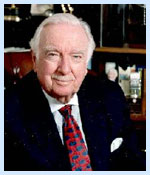
W. Joseph Campbell

Posts Tagged ‘Vietnam War’

The ‘Cronkite Moment’ was fictive

In Cronkite Moment, Debunking, Media myths on July 8, 2011 at 8:01 am

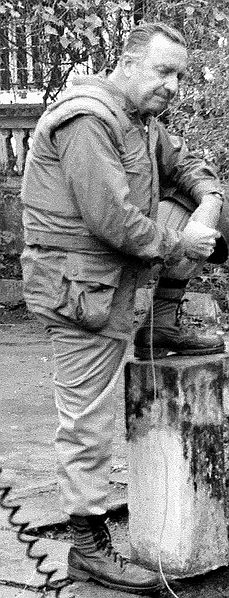
Cronkite in Vietnam

The mythical “Cronkite Moment” of 1968 offers supposedly timeless and irresistible lessons for journalists about the importance of telling truth to power and about the media’s potential to wield decisive influence.

Trouble is, the “Cronkite Moment” is fictive: It had little of the impact so often ascribed to it — impact of the kind described yesterday by Paul Fanlund, editor of the Capital Times in Madison, Wisconsin.

He wrote at a Capital Times blog:

“One has to be of a certain age, or a student of history, to know Walter Cronkite’s impact on Vietnam. In 1968, the famed broadcaster, who had been privately pro-war, pronounced on air that the war was no longer winnable, prompting President Lyndon Johnson to remark, ‘If I’ve lost Cronkite, I’ve lost the country.'”

Unpacking that paragraph reveals that it’s exaggerated in three ways.

One is that Cronkite (as he himself claimed for many years) had little if any “impact” on the war in Vietnam.

Two, Cronkite did not say on air that “the war was no longer winnable.” He said, in a special report broadcast on February 27, 1968, that the U.S. military was “mired in stalemate” in Vietnam and that negotiations might offer America a way out.

Three, Cronkite’s on-air assessment about Vietnam did not prompt President Lyndon Johnson to declare, “If I’ve lost Cronkite, I’ve lost the country.” Or anything akin to such a remark.

As I discuss in my media myth-busting book, Getting It Wrong, Johnson did not see the Cronkite program when it aired. And there is no evidence the president watched the show later, on videotape.

Moreover, Johnson was not in front of a television set when the Cronkite report about Vietnam was broadcast.

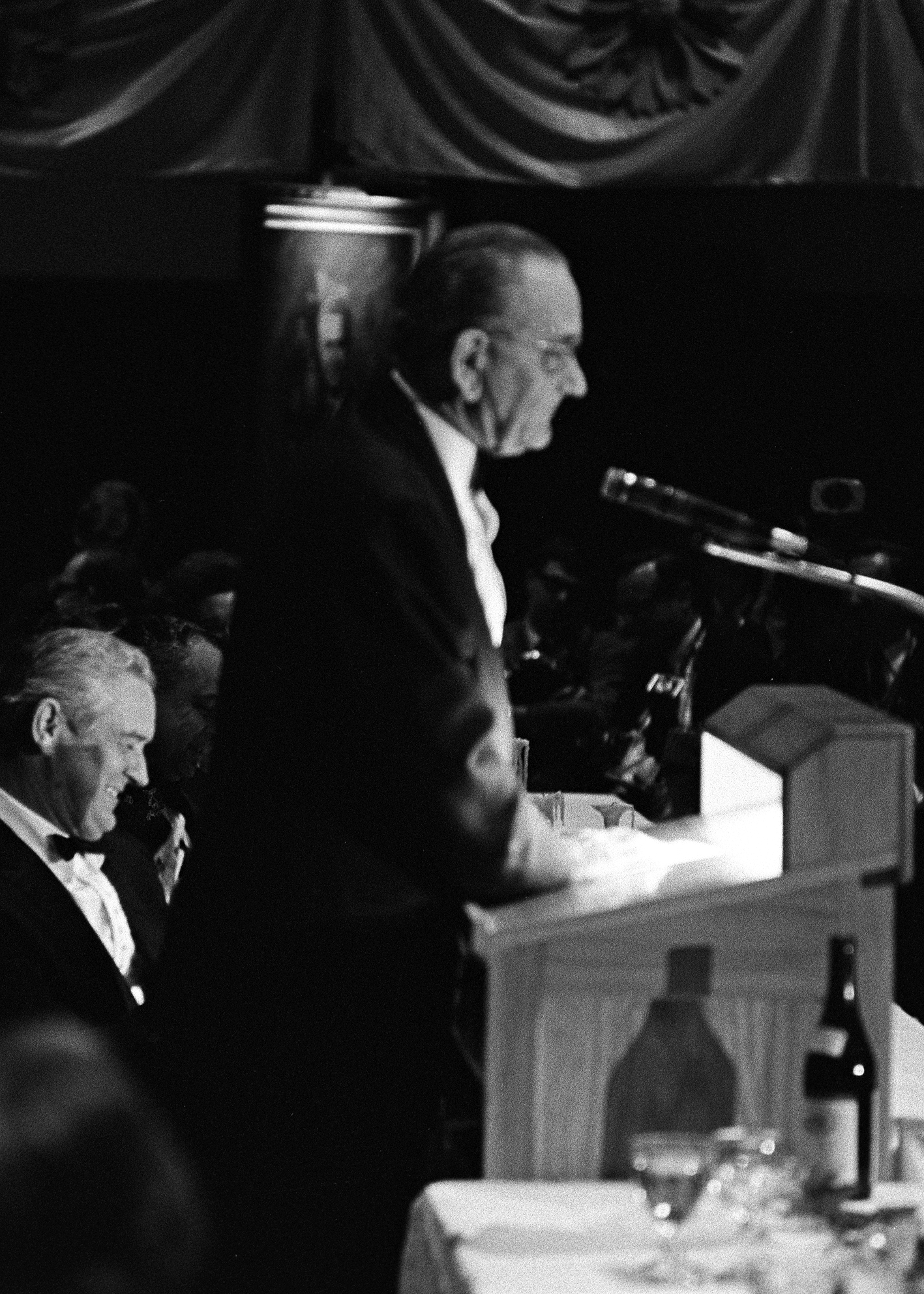
He was on the campus of the University of Texas at Austin, offering light-hearted remarks at the 51st birthday party of Governor John Connally, a long-time political ally.

About the time Cronkite was intoning his “mired in stalemate” assessment, Johnson wasn’t bemoaning his failed Vietnam policy; he wasn’t bemoaning the loss of Cronkite’s support.

He was jesting about Connally’s age.

“Today,” Johnson said, “you are 51, John. That is the magic number that every man of politics prays for—a simple majority.”

Even if he had watched the Cronkite report, it’s unlikely Johnson would have been much moved by the “mired in stalemate” assessment. It was hardly an original observation.

Leading U.S. news outlets such as the New York Times had invoked “stalemate” periodically in the months before the Cronkite program.

For example, in a news analysis published July 4, 1967, the Times said of the war effort:

“Many officers believe that despite the commitment of 466,000 United States troops now in South Vietnam … the military situation there has developed into a virtual stalemate.”

In a report from Saigon that was published August 7, 1967, the Times noted:

“‘Stalemate’ is a fighting word in Washington. President Johnson rejects it as a description of the situation in Vietnam. But it is the word used by almost all Americans here, except the top officials, to characterize what is happening. They use the word for many reasons ….”

By the end of February 1968, “stalemate” had been often used, and had become a rather tame assessment.

Far more assertive was the Wall Street Journal, which, in an editorial published four days before Cronkite’s report, said the U.S. war effort in Vietnam “may be doomed” and that “everyone had better be prepared for the bitter taste of defeat beyond America’s power to prevent.”

Interestingly, Cronkite disputed the notion his report about Vietnam had much impact.

He said in his 1997 memoir that his “mired in stalemate” assessment represented for Johnson “just one more straw in the increasing burden of Vietnam.” It was an analogy Cronkite repeatedly made.

“I think our broadcast simply was another straw on the back of a crippled camel,” he said in an interview on CNN in 1999.

But late in his life, Cronkite began to embrace the purported power of the “Cronkite Moment.” He said in 2006, in an interview with Esquire:

“To be honest, I was rather amazed that my reporting from Vietnam had such an effect on history.”

A case of believing one’s own clippings.

As I note in Getting It Wrong:

“Under scrutiny, the ‘Cronkite moment’ dissolves as illusory — a chimera, a media-driven myth.

“That it does is not so surprising. Seldom, if ever, do the news media exert truly decisive influences in decisions to go to war or to seek negotiated peace. Such decisions typically are driven by forces and factors well beyond the news media’s ability to shape, alter, or significantly influence.

“So it was in Vietnam, where the war ground on for years after the ‘Cronkite moment.'”

WJC

Recent and related:

Those delicious but phony quotes ‘that refuse to die’

In Cinematic treatments, Cronkite Moment, Debunking, Furnish the war, Media myths, Murrow-McCarthy myth, Spanish-American War, Washington Post, Watergate myth on June 25, 2011 at 10:31 am

Craig Silverman, author of Regret the Error, posted an intriguing column yesterday about appealing but dubious quotations that journalists seem especially prone to cite, noting that such famous lines “often turn out to be manufactured or inexact representations.”

It’s an important reminder, given the endless popularity of quotations that are neat, tidy, and irresistibly delicious. As I note in my latest book, Getting It Wrong, “Turns of phrase that sound too neat and tidy often are too perfect to be true.”

Plouffe: Not so 'queasy'?

Silverman’s column, titled “Misquotes that refuse to die,” was centered around a comment attributed in 2009 to David Plouffe, Barrack Obama’s campaign manager in 2008.

Plouffe supposedly said he felt a bit “queasy” about the prospect of Obama’s facing Jon Huntsman, the Republican former Utah governor, in the presidential election in 2012.

“Plouffe never said it,” Silverman wrote, describing how the queasy line took on life of its own.

Journalists can be particularly susceptible to such succinct “little gems,” as Silverman put it, because the gems are so effective in making a point or in distilling complexity.

Silverman’s column noted two famous, dubious quotes that I dismantle in Getting It Wrong.

One of them is the comment misattributed to President Lyndon Johnson who,  in reaction to Walter Cronkite’s on-air assessment that the war in Vietnam was “mired in stalemate,” supposedly said:

“If I’ve lost Cronkite, I’ve lost Middle America.”

Or something to that effect.

Versions as to what Johnson supposedly said vary quite a lot — which can be a marker of a media myth. I also point out in Getting It Wrong that Johnson did not see the Cronkite report when it aired on CBS on February 27, 1968.

The other dubious quote discussed in Getting It Wrong and mentioned by Silverman is William Randolph Hearst’s purported vow to “furnish the war” with Spain.

Reasons for doubting the Hearstian vow are many, I write, and include the fact that the telegram in which Hearst supposedly made the statement has never turned up. Plus, Hearst denied making such a vow.

A number of other famous and delicious quotes favored by journalists likewise have proven to be false, made-up, or of mythical dimension; among them:

  • Too early to say.” It’s often said that Chinese premier Zhou Enlai offered the observation in 1972, as sage, far-sighted analysis about the effects of the French Revolution of 1789. But according to a retired American diplomat, Charles W.  (Chas) Freeman Jr., Zhou’s comment, which came during President Richard Nixon’s visit to China in February 1972, was about political turmoil in France in 1968. “I cannot explain the confusion about Zhou’s comment, except in terms of the extent to which it conveniently bolstered a stereotype” about Chinese leaders taking an exceptionally long and patient view of history, Freeman said recently. Freeman was Nixon’s interpreter on the trip.

So what to do about these delicious but dubious and phony quotations?

Keep pounding away at them, calling them out for what they are, whenever they appear. That’s the only effective way of debunking.

But even then, thorough and utter debunking can be rare.

WJC

Recent and related:

Why history is badly taught, poorly learned

In Cinematic treatments, Debunking, Media myths on June 19, 2011 at 12:41 pm

I’m not much a fan of the work of David McCullough, the award-winning popular historian whose latest book is the well-received The Greater Journey: Americans in Paris.

I couldn’t get through McCullough’s acclaimed 1776, a military history of a decisive year in American life that oddly had little to say about the Declaration of Independence.

But McCullough, in an interview published in yesterday’s Wall Street Journal, offered several provocative and telling points about why American history is so badly taught and so poorly grasped.

The splintered state of historical studies is one of the factors, McCullough said, adding:

“History is often taught in categories — women’s history, African American history, environmental history — so that many of the students have no sense of chronology. They have no idea what followed what.”

That’s a fair point. History by interest group can be an invitation to incoherence.

McCullough also pointed out that textbooks on history tend to “so politically correct as to be comic. Very minor characters that are currently fashionable are given considerable space, whereas people of major consequence … are given very little space or none at all.”

What’s more, as McCullough noted, textbooks often are tedious, boring, and poorly written. Historians by and large “haven’t learned to write very well,” McCullough wrote.

Although McCullough didn’t mention this in the interview, learning history can be frustrating because history is prone to error, distortion, and myth.

History quite simply can be myth-encrusted — and unlearning the myths of history can be challenging, time-consuming, and often unrewarding.

As I discuss in Getting It Wrong, my media-mythbusting book that came out last year, myths in history spring from many sources, including the timeless appeal of the tale that’s simple and delicious.

A telling example is the undying tale about William Randolph Hearst’s purported vow in an exchange of telegrams with Frederic Remington to “furnish the war” with Spain at the end of the 19th century.

As I discuss in Getting It Wrong, among the many reasons for doubting that anecdote are Hearst’s denial and the absence of any supporting documentation. The Remington-Hearst telegrams have never surfaced.

But the tale lives on, as an appealing yet exceedingly simplified explanation about the causes of the Spanish-American War and as presumptive evidence of Hearst’s madcap and ethically compromised ways.

The urge to simplify history also explains the tenacity of the so-called “Cronkite Moment” of 1968, when the CBS News anchorman’s assessment of the Vietnam War as a “stalemate” supposedly prompted President Lyndon Johnson to realize the folly of his war policy and not to seek reelection.

However, as I discuss in Getting It Wrong, Johnson did not see the program when it aired, and Cronkite until late in his life claimed his “stalemate” assessment had at best modest influence, that it was “another straw on the back of a crippled camel.”

And even that effect was probably exaggerated.

But the notion that the “Cronkite Moment” was powerful and decisive has been promoted by many historians, notably David Halberstam in his error-riddled The Powers That Be.

The cinema, too, often injects error and misunderstanding into historical topics.

Hollywood’s treatment of Bob Woodward and Carl Bernstein’s investigative reporting for the Washington Post is an important reason why many people erroneously believe that Woodward and Bernstein brought down Richard Nixon’s corrupt presidency.

Good history and successful cinema are quite often at odds, as Richard Bernstein noted in a memorable essay published several years ago in the New York Times.

“Artists who present as fact things that never happened, who refuse to allow the truth to interfere with a good story, are betraying their art and history,” Bernstein wrote.

So there are plenty of reasons beyond McCullough’s useful observations as to why American history is so poorly understood.

It may always be that way. After all, as the Scottish historian Gerard De Groot has noted, history is “what we decide to remember.

“We mine the past,” he has written, “for myths to buttress our present.”

WJC

Recent and related:

Why they get it wrong

In Bay of Pigs, Cronkite Moment, Debunking, Furnish the war, Jessica Lynch, Media myths, New York Times, Newspapers, Washington Post, Watergate myth on June 3, 2011 at 6:49 am

It’s striking how several well-known journalists and news outlets have indulged over last six months in media-driven myths, those dubious tales about the news media that masquerade as factual.

The lineup of myth-indulgers is impressive and, among others, includes:

  • Bill Keller, executive editor of the New York Times, who rubbed shoulders with the Bay of Pigs suppression myth in a column in the Times in January. The suppression myth holds that at the behest of President John F. Kennedy, the Times killed or emasculated its report about the pending Bay of Pigs invasion in 1961. That tale is unfounded, as I discuss in my latest book, Getting It Wrong.
  • Mother Jones magazine which, in its May/June cover story by Rick Perlstein, offered up a rare two-fer — two media myths discussed in a single article. One of the myths was the hoary and surely apocryphal tale about William Randolph Hearst and his reputed vow to “furnish the war” with Spain. The other was about the so-called the “Cronkite Moment” of 1968, in which Walter Cronkite’s on-air assessment that the U.S. military was “mired in stalemate” in Vietnam was so powerful as to alter U.S. policy.
  • Keith Olbermann, the acerbic cable television commentator who, as he quit his prime-time Countdown show in January, referred to the  “exaggerated rescue” of Army private Jessica Lynch in the early days of the Iraq War. Such claims, raised as long ago as 2003, were unsubstantiated by an inquiry of the Defense Department’s inspector general who found the rescue operation was found to have been “a valid mission” to recover Lynch, a prisoner of war, “under combat conditions.”

What accounts for such lapses by prominent journalists and their outlets? Why do these and other media-driven myths often find their way into news reports and commentaries?

Some media myths are just too good not to be true; they almost are too good to take time to check out. The tale about Hearst’s vowing to “furnish the war” certainly falls into this category. It shouldn’t be at all difficult to locate references to the dubious character of the anecdote, which has been the subject of repeated debunking over the years.

Likewise, it can be far easier to invoke a media myths that to commit to the tedium of research and legwork. Media myths are convenient, readily at hand. Poking into their details takes time, and a willingness to challenge what are accepted as consensus narratives.

As I noted in discussing Keller’s column that invoked the Bay of Pigs suppression myth:

“Had Keller consulted the newspaper’s database of reporting about the run-up to the Bay of Pigs invasion in April 1961, he would have found that the Times reported in detail, if not always accurately, about the preparations to infiltrate a U.S.-trained brigade of Cuban exiles in an attempt to topple Fidel Castro.”

Similarly, some media myths (such as the illusory “Cronkite Moment“) may be too ingrained, too dearly held by journalists, ever to be uprooted or thoroughly repudiated.

Unlearning such tales is no small challenge, after all. The conundrum of unlearning was addressed a few months ago in a Wall Street Journal column, which noted:

“For adults, one of the most important lessons to learn in life is the necessity of unlearning. We all think that we know certain things to be true beyond doubt, but these things often turn out to be false and, until we unlearn them, they get in the way of new understanding.”

Media myths also can be convenient means of scoring political points. The two-fer in Mother Jones magazine, for example, were presented as part of a sneering attack about “fact-free” Republicans.

Moreover, media myths — the most prominent of them, anyway — resonate in contemporary contexts.

History, it has been said, is “what we decide to remember,” and journalism history is not an exception. Recalling and celebrating the memory of Cronkite’s supposedly telling truth to power about Vietnam — or of Bob Woodward and Carl Bernstein’s bringing down a corrupt presidency — is to offer reassurance to contemporary journalists at a time of confusion and upheaval in their field.

Deciding to remember such mythical tales is understandable if not justifiable, given that those tales bring solace and reassurance amid sweeping uncertainty.

WJC

Recent and related:

Recalling how a ‘debunker’s work is never done’

In Bay of Pigs, Bra-burning, Cronkite Moment, Debunking, Furnish the war, Jessica Lynch, Media myths, Murrow-McCarthy myth, New York Times, Reviews, War of the Worlds, Washington Post, Watergate myth, Yellow Journalism on May 20, 2011 at 5:45 am

It’s been a year since Jack Shafer, media critic for slate.com, posted his review of my media-mythbusting book, Getting It Wrong. The review offered the telling observation that a “debunker’s work is never done.”

So true.

In the 52 weeks since the review went online, I’ve posted more than 275 essays at Media Myth Alert, nearly all of them calling attention to media-driven myths that have found their way into traditional or online media.

So, no, a debunker’s work is never done.

The top posts over the past 52 weeks, as measured by page views, were these:

Shafer’s review sent traffic to Media Myth Alert, too, as it linked to my post that critically discussed Evan Thomas’ book, The War Lovers.

The review, which appeared beneath the headline “The Master of Debunk,” noted that “the only way to debunk an enshrined falsehood is with maximum reportorial firepower.”

And repetitive firepower. Debunking media myths will happen no other way.

Even then, some myths are so deeply ingrained — so delicious, beloved, and readily at hand — that they’ll probably never be thoroughly uprooted and forgotten.

The tale about William Randolph Hearst’s vow to “furnish the war” with Spain at the end of the 19th century is an excellent example. It’s been around more than 100 years.

And it surely is apocryphal, for a long list of reasons I discuss in Getting It Wrong.

Even so, “furnish the war” lives on — hardy, robust, and apparently only slightly dented for all the debunking broadsides hurled its way. Evan Thomas turned to it in War Lovers. So, more recently, did the Nieman Watchdog blog.

Another especially hardy media myth is the presumptive “Cronkite Moment” of 1968, when Walter Cronkite’s on-air assessment that the U.S. military was “mired in stalemate” in Vietnam supposedly prompted President Lyndon Johnson to declare:

“If I’ve lost Cronkite, I’ve lost Middle America.”

Or something along those lines. Versions vary markedly.

That they do vary is among the many indicators the “Cronkite Moment” is media myth. Another, more direct indicator is that Johnson did not see the program when it aired.

The “Cronkite Moment” surely will live on, too, as it represents so well the news media conceit of the effects of telling truth to power, of serving as the indispensable watchdog of government.

Shafer noted the durability of media myths in one of his periodic dismantlings of the “pharm party” phenomenon, which in some form has circulated for 40-some years. (The mythical “pharm party” has it that teens swipe pharmaceuticals from medicine cabinets at home, dump the purloined pills into a bowl at a party, and take turns swallowing handfuls to see what sort of high they’ll reach.)

Shafer wrote early last year:

“I regret to inform you that this column has failed to eradicate the ‘pharm party’ meme. Since June 2006, I’ve written five columns … debunking pharm parties, and yet the press keeps on churning out stories that pretend the events are both real and ubiquitous.”

He added:

“Any myth hearty enough to survive and thrive for 40-plus years in the media is probably unkillable.”

The Hearstian vow is easily within the 40-plus-years category. So, too, are the “Cronkite Moment,” the Bay of Pigs suppression myth, and the War of the Worlds panic meme.

Irrepressible myths, all.

WJC

Recent and related:

Pakistan facing its ‘Cronkite Moment’? That ‘Moment’ is a myth

In Cronkite Moment, Debunking, Media myths, New York Times on May 13, 2011 at 5:18 am

'Cronkite Moment' a media myth

This is a twist: The Pakistan military may be facing its “Cronkite Moment” in the fallout from the stunning Navy SEALs’ raid that took down terror leader Osama bin Laden.

That, at least, is what ABC News Radio reported yesterday, noting recent on-air criticism by Kamran Khan, a leading Pakistan television journalist whom it characterized as “typically pro-military.”

Khan said last week of Pakistan:

”We have become the biggest haven of terrorism in the world and we have failed to stop it.”

Khan’s criticism, according to ABC, may represent “the Pakistani military’s ‘Walter Cronkite moment,’ akin to when the United States’ most popular television anchor declared in 1968 that Vietnam was unwinnable — after which Lyndon Johnson said, ‘If I’ve lost Cronkite, I’ve lost middle America.'”

As is discussed in my latest book, Getting It Wrong, the purported “Cronkite Moment” a prominent and hardy media-driven myth — a dubious tale about the news media masquerading as factual.

ABC’s claim notwithstanding, Cronkite did not declare the Vietnam War “unwinnable.” At the close of a special report televised on February 27, 1968, the CBS News anchorman said the U.S. military effort in Vietnam was “mired in stalemate.”

And that was a wholly unremarkable and unoriginal observation. The New York Times had for months been using “stalemate” to characterize the war effort.

I further note in Getting It Wrong that “a close reading of the transcript of Cronkite’s closing remarks reveals how hedged and cautious they really were. … Cronkite held open the possibility that the U.S. military efforts might still force the North Vietnamese to the bargaining table and suggested the U.S. forces be given a few months more to press the fight in Vietnam.”

So, no, Cronkite didn’t declare the war “unwinnable.”

Nor is there any documented evidence that President Lyndon Johnson had a powerful, visceral reaction to Cronkite’s fairly pedestrian commentary.

Johnson, as I discuss in Getting It Wrong, did not see the Cronkite special report when it aired.

Johnson at the time was in Austin, Texas, on the campus of the University of Texas, making light-hearted remarks at the 51st birthday party of a longtime political ally, Governor John Connally.

About the time Cronkite was intoning his “mired in stalemate” assessment, Johnson wasn’t lamenting the supposed loss of the anchorman’s support. He wasn’t lamenting the failings of his Vietnam policy.

Johnson was saying:  “Today you are 51, John. That is the magic number that every man of politics prays for — a simple majority.”

Now, that wasn’t the finest joke ever told by an American president. But it clearly demonstrated that Johnson wasn’t fretting about Cronkite that night.

In the days that followed the purported “Cronkite Moment,” Johnson remained forceful and adamant in public statements about the war effort in Vietnam. He was not despairing.

Indeed, just three days after Cronkite’s special report aired, Johnson took to the podium at a testimonial dinner in Texas and vowed that the United States would “not cut and run” from Vietnam.

“We’re not going to be Quislings,” the president said, invoking the surname of a Norwegian politician who helped the Nazis during World War II. “And we’re not going to be appeasers….”

Clearly, the presumptive “Cronkite Moment” was no epiphany for Lyndon Johnson.

WJC

Recent and related:

‘Getting It Wrong’ wins SPJ award for Research about Journalism

In Bay of Pigs, Bra-burning, Cronkite Moment, Debunking, Furnish the war, Hurricane Katrina, Jessica Lynch, Media myths, Media myths and radio, Murrow-McCarthy myth, New York Times, Spanish-American War, War of the Worlds, Washington Post, Watergate myth, Yellow Journalism on May 10, 2011 at 9:02 am

The Society of Professional Journalists announced today that my media-mythbusting book, Getting It Wrong, is the winner of the 2010 Sigma Delta Chi award for Research about Journalism.

The award will be presented in September at the Excellence in Journalism convention in New Orleans.

Getting It Wrong, which was published last year by the University of California Press, debunks 10 prominent media-driven myths, which are dubious tales about the news media that masquerade as factual.

Here’s a summary of the 10 myths dismantled in Getting It Wrong:

  1. Remington-Hearst: William Randolph Hearst’s famous vow “to furnish the war” with Spain is almost certainly apocryphal.
  2. War of Worlds: The notion that the War of Worlds radio dramatization in 1938 caused nationwide panic and mass hysteria is exaggerated.
  3. Murrow-McCarthy: Edward R. Murrow’s famous See It Now program in March 1954 did not end Senator Joseph McCarthy’s communists-in-government witch-hunt; Murrow in fact was very late to take on McCarthy.
  4. Bay of Pigs: The New York Times did not suppress its reporting in the run-up to the ill-fated Bay of Pigs invasion in April 1961.
  5. Cronkite-Johnson: Walter Cronkite’s special report on Vietnam in February 1968 did not prompt an immediate reassessment or revision of U.S. war policy.
  6. Bra-burning: Humor columnist Art Buchwald helped spread the notion that feminist demonstrators dramatically burned their bras at a Miss America protest in September 1968.
  7. Watergate: The Washington Post’s intrepid reporters, Carl Bernstein and Bob Woodward, did not bring down Richard Nixon’s corrupt presidency. That they did is a trope that knows few bounds.
  8. Crack babies: The much-feared “bio-underclass” of children born to women who smoked crack cocaine during their pregnancies never materialized.
  9. Jessica Lynch: The Washington Post’s erroneous reporting about Jessica Lynch early in the Iraq War gave rise to several myths about her capture and rescue.
  10. Hurricane Katrina: News coverage of Katrina’s aftermath in New Orleans in early September 2005 was marred by wild exaggerations about extreme, Mad Max-like violence.

The “Research about Journalism” award recognizes “an investigative study about some aspect of journalism,” SPJ says, and “must be based on original research; either published or unpublished, and must have been completed during the 2010 calendar year. … Judges will consider value to the profession, significance of the subject matter, thoroughness of the research, and soundness of the conclusion.”

WJC

Recent and related:

Perceptive observations about Woodward, Bernstein, media power

In Cronkite Moment, Debunking, Media myths, Washington Post, Watergate myth on May 9, 2011 at 5:26 am

From time to time at Media Myth Alert, I’ve noted how American media myths have been embraced with gusto by news outlets overseas.

Watergate and the notion that the investigative reporting of Bob Woodward and Carl Bernstein brought down Richard Nixon’s corrupt presidency have particularly powerful myth appeal among news media abroad.

So it’s commendable when an international news organization treats consensus narratives about the U.S. media with decided skepticism, as the Independent newspaper in London did over the weekend.

In a commentary by Patrick Cockburn, the Independent noted that the news media have “always been more dependent on the powers-that-be” than they prefer to acknowledge.”

“American journalists outside Washington often express revulsion and contempt at the slavish ways of the Washington press corps,” Cockburn wrote. “But it is difficult to report any government on a day-to-day basis without a cooperation that can be peremptorily withdrawn to bring critics into line.”

About the Watergate scandal, he added, perceptively:

“Woodward and Bernstein learned about Watergate almost entirely from secondary sources such as judges, prosecutors and government investigative agencies which could force witnesses to come clean by threatening to put them in jail.”

That’s very true.

Woodward and Bernstein’s Watergate reporting often drew upon, and often prominently cited, government investigators such as the FBI.

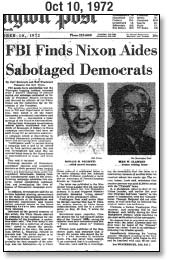
WaPo report, October 10, 1972

The Watergate report they’ve often described as decisive — an article published October 10, 1972, that characterized the scandal as “a massive campaign of political spying and sabotage conducted on behalf of President Nixon’s re-election” — referred prominently to the FBI and the Justice Department.

(That article cited “FBI reports” in asserting that “at least 50 undercover Nixon operatives traveled throughout the country trying to disrupt and spy on Democratic campaigns.” That claim was dismissed as “absolutely false” in internal FBI memoranda, and was scoffed at by Edward Jay Epstein in his brilliant 1976 essay puncturing the purported effects of Woodward and Bernstein’s  Watergate reporting.)

And as I write in my media-mythbusting book, Getting It Wrong, which came out last year, to characterize the reporting of Woodward and Bernstein as decisive in Watergate’s outcome “is to abridge and misunderstand the scandal and to indulge in a particularly beguiling media-driven myth.”

I also note that such a mediacentric interpretation of Watergate “minimizes the far more decisive forces that unraveled the scandal and forced Nixon from office.”

Those forces included special prosecutors, federal judges, both houses of Congress, the Supreme Court, as well as the Justice Department and the FBI, I note, adding:

“Even then, Nixon likely would have served out his term if not for the audiotape recordings he secretly made of most conversations in the Oval Office of the White House. Only when compelled by the Supreme Court did Nixon surrender those recordings, which captured him plotting the cover-up” of the crimes of Watergate.

I argue in Getting It Wrong that debunking media-driven myths “enhances a case for limited news media influence.”

Media power, I write, “tends to be modest, nuanced, diffused, and situational. But too often the ubiquitous presence of the news media is mistaken for power and influence.”

Cockburn’s commentary similarly suggested that media power can be overstated, exaggerated.

“In wars in Vietnam, Iraq and Afghanistan,” he noted, “effective media criticism has tended to follow rather than precede public opinion.”

Quite so.

Walter Cronkite‘s famous on-air assessment in late February 1968 that the U.S. military was “mired in stalemate” in the war in Vietnam is sometimes said to have shifted American public opinion about the conflict.

In reality, though, Americans had begun turning against the war months before Cronkite aired his analysis in a special report on CBS television.

WJC

Recent and related:

Fact-checking ‘Mother Jones’: A rare two-fer

In Cronkite Moment, Debunking, Furnish the war, Media myths, New York Times, Spanish-American War on April 26, 2011 at 7:07 am

The most prominent media-driven myths — those dubious or apocryphal stories about the news media that masquerade as factual — include William Randolph Hearst’s vow to “furnish the war” and the so-called “Cronkite Moment” of 1968.

Mother Jones magazine, in the cover story of its May/June number, cites both tales as if they were genuine, in a rare, myth-indulging two-fer.

In an article written by Rick Perlstein and titled “Inside the GOP’s fact-free nation,” Mother Jones says of Hearst (who was no Republican):

“In a fearsome rivalry with Joseph Pulitzer, he chose as his vehicle the sort of manly imperialism to which the Washington elites of the day were certainly sympathetic — although far too cautiously for Hearst’s taste. ‘You furnish the pictures,’ he supposedly telegraphed a reporter, ‘and I’ll furnish the war.’ The tail wagged the dog.”

You furnish the pictures, and I’ll furnish the war.” Couching it with “supposedly” allows no free pass for myth-telling.

It’s quotation most often attributed to Hearst. And as I discuss in my latest book, Getting It Wrong, it’s a durable media-driven myth that has survived “concerted attempts to discredit and dismantle it.”

It is, I add, “succinct, savory, and easily remembered. It is almost too good not to be true.”

The purported recipient of Hearst’s telegram was not “a reporter,” as Perlstein writes, but Frederic Remington, the famous artist of the American West.

Remington, Davis in Cuba

Hearst had assigned Remington and the correspondent Richard Harding Davis to Cuba to cover the insurrection against Spanish colonial rule. They arrived in Havana in early January 1897, and Remington six days later.

He parted ways with Davis in Matanzas, Cuba, and, before leaving Havana for New York, supposedly cabled Hearst, saying:

“Everything is quiet. There will be no war. I wish to return.”

Hearst, in reply, cabled his famous vow, telling Remington:

“Please remain. You furnish the pictures, and I’ll furnish the war.”

Remington didn’t stay. He promptly returned to New York, where his sketches were given prominent display in Hearst’s New York Journal, appearing beneath such headlines as:

“Cuban War Sketches Gathered in the Field by Frederic Remington; The Gifted Artist, Visiting Cuba Especially for the Journal.”

That’s hardly an accolade Hearst would have extended to someone who had so brazenly disregarded instructions to remain on the scene.

As I write in Getting It Wrong, “the anecdote lives on despite a nearly complete absence of supporting documentation. It lives on even though telegrams supposedly exchanged by Remington and Hearst have never turned up.”

What’s more, I note in Getting It Wrong, the Remington-Hearst anecdote “lives on despite an irreconcilable internal inconsistency: It would have been absurd for Hearst to vow to ‘furnish the war’ because war — specifically, the Cuban rebellion against Spain’s colonial rule — was the very reason Hearst sent Remington to Cuba in the first place.”

Anyone who read U.S. newspapers in early 1897 “would have been well aware,” I write, “that Cuba was a theater of a nasty war,” which gave rise in April 1898 to the Spanish-American War.

The tale about the Remington-Hearst exchange is surely apocryphal.

So, too, is the presumed effect of the “Cronkite Moment” which, like the story about Hearst’s famous vow, is “succinct, savory, and easily remembered.”  It reputedly demonstrates the potency of broadcast journalism.

The “Cronkite Moment” was, I point out in Getting It Wrong, purportedly “an occasion when the power of television news was unequivocally confirmed,” a rare, pivotal moment when a truth-telling broadcast demonstrated the folly of a faraway war.

Perlstein writes in Mother Jones:

“Walter Cronkite traveled to Saigon after the Tet Offensive in 1968, saw things with his own eyes, and told the truth: The Vietnam War was stuck in a disastrous stalemate, no matter what the government said. That was a watershed.”

Well, no, it wasn’t.

Cronkite did indeed travel to Vietnam in February 1968 and upon his return to the United States aired an hour-long special report about the war, in which he concluded that the American military was “mired in stalemate” and suggested that negotiations offered the best way out.

But “mired in stalemate,” I write in Getting It Wrong, “was neither notable nor extraordinary” by February 27, 1968, when Cronkite’s report aired. As Mark Kurlansky wrote in his study of the year 1968, Cronkite’s assessment was “hardly a radical position” for the time.

Indeed, months before the program, the New York Times had been using “stalemate” to describe the war in Vietnam.

On July 4, 1967, for example, the Times said this about the war effort:

“Many officers believe that despite the commitment of 466,000 United States troops now in South Vietnam … the military situation there has developed into a virtual stalemate.”

And in a front-page analysis published August 7, 1967, the Times declared “the war is not going well.” Victory “is not close at hand.”

The Times published the analysis beneath the headline:

Vietnam: The Signs of Stalemate.

And in an editorial published October 29, 1967, the Times offered this assessment:

“Instead of denying a stalemate in Vietnam, Washington should be boasting that it has imposed a stalemate, for that is the prerequisite – on both sides – to a negotiated settlement. That settlement, if it is to be achieved, will have to be pursued with the same ingenuity and determination that have been applied to fighting the war.”

Cronkite’s “mired in stalemate” represented no watershed, no assessment of exceptional and stunning clarity. Cronkite said as much in his memoir, which was published in 1997. He wrote that his special report represented for President Lyndon B. Johnson “just one more straw in the increasing burden of Vietnam.”

In fact, public opinion had begun shifting away from supporting the war months before the “Cronkite Moment.”

It’s often said that Johnson watched Cronkite’s program and, upon hearing the “mired in stalemate” interpretation, snapped off the television set and said something to the effect of:

“If I’ve lost Cronkite, I’ve lost Middle America.”

LBJ: Not watching TV

But as I discuss in Getting It Wrong, Johnson did not see the Cronkite report went it aired. The president at that time wasn’t in front of a television set. And he certainly wasn’t lamenting the loss of Cronkite’s support. Indeed, it is hard to fathom how he could have been much moved by a show he did not see.

At about the time Cronkite was intoning “mired in stalemate,” Johnson was in Austin, Texas, offering light-hearted banter at the 51st birthday party of Governor John Connally.

“Today,” the president said, “you are 51, John. That is the magic number that every man of politics prays for — a simple majority.”

WJC

Many thanks to Little Miss Attila
for linking to this post

Recent and related:

What a Rash remark: ‘If I’ve lost Cronkite, I’ve….’

In Cronkite Moment, Debunking, Media myths, New York Times, Newspapers on April 2, 2011 at 7:17 am

The mythical “Cronkite Moment” can be an irresistible point of reference in broadcast journalism, especially in assessing the shortcomings and inadequacies of contemporary network news anchors.

A commentary posted yesterday at the online site of the Minneapolis Star Tribune offered such a comparison, unfavorably comparing CBS News anchor Katie Couric to the venerable Walter Cronkite.

Couric is believed on her way out as CBS anchor and the commentary’s author, John Rash, noted that Cronkite said he regretted leaving the anchor’s chair in 1981.

In what could pass for a eulogy, Rash also wrote:

“The avuncular Cronkite, once considered the most trusted man in America, was also one of the most influential. His … clear-eyed assessment of Vietnam as a ‘stalemate’ led [John] Kennedy’s successor, President Lyndon B. Johnson, to say, ‘If I’ve lost Cronkite, I’ve lost America.'”

There’s no small amount of myth to unpack in that paragraph.

Most trusted?

For starters, the claim that Cronkite was the “most trusted man in America” rests on a flimsy foundation. The characterization stems from an unrepresentative survey conducted in 18 states in 1972, and from subsequent newspaper advertisements in which CBS touted Cronkite as most trusted.

As for Cronkite’s assertion that the U.S. military was “mired in stalemate” in Vietnam — well, there’s no evidence that Johnson reacted by saying, “If I’ve lost Cronkite, I’ve lost America.”

Or by saying anything akin to such a comment.

The Cronkite-Johnson anecdote, though, is one of the best known in American journalism. It’s often called as the “Cronkite Moment” — and it’s also a media-driven myth, one of 10 I address and debunk in my latest book, Getting It Wrong.

Cronkite certainly made the “mired in stalemate” assessment, at the close of a special report that CBS aired on February 27, 1968.

At the White House, the story goes, Johnson watched the Cronkite program and upon hearing the anchorman’s “mired in stalemate” critique, reached over, snapped off the television and said to an aide or aides:

“If I’ve lost Cronkite, I’ve lost Middle America.”

But as I point out in Getting It Wrong, Johnson wasn’t at the White House that night. He wasn’t in front of a television set.

He didn’t see the program.

Johnson was in Austin, Texas, at the 51st birthday party of Governor John Connally, a longtime political ally.

And about the time Cronkite intoned his “mired in stalemate” assessment, Johnson wasn’t wringing his hands about his war policy. He was cracking a light-hearted joke about Connally’s age.

“Today, you are 51, John,” the president said. “That is the magic number that every man of politics prays for—a simple majority.”

As I’ve noted at Media Myth Alert, it is difficult to fathom how Johnson could have been much moved by a television program he didn’t see.

Besides, Cronkite was scarcely the first to invoke “stalemate” in describing Vietnam.

The New York Times turned to that term periodically in the months before the presumptive “Cronkite Moment.”

In a front-page analysis published August 7, 1967, the Times declared that “the war is not going well. Victory is not close at hand.”

The Times report was published on its front page beneath the headline:

Vietnam: The Signs of Stalemate.

A month before, on July 4, 1967, the Times had said of the war effort:

“Many officers believe that despite the commitment of 466,000 United States troops now in South Vietnam … the military situation there has developed into a virtual stalemate.”

And the Times said in an editorial published October 29, 1967:

“Instead of denying a stalemate in Vietnam, Washington should be boasting that it has imposed a stalemate, for that is the prerequisite–on both sides–to a negotiated settlement. That settlement, if it is to be achieved, will have to be pursued with the same ingenuity and determination that have been applied to fighting the war.”

So Cronkite in his report about Vietnam on February 27, 1968, essentially reiterated an assessment that the Times had offered on a number of occasions  in the months before.

“Stalemate” may have been a “clear-eyed” assessment. But by the time Cronkite invoked the term, “stalemate” in Vietnam was neither novel nor stunning.

WJC

Recent and related: