CNN (really) offered not long ago one of the more coherent recent assessments about the unfolding election campaign between President Donald Trump and former Vice President Joe Biden.
A commentary by two Democratic analysts argued against prematurely dismissing Trump’s chances of winning reelection, despite the polls of July that overwhelmingly are in Biden’s favor.
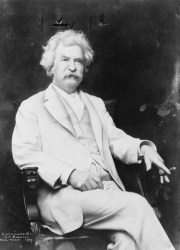
Twain in 1907
“It seems,” wrote Arick Wierson and Bradley Honan, “that Democrats are all too keen on taking a victory lap before they pass the checkered flag.
“Those declaring Trump politically finished,” they added, “should recall the words attributed to the famous American novelist Mark Twain. As the story goes, Twain’s death was rumored when his cousin fell ill and reporters couldn’t locate him while touring in Europe. Upon learning of his supposed demise, Twain, according to his biographer Albert Bigelow Paine, told a reporter that ‘the report of my death has been grossly exaggerated.‘”
The analysis is persuasive; but what most interests Media Myth Alert is the remark attributed to Twain, the American humorist and writer of the 19th and 20th centuries whose given name was Samuel L. Clemens.
The quotation itself is exaggerated — as it has been over the years — and is more emphatic than it really was.
What Twain said in an interview in early June 1897 with William Randolph Hearst’sNew York Journal was subdued. Flat, even.
“The report of my death,” he simply said, “was an exaggeration.”
The more evocative version that appeared in the CNN commentary is not unusual. Twain’s line often has been presented as “the news of my death has been greatly exaggerated.” Or “grossly exaggerated.” And sometimes the Journal is said to have been the source of the erroneous report, not its prompt and thorough debunking.
The Herald reported Twain to be “grievously ill and possibly dying. Worse still, we are told that his brilliant intellect is shattered and that he is sorely in need of money.”
Twain at the time was in London, about to cover Queen Victoria’s Diamond Jubilee for Hearst’s Journal. That association allowed the Journal to quickly knock down the Herald‘s story.
In a front-page article published June 2, 1897, beneath the headline, “Mark Twain Amused,” the Journal skewered the Herald‘s account as false and presented Twain’s straightforward “exaggeration” comment.
The Journal’s article, which carried the byline of Frank Marshall White, began this way:
“Mark Twain was undecided whether to be more amused or annoyed when a Journal representative informed him … of he report in New York that he was dying in poverty in London.
“He is living in comfort and even luxury in a handsomely furnished house in a beautiful square in Chelsea with his wife and children, and has only this week finished the narrative of his recent travels ….”
After invoking the remark about the “report of my death was an exaggeration,” White further quoted Twain as saying: “The report of my poverty is harder to deal with.”
Interesting, all that, but why bother with an exaggerated, long-ago quotation?
Consider, too, the unlikely remark attributed to President Lyndon B. Johnson after Walter Cronkite, the CBS News anchorman, declared in February 1968 that the U.S. war effort in Vietnam was stalemated. “If I’ve lost Cronkite,” the president supposedly uttered in response to Cronkite’s televised comment, “I’ve lost Middle America.” Or something to that effect.
“Bogus quotations share many of the defining features of media-driven myths: They tend to be concise and simplistic, easy to remember, fun to retell, tenacious, and often thinly sourced.”
The tale was invoked yesterday in a Washington Postessay that argued societal rifts and recent civil disorders in contemporary America don’t match those of 1968. “America is polarized today — but not like in 1968,” the essay said. “Today’s polarization is tidy by comparison.”
Maybe. But it’s not a far-fetched assessment. The essay stumbles, though, in claiming without attribution or qualification that Nixon’s “secret plan” was a “tantalizing” pledge that figured significantly in his run for the White House 52 years ago.
The Post presented the claim in this convoluted manner:
Won without a ‘secret plan’
“Besides law and order, he touted a secret plan to end the war in Vietnam. Later, we learned that the plan was secret because it didn’t actually exist. But in 1968, Nixon’s secret was tantalizing indeed, and it helped him to his narrow victory, because Americans wanted the war to end and a secret plan was better than no plan at all.”
Right, “a secret plan was better than no plan at all.”
Tantalizing, that.
Except that Nixon never said he had a plan to end the war without disclosing what he had in mind. He never “touted” a “secret plan,” as Media Myth Alert has noted on several occasions.
Nonethless, Nixon’s “secret plan” has become a media myth that won’t die, its tenacity due in part because it seems so cynical, so utterly Nixonian. Like many media myths, it seems almost too good to be false.
Interestingly, the “secret plan” myth took hold despite Nixon’s assertions to the contrary.
He pointedly and publicly dismissed such a notion early in his campaign in 1968. He was quoted as saying in an article published in the Los Angeles Times in late March that year that he had “no gimmicks or secret plans” for Vietnam.
“If I had any way to end the war,” Nixon was further quoted as saying, “I would pass it on to President [Lyndon] Johnson.” (Nixon’s remarks were made shortly before Johnson announced he would not seek reelection.)
Nixon may or may not have had some sort of “secret plan” in mind in 1968. But such a claim wasn’t a feature of his campaign. He didn’t run on a “secret plan” pledge.
That is clear in the search results of a full-text database of leading U.S. newspapers, including the Post, New York Times, Los Angeles Times, Baltimore Sun, Wall Street Journal, and Chicago Tribune.
No articles were found during the period January 1, 1967, to January 1, 1969, in which Nixon was quoted as touting or otherwise saying he had a “secret plan” for Vietnam. (The search period included the months of Nixon’s presidential campaign and its aftermath.)
Had Nixon had campaigned in 1968 on a “secret plan” for Vietnam, the country’s leading newspapers surely would have reported it.
The “secret plan” anecdote likely is derived from a speech Nixon made on March 5, 1968, in Hampton, New Hampshire, in which he declared “new leadership” in Washington would “end the war” in Vietnam.
The wire service United Press International, in reporting Nixon’s remarks, pointed out that the candidate “did not spell out how” he would “end the war.” The UPI account also said “Nixon’s promise recalled Dwight D. Eisenhower’s pledge in 1952, when Nixon was his running mate, to end the war in Korea.” Late in his winning campaign for president that year, Eisenhower dramatically announced he would “go to Korea” to begin searching for a peaceful settlement.
A New York Times account of Nixon’s speech, published March 6, 1968, quoted the candidate as saying he “could promise ‘no push-button technique’ to end the war. Nixon also said he was not suggesting ‘withdrawal’ from Vietnam.” A brief follow-on report published in the Times that day quoted Nixon as saying he envisioned applying military pressure as well as diplomatic efforts in seeking to end the war.
William Safire, a former Nixon speechwriter and later columnist for the Times, used to relish calling attention to published references to the mythical “secret plan,” which he characterized as a “non-quotation [that] never seems to go away.”
In a column published 20 years ago, for example, Safire recalled an occasion “when a New York Times columnist attributed that direct quote to Nixon, a White House speechwriter challenged him to find the quote in anything taken down by pencil or recorder at the time. The pundit searched high and low and had to admit the supposed remark was unsourceable. (Look, the Nixon speechwriter was me and the columnist was my current colleague, Tony Lewis; I didn’t have to research this.)”
“Though it is often claimed that Nixon spoke of a ‘secret plan’ to end the war, he never uttered those words. Even suggesting that he had a plan would have been too much for Nixon.”
Not surprisingly, a Gallup poll late last month ranked the media last among American leaders and institutions in their response to the coronavirus.
Watergate myth will never die
Even amid a pandemic, peddling media myths — those prominent stories about and/or by the media that are widely believed and often retold but which, under scrutiny, dissolve as apocryphal — has proven irresistible to some news outlets.
Their appearance signals not only how ingrained these myths become in American media; it also suggests an eagerness among journalists to believe their field can project decisive influence.
The article mentioned the Vietnam War, which claimed 58,000 American lives, and said the conflict “had a notable turning point in the court of public opinion. It happened when CBS anchor Walter Cronkite said in a 1968 broadcast that he believed the war was, at best, a ‘stalemate.’ Weeks later, President Lyndon Johnson sensed he had lost public support and declined to seek reelection.”
No evidence was offered for the “turning point” claim; no evidence was presented for the presumptive link to Johnson’s not running for another term.
On both counts, in fact, the evidence runs the other way.
As I pointed out in my media-mythbusting book, Getting It Wrong, polling by Gallup indicated that the turning point in public opinion came in Fall 1967, about 4 1/2 months before Cronkite’s “stalemate” assessment. By then, and for the first time, a plurality of Americans said it had been a mistake to send U.S. troops to fight in Vietnam.
Other appraisals similarly indicated the turning point came in the second half of 1967.
At the end of that year, for example, Don Oberdorfer, then a national correspondent for the Knight newspapers, described what he called “a time of switching” in Summer and Fall 1967, “when millions of American voters — along with many religious leaders, editorial writers and elected officials — appeared to be changing their views about the war.”
In a very real sense, then, Cronkite’s “stalemate” observation was a matter of his following, rather than leading, American public opinion as it turned against the war.
Additionally, the USA Today article suggested that in Cronkite’s “stalemate” assessment about the war, President Johnson “sensed he had lost public support and declined to seek reelection.” But Johnson did not see the Cronkite report when it aired; the President at the time was at a black-tie birthday party for a political ally, Governor John Connally, in Austin, Texas.
And there’s no certain evidence about when or whether he saw the Cronkite program on videotape at some later date.
Factors other than Cronkite’s program weighed more powerfully in discouraging Johnson from seeking reelection. Notably, he faced a serious internal challenge for the Democratic nomination from Senators Eugene McCarthy and Robert F. Kennedy. The latter entered the race for president after McCarthy’s surprisingly strong showing in the New Hampshire primary on March 12, 1968.
Faced with the prospect of humiliating defeats in primary elections after New Hampshire’s, Johnson quit the race.
The war Vietnam gave rise to other tenacious media myths, especially those associated with the “Napalm Girl” photograph taken in June 1972. The image showed a clutch of children fleeing a napalm strike on Trang Bang, their village in what then was South Vietnam.
Near the center of the photograph was a naked 9-year-old girl, screaming from her wounds.
It is said the photograph was so powerful that it swung U.S. public opinion against the war (in fact, as we’ve seen, it turned years before June 1972) and hastened an end to the conflict (in fact, the war went on till April 1975). Another myth of the “Napalm Girl” image was that it showed the effects of a U.S. aerial attack (also false: a warplane of the South Vietnamese Air Force dropped the napalm).
To that lineup of myth, the National Interest introduced another powerful effect — namely, that the “Napalm Girl” image “helped turn public opinion against the use” of flame-throwers as weapons of war.
‘Napalm Girl,’ 1972 (Nick Ut/AP)
The post, however, offered no evidence of a linkage between the photograph and views about flamethrowers — which did not figure in the aerial attack at Trang Bang.
By email, I asked the editor of the National Interest for elaboration about the claim, saying: “I am interested in evidence such as public opinion polling that demonstrates or points to a linkage.”
I further wrote:
“I ask because I have addressed and disputed other claims about the photograph’s presumed impact — notably that it hastened an end to the Vietnam War, that it turned public opinion against the conflict, and that it showed the effects of a U.S. napalm attack on South Vietnam.”
The email was sent nearly three weeks ago. The editor has never replied.
In less earthier terms, Katharine Graham, the newspaper’s publisher during the Watergate scandal, insisted the Post did not topple Nixon. “Sometimes people accuse us of bringing down a president, which of course we didn’t do,” she said in 1997. “The processes that caused [Nixon’s] resignation were constitutional.”
As I pointed out in Getting It Wrong, credit for bringing down Nixon belongs to the federal investigators, federal judges, federal prosecutors, bipartisan congressional panels, the Supreme Court, and others who investigated the scandal and uncovered evidence of obstruction of justice that led to Nixon’s resignation in August 1974.
Against that tableau, I wrote, “the contributions of Woodward and Bernstein were at best modest, and certainly not decisive.”
And yet, the hero-journalist myth lives on — as suggested the other day in a column by the entertainment critic for the Lincoln Journal Star in Nebraska. The column presented a rundown about the top films with a journalism theme. Atop the critic’s list was All the President’s Men, the cinematic adaptation of Woodward and Bernstein’s eponymous, best-selling book.
It’s the “best newspaper picture ever,” the Journal Star critic wrote, declaring that movie showed how Woodward and Bernstein “ferreted out the Watergate scandal and brought down a president.”
Fifty-two years ago tonight, CBS News anchorman Walter Cronkite presented a prime-time report about the war in Vietnam and declared in closing that the U.S. military effort was “mired in stalemate” and that negotiations might eventually offer a way out.
It was a tepid analysis, hardly novel. But over the years, Cronkite’s assessment has swelled in importance, taking on the aura of a vital, media-inspired turning point. It is so singularly important in American journalism that it has come to be called the “Cronkite Moment.”
Notable among the myths of the “Cronkite Moment” is that President Lyndon B. Johnson watched the program and, upon hearing the anchorman’s comment about “stalemate,” snapped off the television and told an aide or aides something to this effect:
“If I’ve lost Cronkite, I’ve lost Middle America.” (Versions vary.)
Cronkite’s remarks supposedly were an epiphany to the president, who realized his war policy was a shambles.
The account of the anchorman’s telling hard truth to power is irresistible to journalists, representing a memorable instance of media influence and power.
But Cronkite’s program on February 27, 1968, hardly had decisive effects. Here’s why (this rundown is adapted from a chapter about the “Cronkite Moment” in my media myth-busting book, Getting It Wrong):
Johnson: Didn’t see Cronkite show
Cronkite said nothing about Vietnam that hadn’t been said by leading journalists many times before. By early 1968, “stalemate” was a decidedly unoriginal — and fairly orthodox — way of characterizing the war effort.
Cronkite’s remarks were decidedly more temperate than other contemporaneous media assessments about the war. Four days before Cronkite’s program, for example, the Wall Street Journal said in an editorial that the U.S. war effort in Vietnam “may be doomed” and that “everyone had better be prepared for the bitter taste of defeat beyond America’s power to prevent.” Not long after Cronikte’s report, Frank McGee of NBC News declared the war was being lost if judged by the Johnson administration’s definition. Not stalemated. Lost.
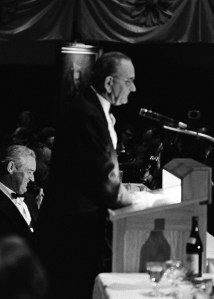
Johnson did not see the Cronkite program when it aired. He was at a black-tie birthday party in Texas at the time (see photo nearby) and it is unclear whether, or when, he watched it afterward on videotape. The presumed impact of the “Cronkite Moment” rests in its sudden, unexpected, and profound effect on the president: Such an effect would have been absent, or sharply diluted, had Johnson seen the program on videotape at some later date.
In the days and weeks afterward, Johnson was conspicuously hawkish in public remarks about the war — as if, in effect, he had brushed aside Cronkite’s downbeat assessment while seeking to rally popular support for the war effort. At one point in March 1968, Johnson called publicly for “a total national effort” to win the war.
Until late in his life, Cronkite dismissed the notion that his pronouncement had much effect on Johnson: He considered its impact as akin to that of a straw on the back of a crippled camel. Cronkite invoked such an analogy in his 1997 memoir, A Reporter’s Life.
Long before Cronkite’s report, public opinion had begun to shift against the war. Polling data and journalists’ observations indicate that a turning point came in Fall 1967. Indeed, it can be said that Cronkite followed rather than led Americans’ changing views about Vietnam. As Daniel C. Hallin wrote in 1998: “Lyndon Johnson had essentially lost Mr. Average Citizen months before Cronkite’s broadcast.”
Johnson’s surprise announcement March 31, 1968, that he would not seek reelection to the presidency pivoted not on what Cronkite had said a month before but on the advice of an informal group of senior advisers, known as the “Wise Men.” The “Wise Men” met at the White House a few days before Johnson’s announcement and, to the president’s surprise, advised disengagement from Vietnam.
It is far easier to embrace the notion that Cronkite’s report 52 years ago altered the equation on Vietnam than it is to dig into its back story and understand it for what it was: A mythical moment of marginal influence in a war that lasted until 1975.
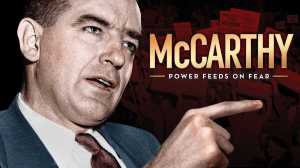
The PBS “American Experience” documentary about Joseph R. McCarthy, the notorious red-baiting U.S. senator of the early Cold War, aired earlier this month. I have puzzled about the program since.
Timing was a source of puzzlement. Why now? Why revisit the McCarthy story in January 2020? Anniversaries can be a convenient peg for such programs. But nothing in early January was memorably associated with the McCarthy saga.
So why now? The producers no doubt wanted to suggest that President Donald Trump, in his bluster, exaggerations, and combative demeanor, is reminiscent of McCarthy.
If that were the implication, the allusion was muddled. And under-developed. Which could be because Trump is a much more complex character than Joe McCarthy, an obscure, hard-drinking Republican senator from Wisconsin who seized on his communists-in-government campaign as a ticket to prominence.
PBS ‘McCarthy’ doc: Notable for what was omitted
So the documentary was notable for what it insinuated — and for what it left out.
It embraced a conventional if misleading interpretation that the American press was unwilling to stand up to McCarthy, reluctant to challenge his thinly sourced charges about communist infiltration of the federal government.
Indeed, the press of the time depicted as complicit with McCarthy’s tactics. Sam Tanenhaus, one of the on-camera authorities presented by PBS, said as much:
“McCarthy brought out the complicity in American journalists, that we like the troublemaker and the rabble-rouser and the theatrical, spectacular figure who says the thing you’re not supposed to say, who breaks the rules, who disregards the facts. That makes for really good copy. And that’s what happened, that’s what kept McCarthy going for a long time until it all fell apart, and then he was just discarded.”
In reality, not all prominent journalists of the time were inclined to excuse McCarthy’s theatrics and allegations.
Notable among them — yet scarcely mentioned in the documentary — was Drew Pearson, an activsit, muckraking, Washington-based syndicated columnist. Pearson went after McCarthy just days after the senator launched his communists-in-government campaign, claiming in a speech in February 1950 to have names of 205 of communists in the State Department. (The number varied; McCarthy soon after claimed to have a list of 57 card-carrying communists in the agency.)
Pearson scoffed at McCarthy’s claims and wrote in a column in mid-February 1950:
“When the Senator from Wisconsin was finally pinned down, he could produce not 57 but only 4 names of State Department officials whom he claimed were Communists.” One of the four had long since been cleared, Pearson noted. Two of them had left the agency, and the fourth person had never worked for the State Department.
What’s more, Pearson wrote, McCarthy’s allegations were similar to disputed charges raised three years earlier by a Republican congressman from Michigan.
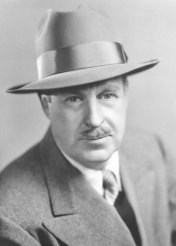
Drew Pearson
Pearson was intrusive, self-important, gossipy, and not an especially heroic figure; media critic Jack Shafer once described him “as one of the skuzziest journalists to ever write a story.” Even so, his persistent challenges to McCarthy deserved more recognition than PBS granted him.
The documentary’s lone reference to Pearson in the documentary was passing mention about his one-sided physical confrontation with McCarthy in December 1950 when the senator cornered him in the cloak room of the fashionable Sulgrave Club in Washington, D.C. McCarthy either kneed, slugged, or slapped Pearson: Contemporaneous accounts differed.
Pearson in his columns not only disputed the senator’s red-baiting claims. He called out McCarthy on other matters — including the senator’s tax troubles in Wisconsin and the suspicious financial contributions to his campaign for senate.
Pearson’s probing “embarrassed and angered McCarthy, who began entertaining thoughts of doing him harm,” I noted in my media-mythbusting book, Getting It Wrong. At a Gridiron Club dinner in Washington in May 1950, McCarthy approached Pearson, placed a hand on his arm, and muttered:
“Someday I’m going to get a hold of you and really break your arm.”
The threat was prelude to the brief but violent encounter at the Sulgrave.
The point here is that journalists were challenging McCarthy in the early days of his communists-in-government crusade. And Pearson was not alone.
Richard Rovere of the New Yorker also was an early critic of McCarthy.
Rovere was not mentioned in the documentary.
Nor was the New York Post’s 17-part series in 1951 about McCarthy and his tactics. The series carried the logo, “Smear, Inc.” and deplored what it termed McCarthy’s “careening, reckless, headlong drive down the road to political power and personal fame” in which he had “smashed the reputations of countless men.”
The documentary made only indirect reference to Post’s bare-knuckled series, noting that the newspaper’s editor, James Wechsler, was summoned before McCarthy’s subcommittee in 1953 in what Wechsler described as “a reprisal against a newspaper and its editor for their opposition to the methods of this committee’s chairman.”
Ignoring the journalists who stood up to and challenged McCarthy’s recklessness was a shortcoming of the documentary.
Another flaw was suggesting that Edward R. Murrow’s famous if myth-encrusted television report in March 1954 about McCarthy was timed to coincide with efforts by the administration of President Dwight D. Eisenhower to defang the senator.
It may have been, but PBS offered as support only the speculation of one of its on-camera authorities, Thomas Doherty.
“My thinking,” Doherty said, “is that Edward R. Murrow got some kind of informal signal from the Eisenhower administration, that this week in March [1954], is the week in which McCarthy’s career will basically be orchestrated to be over.”
Not until December 1954 was McCarthy censured by the Senate, a move that confirmed the disintegration of his political career.
McCarthy died of alcoholism-related illness in 1957. According to the documentary, senators accompanying McCarthy’s coffin on the flight from Washington to Wisconsin played poker on his flag-draped casket.
Media Myth Alert directed attention in 2019 to the appearance of well-known media-driven myths, those prominent tales about and/or by the news media that are widely believed and often retold but which, under scrutiny, dissolve as apocryphal or wildly exaggerated.
An almost-predictable by-product of the impeachment hearings conducted late in the year by the House of Representatives Intelligence Committee were media references to the myth that the Post’s reporting brought down Richard Nixon’s presidency in the Watergate scandal.
Among the references was that of the Post’s own managing editor, Cameron Barr, who declared in a speech in November at the University of Oxford that “Nixon’s resignation was brought to pass by our coverage of the political scandal known as Watergate.”
Brought to pass?
The phrase means caused to happen, and the Post’s reporting did not cause Nixon’s resignation to happen.
For years, senior staff at the Post dismissed or scoffed at the mythical notion the newspaper’s reporting brought down Nixon. Katharine Graham, the newspaper’s publisher during Watergate, said in 1997, at the 25th anniversary of the scandal’s seminal crime, the burglary at Democratic National Committee headquarters in June 1972:
“Sometimes people accuse us of bringing down a president, which of course we didn’t do. The processes that caused [Nixon’s] resignation were constitutional.”
When asked about his “brought to pass” remarks at Oxford, Barr replied by parsing his words:
“You’ll note that I didn’t say that The Post brought down Nixon or took Nixon down or got Nixon – those mischaracterizations [sic] my colleagues have rejected and rightly so. As do you.
“I said The Post’s reporting brought it to pass, and my evidence for that is the historical record. We did our jobs as journalists, setting in motion other factors and forces that compelled him to step down.”
Nice try.
Not only did the Post’s reporting not bring to pass Nixon’s resignation, it’s quite a stretch to say that the Post’s reporting set in motion, or even much contributed to, the vastly more important investigations by subpoena-wielding federal authorities who did uncover the evidence that brought to pass Nixon’s resignation.
As Edward Jay Epstein pointed out in his classic essay about the news media and Watergate, “even in publicizing Watergate, the press was only one among a number of institutions at work.”
■TV made all the difference in McCarthy’s fall, Watergate? Hardly(posted September 29): The Post’s media columnist, Margaret Sullivan, made sweeping claims in late September that television had “made all the difference in 1954″ in exposing and bringing down the red-baiting senator, Joseph R. McCarthy. She further wrote that during the Senate Watergate hearings in 1973, television had had a “disastrous effect on Richard Nixon’s presidency.”
Such interpretations may reassure journalists, reminding them of their presumed power and influence. Media-driven myths tend to have such an effect. But it’s exceedingly mediacentric to claim television was decisive in McCarthy’s fall or in Watergate’s outcome.
If anything, television was a lagging factor in raising challenges to McCarthy and his communists-in-government witch hunt. As for the Watergate hearings, it wasn’t their televised character that had a “disastrous effect” on Nixon’s presidency; it was what the hearings uncovered that proved decisive.
Sullivan wrote in her column: “The moment of truth for McCarthy … came in televised hearings when a lawyer for the U.S. Army shut down the senator with his damning accusation: ‘Have you no sense of decency, sir? At long last, have you left no sense of decency?’”
That encounter took place June 9, 1954. But it hardly “shut down the senator.”
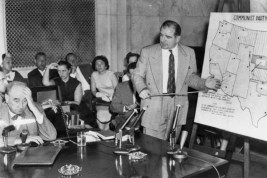
McCarthy at map; Welch, head in hand
The hearing transcript show that McCarthy was quick to reply to the “no sense of decency” remark by the Army’s chief counsel, Joseph N. Welch. McCarthy then launched into a riff about a communist-linked organization to which a young colleague of Welch had belonged.
Television came late to the McCarthy scourge. For months, even years, before 1954, print journalists such as Drew Pearson, a nationally syndicated columnist, and Richard Rovere, a writer for the New Yorker, had directed attention to the McCarthy’s exaggerated allegations.
Televised coverage of the Senate Watergate hearings in 1973 was riveting. But the greatest contribution came from what Senate staffers learned: They found that Nixon had secretly made audio tapes of conversations in the Oval Office of the White House.
Ultimately, when they were pried from Nixon’s possession, the tapes revealed that the president knew about and approved a plan to divert the FBI’s investigation into the scandal’s signal crime — the break-in at Democratic National Committee headquarters in June 1972.
Without the tapes, it’s unlikely Nixon’s guilt in Watergate would have been conclusively demonstrated. That was the interpretation of, among others, Watergate’s preeminent historian, Stanley I. Kutler.
“Absent the tapes, Nixon walks,” Kutler said several years ago. “You had to have that kind of corroborative evidence to nail the president of the United States.”
It was an over-the-top screed that appeared in the newspaper’s Sunday magazine. It also extolled journalism, saying “more often than not” over the years, “reporters got it right, from uncovering the ghastly conditions in slaughterhouses [presumably a reference to Upton Sinclair’s novel The Jungle] to forcing a president’s resignation in the Watergate scandal.”
The allusion to “forcing a president’s resignation” was, of course, to the reporting of Bob Woodward and Carl Bernstein for the Post; around them revolve the heroic-journalist trope, which long ago became the mythical dominant narrative of Watergate.
In reality, forcing Nixon’s resignation in Watergate wasn’t the work of Woodward and Bernstein. Or of any journalist or news organization.
As Woodward once said, in an interview with the old American Journalism Review:
And as I noted in my media-mythbusting book Getting It Wrong, rolling up a sprawling scandal like Watergate required the collective if not always coordinated efforts of special prosecutors, federal judges, both houses of Congress, the Supreme Court, as well as the Justice Department and the FBI.
And even then, I wrote, Nixon likely would have completed his presidential term if not for revelations about the recordings he secretly made of conversations at the Oval Office — a pivotal Watergate story that Woodward and Bernstein missed, by the way.
“Only when compelled by the Supreme Court,” I wrote in Getting It Wrong, “did Nixon surrender those recordings, which captured him plotting the cover-up” of the June 1972 break-in at Democratic National Headquarters, the Watergate scandal’s seminal crime.
“You want fake news?” the Tribune‘s editorial stated. “Here’s some fake news about fake news.”
In discussing Hearst’s debunked vow (which supposedly was contained in a telegram to the artist Frederic Remington, who was on assignment in Spanish-ruled Cuba in early 1897), the newspaper said:
“The story goes that when he was told by Frederick [sic] Remington, the already-famous illustrator he had sent to Cuba to document supposed battles there, that there were no battles to record, Hearst famously replied, ‘You furnish the pictures. I’ll furnish the war.’”
The Remington-Hearst exchange supposedly was done by cable. But the telegrams have never turned up. Hearst denied having sent such a message and Remington, apparently, never discussed it.
Had such messages been sent, moreover, Spanish authorities surely would have intercepted and denounced them as Yankee meddling.
Remington sketch of ‘Cuban war’ (New York Journal)
Not only that, but the “furnish the war” anecdote is illogical because war — the rebellion in Cuba against Spanish rule — was the reason Hearst sent Remington to the island. Remington was to draw sketches of the uprising. And he did.
Given the context — given the war in Cuba — it would have made no sense at all for Hearst to send a telegram, vowing to “furnish the war.”
The Tribune editorial acknowledged the Remington-Hearst tale is “thought to be apocryphal at best.” Even so, the newspaper said, the anecdote was “too good” not to turn to at “appropriate moments.”
Interesting argument.
But if it’s “apocryphal at best,” why would any news organization invoke the anecdote, given that media myths inevitably impugn and undermine the truth-telling objective of American journalism? Enlisting myth and falsehood scarcely makes an editorial argument more compelling. Or more coherent.
Not Hearst’s war
The Tribune’s editorial didn’t stop there. It also claimed that Hearst and the activist “yellow journalism“ he practiced “basically started the Spanish-American War as a stunt to boost newspaper sales.”
Hearst “basically started the Spanish-American War as a stunt to boost newspaper sales”?
Hardly.
The war’s causes went far beyond newspaper content, however exaggerated, and centered on the humanitarian crisis resulting from Spain’s cruel tactics to put down the Cuban rebellion.
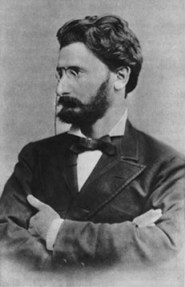
In the PBS treatment, Pulitzer’s talents and commitments seemed endlessly laudatory.
The documentary tells us that Pulitzer was an avid reader, a polyglot, a natural reporter, an accomplished chess player, an unstoppable workaholic. He possessed a Midas-like touch, an uncompromising commitment to investigative journalism, and a “lifelong passion for democratic idealism.” He was a quick study who, before coming to New York, established the most successful newspaper in St. Louis. He served briefly in Congress. He led the fund-raising campaign for the Statue of Liberty’s pedestal. He faced down criminal libel while taking on a U.S. president. He was a fearless crusader who gave voice to the voiceless. He was devoted to the interests of poor people, from whom he commanded unswerving loyalty.
But the effect of the documentary’s gushing wasn’t uplifting or inspiring.
It was misleading.
True, Pulitzer led a crowded, remarkable life. He did have a Midas-like touch — he became enormously wealthy as a newspaper publisher, and his riches allowed him to buy opulent homes and live out his infirmity-wracked final years aboard a luxury yacht.
Pulitzer the irritable (Library of Congress)
Pulitzer was an irritable tyrant who routinely made enemies, who regularly upbraided subordinates, who didn’t think much of his three sons, and whose wife worked like a slave to please him.
The meaner, darker side to Pulitzer wasn’t entirely ignored in the program, which PBS titled “Joseph Pulitzer: Voice of the People.” It just wasn’t examined in much revealing depth.
In the end Pulitzer’s profound failings, personal and journalistic, were mostly excused.
There was more complexity to Pulitzer’s career and character than PBS seemed inclined to investigate.
It was not made very clear, for example, that Pulitzer’s time in New York City journalism was relatively brief. He acquired the New York World in 1883, launched an evening edition in 1887, and left the city in 1890 when he was in his early 40s. Deteriorating health and failing eyesight forced him into absentee ownership until his death in 1911.
For years, he tried to run the newspaper by remote control, from retreats in Maine, Georgia, and Europe. To his editors and managers, he regularly fired off telegrams and letters that were full of instructions, guidance, and reproach. This correspondence reveals a harsh, bullying, and dictatorial component to Pulitzer’s personality.
The documentary-makers might well have plumbed the correspondence for its insights. And they might have considered how effectively, or poorly, Pulitzer ran his newspapers from afar, in what was a fin-de-siècle experiment in mobile, long-distance executive management.
But the effects and implications of Pulitzer’s long absences, infirmities, and remote-control management were not much explored.
The memory of Joseph Pulitzer has been boosted over the decades by a succession of exceptionally generous biographers.
To that lineup of adulation, the flattery of documentary-filmmakers can now be added.
It’s not terribly surprising Richard Jewell the movie has fared poorly in its opening days, grossing about $9.5 million since its debut December 13.
Richard Jewell, which revisits the case of the eponymous, media-maligned hero of the deadly bombing at the Atlanta Summer Olympics, is a disappointment on a number of levels.
The lead character is a beefy, 33-year-old security guard who on July 27, 1996, raised warnings before a pipebomb packed with screws and nails blew up at Centennial Olympic Park, killing one person and injuring more than 100 others. Jewell’s warnings surely saved dozens of lives.
Jewell, who is played by Paul Walter Hauser, is quirky, officious, and rather heavy-handed — the kind of irritating, self-important security guard who routinely oversteps his position to boss people around.
Likewise unconvincing is the portrayal of Kathy Scruggs, the police beat reporter for the Atlanta Journal-Constitution who, in an extra edition published July 30, 1996, disclosed that Jewell was a focus of the FBI’s investigation into the bombing.
Scruggs is presented as a loud, hard-edged floozy, willing to trade sex for information from a FBI source, who tells her the agency suspects Jewell planted the bomb. But Jewell was never charged in the bombing. Time was when journalists wouldn’t identify suspects by name until they had been formally accused.
The film, directed by Clinton Eastwood, has been assailed for its portrayal of Scruggs, which is too bad because the controversy has dimmed the spotlight Richard Jewell tries to direct to the perils that can arise when the news media are in league with federal investigators.
After Scruggs and a colleague, Ron Martz, wrote their unattributed story that Jewell was a suspect in the bombing, a media pack took after the naive and beleaguered security guard, staking out the apartment where he lived with his mother. The pack mostly made his life hell, until federal authorities told him three months later he was not a target. (The day after that, the Journal-Constitution published seven stories that dissected “everything about the case except its own role in starting the media lynching of the hero turned suspect,” Atlanta magazine reported in December 1996.)
Jewell may have been exonerated, but his reputation never recovered. He died in 2007. Scruggs died in 2001.
The Pulitzer citation praised the newspapers for their “deeply sourced, relentlessly reported coverage in the public interest that dramatically furthered the nation’s understanding of Russian interference in the 2016 presidential election and its connections to the Trump campaign, the President-elect’s transition team and his eventual administration.” The citation seems utterly risible now, given how the Trump-Russia narrative came such a cropper.
Eastwood’s movie could have been withering in portraying the media pack that hounded Jewell, a pack motivated by thin suspicions, a vague stereotype, and the Journal-Constitution’s unsourced, but authoritative-sounding, extra-edition article.
From time to time, the pack was shown in massed and menacing pursuit of Jewell. But the portrayal is not especially searching or nearly complete.
The movie doesn’t much consider the AJC’s follow-on reporting. Steven Geimann recalled in 2003 in an article for Media Ethics magazine that as “the scramble intensified to get the story, the AJC stayed in front of the pack, running countless stories not only about the investigation, but about Jewell’s personal life, work history, and potential motives as the ‘lone bomber.'”
Geimann, a former national president of the Society of Professional Journalists, also wrote:
“Legally, the AJC may have been allowed to treat this private citizen as a public figure. But was it the right thing to do? In the frenzy to stay in front of the pack, the editors and reporters of the AJC stopped asking themselves that simple, yet all-important question.”
Howard Kurtz, then the media writer for the Washington Post, made similar observations three weeks after the Centennial Park bombing.
In the aftermath of the attack, Kurtz noted, “few journalists asked the hard questions about the lack of physical evidence or the unwillingness of any federal official to make an on-the-record case against Jewell. In the hyper-competitive world of news gathering, such details are often lost as everyone chases the latest hot scoop.”
Kurtz deplored the “pack mentality” which he said “makes it all too easy for each news organization to blame its behavior on others. The Atlanta Journal-Constitution put Jewell in play by rushing out an extra edition July 30, with a 378-word story saying he ‘is the focus of the federal investigation’ ….
“CNN quickly followed suit. Major newspapers — including The Washington Post, Los Angeles Times, Chicago Tribune, Baltimore Sun and USA Today — checked with their sources and trumpeted the allegations on the front page.”
Had he emphasized such criticism about the media’s pack-like conduct, Eastwood would have given his movie a sharper, more powerful, even devastating focus.
Notably absent from the media frenzy that swept up Jewell was the New York Times.
Sack recalled that Joseph Lelyveld, the Times‘ executive editor at the time, “decreed that we would not join the news media herd in reporting that Mr. Jewell was the leading suspect. Nor would we in any way suggest that Mr. Jewell’s actions or personality merited suspicion, as The [Atlanta] Journal had in publishing, without attribution, that he ‘fits the profile of the lone bomber.’
“Instead,” Sack said, “I was to write a modest article — 642 words, as it ended up, less than half the length I figured it merited — about the media riot that followed The Journal’s revelation. In stark contrast to front-page coverage with screaming headlines around the world, my article would be buried deep inside the next day’s newspaper.”
Sack disagreed with the decision to downplay the suspicions about Jewell.
But in retrospect, Sack said, “the rabbinical wisdom” of Lelyveld, “in the face of intense competitive pressure, provided one of the greatest journalistic lessons of my career. While The Times has demonstrated over the years that it is not immune to misjudgment … we stood out in the coverage of the Jewell story for our restraint. Mr. Lelyveld’s call saved the paper, and me, from embarrassment and perhaps from the litigation that Mr. Jewell later pursued against several news organizations. There but for the grace of Joe went I.”
The Olympics bomber turned out to have been Eric R. Rudolph. He arrested in 2003 after hiding for years in remote reaches of North Carolina. Rudolph was accused of three other bombings and sentenced in 2005 to four life terms plus an additional 120 years in prison.
Rudolph is jailed at the SuperMax federal prison in Colorado. His infamous fellow inmates include Ted Kaczynski, the Unabomber, and Terry Nichols, principal accomplice to Timothy McVeigh in the 1995 Oklahoma City bombing.
Perhaps an inevitable by-product of the recent bombshell-free and wholly unrevealing impeachment hearings conducted by the House of Representatives Intelligence Committee were news media references to the Watergate scandal and the myth that the Washington Post’s reporting brought down Richard Nixon’s presidency in 1974.
Not the Post’s doing: Nixon quits
That’s the heroic-journalist trope of Watergate. It centers around the work of Bob Woodward and Carl Bernstein, the Post’s lead reporters on the scandal, and it was invoked blithely.
Last week, for example, the Guardian of London referred to the Post as “the paper that owned the [Watergate] story and ultimately brought down the presidency of Richard Nixon.”
As the House committee’s hearings were about to go public, David Zurawik, television critic for the Baltimore Sun, wrote that televised hearings during the Watergate scandal “didn’t bring [Nixon] down,” but “the grinding, steady work of the Washington Post led by Bob Woodward and Carl Bernstein did along with some courageous members of Congress, who signaled their willingness to vote for impeachment across party lines.”
A speech the other day at the University of Oxford was the occasion for Cameron Barr, the Post’s managing editor, to recall Watergate. His remarks included this myth-evocative passage:
“Nixon’s resignation was brought to pass by our coverage of the political scandal known as Watergate.”
Brought to pass?
That means caused to happen, and the Post’s reporting didn’t cause Nixon’s resignation to happen.
None other than Katharine Graham, the newspaper’s publisher during Watergate, declared in 1997, at the 25th anniversary of the scandal’s seminal crime, the burglary at Democratic National Committee headquarters in June 1972:
“Sometimes people accuse us of bringing down a president, which of course we didn’t do. The processes that caused [Nixon’s] resignation were constitutional.”
In starkly cruder terms, Woodward concurred, telling an interviewer in 2004:
As I noted in my media-mythbusting book, Getting It Wrong, unraveling a scandal as sweeping and complex as Watergate required the combined if not always coordinated forces of special prosecutors and federal judges, FBI agents, and bipartisan congressional panels. Not to mention the U.S. Supreme Court, which unanimously ruled that Nixon had to surrender to prosecutors White House audiotapes that captured his guilty participation in the Watergate coverup.
That’s what Katharine Graham was referring to in saying that the “processes that caused [Nixon’s] resignation were constitutional.”
By email, I asked Barr about evidence supporting his claim that “Nixon’s resignation was brought to pass by” the Post’s reporting.
He replied by parsing his claim, saying:
“You’ll note that I didn’t say that The Post brought down Nixon or took Nixon down or got Nixon – those mischaracterizations [sic] my colleagues have rejected and rightly so. As do you.
“I said The Post’s reporting brought it to pass, and my evidence for that is the historical record. We did our jobs as journalists, setting in motion other factors and forces that compelled him to step down.”
Not only did the Post’s reporting not bring to pass Nixon’s resignation, it’s highly unlikely that the Post’s reporting set in motion, or even much contributed to, the vastly more important investigations by subpoena-wielding authorities who did uncover the evidence that brought to pass Nixon’s resignation.
As Edward Jay Epstein pointed out in his classic essay about the news media and Watergate, Woodward and Bernstein “were not the only ones publicizing the case” in the summer of 1972. “Immediately after the arrest of the Watergate burglars and throughout the [presidential] campaign, Senator George McGovern denounced Watergate in most of his speeches and suggested in no uncertain terms that the White House was behind the burglary.”
Additionally, Epstein noted, the Democratic National Committee brought a civil lawsuit against Nixon’s reelection committee. “The General Accounting Office, an arm of Congress, and Common Cause, a quasi-public foundation, meanwhile forced Republican officials to disclose information about campaign contributions which indirectly added to the publicity about Watergate,” Epstein wrote, adding:
“In short, even in publicizing Watergate, the press was only one among a number of institutions at work.”
Epstein also correctly noted that federal prosecutors had developed “an airtight case” the the Watergate burglars and their handlers in the summer of 1972, “well in advance of, and without any assistance from, Woodward, Bernstein, or any other reporters.”
Barr’s remarks at Oxford were an occasion to extol the news media and what he called “high-risk, high-impact journalism.”
He also shed some light on the adoption of the Post’ssmug and heavy-handed motto, “Democracy dies in darkness,” saying it was embraced “at the urging of Jeff Bezos, who has owned The Post since 2013.” Bezos is the multi-billionaire boss of Amazon.com.
That motto was adopted soon after President Donald Trump took office and was promptly ridiculed by, among others, Jack Shafer, the prominent media critic. Shafer said on Twitter that “‘Democracy Dies in Darkness’ is something a sincere goofball would say in a Preston Sturges movie.”
The executive editor of the New York Times, Dean Baquet, said “Democracy dies in darkness” reminded him of “the next Batman movie.”
The Washington Post’s media columnist, Margaret Sullivan, offered the facile observation in an essay yesterday that last week brought “a tectonic shift of media attention, [with] every major television network — broadcast and cable alike — focused on a deeply damaging story” about President Donald Trump, a story he “can’t control.”
Sullivan
As if Trump could “control” the frenzy over disclosures he encouraged Ukraine’s president to investigate shady dealings in that country by former Vice President Joe Biden and his son.
As if anyone could “control” such a bizarre frenzy.
We’ll see how long this latest frenzy lasts. For now, allegations of Trump’s misconduct seem too nebulous to support impeachment, let alone conviction after trial before the Republican-controlled Senate.
Of keener interest to Media Myth Alert were passages in Sullivan’s column that touted the presumptive power of television in the downfall of Senator Joseph McCarthy in 1954 and in the Watergate scandal of the early 1970s.
McCarthy at map; Welch, head in hand
“Television,” she wrote, “made all the difference in 1954, as it did again almost two decades later during the televised Watergate hearings, with their disastrous effect on Richard Nixon’s presidency.”
Television made all the difference?
That interpretation may of comfort or reassurance to journalists; media-driven myths tend to be that way. But it’s mediacentric claim that grants television far too much credit as a decisive force in national politics.
If anything, television was a lagging factor in challenging McCarthy and his communists-in-government witchhunt. As for the Watergate hearings, it wasn’t their televised character that had a “disastrous effect” on Nixon’s presidency; it was what the hearings uncovered that was decisive to the outcome of the Watergate scandal.
Let’s take first Sullivan’s claims about television and Joe McCarthy.
She wrote: “The moment of truth for McCarthy … came in televised hearings when a lawyer for the U.S. Army shut down the senator with his damning accusation: ‘Have you no sense of decency, sir? At long last, have you left no sense of decency?'”
That encounter took place June 9, 1954. It hardly “shut down the senator.”
The hearing transcript, excerpts of which the New York Times published the following day, show that McCarthy was quick to reply to the “no sense of decency” remark by the Army’s chief counsel, Joseph N. Welch.
“I know this hurts you, Mr. Welch,” McCarthy snapped.
“I’ll say it hurts,” Welch said.
McCarthy then launched into a riff about a communist-linked organization to which a young colleague of Welch once belonged.
What were known as the Army-McCarthy hearings were televised. But only then-fledgling ABC and the dying Dumont network carried the hearings in sustained fashion. Neither network reached a nationwide audience.
Besides, McCarthy was then falling from his peak influence. As I noted in my media-mythbusting book, Getting It Wrong, opinion polls by the Gallup organization showed McCarthy’s approval ratings were ebbing by late 1953 and early 1954.
The other television moment often said to have been pivotal in the senator’s downfall came on March 9, 1954, when Edward R. Murrow devoted his half-hour See It Now program to a critical report about McCarthy. See It Now made devastating use of unflattering footage of the senator and closed with Murrow’s declaring:
“The actions of the junior Senator from Wisconsin have caused alarm and dismay amongst our allies abroad, and given considerable comfort to our enemies. And whose fault is that? Not really his. He didn’t create this situation of fear; he merely exploited it — and rather successfully. Cassius was right: ‘The fault, dear Brutus, is not in our stars, but in ourselves.'”
It wasn’t a decisive moment, though. More important were the Army’s allegations, raised the same week the Murrow program aired, that McCarthy and his top aide, Roy Cohn, tried to obtain special treatment for David Schine. He was a member of McCarthy’s investigative staff who had been drafted into the Army. The allegations led to the hearings that Sullivan mentioned in her column.
Television came belatedly to the McCarthy scourge. For months, even years before 1954, print journalists such as Drew Pearson, a nationally syndicated columnist and Richard Rovere, a writer for the New Yorker, had directed attention to the McCarthy’s exaggerated allegations.
In fact, Pearson’s challenges were so searching and aggressive that they prompted McCarthy to physically assault the columnist in the coat-check room after a dinner in December 1950 at the hush-hush Sulgrave Club in Washington, D.C. Richard Nixon, then a newly appointed U.S. Senator, broke up the one-sided encounter between the beefy senator and the smaller columnist.
In his memoir RN, Nixon recalled that Pearson “grabbed his overcoat and ran from the room” while McCarthy said, “‘You shouldn’t have stopped me, Dick.’”
Televised coverage of the extended Watergate hearings, convened in Spring 1973 by a Senate select committee, certainly was extensive andriveting. But the greatest contribution came from what the committee staff uncovered — the existence of audio tapes that Nixon secretly had made of his conversations in the Oval Office of the White House.
The tapes proved conclusively that Nixon knew about and approved a plan to divert the FBI’s investigation into the scandal’s signal crime — the break-in at Democratic National Committee headquarters in June 1972.
Without the tapes, it’s not likely Nixon’s guilt in Watergate would have been conclusively demonstrated. That was the interpretation of, among others, Watergate’s preeminent historian, Stanley I. Kutler.
“Absent the tapes, Nixon walks,” he said in a presentation in 2011, almost four years before his death.
“You had to have that kind of corroborative evidence to nail the president of the United States.”
The tapes, not TV, “made all the difference” in Watergate.
It’s almost predictable: When controversy flares about contemporary practices of American journalists, commentators not infrequently reach back to Watergate for reassurance about how effective and admirable high-minded reporting can be.
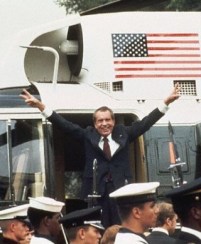
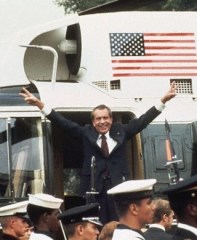
Nixon, 1974: Quits, leaves D.C.
The Watergate parable is ever-available if not especially precise. It’s more mythical than accurate, as a commentary the other day in the Boston Herald suggested.
“Trump Urges Unity vs. Racism,” declared the headline, which survived only the Times’ first print edition of August 6. The newspaper’s executive editor, Dean Baquet, later termed it “a f*cking mess” that editors quickly reworked.
What interests Media Myth Alert is not so much the agitation about the Times’ headline as the Herald’s hero-treatment of Bob Woodward and Carl Bernstein, the Washington Post’s lead reporters on Watergate in 1972-74.
The Herald’s commentary declared: “News reporters working for newspapers and television networks and online media should have only one job to do – to report the news.” OK, no argument there.
Then it added:
“Back in the days of Watergate, Washington Post reporters Bob Woodward and Carl Bernstein or ‘Woodstein’ as they were called, dug deep and reported straight about the allegations that President Nixon had been personally involved in the coverup of the break-in at the Democratic National Committee headquarters.
“Their stories carried weight because they weren’t trying to convince us at least overtly that Nixon was a crook. These guys let the facts speak for themselves and the Nixon administration toppled.”
Let’s unpack those claims.
Woodward and Bernstein’s digging did not lead them to allege, or disclose, that “Nixon had been personally involved in the coverup of the break-in at the Democratic National Committee headquarters,” the seminal crime of the Watergate scandal. Woodward acknowledged as much in an interview in 1973 with Columbia Journalism Review.
Deep in an otherwise congratulatory article, the journalism review noted:
“The Post did not have the whole story [of Watergate], by any means. It had a piece of it. Woodward and Bernstein, for understandable reasons, completely missed perhaps the most insidious acts of all — the story of the coverup and the payment of money to the Watergate defendants to buy their silence.” (Emphasis added.)
The article quoted Woodward as saying about those crucial elements of Watergate:
“’It was too high. It was held too close. Too few people knew. We couldn’t get that high.’”
As I discuss in my media-mythbusting book, Getting It Wrong, the New York Times “was the first news organization to report the payment of hush money to the Watergate burglars, a pivotal disclosure that made clear that efforts were under way to conceal the roles of others in the scandal.” And I quoted a passage in a book by John Dean, Nixon’s former counsel, as saying the Times‘ report about hush-money payments “hit home! It had everyone concerned and folks in the White House and at the reelection committee were on the wall.”
Unequivocal evidence of Nixon’s personal role in coverup was not revealed until August 1974, with the disclosure of the so-called “smoking gun” White House audiotape. Its release was ordered in July 1974 by the U.S. Supreme Court, and its content sealed Nixon’s fate.
Exaggeration lurks in this passage: “These guys let the facts speak for themselves and the Nixon administration toppled.”
That suggests the reporting of Woodward and Bernstein was central to Nixon’s downfall when in fact their work represented a marginal contribution to Watergate’s outcome.
Not only did could they not get to the coverup. They did not disclose the existence of Nixon’s secret White House taping system — a revelation by a former White House staffer in July 1973 changed the course and intensity of Watergate investigations.
As I wrote in Getting It Wrong, rolling up a scandal of the dimensions of Watergate “required the collective if not always the coordinated forces of special prosecutors, federal judges, both houses of Congress, and the Supreme Court, as well as the Justice Department and the FBI.
“Even then, Nixon likely would have served out his term if not for the audiotape recordings he secretly made of most conversations in the Oval Office of the White House.”
Against the tableau of courts, prosecutors, federal investigations, and bipartisan congressional panels, I wrote, “the contributions of Woodward and Bernstein were at best modest, and certainly not decisive.
“Principals at the Post have acknowledged as much. Katharine Graham, the newspaper’s doughty publisher, often insisted that the Post did not topple Nixon. ‘Sometimes people accuse us of bringing down a president, which of course we didn’t do,’ Graham said in 1997, at a program marking the scandal’s twenty-fifth anniversary. ‘The processes that caused [Nixon’s] resignation were constitutional,’ she insisted.”
Well, that’s just it: The intervening years have deeply eroded popular understanding about the forces and figures vital to bringing down Nixon — the investigators, the special prosecutors, the judges, the members of Congress. Instead, the heroic-journalist interpretation has become fixed as the dominant narrative of Watergate, that the dogged reporting of Woodward and Bernstein exposed the crimes of a president and forced his resignation.
It’s far easier to turn to that mythical interpretation than it is to keep straight the many lines of investigation that did unravel the Watergate scandal.
But as I pointed out in Getting It Wrong, “to explain Watergate through the lens of the heroic journalist is to abridge and misunderstand the scandal and to indulge in a particularly beguiling media-driven myth.”










 As I discuss in my media-
 Media Myth Alert